


FprEN ISO 14019-2
(Main)Sustainability information - Part 2: Principles and requirements for verification processes (ISO/FDIS 14019-4:2025)
Sustainability information - Part 2: Principles and requirements for verification processes (ISO/FDIS 14019-4:2025)
This document specifies requirements and gives guidance on the verification of declared sustainability information, including information presented in quantitative and qualitative formats.
NOTE 1 Declared sustainability information can include reporting on environmental, social, governance and other sustainability matters.
NOTE 2 A verification programme can include a combination of validation and verification activities, and result in mixed engagements.
Nachhaltigkeitsinformationen - Teil 2: Grundsätze und Anforderungen für den Verifizierungsprozess (ISO/FDIS 14019‑2:2025)
Informations en matière de durabilité - Partie 2: Principes et exigences pour les processus de vérification (ISO/FDIS 14019-4:2025)
Le présent document spécifie des exigences et donne des recommandations pour la vérification des informations déclarées en matière de durabilité, y compris les informations présentées sous des formats quantitatifs et qualitatifs.
NOTE 1 Les informations déclarées en matière de durabilité peuvent inclure des rapports sur des questions environnementales, sociales, de gouvernance et autres questions de développement durable.
NOTE 2 Un programme de vérification peut inclure une combinaison d’activités de validation et de vérification et donner lieu à des engagements mixtes.
Informacije o trajnostnosti - 2. del: Načela in zahteve za postopke preverjanja (ISO/FDIS 14019-2:2025)
General Information
- Status
- Not Published
- Publication Date
- 01-Feb-2026
- Technical Committee
- CEN/CLC/TC 1 - Criteria for conformity assessment bodies
- Current Stage
- 6055 - CEN Ratification completed (DOR) - Publishing
- Start Date
- 01-Dec-2025
- Completion Date
- 01-Dec-2025
Overview
The FprEN ISO 14019-2 standard, titled Sustainability Information - Part 2: Principles and Requirements for Verification Processes (ISO/FDIS 14019-4:2025), developed by CEN, establishes comprehensive guidelines for the verification of sustainability information. This document sets forth rigorous requirements for verifying both quantitative and qualitative sustainability data, covering environmental, social, governance (ESG), and other related sustainability aspects.
This standard addresses the entire verification process, including planning, execution, reporting, and handling uncertainties linked to sustainability data. The aim is to enhance the reliability and credibility of sustainability reporting by providing a robust framework relevant for organizations committed to transparency and accountability in sustainability disclosures.
Key Topics
Verification Scope and Engagement
Defines pre-engagement conditions, objectives, scope specification, and determination of materiality and levels of assurance suitable for sustainability verification projects.Verification Planning and Team Selection
Details strategic analysis, risk assessment, materiality assessment, and the design of evidence-gathering activities tailored to different types of sustainability data.Quantitative Data Verification
Describes the verification approach for continuous (ratio and interval) and discrete data forms. Incorporates data collection evaluation, data editing, control processes, and numerical techniques supporting analytical testing.Qualitative Data Verification
Covers verification methods for binary, ordinal, and nominal data forms and explains evidence gathering activities that support validation of non-numeric sustainability indicators.Uncertainty and Risk Management
Addresses procedures for managing and assessing uncertainties in sustainability information and how these uncertainties impact verification evidence strength.Reporting and Assurance Opinions
Provides guidance on communication, assurance statements content, types and levels of assurance, including unmodified, adverse, and disclaimer opinions focused on sustainability disclosures.Handling Limitations and Subsequent Findings
Outlines the treatment of inherent and scope limitations during verification and processes to manage new facts discovered after the issuance of assurance opinions.
Applications
This standard is vital for:
Sustainability Report Verification
Organizations preparing sustainability or ESG reports can utilize ISO 14019-2 to ensure their data verification processes meet international best practices, increasing stakeholder confidence.Corporate Social Responsibility (CSR) Assurance
Companies seeking third-party verification for CSR disclosures can align their practices with ISO 14019-2 requirements to demonstrate transparency and accountability.Regulatory Compliance and Market Access
Firms will benefit from adherence to this standard to comply with evolving regulatory frameworks that mandate verified sustainability information.Internal Audit and Risk Management
Verification teams can implement structured risk assessments and evidence-gathering techniques to improve internal controls and data integrity in sustainability metrics.Consulting and Assurance Services
Verification professionals and consultants can adopt this standard to standardize their verification methodologies and deliver credible assurance engagements.
Related Standards
ISO 14001 - Environmental Management Systems
Provides a complementary framework focused on environmental performance improvement alongside verified sustainability information.ISO 26000 - Social Responsibility Guidance
Supports organizational guidance on social responsibility, which aligns with qualitative sustainability aspects verified under ISO 14019-2.GRI Standards (Global Reporting Initiative)
Broad sustainability reporting standards whose disclosures can be verified using ISO 14019-2 verification principles.ISO 19011 - Auditing Management Systems
Offers auditing guidelines used alongside verification processes defined in ISO 14019-2 for sustainability information assurance.
FprEN ISO 14019-2 represents an essential advancement for organizations striving for robust verification of sustainability data. Incorporating its principles ensures integrity, credibility, and increased stakeholder trust in sustainability and ESG reporting.


Get Certified
Connect with accredited certification bodies for this standard

BSI Group
BSI (British Standards Institution) is the business standards company that helps organizations make excellence a habit.

Bureau Veritas
Bureau Veritas is a world leader in laboratory testing, inspection and certification services.

DNV
DNV is an independent assurance and risk management provider.
Sponsored listings
Frequently Asked Questions
FprEN ISO 14019-2 is a draft published by the European Committee for Standardization (CEN). Its full title is "Sustainability information - Part 2: Principles and requirements for verification processes (ISO/FDIS 14019-4:2025)". This standard covers: This document specifies requirements and gives guidance on the verification of declared sustainability information, including information presented in quantitative and qualitative formats. NOTE 1 Declared sustainability information can include reporting on environmental, social, governance and other sustainability matters. NOTE 2 A verification programme can include a combination of validation and verification activities, and result in mixed engagements.
This document specifies requirements and gives guidance on the verification of declared sustainability information, including information presented in quantitative and qualitative formats. NOTE 1 Declared sustainability information can include reporting on environmental, social, governance and other sustainability matters. NOTE 2 A verification programme can include a combination of validation and verification activities, and result in mixed engagements.
FprEN ISO 14019-2 is classified under the following ICS (International Classification for Standards) categories: 03.120.20 - Product and company certification. Conformity assessment; 13.020.20 - Environmental economics. Sustainability. The ICS classification helps identify the subject area and facilitates finding related standards.
FprEN ISO 14019-2 is available in PDF format for immediate download after purchase. The document can be added to your cart and obtained through the secure checkout process. Digital delivery ensures instant access to the complete standard document.
Standards Content (Sample)
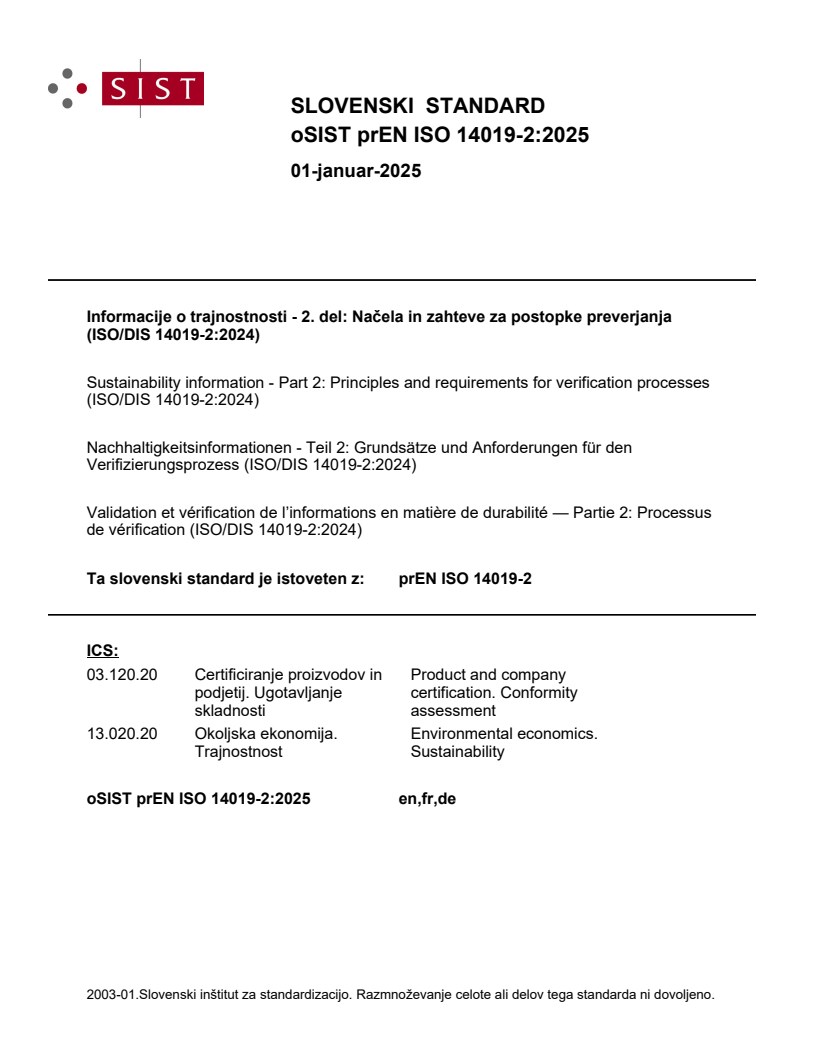
SLOVENSKI STANDARD
oSIST prEN ISO 14019-2:2025
01-januar-2025
Informacije o trajnostnosti - 2. del: Načela in zahteve za postopke preverjanja
(ISO/DIS 14019-2:2024)
Sustainability information - Part 2: Principles and requirements for verification processes
(ISO/DIS 14019-2:2024)
Nachhaltigkeitsinformationen - Teil 2: Grundsätze und Anforderungen für den
Verifizierungsprozess (ISO/DIS 14019-2:2024)
Validation et vérification de l’informations en matière de durabilité — Partie 2: Processus
de vérification (ISO/DIS 14019-2:2024)
Ta slovenski standard je istoveten z: prEN ISO 14019-2
ICS:
03.120.20 Certificiranje proizvodov in Product and company
podjetij. Ugotavljanje certification. Conformity
skladnosti assessment
13.020.20 Okoljska ekonomija. Environmental economics.
Trajnostnost Sustainability
oSIST prEN ISO 14019-2:2025 en,fr,de
2003-01.Slovenski inštitut za standardizacijo. Razmnoževanje celote ali delov tega standarda ni dovoljeno.
oSIST prEN ISO 14019-2:2025
oSIST prEN ISO 14019-2:2025
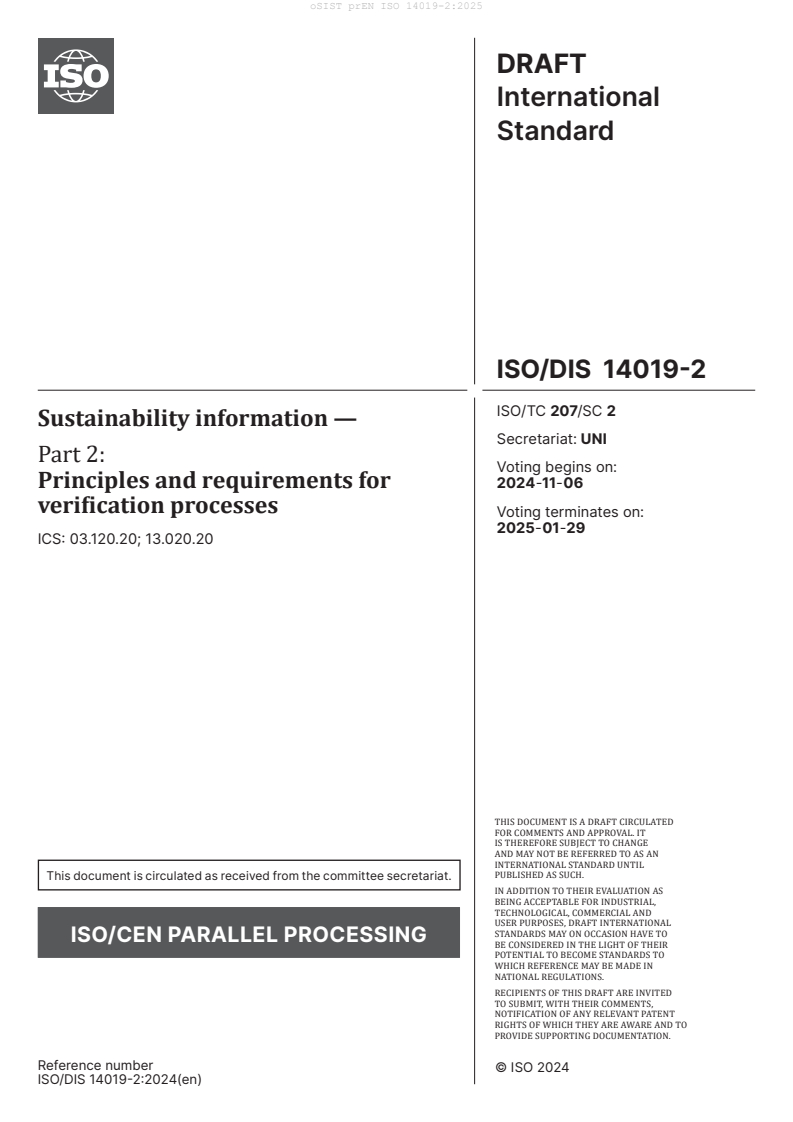
DRAFT
International
Standard
ISO/DIS 14019-2
ISO/TC 207/SC 2
Sustainability information —
Secretariat: UNI
Part 2:
Voting begins on:
Principles and requirements for 2024-11-06
verification processes
Voting terminates on:
2025-01-29
ICS: 03.120.20; 13.020.20
THIS DOCUMENT IS A DRAFT CIRCULATED
FOR COMMENTS AND APPROVAL. IT
IS THEREFORE SUBJECT TO CHANGE
AND MAY NOT BE REFERRED TO AS AN
INTERNATIONAL STANDARD UNTIL
PUBLISHED AS SUCH.
This document is circulated as received from the committee secretariat.
IN ADDITION TO THEIR EVALUATION AS
BEING ACCEPTABLE FOR INDUSTRIAL,
TECHNOLOGICAL, COMMERCIAL AND
USER PURPOSES, DRAFT INTERNATIONAL
STANDARDS MAY ON OCCASION HAVE TO
ISO/CEN PARALLEL PROCESSING
BE CONSIDERED IN THE LIGHT OF THEIR
POTENTIAL TO BECOME STANDARDS TO
WHICH REFERENCE MAY BE MADE IN
NATIONAL REGULATIONS.
RECIPIENTS OF THIS DRAFT ARE INVITED
TO SUBMIT, WITH THEIR COMMENTS,
NOTIFICATION OF ANY RELEVANT PATENT
RIGHTS OF WHICH THEY ARE AWARE AND TO
PROVIDE SUPPORTING DOCUMENTATION.
Reference number
ISO/DIS 14019-2:2024(en)
oSIST prEN ISO 14019-2:2025
DRAFT
ISO/DIS 14019-2:2024(en)
International
Standard
ISO/DIS 14019-2
ISO/TC 207/SC 2
Sustainability information —
Secretariat: UNI
Part 2:
Voting begins on:
Principles and requirements for
verification processes
Voting terminates on:
ICS: 03.120.20; 13.020.20
THIS DOCUMENT IS A DRAFT CIRCULATED
FOR COMMENTS AND APPROVAL. IT
IS THEREFORE SUBJECT TO CHANGE
AND MAY NOT BE REFERRED TO AS AN
INTERNATIONAL STANDARD UNTIL
PUBLISHED AS SUCH.
This document is circulated as received from the committee secretariat.
IN ADDITION TO THEIR EVALUATION AS
BEING ACCEPTABLE FOR INDUSTRIAL,
© ISO 2024
TECHNOLOGICAL, COMMERCIAL AND
USER PURPOSES, DRAFT INTERNATIONAL
All rights reserved. Unless otherwise specified, or required in the context of its implementation, no part of this publication may
STANDARDS MAY ON OCCASION HAVE TO
ISO/CEN PARALLEL PROCESSING
be reproduced or utilized otherwise in any form or by any means, electronic or mechanical, including photocopying, or posting on
BE CONSIDERED IN THE LIGHT OF THEIR
the internet or an intranet, without prior written permission. Permission can be requested from either ISO at the address below
POTENTIAL TO BECOME STANDARDS TO
WHICH REFERENCE MAY BE MADE IN
or ISO’s member body in the country of the requester.
NATIONAL REGULATIONS.
ISO copyright office
RECIPIENTS OF THIS DRAFT ARE INVITED
CP 401 • Ch. de Blandonnet 8
TO SUBMIT, WITH THEIR COMMENTS,
CH-1214 Vernier, Geneva
NOTIFICATION OF ANY RELEVANT PATENT
Phone: +41 22 749 01 11
RIGHTS OF WHICH THEY ARE AWARE AND TO
PROVIDE SUPPORTING DOCUMENTATION.
Email: copyright@iso.org
Website: www.iso.org
Published in Switzerland Reference number
ISO/DIS 14019-2:2024(en)
ii
oSIST prEN ISO 14019-2:2025
ISO/DIS 14019-2:2024(en)
Contents Page
Foreword .v
Introduction .vi
1 Scope . 1
2 Normative references . 1
3 Terms and definitions . 1
4 Pre-engagement. 1
4.1 General .1
4.2 Required information .2
4.3 Suitability of specified requirements and criteria .2
4.4 Relevance determination process and rational purpose .3
4.5 Common understanding .4
4.6 Conditions not met after acceptance of the engagement .4
4.7 Objectives .4
4.8 Type of deliverable .4
4.9 Specification of scope, requirements, and criteria .5
4.10 Materiality .5
4.11 Level of assurance .6
4.12 Inherent limitations and scope limitations .6
4.12.1 General .6
4.12.2 Evaluating consequences of inherent limitation .6
5 Engagement . 6
6 Planning . 7
6.1 Verification team selection .7
6.2 Strategic analysis .7
6.2.1 General .7
6.2.2 Context for the strategic analysis.7
6.2.3 Strategic analysis approach .8
6.2.4 Output from and review of strategic analysis .9
6.3 Risk assessment .9
6.3.1 General .9
6.3.2 Context for risk assessment .9
6.3.3 Process for risk assessment .10
6.3.4 Output from and review of the risk assessment .11
6.4 Assessment of materiality .11
6.4.1 Process for assessing materiality .11
6.4.2 Output of assessing materiality . 12
6.5 Evidence-gathering activities . 12
6.5.1 General . 12
6.5.2 Designing evidence-gathering activities . 12
6.5.3 Use of the responsible party’s internal controls . 13
6.5.4 Evidence gathering for quantitative information .14
6.5.5 Evidence gathering for qualitative information .14
6.5.6 Evidence-gathering techniques .14
6.5.7 Process for evidence gathering . 15
6.5.8 Evidence-gathering plan .16
6.5.9 Verification plan . . .16
6.5.10 Approval of evidence-gathering plan and verification plan .16
6.6 Scope limitations .17
7 Execution . 17
7.1 General .17
7.2 Communication .18
7.3 Insufficient Information .18
iii
oSIST prEN ISO 14019-2:2025
ISO/DIS 14019-2:2024(en)
7.4 Intentional misstatement or noncompliance.18
7.5 Determination of evidence .18
8 Review . 19
9 Decision . 19
10 Assurance opinion . 19
10.1 Content of the assurance statement .19
10.1.1 General .19
10.1.2 Content of assurance information . 20
10.1.3 Subject covered in the assurance opinion. 20
10.2 Opinion –input, extent and types .21
10.3 Unmodified opinion .21
10.4 Level of assurance – linkage to unmodified opinion . 22
10.5 Modified opinions – two types . 22
10.6 Modified - Adverse opinion . 22
10.7 Modified - Disclaimer of opinion . 22
10.8 Amplifications in assurance opinion . 23
10.9 Opinion when changes have been made to the declared sustainability information to
state that there are material misstatements . 23
10.10 Quantitative and qualitative information . 23
11 Facts discovered after issue of the assurance opinion .23
12 Records . .24
Annex A (informative) Sampling .25
Annex B (informative) Level of assurance .27
Annex C (informative) Inherent risk .28
Annex D (informative) Uncertainty .29
Annex E (Normative) Verification approach for qualitative information .30
Bibliography .31
iv
oSIST prEN ISO 14019-2:2025
ISO/DIS 14019-2:2024(en)
Foreword
ISO (the International Organization for Standardization) is a worldwide federation of national standards
bodies (ISO member bodies). The work of preparing International Standards is normally carried out through
ISO technical committees. Each member body interested in a subject for which a technical committee
has been established has the right to be represented on that committee. International organizations,
governmental and non-governmental, in liaison with ISO, also take part in the work. ISO collaborates closely
with the International Electrotechnical Commission (IEC) on all matters of electrotechnical standardization.
The procedures used to develop this document and those intended for its further maintenance are described
in the ISO/IEC Directives, Part 1. In particular, the different approval criteria needed for the different types
of ISO documents should be noted. This document was drafted in accordance with the editorial rules of the
ISO/IEC Directives, Part 2 (see www.iso.org/directives).
ISO draws attention to the possibility that the implementation of this document may involve the use of (a)
patent(s). ISO takes no position concerning the evidence, validity, or applicability of any claimed patent
rights in respect thereof. As of the date of publication of this document, ISO had not received notice of (a)
patent(s) which may be required to implement this document. However, implementers are cautioned that
this may not represent the latest information, which may be obtained from the patent database available at
www.iso.org/patents. ISO shall not be held responsible for identifying any or all such patent rights.
Any trade name used in this document is information given for the convenience of users and does not
constitute an endorsement.
For an explanation of the voluntary nature of standards, the meaning of ISO specific terms and expressions
related to conformity assessment, as well as information about ISO's adherence to the World Trade
Organization (WTO) principles in the Technical Barriers to Trade (TBT), see www.iso.org/iso/foreword.html.
This document was prepared by Technical Committee ISO/TC 207, Environmental management,
Subcommittee SC 2, Environmental auditing, and related environmental investigations in conjunction with
ISO/CASCO, Committee on Conformity Assessment.
A list of all parts in the ISO 14019 series can be found on the ISO website.
Any feedback or questions on this document should be directed to the user’s national standards body. A
complete listing of these bodies can be found at www.iso.org/members.html.
v
oSIST prEN ISO 14019-2:2025
ISO/DIS 14019-2:2024(en)
Introduction
0.1 With increasing public demand and advancing legal provisions (regulatory and contractual) for
declarations, disclosures and reporting of sustainability information, there is a significant market need for
the validation, verification and assurance of this information.
0.2 Standards are needed for both:
a) identifying metrics and indicators, monitoring, compiling, reporting, declaring and disclosing
information about sustainability matters (including environmental, social and governance (ESG)
matters); and
b) harmonised approaches to validation/verification and assurance of that information.
Validated and verified sustainability information can be used for decision making including investment
decisions, procurement decisions, or individual choices during consumer purchasing, the use of services and
decisions on where to work.
0.3 In this document, the sustainability information that is declared by a responsible party is the object
of the validation or verification. Validation and verification bodies assess the declared sustainability
information for its conformity and fulfilment of ‘specified requirements and criteria’.
0.4 Specified requirements and criteria are set by a validation/verification programme, which could
be a mandatory regulatory reporting programme, or a voluntary programme for a specific sector or
sustainability matter. The result of a completed validation/verification activity can be the provision of an
assurance opinion which attests that the specified requirements and criteria have been fulfilled and:
a) the reasonableness of the assumptions, limitations and methods that support declared sustainability
information about a future outcome has been validated; and
b) the material correctness and fair representation of historical data and information has been verified.
NOTE The primary outcome of validation/verification activities under the ISO 14019 series of standards is an
assurance opinion. In addition, the ISO 14019 series of standards allows for alternative non-assurance outcomes or
deliverables. The deliverable chosen for each specific validation/verification activity (i.e. an assurance opinion or a
non-assurance deliverable) is specified in the relevant validation/verification programme and confirmed between the
validation/verification body and it’s client in a specific engagement agreement. Non-assurance deliverables include
reports of factual findings based on agreed-upon procedure (AUP report), findings reports and evidence reports.
These non-assurance deliverables can be appropriate for situations where an assurance opinion is not required, for
example, in voluntary or internal reporting, reporting from organizations upstream or downstream in the value
chain, or for small-medium sized enterprises (SMEs), or in situations where capacity building is being undertaken, or
when the expense of an assurance opinion is prohibitive (see Annex H of ISO 14019-1 for more information).
0.5 The overall aim of validation/verification is to give confidence to intended users that the declared
sustainability information is fairly stated, can be used for the defined purpose and fulfils specified
requirements and criteria. This confidence is provided through an impartial validation or verification
process undertaken by a competent validator/verifier.
0.6 Parties that have an interest in validation/verification include, but are not limited to:
a) clients of validation/verification bodies;
b) validation/verification programme owners and other developers of standards;
c) regulatory authorities;
d) intended users of validated/verified declared sustainability information (e.g. investors, supply chain
partners, industry bodies, NGOs, consumers) and other interested parties.
0.7 Frameworks, principles and processes guiding validation/verification rules and procedures should
be compatible with the globally accepted quality infrastructure (standardisation, conformity assessment
by validation/verification, peer assessment, accreditation). Furthermore, developing these rules and
vi
oSIST prEN ISO 14019-2:2025
ISO/DIS 14019-2:2024(en)
procedures as ISO standards would allow all interested parties, especially those with already implemented
structures and existing instruments, to participate.
0.8 Standards for the declaration and reporting of sustainability information (already existing or under
development) relate, for instance, to entities (e.g. listed companies or suppliers) that are increasingly
required to report specific ESG or sustainability matters under voluntary or mandatory arrangements (e.g.
as a pre-requisite to supply chain or market access, pre-condition for tenders and government procurement,
and as part of securities exchange or regulatory annual reporting).
0.9 Within the existing legal framework of many countries and regions, the global system of conformity
assessment and its recognition (e.g. through multilateral arrangements between accreditation bodies), the
tools for assessing declared sustainability information (claims, reports etc.) and providing assurance on its
fair presentation currently exist. However, standardised specifications of a consistent process for validating
and verifying declared sustainability information is lacking.
0.10 Parties interested in qualitatively trustworthy and quantitatively comparable information will
benefit from standardised validation/verification processes to be performed by legal entities that fulfil the
requirements of ISO/IEC 17029, Conformity assessment — General principles and requirements for validation
and verification bodies.
0.11 While validation and verification both result in a confirmation of declared information, they differ
significantly in their execution. Assessing historic data with respect to truthful and correct statements
in a verification requires different methodological approaches than determining whether declarations on
an intended purpose or future effect is reasonable and plausible in a validation. It is therefore decided to
develop separate ISO 14019 parts dedicated to the validation process (ISO 14019-Part 3) and the verification
process (ISO 14019 Part 2, this document).
0.12 As for the type of information to be validated or verified, distinction could be made according to
the subject matter (e.g. environmental, social, governance). However, taking the perspective of describing
methodologies, the distinction according to the nature of the assessed information, being quantitative or
qualitative, appears more rational.
0.13 Verification processes are generally planned and performed to reach a decision on providing assurance
whether or not the declared sustainability information fulfils the specified requirements and criteria. This
conclusion is issued as assurance opinion. Where the process is organized to gather evidence regarding the
fulfilment of specified requirements and criteria only, the report on these evidence gathering results can be
issued as non-assurance deliverable. Resulting from a review of the evidence, a non-assurance report can
include findings on the suitability, adequacy and effectiveness of the evidence gathering considered with
regard to fulfilment of specified requirements and criteria. Different terms can be used to make reference
to such non-assurance deliverables with reviewed evidence (e.g. findings report) or without (e.g. evidence
report).
0.14 ISO 14019 is developed in separate parts to provide a consistent overview of the entire validation/
verification of sustainability information, and give general and specific requirements for validation/
verification processes. Where the principles and requirements undergo rapid development, the individual
parts can undergo revision separately as required.
0.15 In summary, the parts to ISO 14019 are:
— Part 1 specifies terminology, principles, and general requirements applicable to both validation and
verification.
— The process specifics of verification (Part 2, this document) and validation (Part 3, development intended)
are provided in separate documents.
— Part 4 (under development) contains the specific requirements applying to the validation/verification
bodies and their personnel, the validators and verifiers, in addition to generic requirements of
ISO/IEC 17029.
0.16 For the verification of quantitative information, Part 2 details the approach for continuous and discrete
forms of data and the types of evidence gathering activities that can be applicable to each. Continuous data
vii
oSIST prEN ISO 14019-2:2025
ISO/DIS 14019-2:2024(en)
can be further categorized as ratio and interval data. Verification approaches include an assessment of data
collection, data editing, data transformation, data control processes as well as numerical techniques that aid
in verification of analytical testing.
0.17 For verification of qualitative information, which can be based on numerical and non-numerical
information, Part 2 details the approach to both types, including review of language, terms, adjectives
used in the declared sustainability information to ensure it is appropriate, consistent with the available
information and truthful. Verification approaches include an assessment of the selection, determination,
collection, editing, control processes associated with the qualitative information. It can also include use of
professional judgement to review the overall qualitative information to ensure it is fair and truthful and can
be relied on by interested parties.
viii
oSIST prEN ISO 14019-2:2025
DRAFT International Standard ISO/DIS 14019-2:2024(en)
Sustainability information —
Part 2:
Principles and requirements for verification processes
1 Scope
This document specifies requirements and includes guidance for the verification of declared sustainability
information, including information presented in quantitative and qualitative formats.
NOTE Declared sustainability information can include reporting on environmental, social, governance and other
sustainability matters.
2 Normative references
The following documents are referred to in the text in such a way that some or all of their content constitutes
requirements of this document. For dated references, only the edition cited applies. For undated references,
the latest edition of the referenced document (including any amendments) applies.
ISO/IEC 17029:2019, Conformity assessment — General principles and requirements for validation and
verification bodies
ISO 14019-1:xxxx, Validation and verification of sustainability information —Part 1: General principles and
requirements
3 Terms and definitions
For the purposes of this document, the terms and definitions given in ISO 14019-1:xxxx and the following apply.
ISO and IEC maintain terminology databases for use in standardization at the following addresses:
— ISO Online browsing platform: available at https:// www .iso .org/ obp
— IEC Electropedia: available at https:// www .electropedia .org/
4 Pre-engagement
4.1 General
In pre-engagement, the verification body shall confirm the following:
a) fulfilment of preconditions, including specified requirements and criteria for declared sustainability
information (see 4.2), suitability of specified requirements and criteria (see 4.3), relevance
determination process and rational purpose (see 4.4), common understanding (4.5) and the actions that
may be undertaken if preconditions are found not to have been fulfilled after the execution has been
started (see 4.6);
b) the objective is verification (see 4.7), or a mixture of both validation and verification;
NOTE Declared sustainability information can have elements that need validation/verification.
c) type of deliverable (i.e. report of factual findings or assurance opinion) (see 4.8);
oSIST prEN ISO 14019-2:2025
ISO/DIS 14019-2:2024(en)
d) scope of verification, specified requirements and criteria to be used to prepare the information to be
verified (e.g. specified requirements for declaring information, including categories of sustainability
matter) (see 4.9);
e) materiality (see 4.10);
f) level of assurance (see 4.11); and
g) inherent limitations of the deliverable (see 4.12).
4.2 Required information
4.2.1 The verification body shall ensure that the verification programme that has been agreed with the
client includes:
a) applicable specified requirements and criteria for the declared sustainability information;
b) a process for verification consistent with the requirements of this document; and
c) the process and methodology to confirm the relevance determination process of the responsible party’s
declared sustainability information (see 4.4).
4.2.2 The verification body shall ensure that the client obtains from the responsible party sufficient
information to fulfil the requirements of:
a) ISO/IEC 17029:2019, 9.2.1; and
b) the applicable parts of this ISO 14019 series.
4.2.3 The verification body shall consider whether the party responsible for the declared sustainability
information has adequately identified and taken into account the specified requirements and criteria,
reporting boundaries, relevance determination process and value chain considerations that have been
specified in:
a) the agreed verification programme;
b) any external reporting framework for the declared sustainability information; or
c) a framework established by the responsible party or the verification body.
4.2.4 The verification body shall ensure that the client has obtained confirmation from the responsible
party that the responsible party has a reasonable basis for issuing the declared sustainability information.
4.3 Suitability of specified requirements and criteria
4.3.1 The verification body shall assess whether the specified requirements and criteria proposed by the
responsible party are suitable for the verification to be agreed on with the engagement, including whether
the declared sustainability information and sustainability matters:
a) are capable of consistent measurement (quantitative information) or evaluation (qualitative
information) against applicable specified requirements and criteria;
b) have been subjected to a relevance determination process; and
c) can be subjected to verification activities for obtaining sufficient appropriate evidence.
NOTE Specified requirements and criteria in established programmes (such as regulatory or voluntary reporting
programmes, applicable ISO or other assurance standards) are considered to satisfy this clause.
oSIST prEN ISO 14019-2:2025
ISO/DIS 14019-2:2024(en)
4.3.2 In assessing the suitability of specified requirements and criteria, the verification body shall:
a) evaluate whether there are specified requirements and criteria applicable to the declared sustainability
information that will be verified;
b) identify and confirm the sources of the specified requirements and criteria;
c) evaluate whether the specified requirements and criteria exhibit the following characteristics:
i. relevance;
ii. completeness;
iii. reliability;
iv. neutrality; and
v. understandability.
4.3.3 Specified requirements and criteria shall be available to intended users identified by the responsible
party and, if applicable, interested parties identified by the responsible party or the verification programme.
4.3.4 If the expected outcome of the verification is an assurance opinion, the verification body shall assess
whether it expects to be able to obtain the evidence needed to support its conclusions.
4.4 Relevance determination process and rational purpose
4.4.1 Unless otherwise specified in the verification programme, the verification body shall:
a) review the relevance determination process that the responsible party has undertaken to identify:
i. its relevant sustainability matters, including scope and boundary conditions and any consultation
with interested parties;
ii. intended users and the types of decision that they will make for specific purposes based on the
declared sustainability information;
iii. criteria which are used for determining relevance;
iv. the metrics, units of measurement, and changes in sustainability performance that are included in
the declared sustainability information; and
v. likely effects of the decisions that are based on the declared sustainability information on
sustainability outcomes, intended users and their purpose.
b) question the responsible party on the declared sustainability information to determine whether it
covers the relevant sustainability matters and includes meaningful metrics, units of measurement, and
changes in sustainability performance;
c) select the declared sustainability information that will be used in the verification; and
d) identify any limitations or omissions with regard to relevant sustainability matters, and explicitly state
those inherent limitations or omissions in any assurance opinion.
NOTE 1 The intent of this subclause is to establish a “relevance determination process test” early on in the
verification process and allow for the verification body to question the responsible party’s declared sustainability
information so that it includes relevant sustainability matters and meaningful metrics, units of measurement, and
performance information. By doing this, it is expected that verification activities will avoid focusing on peripheral
or unimportant sustainability matters, metrics etc. and avoid verifying declared sustainability information that has
little or no actual value in terms of sustainability outcomes (e.g. to avoid “green-washing“ or misleading claims or
declarations).
oSIST prEN ISO 14019-2:2025
ISO/DIS 14019-2:2024(en)
NOTE 2 The “relevance determination process test” in this subclause is not to be confused with the separate
consideration of materiality (see 4.10). The separate assessment of materiality is in relation to the confirmed declared
sustainability information after the “relevancy test” has been completed.
4.4.2 The verification body shall decide whether the proposed verification exhibits a rational purpose. In
making this decision the verification body shall confirm that:
a) it is able to obtain a meaningful level of assurance in the case of an engagement agreement for verification
with a limited assurance;
b) the results of the verification will be useful and not misleading to intended users;
c) the scope of the verification is appropriate; and
d) when the scope of the verification excludes part of the declared sustainability information, how this
exclusion is to be communicated to intended users and included in any assurance opinion.
4.5 Common understanding
If the requirements of 4.1 – 4.4 are not met, the verification body shall not accept the engagement agreement
on providing assurance, unless required by law or regulation to do so.
4.6 Conditions not met after acceptance of the engagement
4.6.1 If it is discovered after the engagement agreement has been accepted that one or more conditions
for verification activities to provide assurance are not met, the verifier shall discuss the matter with the
appropriate parties and determine whether the matter can be resolved to the verification body’s satisfaction.
4.6.2 If the matter cannot be resolved to the verification body’s satisfaction, the verification body shall:
a) withdraw from the engagement agreement if that is possible under applicable law or regulation; or
b) if withdrawal is not possible under applicable law or regulation, continue with the verification
and express a qualified or adverse conclusion, or disclaimer of conclusion, as appropriate in the
circumstances.
4.7 Objectives
4.7.1 The verifier and client shall agree on the verification objectives taking into account:
a) the verification programme;
b) intended users;
c) relevant interested parties; and
d) the type of deliverable.
4.7.2 Where the verification will result in an assurance opinion, the verification objectives shall include
reaching a decision about the fair presentation of the declared sustainability information and its conformity
to the specified requirements and criteria.
4.8 Type of deliverable
The verification body and the client shall agree on the type of deliverable (see ISO 14019-1) that is intended
to result from the verification.
NOTE 1 Types of deliverables are:
oSIST prEN ISO 14019-2:2025
ISO/DIS 14019-2:2024(en)
a) assurance opinion;
b) non-assurance results, such as reports of factual findings.
NOTE 2 A single engagement agreement can include more than one type of deliverable.
4.9 Specification of scope, requirements, and criteria
4.9.1 The verification body and the client shall agree on relevant information to be included in the declared
sustainability information.
4.9.2 The verification body shall apply verification programmes (see ISO 14019-1) that address at least the
following:
a) description of the declared sustainability information to be verified (e.g. reporting and disclosure,
sustainability matter and its context, qualitative or quantitative information, and, if applicable,
responsible party’s relevance determination process and its outcome);
b) the applicable sustainability matter criteria including the criteria used in the responsible party’s
relevance determination process for selecting the declared sustainability information;
c) exclusions of declared sustainability information from the scope proposed by the client or the
responsible party and accepted by the verification body, including the responsible party’s reasons for
each exclusion;
NOTE 1 Programmes can allow exclusion of decla
...
Questions, Comments and Discussion
Ask us and Technical Secretary will try to provide an answer. You can facilitate discussion about the standard in here.
Loading comments...