


prEN 196-15
(Main)Methods of testing cement - Part 15 - Sulfate resistance - Flat prism method
General Information
- Abstract
This document describes test methods (reference and alternative) applicable to cast test specimens for evaluating the Sulftate Resistance (SR characteristic) of cements. Sulfate resistance means that these binders can be used in concrete bodies submitted to sulfate attacks.
In these methods, the test is carried out under controlled exposure conditions using an increased concentration of sulfate solution. These test conditions are intended to accelerate external sulfate attack.
The reference test method is adapted from the modified SVA test method (German Institute for Building Technology (DIBt), Expert Committee (SVA)): “Testing the Sulfate Resistance of Cements with pozzolanic main constituents”. The modified SVA test method is listed in European Assessment Document – EAD 150007-01-0301, Annex C. This test method is appropriate for various binders, in particular those with pozzolanic main constituents.
The alternative test method is listed in European Assessment Document – EAD 150009-01-0301, Annex A. This test method is appropriate for CEM III/A cements.
- Status
- Not Published
- Publication Date
- 28-Jun-2028
- Technical Committee
- CEN/TC 51 - Cement and building limes
- Drafting Committee
- CEN/TC 51/WG 12 - Special performance criteria
- Current Stage
- 4020 - Submission to enquiry - Enquiry
- Start Date
- 06-Aug-2026
- Due Date
- 11-Feb-2027
- Completion Date
- 06-Aug-2026

Overview
prEN 196-15: Methods of Testing Cement – Part 15: Sulfate Resistance – Flat Prism Method is a draft European standard developed by CEN/TC 51, outlining standardized laboratory methods for assessing the sulfate resistance (SR characteristic) of cement. This standard is vital for identifying cements suitable for structures exposed to aggressive sulfate conditions, such as sewage infrastructure, foundations, and marine environments.
The document describes two main test methods: a reference method adapted from the German SVA approach, particularly appropriate for binders with pozzolanic constituents, and an alternative method suitable for CEM III/A cements. Both methods use cast mortar specimens and controlled exposure to sulfate-rich solutions under accelerated, standardized conditions to simulate external sulfate attack.
Key Topics
- Sulfate Resistance of Cement: The document defines sulfate resistance as the ability of cement binders to withstand chemical attack from sulfates, ensuring durability in concrete exposed to harsh environments.
- Flat Prism Method: Specimens are prepared in flat prism shapes and subjected to increased concentrations of sodium sulfate solution at two different temperatures. Reference and alternative test durations and solution concentrations are specified.
- Controlled Test Conditions: Exposure takes place under rigorously regulated temperature and solution conditions to accelerate and standardize the sulfate attack process.
- Specimen Preparation and Measurement:
- Mortar specimens are cast following EN 196-1 and pre-conditioned for set periods.
- Measurements include precise tracking of changes in specimen length, mass, and dynamic modulus of elasticity, using standardized apparatus and procedures.
- Visual inspections and photographic documentation accompany quantitative data.
- Data Analysis: Results are analyzed by comparing length changes of prisms exposed to sulfate against those in inert reference solutions to quantify expansion due to sulfate attack.
Applications
The methods in prEN 196-15 are applied widely in:
- Cement Quality Control: Cement manufacturers use these standardized sulfate resistance tests during development and production to certify their products for specific high-durability applications.
- Construction Project Specification: Engineers and specifiers refer to these methods to select appropriate cements for use in concrete structures exposed to sulfate-rich soils or waters.
- Compliance with European Standards: The flat prism method helps manufacturers and laboratories demonstrate compliance with European and national cement requirements, supporting product certification and market acceptance.
- Research and Development: Researchers employ these accelerated test protocols to evaluate new cement formulations and additives aimed at enhancing sulfate resistance.
Related Standards
The following standards and documents are referenced or closely related to prEN 196-15:
- EN 196-1: Methods of testing cement – Part 1: Determination of strength
- EN 197-1: Cement – Part 1: Composition, specifications, and conformity criteria for common cements
- EN 14146: Natural stone test methods – Determination of the dynamic modulus of elasticity
- European Assessment Document EAD 150007-01-0301 (Annex C): Modified SVA test method guideline
- European Assessment Document EAD 150009-01-0301 (Annex A): Alternative test method guideline
Practical Value
Adhering to prEN 196-15 ensures:
- Consistent Testing and Results: Unified laboratory procedures allow for benchmarked comparison of cements across Europe.
- Improved Durability: The detection and quantification of sulfate resistance support the production of more durable, reliable concrete mixes.
- Enhanced Safety: Supports long-term performance of critical infrastructure, minimizing the risk of premature failure due to sulfate attack.
- Facilitated Certification Processes: Helps streamline certification, regulatory compliance, and market entry within the European construction sector.
For all stakeholders-from manufacturers to engineers-implementing prEN 196-15’s sulfate resistance testing methods delivers verified performance, supports regulatory compliance, and safeguards structural integrity in challenging environments.
Get Certified
Connect with accredited certification bodies for this standard

DIBt (Deutsches Institut für Bautechnik)
German Institute for Building Technology.
DIN CERTCO
DIN Group product certification.

Aboma Certification B.V.
Specialized in construction, metal, and transport sectors.
Sponsored listings
Frequently Asked Questions
prEN 196-15 is a draft published by the European Committee for Standardization (CEN). Its full title is "Methods of testing cement - Part 15 - Sulfate resistance - Flat prism method". This standard covers: This document describes test methods (reference and alternative) applicable to cast test specimens for evaluating the Sulftate Resistance (SR characteristic) of cements. Sulfate resistance means that these binders can be used in concrete bodies submitted to sulfate attacks. In these methods, the test is carried out under controlled exposure conditions using an increased concentration of sulfate solution. These test conditions are intended to accelerate external sulfate attack. The reference test method is adapted from the modified SVA test method (German Institute for Building Technology (DIBt), Expert Committee (SVA)): “Testing the Sulfate Resistance of Cements with pozzolanic main constituents”. The modified SVA test method is listed in European Assessment Document – EAD 150007-01-0301, Annex C. This test method is appropriate for various binders, in particular those with pozzolanic main constituents. The alternative test method is listed in European Assessment Document – EAD 150009-01-0301, Annex A. This test method is appropriate for CEM III/A cements.
This document describes test methods (reference and alternative) applicable to cast test specimens for evaluating the Sulftate Resistance (SR characteristic) of cements. Sulfate resistance means that these binders can be used in concrete bodies submitted to sulfate attacks. In these methods, the test is carried out under controlled exposure conditions using an increased concentration of sulfate solution. These test conditions are intended to accelerate external sulfate attack. The reference test method is adapted from the modified SVA test method (German Institute for Building Technology (DIBt), Expert Committee (SVA)): “Testing the Sulfate Resistance of Cements with pozzolanic main constituents”. The modified SVA test method is listed in European Assessment Document – EAD 150007-01-0301, Annex C. This test method is appropriate for various binders, in particular those with pozzolanic main constituents. The alternative test method is listed in European Assessment Document – EAD 150009-01-0301, Annex A. This test method is appropriate for CEM III/A cements.
prEN 196-15 is classified under the following ICS (International Classification for Standards) categories: 91.100.10 - Cement. Gypsum. Lime. Mortar. The ICS classification helps identify the subject area and facilitates finding related standards.
prEN 196-15 is available in PDF format for immediate download after purchase. The document can be added to your cart and obtained through the secure checkout process. Digital delivery ensures instant access to the complete standard document.
Standards Content (Sample)
SLOVENSKI STANDARD
01-oktober-2026
Metode preskušanja cementa - 15. del - Odpornost na sulfate - Metoda ploščatih
prizem
Methods of testing cement - Part 15 - Sulfate resistance - Flat prism method
Prüfverfahren für Zement - Teil15: Sulfatbeständigkeit - Flachprismenmethode
Méthodes d'essais des ciments - Partie 15 : Résistance aux sulfates - Méthode du
prisme plat
Ta slovenski standard je istoveten z: prEN 196-15
ICS:
91.100.10 Cement. Mavec. Apno. Malta Cement. Gypsum. Lime.
Mortar
2003-01.Slovenski inštitut za standardizacijo. Razmnoževanje celote ali delov tega standarda ni dovoljeno.
DRAFT
EUROPEAN STANDARD
NORME EUROPÉENNE
EUROPÄISCHE NORM
August 2026
ICS 91.100.10
English Version
Methods of testing cement - Part 15 - Sulfate resistance -
Flat prism method
Méthodes d'essais des ciments - Partie 15 : Résistance Prüfverfahren für Zement - Teil15: Sulfatbeständigkeit
aux sulfates - Méthode du prisme plat - Flachprismenmethode
This draft European Standard is submitted to CEN members for enquiry. It has been drawn up by the Technical Committee
CEN/TC 51.
If this draft becomes a European Standard, CEN members are bound to comply with the CEN/CENELEC Internal Regulations
which stipulate the conditions for giving this European Standard the status of a national standard without any alteration.
This draft European Standard was established by CEN in three official versions (English, French, German). A version in any other
language made by translation under the responsibility of a CEN member into its own language and notified to the CEN-CENELEC
Management Centre has the same status as the official versions.
CEN members are the national standards bodies of Austria, Belgium, Bulgaria, Croatia, Cyprus, Czech Republic, Denmark, Estonia,
Finland, France, Germany, Greece, Hungary, Iceland, Ireland, Italy, Latvia, Lithuania, Luxembourg, Malta, Netherlands, Norway,
Poland, Portugal, Republic of North Macedonia, Romania, Serbia, Slovakia, Slovenia, Spain, Sweden, Switzerland, Türkiye and
United Kingdom.
Recipients of this draft are invited to submit, with their comments, notification of any relevant patent rights of which they are
aware and to provide supporting documentation.
Warning : This document is not a European Standard. It is distributed for review and comments. It is subject to change without
notice and shall not be referred to as a European Standard.
EUROPEAN COMMITTEE FOR STANDARDIZATION
COMITÉ EUROPÉEN DE NORMALISATION
EUROPÄISCHES KOMITEE FÜR NORMUNG
CEN-CENELEC Management Centre: Rue de la Science 23, B-1040 Brussels
© 2026 CEN All rights of exploitation in any form and by any means reserved Ref. No. prEN 196-15:2026 E
worldwide for CEN national Members.
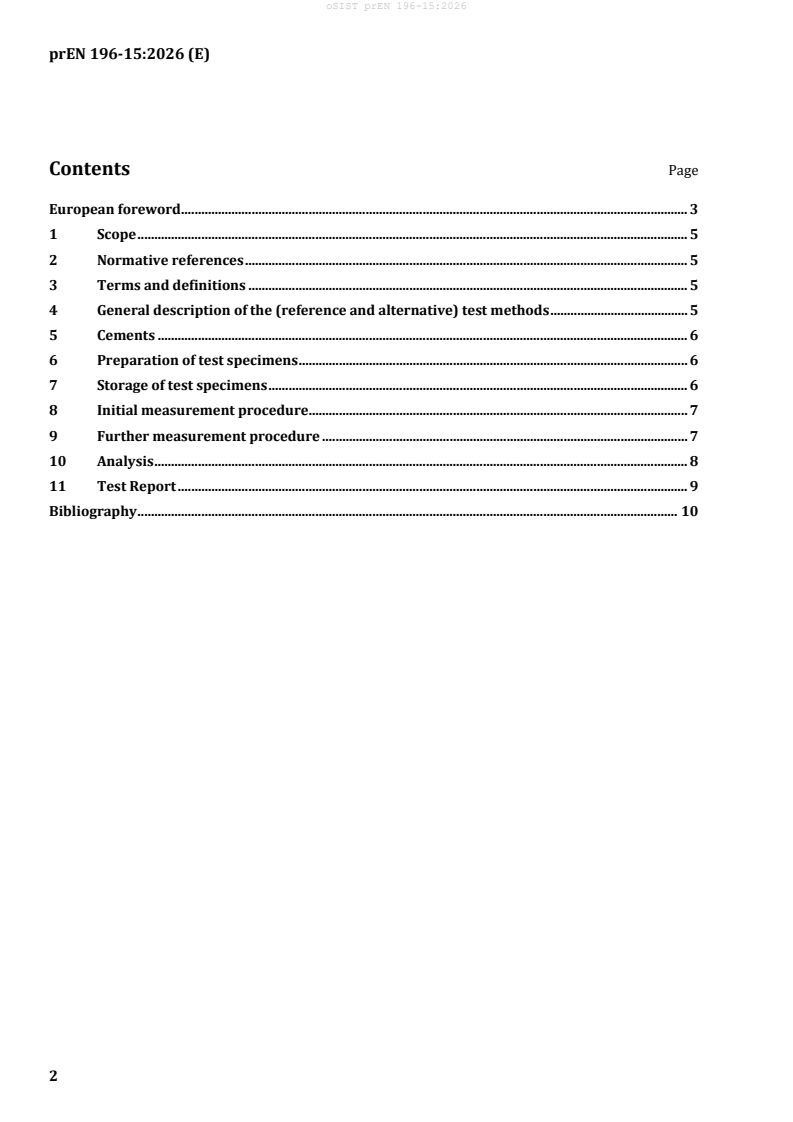
Contents Page
European foreword . 3
1 Scope . 5
2 Normative references . 5
3 Terms and definitions . 5
4 General description of the (reference and alternative) test methods . 5
5 Cements . 6
6 Preparation of test specimens . 6
7 Storage of test specimens . 6
8 Initial measurement procedure . 7
9 Further measurement procedure . 7
10 Analysis . 8
11 Test Report . 9
Bibliography . 10
European foreword
This document (prEN 196-15: 2026) has been prepared by Technical Committee CEN/TC 51 “Cement
and building limes”, the secretariat of which is held by NBN.
This document is currently submitted to the CEN Enquiry.
Introduction
This document describes test methods (reference and alternative) applicable to cast test specimens for
evaluating the sulftate resistance (SR characteristic) of cements. Sulfate resistance means that these
binders can be used in concrete bodies submitted to sulfate attacks.
They are established within the framework of EN 197-1.
Precision data, coming from broad round robin tests and valid for a European standard, are not yet
available.
1 Scope
This document describes test methods (reference and alternative) applicable to cast test specimens for
evaluating the Sulftate Resistance (SR characteristic) of cements. Sulfate resistance means that these
binders can be used in concrete bodies submitted to sulfate attacks.
In these methods, the test is carried out under controlled exposure conditions using an increased
concentration of sulfate solution. These test conditions are intended to accelerate external sulfate
attack.
The reference test method is adapted from the modified SVA test method (German Institute for Building
Technology (DIBt), Expert Committee (SVA)): “Testing the Sulfate Resistance of Cements with
pozzolanic main constituents”. The modified SVA test method is listed in European Assessment
Document – EAD 150007-01-0301, Annex C. This test method is appropriate for various binders, in
particular those with pozzolanic main constituents.
The alternative test method is listed in European Assessment Document – EAD 150009-01-0301,
Annex A. This test method is appropriate for CEM III/A cements.
2 Normative references
The following documents are referred to in the text in such a way that some or all of their content
constitutes requirements of this document. For dated references, only the edition cited applies. For
undated references, the latest edition of the referenced document (including any amendment) applies.
EN 196-1, Methods of testing cement - Part 1: Determination of strength
EN 197-1, Cement – Part 1: Composition, specifications and conformity criteria for common cements
EN 14146, Natural stone test methods - determination of the dynamic modulus of elasticity (by measuring
the fundamental resonance frequency)
3 Terms and definitions
No terms and definitions are listed in this document.
4 General description of the (reference and alternative) test methods
The sulfate resistance shall be determined by the flat prism method (SFPMm) on mortar specimens
aged up to minimum of 728 days (104 weeks) (reference method) or 182 days (alternative method) in a
Na SO -solution (NS), and in a saturated calcium hydroxide (Ca(OH) )-solution (CH) at a storage
2 4 2
temperature (T) of (5 ± 2) °C (T ) and (20 ± 2) °C (T ).
5 20
The length and the mass as well as the longitudinal resonance frequency for the determination of the
dynamic modulus of elasticity of the specimens are determined at the beginning of the storage of the
specimens in the test solutions and every 13 weeks thereafter in the reference method. In the
alternative method, these values are determined at the beginning of the storage and after 14, 28, 56, 90
and 180 days.
With the measured length of the specimens after a storage time t, the length difference of the flat
i
prisms for each storage solution (NS and CH) and storage temperature (T and T ) shall be calculated
5 20
as mean value from 3 specimens (Δl (t ,T) and Δl (t ,T)).
NS i CH i
The difference in elongation between the sulfate storage (Δl (t,T)) and the reference storage
NS i
(Δl (t ,T)) for a storage time (t ) and a storage temperature (T and T ) is given as expansion of the
CH i i 5 20
length (Δl(ti,T)).
In addition, the mass of the specimens (w (t ,T) and w (t ,T)) and the dynamic modulus of elasticity
NS i CH i
(E (t ,T) and E (t ,T)) shall be determined at a storage time t for each storage solution (NS and CH)
NS i CH i i
and storage temperature (T and T ).
5 20
5 Cements
The sulfate resistance shall be tested on specimens made of mortar according to EN 196-1.
6 Preparation of test specimens
Mortar shall be made from each cement (tested cement and the two reference cements according to
EN 197-1) in accordance with EN 196-1, with a water/cement-r
...