


CEN/TR 13933:2023
(Main)Masonry cement - Testing for workability (cohesivity)
General Information
- Abstract
This document deals with the adaption of existing test methods and equipment to provide a repeatable and reproducible means of assessing the workability ("cohesivity") imparted to mortar by masonry cements.
- Status
- Published
- Publication Date
- 14-Nov-2023
- Technical Committee
- CEN/TC 51 - Cement and building limes
- Drafting Committee
- CEN/TC 51/WG 10 - Masonry cement
- Current Stage
- 6060 - Definitive text made available (DAV) - Publishing
- Start Date
- 15-Nov-2023
- Due Date
- 16-Sep-2023
- Completion Date
- 15-Nov-2023

Overview
CEN/TR 13933:2023 - Masonry cement: Testing for workability (cohesivity) - is a CEN Technical Report that adapts existing test methods and equipment to provide a repeatable, reproducible means of assessing the workability (cohesivity) that masonry cements impart to mortar. The report focuses on a dynamic assessment of mortar plasticity (how the mortar flows and stays cohesive in use), using calibrated flow tables and standardised preparation of mortar at a controlled consistence.
Key topics and requirements
- Scope and purpose: Defines a method to assess cohesivity separately from consistence (wetness), enabling meaningful comparisons between masonry cements.
- Starting point: Mortar prepared at a controlled standard consistence following EN 413-2:1994 and mixed in the EN 196-1:1994 mixer.
- Apparatus:
- Flow tables (reference: EN 459-2:1994); tabletop must be secured to a firm non-plastic base (monolithic concrete ≥ 50 kg recommended).
- Calipers, timer, mortar mixer, consistence plunger, tamper (13 × 25 mm cross-section; length 127–152 mm).
- Calibration of flow tables: Uses a sand/water calibration mix (1 350 ± 5 g CEN standard sand and 203 ± 1 g water) mixed per EN 196-1. The mould is filled, tamped (10 times per layer), and the tabletop jolted at 1 jolt/s. Spreads are measured after 5, 10, 15, 20 and 25 jolts (two perpendicular measurements averaged). Calibration compensates for wide performance differences between table designs discovered in a co‑operative test program.
- Cohesivity indices:
- Index A: based on average spread after 15 jolts.
- Index B: derived from the number of jolts required to reach a spread of 145 mm (interpolated from measured spreads).
- Performance notes: ASTM C‑230 and BS 4551 style tables generally satisfactory; some historic tables (e.g., BS 890:1972) may be unsuitable.
Practical applications
- Quality control and specification testing of masonry cements used for bedding, jointing and rendering.
- Product development and comparative performance evaluation for cement manufacturers and mortar formulators.
- Laboratory methods for R&D, certification bodies and third‑party testing to ensure consistent on‑site behavior (flow from trowel, spread without segregation).
Who should use this standard
- Cement and mortar manufacturers
- Construction materials testing laboratories
- Standards committees and conformity assessment bodies
- Specification authors, R&D teams and quality managers in masonry construction
Related standards
- EN 413-2:1994 (masonry cement test methods / consistence)
- EN 196-1:1994 (mortar mixing procedures)
- EN 459-2:1994 (reference flow table)
- Referenced national/industry tables: ASTM C‑230, BS 4551, BS 890:1972
Keywords: masonry cement, cohesivity, workability, flow table calibration, mortar testing, CEN/TR 13933:2023, EN 413-2, EN 196-1, Cohesivity Index.
Relations
- Effective Date
- 18-Jan-2023
Get Certified
Connect with accredited certification bodies for this standard

DIBt (Deutsches Institut für Bautechnik)
German Institute for Building Technology.
DIN CERTCO
DIN Group product certification.

Aboma Certification B.V.
Specialized in construction, metal, and transport sectors.
Sponsored listings
Frequently Asked Questions
CEN/TR 13933:2023 is a technical report published by the European Committee for Standardization (CEN). Its full title is "Masonry cement - Testing for workability (cohesivity)". This standard covers: This document deals with the adaption of existing test methods and equipment to provide a repeatable and reproducible means of assessing the workability ("cohesivity") imparted to mortar by masonry cements.
This document deals with the adaption of existing test methods and equipment to provide a repeatable and reproducible means of assessing the workability ("cohesivity") imparted to mortar by masonry cements.
CEN/TR 13933:2023 is classified under the following ICS (International Classification for Standards) categories: 91.100.10 - Cement. Gypsum. Lime. Mortar. The ICS classification helps identify the subject area and facilitates finding related standards.
CEN/TR 13933:2023 has the following relationships with other standards: It is inter standard links to CR 13933:2000. Understanding these relationships helps ensure you are using the most current and applicable version of the standard.
CEN/TR 13933:2023 is associated with the following European legislation: EU Directives/Regulations: 305/2011. When a standard is cited in the Official Journal of the European Union, products manufactured in conformity with it benefit from a presumption of conformity with the essential requirements of the corresponding EU directive or regulation.
CEN/TR 13933:2023 is available in PDF format for immediate download after purchase. The document can be added to your cart and obtained through the secure checkout process. Digital delivery ensures instant access to the complete standard document.
Standards Content (Sample)
SLOVENSKI STANDARD
01-januar-2024
Nadomešča:
SIST CR 13933:2001
Zidarski cement - Preskušanje obdelavnosti (kohezivnost)
Masonry cement - Testing for workability (cohesivity)
Putz- und Mauerbinder - Bestimmung der Verarbeitbarkeit (Kohäsion)
Ciment de maçonnerie - Test de maniabilité (cohésivité)
Ta slovenski standard je istoveten z: CEN/TR 13933:2023
ICS:
91.100.10 Cement. Mavec. Apno. Malta Cement. Gypsum. Lime.
Mortar
2003-01.Slovenski inštitut za standardizacijo. Razmnoževanje celote ali delov tega standarda ni dovoljeno.
CEN/TR 13933
TECHNICAL REPORT
RAPPORT TECHNIQUE
November 2023
TECHNISCHER REPORT
ICS 91.100.10 Supersedes CR 13933:2000
English Version
Masonry cement - Testing for workability (cohesivity)
Ciment de maçonnerie - Test de maniabilité Mauerzement - Prüfung auf Verarbeitbarkeit
(cohésivité) (Kohäsion)
This Technical Report was approved by CEN on 20 November 2023. It has been drawn up by the Technical Committee CEN/TC
51.
CEN members are the national standards bodies of Austria, Belgium, Bulgaria, Croatia, Cyprus, Czech Republic, Denmark, Estonia,
Finland, France, Germany, Greece, Hungary, Iceland, Ireland, Italy, Latvia, Lithuania, Luxembourg, Malta, Netherlands, Norway,
Poland, Portugal, Republic of North Macedonia, Romania, Serbia, Slovakia, Slovenia, Spain, Sweden, Switzerland, Türkiye and
United Kingdom.
EUROPEAN COMMITTEE FOR STANDARDIZATION
COMITÉ EUROPÉEN DE NORMALISATION
EUROPÄISCHES KOMITEE FÜR NORMUNG
CEN-CENELEC Management Centre: Rue de la Science 23, B-1040 Brussels
© 2023 CEN All rights of exploitation in any form and by any means reserved Ref. No. CEN/TR 13933:2023 E
worldwide for CEN national Members.
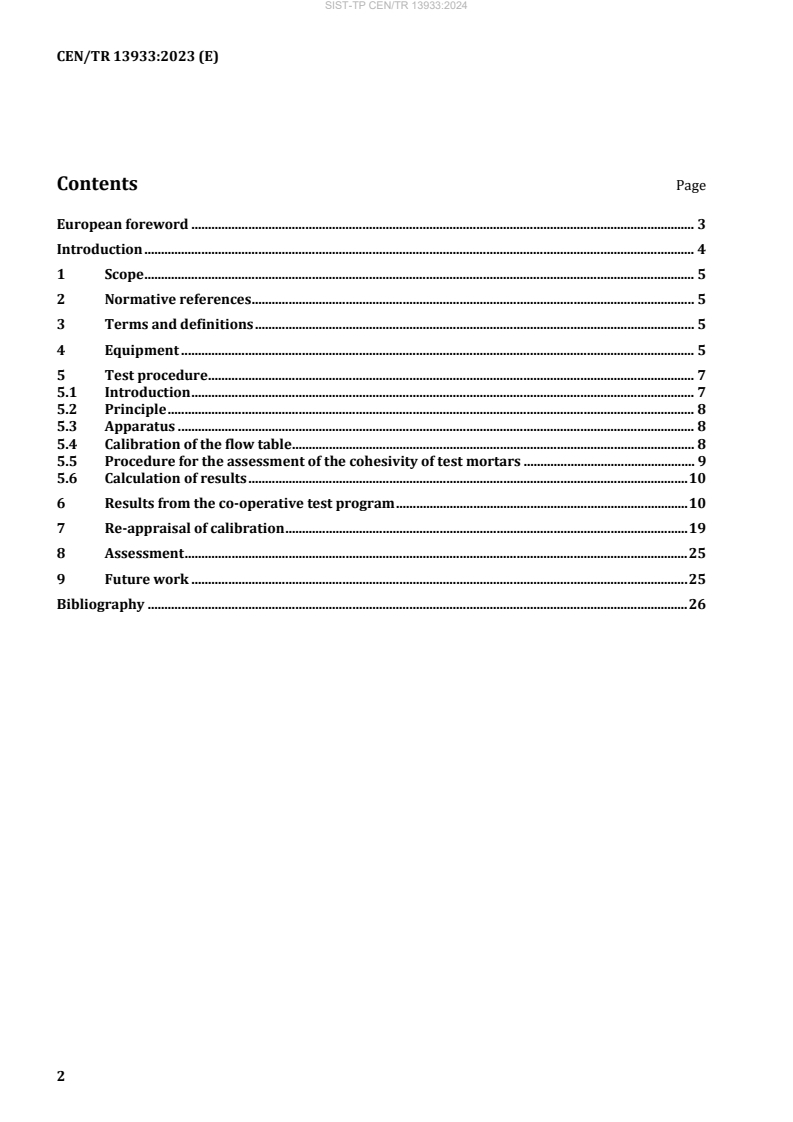
Contents Page
European foreword . 3
Introduction . 4
1 Scope . 5
2 Normative references . 5
3 Terms and definitions . 5
4 Equipment . 5
5 Test procedure . 7
5.1 Introduction . 7
5.2 Principle . 8
5.3 Apparatus . 8
5.4 Calibration of the flow table . 8
5.5 Procedure for the assessment of the cohesivity of test mortars . 9
5.6 Calculation of results . 10
6 Results from the co-operative test program . 10
7 Re-appraisal of calibration . 19
8 Assessment . 25
9 Future work . 25
Bibliography . 26
European foreword
This document (CEN/TR 13933:2023) has been prepared by Technical Committee CEN/TC 51 “Cement
and building limes”, the secretariat of which is held by NBN.
Attention is drawn to the possibility that some of the elements of this document may be the subject of
patent rights. CEN shall not be held responsible for identifying any or all such patent rights.
This document supersedes CR 13933:2000.
This document includes the following significant technical changes with respect to CR 13933:2000:
— the titles have been added in French and in German,
— text has been rewritten to exclude permissions, recommendations and requirements.
Any feedback and questions on this document should be directed to the users’ national standards body.
A complete listing of these bodies can be found on the CEN website.
Introduction
Mortars incorporating masonry cements are used for bedding masonry units and also for rendering and
plastering. In 1988 the CEN Technical Committee responsible for Cements and Building Limes (TC 51)
charged its Working Group 10 to produce a Standard for Masonry cements and for the test methods to
support that Standard.
Test methods for setting time, soundness and strength are common requirements in most cement
standards. However, where the cement is specifically designed to adhere to and subsequently provide a
good bond with masonry units, it is important that an adequate level of workability is achieved. In
contrast to the concept of workability as applied to concrete, workability in mortars is not just a question
of adjusting the "wetness" of the mortar by adding more or less water. In masonry work, the craftsman
requires rather more of his materials in that he expects them to flow easily from the trowel and to spread
on to the masonry unit evenly and without segregation. It is only when these properties are present that
he can expect to achieve the consistent degree of bonding necessary to produce durable watertight joints
and renderings.
The appropriate RILEM Committee considered that workability comprised two main components,
notably: consistence and plasticity. They defined these components as follows:
Consistence: That property of a mortar by virtue of which it tends to resist deformation.
Plasticity: That property of a mortar by virtue of which it tends to retain its deformation after reduction
of the deforming stress to its yield point.
Consistence is a measure of wetness and is measured using a penetration device, but that plasticity
required a more dynamic assessment such as could be achieved by using apparatus which caused the
mortar to move. However, in order to obtain any meaningful numerical measure of plasticity, it was
adjudged important to ensure that the testing for this characteristic was carried out on mortars where
the consistence had been controlled to a narrow band.
Since the testing procedure adopted in the CEN Standard EN 413-2:1994, Masonry cement - Part 2: Test
methods involved the preparation of a mortar using standard sand and with sufficient water to achieve a
narrow band of consistence as assessed using a plunger (penetration) test, this was considered as the
starting point for the work to assess workability, or as was deemed more appropriate "cohesivity".
Early work involved measuring the time taken for a mortar of standard consistence to flow between two
points in the AFNOR workability meter. This method was incorporated into EN 413-2:1994 as a test
method, but on account of the limited amount of experience available no limits were set in the Masonry
cement Prestandard ENV 413-1. Subsequently, further testing revealed significant calibration problems
between laboratories and consideration was given to the use of a flow table as an alternative means of
providing the dynamic component of the test. This document deals with the development of the test using
flow tables.
1 Scope
This document deals with the adaption of existing test methods and equipment to provide a repeatable
and reproducible means of assessing the workability ("cohesivity") imparted to mortar by masonry
cements.
2 Normative references
There are no normative references in this document.
3 Terms and definitions
No terms and definitions are listed in this document.
ISO and IEC maintain terminology databases for use in standardization at the following addresses:
— IEC Electropedia: available at https://www.electropedia.org/
— ISO Online browsing platform: available at https://www.iso.org/obp/
4 Equipment
As has been discussed in the introduction, there is considerable merit in using the standard consistence
mortar produced in EN 413-2:1994 as the starting point for the cohesivity test. Such a practice uses no
equipment beyond that already in use for masonry cement testing. The mortar is prepared in the mixer
defined in EN 196-1:1994 and the sand used and the plunger device for measuring consistence are those
specified in EN 413-2:1994.
Since flow tables are not uncommon in cement testing laboratories it was decided to evaluate these in
order to provide a measure of cohesivity. However, previous experience suggests that even where these
pieces of equipment are covered by strict specification requirements, their performance can be expected
to vary from table to table. A review of the flow tables in use in various European testing laboratories
revealed considerable differences as is shown in Table 1. Calibration of the tables was therefore
considered to be an essential step in the test procedure.
In order to keep this calibration procedure as simple as possible, the first attempts at calibration were
carried out using the EN 196-1:1994 sand damped with a fixed amount of water. The results from this
calibration as carried out in the nine laboratories participating in the co-operative test program are given
in Table 1.
Table 1 — Calibration Results
Test Lab Flow Table (drop in mm) Flow Table mould mm Sand Flow table calibration - spread after jolting mm
Type Top kg Drop Top Btm dia Ht. 196-1 5 10 15 20 25 30
BC ASTM 4,08 12,5 70,7 102 51 German 129 140 153 165 171
(UK) 131 139 148 160 172
129 139 150 161 172
ave 129 139 150 161 172
BLI ASTM 4,002 14 70 101 51 France 126 138 146 158 167 177
(UK) 127 139 149 156 164 171
124 137 148 157 170 180
ave 126 138 148 157 167 176
Cimpor BS 6463 6,6 19,1 70 100 60 France 150 158 162 163 163
(Port'al) 152 158 160 163 164
154 159 164 164 163
ave 152 158 162 163 163
DBDK EN 459 4,352 10,2 70 110 60 German 119 132 154 160 163
ave
ENCI RMU 3,298 10 70 100 90 German 122 134 139 145 147
ave
Italicem 3,34 10,1 69,9 100 60 France 114 129 140 145 149
(Italy) 114 127 136 143 144 148
116 128 139 144 148
ave 115 128 138 144 147
UNI 3,22 10,0 70,2 100 60 France 113 131 139 144 146 147
119 136 137 140 144 148
116 134 138 138 143 147
ave 116 134 138 141 144 147
Lafarge ASTM 4,1 12,5 70 100 50 France 132 143 151 153 162
(France) 129 145 151 154 161
127 130 146 151 159
ave 129 139 149 153 161
Norcem NS 3107 3,495 9 German 166 175 184 191 198
ave
VDZ EN 459 4,35 10 70 100 60 German 125 141 147 153 157
Germany 124 141 148 153 156
124 142 150 155 159
123 143 150 155 158
122 141 146 151 154
122 139 147 150 155
ave 123 141 148 153 157
DBDK was the German Lime Association, ENCI was the Netherlands cement manufacturer and Norcem
was the Norwegian cement manufacturer.
The number of jolts and the log10 of the number of jolts for a spread of 145 mm is shown in Table 2. The
log of the number of jolts is given since the relationship between the log of the number of jolts and the
spreads approaches linearity.
Table 2 — Number of jolts and the log of the number of jolts for a spread of 145 mm
Test Laboratory Flow Table Number of jolts requested for a
spread of 145 mm
Number log of number
BC ASTM 13 1.114
BLI ASTM 13 1.114
Cimpor BS 6463 4 0.602
DBDK EN 459 13 1.114
ENCI RMU 20 1.301
Italicementi DIN ? 22 1.342
UNI 26 1.415
Lafarge ASTM 13 1.114
Norcem NS 3107 3 0.544
VDZ EN 459 12 1.079
The results obtained revealed large differences between the design of the flow tables in common use in
the different laboratories and also in the spread of mortar obtained from a given number of jolts.
However, despite these differences, there was good agreement between the ASTM tables in three of the
laboratories in achieving a spread of 145 mm and a tolerable level of agreement between the ASTM tables
and the EN 459 tables. The Italian table and those in use in Norway and Portugal however, gave very
different results. At this stage of the evaluation there was promise that an effective means of calibration
was possible and it was encouraging to proceed further with this type of test procedure.
An attempt was also made to calibrate the flow tables using mixtures of EN 196-1:1994 sand and aqueous
solutions of cellulose ethers and standard viscosity oils. The rheological properties of these materials
proved to be markedly different from those of the mortars to be tested and they were not proceeded with.
5 Test procedure
5.1 Introduction
The test procedure below was adopted for evaluation in a co-operative test program and follows that
given in the papers of Slavin (see [1] in Bibliography) and of Bowler, Jackson & Monk (see [2] in
Bibliography).
Recently published work [1] and [2] provide details of a method for the determination of the cohesivity
(at a given level of consistence) provided by binders when used to prepare mortars for use in masonry
applications (brick and block laying and rendering). This property is different from consistence, which
for building mortars implies "wetness", whereas cohesivity describes the ability of the mortar to flow in
the desired manner from the craftsman's trowel and to form a coherent mass when placed upon masonry
units. This document describes its application to masonry cement.
5.2 Principle
The mortar is prepared in accordance with the method given in EN 413-2:1994.
This mortar is placed in a mould on a calibrated flow table and the spread is measured after the
appropriate number of jolts.
Cohesive materials give either a significantly lower spread or an increased number of jolts than the less
cohesive materials.
Cohesivity is expressed as indices which incorporate the calibration of the flow table.
5.3 Apparatus
5.3.1 Flow tables
For reference purposes, see the flow table described in EN 459-2:1994.
Other flow tables and their moulds, the performance of which is related to the reference table, are used.
It is important that the EN 196-1:1994 sand/water calibration material remains cohesive up to the
relevant spread. If a flow table does not permit this, then it is not suitable for this test.
It is important that the flow table is tightly secured to a horizontal, firm and non-plastic base. A monolithic
cast concrete base weighing at least 50 kg is suitable.
NOTE The ASTM C-230 flow table and the BS 4551 flow table and their moulds have been shown to be
satisfactory. The BS 890:1972 flow table and its mould is not satisfactory.
5.3.2 Calliper with jaws opening to at least the diameter of the flow table is used in conjunction with a
measuring device or ruler calibrated in units of 1 mm.
5.3.3 Timer indicating seconds or better.
5.3.4 Mortar mixer and associated equipment, described in EN 196-1:1994.
5.3.5 Consistence plunger and associated equipment, described in EN 413-2:1994.
5.3.6 Tamper to use with the flow table mould. This is made of non-absorptive, non-abrasive, non-
brittle material and having a cross section of 13 mm by 25 mm and a length of 127 mm to 152 mm. The
tamping face is flat and at right angles to the length of the tamper.
5.3.7 Metal straight edge, described in 5.3.2 of EN 413-2:1994.
5.4 Calibration of the flow table
If the flow table has not been used during the previous hour, the empty table is jolted several times before
use. It is ensured that the tabletop and also the inner surface of the mould are dry and free from any
dullness due to the presence of moisture.
(1 350 ± 5) g of CEN standard sand, complying with 5.1.3 of EN 196-1:1994, is placed into the bowl of the
mixer, complying with 4.4 of EN 196-1:1994. (203 ± 1) g of water is added and the mixing procedure
described in 6.3 b), 6.3 c) and 6.3 d) of EN 196-1:1994 is followed.
The mould is placed in the centre of the flow tabletop and filled in two layers, each of approximately the
same height. Each layer is tamped 10 times using the tamper described in 5.3.6 above. Excess material is
removed, avoiding any spillage onto the table surface. If water separation is seen between the base of the
mould and the tabletop, then tamping has been too vigorous.
The mould is removed and the mix is spread by jolting the tabletop at a rate of one jolt every second.
Jolting is commenced within 2,0 minutes of the mixing procedure having been completed.
The spread is measured in two directions at right angles to each other after 5,10,15, 20 and 25 or more
jolts of the table (sufficient to give a minimum spread of 145 mm).
NOTE More than 25 jolts are needed with some flow tables to achieve the relevant spread to calculate
Cohesivity Index "B".
The average of the two measurements is reported to 1 mm.
The full number of jolts is completed within 5,0 min of the first jolt.
Two further fresh batches of the sand/water mix are prepared and the test described above is repeated
in order to provide an average of three results.
The average spread on the flow table after 15 jolts in the calculation of Cohesivity Index "A" is used.
The number of jolts is used to give a spread of 145 mm established by interpolation from the spread
obtained at 5, 10, 15, 20 and 25 jolts in the calculation of Cohesivity Index "B".
5.5 Procedure for the assessment of the cohesivity of test mortars
5.5.1 The test mortar is prepared in accordance with 4.2.2 of EN 413-2:1994. Sufficient water is added
at the start of mixing in the EN 196-1:1994 mixer to give a plunger penetration using the method for
consistence described in EN 413-2:1994 of (35 ± 3) mm.
5.5.2 The flow table mould is placed on to the flow tabletop (prepared as in 5.4 above). The mortar
remaining in the mixing bowl is gently turned over by hand, using a suitable implement. The mortar is
placed into the mould (as described in 5.4 above).
The mould is removed and the mortar is spread by jolting the flow tabletop at one jolt each second. Jolting
is commenced within 4,0 minutes of the mixing procedure having been completed. The spread is
measured in two directions at right angles to each other after 5, 10, 15, 20 and 25 or more jolts of the
table (sufficient to give a minimum spread of 210 mm).
NOTE 1 More than 25 jolts are needed with some flow tables to achieve the relevant spread to calculate
Cohesivity Index "B".
The average of two measurements is reported to 1 mm.
The full number of jolts is completed within 5,0 minutes of the first jolt.
Two further fresh mortar batches are prepared and the test described above is repeated to provide an
average of three results.
Cohesivity Index "A" {CI(A)} is calculated using the spread in mm on the flow table after 15 jolts.
NOTE 2 More cohesive mortars give LOWER values of CI(A).
Cohesivity Index "B" {CI(B)} is calculated using the number of jolts to give a spread of 210 mm established
by interpolation from the spread obtained at 5, 10, 15, 20 and 25 or more jolts.
NOTE 3 More cohesive mortars give HIGHER values of CI(B).
5.6 Calculation of results
5.6.1 Cohesivity Index "A" = Flow table spread (in mm) after 15 jolts using the calibration mix
Flow table spread (in mm) after 15 jolts using the test mortar
5.6.2 Cohesivity Index "B" = Number of jolts to give a spread of 210 mm using the test mortar
Log10 number of jolts to give a spread of 145 mm using the calibration
mix
6 Results from the co-operative test program
Nine laboratories in seven European countries participated in the co-operative test program. One
EN 197-1 CEM I cement and five ENV 413-1 masonry cements were tested in each laboratory using the
procedures given in 4 above. The ENV 413 masonry cements comprised one MC5 from Germany, one MC5
from Italy, one MC12.5 from the Netherlands, one MC12.5 from the UK and one MC22.5X from France.
The EN 196-1:1994 sand as used was that in normal use in the laboratory in question and was as used in
the calibration work (Table 1).
The results obtained are given in Tables 3,4,5,6,7 and 8.
Table 3 — CEM I Common Cement (EN 197-1) from UK
Water Penetration Flow Table Spread mm after jolting Index Index
Sample Test Lab Test No Jolts for 210 mm spread
g mm CI(A) CI(B)
5 10 15 20 25 30 35 40
CEM I BC 1 235 34 178 211 231 240 251
2 235 35 180 212 233 244 250
3 235 34 176 210 229 245 253
Ave 235 34 178 211 231 243 251 1,54 10 9,0
BLI 1 245 35 176 211 232 240
2 244 33 172 205 225 239
3 248 34 175 217 229 241
Ave 247 36 174 211 229 240 1,55 10 9,0
Cimpor 1 255 36 179 208 229 240 251
2 255 34 179 208 228 241 250
3 255 35 180 208 228 242 253
Ave 255 35 174 208 228 241 251 1,41 11 18,3
DBDK 1 236 34 156 186 208 224 235 1,35 16 14,4
Ave
ENCI 1 236 34 147 172 190 204 215 1,37 23 17,7
Ave
Italicm 1/3 245 35:34:35 154 183 202 217 225
4/6 245 35:35:35 152 179 197 211 223
7/9 245 34:35:35 152 180 199 213 224
Ave 245 34,9 152 181 200 214 224 1,45 19 14,2
Italicm 1/3 245 35:34:35 159 187 206 220 231
UNI 4/6 245 35:35:35 160 189 205 223 231
7/9 245 34:35:35 160 186 205 219 229
Ave 245 34,9 160 187 205 221 230 1,49 17 12,0
Lafarg 1 243 33 189 222 244 250
2 186 219 238 250
3 190 224 244 250
Ave 188 222 242 250 1,62 8 7,2
Not Norcm 1 238 37 130 156 175 189 201
CEM I
Ave
VDZ 1 235 34 153 183 203 218 230
2 158 187 206 220 231
3 156 185 203 217 228
Ave 156 185 204 218 230 1,38 17 14,8
Table 4 — Masonry cement - MC5 (ENV 413-1) from Germany
Jolts for
Test Test Water Penetration Index Index
Sample Flow Table Spread mm. after jolting 210 mm
Lab No g mm CI(A) CI(B)
spread
MC5 5 10 15 20 25 30 35 40 45 50
(G) B.C. 1 232 36 156 177 190 201 209 222
2 232 37 157 177 190 200 213
3 232 35 157 177 191 202 216
Ave 232 36 157 177 190 201 213 1,27 24 21,6
BLI 1 245 38 159 180 194 206 218 226 233
2 244 38 159 181 195 208 219 227 235
3 243 37 157 182 194 210 218 226
Ave 244 38 158 181 194 208 218 226 1,31 21 18,9
Cimpor 1 230 35 165 183 197 205 213
2 232 37 166 187 198 208 213
3 229 36 164 185 196 207 214
Ave 230 36 165 185 197 206 213 1,21 23 38,2
DBDK 1 235 35 148 171 186 197 206 212 1,21 28 25,1
Ave
ENCI 1 229 36 130 147 160 167 175 181 1,20 55 42,3
Ave
Italicm 1/3 230 36:36:37 138 156 171 180 189 195 200 205 210 214
4/6 230 37:37:37 140 159 172 182 190 195 201 206 210 214
7/9 230 37:37:34 141 160 173 183 190 199 202 207 211 214
Ave 230 36,2 140 158 172 182 189 196 201 206 210 214 1,25 45 33,6
Italicm 1/3 230 36:36:37 143 162 175 184 191 197 202 206 210 214
UNI 4/6 230 37:37:37 142 160 173 182 189 195 200 205 209 213
7/9 230 37:37:34 141 159 172 181 189 194 199 204 208 212
Ave 230 36,2 142 160 173 182 190 195 200 205 209 213 1,25 46 32,5
Lafarg 1 234 37 169 192 207 220 231
2 170 190 207 218 230
3 170 193 208 223 235
Ave 170 192 207 220 232 1,39 16 14,4
Norcm 1 226 35 111 120 149 134 139
2 226 34
Ave 226 35
VDZ 1 235 37 147 165 183 193 202 211
...