


EN 15651-1:2010
(Main)Sealants for non-structural use in joints in buildings and pedestrian walkways - Part 1: Sealants for facade elements
General Information
- Abstract
This document specifies definitions and requirements for non-structural facade sealants intended for sealing exterior wall joints, window and door perimeter joints in building construction, including the interior face.
NOTE Provisions on evaluation of conformity (i.e. Initial Type Testing and Factory Production Control) and marking of these products are given in EN 15651-5.
This document does not apply to non-structural sealants in any of non-paste form, to those used in internal walls and/or partitions and to oil-based mastics.
- Status
- Withdrawn
- Publication Date
- 02-Mar-2010
- Withdrawal Date
- 11-Sep-2012
- Technical Committee
- CEN/TC 349 - Sealants for joints in building construction
- Drafting Committee
- CEN/TC 349/WG 1 - Sealants for facade
- Current Stage
- 9960 - Withdrawal effective - Withdrawal
- Start Date
- 12-Sep-2012
- Completion Date
- 12-Sep-2012
- Directive
- Harmonized Standard305/2011 - Regulation (eu) No 305/2011 of the European Parliament and of the Council of 9 march 2011 laying down harmonised conditions for the marketing of construction products and repealing council directive 89/106/eec
Not Harmonized89/106/EEC - Construction products

Relations
- Effective Date
- 19-Sep-2012
- Referred By
EN 13099:2003 - Transportable gas cylinders - Conditions for filling gas mixtures into receptacles - Effective Date
- 28-Jan-2026
Get Certified
Connect with accredited certification bodies for this standard

DIBt (Deutsches Institut für Bautechnik)
German Institute for Building Technology.
DIN CERTCO
DIN Group product certification.

Aboma Certification B.V.
Specialized in construction, metal, and transport sectors.
Sponsored listings
Frequently Asked Questions
EN 15651-1:2010 is a standard published by the European Committee for Standardization (CEN). Its full title is "Sealants for non-structural use in joints in buildings and pedestrian walkways - Part 1: Sealants for facade elements". This standard covers: This document specifies definitions and requirements for non-structural facade sealants intended for sealing exterior wall joints, window and door perimeter joints in building construction, including the interior face. NOTE Provisions on evaluation of conformity (i.e. Initial Type Testing and Factory Production Control) and marking of these products are given in EN 15651-5. This document does not apply to non-structural sealants in any of non-paste form, to those used in internal walls and/or partitions and to oil-based mastics.
This document specifies definitions and requirements for non-structural facade sealants intended for sealing exterior wall joints, window and door perimeter joints in building construction, including the interior face. NOTE Provisions on evaluation of conformity (i.e. Initial Type Testing and Factory Production Control) and marking of these products are given in EN 15651-5. This document does not apply to non-structural sealants in any of non-paste form, to those used in internal walls and/or partitions and to oil-based mastics.
EN 15651-1:2010 is classified under the following ICS (International Classification for Standards) categories: 91.100.50 - Binders. Sealing materials. The ICS classification helps identify the subject area and facilitates finding related standards.
EN 15651-1:2010 has the following relationships with other standards: It is inter standard links to EN 15651-1:2012, EN 13099:2003. Understanding these relationships helps ensure you are using the most current and applicable version of the standard.
EN 15651-1:2010 is associated with the following European legislation: EU Directives/Regulations: 305/2011, 89/106/EEC. When a standard is cited in the Official Journal of the European Union, products manufactured in conformity with it benefit from a presumption of conformity with the essential requirements of the corresponding EU directive or regulation.
EN 15651-1:2010 is available in PDF format for immediate download after purchase. The document can be added to your cart and obtained through the secure checkout process. Digital delivery ensures instant access to the complete standard document.
Standards Content (Sample)
2003-01.Slovenski inštitut za standardizacijo. Razmnoževanje celote ali delov tega standarda ni dovoljeno.Tesnilne mase za nekonstrukcijske stike v stavbah in na sprehajalnih površinah - 1. del: Tesnilne mase za fasadeFugendichtstoffe für nicht tragende Anwendungen in Gebäuden und Fußgängerwegen - Teil 1: Fugendichtstoffe für FassadenelementeMastics pour joints dans la construction immobilière - Définitions, exigences et évaluation de la conformité - Partie 1: Mastics pour façadesSealants for non-structural use in joints in buildings and pedestrian walkways - Part 1: Sealants for facade elements91.100.50Veziva. Tesnilni materialiBinders. Sealing materials91.060.10Stene. Predelne stene. FasadeWalls. Partitions. FacadesICS:Ta slovenski standard je istoveten z:EN 15651-1:2010SIST EN 15651-1:2010en,de01-maj-2010SIST EN 15651-1:2010SLOVENSKI
STANDARD
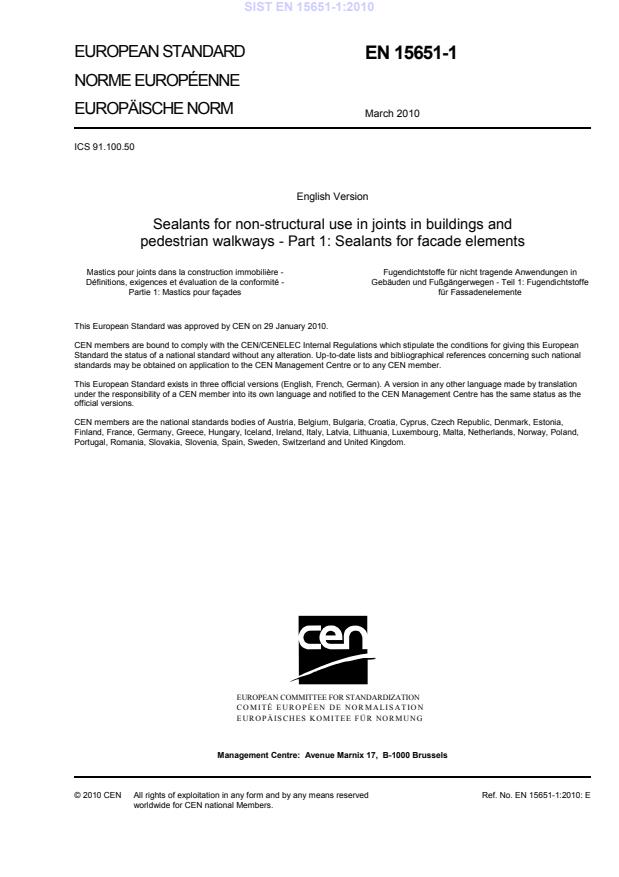
EUROPEAN STANDARD NORME EUROPÉENNE EUROPÄISCHE NORM
EN 15651-1
March 2010 ICS 91.100.50 English Version
Sealants for non-structural use in joints in buildings and pedestrian walkways - Part 1: Sealants for facade elements
Mastics pour joints dans la construction immobilière - Définitions, exigences et évaluation de la conformité - Partie 1: Mastics pour façades
Fugendichtstoffe für nicht tragende Anwendungen in Gebäuden und Fußgängerwegen - Teil 1: Fugendichtstoffe für Fassadenelemente This European Standard was approved by CEN on 29 January 2010.
CEN members are bound to comply with the CEN/CENELEC Internal Regulations which stipulate the conditions for giving this European Standard the status of a national standard without any alteration. Up-to-date lists and bibliographical references concerning such national standards may be obtained on application to the CEN Management Centre or to any CEN member.
This European Standard exists in three official versions (English, French, German). A version in any other language made by translation under the responsibility of a CEN member into its own language and notified to the CEN Management Centre has the same status as the official versions.
CEN members are the national standards bodies of Austria, Belgium, Bulgaria, Croatia, Cyprus, Czech Republic, Denmark, Estonia, Finland, France, Germany, Greece, Hungary, Iceland, Ireland, Italy, Latvia, Lithuania, Luxembourg, Malta, Netherlands, Norway, Poland, Portugal, Romania, Slovakia, Slovenia, Spain, Sweden, Switzerland and United Kingdom.
EUROPEAN COMMITTEE FOR STANDARDIZATION
COMITÉ EUROPÉEN DE NORMALISATION EUROPÄISCHES KOMITEE FÜR NORMUNG
Management Centre:
Avenue Marnix 17,
B-1000 Brussels © 2010 CEN All rights of exploitation in any form and by any means reserved worldwide for CEN national Members. Ref. No. EN 15651-1:2010: ESIST EN 15651-1:2010
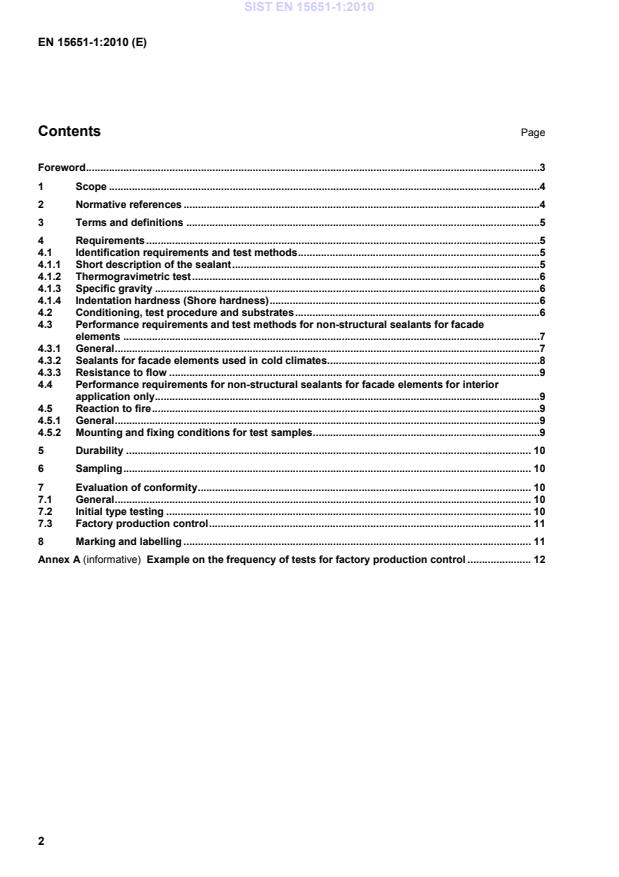
Example on the frequency of tests for factory production control . 12 SIST EN 15651-1:2010
2 Normative references The following referenced documents are indispensable for the application of this document. For dated references, only the edition cited applies. For undated references, the latest edition of the referenced document (including any amendments) applies. EN 13238, Reaction to fire tests for building products Conditioning procedures and general rules for selection of substrates EN 13501-1, Fire classification of construction products and building elements Part 1: Classification using data from reaction to fire tests EN 13823, Reaction to fire tests for building products Building products excluding floorings exposed to the thermal attack by a single burning item EN 15651-5, Sealants for non-structural use in joints in buildings and pedestrian walkways Part 5: Evaluation of conformity and marking EN 26927:1990, Building construction Jointing products Sealants Vocabulary (ISO 6927:1981) EN ISO 868, Plastics and ebonite Determination of indentation hardness by means of a durometer (Shore hardness) (ISO 868:2003) EN ISO 1183-1, Plastics Methods for determining the density of non-cellular plastics Part 1: Immersion method, liquid pyknometer method and titration method (ISO 1183-1:2004) EN ISO 7389, Building construction Jointing products Determination of elastic recovery of sealants (ISO 7389:2002) EN ISO 7390, Building construction Jointing products
Determination of resistance to flow of sealants (ISO 7390:2003) EN ISO 8339, Building construction Sealants Determination of tensile properties (Extension to break) (ISO 8339:2005) EN ISO 8340, Building construction Sealants Determination of tensile properties at maintained extension (ISO 8340:2005) EN ISO 9046, Building construction Jointing products Determination of adhesion/cohesion properties of sealants at constant temperature (ISO 9046:2002) EN ISO 9047, Building construction Jointing products Determination of adhesion/cohesion properties of sealants at variable temperatures (ISO 9047:2001) SIST EN 15651-1:2010
(ISO 10563:2005) EN ISO 10590, Building construction Sealants Determination of tensile properties of sealants at maintained extension after immersion in water (ISO 10590:2005) EN ISO 10591, Building construction Sealants Determination of adhesion/cohesion properties of sealants after immersion in water (ISO 10591:2005) EN ISO 11358, Plastics Thermogravimetry (TG) of polymers General principles (ISO 11358:1997) EN ISO 11600, Building construction Jointing products Classification and requirements for sealants
(ISO 11600:2002) EN ISO 11925-2, Reaction to fire tests Ignitability of building products subjected to direct impingement of flame Part 2: Single-flame source test (ISO 11925-2:2002) ISO 13640, Building construction Jointing products Specifications for test substrates 3 Terms and definitions For the purposes of this document, the terms and definitions given in EN 26927:1990 and the following apply. 3.1 non-reactive sealant mainly physical drying mechanism, without significant change in the molecular weight of the main polymer 3.2 reactive sealant mainly curing by chemical reaction, with significant increase of the molecular weight of the main polymer 3.3 cure irreversible transformation of a sealant from a liquid or paste like state into a hardened or rubber like solid state
3.4 uncured / wet state of a sealant prior to the above transformation 4 Requirements 4.1 Identification requirements and test methods 4.1.1 Short description of the sealant The short description of the non-structural sealant for facade elements shall include brand name, type (general chemical family), opaque or translucent, waterborne or solvent based or solvent free, reactive or
non-reactive, and one or multi-component (e.g. waterborne acrylic opaque and one component, etc.). The primer shall be stated for the substrate concerned, if relevant (name, chemical typ
...