


EN ISO 8980-3:2022/A1:2026
(Amendment)Ophthalmic optics - Uncut finished spectacle lenses - Part 3: Transmittance specifications and test methods - Amendment 1 (ISO 8980 3:2022/Amd 1:2026)
General Information
- Abstract
- Status
- Published
- Publication Date
- 18-Aug-2026
- Technical Committee
- CEN/TC 170 - Ophthalmic optics
- Current Stage
- 6060 - Definitive text made available (DAV) - Publishing
- Start Date
- 19-Aug-2026
- Completion Date
- 19-Aug-2026


Overview
EN ISO 8980-3:2022/A1:2026 sets out updated requirements for the transmittance properties and test methods of uncut finished spectacle lenses. This standard, developed by CEN in collaboration with ISO, outlines specifications for how much light, including solar radiation, is transmitted through ophthalmic lenses. Amendment 1 introduces clarified procedures and parameters for claiming wavelength cut properties, updates for measurement uncertainties, and guidance on test methods, delivering more precise and comparable results in the optical industry.
This standard is essential for manufacturers, optical laboratories, and quality assurance professionals involved with ophthalmic optics, ensuring consistent quality and consumer safety in spectacle lens production.
Key Topics
Transmittance Properties
Specifies requirements and claims regarding the light transmittance of uncut finished spectacle lenses, including defined limits for attenuation of solar radiation.Wavelength Cut Claims
Sets stringent rules for claiming a wavelength cut (e.g., UV-blocking or blue light filtering). For lenses with claimed wavelength cut-off points, the spectral transmittance at the stated wavelength must be below 5%, and below 1% for wavelengths from 280 nm up to 10 nm less than the stated cut-off.Measurement Uncertainties
Updates acceptable uncertainty levels for spectral transmittance measurement:- Not greater than 2.0% absolute for values above 20%
- 1.0% absolute for 5%-20%
- 0.5% absolute for values less than 5% These are to be based on a 95% confidence interval, enhancing reliability in transmittance testing.
Test Methodology
Details required measurement devices such as spectrophotometers, and their technical specifications (e.g., wavelength range, spectral bandwidth), including the use of calibration standards like holmium oxide or didymium filters. It prescribes measurement methods for evaluating claimed wavelength cuts and highlights factors affecting outcome, such as lens thickness and instrument configuration.Influencing Parameters
Discusses how lens geometry (e.g. thickness) and instrument type (e.g. spectrophotometer bandwidth and type) impact transmittance measurement, ensuring manufacturers account for and communicate these variables.
Applications
Manufacturing and Quality Control
Manufacturers of uncut finished spectacle lenses must comply with these specifications to reliably claim UV or blue-light protection, helping ensure consistent product performance and safety for end-users.Product Development
Engineers and designers rely on this standard for the development and verification of new lens materials and coatings, especially those marketed for specific wavelength blocking (UV, high-energy visible light, etc.).Regulatory Compliance
Adhering to EN ISO 8980-3:2022/A1:2026 aids compliance with international and European regulations related to ophthalmic optics, streamlining market access and reducing legal risks.Testing Laboratories
Laboratories use the prescribed methods and uncertainty levels to deliver accurate, recognized certification and validation services for ophthalmic products.
Related Standards
- ISO 8980-3:2022 - The main international standard for uncut finished spectacle lenses' transmittance.
- ISO/IEC Guide 98-3 - Guidance on the expression of uncertainty in measurement, which underpins the measurement requirements in this standard.
- ISO 18526-2:2020 - Provides further advice on measurement uncertainty in ophthalmic lens testing, referenced for detailed guidance.
- Other parts of EN ISO 8980 - Address additional requirements such as optical and mechanical properties of spectacle lenses.
By following EN ISO 8980-3:2022/A1:2026, industry professionals support quality assurance, consumer protection, and harmonization across the ophthalmic optics sector. The standard’s transmittance specifications and robust test methods underpin reliable claims for light filtration and lens safety in modern eyewear.
Relations
- Effective Date
- 12-Feb-2026
- Effective Date
- 19-Jul-2023
Get Certified
Connect with accredited certification bodies for this standard

BSI Group
BSI (British Standards Institution) is the business standards company that helps organizations make excellence a habit.

TÜV Rheinland
TÜV Rheinland is a leading international provider of technical services.

TÜV SÜD
TÜV SÜD is a trusted partner of choice for safety, security and sustainability solutions.
Sponsored listings
Frequently Asked Questions
EN ISO 8980-3:2022/A1:2026 is a amendment published by the European Committee for Standardization (CEN). Its full title is "Ophthalmic optics - Uncut finished spectacle lenses - Part 3: Transmittance specifications and test methods - Amendment 1 (ISO 8980 3:2022/Amd 1:2026)". This standard covers: Ophthalmic optics - Uncut finished spectacle lenses - Part 3: Transmittance specifications and test methods - Amendment 1 (ISO 8980 3:2022/Amd 1:2026)
Ophthalmic optics - Uncut finished spectacle lenses - Part 3: Transmittance specifications and test methods - Amendment 1 (ISO 8980 3:2022/Amd 1:2026)
EN ISO 8980-3:2022/A1:2026 is classified under the following ICS (International Classification for Standards) categories: 11.040.70 - Ophthalmic equipment. The ICS classification helps identify the subject area and facilitates finding related standards.
EN ISO 8980-3:2022/A1:2026 has the following relationships with other standards: It is inter standard links to ISO 8980-3:2022/Amd 1:2026, EN ISO 8980-3:2022. Understanding these relationships helps ensure you are using the most current and applicable version of the standard.
EN ISO 8980-3:2022/A1:2026 is available in PDF format for immediate download after purchase. The document can be added to your cart and obtained through the secure checkout process. Digital delivery ensures instant access to the complete standard document.
Standards Content (Sample)
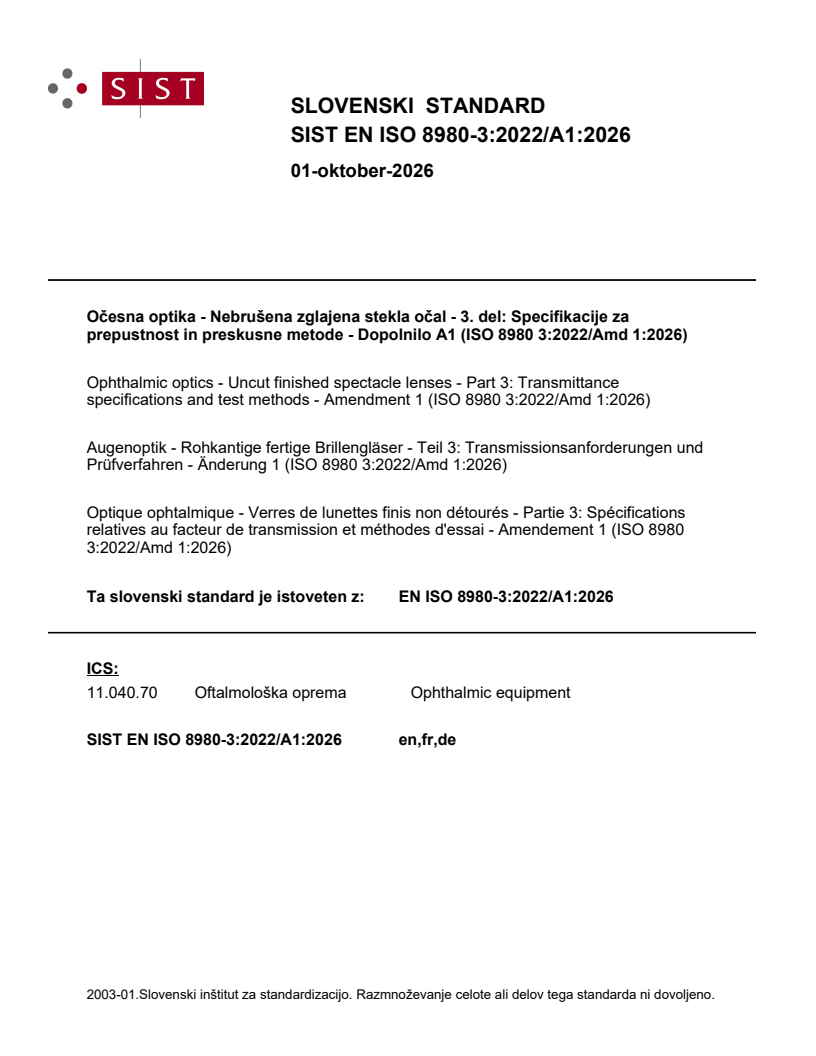
SLOVENSKI STANDARD
01-oktober-2026
Očesna optika - Nebrušena zglajena stekla očal - 3. del: Specifikacije za
prepustnost in preskusne metode - Dopolnilo A1 (ISO 8980 3:2022/Amd 1:2026)
Ophthalmic optics - Uncut finished spectacle lenses - Part 3: Transmittance
specifications and test methods - Amendment 1 (ISO 8980 3:2022/Amd 1:2026)
Augenoptik - Rohkantige fertige Brillengläser - Teil 3: Transmissionsanforderungen und
Prüfverfahren - Änderung 1 (ISO 8980 3:2022/Amd 1:2026)
Optique ophtalmique - Verres de lunettes finis non détourés - Partie 3: Spécifications
relatives au facteur de transmission et méthodes d'essai - Amendement 1 (ISO 8980
3:2022/Amd 1:2026)
Ta slovenski standard je istoveten z: EN ISO 8980-3:2022/A1:2026
ICS:
11.040.70 Oftalmološka oprema Ophthalmic equipment
2003-01.Slovenski inštitut za standardizacijo. Razmnoževanje celote ali delov tega standarda ni dovoljeno.
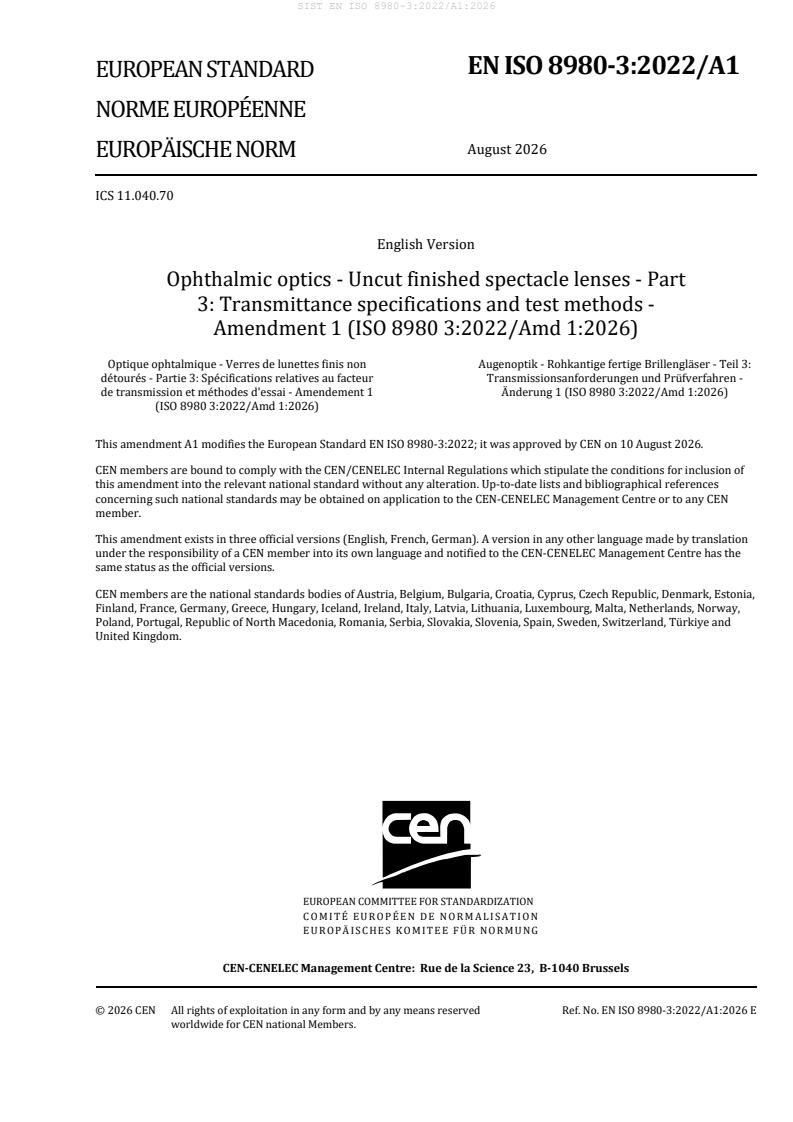
EN ISO 8980-3:2022/A1
EUROPEAN STANDARD
NORME EUROPÉENNE
August 2026
EUROPÄISCHE NORM
ICS 11.040.70
English Version
Ophthalmic optics - Uncut finished spectacle lenses - Part
3: Transmittance specifications and test methods -
Amendment 1 (ISO 8980 3:2022/Amd 1:2026)
Optique ophtalmique - Verres de lunettes finis non Augenoptik - Rohkantige fertige Brillengläser - Teil 3:
détourés - Partie 3: Spécifications relatives au facteur Transmissionsanforderungen und Prüfverfahren -
de transmission et méthodes d'essai - Amendement 1 Änderung 1 (ISO 8980 3:2022/Amd 1:2026)
(ISO 8980 3:2022/Amd 1:2026)
This amendment A1 modifies the European Standard EN ISO 8980-3:2022; it was approved by CEN on 10 August 2026.
CEN members are bound to comply with the CEN/CENELEC Internal Regulations which stipulate the conditions for inclusion of
this amendment into the relevant national standard without any alteration. Up-to-date lists and bibliographical references
concerning such national standards may be obtained on application to the CEN-CENELEC Management Centre or to any CEN
member.
This amendment exists in three official versions (English, French, German). A version in any other language made by translation
under the responsibility of a CEN member into its own language and notified to the CEN-CENELEC Management Centre has the
same status as the official versions.
CEN members are the national standards bodies of Austria, Belgium, Bulgaria, Croatia, Cyprus, Czech Republic, Denmark, Estonia,
Finland, France, Germany, Greece, Hungary, Iceland, Ireland, Italy, Latvia, Lithuania, Luxembourg, Malta, Netherlands, Norway,
Poland, Portugal, Republic of North Macedonia, Romania, Serbia, Slovakia, Slovenia, Spain, Sweden, Switzerland, Türkiye and
United Kingdom.
EUROPEAN COMMITTEE FOR STANDARDIZATION
COMITÉ EUROPÉEN DE NORMALISATION
EUROPÄISCHES KOMITEE FÜR NORMUNG
CEN-CENELEC Management Centre: Rue de la Science 23, B-1040 Brussels
© 2026 CEN All rights of exploitation in any form and by any means reserved Ref. No. EN ISO 8980-3:2022/A1:2026 E
worldwide for CEN national Members.
Contents Page
European foreword . 3
European foreword
This document (EN ISO 8980-3:2022/A1:2026) has been prepared by Technical Committee ISO/TC 172
"Optics and photonics" in collaboration with Technical Committee CEN/TC 170 “Ophthalmic optics” the
secretariat of which is held by DIN.
This Amendment to the European Standard EN ISO 8980-3:2022 shall be given the status of a national
standard, either by publication of an identical text or by endorsement, at the latest by February 2027,
and conflicting national standards shall be withdrawn at the latest by February 2027.
Attention is drawn to the possibility that some of the elements of this document may be the subject of
patent rights. CEN shall not be held responsible for identifying any or all such patent rights.
Any feedback and questions on this document should be directed to the users’ national standards
body/national committee. A complete listing of these bodies can be found on the CEN website.
According to the CEN-CENELEC Internal Regulations, the national standards organizations of the
following countries are bound to implement this European Standard: Austria, Belgium, Bulgaria,
Croatia, Cyprus, Czech Republic, Denmark, Estonia, Finland, France, Germany, Greece, Hungary, Iceland,
Ireland, Italy, Latvia, Lithuania, Luxembourg, Malta, Netherlands, Norway, Poland, Portugal, Republic of
North Macedonia, Romania, Serbia, Slovakia, Slovenia, Spain, Sweden, Switzerland, Türkiye and the
United Kingdom.
Endorsement notice
The text of ISO 8980-3:2022/Amd 1:2026 has been approved by CEN as EN ISO 8980-3:2022/A1:2026
without any modification.
International
Standard
ISO 8980-3
Fourth edition
Ophthalmic optics — Uncut finished
2022-06
spectacle lenses —
AMENDMENT 1
Part 3:
2026-08
Transmittance specifications and
test methods
AMENDMENT 1
Optique ophtalmique — Verres de lunettes finis non détourés —
Partie 3: Spécifications relatives au facteur de transmission et
méthodes d'essai
AMENDEMENT 1
Reference number
ISO 8980-3:2022/Amd.1:2026(en) © ISO 2026
ISO 8980-3:2022/Amd.1:2026(en)
© ISO 2026
All rights reserved. Unless otherwise specified, or required in the context of its implementation, no part of this publication may
be reproduced or utilized otherwise in any form or by any means, electronic or mechanical, including photocopying, or posting on
the internet or an intranet, without prior written permission. Permission can be requested from either ISO at the address below
or ISO’s member body in the country of the requester.
ISO copyright office
CP 401 • Ch. de Blandonnet 8
CH-1214 Vernier, Geneva
Phone: +41 22 749 01 11
Email: copyright@iso.org
Website: www.iso.org
Published in Switzerland
ii
ISO 8980-3:2022/Amd.1:2026(en)
Foreword
ISO (the International Organization for Standardization) is a worldwide federation of national standards
bodies (ISO member bodies). The work of preparing International Standards is normally carried out through
ISO technical committees. Each member body interested in a subject for which a technical committee
has been established has the right to be represented on that committee. International organizations,
governmental and non-governmental, in liaison with ISO, also take part in the work. ISO collaborates closely
with the International Electrotechnical Commission (IEC) on all matters of electrotechnical standardization.
The procedures used to develop this document and those intended for its further maintenance are described
in the ISO/IEC Directives, Part 1. In particular, the different approval criteria needed for the different types
of ISO documents should be noted. This document was drafted in accordance with the editorial rules of the
ISO/IEC Directives, Part 2 (see www.iso.org/directives).
ISO draws attention to the possibility that the implementation of this document may involve the use of (a)
patent(s). ISO takes no position concerning the evidence, validity or applicability of any claimed patent
rights in respect thereof. As of the date of publication of this document, ISO had not received notice of (a)
patent(s) which may be required to implement this document. However, implementers are cautioned that
this may not represent the latest information, which may be obtained from the patent database available at
www.iso.org/patents. ISO shall not be held responsible for identifying any or all such patent rights.
Any trade name used in this document is information given for the convenience of users and does not
constitute an endorsement.
For an explanation of the voluntary nature of standards, the meaning of ISO specific terms and expression
...