


EN 16128:2011
(Main)Reference test method for release of nickel from those parts of spectacle frames and sunglasses intended to come into close and prolonged contact with the skin
General Information
- Abstract
This European Standard specifies a method for simulating the release of nickel from those parts of spectacle frames and sunglasses intended to come into direct and prolonged contact with the skin in order to determine whether they release nickel at a rate greater than 0,5 µg/cm2/week.
NOTE 1 This European Standard, EN 16128, has been prepared in reply to the European Commission's Mandate M/448 addressed to CEN. From the technical point of view, this European Standard provides an unchanged re-publication of the technical requirements that had previously been specified in EN 1811:1998, but restricted in scope to apply only to spectacle frames and sunglasses.
NOTE 2 Users of this European Standard may wish to note that, also in reply to the European Commission's Mandate M/448, this European Standard is currently subject to review with the objective of developing a new standardized method to supersede this European Standard when the new method becomes available.
NOTE 3 Nickel release testing of products other than spectacle frames and sunglasses is specified in prEN 1811:2009.
- Status
- Withdrawn
- Publication Date
- 08-Mar-2011
- Withdrawal Date
- 22-Sep-2026
- Technical Committee
- CEN/TC 170 - Ophthalmic optics
- Drafting Committee
- CEN/TC 170 - Ophthalmic optics
- Current Stage
- 9960 - Withdrawal effective - Withdrawal
- Start Date
- 04-Nov-2015
- Completion Date
- 23-Sep-2026
- Directive
- Harmonized Standard1907/2006 - Regulation (EC) No 1907/2006 of the European Parliament and of the Council of 18 December 2006 concerning the Registration, Evaluation, Authorisation and Restriction of Chemicals (REACH), establishing a European Chemicals Agency, amending Directive 1999/45/EC and repealing Council Regulation (EEC) No 793/93 and Commission Regulation (EC) No 1488/94 as well as Council Directive 76/769/EEC and Commission Directives 91/155/EEC, 93/67/EEC, 93/105/EC and 2000/21/ECOJ Ref: C, C 142 OJ Date: 22-May-2012



Relations
- Effective Date
- 08-Jun-2022
- Effective Date
- 17-Apr-2010
Get Certified
Connect with accredited certification bodies for this standard

BSI Group
BSI (British Standards Institution) is the business standards company that helps organizations make excellence a habit.

TÜV Rheinland
TÜV Rheinland is a leading international provider of technical services.

TÜV SÜD
TÜV SÜD is a trusted partner of choice for safety, security and sustainability solutions.
Sponsored listings
Frequently Asked Questions
EN 16128:2011 is a standard published by the European Committee for Standardization (CEN). Its full title is "Reference test method for release of nickel from those parts of spectacle frames and sunglasses intended to come into close and prolonged contact with the skin". This standard covers: This European Standard specifies a method for simulating the release of nickel from those parts of spectacle frames and sunglasses intended to come into direct and prolonged contact with the skin in order to determine whether they release nickel at a rate greater than 0,5 µg/cm2/week. NOTE 1 This European Standard, EN 16128, has been prepared in reply to the European Commission's Mandate M/448 addressed to CEN. From the technical point of view, this European Standard provides an unchanged re-publication of the technical requirements that had previously been specified in EN 1811:1998, but restricted in scope to apply only to spectacle frames and sunglasses. NOTE 2 Users of this European Standard may wish to note that, also in reply to the European Commission's Mandate M/448, this European Standard is currently subject to review with the objective of developing a new standardized method to supersede this European Standard when the new method becomes available. NOTE 3 Nickel release testing of products other than spectacle frames and sunglasses is specified in prEN 1811:2009.
This European Standard specifies a method for simulating the release of nickel from those parts of spectacle frames and sunglasses intended to come into direct and prolonged contact with the skin in order to determine whether they release nickel at a rate greater than 0,5 µg/cm2/week. NOTE 1 This European Standard, EN 16128, has been prepared in reply to the European Commission's Mandate M/448 addressed to CEN. From the technical point of view, this European Standard provides an unchanged re-publication of the technical requirements that had previously been specified in EN 1811:1998, but restricted in scope to apply only to spectacle frames and sunglasses. NOTE 2 Users of this European Standard may wish to note that, also in reply to the European Commission's Mandate M/448, this European Standard is currently subject to review with the objective of developing a new standardized method to supersede this European Standard when the new method becomes available. NOTE 3 Nickel release testing of products other than spectacle frames and sunglasses is specified in prEN 1811:2009.
EN 16128:2011 is classified under the following ICS (International Classification for Standards) categories: 11.040.70 - Ophthalmic equipment. The ICS classification helps identify the subject area and facilitates finding related standards.
EN 16128:2011 has the following relationships with other standards: It is inter standard links to EN 1811:1998+A1:2008, EN 16128:2015. Understanding these relationships helps ensure you are using the most current and applicable version of the standard.
EN 16128:2011 is associated with the following European legislation: EU Directives/Regulations: 1907/2006, 76/769/EEC; Standardization Mandates: M/448. When a standard is cited in the Official Journal of the European Union, products manufactured in conformity with it benefit from a presumption of conformity with the essential requirements of the corresponding EU directive or regulation.
EN 16128:2011 is available in PDF format for immediate download after purchase. The document can be added to your cart and obtained through the secure checkout process. Digital delivery ensures instant access to the complete standard document.
Standards Content (Sample)
2003-01.Slovenski inštitut za standardizacijo. Razmnoževanje celote ali delov tega standarda ni dovoljeno.RReferenzprüfverfahren zur Bestimmung der Nickellässigkeit derjenigen Teile von Brillenfassungen und Sonnenbrillen, die bestimmungsgemäß unmittelbar und länger mit der Haut in Berührung kommenMéthode d'essai de référence relative à la libération du nickel par les parties des montures de lunettes et lunettes de soleil destinées à entrer en contact direct et prolongé avec la peauReference test method for release of nickel from those parts of spectacle frames and sunglasses intended to come into close and prolonged contact with the skin11.040.70Oftalmološka opremaOphthalmic equipmentICS:Ta slovenski standard je istoveten z:EN 16128:2011SIST EN 16128:2011en,fr,de01-september-2011SIST EN 16128:2011SLOVENSKI
STANDARDSIST EN 1811:1999+A1:20081DGRPHãþD
EUROPEAN STANDARD NORME EUROPÉENNE EUROPÄISCHE NORM
EN 16128
March 2011 ICS 11.040.70 Supersedes EN 1811:1998+A1:2008English Version
Reference test method for release of nickel from those parts of spectacle frames and sunglasses intended to come into close and prolonged contact with the skin
Méthode d'essai de référence relative à la libération du nickel par les parties des montures de lunettes et lunettes de soleil destinées à entrer en contact direct et prolongé avec la peau
Referenzprüfverfahren zur Bestimmung der Nickellässigkeit derjenigen Teile von Brillenfassungen und Sonnenbrillen, die bestimmungsgemäß unmittelbar und länger mit der Haut in Berührung kommen This European Standard was approved by CEN on 9 January 2011.
CEN members are bound to comply with the CEN/CENELEC Internal Regulations which stipulate the conditions for giving this European Standard the status of a national standard without any alteration. Up-to-date lists and bibliographical references concerning such national standards may be obtained on application to the CEN-CENELEC Management Centre or to any CEN member.
This European Standard exists in three official versions (English, French, German). A version in any other language made by translation under the responsibility of a CEN member into its own language and notified to the CEN-CENELEC Management Centre has the same status as the official versions.
CEN members are the national standards bodies of Austria, Belgium, Bulgaria, Croatia, Cyprus, Czech Republic, Denmark, Estonia, Finland, France, Germany, Greece, Hungary, Iceland, Ireland, Italy, Latvia, Lithuania, Luxembourg, Malta, Netherlands, Norway, Poland, Portugal, Romania, Slovakia, Slovenia, Spain, Sweden, Switzerland and United Kingdom.
EUROPEAN COMMITTEE FOR STANDARDIZATION
COMITÉ EUROPÉEN DE NORMALISATION EUROPÄISCHES KOMITEE FÜR NORMUNG
Management Centre:
Avenue Marnix 17,
B-1000 Brussels © 2011 CEN All rights of exploitation in any form and by any means reserved worldwide for CEN national Members. Ref. No. EN 16128:2011: ESIST EN 16128:2011
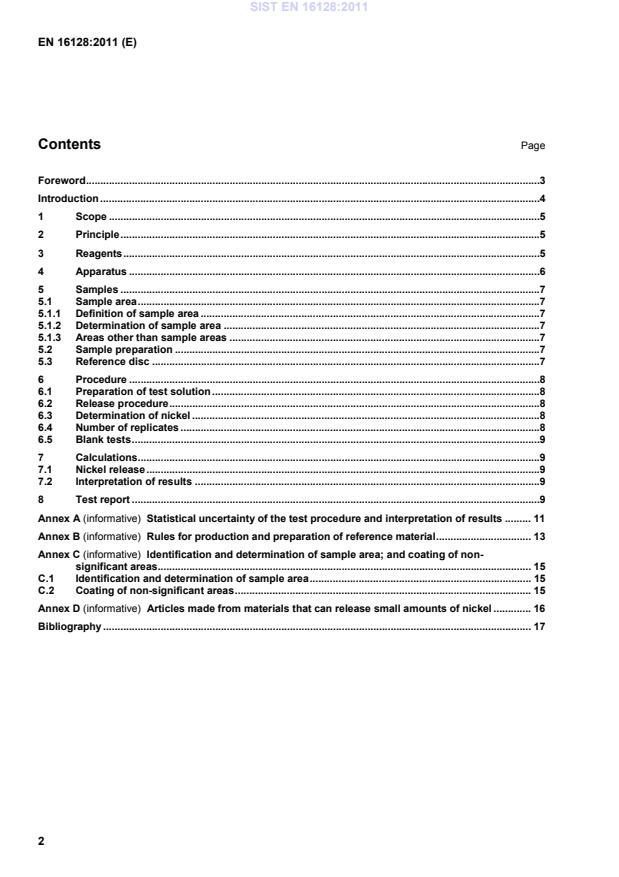
Statistical uncertainty of the test procedure and interpretation of results . 11Annex B (informative)
Rules for production and preparation of reference material . 13Annex C (informative)
Identification and determination of sample area; and coating of non-significant areas. 15C.1Identification and determination of sample area . 15C.2Coating of non-significant areas . 15Annex D (informative)
Articles made from materials that can release small amounts of nickel . 16Bibliography . 17 SIST EN 16128:2011
NOTE 2 Users of this European Standard may wish to note that, also in reply to the European Commission's Mandate M/448, this European Standard is currently subject to review with the objective of developing a new standardized method to supersede this European Standard when the new method becomes available. NOTE 3 Nickel release testing of products other than spectacle frames and sunglasses is specified in EN 1811:2011.
2 Principle The parts to be tested for nickel release are placed in an artificial sweat test solution for 1 week. The concentration of dissolved nickel in the solution is determined by atomic absorption spectrometry, inductively-coupled plasma spectrometry or other appropriate analytical method. The nickel release is expressed in micrograms per square centimetre per week (µg/cm2/week). 3 Reagents Except where indicated, all reagents shall be of recognized pro analysis, p.a., grade or better and shall be free of nickel. 3.1 Deionized and aerated water. Fill a tall-form 2-l beaker with deionized water, specific conductivity max. 1 µS/cm. Saturate with air by attaching a gas distribution tube (porosity 1) to a cork and positioning the lower end of the tube on the bottom of the beaker. Allow grease-free air to flow at a rate of 150 ml/min. for 30 min. 3.2 Sodium chloride. 3.3 DL-Lactic acid, ρ = 1,21 g/ml, >88 % (m/m). 3.4 Urea. 3.5 Ammonia solution, ρ = 0,91 g/ml, 25 % (m/m). 3.6 Dilute ammonia solution, 1 % (m/m). Transfer 10 ml of ammonia solution (3.5) into a 250-ml beaker containing 100 ml of deionized water. Stir and cool to room temperature. Transfer the solution to a 250-ml volumetric flask and make up to volume with deionized water. 3.7 Nitric acid, ρ = 1,40 g/ml, 65 % (m/m). 3.8 Dilute nitric acid, approximately 5 % (m/m). Transfer 30 ml of nitric acid (3.7) into a 500-ml beaker containing 350 ml of deionized water. Stir and cool to room temperature. Transfer the solution to a 500-ml volumetric flask and make up to volume with deionized water. SIST EN 16128:2011
NOTE If, when non-significant surfaces are considered to be part of the sample area, the nickel release from the frame is found to be unacceptable, consideration should be given to dismantling the frame and testing any internal components for nickel release. If the nickel release from such internal components is si
...