


EN ISO 10855-1:2024
(Main)Offshore containers and associated lifting sets - Part 1: Design, manufacture and marking of offshore containers (ISO 10855-1:2024)
General Information
- Abstract
This document specifies requirements for the design, manufacture and marking of offshore containers with a maximum gross mass not exceeding 25 000 kg, intended for repeated use to, from and between offshore installations and ships.
This document specifies only transport-related requirements.
- Status
- Published
- Publication Date
- 26-Nov-2024
- Current Stage
- 6060 - Definitive text made available (DAV) - Publishing
- Start Date
- 27-Nov-2024
- Completion Date
- 27-Nov-2024
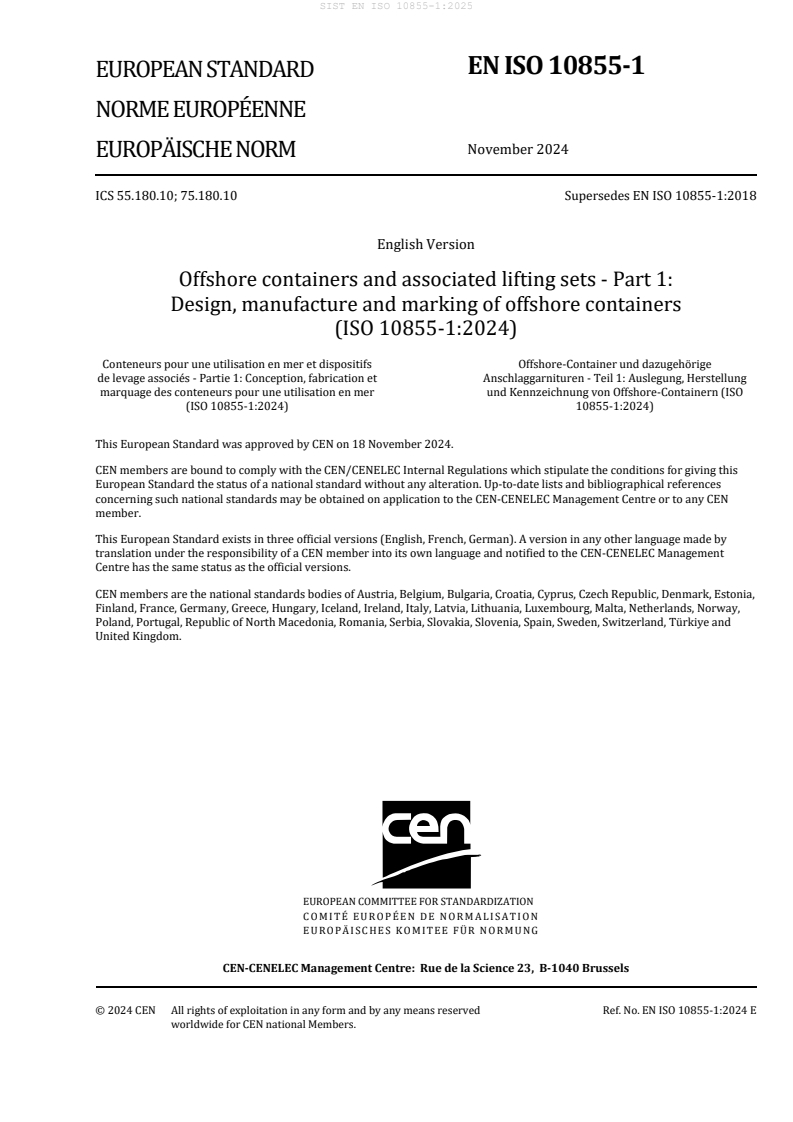
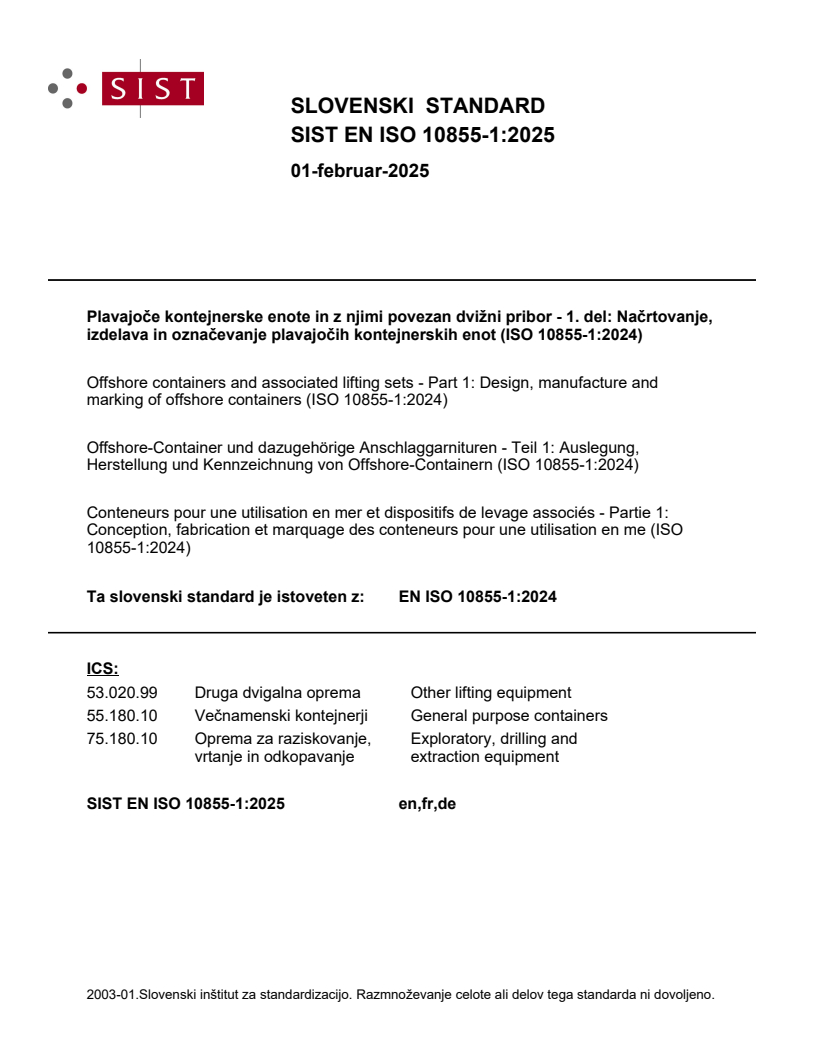

Overview
EN ISO 10855-1:2024 - "Offshore containers and associated lifting sets - Part 1: Design, manufacture and marking of offshore containers" - is a CEN-adopted international standard that specifies transport-related requirements for offshore containers with a maximum gross mass not exceeding 25 000 kg. It covers design, materials, production, testing and marking for containers intended for repeated use to, from and between offshore installations and ships. This edition supersedes EN ISO 10855-1:2018 and aligns the ISO text with European national implementation.
Key topics and technical requirements
The standard focuses on practical, safety-related aspects of offshore container design and manufacture:
- Scope, terms and symbols - definitions and notations used throughout the standard.
- Design requirements - structural strength, lifting loads, impact loads, internal forces and minimum material thicknesses.
- Specific design details - floors, doors/hatches, intermediate cargo decks, driving ramps, internal lashing points, forklift pockets, top protection, pad eyes and corner fittings.
- Materials - requirements for steels (including rolled/extruded steels, stainless steel, forgings and castings), aluminium and non‑metallic materials, plus material documentation.
- Welding and fabrication - welding qualifications, weld examination and production controls for primary and secondary structures.
- Type testing - lifting tests (including all-point and two‑point lifting), vertical impact tests and post-test inspections to verify structural integrity.
- Coating and corrosion protection - recommendations for durability in offshore environments.
- Specific container types - rules for tank containers and containers for bulk solids where applicable.
- Marking and documentation - required identification, safe working loads and traceability details for transport use.
Applications
EN ISO 10855-1:2024 is used wherever safe, repeatable transport of cargo to/from offshore installations is required:
- Offshore oil & gas platforms and supply vessels
- Offshore wind and marine renewable projects
- Marine logistics and vessel operators moving equipment, tools and supplies
- Manufacturers and fabricators of offshore containers and accessories
- Certification bodies and inspection authorities verifying compliance
Who should use this standard
- Design engineers and structural designers of offshore containers
- Fabrication shops and quality managers responsible for welding and production control
- Marine and offshore operators specifying container procurement and marking
- Third‑party inspectors, notified bodies and classification societies
Related standards
- Other parts of the ISO 10855 series and complementary offshore lifting and marine transport standards
- National maritime regulations and CEN-adopted standards for lifting equipment and cargo securing
Keywords: EN ISO 10855-1:2024, offshore containers, design, manufacture, marking, lifting tests, offshore transport standard, container certification.
Relations
- Effective Date
- 04-May-2022
- Effective Date
- 25-Aug-2026
- Effective Date
- 25-Aug-2026
- Effective Date
- 25-Aug-2026
- Effective Date
- 25-Aug-2026
- Effective Date
- 25-Aug-2026
- Effective Date
- 25-Aug-2026
- Effective Date
- 25-Aug-2026
- Effective Date
- 25-Aug-2026
- Effective Date
- 25-Aug-2026
- Refers
ISO 23278:2015 - Non-destructive testing of welds — Magnetic particle testing — Acceptance levels - Effective Date
- 25-Aug-2026
- Effective Date
- 25-Aug-2026
- Refers
ISO 1161:2016 - Series 1 freight containers — Corner and intermediate fittings — Specifications - Effective Date
- 25-Aug-2026
- Effective Date
- 25-Aug-2026
- Effective Date
- 25-Aug-2026
Get Certified
Connect with accredited certification bodies for this standard

Element Materials Technology
Materials testing and product certification.

ABS Group Brazil
ABS Group certification services in Brazil.

ABS Quality Evaluations Inc.
American Bureau of Shipping quality certification.
Sponsored listings
Frequently Asked Questions
EN ISO 10855-1:2024 is a standard published by the European Committee for Standardization (CEN). Its full title is "Offshore containers and associated lifting sets - Part 1: Design, manufacture and marking of offshore containers (ISO 10855-1:2024)". This standard covers: This document specifies requirements for the design, manufacture and marking of offshore containers with a maximum gross mass not exceeding 25 000 kg, intended for repeated use to, from and between offshore installations and ships. This document specifies only transport-related requirements.
This document specifies requirements for the design, manufacture and marking of offshore containers with a maximum gross mass not exceeding 25 000 kg, intended for repeated use to, from and between offshore installations and ships. This document specifies only transport-related requirements.
EN ISO 10855-1:2024 is classified under the following ICS (International Classification for Standards) categories: 55.180.10 - General purpose containers; 75.180.10 - Exploratory, drilling and extraction equipment. The ICS classification helps identify the subject area and facilitates finding related standards.
EN ISO 10855-1:2024 has the following relationships with other standards: It is inter standard links to EN ISO 10855-1:2018, ISO 15614-2:2005, ISO 1496-3:2019, ISO 11666:2018, ISO 15607:2019, ISO 10675-2:2021, ISO 23277:2015, ISO 148-1:2016, ISO 5817:2023, ISO 1496-1:2013, ISO 23278:2015, ISO 209:2007, ISO 1161:2016, ISO 15609-1:2019, ISO 17640:2018. Understanding these relationships helps ensure you are using the most current and applicable version of the standard.
EN ISO 10855-1:2024 is available in PDF format for immediate download after purchase. The document can be added to your cart and obtained through the secure checkout process. Digital delivery ensures instant access to the complete standard document.
Standards Content (Sample)
SLOVENSKI STANDARD
01-februar-2025
Plavajoče kontejnerske enote in z njimi povezan dvižni pribor - 1. del: Načrtovanje,
izdelava in označevanje plavajočih kontejnerskih enot (ISO 10855-1:2024)
Offshore containers and associated lifting sets - Part 1: Design, manufacture and
marking of offshore containers (ISO 10855-1:2024)
Offshore-Container und dazugehörige Anschlaggarnituren - Teil 1: Auslegung,
Herstellung und Kennzeichnung von Offshore-Containern (ISO 10855-1:2024)
Conteneurs pour une utilisation en mer et dispositifs de levage associés - Partie 1:
Conception, fabrication et marquage des conteneurs pour une utilisation en me (ISO
10855-1:2024)
Ta slovenski standard je istoveten z: EN ISO 10855-1:2024
ICS:
53.020.99 Druga dvigalna oprema Other lifting equipment
55.180.10 Večnamenski kontejnerji General purpose containers
75.180.10 Oprema za raziskovanje, Exploratory, drilling and
vrtanje in odkopavanje extraction equipment
2003-01.Slovenski inštitut za standardizacijo. Razmnoževanje celote ali delov tega standarda ni dovoljeno.
EN ISO 10855-1
EUROPEAN STANDARD
NORME EUROPÉENNE
November 2024
EUROPÄISCHE NORM
ICS 55.180.10; 75.180.10 Supersedes EN ISO 10855-1:2018
English Version
Offshore containers and associated lifting sets - Part 1:
Design, manufacture and marking of offshore containers
(ISO 10855-1:2024)
Conteneurs pour une utilisation en mer et dispositifs Offshore-Container und dazugehörige
de levage associés - Partie 1: Conception, fabrication et Anschlaggarnituren - Teil 1: Auslegung, Herstellung
marquage des conteneurs pour une utilisation en mer und Kennzeichnung von Offshore-Containern (ISO
(ISO 10855-1:2024) 10855-1:2024)
This European Standard was approved by CEN on 18 November 2024.
CEN members are bound to comply with the CEN/CENELEC Internal Regulations which stipulate the conditions for giving this
European Standard the status of a national standard without any alteration. Up-to-date lists and bibliographical references
concerning such national standards may be obtained on application to the CEN-CENELEC Management Centre or to any CEN
member.
This European Standard exists in three official versions (English, French, German). A version in any other language made by
translation under the responsibility of a CEN member into its own language and notified to the CEN-CENELEC Management
Centre has the same status as the official versions.
CEN members are the national standards bodies of Austria, Belgium, Bulgaria, Croatia, Cyprus, Czech Republic, Denmark, Estonia,
Finland, France, Germany, Greece, Hungary, Iceland, Ireland, Italy, Latvia, Lithuania, Luxembourg, Malta, Netherlands, Norway,
Poland, Portugal, Republic of North Macedonia, Romania, Serbia, Slovakia, Slovenia, Spain, Sweden, Switzerland, Türkiye and
United Kingdom.
EUROPEAN COMMITTEE FOR STANDARDIZATION
COMITÉ EUROPÉEN DE NORMALISATION
EUROPÄISCHES KOMITEE FÜR NORMUNG
CEN-CENELEC Management Centre: Rue de la Science 23, B-1040 Brussels
© 2024 CEN All rights of exploitation in any form and by any means reserved Ref. No. EN ISO 10855-1:2024 E
worldwide for CEN national Members.
Contents Page
European foreword . 3
European foreword
This document (EN ISO 10855-1:2024) has been prepared by Technical Committee ISO/TC 67 "Oil and
gas industries including lower carbon energy" in collaboration with Technical Committee CEN/TC 12
“Oil and gas industries including lower carbon energy” the secretariat of which is held by NEN.
This European Standard shall be given the status of a national standard, either by publication of an
identical text or by endorsement, at the latest by May 2025, and conflicting national standards shall be
withdrawn at the latest by May 2025.
Attention is drawn to the possibility that some of the elements of this document may be the subject of
patent rights. CEN shall not be held responsible for identifying any or all such patent rights.
This document supersedes EN ISO 10855-1:2018.
Any feedback and questions on this document should be directed to the users’ national standards
body/national committee. A complete listing of these bodies can be found on the CEN website.
According to the CEN-CENELEC Internal Regulations, the national standards organizations of the
following countries are bound to implement this European Standard: Austria, Belgium, Bulgaria,
Croatia, Cyprus, Czech Republic, Denmark, Estonia, Finland, France, Germany, Greece, Hungary, Iceland,
Ireland, Italy, Latvia, Lithuania, Luxembourg, Malta, Netherlands, Norway, Poland, Portugal, Republic of
North Macedonia, Romania, Serbia, Slovakia, Slovenia, Spain, Sweden, Switzerland, Türkiye and the
United Kingdom.
Endorsement notice
The text of ISO 10855-1:2024 has been approved by CEN as EN ISO 10855-1:2024 without any
modification.
International
Standard
ISO 10855-1
Second edition
Offshore containers and associated
2024-11
lifting sets —
Part 1:
Design, manufacture and marking
of offshore containers
Conteneurs pour une utilisation en mer et dispositifs de levage
associés —
Partie 1: Conception, fabrication et marquage des conteneurs
pour une utilisation en mer
Reference number
ISO 10855-1:2024(en) © ISO 2024
ISO 10855-1:2024(en)
© ISO 2024
All rights reserved. Unless otherwise specified, or required in the context of its implementation, no part of this publication may
be reproduced or utilized otherwise in any form or by any means, electronic or mechanical, including photocopying, or posting on
the internet or an intranet, without prior written permission. Permission can be requested from either ISO at the address below
or ISO’s member body in the country of the requester.
ISO copyright office
CP 401 • Ch. de Blandonnet 8
CH-1214 Vernier, Geneva
Phone: +41 22 749 01 11
Email: copyright@iso.org
Website: www.iso.org
Published in Switzerland
ii
ISO 10855-1:2024(en)
Contents Page
Foreword .v
Introduction .vi
1 Scope . 1
2 Normative references . 1
3 Terms and definitions . 3
4 Symbols . 5
5 Design . 5
5.1 General .5
5.2 Structural strength .6
5.2.1 General .6
5.2.2 Lifting loads .6
5.2.3 Impact loads .8
5.2.4 Internal forces on container walls .9
5.2.5 Minimum material thickness .9
5.3 Welding . .9
5.4 Additional design details .9
5.4.1 Floor . .9
5.4.2 Doors and hatches .9
5.4.3 Intermediate cargo decks .9
5.4.4 Driving ramps .10
5.4.5 Internal lashing points .10
5.4.6 Forklift pockets .10
5.4.7 Top protection .10
5.4.8 Pad eyes .11
5.4.9 Corner fittings .11
5.4.10 Equipment supports and protection. 12
5.4.11 Coating and corrosion protection . 12
5.5 Tank containers . 12
5.5.1 General . 12
5.5.2 Frame . 12
5.5.3 Tanks for fluids . 13
5.5.4 Impact protection on tank containers for dangerous cargoes . 13
5.6 Containers for bulk solids . 13
6 Materials .13
6.1 Steel — General . 13
6.2 Rolled and extruded steels in offshore container structures .14
6.2.1 General requirements .14
6.2.2 Groups of steels .14
6.2.3 Stainless steel . 15
6.2.4 Steel forgings . 15
6.2.5 Steel castings in corner fittings . 15
6.3 Aluminium .16
6.4 Non-metallic materials .17
6.5 Material documents .17
7 Type testing . 17
7.1 General .17
7.2 Test equipment and calibration .18
7.2.1 Test mass or test load .18
7.2.2 Calibration . . .18
7.3 Lifting test .18
7.3.1 General .18
7.3.2 All-point lifting . .18
iii
ISO 10855-1:2024(en)
7.3.3 Two-point lifting .18
7.3.4 Post-lifting test inspection and examination .19
7.4 Vertical impact test.19
7.5 Other tests .19
8 Production .20
8.1 General . 20
8.2 Primary structure . 20
8.2.1 General . 20
8.2.2 Approved welders. 20
8.2.3 Examination of welds . 20
8.3 Secondary structure .21
8.4 Production testing . 22
8.4.1 Lifting test . 22
8.4.2 Weather proofness testing . 22
8.5 Failure of production containers . 22
9 Marking . .23
9.1 Safety marking . 23
9.2 Identification markings . 23
9.3 Information markings . 23
9.4 Other markings .24
10 Container data plate .24
10.1 General .24
10.2 Contents of data plate .24
11 Certificate of conformity .25
11.1 General . 25
11.2 Documentation . 25
11.3 Contents of the certificate of conformity . 26
Annex A (informative) Regulations for offshore containers .27
Bibliography .29
iv
ISO 10855-1:2024(en)
Foreword
ISO (the International Organization for Standardization) is a worldwide federation of national standards
bodies (ISO member bodies). The work of preparing International Standards is normally carried out through
ISO technical committees. Each member body interested in a subject for which a technical committee
has been established has the right to be represented on that committee. International organizations,
governmental and non-governmental, in liaison with ISO, also take part in the work. ISO collaborates closely
with the International Electrotechnical Commission (IEC) on all matters of electrotechnical standardization.
The procedures used to develop this document and those intended for its further maintenance are described
in the ISO/IEC Directives, Part 1. In particular, the different approval criteria needed for the different types
of ISO document should be noted. This document was drafted in accordance with the editorial rules of the
ISO/IEC Directives, Part 2 (see www.iso.org/directives).
ISO draws attention to the possibility that the implementation of this document may involve the use of (a)
patent(s). ISO takes no position concerning the evidence, validity or applicability of any claimed patent
rights in respect thereof. As of the date of publication of this document, ISO had not received notice of (a)
patent(s) which may be required to implement this document. However, implementers are cautioned that
this may not represent the latest information, which may be obtained from the patent database available at
www.iso.org/patents. ISO shall not be held responsible for identifying any or all such patent rights.
Any trade name used in this document is information given for the convenience of users and does not
constitute an endorsement.
For an explanation of the voluntary nature of standards, the meaning of ISO specific terms and expressions
related to conformity assessment, as well as information about ISO's adherence to the World Trade
Organization (WTO) principles in the Technical Barriers to Trade (TBT), see www.iso.org/iso/foreword.html.
This document was prepared by Technical Committee ISO/TC 67, Oil and gas industries including lower
carbon energy, Subcommittee SC 7, Offshore structures, in collaboration with the European Committee for
Standardization (CEN) Technical Committee CEN/TC 12, Oil and gas industries including lower carbon energy,
in accordance with the Agreement on technical cooperation between ISO and CEN (Vienna Agreement).
This second edition cancels and replaces the first edition (ISO 10855-1:2018), which has been technically
revised.
The main changes are as follows:
— definitions have been updated.
A list of all parts in the ISO 10855 series can be found on the ISO website.
Any feedback or questions on this document should be directed to the user’s national standards body. A
complete listing of these bodies can be found at www.iso.org/members.html.
v
ISO 10855-1:2024(en)
Introduction
The ISO 10855 series meets the requirements of IMO MSC/Circ.860 (1998) for the design, construction,
inspection, testing and in-service examination of offshore containers and associated lifting sets which are
handled in open seas.
The ISO 10855 series does not cover operational use or maintenance.
Under conditions in which offshore containers are often transported and handled, the 'normal' rate of wear
and tear is high, and damage necessitating repair can occur. However, containers designed, manufactured
and periodically inspected according to the ISO 10855 series have sufficient strength to withstand the
normal forces encountered in offshore operations and to not suffer from complete failure even if subject to
extreme loads.
vi
International Standard ISO 10855-1:2024(en)
Offshore containers and associated lifting sets —
Part 1:
Design, manufacture and marking of offshore containers
1 Scope
This document specifies requirements for the design, manufacture and marking of offshore containers with
a maximum gross mass not exceeding 25 000 kg, intended for repeated use to, from and between offshore
installations and ships.
This document specifies only transport-related requirements.
2 Normative references
The following documents are referred to in the text in such a way that some or all of their content constitutes
requirements of this document. For dated references, only the edition cited applies. For undated references,
the latest edition of the referenced document (including any amendments) applies.
ISO 148-1, Metallic materials — Charpy pendulum impact test — Part 1: Test method
ISO 209, Aluminium and aluminium alloys — Chemical composition
ISO 1161, Series 1 freight containers — Corner and intermediate fittings — Specifications
ISO 1496-1, Series 1 freight containers — Specification and testing — Part 1: General cargo containers for
general purposes
ISO 1496-3:2019, Series 1 freight containers — Specification and testing — Part 3: Tank containers for liquids,
gases and pressurized dry bulk
ISO 1496-4:2023, Series 1 freight containers — Specification and testing — Part 4: Non-pressurized containers
for dry bulk
ISO 3452-1, Non-destructive testing — Penetrant testing — Part 1: General principles
ISO 5817, Welding — Fusion-welded joints in steel, nickel, titanium and their alloys (beam welding excluded) —
Quality levels for imperfections
ISO 6892-1, Metallic materials — Tensile testing — Part 1: Method of test at room temperature
ISO 7500-1, Metallic materials — Calibration and verification of static uniaxial testing machines — Part 1:
Tension/compression testing machines — Calibration and verification of the force-measuring system
ISO 9606-1, Qualification testing of welders — Fusion welding — Part 1: Steels
ISO 9606-2, Qualification test of welders — Fusion welding — Part 2: Aluminium and aluminium alloys
ISO 9712, Non-destructive testing — Qualification and certification of NDT personnel
ISO 10042, Welding — Arc-welded joints in aluminium and its alloys — Quality levels for imperfections
ISO 10474, Steel and steel products — Inspection documents
ISO 10855-1:2024(en)
ISO 10675-1, Non-destructive testing of welds — Acceptance levels for radiographic testing — Part 1: Steel,
nickel, titanium and their alloys
ISO 10675-2, Non-destructive testing of welds — Acceptance levels for radiographic testing — Part 2: Aluminium
and its alloys
ISO 11666, Non-destructive testing of welds — Ultrasonic testing — Acceptance levels
ISO 15607, Specification and qualification of welding procedures for metallic materials — General rules
ISO 15609-1, Specification and qualification of welding procedures for metallic materials — Welding procedure
specification — Part 1: Arc welding
ISO 15614-1, Specification and qualification of welding procedures for metallic materials — Welding procedure
test — Part 1: Arc and gas welding of steels and arc welding of nickel and nickel alloys
ISO 15614-2, Specification and qualification of welding procedures for metallic materials — Welding procedure
test — Part 2: Arc welding of aluminium and its alloys
ISO 17636-1, Non-destructive testing of welds — Radiographic testing — Part 1: X- and gamma-ray techniques
with film
ISO 17636-2, Non-destructive testing of welds — Radiographic testing — Part 2: X- and gamma-ray techniques
with digital detectors
ISO 17637, Non-destructive testing of welds — Visual testing of fusion-welded joints
ISO 17638, Non-destructive testing of welds — Magnetic particle testing
ISO 17640, Non-destructive testing of welds — Ultrasonic testing — Techniques, testing levels, and assessment
ISO 23277, Non-destructive testing of welds — Penetrant testing — Acceptance levels
ISO 23278, Non-destructive testing of welds — Magnetic particle testing — Acceptance levels
EN 10025-1, Hot rolled products of structural steels — Part 1: General technical delivery conditions
EN 10025-2, Hot rolled products of structural steels — Part 2: Technical delivery conditions for non-alloy
structural steels
EN 10025-3, Hot rolled products of structural steels — Part 3: Technical delivery conditions for normalized/
normalized rolled weldable fine grain structural steels
EN 10025-4, Hot rolled products of structural steels — Part 4: Technical delivery conditions for thermomechanical
rolled weldable fine grain structural steels
EN 10088-2, Stainless steels — Part 2: Technical delivery conditions for sheet/plate and strip of corrosion
resisting steels for general purposes
EN 10164, Steel products with improved deformation properties perpendicular to the surface of the product —
Technical delivery conditions
EN 10210-1, Hot finished structural hollow sections of non-alloy and fine grain structural steels — Part 1:
Technical delivery requirements
EN 10219-1, Cold formed welded structural hollow sections of non-alloy and fine grain steels — Part 1: Technical
delivery requirements
EN 10250-2, Open die steel forgings for general engineering purposes — Part 2: Non-alloy quality and special steels
EN 10250-3, Open die steel forgings for general engineering purposes — Part 3: Alloy special steels
ISO 10855-1:2024(en)
3 Terms and definitions
For the purposes of this document, the following terms and definitions apply.
ISO and IEC maintain terminology databases for use in standardization at the following addresses:
— ISO Online browsing platform: available at https:// www .iso .org/ obp
— IEC Electropedia: available at https:// www .electropedia .org/
3.1
offshore container
portable unit for repeated use in the transport of goods or equipment handled in open seas to, from and
between fixed and/or floating installations and ships
EXAMPLE
— general cargo container: closed container with doors;
— cargo basket: open top container for general or special cargo;
— tank container: container for the transport of dangerous or non-dangerous fluids (other types of tanks,
e.g. processing plants, storage tanks, that are empty during transport, are considered to be service
equipment, and are not covered by this document);
— bulk container: container for the transport of solids in bulk;
— service container: built and equipped for a special service task, usually as a temporary installation e.g.
laboratories, workshops, stores, power plants, control stations, accommodation, engine, compressor,
generator;
— special container: frame or skid for the transport of special cargo e.g. garbage containers, equipment
boxes, gas cylinder racks, IBC (intermediate bulk container) frame.
— offshore waste skip: open or closed offshore container used for the storage and removal of waste.
Note 1 to entry: For the purposes of this document, the maximum gross mass of offshore containers shall not exceed
25 000 kg.
Note 2 to entry: The unit incorporates permanently installed equipment for lifting and handling and can include
equipment for filling, emptying, cooling, heating, etc.
Note 3 to entry: Offshore waste skips are normally constructed from flat steel plates forming the load bearing sections
of the container, with bracing in the form of steel profiles (e.g. channel or hollow section) being fitted horizontally
and/or vertically around sides and ends. In addition to the pad eyes for the lifting set (3.7), these containers can have
side-mounted lugs suitable for use with the lifting equipment mounted on a skip lift vehicle.
3.2
permanent equipment
equipment that is permanently attached to the container and which is not cargo
EXAMPLE Lifting sets (3.7), refrigeration units, shelves, lashing points, garbage compactors.
3.3
primary structure
load-carrying and supporting frames and load-carrying panels
Note 1 to entry: Primary structure is divided into two subgroups (see 3.3.1 and 3.3.2).
ISO 10855-1:2024(en)
3.3.1
essential primary structure
structural elements which transfer the cargo load to the crane hook, forming the load path from the payload
to the lifting set and is non-redundant
EXAMPLE
— top and bottom side rails;
— top and bottom end rails;
— corner posts;
— pad eyes;
— fork pockets.
3.3.2
non-essential primary structure
structural elements whose main function is not essential and can be redundant
EXAMPLE Floor plates and protective frame members.
Note 1 to entry: Side and roof panels, including corrugated panels, are not considered to be part of the primary
structure (3.3).
3.4
secondary structure
parts which are not considered as load carrying for the purposes of the design calculations, including at
least the following components:
— doors, wall and roof panels;
— panel stiffeners and corrugations;
— structural components used for tank protection only;
— internal lashing points
Note 1 to entry: Not all container walls are corrugated.
3.5
prototype
equipment item, used for type testing, considered to be representative of the product for which conformity
is being assessed
Note 1 to entry: It may be either fabricated especially for type testing or selected at random from a production series.
3.6
owner
legal owner of the offshore container (3.1) or the delegated nominee of that body
3.7
lifting set
items of integrated lifting equipment used to connect the offshore container (3.1) to the lifting appliance
3.8
sling
one leg of a lifting set
ISO 10855-1:2024(en)
3.9
visual examination
examination which uses the human eye as a detector
Note 1 to entry: For the purposes of this document, visual examination shall be in accordance with ISO 17637.
[SOURCE: ISO 9022-1:2016, 2.9.1, modified — Note 1 to entry has been added.]
3.10
non-combustible material
material that does not burn or give off flammable vapours in sufficient quantity for self-ignition when heated
to 750 °C
4 Symbols
m rating, i.e. the maximum gross mass of the container including permanent equipment and its cargo,
R
in kg, but excluding the lifting set
m tare mass, i.e. the mass of an empty container including any permanent equipment but excluding
T
cargo and lifting set, in kg
m payload, i.e. the maximum permissible mass of cargo which may be safely transported by the
P
container, in kg
NOTE 1 m = m − m .
P R T
NOTE 2 m , m and m are expressed in kg. Where design requirements are based on the gravitational forces
R T P
derived from these values, those forces are indicated thus as m g m g and m g, expressed in N.
R T P
m mass of the lifting set, in kg
S
T design air temperature, i.e. a minimum reference temperature used for the selection of steel grades
D
used in offshore containers and equipment, expressed in °C
σ von Mises equivalent stress, expressed in MPa or N/mm
e
R specified minimum yield stress, expressed in MPa or N/mm
e
5 Design
5.1 General
5.1.1 An offshore container shall be designed to allow loading and unloading from supply vessels operating
offshore in a sea state with wave heights of 6 m.
NOTE Local impacts, e.g. from hitting other deck cargo or rigid parts of the ship structure, can cause extreme
loads in such conditions.
5.1.2 To prevent the containers from overturning (tipping) on a moving deck, they shall be designed to
withstand tilting at 30° in any direction, without overturning when loaded at their maximum gross mass, in
empty condition or any intermediate condition, and with the centre of gravity considered to be at the half
height of the container. For dedicated-purpose containers (e.g. bottle racks and tank containers), the actual
centre of gravity shall be used.
5.1.3 Protruding parts on the outside of the offshore container that can snag on other containers or
structures shall be avoided. Protruding parts (e.g. doors handles, hatch cleats) shall be so placed or so
protected that they do not catch the lifting set.
ISO 10855-1:2024(en)
5.1.4 Stacking fittings and guides and other structures that protrude above the top of the container frame
shall be designed and located to minimize the potential to catch on structures on the ship or on other deck
cargoes during lifting operations. They shall be designed such that the risk of damage to other containers or
cargoes from these is minimized. They shall also be designed such that damage to the stacking fittings does
not cause damage to the pad eyes.
Particular attention should be given to avoiding the risk of catching. Protrusions such as stacking guides can
catch in openings in the bulwarks of supply vessels.
Such risks can be reduced by suitable designs.
5.1.5 If containers are designed for stacking, the corners or stacking fittings shall be sufficiently raised
above the frame and roof to prevent damage to the lifting set.
NOTE Parts of the permanently attached lifting sets often hang over the side of the top frame.
5.1.6 Containers shall be designed as structural frames (primary structure), with non-load bearing
cladding where necessary (secondary structure). Only the primary structure shall be considered in the
design calculations; however, on certain types of containers, with only a non-stressed cover above the
bracing where the pad eyes are attached, the whole structure may be considered as a primary structure,
and the design calculations may treat such a container as a monocoque construction.
EXAMPLE Waste skips with trapezium shaped sides are examples of containers with only a non-stressed cover
over the bracing where the pad eyes are attached.
5.1.7 T shall not be higher than the (statistically) lowest daily mean temperature for the area where the
D
offshore container is to operate and shall not be higher than −20 °C.
For containers with exposed aluminium, the danger of sparks caused by the impact of aluminium against
corroded steel (the thermite reaction) shall be considered.
When preparing the specification for a service container, a rating higher than the estimated fitted out
mass should be chosen. This allows for changes in the amount and mass of equipment fitted in a container
during its operational life, and it can also be useful to be able to carry a certain amount of non-permanent
equipment.
NOTE For containers with special features, additional regulatory design requirements can apply; see Annex A.
5.2 Structural strength
5.2.1 General
The required strength of a container shall be determined by calculation and verified by type tests, as
specified in Clause 7.
5.2.2 Lifting loads
5.2.2.1 Allowable stresses
For design loads defined in 5.2.2.2 and 5.2.2.3, the equivalent stress level, σ , shall not exceed the figure
e
calculated as:
σ = 0,85C
e
ISO 10855-1:2024(en)
where
for steel: C = R
e
for aluminium: base material C = R
0,2
heat-affected zone C = 0,7 βR
m
where
R is the tensile strength of aluminium;
m
β is 0,8 for ISO AlMg4,5Mn-HAR/AA5083-H32;
β is 0,7 for all other aluminium alloys and tempers.
Aluminium alloys shall be in accordance with Table 4.
5.2.2.2 Lifting with lifting set
The design force on the primary structure shall be calculated as 2,5 m g where g is the acceleration due to
R
gravity (in m/s , i.e. 9,806 65).
The internal loading shall be taken as (2,5 m − m ) g evenly distributed over the container floor. For tank
R T
containers, the actual distribution of the tare mass shall be used for the calculations.
Pad eyes shall be designed for a total vertical force of 3 m g.
R
The force shall be considered to be evenly distributed between (n − 1) pad eyes. For calculation purposes n
shall not exceed 4 or be less than 2.
To determine the resulting sling force on the pad eyes, the sling angle shall be considered, so that the
resulting sling force on each pad eye is calculated as follows:
3mg
R
F =
n−1 cosθ
()
where
F is the resulting sling force, in newtons (N);
n is the actual number of pad eyes (for calculation purposes n shall not exceed 4 and shall be not less
than 2);
θ is the angle between a sling leg and the vertical, in degrees and shall be assumed to be 45° unless
otherwise specified.
For containers with only one pad eye, that pad eye shall be designed for a total vertical force of 5 m g.
R
Containers without a roof can have insufficient strength and stiffness to pass the two-point liftin
...