


EN 12186:2025
(Main)Gas infrastructure - Gas pressure control stations for transmission and distribution - Functional requirements
General Information
- Abstract
This document specifies the functional requirements relevant for design, materials, construction, testing, operation and maintenance of gas pressure control stations to ensure their reliability in terms of safety of the station itself and the downstream system and continuity of service.
This document is applicable for gas pressure control stations which are part of gas transmission or distribution systems for hydrogen, and hydrogen rich, and methane rich gases. Additional requirements in the case of gases heavier than air and/or toxic or corrosive gases are not covered by this document.
This document does not apply to gas pressure control stations in operation prior to the publication of this document. However, Annex D of this document can be used as guidance for the evaluation of stations in operation prior to the publication of this document, regarding the change of the type of gas, e.g. repurposing for the use with hydrogen.
The stations covered by this document have a maximum upstream operating pressure, which does not exceed 100 bar. For higher maximum upstream operating pressures, this document can be used as a guideline.
If the inlet pipework of the station is a service line and the maximum upstream operating pressure does not exceed 16 bar and the design flow rate is equal to 2000 kW based on the gross calorific value or less, EN 12279 applies.
This document contains the basic system requirements for gas pressure control stations. Requirements for individual components (valves, regulators, safety devices, pipes, etc.) or installation of the components are contained in the appropriate European Standards.
NOTE For combined control and measuring stations, the additional requirements of EN 1776 can apply.
The requirements in this document do not apply to the design and construction of auxiliary facilities such as sampling, calorimetering, odorization systems and density measuring. These facilities are covered by the appropriate European Standards, where existing, or applicable national standards.
The requirements of this document are based on good gas engineering practice under conditions normally encountered in the gas industry. Requirements for unusual conditions cannot be specifically provided for, nor are all engineering and construction details prescribed.
The objective of this document is to ensure the safe operation of such stations. This does not, however, relieve all concerned of the responsibility for taking the necessary care and applying effective quality and safety management during the design, construction, operation and maintenance.
- Status
- Published
- Publication Date
- 09-Dec-2025
- Technical Committee
- CEN/TC 234 - Gas infrastructure
- Drafting Committee
- CEN/TC 234/WG 6 - Gas Regulation
- Current Stage
- 6060 - Definitive text made available (DAV) - Publishing
- Start Date
- 10-Dec-2025
- Due Date
- 01-Aug-2026
- Completion Date
- 10-Dec-2025

Overview
EN 12186:2025 - published by CEN - defines the functional requirements for gas pressure control stations used in transmission and distribution systems. The standard addresses design, materials, construction, testing, operation and maintenance to ensure safety, continuity of service and protection of downstream systems. It applies to stations handling hydrogen, hydrogen‑rich and methane‑rich gases with a maximum upstream operating pressure up to 100 bar (and can be used as a guideline for higher pressures). Gases that are heavier than air, toxic or corrosive are excluded. Note: stations in operation prior to publication are outside the scope, although Annex D provides guidance for evaluating repurposing (e.g., conversion to hydrogen).
Key Topics and Requirements
This document focuses on system‑level, functional requirements rather than detailed component specifications. Major topics include:
- Quality and safety management systems for station lifecycle
- Environmental interaction: waste, greenhouse gas emissions, climate adaptation and seismic considerations
- Layout, site security and housings (including underground and buried vessel types)
- Station design: continuity of supply, filters/separators, pre‑heating, noise mitigation
- Pressure control requirements: pressure regulating systems, pressure safety systems, safety shut‑off devices, monitors and venting
- Instrumentation, bypasses and pipework (welding, stress analysis, supports, flexibility)
- Testing, commissioning, reporting and documented acceptance
- Operation & maintenance: documentation, maintenance regimes, training and firefighting
- Decommissioning and disposal
- Smart technologies, information security and cyber‑security for control/monitoring systems
- Cathodic protection, earthing, electromagnetic compatibility
The standard references component and installation standards for valves, regulators, safety devices and measuring equipment rather than prescribing those details.
Practical Applications - Who Uses It
EN 12186:2025 is intended for:
- Gas network designers and engineering firms (EPCs)
- Transmission and distribution asset owners/operators
- Station manufacturers and integrators
- Maintenance and operations teams
- Regulators and safety auditors assessing station functional safety
- Organizations repurposing infrastructure for hydrogen use (see Annex D for guidance)
Use cases: specifying requirements for new pressure control stations, designing upgrades for hydrogen blending/repurposing, developing operational procedures, and preparing commissioning/test plans.
Related Standards
- EN 12279 (applies where inlet service line ≤16 bar and design flow ≤2000 kW)
- EN 1776 (additional requirements for combined control and measuring stations)
- Relevant EN/component standards for valves, regulators, safety devices, odorization, calorimetry and instrumentation
Keywords: EN 12186:2025, gas pressure control stations, gas infrastructure, functional requirements, hydrogen, transmission and distribution, pressure safety system, CEN.
Relations
- Effective Date
- 08-Apr-2024
- Effective Date
- 09-Feb-2026
- Effective Date
- 09-Feb-2026
- Effective Date
- 09-Feb-2026
- Effective Date
- 09-Feb-2026
- Effective Date
- 09-Feb-2026
- Effective Date
- 09-Feb-2026
- Effective Date
- 09-Feb-2026
- Effective Date
- 09-Feb-2026
- Effective Date
- 09-Feb-2026
- Effective Date
- 09-Feb-2026
- Effective Date
- 28-Jan-2026
- Effective Date
- 28-Jan-2026
- Effective Date
- 28-Jan-2026
- Effective Date
- 28-Jan-2026
Get Certified
Connect with accredited certification bodies for this standard

DNV
DNV is an independent assurance and risk management provider.

Lloyd's Register
Lloyd's Register is a global professional services organisation specialising in engineering and technology.
DNV Energy Systems
Energy and renewable energy certification.
Sponsored listings
Frequently Asked Questions
EN 12186:2025 is a standard published by the European Committee for Standardization (CEN). Its full title is "Gas infrastructure - Gas pressure control stations for transmission and distribution - Functional requirements". This standard covers: This document specifies the functional requirements relevant for design, materials, construction, testing, operation and maintenance of gas pressure control stations to ensure their reliability in terms of safety of the station itself and the downstream system and continuity of service. This document is applicable for gas pressure control stations which are part of gas transmission or distribution systems for hydrogen, and hydrogen rich, and methane rich gases. Additional requirements in the case of gases heavier than air and/or toxic or corrosive gases are not covered by this document. This document does not apply to gas pressure control stations in operation prior to the publication of this document. However, Annex D of this document can be used as guidance for the evaluation of stations in operation prior to the publication of this document, regarding the change of the type of gas, e.g. repurposing for the use with hydrogen. The stations covered by this document have a maximum upstream operating pressure, which does not exceed 100 bar. For higher maximum upstream operating pressures, this document can be used as a guideline. If the inlet pipework of the station is a service line and the maximum upstream operating pressure does not exceed 16 bar and the design flow rate is equal to 2000 kW based on the gross calorific value or less, EN 12279 applies. This document contains the basic system requirements for gas pressure control stations. Requirements for individual components (valves, regulators, safety devices, pipes, etc.) or installation of the components are contained in the appropriate European Standards. NOTE For combined control and measuring stations, the additional requirements of EN 1776 can apply. The requirements in this document do not apply to the design and construction of auxiliary facilities such as sampling, calorimetering, odorization systems and density measuring. These facilities are covered by the appropriate European Standards, where existing, or applicable national standards. The requirements of this document are based on good gas engineering practice under conditions normally encountered in the gas industry. Requirements for unusual conditions cannot be specifically provided for, nor are all engineering and construction details prescribed. The objective of this document is to ensure the safe operation of such stations. This does not, however, relieve all concerned of the responsibility for taking the necessary care and applying effective quality and safety management during the design, construction, operation and maintenance.
This document specifies the functional requirements relevant for design, materials, construction, testing, operation and maintenance of gas pressure control stations to ensure their reliability in terms of safety of the station itself and the downstream system and continuity of service. This document is applicable for gas pressure control stations which are part of gas transmission or distribution systems for hydrogen, and hydrogen rich, and methane rich gases. Additional requirements in the case of gases heavier than air and/or toxic or corrosive gases are not covered by this document. This document does not apply to gas pressure control stations in operation prior to the publication of this document. However, Annex D of this document can be used as guidance for the evaluation of stations in operation prior to the publication of this document, regarding the change of the type of gas, e.g. repurposing for the use with hydrogen. The stations covered by this document have a maximum upstream operating pressure, which does not exceed 100 bar. For higher maximum upstream operating pressures, this document can be used as a guideline. If the inlet pipework of the station is a service line and the maximum upstream operating pressure does not exceed 16 bar and the design flow rate is equal to 2000 kW based on the gross calorific value or less, EN 12279 applies. This document contains the basic system requirements for gas pressure control stations. Requirements for individual components (valves, regulators, safety devices, pipes, etc.) or installation of the components are contained in the appropriate European Standards. NOTE For combined control and measuring stations, the additional requirements of EN 1776 can apply. The requirements in this document do not apply to the design and construction of auxiliary facilities such as sampling, calorimetering, odorization systems and density measuring. These facilities are covered by the appropriate European Standards, where existing, or applicable national standards. The requirements of this document are based on good gas engineering practice under conditions normally encountered in the gas industry. Requirements for unusual conditions cannot be specifically provided for, nor are all engineering and construction details prescribed. The objective of this document is to ensure the safe operation of such stations. This does not, however, relieve all concerned of the responsibility for taking the necessary care and applying effective quality and safety management during the design, construction, operation and maintenance.
EN 12186:2025 is classified under the following ICS (International Classification for Standards) categories: 23.060.40 - Pressure regulators; 27.060.20 - Gas fuel burners; 75.200 - Petroleum products and natural gas handling equipment. The ICS classification helps identify the subject area and facilitates finding related standards.
EN 12186:2025 has the following relationships with other standards: It is inter standard links to EN 12186:2014, EN IEC 61340-5-1:2024, EN IEC 62443-3-3:2019, EN IEC 60079-10-1:2021, EN IEC 60079-14:2024, EN IEC 61000-6-4:2019, EN IEC 62443-3-2:2020, EN IEC 62443-4-1:2018, EN IEC 62443-2-1:2024, EN IEC 62443-4-2:2019, EN IEC 62443-2-4:2024, EN 12327:2012, EN ISO 4126-1:2013, EN 12007-3:2015, EN ISO 4126-5:2013. Understanding these relationships helps ensure you are using the most current and applicable version of the standard.
EN 12186:2025 is associated with the following European legislation: Standardization Mandates: M/017. When a standard is cited in the Official Journal of the European Union, products manufactured in conformity with it benefit from a presumption of conformity with the essential requirements of the corresponding EU directive or regulation.
EN 12186:2025 is available in PDF format for immediate download after purchase. The document can be added to your cart and obtained through the secure checkout process. Digital delivery ensures instant access to the complete standard document.
Standards Content (Sample)
SLOVENSKI STANDARD
01-maj-2026
Nadomešča:
SIST EN 12186:2015
Infrastruktura za plin - Plinske postaje za regulacijo tlaka za prenos in distribucijo -
Funkcionalne zahteve
Gas infrastructure - Gas pressure control stations for transmission and distribution -
Functional requirements
Gasinfrastruktur - Gas-Druckregelanlagen für Transport und Verteilung - Funktionale
Anforderungen
Infrastructures gazières - Postes de détente régulation de pression de gaz pour le
transport et la distribution - Prescriptions fonctionnelles
Ta slovenski standard je istoveten z: EN 12186:2025
ICS:
23.060.40 Tlačni regulatorji Pressure regulators
75.200 Oprema za skladiščenje Petroleum products and
nafte, naftnih proizvodov in natural gas handling
zemeljskega plina equipment
2003-01.Slovenski inštitut za standardizacijo. Razmnoževanje celote ali delov tega standarda ni dovoljeno.
EN 12186
EUROPEAN STANDARD
NORME EUROPÉENNE
December 2025
EUROPÄISCHE NORM
ICS 23.060.40; 27.060.20; 75.200 Supersedes EN 12186:2014
English Version
Gas infrastructure - Gas pressure control stations for
transmission and distribution - Functional requirements
Infrastructures gazières - Postes de détente-régulation Gasinfrastruktur - Gas-Druckregelanlagen für
de pression de gaz pour le transport et la distribution - Transport und Verteilung - Funktionale Anforderungen
Prescriptions fonctionnelles
This European Standard was approved by CEN on 10 November 2025.
CEN members are bound to comply with the CEN/CENELEC Internal Regulations which stipulate the conditions for giving this
European Standard the status of a national standard without any alteration. Up-to-date lists and bibliographical references
concerning such national standards may be obtained on application to the CEN-CENELEC Management Centre or to any CEN
member.
This European Standard exists in three official versions (English, French, German). A version in any other language made by
translation under the responsibility of a CEN member into its own language and notified to the CEN-CENELEC Management
Centre has the same status as the official versions.
CEN members are the national standards bodies of Austria, Belgium, Bulgaria, Croatia, Cyprus, Czech Republic, Denmark, Estonia,
Finland, France, Germany, Greece, Hungary, Iceland, Ireland, Italy, Latvia, Lithuania, Luxembourg, Malta, Netherlands, Norway,
Poland, Portugal, Republic of North Macedonia, Romania, Serbia, Slovakia, Slovenia, Spain, Sweden, Switzerland, Türkiye and
United Kingdom.
EUROPEAN COMMITTEE FOR STANDARDIZATION
COMITÉ EUROPÉEN DE NORMALISATION
EUROPÄISCHES KOMITEE FÜR NORMUNG
CEN-CENELEC Management Centre: Rue de la Science 23, B-1040 Brussels
© 2025 CEN All rights of exploitation in any form and by any means reserved Ref. No. EN 12186:2025 E
worldwide for CEN national Members.
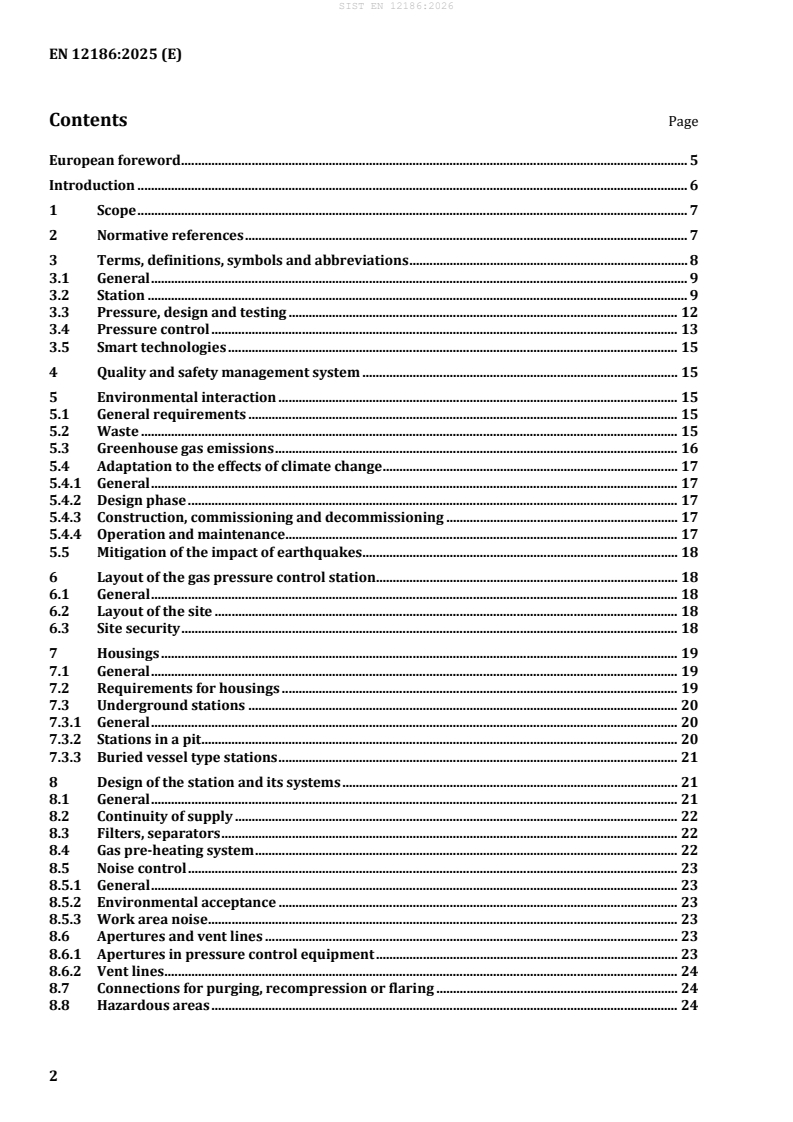
Contents Page
European foreword . 5
Introduction . 6
1 Scope . 7
2 Normative references . 7
3 Terms, definitions, symbols and abbreviations . 8
3.1 General . 9
3.2 Station . 9
3.3 Pressure, design and testing . 12
3.4 Pressure control . 13
3.5 Smart technologies . 15
4 Quality and safety management system . 15
5 Environmental interaction . 15
5.1 General requirements . 15
5.2 Waste . 15
5.3 Greenhouse gas emissions . 16
5.4 Adaptation to the effects of climate change . 17
5.4.1 General . 17
5.4.2 Design phase . 17
5.4.3 Construction, commissioning and decommissioning . 17
5.4.4 Operation and maintenance . 17
5.5 Mitigation of the impact of earthquakes . 18
6 Layout of the gas pressure control station . 18
6.1 General . 18
6.2 Layout of the site . 18
6.3 Site security . 18
7 Housings . 19
7.1 General . 19
7.2 Requirements for housings . 19
7.3 Underground stations . 20
7.3.1 General . 20
7.3.2 Stations in a pit . 20
7.3.3 Buried vessel type stations . 21
8 Design of the station and its systems . 21
8.1 General . 21
8.2 Continuity of supply . 22
8.3 Filters, separators . 22
8.4 Gas pre-heating system . 22
8.5 Noise control . 23
8.5.1 General . 23
8.5.2 Environmental acceptance . 23
8.5.3 Work area noise . 23
8.6 Apertures and vent lines . 23
8.6.1 Apertures in pressure control equipment . 23
8.6.2 Vent lines . 24
8.7 Connections for purging, recompression or flaring . 24
8.8 Hazardous areas . 24
8.9 Cathodic protection and electrical isolation system . 24
8.10 Lightning protection, electric continuity and earthing . 25
8.11 Pressure control system. 25
8.12 Flow-rate control system . 25
8.13 Pipework system. 26
8.14 Welding . 26
8.15 Instrumentation pipework . 26
8.16 Stress analysis . 27
8.16.1 Design pressure . 27
8.16.2 Design factor . 27
8.16.3 Supports . 27
8.16.4 Flexibility . 28
8.16.5 Temperature . 28
8.16.6 Gas velocity . 28
8.17 Standard pressure equipment strength . 28
8.18 Isolating valves . 28
8.19 Smart systems and equipment . 29
8.19.1 General . 29
8.19.2 Fail safe conditions (safety and continuity of supply) . 29
8.20 Electromagnetic compatibility, electrostatic phenomena and personal protection . 29
8.21 Information security. 29
9 Pressure control requirements . 30
9.1 General . 30
9.2 Pressure regulating system . 31
9.3 Pressure safety system . 31
9.3.1 General . 31
9.3.2 Operating principles of pressure safety systems . 31
9.3.3 Applications . 31
9.3.4 Safety shut-off devices . 32
9.3.5 Monitors . 33
9.3.6 Safety-related electrical/electronic solutions . 33
9.3.7 Venting devices . 34
9.4 Pressure alarm system . 34
9.5 Instrumentation . 34
9.6 Bypasses . 35
9.6.1 Bypasses for equalization or testing of components . 35
9.6.2 Bypasses of the pressure control system . 35
10 Testing . 35
10.1 General . 35
10.2 Pressure testing . 35
10.2.1 General . 35
10.2.2 Strength test . 35
10.2.3 Tightness test . 36
10.3 Reporting . 36
11 Commissioning . 37
12 Operation and maintenance . 37
12.1 General . 37
12.2 Documentation . 38
12.3 Maintenance requirements . 38
12.4 Training . 39
12.5 Work undertaken . 39
12.6 Fire fighting . 40
12.7 Cyber security . 40
13 Decommissioning and disposal. 40
13.1 Decommissioning . 40
13.2 Disposal . 40
Annex A (informative) Glossary . 41
Annex B (informative) Categories of greenhouse gas emissions in the scope of this
document . 43
Annex C (informative) Mitigation of the impact of earthquakes. 44
Annex D (informative) Stations in operation - Changing of the type of gas . 45
Annex E (informative) Significant technical changes from the last edition of this document,
EN 12186:2014 . 46
Bibliography . 48
European foreword
This document (EN 12186:2025) has been prepared by Technical Committee CEN/TC 234 “Gas
infrastructure”, the secretariat of which is held by DIN.
This European Standard shall be given the status of a national standard, either by publication of an
identical text or by endorsement, at the latest by June 2026, and conflicting national standards shall be
withdrawn at the latest by June 2026.
Attention is drawn to the possibility that some of the elements of this document may be the subject of
patent rights. CEN shall not be held responsible for identifying any or all such patent rights.
This document supersedes EN 12186:2014.
— the scope of the standard is expanded and now covers natural gas, blends of natural gas with
hydrogen and hydrogen, as mentioned in CEN/TR 17797;
— measures to avoid greenhouse gas emissions were further detailed throughout the document;
— measures for adapting to climate change were included;
— as part of comprehensive automation, regulators, valves and safety devices are increasingly being
equipped with communication interfaces so that they can be integrated into the overall information
management of a pressure control station. The relevant requirements for these smart systems and
equipment are defined in this document;
— gas pressure control stations are increasingly being integrated into operators' communication
infrastructures. This has been taken into account in this edition of EN 12186 by including basic
requirements for information security and safety-related electrical/electronic solutions.
Annex E provides the details of significant technical changes between this document and the previous
edition.
This document has been prepared under a standardization request addressed to CEN by the European
Commission. The Standing Committee of the EFTA States subsequently approves these requests for its
Member States.
Any feedback and questions on this document should be directed to the users’ national standards body.
A complete listing of these bodies can be found on the CEN website.
According to the CEN-CENELEC Internal Regulations, the national standards organisations of the
following countries are bound to implement this European Standard: Austria, Belgium, Bulgaria, Croatia,
Cyprus, Czech Republic, Denmark, Estonia, Finland, France, Germany, Greece, Hungary, Iceland, Ireland,
Italy, Latvia, Lithuania, Luxembourg, Malta, Netherlands, Norway, Poland, Portugal, Republic of North
Macedonia, Romania, Serbia, Slovakia, Slovenia, Spain, Sweden, Switzerland, Türkiye and the United
Kingdom.
Introduction
The gas infrastructure is complex and the importance on safety of its construction and use has led to the
development of very detailed codes of practice and operating manuals in the member countries. These
detailed statements embrace recognized standards of gas engineering and the specific requirements
imposed by the legal structures of the member countries.
There is a complete suite of functional standards prepared by CEN/TC 234 “Gas Infrastructure” to cover
all parts of the gas infrastructure from the input of gas into the on-shore transmission network up to the
inlet connection of gas appliances, including injection, transmission, compression, pressure control,
storage, blending, gas treatment, odorization, distribution, measuring, and associated installation
pipework, as well as related requirements such as safety, gas quality, sustainability, environment and
emissions. Within the scope of CEN/TC 234, gaseous energy carriers and blends describe gases which are
in the gaseous state when conveyed in the gas pipeline infrastructure such as hydrogen, hydrogen rich,
and methane rich gases, dimethyl ether (DME) and propane and butanes used for combustion and/or as
feedstock, excluding steam and compressed air.
In preparing this document, a basic understanding of gas infrastructure by the user has been assumed.
CEN/TC 234 standards are maintained to provide the state of the art and especially to facilitate the use
of green gases in the gas infrastructure.
As gas pressure control stations for transmission and distribution are specifically designed for pipelines,
they are considered as annexed equipment, and as such are excluded from the scope of the Directive
2014/68/EU (Pressure Equipment Directive – PED [3]). However, standard pressure equipment installed
in these stations, e.g. gas pressure regulators, safety valves, valves, filters, heat exchangers, vessels, is
covered by the directive [4].
Directive (EU) 2024/1788 [9] on common rules for the internal markets for renewable gas, natural gas
and hydrogen and the related Regulation (EU) 2024/1789 [10] on the internal markets for renewable
gas, natural gas and hydrogen also aim at technical safety (security) including technical reliability of the
European gas and hydrogen system. These aspects and Directive (EU) 2018/2001 on the promotion of
the use of energy from renewable sources [5] are also in the focus of CEN/TC 234 standardization. In this
respect CEN/TC 234 evaluated the indicated EU legislation and amended this technical standard
accordingly, where required and appropriate.
This document has been adapted to the requirements of the Regulation (EU) 2024/1787 on the reduction
of methane emissions in the energy sector [8].
In this edition of EN 12186 environmental aspects relevant to the design, construction and testing,
operation and maintenance, decommissioning and disposal of pressure control stations in the scope of
this document are covered in accordance with CEN Guide 4 and CEN/TR 16388.
This document supports the mainstreaming climate adaptation into European standards according to the
European Climate Law ((EU) 2021/1119 [6]) and the 2021 EU Adaptation Strategy for adaptation to
climate change.
This document specifies common basic principles for the gas infrastructure. Users of this document are
expected be aware that more detailed national standards and/or codes of practice can exist in the CEN
member countries.
This document is intended to be applied in association with these national standards and/or codes of
practice setting out the basic principles as outlined in Clause 1 of this document.
1 Scope
This document specifies the functional requirements relevant for design, materials, construction, testing,
operation and maintenance of gas pressure control stations to ensure their reliability in terms of safety
of the station itself and the downstream system and continuity of service.
This document is applicable for gas pressure control stations which are part of gas transmission or
distribution systems for hydrogen, and hydrogen rich, and methane rich gases. Additional requirements
in the case of gases heavier than air and/or toxic or corrosive gases are not covered by this document.
This document does not apply to gas pressure control stations in operation prior to the publication of this
document. However, Annex D of this document can be used as guidance for the evaluation of stations in
operation prior to the publication of this document, regarding the change of the type of gas, e.g.
repurposing for the use with hydrogen.
The stations covered by this document have a maximum upstream operating pressure, which does not
exceed 100 bar. For higher maximum upstream operating pressures, this document can be used as a
guideline.
If the inlet pipework of the station is a service line and the maximum upstream operating pressure does
not exceed 16 bar and the design flow rate is equal to 2000 kW based on the gross calorific value or less,
EN 12279 applies.
This document contains the basic system requirements for gas pressure control stations. Requirements
for individual components (valves, regulators, safety devices, pipes, etc.) or installation of the
components are contained in the appropriate European Standards.
NOTE For combined control and measuring stations, the additional requirements of EN 1776 can apply.
The requirements in this document do not apply to the design and construction of auxiliary facilities such
as sampling, calorimetering, odorization systems and density measuring. These facilities are covered by
the appropriate European Standards, where existing, or applicable national standards.
The requirements of this document are based on good gas engineering practice under conditions
normally encountered in the gas industry. Requirements for unusual conditions cannot be specifically
provided for, nor are all engineering and construction details prescribed.
The objective of this document is to ensure the safe operation of such stations. This does not, however,
relieve all concerned of the responsibility for taking the necessary care and applying effective quality and
safety management during the design, construction, operation and maintenance.
2 Normative references
The following documents are referred to in the text in such a way that some or all of their content
constitutes requirements of this document. For dated references, only the edition cited applies. For
undated references, the latest edition of the referenced document (including any amendments) applies.
EN 334, Gas pressure regulators for inlet pressures up to 10 MPa (100 bar)
EN 1127-1, Explosive atmospheres — Explosion prevention and protection — Part 1: Basic concepts and
methodology
EN 1594, Gas infrastructure — Pipelines for maximum operating pressure over 16 bar — Functional
requirements
EN 10204, Metallic products — Types of inspection documents
EN 12007-1, Gas infrastructure — Pipelines for maximum operating pressure up to and including 16 bar —
Part 1: General functional requirements
EN 12007-3, Gas infrastructure — Pipelines for maximum operating pressure up to and including 16 bar —
Part 3: Specific functional requirements for steel
EN 12327, Gas infrastructure — Pressure testing, commissioning and decommissioning procedures —
Functional requirements
EN 12732, Gas infrastructure — Welding steel pipework — Functional requirements
EN 14382, Gas safety shut-off devices for inlet pressures up to 10 MPa (100 bar)
EN 17649, Gas infrastructure — Safety Management System (SMS) and Pipeline Integrity Management
System (PIMS) — Functional requirements
EN ISO 4126-1, Safety devices for protection against excessive pressure — Part 1: Safety valves (ISO 4126-1)
EN ISO 4126-4, Safety devices for protection against excessive pressure — Part 4: Pilot-operated safety
valves (ISO 4126-4)
EN ISO 4126-5, Safety devices for protection against excessive pressure — Part 5: Controlled safety pressure
relief systems (CSPRS) (ISO 4126-5)
EN ISO 80079-36, Explosive atmospheres — Part 36: Non-electrical equipment for explosive atmospheres
— Basic method and requirements (ISO 80079-36)
EN IEC 60079-10-1, Explosive atmospheres — Part 10-1: Classification of areas — Explosive gas
atmospheres
EN IEC 60079-14, Explosive atmospheres — Part 14: Electrical installation design, selection and
installation of equipment, including initial inspection
EN IEC 61000-6-4, Electromagnetic compatibility (EMC) — Part 6-4: Generic standards — Emission
standard for industrial environments
EN IEC 61340-5-1, Electrostatics — Part 5-1: Protection of electronic devices from electrostatic phenomena
— General requirements
EN IEC 62443 (all parts), Security for industrial automation and control systems
3 Terms, definitions, symbols and abbreviations
For the purposes of this document, the following terms, definitions, symbols and abbreviations apply.
Annex A provides a glossary and gives translation to French and German.
ISO and IEC maintain terminology databases for use in standardization at the following addresses:
— ISO Online browsing platform: available at https://www.iso.org/obp/ui
— IEC Electropedia: available at https://www.electropedia.org/
3.1 General
3.1.1
authorized person
competent person who is appointed to fulfil a given task on gas pressure control stations
Note 1 to entry: The appointment procedure is defined in each member country.
3.1.2
competent person
person who is trained, experienced and approved to perform activities relating to gas pressure control
stations
Note 1 to entry: Means of approval, if any, will be determined within each member country.
3.1.3
gas
energy carrier, which is in the gaseous state when conveyed in the gas pipeline infrastructure used for
combustion and/or as feedstock
Note 1 to entry: For the purpose of this document, the term gas refers to a non-toxic, non-corrosive methane rich
gas, hydrogen rich gas or hydrogen.
3.1.4
hazardous area
area in which an explosive or flammable gas atmosphere is present or can be expected to be present, in
quantities such that special precautions for the construction, installation and use of equipment are
required
[SOURCE: EN IEC 60079-10-1:2021, 3.3.1 – modified: added “or flamable gas“]
3.1.5
hazardous area zone
hazardous area classification based on the frequency of the occurrence and duration of the explosive
atmosphere
[SOURCE: EN IEC 60079-10-1:2021, 3.3.3 – modified: added “hazardous area”]
3.2 Station
3.2.1
cavity wall
wall formed from two layers such as brick or blockwork with a space between
3.2.2
enclosed installation
plant installed in an enclosed space (apart from any necessary ventilation apertures)
3.2.3
open-air installation
plant installed outdoors, which can be protected by a canopy
3.2.4
separate building
building which is detached from any other building and is used exclusively for the enclosed installation
of gas pressure control and/or measuring equipment and ancillaries and can be accessed by personnel
3.2.5
cabinet station
enclosed space (apart from any necessary ventilation apertures), which is used exclusively to house gas
pressure control and/or measuring equipment and ancillaries and is too small for access by personnel
3.2.6
underground station
space, partly or totally below ground level in which the gas pressure control and/or measuring
equipment and ancillaries are installed
3.2.7
component
item from which a gas pressure control station is constructed
Note 1 to entry: A distinction is drawn between the following groups of components:
— equipment – e.g. valves, meters, preheaters, line filters, safety shut-off devices and pressure regulators which
are used to control the flow of gas into and out of the station;
— pipework – e.g. pipe, reducers, bends, tees, flanges and insulating joints which are used to connect the
equipment;
— ancillaries – additional devices and instrumentation which ensure that the equipment functions correctly.
3.2.8
inlet pipework
connecting pipework through which gas enters the station
3.2.9
main
pipework in the gas infrastructure to which service lines are connected
3.2.10
outlet pipework
connecting pipework through which gas leaves the station
3.2.11
pressure control station
installation comprising all components including the inlet and outlet pipework and any structure within
which the components are installed, used for gas pressure regulation and over-pressure protection
3.2.12
service line
pipework from the main to the point of delivery of the gas into the installation pipework
3.2.13
standard pressure equipment
equipment covered by Directive 2014/68/EU (Pressure Equipment Directive - PED) [3]
EXAMPLE Gas pressure regulators, safety valves, valves, filters, heat exchangers, vessels.
Note 1 to entry: See Article 1 No. 2 (A) of Directive 2014/68/EU [3] and Guideline A-17 of the Commission’s
Working Group “Pressure” [4].
3.2.14
commissioning
activities required to fill pipework, equipment and assemblies with gas for the first time and to perform
test runs to check the system‘s integrity
3.2.15
decommissioning
activities required to take out of service any pipework, station, equipment or assemblies filled with gas
and to disconnect them from the system
3.2.16
inspection
process of measuring, examining, testing, gauging or otherwise determining the status of items of the
pipeline system or installation and comparing it with the applicable requirements
3.2.17
maintenance
combination of all technical and associated administrative actions intended to keep an item in, or restore
it to, a state in which it can perform its required function
Note 1 to entry: Maintenance includes surveillance, inspection, function check-out, overhaul and repair.
Note 2 to entry: For further terms and definitions related to maintenance, see EN 13306.
3.2.18
disposal
activities to be performed after components of a decommissioned gas pressure control station have been
dismantled
3.2.19
station availability
ability to be in a state to perform as and when required under given conditions, assuming that the
required external resources are provided
[SOURCE: EN 13306:2017, 4.7 – modified: added “station”; deleted: “of an item”]
3.2.20
reliability
ability of a component or system to perform a required function under given conditions for a given time
interval
[SOURCE: EN 13306:2017, 4.1 – modified: substitute: “an item” with “a component or system”]
3.3 Pressure, design and testing
3.3.1
design factor
fo
factor applied when calculating the wall thickness or design pressure
3.3.2
design flow rate
flow rate on which the design calculations are based
3.3.3
design pressure
DP
pressure on which design calculations are based
Note 1 to entry: A part of a pressure control station designed for a design pressure DP can comprise components
designed for a different maximum allowable pressure (PS).
3.3.4
pressure
gauge pressure of the fluid inside the system, measured in static conditions
3.3.5
operating pressure
OP
pressure which occurs within a system under normal operating conditions
3.3.6
maximum operating pressure
MOP
maximum pressure at which a system can be operated continuously under normal operating conditions
Note 1 to entry: Normal operating conditions are: no fault in any device or stream.
3.3.7
temporary operating pressure
TOP
pressure at which a system can be operated temporarily under control of regulating devices
3.3.8
maximum incidental pressure
MIP
maximum pressure which a system can experience during a short time, limited by the safety devices
3.3.9
maximum allowable pressure
PS
maximum pressure for which the equipment is designed, as specified by the manufacturer
Note 1 to entry: Definition according to Directive 2014/68/EU [3].
3.3.10
strength test
specific procedure to verify that the pipework and/or station meets the requirements for mechanical
strength
3.3.11
tightness test
specific procedure to verify that the pipework and/or station meets the requirements for tightness
3.3.12
combined test
specific procedure to verify that the pipework and/or station meets the requirements for mechanical
strength and tightness
3.3.13
test pressure
TP
pressure at which pressure tests are conducted
3.3.14
strength test pressure
STP
pressure applied to a system during strength testing
3.3.15
combined test pressure
CTP
pressure applied to a system during combined testing, i.e. tightness and strength testing
3.4 Pressure control
3.4.1
alarm
signal of a situation in which manual intervention might be needed or in which the system itself might
perform a safety action
3.4.2
creep relief device
pressure relief device designed to discharge small amounts of gas resulting from a gradual pressure
increase (creep) downstream of the control system in its closed position
Note 1 to entry: A creep relief device cannot be considered a safety device.
3.4.3
direct-acting
requiring no auxiliary energy for operation
3.4.4
indirect-acting
requiring auxiliary energy for operation
3.4.5
instrumentation
system or combination of equipment for measurement and control
3.4.6
instrumentation pipework
pipework required for the proper functioning of the pressure control equipment installed within the
pressure control station
EXAMPLE Sensing, auxiliary and sampling lines.
3.4.7
monitor
second regulator used as a safety device in series with the active regulator which assumes control of the
pressure at a higher set value in the event of the active regulator failing open
3.4.8
safety slam-shut device
device designed to quickly shut off the gas flow in the event of an unacceptable pressure being detected
within the system it protects
3.4.9
safety cut-off device
device designed to shut off the gas flow which responds slower dynamically than a slam shut device in
the event of an unacceptable pressure being detected within the system it protects
3.4.10
safety relief device
device designed to release gas in the event of an unacceptable pressure being detected within the system
it protects
3.4.11
pressure regulating system
system which ensures that a pressure is maintained in the outlet system within required limits
3.4.12
pressure safety system
system which, independent of the pressure regulating system, ensures that the outlet pressure of that
system does not exceed the safety limits
3.4.13
pressure alarm system
system which alerts the system operator in the case of an undesired pressure
Note 1 to entry: For definition of ‘system operator’ see EN 17649.
3.4.14
pressure control system
combined system including pressure regulating, pressure safety and possibly pressure recording and
alarm systems
3.5 Smart technologies
3.5.1
smart system
system of multiple components and parts of equipment, where at least one piece of smart equipment (see
3.5.2) is incorporated to improve the performance and management of a pressure control station
Note 1 entry: A smart system can consist of only stand-alone smart equipment.
3.5.2
smart equipment
equipment that natively, or by modification, produces information that can be connected to, or used by,
other systems to enhance monitoring, control, interoperability and autonomy of the equipment or
connected systems
4 Quality and safety management system
The life of a pressure control station can be divided into four phases:
— the design;
— the construction and testing;
— the operation and maintenance;
— decommissioning and disposal.
A safety management system shall be applied by system operators in accordance with this document,
which includes these four phases. Reference shall be made to EN 17649 or applicable national standards
or regulations.
A quality management system shall be applied in accordance with this document by manufacturers and
service providers.
NOTE EN ISO 9001 is available for purpose.
Standardized safety design rules on pressure control stations shall be incorporated and documented in
the quality and safety management systems.
5 Environmental int
...