


EN 40-7:2002
(Main)Lighting columns - Part 7: Requirements for fibre reinforced polymer composite lighting columns
General Information
- Abstract
This Part of EN 40 specifies the performance requirements for fibre reinforced polymer composite lighting columns for which the main intended use is road lighting. It includes materials and test methods. The composite materials considered are those constructed from a fibrous reinforcing material that is suspended in a matrix of resin material. It applies to post top columns not exceeding 20 m height for post top lanterns and columns with brackets not exceeding 18 m height for side entry lanterns.
- Status
- Published
- Publication Date
- 17-Dec-2002
- Withdrawal Date
- 29-Sep-2004
- Technical Committee
- CEN/TC 50 - Lighting columns and spigots
- Drafting Committee
- CEN/TC 50 - Lighting columns and spigots
- Current Stage
- 6060 - Definitive text made available (DAV) - Publishing
- Start Date
- 18-Dec-2002
- Completion Date
- 18-Dec-2002
- Directive
- Harmonized Standard305/2011 - Regulation (eu) No 305/2011 of the European Parliament and of the Council of 9 march 2011 laying down harmonised conditions for the marketing of construction products and repealing council directive 89/106/eecOJ Ref: C, C 259 OJ Date: 08-Aug-2014
Not Harmonized89/106/EEC - Construction productsOJ Ref: C, C 139, C 165, C 319 OJ Date: 16-Jul-2003


Overview
EN 40-7:2002 (CEN) specifies performance requirements for fibre reinforced polymer (FRP) composite lighting columns intended mainly for road lighting. The standard covers materials, manufacturing and test methods for post-top columns (≤ 20 m) and side-entry/ bracket columns (≤ 18 m). It sets requirements for structural performance (wind loads), durability, impact resistance (passive safety), and conformity assessment to ensure safe, long‑lasting lighting columns.
Key Topics
- Scope & limits
- Applies to FRP composite columns for road lighting: post-top (≤ 20 m) and side-entry with brackets (≤ 18 m).
- Materials
- Acceptable constituents include fibrous reinforcement (e.g., E‑glass) and resin systems (e.g., isophthalic polyester); batches must be verified against supplier specifications.
- Guidance on fillers, UV stabilisers and sealing of cut edges to prevent moisture ingress.
- Design & verification
- Structural design verified by calculation (prEN 40-3-3) or testing (EN 40-3-2); Annex B gives additional design/verification requirements for FRP columns.
- Columns must resist specified dead and wind loads (EN 40-3-1).
- Mechanical & surface properties
- Pigmentation throughout the laminate; smooth surface finish or protective veil/gelcoat to prevent fibre breakout.
- Characteristic laminate properties determined per Annex C (tensile, flexural, shear methods referenced to ISO standards).
- Impact & safety
- Vehicle impact/passive safety requirements aligned with EN 12767.
- Mechanical impact protection test: IK08 rating per EN 50102 using impact pendulum or free-fall hammer; specific acceptance criteria (e.g., max 3 mm indentation at door area).
- Conformity & production control
- Factory production control, initial type testing (Annex E), sampling rules and acceptance criteria defined to ensure ongoing compliance.
- Jointing, attachments & corrosion
- Recommendations for composite or equivalent durable fixings; no special corrosion protection required beyond sealed edges (Annex D informative).
Applications and Who Uses It
- Intended users:
- Lighting column manufacturers, composite fabricators and material suppliers
- Civil and structural engineers specifying road lighting infrastructure
- Procurement teams for municipalities and highway authorities
- Testing laboratories and conformity assessment bodies
- Practical uses:
- Specifying material selections, production controls and acceptance tests for FRP columns used on roads, streets and highways.
- Verifying passive safety and impact performance for roadside equipment.
Related Standards
- EN 40 series (Parts 1–6) - definitions, general requirements, design & verifications
- EN 40-3-1 / EN 40-3-2 / prEN 40-3-3 - design and verification methods
- EN 12767 - passive safety of support structures
- EN 50102 - IK impact protection
- EN ISO 527-4/5, EN ISO 14125, EN ISO 14129 - composite test methods
Keywords: EN 40-7, fibre reinforced polymer composite lighting columns, FRP lighting columns, CEN, road lighting, IK08, E‑glass, isophthalic polyester, design verification, passive safety, factory production control.
Relations
- Effective Date
- 28-Jan-2026
- Effective Date
- 28-Jan-2026
- Effective Date
- 28-Jan-2026
- Refers
EN 40-3-2:2013 - Lighting columns - Part 3-2: Design and verification - Verification by testing - Effective Date
- 28-Jan-2026
- Effective Date
- 28-Jan-2026
- Effective Date
- 28-Jan-2026
- Effective Date
- 28-Jan-2026
- Refers
EN 40-3-3:2013 - Lighting columns - Part 3-3: Design and verification - Verification by calculation - Effective Date
- 28-Jan-2026
- Effective Date
- 28-Jan-2026
- Effective Date
- 28-Jan-2026
- Effective Date
- 28-Jan-2026
Get Certified
Connect with accredited certification bodies for this standard

DIN CERTCO
DIN Group product certification.

Smithers Quality Assessments
US management systems and product certification.
Zavod za gradbeništvo Slovenije (ZAG) - Inšpekcija
ZAG inspection body for construction products, structures, and materials.
Sponsored listings
Frequently Asked Questions
EN 40-7:2002 is a standard published by the European Committee for Standardization (CEN). Its full title is "Lighting columns - Part 7: Requirements for fibre reinforced polymer composite lighting columns". This standard covers: This Part of EN 40 specifies the performance requirements for fibre reinforced polymer composite lighting columns for which the main intended use is road lighting. It includes materials and test methods. The composite materials considered are those constructed from a fibrous reinforcing material that is suspended in a matrix of resin material. It applies to post top columns not exceeding 20 m height for post top lanterns and columns with brackets not exceeding 18 m height for side entry lanterns.
This Part of EN 40 specifies the performance requirements for fibre reinforced polymer composite lighting columns for which the main intended use is road lighting. It includes materials and test methods. The composite materials considered are those constructed from a fibrous reinforcing material that is suspended in a matrix of resin material. It applies to post top columns not exceeding 20 m height for post top lanterns and columns with brackets not exceeding 18 m height for side entry lanterns.
EN 40-7:2002 is classified under the following ICS (International Classification for Standards) categories: 83.120 - Reinforced plastics; 93.080.40 - Street lighting and related equipment. The ICS classification helps identify the subject area and facilitates finding related standards.
EN 40-7:2002 has the following relationships with other standards: It is inter standard links to EN ISO 14125:1998, EN 40-3-1:2013, EN ISO 14129:1997, EN 40-3-2:2013, EN 12767:2019+A1:2024, EN 40-1:1991, EN ISO 527-5:2021, EN 40-3-3:2013, EN 40-2:2004, EN ISO 527-4:2023, EN 1993-3-1:2006. Understanding these relationships helps ensure you are using the most current and applicable version of the standard.
EN 40-7:2002 is associated with the following European legislation: EU Directives/Regulations: 305/2011, 89/106/EEC; Standardization Mandates: M/111. When a standard is cited in the Official Journal of the European Union, products manufactured in conformity with it benefit from a presumption of conformity with the essential requirements of the corresponding EU directive or regulation.
EN 40-7:2002 is available in PDF format for immediate download after purchase. The document can be added to your cart and obtained through the secure checkout process. Digital delivery ensures instant access to the complete standard document.
Standards Content (Sample)
2003-01.Slovenski inštitut za standardizacijo. Razmnoževanje celote ali delov tega standarda ni dovoljeno.Drogovi za razsvetljavo - 7. del: Zahteve za drogove za razsvetljavo iz vlaknatoarmiranega polimernega kompozitaLichtmaste - Teil 7: Anforderungen an Lichtmaste aus faserverstärktem PolymerverbundstoffCandélabres - Partie 7: Spécifications pour les candélabres en composite renforcés de fibresLighting columns - Part 7: Requirements for fibre reinforced polymer composite lighting columns93.080.40Street lighting and related equipmentICS:Ta slovenski standard je istoveten z:EN 40-7:2002SIST EN 40-7:2003en01-julij-2003SIST EN 40-7:2003SLOVENSKI
STANDARD
EUROPEAN STANDARDNORME EUROPÉENNEEUROPÄISCHE NORMEN 40-7December 2002ICS 93.080.40Supersedes CR 40-7:1984English versionLighting columns - Part 7: Requirements for fibre reinforcedpolymer composite lighting columnsCandélabres - Partie 7: Spécifications pour les candélabresen composite renforcés de fibresLichtmaste - Teil 7: Anforderungen an Lichtmaste ausfaserverstärtem PolymerverbundstoffThis European Standard was approved by CEN on 7 November 2002.CEN members are bound to comply with the CEN/CENELEC Internal Regulations which stipulate the conditions for giving this EuropeanStandard the status of a national standard without any alteration. Up-to-date lists and bibliographical references concerning such nationalstandards may be obtained on application to the Management Centre or to any CEN member.This European Standard exists in three official versions (English, French, German). A version in any other language made by translationunder the responsibility of a CEN member into its own language and notified to the Management Centre has the same status as the officialversions.CEN members are the national standards bodies of Austria, Belgium, Czech Republic, Denmark, Finland, France, Germany, Greece,Iceland, Ireland, Italy, Luxembourg, Malta, Netherlands, Norway, Portugal, Spain, Sweden, Switzerland and United Kingdom.EUROPEAN COMMITTEE FOR STANDARDIZATIONCOMITÉ EUROPÉEN DE NORMALISATIONEUROPÄISCHES KOMITEE FÜR NORMUNGManagement Centre: rue de Stassart, 36
B-1050 Brussels© 2002 CENAll rights of exploitation in any form and by any means reservedworldwide for CEN national Members.Ref. No. EN 40-7:2002 ESIST EN 40-7:2003
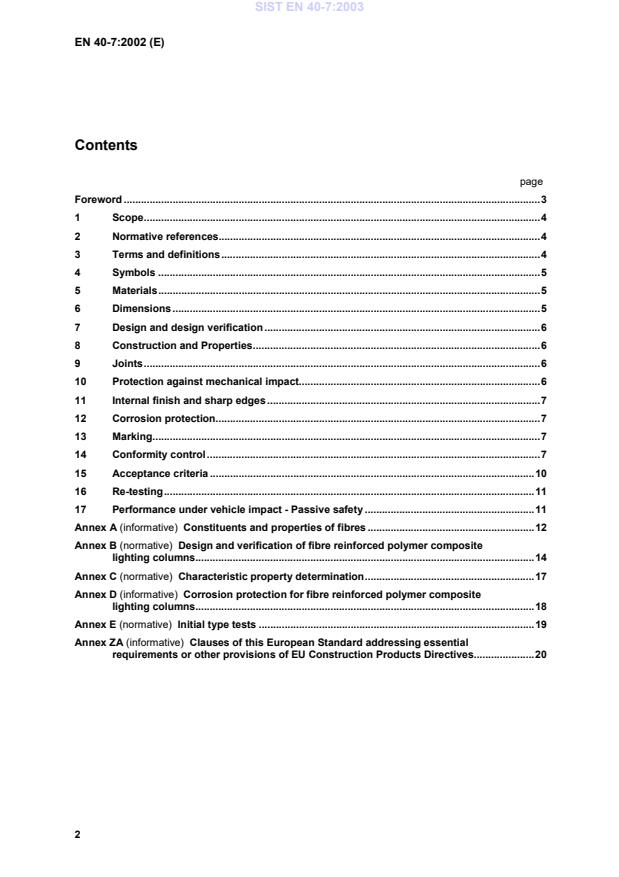
Constituents and properties of fibres.12Annex B (normative)
Design and verification of fibre reinforced polymer compositelighting columns.14Annex C (normative)
Characteristic property determination.17Annex D (informative)
Corrosion protection for fibre reinforced polymer compositelighting columns.18Annex E (normative)
Initial type tests.19Annex ZA (informative)
Clauses of this European Standard addressing essentialrequirements or other provisions of EU Construction Products Directives.20SIST EN 40-7:2003
equipment against externalmechanical impacts (IK code).EN ISO 527-4, Plastics - Determination of tensile properties - Part 4: Test conditions for isotropic andorthotopic fibre-reinforced plastic composites (ISO 527-4:1997).EN ISO 527-5, Plastics - Determination of tensile properties - Part 5: Test conditions for unidirectionalfibre-reinforced plastic composites (ISO 527-5:1997).EN ISO 14125, Fibre-reinforced plastic composites - Determination of flexural properties (ISO14125:1998).EN ISO 14129, Fibre-reinforced plastic composites - Determination of the in-plane shear stress/shearstrain response, including the in-plane shear modulus and strength, by the +/- 45° tension test method(ISO 14129:1997).3 Terms and definitionsFor the purposes of this European Standard the terms and definitions given in EN 40-1:1991 apply.SIST EN 40-7:2003
Factor applied to f1 in bending strength calculation.E1
Flexural modulus of elasticity in the longitudinal direction.E2
Flexural modulus of elasticity in the transverse direction.G
In plane shear modulus.n12
Poisson’s ratio when loaded in the longitudinal direction.n21
Poisson’s ratio when loaded in the transverse direction.tu
Interlaminar shear strength.h
Constant.5 Materials5.1 Fibre ReinforcementThe fibre material shall have mechanical and durability characteristics that are adequate for theenvironment and design life of the column. E-glass fibre reinforcement having the typical propertiesdescribed in annex A is likely to comply. Additional or alternative fibres shall have mechanical anddurability characteristics that are equivalent to or greater than E-glass.A verification shall be obtained for each fibre batch supplied to the lighting column manufacturer,verifying that the batch complies with the fibre manufacturers’ performance specification.5.2 Polymer resinThe resin system shall have mechanical and durability characteristics that are adequate for theenvironment and design life of the column, and should have processing characteristics suited to themanufacturing process and fibre reinforcement. Thermosetting isophthalic polyester resin having thetypical properties given in annex A, Table A.3 is likely to comply. Alternative or additional resins shallhave mechanical and durability characteristics that are equivalent or greater than thermosettingpolyester. Filler content shall not adversely affect the mechanical and durability properties of the resin.To minimise the degradation of the material and colour fading during the designed lifetime a suitableUV stabilizer shall be added to the resin.A verification shall be obtained for each resin batch supplied to the lighting column manufacturer,certifying that the batch complies with the resin manufacturers’ performance specification.5.3 Attachments and fixingsAll structural attachments and fixings should be made of polymer composite materials or othermaterials that offer equivalent or enhanced durability.6 DimensionsThe main dimensions of fibre reinforced polymer composite lighting columns shall be in accordancewith prEN 40-2.SIST EN 40-7:2003
...