


EN 682:2002
(Main)Elastomeric Seals - Materials requirements for seals used in pipes and fittings carrying gas and hydrocarbon fluids
General Information
- Abstract
This European Standard specifies requirements for elastomeric materials used in seals for supply pipes and fittings, ancillaries and valves at operating temperatures in general from - 5 °C up to 50 °C and in special cases from - 15 °C up to 50 °C, for the following:
General applications (see Table 4, type G)
a) gaseous fuel (manufactured, natural and liquefied petroleum gas [LPG] in gaseous phase);
b) hydrocarbon fluids with aromatic content up to 30 % (V/V), including LPG in liquid phase.
Special applications (see Table 4, type H)
Materials suitable for carrying gaseous fuels containing gas condensates and hydrocarbon fluids of unrestricted aromatic content.
General requirements for finished joint seals are also given; any additional requirements called for by the particular application are specified in the relevant product standards taking into account that the performance of pipe joints is a function of the seal material properties, seal geometry and pipe joint design. This European Standard should be used where appropriate with product standards which specify performance requirements for joints.
This European Standard is applicable to joint seals for all pipeline materials including iron, steel, copper and plastics.
In the case of composite seals requirements in 4.2.8 and 4.2.9 apply only when the materials used for any elastomeric parts come into contact with gaseous fuel or hydrocarbon fluid.
Elongation at break, tensile strength, compression set and stress relaxation requirements for materials of hardness categories 80 and 90 apply only when they constitute that part of the seal which participates directly in the sealing function or in long term stability.
This standard is not applicable to the following:
a) seals made from cellular materials;
b) seals with enclosed voids as part of their design;
c) seals with requirements of resistance to flame or to thermal stress;
d) seals which contain splices joining pre-vulcanised profile ends.
- Status
- Published
- Publication Date
- 05-Feb-2002
- Technical Committee
- CEN/TC 208 - Elastomeric seals for joints in pipework and pipelines
- Drafting Committee
- CEN/TC 208 - Elastomeric seals for joints in pipework and pipelines
- Current Stage
- 9093 - Decision to confirm - Review Enquiry
- Start Date
- 14-Feb-2022
- Completion Date
- 23-Sep-2026
- Directive
- Harmonized Standard305/2011 - Regulation (eu) No 305/2011 of the European Parliament and of the Council of 9 march 2011 laying down harmonised conditions for the marketing of construction products and repealing council directive 89/106/eecOJ Ref: C, C 259 OJ Date: 08-Aug-2014
Not Harmonized89/106/EEC - Construction productsOJ Ref: C, C 139, C 154, C 319 OJ Date: 28-Jun-2002



Overview
EN 682:2002 - "Elastomeric Seals - Materials requirements for seals used in pipes and fittings carrying gas and hydrocarbon fluids" (CEN) defines material and finished‑seal requirements for elastomeric joint seals used in gas supply systems and hydrocarbon fluid pipelines. The standard covers general operating temperatures (generally ‑5 °C to 50 °C, and where required ‑15 °C to 50 °C), and classifies seals for general (type G) and special (type H) applications depending on fluid aromatic content and presence of condensates.
Key points:
- Applies to seals in pipes, fittings, ancillaries and valves across all pipeline materials (iron, steel, copper, plastics).
- Distinguishes seals suitable for gaseous fuels and hydrocarbons up to 30% aromatics (type G) and seals for fuels with condensates or unrestricted aromatics (type H).
- Excludes cellular materials, seals with enclosed voids by design, seals requiring flame/thermal‑stress resistance, and spliced pre‑vulcanized profile joints.
Key Topics and Technical Requirements
The standard specifies material properties, test methods and factory controls, referencing established ISO methods. Major technical topics include:
- Material integrity: Materials must be free from substances that harm seal life or pipe materials.
- Hardness: Nominal hardness categories are defined (IRHD categories broadly covering 50–90 IRHD) with permitted tolerances and micro‑test method guidance (ISO 48).
- Mechanical properties: Tensile strength and elongation at break tested per ISO 37; minimum values vary by material category.
- Compression set: Measured at ambient and elevated/low temperatures (ISO 815) to assess long‑term sealing performance.
- Stress relaxation: Compression stress relaxation tests per ISO 3384 with 7‑day and 90‑day assessment for type approval.
- Aging and chemical compatibility: Accelerated ageing (ISO 188), volume change after immersion in specified liquids and oils (ISO 1817), and ozone resistance (ISO 1431‑1).
- Finished seal requirements: Dimensional tolerances (ISO 3302‑1), permissible imperfections (ISO 9691), sampling and production control (ISO 2859, ISO 3951).
- Testing conditions: Detailed test temperatures, durations and sampling protocols are specified to ensure reproducible qualification.
Applications and Who Uses It
EN 682:2002 is essential for:
- Seal manufacturers designing elastomeric joint rings and gaskets for gas distribution and hydrocarbon pipelines.
- Pipe and fitting manufacturers, valve makers specifying compatible seals.
- Utilities and installers ensuring compliant components for gas supply systems.
- Testing laboratories and certification bodies carrying out material qualification and type approval.
- Product standards authors and regulators using EN 682 alongside product‑specific standards to define joint performance.
Related Standards (if applicable)
EN 682 builds on and references multiple ISO standards for test methods (ISO 37, ISO 48, ISO 81x series, ISO 1817, ISO 3384, ISO 1431‑1) and is based on earlier ISO work (ISO 6447, ISO 6448). Use EN 682 together with product‑specific joint standards that specify joint performance and installation requirements.
Keywords: EN 682:2002, elastomeric seals, seals for gas, hydrocarbon fluids, compression set, tensile strength, ozone resistance, pipe joint seals, CEN standard, ISO testing.
Relations
- Effective Date
- 25-Aug-2026
- Effective Date
- 25-Aug-2026
- Effective Date
- 25-Aug-2026
- Effective Date
- 25-Aug-2026
- Effective Date
- 25-Aug-2026
- Effective Date
- 25-Aug-2026
- Effective Date
- 25-Aug-2026
- Effective Date
- 25-Aug-2026
- Effective Date
- 25-Aug-2026
- Effective Date
- 25-Aug-2026
- Refers
ISO 3951:1989 - Sampling procedures and charts for inspection by variables for percent nonconforming - Effective Date
- 09-Feb-2026
- Refers
ISO 188:1998 - Rubber, vulcanized or thermoplastic — Accelerated ageing and heat resistance tests - Effective Date
- 09-Feb-2026
- Effective Date
- 09-Feb-2026
- Effective Date
- 28-Jan-2026
- Effective Date
- 28-Jan-2026
Get Certified
Connect with accredited certification bodies for this standard

DIN CERTCO
DIN Group product certification.

Smithers Quality Assessments
US management systems and product certification.
Sponsored listings
Frequently Asked Questions
EN 682:2002 is a standard published by the European Committee for Standardization (CEN). Its full title is "Elastomeric Seals - Materials requirements for seals used in pipes and fittings carrying gas and hydrocarbon fluids". This standard covers: This European Standard specifies requirements for elastomeric materials used in seals for supply pipes and fittings, ancillaries and valves at operating temperatures in general from - 5 °C up to 50 °C and in special cases from - 15 °C up to 50 °C, for the following: General applications (see Table 4, type G) a) gaseous fuel (manufactured, natural and liquefied petroleum gas [LPG] in gaseous phase); b) hydrocarbon fluids with aromatic content up to 30 % (V/V), including LPG in liquid phase. Special applications (see Table 4, type H) Materials suitable for carrying gaseous fuels containing gas condensates and hydrocarbon fluids of unrestricted aromatic content. General requirements for finished joint seals are also given; any additional requirements called for by the particular application are specified in the relevant product standards taking into account that the performance of pipe joints is a function of the seal material properties, seal geometry and pipe joint design. This European Standard should be used where appropriate with product standards which specify performance requirements for joints. This European Standard is applicable to joint seals for all pipeline materials including iron, steel, copper and plastics. In the case of composite seals requirements in 4.2.8 and 4.2.9 apply only when the materials used for any elastomeric parts come into contact with gaseous fuel or hydrocarbon fluid. Elongation at break, tensile strength, compression set and stress relaxation requirements for materials of hardness categories 80 and 90 apply only when they constitute that part of the seal which participates directly in the sealing function or in long term stability. This standard is not applicable to the following: a) seals made from cellular materials; b) seals with enclosed voids as part of their design; c) seals with requirements of resistance to flame or to thermal stress; d) seals which contain splices joining pre-vulcanised profile ends.
This European Standard specifies requirements for elastomeric materials used in seals for supply pipes and fittings, ancillaries and valves at operating temperatures in general from - 5 °C up to 50 °C and in special cases from - 15 °C up to 50 °C, for the following: General applications (see Table 4, type G) a) gaseous fuel (manufactured, natural and liquefied petroleum gas [LPG] in gaseous phase); b) hydrocarbon fluids with aromatic content up to 30 % (V/V), including LPG in liquid phase. Special applications (see Table 4, type H) Materials suitable for carrying gaseous fuels containing gas condensates and hydrocarbon fluids of unrestricted aromatic content. General requirements for finished joint seals are also given; any additional requirements called for by the particular application are specified in the relevant product standards taking into account that the performance of pipe joints is a function of the seal material properties, seal geometry and pipe joint design. This European Standard should be used where appropriate with product standards which specify performance requirements for joints. This European Standard is applicable to joint seals for all pipeline materials including iron, steel, copper and plastics. In the case of composite seals requirements in 4.2.8 and 4.2.9 apply only when the materials used for any elastomeric parts come into contact with gaseous fuel or hydrocarbon fluid. Elongation at break, tensile strength, compression set and stress relaxation requirements for materials of hardness categories 80 and 90 apply only when they constitute that part of the seal which participates directly in the sealing function or in long term stability. This standard is not applicable to the following: a) seals made from cellular materials; b) seals with enclosed voids as part of their design; c) seals with requirements of resistance to flame or to thermal stress; d) seals which contain splices joining pre-vulcanised profile ends.
EN 682:2002 is classified under the following ICS (International Classification for Standards) categories: 83.140.50 - Seals. The ICS classification helps identify the subject area and facilitates finding related standards.
EN 682:2002 has the following relationships with other standards: It is inter standard links to ISO 48:1994, ISO 815:1991, ISO 4661-1:1993, ISO 9691:1992, ISO 3384:1999, ISO 2859-1:1999, ISO 37:1994, ISO 471:1995, ISO 1431-1:1989, ISO 3302-1:1996, ISO 3951:1989, ISO 188:1998, ISO 1817:1999, EN 1870-15:2004, EN 1602:1996/AC:1997. Understanding these relationships helps ensure you are using the most current and applicable version of the standard.
EN 682:2002 is associated with the following European legislation: EU Directives/Regulations: 305/2011, 89/106/EEC; Standardization Mandates: M/131. When a standard is cited in the Official Journal of the European Union, products manufactured in conformity with it benefit from a presumption of conformity with the essential requirements of the corresponding EU directive or regulation.
EN 682:2002 is available in PDF format for immediate download after purchase. The document can be added to your cart and obtained through the secure checkout process. Digital delivery ensures instant access to the complete standard document.
Standards Content (Sample)
2003-01.Slovenski inštitut za standardizacijo. Razmnoževanje celote ali delov tega standarda ni dovoljeno.Elastomer-Dichtungen - Werkstoff-Anforderungen für Dichtungen in Versorgungsleitungen und Bauteilen für Gas und flüssige KohlenwasserstoffeGarnitures d'étanchéité en caoutchouc - Spécification des matériaux pour garnitures d'étanchéité de joints de canalisatisations et des raccords véhiculant du gaz et des fluides hydrocarburesElastomeric Seals - Materials requirements for seals used in pipes and fittings carrying gas and hydrocarbon fluids91.140.40Sistemi za oskrbo s plinomGas supply systems83.140.50TesnilaSealsICS:Ta slovenski standard je istoveten z:EN 682:2002SIST EN 682:2002en01-december-2002SIST EN 682:2002SLOVENSKI
STANDARD
EUROPEAN STANDARDNORME EUROPÉENNEEUROPÄISCHE NORMEN 682February 2002ICS 83.140.50English versionElastomeric Seals - Materials requirements for seals used inpipes and fittings carrying gas and hydrocarbon fluidsGarnitures d'étanchéité en caoutchouc - Spécification desmatériaux pour garnitures d'étanchéité pour joints decanalisations et des raccords véhiculant du gaz et desfluides hydrocarburesElastomer-Dichtungen - Werkstoff-Anforderungen fürDichtungen in Versorgungsleitungen und Bauteilen für Gasund flüssige KohlenwasserstoffeThis European Standard was approved by CEN on 16 November 2001.CEN members are bound to comply with the CEN/CENELEC Internal Regulations which stipulate the conditions for giving this EuropeanStandard the status of a national standard without any alteration. Up-to-date lists and bibliographical references concerning such nationalstandards may be obtained on application to the Management Centre or to any CEN member.This European Standard exists in three official versions (English, French, German). A version in any other language made by translationunder the responsibility of a CEN member into its own language and notified to the Management Centre has the same status as the officialversions.CEN members are the national standards bodies of Austria, Belgium, Czech Republic, Denmark, Finland, France, Germany, Greece,Iceland, Ireland, Italy, Luxembourg, Malta, Netherlands, Norway, Portugal, Spain, Sweden, Switzerland and United Kingdom.EUROPEAN COMMITTEE FOR STANDARDIZATIONCOMITÉ EUROPÉEN DE NORMALISATIONEUROPÄISCHES KOMITEE FÜR NORMUNGManagement Centre: rue de Stassart, 36
B-1050 Brussels© 2002 CENAll rights of exploitation in any form and by any means reservedworldwide for CEN national Members.Ref. No. EN 682:2002 ESIST EN 682:2002
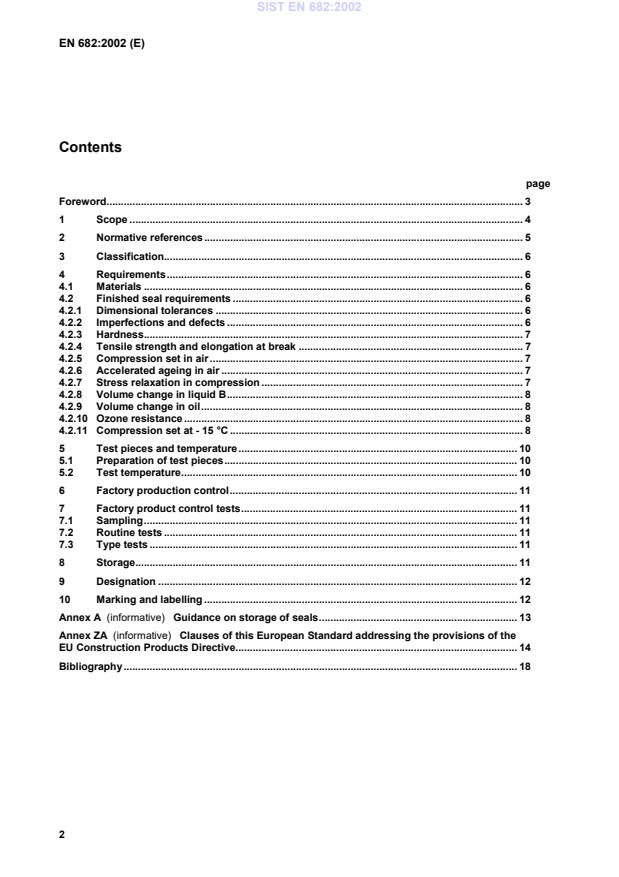
(informative)
Guidance on storage of seals.13Annex ZA
(informative)
Clauses of this European Standard addressing the provisions of theEU Construction Products Directive.14Bibliography.18SIST EN 682:2002
Low temperature compression set at 5 °CWhen determined by the method specified in ISO 815 using the small type B test piece and a recoverytime of (30 ± 3) min, the compression set after 72 h at -5 °C, when measured at -5 °C, shall conform tothe requirements given in Tables 2 or 3.4.2.6 Accelerated ageing in airTest pieces prepared for the determination of hardness (see 4.2.3) and for the determination of tensilestrength and elongation at break (see 4.2.4) shall be aged in air at 70 °C for 7 days by the normal ovenmethod specified in ISO 188:1998 (Method A).The changes in hardness, tensile strength and elongation at break shall conform to the requirementsgiven in Tables 2 or 3.4.2.7 Stress relaxation in compressionThe stress relaxation shall be determined by Method A of ISO 3384:1999, using a test piece inaccordance with 5.1, after applying mechanical and thermal conditioning. Measurements shall be takenafter 3 h, 1 day, 3 days and 7 days for the 7 days test and after 3 h, 1 day, 3 days, 7 days, 30 days and90 days for the 90 days test. The best fit straight line shall be determined by regression analysis using aSIST EN 682:2002
...