


EN 13731:2007
(Main)Lifting bag systems for fire and rescue service use - Safety and performance requirements
General Information
- Abstract
This European Standard specifies requirements for lifting bag systems, where intended operation is inflation by compressed air and used primarily by fire and rescue services.
This European Standard applies to lifting bag systems including some or all of the following components:
- hose assemblies and couplings;
- regulators;
- control devices;
- pressure indicators;
- safety valves;
- lifting bags.
This European Standard applies to lifting bag systems intended for operation under ambient temperatures between -20 °C and 55 °C.
This European Standard deals with all significant hazards, hazardous situations and events during the commissioning, operation and maintenance arising from a lifting bag system when it is used as intended and under the conditions of misuse which are reasonably foreseeable by the manufacturer (see Clause 4).
This European Standard specifies minimum performance requirements and test methods for lifting bag systems.
This European Standard does not establish the additional requirements for:
a) operation in severe conditions ( e.g. extreme environmental conditions such as: temperatures outside the range from -20 °C to + 55 °C, corrosive environment, tropical environment, contaminating environments, strong magnetic fields, potentially explosive atmospheres);
NOTE 1 If use of the lifting bag system is foreseen in severe conditions, this should be agreed between the purchaser and the manufacturer at the time of ordering. In this case an additional risk analysis should be carried out. Additional measures and additional information for use may be necessary.
b) risk directly arising from any means for handling or transportation of the lifting bag system by equipment other than that designed as part of the lifting bag;
c) lifting bag systems manufactured for specialized use, e.g. the lifting of persons or heavy recovery where exceptional stroke movement is required;
d) any hazard arising from the source of compressed air, except where this
- Status
- Published
- Publication Date
- 20-Nov-2007
- Withdrawal Date
- 30-May-2008
- Technical Committee
- CEN/TC 192 - Fire service equipment
- Drafting Committee
- CEN/TC 192/WG 7 - Hydraulic rescue tools and lifting bags
- Current Stage
- 9093 - Decision to confirm - Review Enquiry
- Start Date
- 10-Jan-2024
- Completion Date
- 23-Sep-2026
- Directive
- Harmonized Standard2006/42/EC - Directive 2006/42/EC of the European Parliament and of the Council of 17 May 2006 on machinery, and amending Directive 95/16/EC (recast)OJ Ref: C, C 214 OJ Date: 08-Sep-2009
Not Harmonized98/37/EC - Machinery

Overview
EN 13731:2007 - Lifting bag systems for fire and rescue service use - is a CEN European Standard that defines safety and performance requirements for lifting bag systems inflated by compressed air and used primarily by fire and rescue services. The standard applies to complete systems and common components (hose assemblies, couplings, regulators, control devices, pressure indicators, safety valves and lifting bags) intended for ambient operation between -20 °C and +55 °C. EN 13731:2007 specifies minimum performance requirements, test methods, verification and information for use, and addresses significant hazards during commissioning, operation and maintenance.
Key topics and technical requirements
- Scope and limits: Covers systems driven by compressed air (manual pump included) but excludes severe environments (temperatures outside -20 °C to +55 °C, corrosive/tropical/explosive atmospheres), specialized-person-lifting designs and risks from external compressed-air sources (except manual pumps).
- Component requirements: Sets requirements and tests for hose assemblies and couplings, regulators (including pre-set regulators), control devices and manual actuators, pressure indicators, safety valves, and lifting bags.
- Performance and verification: Specifies minimum performance criteria and test methods (see Clause 5 and Clause 6) for structural integrity, lifting capacity, pressure handling, PV (pressure-volume) considerations, and control reliability.
- Safety management: Addresses significant hazards, reasonably foreseeable misuse, and requires manufacturers to provide risk-related information, marking and instructions (Clause 4, Clause 7, Annex A).
- Documentation and user information: Requires accompanying documents for safe operation, maintenance, training and stowage (Annex A), and guidance for verification and inspection schedules.
Practical applications and users
EN 13731:2007 is intended for:
- Fire and rescue services specifying or procuring lifting bag systems for vehicle extrication, collapsed-structure rescue, heavy-object shifting and stabilization tasks.
- Manufacturers and designers developing lifting bag systems and components to meet European safety and performance benchmarks.
- Procurement officers and safety managers assessing conformity, test reports and product suitability for intended operating conditions.
- Test laboratories and certification bodies performing type testing, verification and conformity assessments against the standard.
- Training providers and maintenance teams using the standard’s information requirements to develop operating procedures, inspection regimes and user manuals.
Related standards
EN 13731 references and aligns with several normative documents such as:
- EN ISO 12100 (machine safety principles)
- EN ISO 2398 / EN ISO 5774 (hoses for compressed air)
- EN ISO 4126-1 (safety valves)
- EN 837 series (pressure gauges) These related standards govern component-level requirements and measurement methods referenced by EN 13731.
Keywords: EN 13731:2007, lifting bag systems, fire and rescue, compressed air, safety and performance requirements, regulators, hose assemblies, pressure indicators, CEN.
Relations
- Effective Date
- 09-Feb-2026
- Effective Date
- 09-Feb-2026
- Effective Date
- 28-Jan-2026
- Effective Date
- 28-Jan-2026
- Effective Date
- 28-Jan-2026
- Effective Date
- 28-Jan-2026
- Effective Date
- 28-Jan-2026
- Effective Date
- 28-Jan-2026
- Effective Date
- 28-Jan-2026
- Effective Date
- 28-Jan-2026
- Effective Date
- 28-Jan-2026
- Effective Date
- 28-Jan-2026
- Effective Date
- 28-Jan-2026
- Effective Date
- 28-Jan-2026
- Effective Date
- 28-Jan-2026
Get Certified
Connect with accredited certification bodies for this standard

BSI Group
BSI (British Standards Institution) is the business standards company that helps organizations make excellence a habit.

TÜV Rheinland
TÜV Rheinland is a leading international provider of technical services.

TÜV SÜD
TÜV SÜD is a trusted partner of choice for safety, security and sustainability solutions.
Sponsored listings
Frequently Asked Questions
EN 13731:2007 is a standard published by the European Committee for Standardization (CEN). Its full title is "Lifting bag systems for fire and rescue service use - Safety and performance requirements". This standard covers: This European Standard specifies requirements for lifting bag systems, where intended operation is inflation by compressed air and used primarily by fire and rescue services. This European Standard applies to lifting bag systems including some or all of the following components: - hose assemblies and couplings; - regulators; - control devices; - pressure indicators; - safety valves; - lifting bags. This European Standard applies to lifting bag systems intended for operation under ambient temperatures between -20 °C and 55 °C. This European Standard deals with all significant hazards, hazardous situations and events during the commissioning, operation and maintenance arising from a lifting bag system when it is used as intended and under the conditions of misuse which are reasonably foreseeable by the manufacturer (see Clause 4). This European Standard specifies minimum performance requirements and test methods for lifting bag systems. This European Standard does not establish the additional requirements for: a) operation in severe conditions ( e.g. extreme environmental conditions such as: temperatures outside the range from -20 °C to + 55 °C, corrosive environment, tropical environment, contaminating environments, strong magnetic fields, potentially explosive atmospheres); NOTE 1 If use of the lifting bag system is foreseen in severe conditions, this should be agreed between the purchaser and the manufacturer at the time of ordering. In this case an additional risk analysis should be carried out. Additional measures and additional information for use may be necessary. b) risk directly arising from any means for handling or transportation of the lifting bag system by equipment other than that designed as part of the lifting bag; c) lifting bag systems manufactured for specialized use, e.g. the lifting of persons or heavy recovery where exceptional stroke movement is required; d) any hazard arising from the source of compressed air, except where this
This European Standard specifies requirements for lifting bag systems, where intended operation is inflation by compressed air and used primarily by fire and rescue services. This European Standard applies to lifting bag systems including some or all of the following components: - hose assemblies and couplings; - regulators; - control devices; - pressure indicators; - safety valves; - lifting bags. This European Standard applies to lifting bag systems intended for operation under ambient temperatures between -20 °C and 55 °C. This European Standard deals with all significant hazards, hazardous situations and events during the commissioning, operation and maintenance arising from a lifting bag system when it is used as intended and under the conditions of misuse which are reasonably foreseeable by the manufacturer (see Clause 4). This European Standard specifies minimum performance requirements and test methods for lifting bag systems. This European Standard does not establish the additional requirements for: a) operation in severe conditions ( e.g. extreme environmental conditions such as: temperatures outside the range from -20 °C to + 55 °C, corrosive environment, tropical environment, contaminating environments, strong magnetic fields, potentially explosive atmospheres); NOTE 1 If use of the lifting bag system is foreseen in severe conditions, this should be agreed between the purchaser and the manufacturer at the time of ordering. In this case an additional risk analysis should be carried out. Additional measures and additional information for use may be necessary. b) risk directly arising from any means for handling or transportation of the lifting bag system by equipment other than that designed as part of the lifting bag; c) lifting bag systems manufactured for specialized use, e.g. the lifting of persons or heavy recovery where exceptional stroke movement is required; d) any hazard arising from the source of compressed air, except where this
EN 13731:2007 is classified under the following ICS (International Classification for Standards) categories: 11.160 - First aid; 13.220.10 - Fire-fighting. The ICS classification helps identify the subject area and facilitates finding related standards.
EN 13731:2007 has the following relationships with other standards: It is inter standard links to ISO 5598:1985, EN IEC/IEEE 82079-1:2020, EN 837-2:1997, EN 894-1:1997+A1:2008, EN ISO 12100-2:2003, EN ISO 7751:2016, EN ISO 4672:1999, EN 837-1:1996, EN 659:2003+A1:2008, EN 764-1:2004, EN ISO 12100-1:2003, EN ISO 5774:2023, EN 894-2:1997+A1:2008, EN 894-3:2000+A1:2008, EN 837-3:1996. Understanding these relationships helps ensure you are using the most current and applicable version of the standard.
EN 13731:2007 is associated with the following European legislation: EU Directives/Regulations: 2006/42/EC, 98/37/EC; Standardization Mandates: M/079. When a standard is cited in the Official Journal of the European Union, products manufactured in conformity with it benefit from a presumption of conformity with the essential requirements of the corresponding EU directive or regulation.
EN 13731:2007 is available in PDF format for immediate download after purchase. The document can be added to your cart and obtained through the secure checkout process. Digital delivery ensures instant access to the complete standard document.
Standards Content (Sample)
2003-01.Slovenski inštitut za standardizacijo. Razmnoževanje celote ali delov tega standarda ni dovoljeno.Lifting bag systems for fire and rescue service use - Safety and performance requirementsDvižne blazine in sistemi za gasilske in reševalne enote - Zahteve za delovanje in varnost v uporabiCoussins de levage a l'usage des services d'incendie et de secours - Prescriptions de sécurité et de performancesHebekissenysteme für Feuerwehr und Rettungsdienste - Sicherheits- und LeistungsanforderungenTa slovenski standard je istoveten z:EN 13731:2007SIST EN 13731:2008en,fr,de13.220.1011.160ICS:SLOVENSKI
STANDARDSIST EN 13731:200801-april-2008
EUROPEAN STANDARDNORME EUROPÉENNEEUROPÄISCHE NORMEN 13731November 2007ICS 11.160; 13.220.10 English VersionLifting bag systems for fire and rescue service use - Safety andperformance requirementsCoussins de levage à l'usage des services d'incendie et desecours - Prescriptions de sécurité et de performancesHebekissenysteme für Feuerwehr und Rettungsdienste -Sicherheits- und LeistungsanforderungenThis European Standard was approved by CEN on 30 September 2007.CEN members are bound to comply with the CEN/CENELEC Internal Regulations which stipulate the conditions for giving this EuropeanStandard the status of a national standard without any alteration. Up-to-date lists and bibliographical references concerning such nationalstandards may be obtained on application to the CEN Management Centre or to any CEN member.This European Standard exists in three official versions (English, French, German). A version in any other language made by translationunder the responsibility of a CEN member into its own language and notified to the CEN Management Centre has the same status as theofficial versions.CEN members are the national standards bodies of Austria, Belgium, Bulgaria, Cyprus, Czech Republic, Denmark, Estonia, Finland,France, Germany, Greece, Hungary, Iceland, Ireland, Italy, Latvia, Lithuania, Luxembourg, Malta, Netherlands, Norway, Poland, Portugal,Romania, Slovakia, Slovenia, Spain, Sweden, Switzerland and United Kingdom.EUROPEAN COMMITTEE FOR STANDARDIZATIONCOMITÉ EUROPÉEN DE NORMALISATIONEUROPÄISCHES KOMITEE FÜR NORMUNGManagement Centre: rue de Stassart, 36
B-1050 Brussels© 2007 CENAll rights of exploitation in any form and by any means reservedworldwide for CEN national Members.Ref. No. EN 13731:2007: E
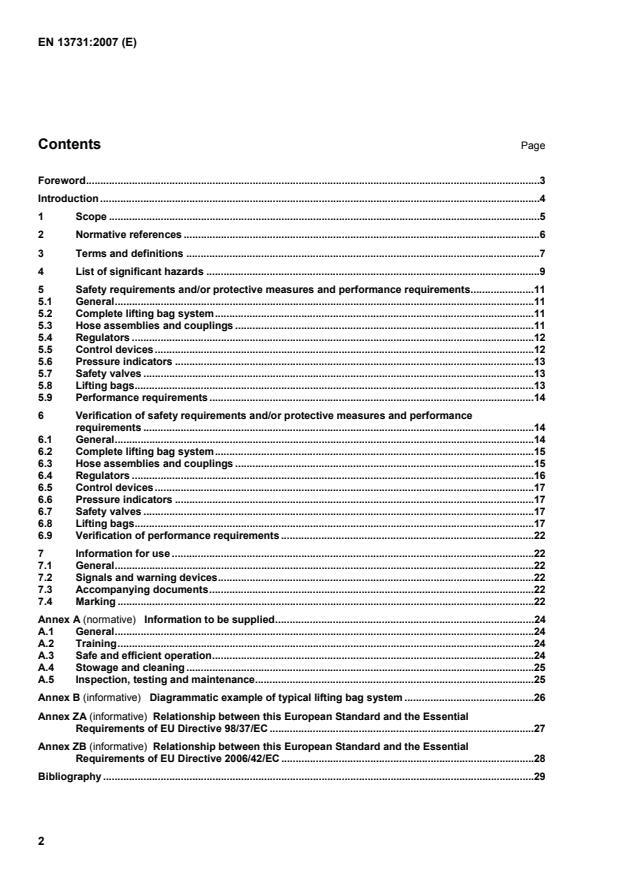
Information to be supplied.24 A.1 General.24 A.2 Training.24 A.3 Safe and efficient operation.24 A.4 Stowage and cleaning.25 A.5 Inspection, testing and maintenance.25 Annex B (informative)
Diagrammatic example of typical lifting bag system.26 Annex ZA (informative)
Relationship between this European Standard and the Essential Requirements of EU Directive 98/37/EC.27 Annex ZB (informative)
Relationship between this European Standard and the Essential Requirements of EU Directive 2006/42/EC.28 Bibliography.29
Introduction This European Standard is a type C standard as stated in EN ISO 12100-1. The machinery concerned and the extent to which hazards, hazardous situations and events are covered are indicated in the scope of this document. Where provisions of this type C standard are different from those which are stated in type A or B standards, the provisions of this type C standard take precedence over the provisions of the other standards, for machines that have been designed and built according to the provisions of this type C standard. Lifting bag systems are used by Fire and Rescue Services principally to facilitate the release of persons trapped following accidents involving vehicles, heavy machinery, collapsed buildings, collapsed trenches, fallen trees and other natural objects. Lifting bag systems are generally used in conjunction with other means to support or stabilise the load being moved, for example, blocks, chocks and props. When compiling this European Standard, it was assumed that: a) the manufacturer will design and/or use components in accordance with the usual engineering practise and calculation codes, including all failure modes; b) only trained and competent persons whilst wearing suitable gloves, will use and operate the machinery; c) the working place is adequately lit; d) negotiations occur between the manufacturer and the purchaser concerning particular conditions for the use and places of use for the machinery related to health and safety, which are not within the limits of the scope of this European Standard.
1 Scope This European Standard specifies requirements for lifting bag systems, where intended operation is inflation by compressed air and used primarily by fire and rescue services. This European Standard applies to lifting bag systems including some or all of the following components: hose assemblies and couplings; regulators; control devices; pressure indicators; safety valves; lifting bags. This European Standard applies to lifting bag systems intended for operation under ambient temperatures between -20 °C and 55 °C. This European Standard deals with all significant hazards, hazardous situations and events during the commissioning, operation and maintenance arising from a lifting bag system when it is used as intended and under the conditions of misuse which are reasonably foreseeable by the manufacturer (see Clause 4). This European Standard specifies minimum performance requirements and test methods for lifting bag systems. This European Standard does not establish the additional requirements for: a) operation in severe conditions ( e.g. extreme environmental conditions such as: temperatures outside the range from -20 °C to + 55 °C, corrosive environment, tropical environment, contaminating environments, strong magnetic fields, potentially explosive atmospheres); NOTE 1 If use of the lifting bag system is foreseen in severe conditions, this should be agreed between the purchaser and the manufacturer at the time of ordering. In this case an additional risk analysis should be carried out. Additional measures and additional information for use may be necessary. b) risk directly arising from any means for handling or transportation of the lifting bag system by equipment other than that designed as part of the lifting bag; c) lifting bag systems manufactured for specialized use, e.g. the lifting of persons or heavy recovery where exceptional stroke movement is required; d) any hazard arising from the source of compressed air, except where this is a manually operated air pump. NOTE 2 Where the source is from an air compressor or from a pressurised cylinder or other similar source, it is assumed that the source conforms to an appropriate European Standard or legislation. This European Standard is not dealing with noise, as it is not considered to be a significant hazard. This European Standard is not applicable to lifting bag systems which are manufactured before the date of its publication by CEN.
(ISO 4126-1:2004) EN ISO 4672:1999, Rubber and plastics hoses — Sub-ambient temperature flexibility tests (ISO 4672:1997) EN ISO 5774, Plastics hoses, textile-reinforced, for compressed air — Specification (ISO 5774:1997) EN ISO 7751, Rubber and plastics hoses and hose assemblies — Ratios of proof and burst pressure to design working pressure (ISO 7751:1991) EN ISO 12100-1:2003, Safety of machinery — Basic concepts, general principles for design — Part 1: Basic terminology, methodology (ISO 12100-1:2003) EN ISO 12100-2:2003, Safety of machinery — Basic concepts, general principles for design — Part 2: Technical principles (ISO 12100-2:2003) ISO 5598:1985, Fluid power systems and components — Vocabulary
3.2 allowable pressure (AP) maximum operating pressure for each component of the system stated in bar 3.3 control device component of a lifting bag system, being operated by manual actuator(s), which controls the inflation and deflation of a lifting bag NOTE Where a manual pump (hand or foot operated) forms part of the control device of the lifting bag system, it is considered to be part of the system, and all appropriate requirements should apply. 3.4 force product of the allowable pressure and effective surface of the lifting bag stated in kilo-Newtons 3.5 inlet connection tube or opening incorporated into the lifting bag in such a manner that it is not readily removable, to which is attached a quick action coupling for the attachment of a hose 3.6 hose assembly hose complete with attached quick-action coupling(s) with or without fittings 3.7 insertion height smallest opening into which a deflated bag can be inserted 3.8 lifting bag portable inflatable bag, used to apply force on objects, and/or lift or move objects in a prescribed manner 3.9 lifting bag system combination of components, excluding the energizing source unless it is a manual pump, which, when assembled, will enable a lifting bag(s) to be inflated by compressed air from the energizing source under the control of an operator and to subsequently be deflated also under the control of an operator 3.10 lifting capacity maximum load in tonnes, which a lifting bag will lift at allowable pressure, as a result of the force generated 3.11 lifting height sum of the insertion height plus a proportion of the stroke
Significant hazards Corresponding requirements in this Standard 1 Mechanical hazards due to machine parts or work pieces: 1 g) Liquids and gases under pressure 5.2.2; 5.2.3; 5.3.1; 5.3.2; 5.4.2; 5.4.3; 5.5.3; 5.5.4; 5.5.7; 5.5.8; 5.5.9; 5.5.11; 5.6.2; 5.7.1; 5.7.3; 5.8.1;
1.1 Crushing hazard 5.5.3; 5.5.4; 5.5.8; 5.5.9; A.3.2 c) 1.9 High pressure fluid injection or ejection hazard 5.3.4; 5.3.5; 5.3.6; 5.3.7 8 Hazards generated by neglecting ergonomic principles in machinery design 8.1 Unhealthy postures or excessive effort A.3.2 a); 5.8.3 8.3 Neglected use of Personal Protective Equipment (PPE) 5.3.7; 5.5.12 8.5 Mental overload and underload, stress 5.2.2; 5.5.5; 5.5.8; 5.5.10 8.6 Human error, human behaviour 5.2.2; 5.3.5; 5.3.6; 5.3.7; 5.4.3; 5.5.4; 5.5.9; 5.8.4 8.7 Inadequate design, location or identification of manual controls 5.4.1; 5.4.3; 5.5.2; 5.5.4; 5.5.5; 5.5.6; 5.5.7; 5.5.8; 5.5.9; 5.5.10; 5.5.12; 5.6.1; 5.7.1 8.8 Inadequate design or location of visual displays 5.5.2; 5.5.4; 5.6.1 10 Unexpected start-up, unexpected over-run/over-speed 10.1 Failure/disorder of the control system 5.7.1; 5.7.2; 5.7.3 10.2 Restoration of energy supply after an interruption 5.5.5; 5.5.9 10.6 Errors made by the operator (due to mismatch of machinery with human characteristics and abilities, see 8.6) 5.2.2; 5.3.5; 5.3.6; 5.3.7 5.4.3
Errors of fitting 5.3.5; 5.3.6; 5.3.7; 5.5.8; 5.5.9; 5.5.10 5.5.12; 5.2.2 18 Loss of stability A.3.2 c); A.3.2 d) Additional Hazards 22 Due to the control system 5.5.3 22.2 Inadequate design of manual controls and their mode of operation 5.5.3; 5.5.4; 5.5.5; 5.5.6; 5.5.7; 5.5.8; 5.5.9; 5.5.10 23 Handling
5.8.3; A.3.2.a) 25 From/to third persons 25.1 Unauthorized start up/use A.2.1 25.2 Drift of part from stopping position 5.5.5 25.3 Lack or inadequacy of visual or acoustic warning means 5.5.2; 5.6; 5.7.2 26 Insufficient instructions for the operator A.1; A.2.1; A.2.2; A.3.2 27 Mechanical hazards and hazardous events 27.1 Load falls, collisions, machine tipping caused by: 27.1.1 Lack of stability 5.5.3; 5.5.4; 5.5.5; 5.5.6; 5.5.7; 5.5.8; 5.5.9; A.3.2 c); A.3.2 d) 27.1.2 Uncontrolled loading - overloading
5.8.4; 5.8.6; 5.2.1 27.1.3 Uncontrolled amplitude of movements 5.5.3; 5.5.9; 5.8.5 27.1.4 Unexpected/unintended movement of loads A.3.2 c); A.3.2 d) 27.1.5 Inadequate holding devices/accessories 5.8.3; A.3.2 a) 27.4 Insufficient mechanical strength of parts 5.3.3; 5.8.1; 5.8.2; 5.8.3; 5.8.5 27.8 Abnormal conditions of assembly/testing/use/maintenance A.1; A.2; A.3; A.4 27.9 The effect of load on persons A.3.2 a)
In addition, the system shall be designed according to the principles of EN ISO 12100-2 for hazards relevant but not significant, which are not dealt with by this document (e.g. sharp edges and noise). NOTE For hazards which are to be reduced by the application of a B-level standard such as EN 894 (all parts), the manufacturer should carry out a risk assessment to establish the requirements of the type B-standard which are to be applied. This specific risk assessment should be part of the general risk assessment of the machine. Where the means of reducing the risk is by a safe system of working the lifting bag equipment, the manufacturer shall include in the Information for Use details of the system and of the elements of training required by the operating personnel (see Clause 7 and Annex A). 5.2 Complete lifting bag system 5.2.1 A lifting bag system (see Figure B.1) shall include the following components: hose and/or hose assemblies; regulator; control device for each lifting bag; pressure indicators for each lifting bag; safety valve for each lifting bag; lifting bag(s). 5.2.2 Components of a lifting bag system as shown in Figure B.1 shall be designed only to fit mating components that are intended for use with the same allowable pressure. 5.2.3 All components in the system shall be designed to mitigate unintentional hazardous movement due to airflow: e.g. ‘snaking’. 5.2.4 The complete lifting bag system shall be capable of being operated within the ambient temperature range of –20 °C to + 55 °C. 5.3 Hose assemblies and couplings 5.3.1 Rubber hoses shall conform to EN ISO 2398 and plastic hoses shall conform to EN ISO 5774. 5.3.2 Hose assemblies shall conform to EN ISO 7751. 5.3.3 At a temperature of (-20 ± 2) °C, hoses shall achieve a bend radius of 75 mm, or less. 5.3.4 Hose fittings and quick action couplings shall withstand an axial pulling force of at least 1 000 N when the internal pressure is at atmospheric pressure and when at allowable pressure. There shall be no leakage. 5.3.5 Quick-action couplings shall require at least two separate manual actions to disconnect.
...