


CEN/TS 16629:2024
(Main)Energy performance of buildings - Detailed technical rules for the set of EPB-standards
General Information
- Abstract
This document describes the detailed technical rules to be followed in the development and maintenance of standards intended to support the assessment of the overall energy performance of a building (EPB) using a holistic approach.
This document supports the development and maintenance of a set of EPB standards that provides a systematic, clear, consistent and comprehensive methodology for the benefit of professionals and government entities. The main application is the assessment of the overall energy performance of a building in the context of building regulations, e.g. to specify EP requirements, EP rating and EP certificates.
The rules cover general and common aspects on the required quality, accuracy, usability, consistency and interoperability of the EPB standards as a set and individually. For that purpose, this document provides guidance on the process, structure and layout of these EPB standards and accompanying publications, complementary to the CEN and ISO internal regulations.
This document is based on the basic principles given in CEN/TS 16628, and is complemented by the overarching EPB standard, EN ISO 52000-1 and supporting documents.
- Status
- Published
- Publication Date
- 26-Nov-2024
- Drafting Committee
- CEN/TC 371/WG 1 - Chair Advisory Panel
- Current Stage
- 6060 - Definitive text made available (DAV) - Publishing
- Start Date
- 27-Nov-2024
- Due Date
- 08-Sep-2024
- Completion Date
- 27-Nov-2024

Overview
CEN/TS 16629:2024 specifies detailed technical rules for the development and maintenance of the set of standards used to assess the energy performance of buildings (EPB). Approved by CEN in 2024 and intended for provisional application, this Technical Specification defines the process, structure and editorial conventions that ensure the EPB standards work as a systematic, consistent and interoperable package. Its primary purpose is to support building regulations - e.g., energy performance (EP) requirements, EP ratings and EP certificates - using a holistic methodology aligned with the EPBD 2024.
Key Topics
- Quality and consistency: Rules to safeguard the required quality, accuracy, usability and balanced accuracy across the EPB standards set.
- Coordination and governance: Procedures for coordination within CEN and ISO, cooperation with adjacent standardization areas, and overall management of EPB work items.
- Modular structure & templates: Common templates, editorial rules and document partitioning to make individual EPB standards uniform and easier to maintain.
- Common definitions & boundaries: Shared terms, assessment boundaries, building/system partitioning, input assumptions and output requirements to enable consistent EPB assessments.
- Verification & interoperability: Guidance for interoperability, verification of calculation standards, common example cases and rules to demonstrate consistency.
- National implementation provisions: Guidance on national choices, optional national application documents and mechanisms for feedback and maintenance.
- Digital transformation: Steps to make standards more machine‑readable and software‑ready (ISO SMART / CEN “Standards of the Future”) to support digital workflows and energy assessment tools.
- Flexibility & innovation: Provisions for innovation, equivalent solutions and adaptability to future regulatory needs.
Applications
CEN/TS 16629:2024 is intended for anyone involved in the creation, application or enforcement of EPB standards and procedures:
- Standards developers (CEN/TC 371, ISO working groups) implementing or updating EPB standards
- Regulators and government bodies adopting harmonized EP calculation methods for EPBD compliance
- Energy assessors and certification bodies ensuring consistent EP ratings and certificates
- Software developers building compliant, machine‑readable EP calculation tools
- Design professionals and consulting engineers using standardized inputs and outputs for building design and retrofit decisions
- Product manufacturers and testing organizations referencing standardized EPB requirements
Related Standards (if applicable)
- CEN/TS 16628 (basic principles for EPB standards)
- EN ISO 52000-1 (overarching EPB standard)
- ISO SMART initiative and CEN “Standards of the Future” (digital/semantic standardization efforts)
- European Performance of Buildings Directive (EPBD 2024) - regulatory context
CEN/TS 16629:2024 helps make EPB standards transparent, interoperable and software-ready-supporting consistent building energy performance assessments across jurisdictions.
Relations
- Effective Date
- 28-Jan-2023
- Effective Date
- 28-Jan-2026
- Effective Date
- 28-Jan-2026
- Effective Date
- 28-Jan-2026
- Referred By
CEN/TS 16628:2024 - Energy performance of buildings - Basic principles for the set of EPB standards - Effective Date
- 28-Jan-2026
- Referred By
CEN/TS 16628:2014 - Energy Performance of Buildings - Basic Principles for the set of EPB standards - Effective Date
- 28-Jan-2026
- Effective Date
- 28-Jan-2026
Get Certified
Connect with accredited certification bodies for this standard

DIBt (Deutsches Institut für Bautechnik)
German Institute for Building Technology.
DIN CERTCO
DIN Group product certification.

Aboma Certification B.V.
Specialized in construction, metal, and transport sectors.
Sponsored listings
Frequently Asked Questions
CEN/TS 16629:2024 is a technical specification published by the European Committee for Standardization (CEN). Its full title is "Energy performance of buildings - Detailed technical rules for the set of EPB-standards". This standard covers: This document describes the detailed technical rules to be followed in the development and maintenance of standards intended to support the assessment of the overall energy performance of a building (EPB) using a holistic approach. This document supports the development and maintenance of a set of EPB standards that provides a systematic, clear, consistent and comprehensive methodology for the benefit of professionals and government entities. The main application is the assessment of the overall energy performance of a building in the context of building regulations, e.g. to specify EP requirements, EP rating and EP certificates. The rules cover general and common aspects on the required quality, accuracy, usability, consistency and interoperability of the EPB standards as a set and individually. For that purpose, this document provides guidance on the process, structure and layout of these EPB standards and accompanying publications, complementary to the CEN and ISO internal regulations. This document is based on the basic principles given in CEN/TS 16628, and is complemented by the overarching EPB standard, EN ISO 52000-1 and supporting documents.
This document describes the detailed technical rules to be followed in the development and maintenance of standards intended to support the assessment of the overall energy performance of a building (EPB) using a holistic approach. This document supports the development and maintenance of a set of EPB standards that provides a systematic, clear, consistent and comprehensive methodology for the benefit of professionals and government entities. The main application is the assessment of the overall energy performance of a building in the context of building regulations, e.g. to specify EP requirements, EP rating and EP certificates. The rules cover general and common aspects on the required quality, accuracy, usability, consistency and interoperability of the EPB standards as a set and individually. For that purpose, this document provides guidance on the process, structure and layout of these EPB standards and accompanying publications, complementary to the CEN and ISO internal regulations. This document is based on the basic principles given in CEN/TS 16628, and is complemented by the overarching EPB standard, EN ISO 52000-1 and supporting documents.
CEN/TS 16629:2024 is classified under the following ICS (International Classification for Standards) categories: 91.120.10 - Thermal insulation of buildings; 91.140.01 - Installations in buildings in general. The ICS classification helps identify the subject area and facilitates finding related standards.
CEN/TS 16629:2024 has the following relationships with other standards: It is inter standard links to CEN/TS 16629:2014, EN ISO 52003-1:2017, CEN ISO/TR 52000-2:2017, EN ISO 52000-1:2017, CEN/TS 16628:2024, CEN/TS 16628:2014, EN 16798-3:2025. Understanding these relationships helps ensure you are using the most current and applicable version of the standard.
CEN/TS 16629:2024 is associated with the following European legislation: EU Directives/Regulations: 2010/31/EU; Standardization Mandates: M/480. When a standard is cited in the Official Journal of the European Union, products manufactured in conformity with it benefit from a presumption of conformity with the essential requirements of the corresponding EU directive or regulation.
CEN/TS 16629:2024 is available in PDF format for immediate download after purchase. The document can be added to your cart and obtained through the secure checkout process. Digital delivery ensures instant access to the complete standard document.
Standards Content (Sample)
SLOVENSKI STANDARD
01-januar-2025
Energijske lastnosti stavb - Podrobna tehnična pravila za skupino standardov EPB
Energy performance of buildings - Detailed technical rules for the set of EPB-standards
Energieeffizienz von Gebäuden - Detaillierte technische Regeln für das EPB-
Normenpaket
Performance énergétique des bâtiments - Règles techniques détaillées pour la série de
normes sur la performance énergétique des bâtiments
Ta slovenski standard je istoveten z: CEN/TS 16629:2024
ICS:
27.015 Energijska učinkovitost. Energy efficiency. Energy
Ohranjanje energije na conservation in general
splošno
91.120.10 Toplotna izolacija stavb Thermal insulation of
buildings
2003-01.Slovenski inštitut za standardizacijo. Razmnoževanje celote ali delov tega standarda ni dovoljeno.
CEN/TS 16629
TECHNICAL SPECIFICATION
SPÉCIFICATION TECHNIQUE
November 2024
TECHNISCHE SPEZIFIKATION
ICS 91.120.10; 91.140.01 Supersedes CEN/TS 16629:2014
English Version
Energy performance of buildings - Detailed technical rules
for the set of EPB-standards
Performance énergétique des bâtiments - Règles Energieeffizienz von Gebäuden - Detaillierte technische
techniques détaillées pour la série de normes sur la Regeln für das EPB-Normenpaket
performance énergétique des bâtiments
This Technical Specification (CEN/TS) was approved by CEN on 14 July 2024 for provisional application.
The period of validity of this CEN/TS is limited initially to three years. After two years the members of CEN will be requested to
submit their comments, particularly on the question whether the CEN/TS can be converted into a European Standard.
CEN members are required to announce the existence of this CEN/TS in the same way as for an EN and to make the CEN/TS
available promptly at national level in an appropriate form. It is permissible to keep conflicting national standards in force (in
parallel to the CEN/TS) until the final decision about the possible conversion of the CEN/TS into an EN is reached.
CEN members are the national standards bodies of Austria, Belgium, Bulgaria, Croatia, Cyprus, Czech Republic, Denmark, Estonia,
Finland, France, Germany, Greece, Hungary, Iceland, Ireland, Italy, Latvia, Lithuania, Luxembourg, Malta, Netherlands, Norway,
Poland, Portugal, Republic of North Macedonia, Romania, Serbia, Slovakia, Slovenia, Spain, Sweden, Switzerland, Türkiye and
United Kingdom.
EUROPEAN COMMITTEE FOR STANDARDIZATION
COMITÉ EUROPÉEN DE NORMALISATION
EUROPÄISCHES KOMITEE FÜR NORMUNG
CEN-CENELEC Management Centre: Rue de la Science 23, B-1040 Brussels
© 2024 CEN All rights of exploitation in any form and by any means reserved Ref. No. CEN/TS 16629:2024 E
worldwide for CEN national Members.
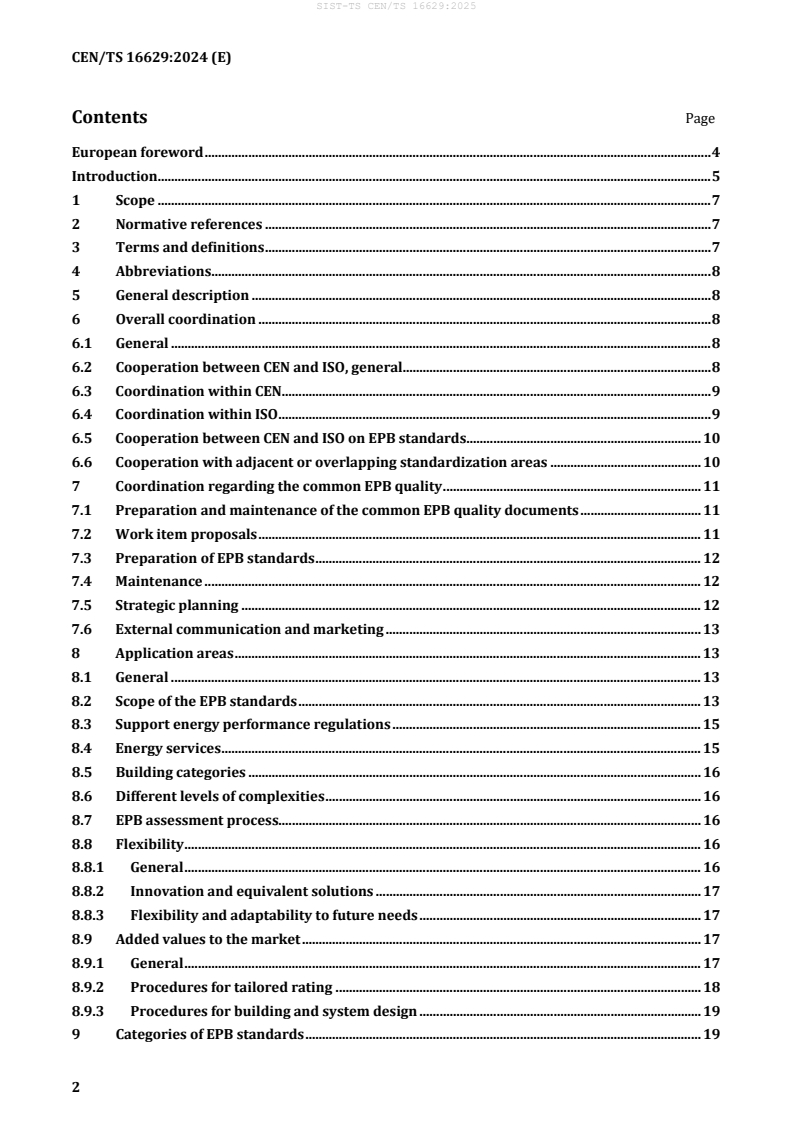
Contents Page
European foreword . 4
Introduction. 5
1 Scope . 7
2 Normative references . 7
3 Terms and definitions . 7
4 Abbreviations . 8
5 General description . 8
6 Overall coordination . 8
6.1 General . 8
6.2 Cooperation between CEN and ISO, general. 8
6.3 Coordination within CEN . 9
6.4 Coordination within ISO . 9
6.5 Cooperation between CEN and ISO on EPB standards. 10
6.6 Cooperation with adjacent or overlapping standardization areas . 10
7 Coordination regarding the common EPB quality . 11
7.1 Preparation and maintenance of the common EPB quality documents . 11
7.2 Work item proposals . 11
7.3 Preparation of EPB standards . 12
7.4 Maintenance . 12
7.5 Strategic planning . 12
7.6 External communication and marketing . 13
8 Application areas . 13
8.1 General . 13
8.2 Scope of the EPB standards . 13
8.3 Support energy performance regulations . 15
8.4 Energy services . 15
8.5 Building categories . 16
8.6 Different levels of complexities . 16
8.7 EPB assessment process. 16
8.8 Flexibility . 16
8.8.1 General . 16
8.8.2 Innovation and equivalent solutions . 17
8.8.3 Flexibility and adaptability to future needs . 17
8.9 Added values to the market . 17
8.9.1 General . 17
8.9.2 Procedures for tailored rating . 18
8.9.3 Procedures for building and system design . 19
9 Categories of EPB standards . 19
9.1 Modular structure . 19
9.2 Themes and use categories . 21
9.3 Numbering of the EPB documents . 22
10 Aspects related to national implementation . 22
10.1 General . 22
10.2 National choices . 22
10.3 Optional national application document . 23
10.4 Technical information on the set of EPB standards and feedback . 24
11 Common rules to verify the quality and consistency . 24
11.1 General . 24
11.2 Interoperability of each EPB standard . 24
11.3 Verification and demonstration of individual EPB calculation standards . 25
11.4 Relevance, sensitivity and balanced accuracy . 25
11.5 Transparency aspects . 25
11.6 Common example cases . 25
12 Overarching structure of each EPB standard and supporting documents . 25
12.1 Partitioning into documents . 25
12.2 Normative standards and informative accompanying TRs . 26
12.3 Common terms, definitions and symbols . 27
12.4 Common assessment boundaries . 27
12.5 Common building and systems partitioning rules for EPB assessment . 27
12.6 List of technologies to be covered . 27
12.7 Matching calculation time intervals . 27
12.8 Common rules on input values and assumptions . 27
12.9 Common operating assumptions and environment conditions . 29
12.10 Common overarching output . 29
13 Digital transformation . 29
14 Common template and editorial rules for each standard . 29
14.1 General . 29
14.2 Common template of an EPB standard . 29
14.3 Common technical and editorial rules for an EPB standard . 30
14.4 Common template and technical and editorial rules for an accompanying TR . 30
14.5 Common template and technical and editorial rules for a spreadsheet . 30
Annex A (normative) The numbering of the ISO 52000 family . 32
Bibliography . 39
European foreword
This document (CEN/TS 16629:2024) has been prepared by Technical Committee CEN/TC 371 “Energy
performance of Buildings”, the secretariat of which is held by NEN.
Attention is drawn to the possibility that some of the elements of this document may be the subject of
patent rights. CEN shall not be held responsible for identifying any or all such patent rights.
This document supersedes CEN/TS 16629:2014.
CEN/TS 16629:2024 includes the following significant technical changes with respect to the previous
editions of CEN/TS 16629:
— The changes in the organization that aims to safeguard the overall quality and consistency of the set
of EPB standards, both in CEN and in ISO.
— Removal of redundant content that, after the publication of CEN/TS 16628 has been covered
elsewhere.
— Improvements based on experience from the preparation of the EPB standards since 2014
— Changes in the CEN and ISO rules.
— Discussions in the context of the preparation of a guidance document for the 2022 Systematic Review
of the EPB standards that were published in 2017.
— The digital transformation process: further -proactive- steps into the direction of making the
standards (closer to) machine readable and software ready (ISO SMART initiative [4], CEN initiative
Standards of the Future [5])
— In Europe, the European Directive on the Energy Performance of Buildings (EPBD) was revised
(2024) [3]. The role of the set of EPB standards is reinforced. There are also important changes in the
requirements on EPB calculation procedures and EPB indicators, minimum requirements and
certificates.
This document has been prepared under a standardization request addressed to CEN by the European
Commission. The Standing Committee of the EFTA States subsequently approves these requests for its
Member States.
Any feedback and questions on this document should be directed to the users’ national standards body.
A complete listing of these bodies can be found on the CEN website.
According to the CEN-CENELEC Internal Regulations, the national standards organisations of the
following countries are bound to implement this European Standard: Austria, Belgium, Bulgaria, Croatia,
Cyprus, Czech Republic, Denmark, Estonia, Finland, France, Germany, Greece, Hungary, Iceland, Ireland,
Italy, Latvia, Lithuania, Luxembourg, Malta, Netherlands, Norway, Poland, Portugal, Republic of North
Macedonia, Romania, Serbia, Slovakia, Slovenia, Spain, Sweden, Switzerland, Türkiye and the United
Kingdom.
Introduction
CEN/TS 16629:2014 was prepared under a mandate given to CEN by the European Commission and the
European Free Trade Association (Mandate M/480 [1]) to support requirements of EU Directive
2010/31/EC on the energy performance of buildings (EPBD [2]). It formed part of a series of standards
aimed at European harmonization of the methodology for the calculation of the energy performance of
buildings.
This document replaces CEN/TS 16629:2014 and aims to support the EPBD 2024 [3]. At the same time
this document aims to be of global relevance, because many EPB standards are also available at global
level as EN ISO standards and their number is increasing. This development strengthens the quality and
usability of the whole set of EPB standards. In case there are conflicting needs at a certain level of detail,
parallel options can be provided, as explained in this document.
The EPBD [3] Intends to promote the improvement of the energy performance of buildings and the
reduction of greenhouse gas emissions from buildings within the European Union, with a view to
achieving a zero-emission building stock by 2050 taking into account outdoor climatic and local
conditions, as well as indoor climate requirements and cost-effectiveness. This Directive lays down
requirements as regards the common general framework for a methodology for calculating the integrated
energy performance of buildings and building units, the application of minimum requirements to the
energy performance of new buildings and new building units, existing buildings and building units that
are subject to major renovation, building envelope elements and technical building systems whenever
they are installed, retrofitted, replaced or upgraded. The Directive also lays down requirements as
regards to the application of minimum energy performance standards (read: requirements) to existing
buildings and existing building units, renovation passports, national building renovation plans,
sustainable mobility infrastructure in and adjacent to buildings, smart buildings, energy performance
certification of buildings or building units and specific inspection and control processes.
The use of international standards increases the accessibility, transparency and objectivity of the energy
performance assessment in the CEN and ISO member countries, facilitating the comparison of best
practices and supporting the market for high performing construction products. The use of EPB standards
for calculating energy performance, as well as for energy performance certification and the inspection of
heating systems and boilers, ventilation and air-conditioning systems will reduce costs compared to
developing different standards at national level.
The mandate to CEN (M/480) [1] was issued to reformulate and add standards so that they become on
the one hand unambiguous and compatible, and on the other hand a clear and explicit overview of the
choices, boundary conditions and input data that need to be defined at national or regional level. Some
national or regional choices may remain necessary, due to differences in climate, culture and building
tradition, policy and legal frameworks. EPB standards should be flexible enough to allow for necessary
national and regional differentiation and facilitate implementation in different countries and the setting
of national or regional energy performance requirements.
The set of EPB standards aims to form a comprehensive package that is manageable and user-friendly for
regulators, product technical specification drafters, drafters of European Assessment Documents (EAD),
producers, notified bodies and users.
The basic principles and detailed technical rules were developed to ensure the necessary overall
consistency in terminology, approach, input/output relations and formats in all EPB standards. In these
rules and specifications, requirements from competent national legal authorities of EU and EFTA Member
States were taken into account.
This document has been developed to guide all future work on EPB standards. In order to facilitate
coordination, consistency and coherence of the set of EPB standards the following tools are available:
a) a Technical Specification on the basic principles to be followed in drafting EPB standards
CEN/TS 16628;
b) a Technical Specification on the detailed technical rules to be followed in drafting EPB standards (this
document);
c) in addition, the following documents are available at committee level:
1) a template for the EPB standards;
2) a template for the EPB TRs that will accompany each EPB standard;
NOTE Other available support tools and documentation:
1) a spreadsheet template to be used to demonstrate the correctness and usability of the standardized
calculation procedures.
2) a guide to fill in National Annexes [6]
3) EPB Center website [7] with background information, explanation, FAQs, short videos, case studies and
more.
The numbering of the clauses and subclauses in this document follows the numbering of clauses and
subclauses in CEN/TS 16628. The Annexes in this document are used for more detailed information on
specific subjects.
1 Scope
This document describes the detailed technical rules to be followed in the development and maintenance
of standards intended to support the assessment of the overall energy performance of a building (EPB)
using a holistic approach.
This document supports the development and maintenance of a set of EPB standards that provides a
systematic, clear, consistent and comprehensive methodology for the benefit of professionals and
government entities. The main application is the assessment of the overall energy performance of a
building in the context of building regulations, e.g. to specify EP requirements, EP rating and EP
certificates.
The rules cover general and common aspects on the required quality, accuracy, usability, consistency and
interoperability of the EPB standards as a set and individually. For that purpose, this document provides
guidance on the process, structure and layout of these EPB standards and accompanying publications,
complementary to the CEN and ISO internal regulations.
This document is based on the basic principles given in CEN/TS 16628, and is complemented by the
overarching EPB standard, EN ISO 52000-1 and supporting documents.
2 Normative references
The following documents are referred to in the text in such a way that some or all of their content
constitutes requirements of this document. For dated references, only the edition cited applies. For
undated references, the latest edition of the referenced document (including any amendments) applies.
CEN ISO/TR 52000-2, Energy performance of buildings — Overarching EPB assessment — Part 2:
Explanation and justification of ISO 52000-1 (ISO/TR 52000-2)
CEN/TS 16628:2024, Energy Performance of Buildings — Basic Principles for the set of EPB-standards
EN ISO 52000-1:2017, Energy performance of buildings — Overarching EPB assessment — Part 1: General
framework and procedures (ISO 52000-1:2017)
EN ISO 52003-1, Energy performance of buildings — Indicators, requirements, ratings and certificates —
Part 1: General aspects and application to the overall energy performance (ISO 52003-1)
3 Terms and definitions
For the purposes of this document, the terms and definitions given in EN ISO 52000-1:2017 and the
following apply.
ISO and IEC maintain terminology databases for use in standardization at the following addresses:
— ISO Online browsing platform: available at http://www.iso.org/obp
— IEC Electropedia: available at http://www.electropedia.org/
3.1
EPB standard
standard that complies with the requirements given in EN ISO 52000-1, CEN/TS 16628 and
CEN/TS 16629 (the underlying document) or superseding documents
[SOURCE: ISO 52000-1:2017, 3.5.14, modified — The definition has been editorially revised.]
4 Abbreviations
Abbreviation Term
EC European Commission
EP energy performance
EPB energy performance of buildings
EPBD European directive on the energy performance of
buildings
IEQ indoor environmental quality
JAG joint advisory group
JWG joint working group
NSB National Standards Body of CEN and/or ISO
NWIP New Work Item Proposal
TC Technical Committee
TR Technical Report (of CEN or ISO)
5 General description
See CEN/TS 16628:2024, Clause 5. The various aspects involved are worked out successively in the
following clauses. The numbering of the clauses in this document corresponds to the numbering in
CEN/TS 16628.
6 Overall coordination
6.1 General
The basic principles described in CEN/TS 16628:2024, 6.1 shall be applied on the set of EPB standards.
Practical rules for cooperation have been set up and are regularly updated based on the experience and
feedback since the early days (2009) of the development of the set of EPB standards.
6.2 Cooperation between CEN and ISO, general
CEN ISO cooperation regarding individual EPB standards is based on the Vienna Agreement between CEN
and ISO [8].
NOTE According to the Vienna Agreement, the revision of EN ISO standards is under ISO lead. If agreed by the
CEN and ISO technical bodies, and specifically by the non-European members of the ISO technical body, the lead can
however be assigned to CEN.
CEN and ISO have collaborated since decades to develop and publish common (EN ISO) standards to
assess the thermal and solar properties of building components and elements, to calculate the energy
needs for heating and cooling and to gather climatic data for energy calculations. Under Mandate M/480
these standards became part of the set of EPB standards. In addition, as a result of the work under
Mandate M/480 and follow up activities, EPB standards from other areas were also prepared and
published as EN ISO standards, including a number of overarching and other key EPB standards.
See Introduction.
6.3 Coordination within CEN
To guard the coherency of EPB standards within CEN, central coordination by CEN/TC 371 (Energy
performance of buildings) is required combined with active involvement and commitment of the five
parallel CEN/TCs who have the technical expertise and competence regarding specific technological
fields under the holistic approach:
— CEN/TC 89, Thermal performance of buildings and building components;
— CEN/TC 156, Ventilation for buildings;
— CEN/TC 169, Light and lighting;
— CEN/TC 228, Heating systems and water-based cooling systems in buildings;
— CEN/TC 247, Building automation, controls and building management.
The preparation of overarching EPB standards is assigned to CEN/TC 371.
CEN/TC 371 is also responsible for the coordination of the overall quality and consistency of the set of
EPB standards in CEN (to prepare the rules and check the implementation) and for the overall strategy
and communication regarding the total set.
In order to ensure that work on (possible) EBP standards complies with common EPB quality
requirements set by CEN/TC 371 and the technical requirements set by the competent TCs, team leaders
of groups of experts revising or drafting EPB standards are preferably appointed as formal liaison experts
by the associated “parallel” TC to CEN/TC 371. Their task is to ensure that the contribution from the
competent TC complies with the common EPB quality requirements and to report on any differences and
considerations and by encompassing the respective decisions to the competent TC and CEN/TC 371.
6.4 Coordination within ISO
The preparation of EPB standards of common interest of ISO/TC 163 and ISO/TC 205 is assigned to the
Joint Working Group of ISO/TC 163 and ISO/TC 205. This concerns mainly overarching EPB standards.
The coordination of the overall quality and consistency of the set of EPB standards in ISO is in the hands
of:
— the Joint Advisory Group of ISO/TC 205 and ISO/TC 163 (ISO/TC 205/JAG1, Coordination of
ISO 52000 family),
— the ISO/TC 163 and TC 205 Joint Working Group (ISO/TC 163/JWG 4, Energy Performance of
Buildings using the holistic approach)
The JAG and JWG are complementary. The raison d’être of the JWG is to prepare documents (standards,
technical specifications and TRs), as assigned to it by the parent committees. The JAG is under direct
authority of the committee leaderships to ensure practical coordination and advise.
The core of the ISO JAG consists of the leadership of the JWG and the leaderships of ISO/TC 163, ISO/TC
205 and ISO/TC 163/SC 2, because the core of the holistic approach on EPB is by these committees. The
ISO Technical Programme Manager (TPM) is also involved, because of the ISO 52000 family numbering,
links with the Technical Management Board (TMB) and other committees and external communication.
A liaison is established with ISO/TC 274 (Light and lighting).
A detailed task distribution between JWG and JAG has been worked out and decided by ISO/TC 163 and
ISO/TC 205 in 2018 [9]. This includes preparation of the common EPB quality rules and checking their
implementation, overall strategy and communication regarding the total set, issuing numbers of the
ISO 52000 family of EPB standards, monitoring the quality during the development of an EPB standard,
identification of work and more.
6.5 Cooperation between CEN and ISO on EPB standards
Good working relations have been established and should be maintained at experts level: many of the
European experts are also active in the ISO working groups and, in case of CEN lead, non-European ISO
experts are invited in CEN working groups, in accordance with the CEN and ISO rules.
With regard to the preparation of a common EN ISO standard:
Different choices between CEN and ISO can be made in the same way as choices that are provided at
national or regional level via the normative template for the national choices (National Annex) of each
EPB standard.
A special type of difference is on referencing other standards:
Practical solutions to make a differentiation for different regions within a common EN ISO standard have
also been developed in consultation with both CEN/CCMC and ISO/CS. CEN members are bound to adopt
European Standards at national level. They can only make reference to these even in case where there is
a corresponding ISO standard. In consultation with both CEN/CCMC and ISO/CS a practical solution has
been worked out, by the introduction of a normative annex, to indicate the regions for which the different
references are applicable. An example will be given in the common template for EPB standards. New
options should be explored, based on experiences in other domains (e.g. CEN Eurocodes), feedback from
the NSBs and new options provided by the most recent CEN and ISO directives.
NOTE If all options to solve problems in developing an EN ISO standard have failed, developing separate
standards is possible. The Vienna Agreement on the co-operation between CEN and ISO ([8]) leaves the possibility
open to go separate ways at any moment, for each individual work item, if necessary.
Of course, the national choices that are offered in each EPB standard can also be used to differentiate
between CEN and ISO needs or wishes within the same EPB standard.
Therefore, a specific difference does not necessarily have to lead to different standards with the risk of
increased divergence and mismatch.
CEN ISO collaboration is also needed to safeguard the overall quality and consistency of the set of EPB
standards:
— On the preparation of the EPB quality documents: CEN/TS 16628 and CEN/TS 16629 (this document)
and on checking the implementation;
— the specification of overarching issues provided in EN ISO 52000-1;
— the standardization process;
— strategy and communication.
This collaboration is organized by liaising the chairperson of CEN/TC 371 to the ISO JAG and by mutual
liaisons between the relevant CEN and ISO committees.
6.6 Cooperation with adjacent or overlapping standardization areas
Important adjacent standardization areas are:
— Assessment of product data as input for specific EPB standards:
— CEN:
— Sector Forum on Construction
— CEN/TC 88 Thermal insulating materials and products
— All relevant ISO and CEN committees providing test methods for building components and
services included in the EPB assessment
EXAMPLE
— CEN: CEN/TC 312 Thermal solar systems, CEN/TC 113 Heat pumps and air conditioning units
— ISO: ISO/TC 59 Buildings and civil engineering works
— Assessment of carbon footprint or sustainability of a building or the built environment, using
output of the set of EPB standards as input:
— CEN: TC 350 Sustainability of construction works
— ISO: ISO/TC 59/SC 17 Sustainability in buildings and civil engineering works
NOTE In general, for this purpose, all data needed for LCA (such as: amount, thickness, length, are, weight,
density) need to be available for all products dealt with in the EPB calculation. This includes heat pumps and its
refrigerants, pumps, etc. Many of these are not needed for the EPB assessment.
— Energy management:
— CEN/CENELEC: CEN/CLC/TC 14 - Energy management, energy audits, energy savings
— CENELEC: CLC/TC 205 Home and Building Electronic Systems (HBES)
— ISO: ISO/TC 301 Energy management and energy savings
— Building information modelling (BIM):
— CEN: CEN/TC 442 Building information modelling
— ISO: ISO/TC 59/SC 13 Organization and digitization of information about buildings and civil
engineering works, including building information modelling (BIM)
In most of these areas the work is done in collaboration between CEN and ISO.
Cooperation between these committees shall aim to increase the relevance of the set of EPB standards.
The technical bodies shall do their best to achieve awareness and recognition of the set of EPB standards.
7 Coordination regarding the common EPB quality
7.1 Preparation and maintenance of the common EPB quality documents
The EPB quality assurance documents should be kept up-to-date, in collaboration between CEN and ISO.
Cooperation on EN ISO 52000-1 is established via the Vienna Agreement between ISO and CEN. ISO/JAG
accepted that the revision of CEN/TS 16628 and CEN/TS 16629 (the underlying document) will be done
by CEN/TC 371. Feedback from ISO will be organized via the JAG.
7.2 Work item proposals
In CEN:
It is the task of CEN/TC 371, in consultation with the other relevant CEN committees, to check if a new
work item proposal and/or proposal for revision of an existing EPB standard or TR fits in the set of EPB
standards and to check if the proposed numbering is in line with the agreed numbering system (see 9.3).
The relevant other CEN committees are CEN/TC 89, TC 156, TC 169, TC 228 and TC 247. Liaisons between
CEN/TC 371 and these committees are established for this purpose.
If such proposal comes from another CEN committee, adoption as EPB standard shall only be accepted
under the condition that the other committee accepts the common set of requirements for all EPB
standards. This would include acceptance of involvement of the CEN/TC 371 leadership during the
development of the document(s), from the perspective of the quality assurance of the set of EPB
standards, and agreeing to the requirements for EPB standards, given in EN ISO 52000-1, CEN/TS 16628
and CEN/TS 16629 (this document) or superseding documents.
In ISO:
The ISO/TC 205 and TC 163 JAG (Coordination of the ISO 52000 family of standards), in short: the JAG, has
the task to check if a new work item proposal and/or proposal for revision of an existing ISO 52000
standard or TR fits in the set of EPB standards and to advise both TC leaderships and the TC 163 and TC
205 Technical Programme Manager, on the issuing of an appropriate number from the ISO 52000 family
(see 9.3).
If such proposal comes from another ISO committee than TC 163 and TC 205, an appropriate number
from the ISO 52000 family will only be issued under the condition that the other committee accept the
common set of requirements for all EPB standards. This would include acceptance of involvement of the
JAG during the development of the document(s), from the perspective of the quality assurance of the set
of EPB standards.
7.3 Preparation of EPB standards
In CEN it is the CEN/TC 371 leadership and in ISO it is the JAG that have the task to monitor, during the
development of an EPB document, that the set of requirements for all EPB standards are met. The
CEN/TC 371 leadership is represented in the ISO JAG for coordination between ISO and CEN.
Also the CEN/TC 371/WG 2 Chair Advisory Group (CAG) has been established to coordinate between all
concerned CEN/TCs. Members of the CAG are the leaderships of the concerned TCs.
For efficiency reasons the correct use of the common template for all EPB standards should be checked
before public enquiry of the document (ISO/DIS, prEN). This can prevent many comments from NSBs and
the CEN or ISO Editorial Programme Manager during enquiry or DIS and increase the chance that
inconsistencies with other EPB standards are detected and repaired.
For the same reason: in case of an EPB calculation standard, a fully operational draft spreadsheet tool
(see 11.3) should also be available before public enquiry of the document.
Because the EPB standard shall be as concise as possible, it is equally important that a draft of the
accompanying TR (see 12.2) is also already available during enquiry of the EPB standards, to provide
explanation, justification and examples. In case of an EPB calculation standard, the examples shall include
reporting of cases run with the spreadsheet (see 11.3).
7.4 Maintenance
A complete overview of the set of EPB standards is made available and kept up-to-date by the ISO JAG
leadership. They shall inform the related TCs at least once a year.
At the EPB Center website the documents are introduced, with links to the CEN database and ISO
catalogue and links to more detailed information and tools that help interested parties to better
understand and to facilitate the use the set of EPB standards.
For the task to monitor, during the revision of document(s), that the set of requirements for all EPB
standards are met, the same procedure applies as for new documents, as described in 7.2and 7.3.
7.5 Strategic planning
In CEN it is the CEN/TC 371 leadership and in ISO it is the JAG that have the task to identify new work or
identify harmonization areas of existing standards as early as possible, and to optimize the use and
sharing of resources for the development of standards or further harmonization of existing standards
needed for the assessment of the energy performance of buildings, including guidance on the assignment
of the work.
This includes:
— To encourage, collect and analyse feedback from CEN and ISO national members and other
stakeholders on the quality, usability and completeness of the set of EPB standards, with the aim to
increase the confidence in and usability of the set, also in the light of technical innovations and other
new demands.
— To identify adjacent areas of work that are important for collaboration and to establish plans for
collaboration, see 6.5.
Several experts on the EPB standards are active in the EPB Center to support the implementation and
application of the set of EPB standards in practice. For this purpose, the EPB Center experts maintain
contacts with a variety of stakeholders, including policy makers. The ISO and CEN committees welcome
input and feedback from the EPB Center experts.
7.6 External communication and marketing
The set of EPB standards, and in particular the ISO 52000 family, should be promoted externally at a
regular basis and at special occasions.
For instance in case of publication of a new or revised EPB standard, in case of related international policy
changes or events the following options are available:
— the CEN and ISO communication and marketing department;
— conference and journal papers;
— the public part of the relevant CEN and ISO committee websites;
— the website of the EPB Center.
The coordinating CEN and ISO committees should serve as the CEN and ISO focal points for interfacing
with energy performance of buildings bodies from the United Nations Economic Commission for Europe
(UNECE), and other recognized organizations, including consortia.
More details could e.g. be laid down in the respective business plans and in a common roadmap of
CEN/TC 371, ISO/TC 163 and ISO/TC 205.
8 Application areas
8.1 General
The application areas described in CEN/TS 16628 shall be covered in EN ISO 52000-1 and all other
relevant EPB standards.
It is up to the EPB standards writers to check whether all application areas are covered that are relevant
for the specific EPB standard.
8.2 Scope of the EPB standards
The set of EPB standards is designed to cover collectively:
— (1a) The determination of the overall energy performance assessment for buildings or building units,
under design, new, existing or subject to major renovation. The purpose is to ensure a certain
minimum EP-level and/or to provide information on the energetic quality of the object.
— (1b) The determination of the partial energy performance: thermal energy balance and building
fabric features and technical building systems (e.g. heating, hot water, air conditioning, ventilation
and lighting systems), when newly built, replaced, upgraded or used. The purpose is to ensure a
certain minimum EP-level and/or to provide information on the energetic quality of the object and
on its impact on the overall EPB.
— Specific details:
— Compliance with the energy performance requirements is subject to national or regional
regulations and can be necessary to get a permit to construct or use the building, to renovate
the building or to become eligible for financial schemes.
— The assessment is typically performed by professionals participating in the design or
renovation process or specially trained assessors.
— The enforcement is typically performed by governmental entities or by independent experts
or institutions on behalf of these authorities. The requirements have direct design and
economic consequences for the building or building unit.
— For comparison against benchmarks and legal requirements, the assessment is done or
converted to standard conditions of use and standard outdoor environment conditions.
— (2) The assessment of the indoor environment quality (IEQ) of the building or building unit, covering
information on the thermal comfort, indoor air quality, lighting, acoustics and thermal comfort of
domestic hot water supply. The purpose is twofold: to provide the basis for the (standard) conditions
of use (as function of the type of space) and to determine if the measures to improve the energy
performance do not have a negative impact on the IEQ.
— (3) The methodology for data acquisition and data processin
...