


EN 1427:2015
(Main)Bitumen and bituminous binders - Determination of the softening point - Ring and Ball method
General Information
- Abstract
This European Standard specifies a method for the determination of the softening point of bitumen and bituminous binders in the range of 28 °C to 150 °C.
Technical warning - The change from mercury thermometers to electronic temperature devices has revealed that the temperature definition in the mercury thermometer has not been precise enough to make a correct, unbiased transfer to electronic devices. Care should be taken for softening points ring and ball above 100 °C as the condition may have changed from previous practise to present days testing equipment. Below approx. 100 °C the difference in temperature readings between electronic and mercury stem thermometer is acceptable compared to the repeatability of this test methods. [Reference: ASTM E20 Group]
NOTE The method described is also applicable to bituminous binders that have been recovered from bituminous mixes, e.g. by extraction.
WARNING — Use of this European Standard can involve hazardous materials, operations and equipment. This European Standard does not purport to address all of the safety problems associated with its use. It is the responsibility of the user of this European Standard to establish appropriate safety and health practices and determine the applicability of regulatory limitations prior to use.
- Status
- Withdrawn
- Publication Date
- 30-Jun-2015
- Withdrawal Date
- 16-Sep-2026
- Technical Committee
- CEN/TC 336 - Bituminous binders
- Drafting Committee
- CEN/TC 336/WG 1 - Bituminous binders for paving
- Current Stage
- 9960 - Withdrawal effective - Withdrawal
- Start Date
- 20-May-2026
- Completion Date
- 17-Sep-2026



Overview
EN 1427:2015 - published by CEN - defines the Ring and Ball method for determining the softening point of bitumen and bituminous binders in the range 28 °C to 150 °C. The softening point is the temperature at which a sample, under standardized conditions, attains a specified consistency. The method applies to virgin binders and binders recovered from mixes.
Key topics and technical requirements
- Principle: Two horizontal discs of binder are cast in brass rings; each supports a steel ball. The bath is heated at a controlled rate and the softening point is the mean temperature when each ball falls 25.0 ± 0.4 mm.
- Apparatus: square-shouldered brass rings, pouring plate, stainless-steel balls (diameter 9.50 ± 0.05 mm, mass 3.50 ± 0.05 g), ball guides, ring holder, beaker-type bath and stirrer; automatic/semi-automatic equipment is permitted if calibrated.
- Bath liquids:
- Water for softening points 28–80 °C (initial bath 5 ± 1 °C).
- Glycerol for >80 °C up to 150 °C (initial bath 30 ± 1 °C). Glycerol must meet density and purity requirements.
- Temperature measurement:
- For water tests: sensor range ~0–90 °C, readable to 0.2 °C, accuracy ≤0.3 °C.
- For glycerol tests: range ~30–155 °C, readable to 0.5 °C, accuracy ≤0.3 °C.
- Solid stem mercury thermometers are allowed only where national rules permit; attention is required when converting from mercury to electronic devices - especially above 100 °C (possible systematic differences).
- Sampling & preparation: follows EN 58 and EN 12594; samples must be cast, cooled and trimmed within specified times to avoid bias.
- Calibration & verification: equipment calibration/verification at least annually; thermal response of sensors should be comparable to historical references.
- Safety: standard warns of hazardous materials and operations (e.g., glycerol flash/splash risk above 100 °C) and requires appropriate lab safety practices.
Applications and users
Who uses EN 1427:2015:
- Asphalt and binder manufacturers for quality control and product specification.
- Construction and road authorities for acceptance testing of binders.
- Testing laboratories (commercial, contract, research) performing binder characterization.
- Material engineers and R&D teams assessing modified bitumens or binders recovered from mixes.
Practical uses:
- Routine QC to monitor binder consistency and temperature susceptibility.
- Comparative testing of formulations (e.g., polymer-modified binders).
- Contract compliance and specification verification for paving and roofing materials.
Related standards
- EN 58 - Sampling bituminous binders
- EN 12594 - Preparation of test samples
- EN 12597 - Terminology for bitumen and binders
- EN ISO 3696 - Water for laboratory use
EN 1427:2015 is essential for reliable, standardized softening point measurements (Ring and Ball method) and for ensuring test comparability across laboratories and projects.
Relations
- Effective Date
- 08-Jul-2015
- Effective Date
- 25-Nov-2020
- Effective Date
- 28-Jan-2026
- Effective Date
- 28-Jan-2026
- Effective Date
- 28-Jan-2026
- Effective Date
- 28-Jan-2026
- Effective Date
- 28-Jan-2026
- Effective Date
- 28-Jan-2026
- Effective Date
- 28-Jan-2026
- Effective Date
- 28-Jan-2026
- Effective Date
- 28-Jan-2026
- Effective Date
- 28-Jan-2026
- Effective Date
- 28-Jan-2026
- Effective Date
- 28-Jan-2026
- Effective Date
- 28-Jan-2026
Get Certified
Connect with accredited certification bodies for this standard

DIBt (Deutsches Institut für Bautechnik)
German Institute for Building Technology.
DIN CERTCO
DIN Group product certification.

Element Materials Technology
Materials testing and product certification.
Sponsored listings
Frequently Asked Questions
EN 1427:2015 is a standard published by the European Committee for Standardization (CEN). Its full title is "Bitumen and bituminous binders - Determination of the softening point - Ring and Ball method". This standard covers: This European Standard specifies a method for the determination of the softening point of bitumen and bituminous binders in the range of 28 °C to 150 °C. Technical warning - The change from mercury thermometers to electronic temperature devices has revealed that the temperature definition in the mercury thermometer has not been precise enough to make a correct, unbiased transfer to electronic devices. Care should be taken for softening points ring and ball above 100 °C as the condition may have changed from previous practise to present days testing equipment. Below approx. 100 °C the difference in temperature readings between electronic and mercury stem thermometer is acceptable compared to the repeatability of this test methods. [Reference: ASTM E20 Group] NOTE The method described is also applicable to bituminous binders that have been recovered from bituminous mixes, e.g. by extraction. WARNING — Use of this European Standard can involve hazardous materials, operations and equipment. This European Standard does not purport to address all of the safety problems associated with its use. It is the responsibility of the user of this European Standard to establish appropriate safety and health practices and determine the applicability of regulatory limitations prior to use.
This European Standard specifies a method for the determination of the softening point of bitumen and bituminous binders in the range of 28 °C to 150 °C. Technical warning - The change from mercury thermometers to electronic temperature devices has revealed that the temperature definition in the mercury thermometer has not been precise enough to make a correct, unbiased transfer to electronic devices. Care should be taken for softening points ring and ball above 100 °C as the condition may have changed from previous practise to present days testing equipment. Below approx. 100 °C the difference in temperature readings between electronic and mercury stem thermometer is acceptable compared to the repeatability of this test methods. [Reference: ASTM E20 Group] NOTE The method described is also applicable to bituminous binders that have been recovered from bituminous mixes, e.g. by extraction. WARNING — Use of this European Standard can involve hazardous materials, operations and equipment. This European Standard does not purport to address all of the safety problems associated with its use. It is the responsibility of the user of this European Standard to establish appropriate safety and health practices and determine the applicability of regulatory limitations prior to use.
EN 1427:2015 is classified under the following ICS (International Classification for Standards) categories: 75.140 - Waxes, bituminous materials and other petroleum products; 91.100.50 - Binders. Sealing materials. The ICS classification helps identify the subject area and facilitates finding related standards.
EN 1427:2015 has the following relationships with other standards: It is inter standard links to EN 1427:2007, EN 1427:2026, EN ISO 3696:1995, EN 12597:2024, EN 58:2012, EN 13924-2:2014, EN 13398:2017, EN 13108-3:2006, EN 12068:1998, EN 13108-7:2016, EN 12607-1:2007, EN 15326:2007+A1:2009, EN 14263:2003, EN 12607-1:2014, EN 14261:2003. Understanding these relationships helps ensure you are using the most current and applicable version of the standard.
EN 1427:2015 is available in PDF format for immediate download after purchase. The document can be added to your cart and obtained through the secure checkout process. Digital delivery ensures instant access to the complete standard document.
Standards Content (Sample)
2003-01.Slovenski inštitut za standardizacijo. Razmnoževanje celote ali delov tega standarda ni dovoljeno.Bitumen und bitumenhaltige Bindemittel - Bestimmung des Erweichungspunktes - Ring- und Kugel-VerfahrenBitumes et liants bitumineux - Détermination du point de ramollissement - Méthode Bille et AnneauBitumen and bituminous binders - Determination of the softening point - Ring and Ball method91.100.50Veziva. Tesnilni materialiBinders. Sealing materials75.140Voski, bitumni in drugi naftni proizvodiWaxes, bituminous materials and other petroleum productsICS:Ta slovenski standard je istoveten z:EN 1427:2015SIST EN 1427:2015en,fr,de01-oktober-2015SIST EN 1427:2015SLOVENSKI
STANDARDSIST EN 1427:20071DGRPHãþD
EUROPEAN STANDARD NORME EUROPÉENNE EUROPÄISCHE NORM
EN 1427
July 2015 ICS 91.100.50; 75.140 Supersedes EN 1427:2007English Version
Bitumen and bituminous binders - Determination of the softening point - Ring and Ball method
Bitumes et liants bitumineux - Détermination du point de ramollissement - Méthode Bille et Anneau
Bitumen und bitumenhaltige Bindemittel - Bestimmung des Erweichungspunktes - Ring- und Kugel-Verfahren This European Standard was approved by CEN on 27 May 2015.
CEN members are bound to comply with the CEN/CENELEC Internal Regulations which stipulate the conditions for giving this European Standard the status of a national standard without any alteration. Up-to-date lists and bibliographical references concerning such national standards may be obtained on application to the CEN-CENELEC Management Centre or to any CEN member.
This European Standard exists in three official versions (English, French, German). A version in any other language made by translation under the responsibility of a CEN member into its own language and notified to the CEN-CENELEC Management Centre has the same status as the official versions.
CEN members are the national standards bodies of Austria, Belgium, Bulgaria, Croatia, Cyprus, Czech Republic, Denmark, Estonia, Finland, Former Yugoslav Republic of Macedonia, France, Germany, Greece, Hungary, Iceland, Ireland, Italy, Latvia, Lithuania, Luxembourg, Malta, Netherlands, Norway, Poland, Portugal, Romania, Slovakia, Slovenia, Spain, Sweden, Switzerland, Turkey and United Kingdom.
EUROPEAN COMMITTEE FOR STANDARDIZATION
COMITÉ EUROPÉEN DE NORMALISATION EUROPÄISCHES KOMITEE FÜR NORMUNG
CEN-CENELEC Management Centre:
Avenue Marnix 17,
B-1000 Brussels © 2015 CEN All rights of exploitation in any form and by any means reserved worldwide for CEN national Members. Ref. No. EN 1427:2015 ESIST EN 1427:2015
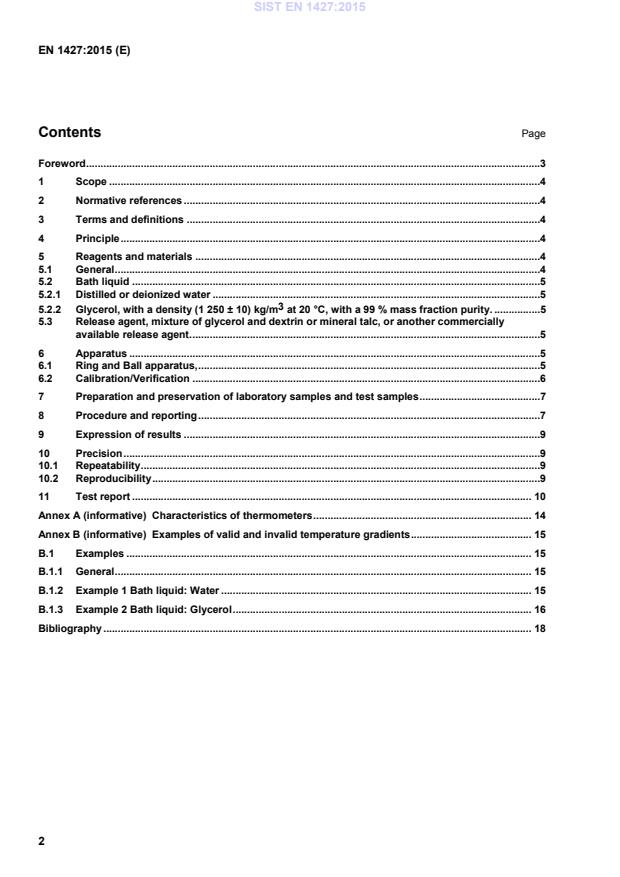
Characteristics of thermometers . 14 Annex B (informative)
Examples of valid and invalid temperature gradients . 15 B.1 Examples . 15 B.1.1 General . 15 B.1.2 Example 1 Bath liquid: Water . 15 B.1.3 Example 2 Bath liquid: Glycerol . 16 Bibliography . 18
A temperature measuring device (combining sensor and reading unit) shall for determination in water: SIST EN 1427:2015
...