


EN 1090-2:2008
(Main)Execution of steel structures and aluminium structures - Part 2: Technical requirements for steel structures
General Information
- Abstract
This European Standard specifies requirements for execution of structural steelwork as structures or as manufactured components, produced from:
a) hot rolled, structural steel products up to and including grade S690;
b) cold formed components and sheeting up to and including grades S700 for stainless steels and including S690 for carbon steels;
c) hot finished and cold formed austenitic, austenitic-ferritic and ferritic stainless steel products;
d) hot finished and cold formed structural hollow sections, including standard range and custom-made rolled products and hollow sections manufactured by welding.
This European Standard may also be used for structural steel grades up to and including S960, provided that conditions for execution are verified against reliability criteria and any necessary additional requirements are specified.
This European Standard specifies requirements independent of the type and shape of the steel structure (e.g. buildings, bridges, plated or latticed components) including structures subjected to fatigue or seismic actions.
This European Standard applies to structures designed according to the relevant part of EN 1993.
This European Standard applies to structural components and sheeting as defined in EN 1993-1-3.
This European Standard applies to steel components in composite steel and concrete structures designed according to the relevant part of EN 1994.
This European Standard may be used for structures designed according to other design rules provided that conditions for execution comply with them and any necessary additional requirements are specified.
This European Standard specifies requirements related to execution classes.
This European Standard specifies requirements related to geometrical tolerances.
NOTE Geometrical tolerances required by EN 1993 design rules are covered by the essential tolerance type.
- Status
- Withdrawn
- Publication Date
- 22-Jul-2008
- Withdrawal Date
- 02-Aug-2011
- Technical Committee
- CEN/TC 135 - Execution of steel structures
- Drafting Committee
- CEN/TC 135 - Execution of steel structures
- Current Stage
- 9960 - Withdrawal effective - Withdrawal
- Start Date
- 03-Aug-2011
- Completion Date
- 03-Aug-2011
- Directive
- Harmonized Standard305/2011 - Regulation (eu) No 305/2011 of the European Parliament and of the Council of 9 march 2011 laying down harmonised conditions for the marketing of construction products and repealing council directive 89/106/eec
Not Harmonized89/106/EEC - Construction products
Relations
- Effective Date
- 22-Dec-2008
- Replaces
ENV 1090-1:1996 - Execution of steel structures - Part 1: General rules and rules for buildings - Effective Date
- 22-Dec-2008
- Replaces
ENV 1090-6:2000 - Execution of steel structures - Part 6: Supplementary rules for stainless steel - Effective Date
- 22-Dec-2008
- Effective Date
- 22-Dec-2008
- Effective Date
- 22-Dec-2008
- Effective Date
- 22-Dec-2008
- Effective Date
- 04-Jun-2011
- Effective Date
- 28-Jan-2026
- Effective Date
- 28-Jan-2026
- Referred By
EN 15048-1:2007 - Non-preloaded structural bolting assemblies - Part 1: General requirements - Effective Date
- 28-Jan-2026
- Effective Date
- 30-Oct-2010
Get Certified
Connect with accredited certification bodies for this standard

DIBt (Deutsches Institut für Bautechnik)
German Institute for Building Technology.
DIN CERTCO
DIN Group product certification.

Aboma Certification B.V.
Specialized in construction, metal, and transport sectors.
Sponsored listings
Frequently Asked Questions
EN 1090-2:2008 is a standard published by the European Committee for Standardization (CEN). Its full title is "Execution of steel structures and aluminium structures - Part 2: Technical requirements for steel structures". This standard covers: This European Standard specifies requirements for execution of structural steelwork as structures or as manufactured components, produced from: a) hot rolled, structural steel products up to and including grade S690; b) cold formed components and sheeting up to and including grades S700 for stainless steels and including S690 for carbon steels; c) hot finished and cold formed austenitic, austenitic-ferritic and ferritic stainless steel products; d) hot finished and cold formed structural hollow sections, including standard range and custom-made rolled products and hollow sections manufactured by welding. This European Standard may also be used for structural steel grades up to and including S960, provided that conditions for execution are verified against reliability criteria and any necessary additional requirements are specified. This European Standard specifies requirements independent of the type and shape of the steel structure (e.g. buildings, bridges, plated or latticed components) including structures subjected to fatigue or seismic actions. This European Standard applies to structures designed according to the relevant part of EN 1993. This European Standard applies to structural components and sheeting as defined in EN 1993-1-3. This European Standard applies to steel components in composite steel and concrete structures designed according to the relevant part of EN 1994. This European Standard may be used for structures designed according to other design rules provided that conditions for execution comply with them and any necessary additional requirements are specified. This European Standard specifies requirements related to execution classes. This European Standard specifies requirements related to geometrical tolerances. NOTE Geometrical tolerances required by EN 1993 design rules are covered by the essential tolerance type.
This European Standard specifies requirements for execution of structural steelwork as structures or as manufactured components, produced from: a) hot rolled, structural steel products up to and including grade S690; b) cold formed components and sheeting up to and including grades S700 for stainless steels and including S690 for carbon steels; c) hot finished and cold formed austenitic, austenitic-ferritic and ferritic stainless steel products; d) hot finished and cold formed structural hollow sections, including standard range and custom-made rolled products and hollow sections manufactured by welding. This European Standard may also be used for structural steel grades up to and including S960, provided that conditions for execution are verified against reliability criteria and any necessary additional requirements are specified. This European Standard specifies requirements independent of the type and shape of the steel structure (e.g. buildings, bridges, plated or latticed components) including structures subjected to fatigue or seismic actions. This European Standard applies to structures designed according to the relevant part of EN 1993. This European Standard applies to structural components and sheeting as defined in EN 1993-1-3. This European Standard applies to steel components in composite steel and concrete structures designed according to the relevant part of EN 1994. This European Standard may be used for structures designed according to other design rules provided that conditions for execution comply with them and any necessary additional requirements are specified. This European Standard specifies requirements related to execution classes. This European Standard specifies requirements related to geometrical tolerances. NOTE Geometrical tolerances required by EN 1993 design rules are covered by the essential tolerance type.
EN 1090-2:2008 is classified under the following ICS (International Classification for Standards) categories: 91.080.10 - Metal structures; 91.080.13 - Steel structures. The ICS classification helps identify the subject area and facilitates finding related standards.
EN 1090-2:2008 has the following relationships with other standards: It is inter standard links to ENV 1090-2:1998, ENV 1090-1:1996, ENV 1090-6:2000, ENV 1090-3:1997, ENV 1090-5:1998, ENV 1090-4:1997, EN 1090-2:2008+A1:2011, EN 74-2:2008, EN 474-11:2022, EN 15048-1:2007, EN 1090-2:2008/FprA1. Understanding these relationships helps ensure you are using the most current and applicable version of the standard.
EN 1090-2:2008 is associated with the following European legislation: EU Directives/Regulations: 305/2011, 89/106/EEC; Standardization Mandates: M/120. When a standard is cited in the Official Journal of the European Union, products manufactured in conformity with it benefit from a presumption of conformity with the essential requirements of the corresponding EU directive or regulation.
EN 1090-2:2008 is available in PDF format for immediate download after purchase. The document can be added to your cart and obtained through the secure checkout process. Digital delivery ensures instant access to the complete standard document.
Standards Content (Sample)
2003-01.Slovenski inštitut za standardizacijo. Razmnoževanje celote ali delov tega standarda ni dovoljeno.Ausführung von Stahltragwerken und Aluminiumtragwerken - Teil 2:Technische Anforderungen an Tragwerke aus StahlExécution des structures en acier et des structures en aluminium – Partie 2: Exigences techniques pour les structures en acierExecution of steel structures and aluminium structures – Part 2: Technical requirements for steel structures91.080.10Kovinske konstrukcijeMetal structuresICS:Ta slovenski standard je istoveten z:EN 1090-2:2008SIST EN 1090-2:2008en,fr,de01-december-2008SIST EN 1090-2:2008SLOVENSKI
STANDARDSIST ENV 1090-4:2001SIST ENV 1090-5:2001SIST ENV 1090-6:2001SIST ENV 1090-1:1999SIST ENV 1090-2:2001SIST ENV 1090-3:20011DGRPHãþD
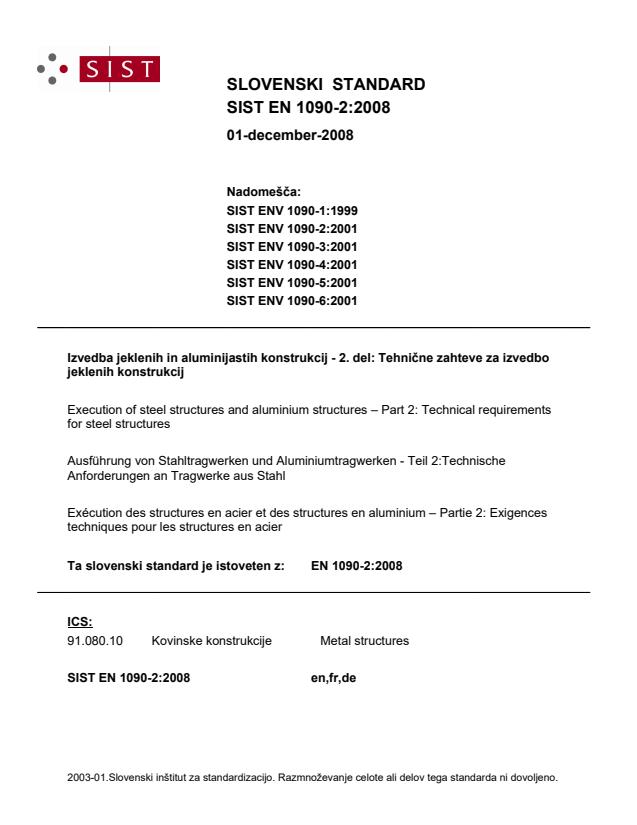
EUROPEAN STANDARDNORME EUROPÉENNEEUROPÄISCHE NORMEN 1090-2July 2008ICS 91.080.10Supersedes ENV 1090-1:1996, ENV 1090-2:1998, ENV1090-3:1997, ENV 1090-4:1997, ENV 1090-5:1998, ENV1090-6:2000
English VersionExecution of steel structures and aluminium structures - Part 2:Technical requirements for steel structuresExécution des structures en acier et des structures enaluminium - Partie 2: Exigences techniques pour lesstructures en acierAusführung von Stahltragwerken und Aluminiumtragwerken- Teil 2:Technische Anforderungen an Tragwerke aus StahlThis European Standard was approved by CEN on 11 April 2008.CEN members are bound to comply with the CEN/CENELEC Internal Regulations which stipulate the conditions for giving this EuropeanStandard the status of a national standard without any alteration. Up-to-date lists and bibliographical references concerning such nationalstandards may be obtained on application to the CEN Management Centre or to any CEN member.This European Standard exists in three official versions (English, French, German). A version in any other language made by translationunder the responsibility of a CEN member into its own language and notified to the CEN Management Centre has the same status as theofficial versions.CEN members are the national standards bodies of Austria, Belgium, Bulgaria, Cyprus, Czech Republic, Denmark, Estonia, Finland,France, Germany, Greece, Hungary, Iceland, Ireland, Italy, Latvia, Lithuania, Luxembourg, Malta, Netherlands, Norway, Poland, Portugal,Romania, Slovakia, Slovenia, Spain, Sweden, Switzerland and United Kingdom.EUROPEAN COMMITTEE FOR STANDARDIZATIONCOMITÉ EUROPÉEN DE NORMALISATIONEUROPÄISCHES KOMITEE FÜR NORMUNGManagement Centre: rue de Stassart, 36
B-1050 Brussels© 2008 CENAll rights of exploitation in any form and by any means reservedworldwide for CEN national Members.Ref. No. EN 1090-2:2008: ESIST EN 1090-2:2008
Additional information, list of options and requirements related to the execution classes.100 A.1 List of required additional information.100 A.2 List of options.103 A.3 Requirements related to the execution classes.107 Annex B (informative)
Guidance for the determination of execution classes.111 B.1 Introduction.111 B.2 Governing factors for choice of execution class.111 B.2.1 Consequence classes.111 SIST EN 1090-2:2008
Check-list for the content of a quality plan.114 C.1 Introduction.114 C.2 Content.114 C.2.1 Management.114 C.2.2 Specification review.114 C.2.3 Documentation.114 C.2.4 Inspection and testing procedures.115 Annex D (normative)
Geometrical tolerances.116 D.1 Essential tolerances.116 D.1.1 Essential manufacturing tolerances – Welded profiles.117 D.1.2 Essential manufacturing tolerances – Press braked cold formed profiles.118 D.1.3 Essential manufacturing tolerances – Flanges of welded profiles.119 D.1.4 Essential manufacturing tolerances – Flanges of welded box sections.120 D.1.5 Essential manufacturing tolerances – Web stiffeners of profiles or box sections.121 D.1.6 Essential manufacturing tolerances – Stiffened plating.123 D.1.7 Essential manufacturing tolerances – Cold formed profiled sheets.124 D.1.8 Essential manufacturing tolerances – Fastener holes, notches and cut edges.125 D.1.9 Essential manufacturing tolerances – Cylindrical and conical shells.126 D.1.10 Essential manufacturing tolerances – Lattice components.127 D.1.11 Essential erection tolerances – Single storey columns.128 D.1.12 Essential erection tolerances – Multi-storey columns.129 D.1.13 Essential erection tolerances – Full contact end bearing.131 D.1.14 Essential erection tolerances – Towers and masts.131 D.1.15 Essential erection tolerances – Beams subject to bending and components subject to compression.132 D.2 Functional tolerances.133 D.2.1 Functional manufacturing tolerances – Welded profiles.134 D.2.2 Functional manufacturing tolerances – Press braked cold formed profiles.135 D.2.3 Functional manufacturing tolerances – Flanges of welded profiles.137 D.2.4 Functional manufacturing tolerances – Welded box sections.138 D.2.5 Functional manufacturing tolerances – Webs of welded profiles or box sections.139 D.2.6 Functional manufacturing tolerances – Web stiffeners of welded profiles or box sections.140 D.2.7 Functional manufacturing tolerances – Components.141 D.2.8 Functional manufacturing tolerances – Fastener holes, notches and cut edges.142 D.2.9 Functional manufacturing tolerances – Column splices and baseplates.143 D.2.10 Functional manufacturing tolerances – Lattice components.144 D.2.11 Functional manufacturing tolerances – Stiffened plating.145 D.2.12 Functional manufacturing tolerances – Towers and masts.147 D.2.13 Functional manufacturing tolerances – Cold formed profiled sheets.148 D.2.14 Functional manufacturing tolerances – Bridge decks.148 D.2.15 Functional erection tolerances – Bridges.150 D.2.16 Functional erection tolerances – Bridge decks (sheet 1/3).151 D.2.17 Functional erection tolerances – Bridge decks(sheet 2/3).152 D.2.18 Functional erection tolerances – Bridges decks (sheet 3/3).153 D.2.19 Functional manufacturing and erection tolerances – Crane beams and rails.154 D.2.20 Functional tolerances – Concrete foundations and supports.155 D.2.21 Functional erection tolerances – Crane runways.157 D.2.22 Functional erection tolerances – Positions of columns.158 D.2.23 Functional erection tolerances – Single storey columns.159 D.2.24 Functional erection tolerances – Multi-storey columns.160 D.2.25 Functional erection tolerances – Buildings.161 D.2.26 Functional erection tolerances – Beams in buildings.162 D.2.27 Functional erection tolerances - Roof sheeting designed as a stressed-skin.163 D.2.28 Functional erection tolerances - Profiled steel sheeting.163 Annex E (informative)
Welded joints in hollow sections.164 E.1 General.164 SIST EN 1090-2:2008
Corrosion protection.172 F.1 General.172 F.1.1 Field of application.172 F.1.2 Performance specification.172 F.1.3 Prescriptive requirements.172 F.1.4 Work method.173 F.2 Surface preparation of carbon steels
...