


SIST EN ISO 13937-4:2000
(Main)Textiles - Tear properties of fabrics - Part 4: Determination of tear force of tongue-shaped test specimens (Double tear test) (ISO 13937-4:2000)
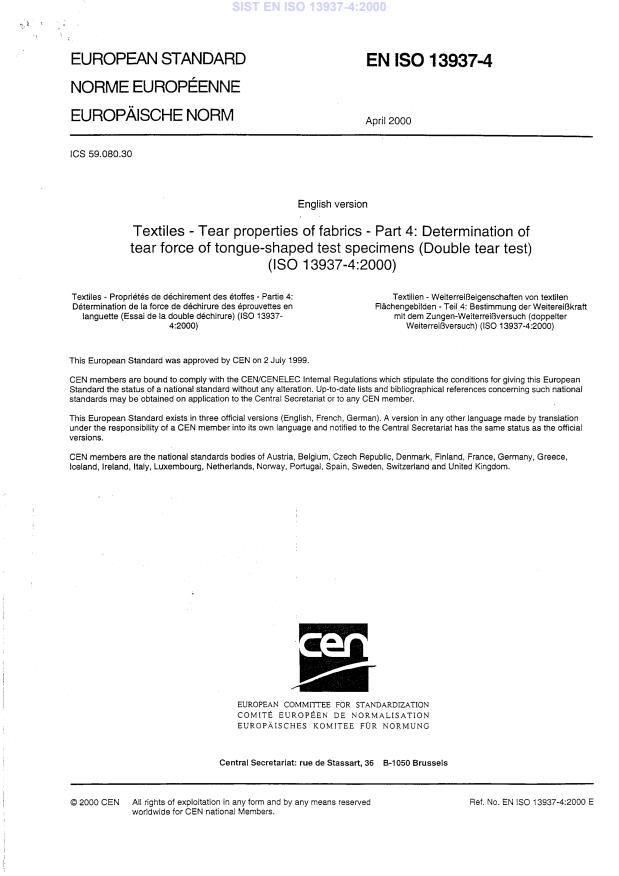
Textiles - Tear properties of fabrics - Part 4: Determination of tear force of tongue-shaped test specimens (Double tear test) (ISO 13937-4:2000)
This Part of EN ISO 13937 describes a double-tear method known as the tongue test, using a test specimen with cuts shaped to form a tongue. The tear force measured is the force required to propagate the previously started double tears when the force is applied parallel to the cuts and the fabric tears in the direction of the applied force.
Textilien - Weiterreißeigenschaften von textilen Flächengebilden - Teil 4: Bestimmung der Weiterreißkraft mit dem Zungen-Weiterreißversuch (doppelter Weiterreißversuch) (ISO 13937-4:2000)
Dieser Teil von EN ISO 13937 beschreibt den Zungen-Weiterreißversuch, bei dem Einschnitte, die eine Zunge formen, in eine Meßprobe geschnitten werden. Die gemessene Weiterreißkraft ist die Kraft, die zum Weiterreißen der beiden zuvor erzeugten Einschnitte erforderlich ist, wenn die Kraft parallel zu den Einschnitten aufgebracht wird und das textile Flächengebilde in Kraftrichtung reißt.
Textiles - Propriétés de déchirement des étoffes - Partie 4: Détermination de la force de déchirure des éprouvettes en languette (Essai de la double déchirure) (ISO 13937-4:2000)
La présente partie de l'ISO 13937 décrit une méthode à double déchirure, appelée essai de languette, effectuée sur une éprouvette découpée en forme de languette. La force de déchirure mesurée est la force nécessaire à la propagation des deux déchirures amorcées lorsque la force est appliquée parallèlement aux entailles et que l'étoffe se déchire dans le sens de l'application de la force.L'essai s'applique essentiellement aux étoffes tissées. Il peut être appliqué aux étoffes produites par d'autres techniques, comme les non-tissés (avec les mêmes restrictions que celles qui sont mentionnées ci-dessous pour les étoffes tissées).En général, l'essai ne s'applique pas aux étoffes tricotées et aux tissus élastiques.La présente méthode permet uniquement l'utilisation d'appareils d'essai à vitesse constante d'allongement (CRE, en anglais : constant rate of extension).NOTE 1 : Pour les autres méthodes d'essai de déchirure utilisant des appareils d'essai de traction, la partie 2 de la norme décrit une méthode appelée essai sur éprouvette pantalon, la partie 3 la méthode de l'essai sur éprouvette croissant et la partie 1 traite de la méthode balistique au pendule (méthode Elmendorf).NOTE 2 : En ce qui concerne la méthode sur éprouvette trapézoïdale, se référer à l'ISO 9073-4 pour les non-tissés et à l'ISO 4674 pour les étoffes revêtues.
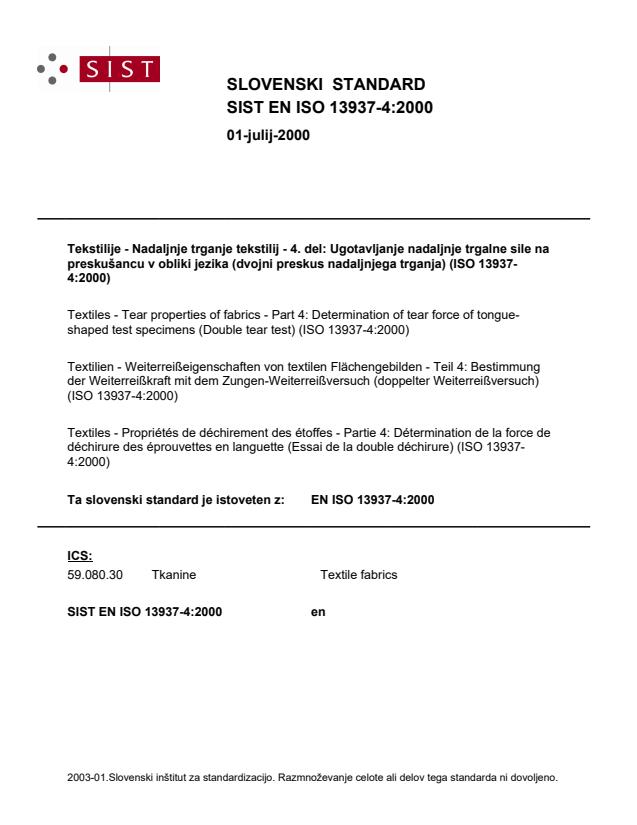
Tekstilije - Nadaljnje trganje tekstilij - 4. del: Ugotavljanje nadaljnje trgalne sile na preskušancu v obliki jezika (dvojni preskus nadaljnjega trganja) (ISO 13937-4:2000)
General Information
- Status
- Published
- Publication Date
- 30-Jun-2000
- Technical Committee
- ITEK - Textile and textile products
- Current Stage
- 6060 - National Implementation/Publication (Adopted Project)
- Start Date
- 01-Jul-2000
- Due Date
- 01-Jul-2000
- Completion Date
- 01-Jul-2000

Relations
- Effective Date
- 28-Jan-2026
- Effective Date
- 22-Dec-2008
Overview
SIST EN ISO 13937-4:2000 is an important international standard that specifies a test method for determining the tear force of textile fabrics using tongue-shaped test specimens, commonly referred to as the double tear test. Published by the Slovenian Institute for Standardization (SIST) and aligned with ISO 13937-4:2000, this standard provides a consistent procedure for assessing the tear properties of woven and non-woven fabrics. Understanding and measuring the tear strength of textiles is essential for evaluating their durability and performance, particularly for applications where fabric integrity is critical.
Key Topics
- Tongue Test Method: The standard describes a method where a tongue-shaped specimen is cut from the fabric. A force is applied parallel to the pre-cut lines, and the force needed to continue tearing the specimen is measured.
- Double Tear Test: This method evaluates the force required to propagate two tears simultaneously, offering a reliable measure of fabric resistance to tearing.
- Test Consistency: By standardizing procedures, the test ensures comparability of results across different materials, laboratories, and applications.
- Measurement of Tear Propagation: The focus is on the force required to propagate an initiated tear, which is often more relevant for end-use performance than the force required to initiate a tear.
Applications
The guidelines and methods outlined in SIST EN ISO 13937-4:2000 are widely applied in the textile industry and research settings. The double tear test is particularly useful for:
- Quality Control: Ensuring textile fabrics used in garments, upholstery, technical textiles, and industrial applications meet durability requirements.
- Product Development: Evaluating and comparing the tear resistance of new fabric constructions and finishes.
- Compliance and Certification: Demonstrating compliance with international safety and durability standards for textiles.
- Performance Assessment: Supporting decision-making for the selection of fabrics in sectors where resistance to tearing is essential, such as outdoor equipment, uniforms, and workwear.
This standard is intended for laboratory use and can be applied to most textile fabrics, regardless of their construction or fiber type.
Related Standards
Several standards are closely linked to SIST EN ISO 13937-4:2000 and provide a broader framework for textile tear strength testing:
- EN ISO 13937-1: Textiles - Tear properties of fabrics - Part 1: Determination of tear force using the Elmendorf method.
- EN ISO 13937-2: Textiles - Tear properties of fabrics - Part 2: Determination of tear force of trouser-shaped test specimens.
- EN ISO 13937-3: Textiles - Tear properties of fabrics - Part 3: Determination of tear force of trapezoid-shaped test specimens.
- ISO 9073-4: Textiles - Test methods for nonwovens - Part 4: Determination of tear resistance.
- General textile testing standards: These offer additional methodologies for assessing other mechanical and physical properties of fabrics.
Summary
SIST EN ISO 13937-4:2000 provides a robust, internationally accepted method for measuring the tear force of textiles using a tongue-shaped specimen in a double tear test. This standard is essential for ensuring fabric performance, aiding in product development, and supporting compliance with quality and safety standards in the global textile industry. Adhering to this method helps manufacturers, laboratories, and researchers ensure that textile products are fit for purpose and meet market expectations for durability and reliability.
Get Certified
Connect with accredited certification bodies for this standard

Control Union Certifications
Global certification for agriculture and sustainability.

Hohenstein Institut
Textile testing and certification.

Bureau Veritas Bangladesh
Bureau Veritas certification services in Bangladesh.
Sponsored listings
Frequently Asked Questions
SIST EN ISO 13937-4:2000 is a standard published by the Slovenian Institute for Standardization (SIST). Its full title is "Textiles - Tear properties of fabrics - Part 4: Determination of tear force of tongue-shaped test specimens (Double tear test) (ISO 13937-4:2000)". This standard covers: This Part of EN ISO 13937 describes a double-tear method known as the tongue test, using a test specimen with cuts shaped to form a tongue. The tear force measured is the force required to propagate the previously started double tears when the force is applied parallel to the cuts and the fabric tears in the direction of the applied force.
This Part of EN ISO 13937 describes a double-tear method known as the tongue test, using a test specimen with cuts shaped to form a tongue. The tear force measured is the force required to propagate the previously started double tears when the force is applied parallel to the cuts and the fabric tears in the direction of the applied force.
SIST EN ISO 13937-4:2000 is classified under the following ICS (International Classification for Standards) categories: 59.080.30 - Textile fabrics. The ICS classification helps identify the subject area and facilitates finding related standards.
SIST EN ISO 13937-4:2000 has the following relationships with other standards: It is inter standard links to SIST EN 4863:2023; is excused to SIST EN ISO 13937-1:2000. Understanding these relationships helps ensure you are using the most current and applicable version of the standard.
SIST EN ISO 13937-4:2000 is available in PDF format for immediate download after purchase. The document can be added to your cart and obtained through the secure checkout process. Digital delivery ensures instant access to the complete standard document.
Standards Content (Sample)
2003-01.Slovenski inštitut za standardizacijo. Razmnoževanje celote ali delov tega standarda ni dovoljeno.Tekstilije - Nadaljnje trganje tekstilij - 4. del: Ugotavljanje nadaljnje trgalne sile na preskušancu v obliki jezika (dvojni preskus nadaljnjega trganja) (ISO 13937-4:2000)Textilien - Weiterreißeigenschaften von textilen Flächengebilden - Teil 4: Bestimmung der Weiterreißkraft mit dem Zungen-Weiterreißversuch (doppelter Weiterreißversuch) (ISO 13937-4:2000)Textiles - Propriétés de déchirement des étoffes - Partie 4: Détermination de la force de déchirure des éprouvettes en languette (Essai de la double déchirure) (ISO 13937-4:2000)Textiles - Tear properties of fabrics - Part 4: Determination of tear force of tongue-s
...