


SIST EN 60335-2-42:2003
(Main)Household and similar electrical appliances - Safety -- Part 2-42: Particular requirements for commercial electric forced convection ovens, steam cookers and steam-convection ovens
Household and similar electrical appliances - Safety -- Part 2-42: Particular requirements for commercial electric forced convection ovens, steam cookers and steam-convection ovens
Deals with the safety of electrically operated commercial forced convection ovens, steam cookers, steam-convection ovens and, exclusive of any other use, steam generators, not intended for household use. The rated voltage being not more than 250 V for single-phase appliances connected between one phase and neutral and 480 V for other appliances. Appliances within the scope of this standard are typically used in restaurants, canteens, hospitals and commercial enterprises such as bakeries, butcheries, etc. The electrical part of appliances making use of other forms of energy is also within the scope of this standard.
Sicherheit elektrischer Geräte für den Hausgebrauch und ähnliche Zwecke -- Teil 2-42: Besondere Anforderungen für elektrische Heißumluftöfen, Dampfgeräte und Heißluftdämpfer für den gewerblichen Gebrauch
Appareils électrodomestiques et analogues - Sécurité -- Partie 2-42: Règles particulières pour les fours électriques à convection forcée, les cuiseurs à vapeur électriques et les fours combinés vapeur-convection électriques à usage collectif
En anglais seulement.
Gospodinjski in podobni električni aparati - Varnost - 2-42. del: Posebne zahteve za komercialne električne pečice s prisilnim kroženjem zraka, parne kuhalnike in pečice s kroženjem pare (IEC 60335-2-42:2002) (vsebuje popravek AC:2007)
Standard obravnava varnost električno upravljanih komercialnih pečic s prisilnim kroženjem zraka, parnih kuhalnikov, pečic s kroženjem pare in generatorjev pare (ki so namenjeni izključno tej uporabi), ki niso namenjeni gospodinjski uporabi. Nazivna napetost mora biti manjša od 250 V za enofazne aparate, priključene med fazo in nevtralni vodnik, in 480 V za ostale aparate. Aparati, ki spadajo v področje uporabe tega standarda, se običajno uporabljajo v restavracijah, menzah, bolnišnicah in komercialnih podjetjih, kot so pekarne, mesnice itd. Tudi električni del aparatov, ki uporabljajo druge vire energije, spada v področje uporabe tega standarda.
General Information
- Status
- Published
- Publication Date
- 30-Apr-2003
- Technical Committee
- VGA - Safety of household and similar electrical appliances
- Current Stage
- 6060 - National Implementation/Publication (Adopted Project)
- Start Date
- 01-May-2003
- Due Date
- 01-May-2003
- Completion Date
- 01-May-2003
Relations
- Effective Date
- 01-May-2003
- Effective Date
- 01-Jan-2025
- Effective Date
- 01-Jan-2025
- Effective Date
- 28-Jan-2023
- Effective Date
- 21-Sep-2010
Overview
EN 60335-2-42:2003 (CLC adoption of IEC 60335-2-42:2002, incl. Corrigendum AC:2007) is a European safety standard for commercial electric forced convection ovens, steam cookers and steam‑convection ovens. It specifies particular safety requirements for electrically operated commercial catering equipment (rated voltage ≤ 250 V single‑phase to neutral, ≤ 480 V for other appliances) that are not intended for household use. The standard supplements and modifies the general safety requirements in EN 60335-1, and is intended for appliances used in restaurants, canteens, hospitals, bakeries, butcheries and similar commercial enterprises.
Key topics and technical requirements
EN 60335-2-42 focuses on electrical and mechanical safety aspects specific to commercial ovens and steam equipment. Main technical topics include:
- Scope & classification: definition of appliances covered (forced convection, steam and combined units) and voltage limits.
- Construction & mechanical safety: stability, mechanical strength, moving parts, access protection and risk reduction for mechanical hazards.
- Heating systems: safe design of heating elements and heat distribution in forced convection and steam modes.
- Electrical safety: requirements for internal wiring, components, terminals, earthing provisions, clearances and creepage distances.
- Moisture and steam resistance: tests and measures to prevent ingress, leakage current and electric strength under operating/steam conditions.
- Abnormal operation & endurance testing: design for foreseeable misuse, overload protection and endurance tests to verify safe operation.
- Marking & instructions: mandatory labelling, operating and installation instructions for safe use and maintenance.
- Fire and heat resistance: materials and construction to resist heat and reduce fire risk.
- Specific tests/annexes: includes normative test methods such as the proof tracking test (Annex N) and other referenced test procedures.
Practical applications and who uses this standard
EN 60335-2-42 is essential for stakeholders involved in the design, manufacture, testing, certification and procurement of commercial catering equipment:
- Manufacturers and Design Engineers - to ensure product designs meet European safety requirements for commercial ovens and steam cookers.
- Test laboratories and Certification Bodies - to perform compliance testing and issue CE conformity evidence under the Low Voltage Directive.
- Safety & Compliance Engineers - to assess risk, prepare technical files and support regulatory approvals.
- Purchasers & Facility Managers (restaurants, hospitals, bakeries) - to specify safe, compliant equipment.
- Regulators and Notified Bodies - to verify conformity with harmonized standards.
Related standards
- EN 60335-1 (Household and similar electrical appliances - Part 1: General requirements) - mandatory companion standard.
- IEC 60335-2-42 (international equivalent) and relevant CENELEC/CENELEC guidance.
- Applicable EU directives: Low Voltage Directive (and considerations from the Machinery Directive as noted in the standard).
Keywords: EN 60335-2-42, commercial electric forced convection ovens, steam cookers, steam-convection ovens, safety standard, IEC 60335-2-42, EN 60335-1, commercial catering equipment, CE compliance.


Frequently Asked Questions
SIST EN 60335-2-42:2003 is a standard published by the Slovenian Institute for Standardization (SIST). Its full title is "Household and similar electrical appliances - Safety -- Part 2-42: Particular requirements for commercial electric forced convection ovens, steam cookers and steam-convection ovens". This standard covers: Deals with the safety of electrically operated commercial forced convection ovens, steam cookers, steam-convection ovens and, exclusive of any other use, steam generators, not intended for household use. The rated voltage being not more than 250 V for single-phase appliances connected between one phase and neutral and 480 V for other appliances. Appliances within the scope of this standard are typically used in restaurants, canteens, hospitals and commercial enterprises such as bakeries, butcheries, etc. The electrical part of appliances making use of other forms of energy is also within the scope of this standard.
Deals with the safety of electrically operated commercial forced convection ovens, steam cookers, steam-convection ovens and, exclusive of any other use, steam generators, not intended for household use. The rated voltage being not more than 250 V for single-phase appliances connected between one phase and neutral and 480 V for other appliances. Appliances within the scope of this standard are typically used in restaurants, canteens, hospitals and commercial enterprises such as bakeries, butcheries, etc. The electrical part of appliances making use of other forms of energy is also within the scope of this standard.
SIST EN 60335-2-42:2003 is classified under the following ICS (International Classification for Standards) categories: 97.040.20 - Cooking ranges, working tables, ovens and similar appliances. The ICS classification helps identify the subject area and facilitates finding related standards.
SIST EN 60335-2-42:2003 has the following relationships with other standards: It is inter standard links to SIST EN 60335-2-42:2001, SIST EN 60335-2-42:2003/A12:2025, SIST EN 60335-2-42:2003/A2:2025, SIST EN 60335-2-42:2003/A11:2012, SIST EN 60335-2-42:2003/A1:2009. Understanding these relationships helps ensure you are using the most current and applicable version of the standard.
SIST EN 60335-2-42:2003 is associated with the following European legislation: EU Directives/Regulations: 2006/42/EC, 2006/95/EC, 2014/35/EU, 73/23/EEC. When a standard is cited in the Official Journal of the European Union, products manufactured in conformity with it benefit from a presumption of conformity with the essential requirements of the corresponding EU directive or regulation.
SIST EN 60335-2-42:2003 is available in PDF format for immediate download after purchase. The document can be added to your cart and obtained through the secure checkout process. Digital delivery ensures instant access to the complete standard document.
Standards Content (Sample)
SLOVENSKI STANDARD
01-maj-2003
Gospodinjski in podobni električni aparati - Varnost - 2-42. del: Posebne zahteve
za komercialne električne pečice s prisilnim kroženjem zraka, parne kuhalnike in
pečice s kroženjem pare (IEC 60335-2-42:2002) (vsebuje popravek AC:2007)
Household and similar electrical appliances - Safety -- Part 2-42: Particular requirements
for commercial electric forced convection ovens, steam cookers and steam-convection
ovens
Sicherheit elektrischer Geräte für den Hausgebrauch und ähnliche Zwecke -- Teil 2-42:
Besondere Anforderungen für elektrische Heißumluftöfen, Dampfgeräte und
Heißluftdämpfer für den gewerblichen Gebrauch
Appareils électrodomestiques et analogues - Sécurité -- Partie 2-42: Règles particulières
pour les fours électriques à convection forcée, les cuiseurs à vapeur électriques et les
fours combinés vapeur-convection électriques à usage collectif
Ta slovenski standard je istoveten z: EN 60335-2-42:2003
ICS:
97.040.20 Štedilniki, delovni pulti, Cooking ranges, working
pečice in podobni aparati tables, ovens and similar
appliances
2003-01.Slovenski inštitut za standardizacijo. Razmnoževanje celote ali delov tega standarda ni dovoljeno.
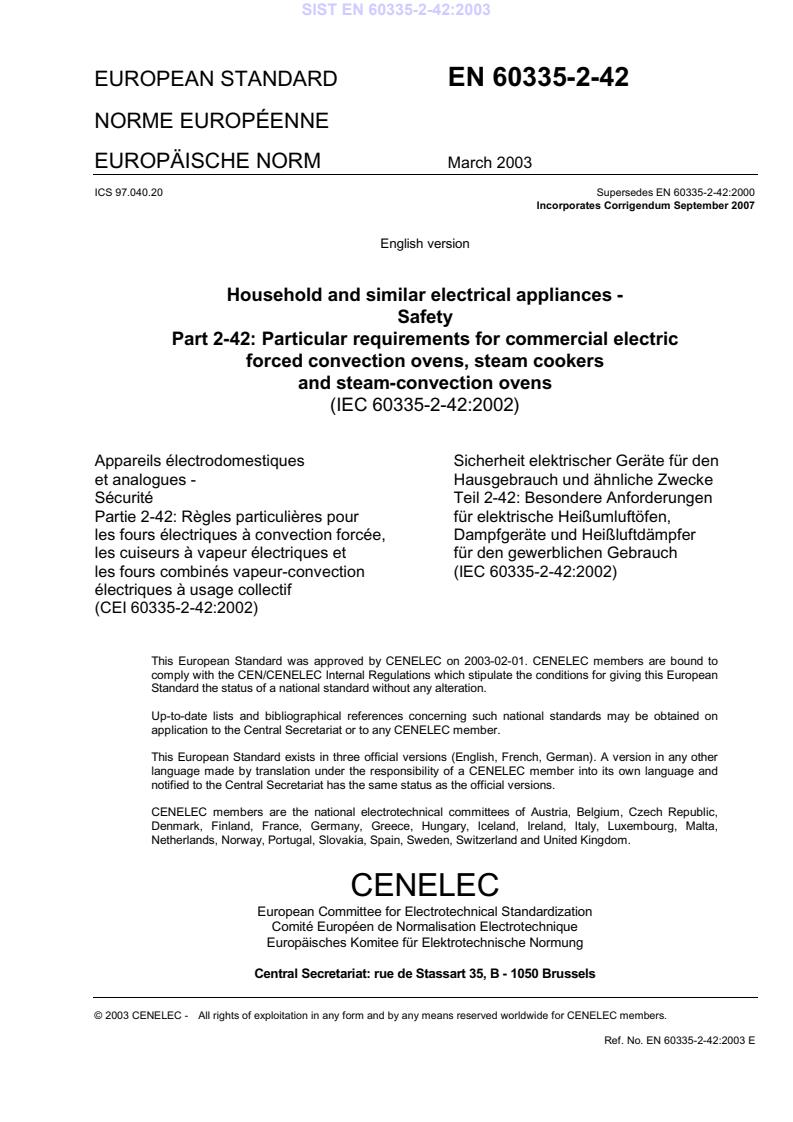
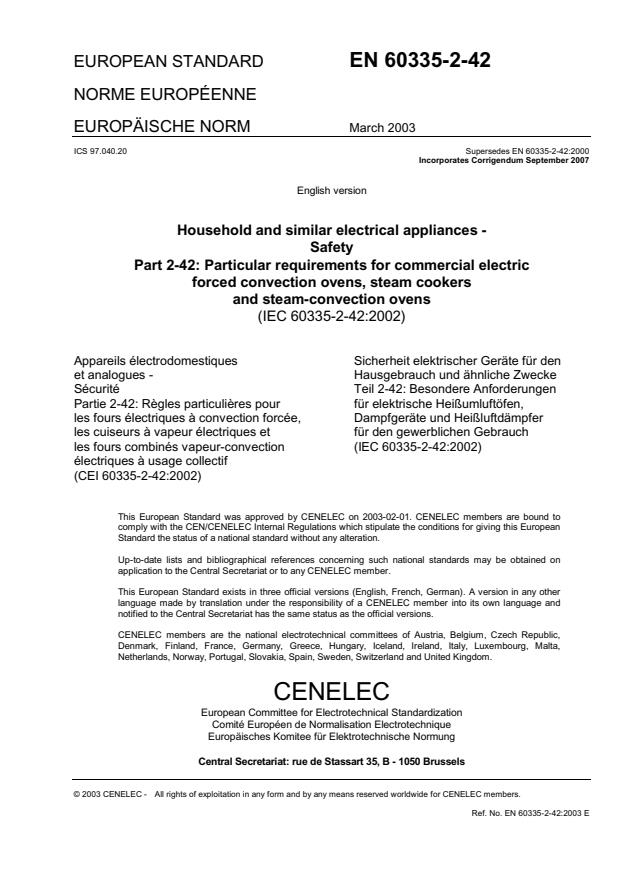
EUROPEAN STANDARD EN 60335-2-42
NORME EUROPÉENNE
EUROPÄISCHE NORM March 2003
ICS 97.040.20 Supersedes EN 60335-2-42:2000
Incorporates Corrigendum September 2007
English version
Household and similar electrical appliances -
Safety
Part 2-42: Particular requirements for commercial electric
forced convection ovens, steam cookers
and steam-convection ovens
(IEC 60335-2-42:2002)
Appareils électrodomestiques Sicherheit elektrischer Geräte für den
et analogues - Hausgebrauch und ähnliche Zwecke
Sécurité Teil 2-42: Besondere Anforderungen
Partie 2-42: Règles particulières pour für elektrische Heißumluftöfen,
les fours électriques à convection forcée, Dampfgeräte und Heißluftdämpfer
les cuiseurs à vapeur électriques et für den gewerblichen Gebrauch
les fours combinés vapeur-convection (IEC 60335-2-42:2002)
électriques à usage collectif
(CEI 60335-2-42:2002)
This European Standard was approved by CENELEC on 2003-02-01. CENELEC members are bound to
comply with the CEN/CENELEC Internal Regulations which stipulate the conditions for giving this European
Standard the status of a national standard without any alteration.
Up-to-date lists and bibliographical references concerning such national standards may be obtained on
application to the Central Secretariat or to any CENELEC member.
This European Standard exists in three official versions (English, French, German). A version in any other
language made by translation under the responsibility of a CENELEC member into its own language and
notified to the Central Secretariat has the same status as the official versions.
CENELEC members are the national electrotechnical committees of Austria, Belgium, Czech Republic,
Denmark, Finland, France, Germany, Greece, Hungary, Iceland, Ireland, Italy, Luxembourg, Malta,
Netherlands, Norway, Portugal, Slovakia, Spain, Sweden, Switzerland and United Kingdom.
CENELEC
European Committee for Electrotechnical Standardization
Comité Européen de Normalisation Electrotechnique
Europäisches Komitee für Elektrotechnische Normung
Central Secretariat: rue de Stassart 35, B - 1050 Brussels
© 2003 CENELEC - All rights of exploitation in any form and by any means reserved worldwide for CENELEC members.
Ref. No. EN 60335-2-42:2003 E
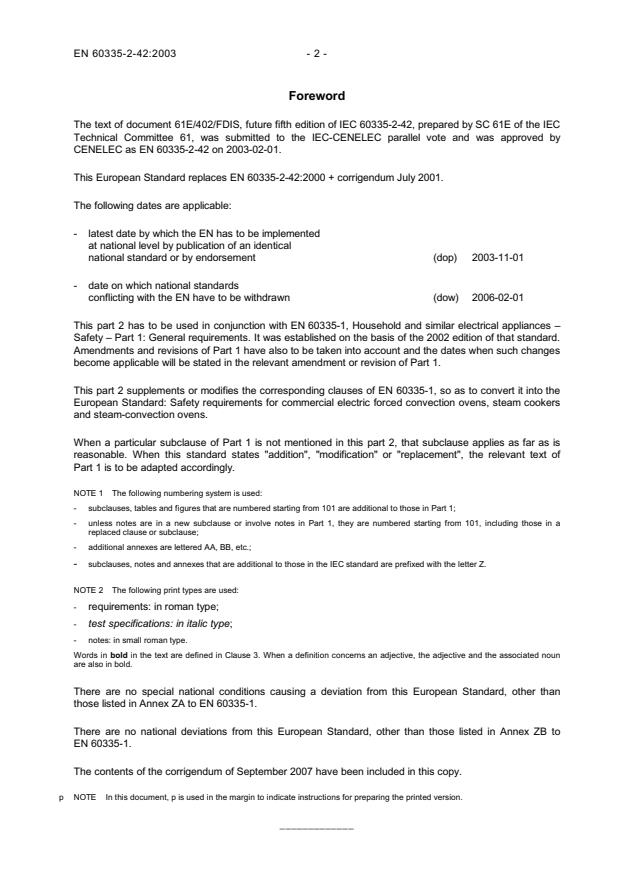
Foreword
The text of document 61E/402/FDIS, future fifth edition of IEC 60335-2-42, prepared by SC 61E of the IEC
Technical Committee 61, was submitted to the IEC-CENELEC parallel vote and was approved by
CENELEC as EN 60335-2-42 on 2003-02-01.
This European Standard replaces EN 60335-2-42:2000 + corrigendum July 2001.
The following dates are applicable:
- latest date by which the EN has to be implemented
at national level by publication of an identical
national standard or by endorsement (dop) 2003-11-01
- date on which national standards
conflicting with the EN have to be withdrawn (dow) 2006-02-01
This part 2 has to be used in conjunction with EN 60335-1, Household and similar electrical appliances –
Safety – Part 1: General requirements. It was established on the basis of the 2002 edition of that standard.
Amendments and revisions of Part 1 have also to be taken into account and the dates when such changes
become applicable will be stated in the relevant amendment or revision of Part 1.
This part 2 supplements or modifies the corresponding clauses of EN 60335-1, so as to convert it into the
European Standard: Safety requirements for commercial electric forced convection ovens, steam cookers
and steam-convection ovens.
When a particular subclause of Part 1 is not mentioned in this part 2, that subclause applies as far as is
reasonable. When this standard states "addition", "modification" or "replacement", the relevant text of
Part 1 is to be adapted accordingly.
NOTE 1 The following numbering system is used:
- subclauses, tables and figures that are numbered starting from 101 are additional to those in Part 1;
- unless notes are in a new subclause or involve notes in Part 1, they are numbered starting from 101, including those in a
replaced clause or subclause;
- additional annexes are lettered AA, BB, etc.;
- subclauses, notes and annexes that are additional to those in the IEC standard are prefixed with the letter Z.
NOTE 2 The following print types are used:
- requirements: in roman type;
- test specifications: in italic type;
- notes: in small roman type.
Words in bold in the text are defined in Clause 3. When a definition concerns an adjective, the adjective and the associated noun
are also in bold.
There are no special national conditions causing a deviation from this European Standard, other than
those listed in Annex ZA to EN 60335-1.
There are no national deviations from this European Standard, other than those listed in Annex ZB to
EN 60335-1.
The contents of the corrigendum of September 2007 have been included in this copy.
p NOTE In this document, p is used in the margin to indicate instructions for preparing the printed version.
_____________
- 3 - EN 60335-2-42:2003
Introduction
p Add:
An investigation by CENELEC TC 61 has shown that all risks from products within the scope of this
standard are fully covered by the Low Voltage Directive, 73/23/EEC. For products having mechanical
moving parts, a risk assessment in accordance with the Machinery Directive, 98/37/EC, has shown that
the risks are mainly of electrical origin and consequently this directive is not applicable. However, the
relevant essential safety requirements of the Machinery Directive are covered by this standard together
with the principal objectives of the Low Voltage Directive.
____________
Endorsement notice
The text of the International Standard IEC 60335-2-42:2002 was approved by CENELEC as a European
Standard without any modification.
____________
NORME CEI
INTERNATIONALE IEC
60335-2-42
INTERNATIONAL
Cinquième édition
STANDARD
Fifth edition
2002-11
Appareils électrodomestiques et analogues –
Sécurité –
Partie 2-42:
Règles particulières pour les fours électriques
à convection forcée, les cuiseurs à vapeur
électriques et les fours combinés vapeur-
convection électriques à usage collectif
Household and similar electrical appliances –
Safety –
Part 2-42:
Particular requirements for commercial electric
forced convection ovens, steam cookers and
steam-convection ovens
IEC 2005 Droits de reproduction réservés Copyright - all rights reserved
Aucune partie de cette publication ne peut être reproduite ni No part of this publication may be reproduced or utilized in any
utilisée sous quelque forme que ce soit et par aucun procédé, form or by any means, electronic or mechanical, including
électronique ou mécanique, y compris la photocopie et les photocopying and microfilm, without permission in writing from
microfilms, sans l'accord écrit de l'éditeur. the publisher.
International Electrotechnical Commission, 3, rue de Varembé, PO Box 131, CH-1211 Geneva 20, Switzerland
Telephone: +41 22 919 02 11 Telefax: +41 22 919 03 00 E-mail: inmail@iec.ch Web: www.iec.ch
CODE PRIX
Commission Electrotechnique Internationale PRICE CODE T
International Electrotechnical Commission
Международная Электротехническая Комиссия
Pour prix, voir catalogue en vigueur
For price, see current catalogue
60335-2-42 IEC:2005 – 3 –
CONTENTS
FOREWORD.5
INTRODUCTION.9
1 Scope .11
2 Normative references .11
3 Definitions .11
4 General requirement.15
5 General conditions for the tests .17
6 Classification.17
7 Marking and instructions .17
8 Protection against access to live parts .21
9 Starting of motor-operated appliances.21
10 Power input and current.21
11 Heating .21
12 Void .23
13 Leakage current and electric strength at operating temperature .25
14 Transient overvoltages .25
15 Moisture resistance .25
16 Leakage current and electric strength .29
17 Overload protection of transformers and associated circuits .29
18 Endurance.29
19 Abnormal operation .29
20 Stability and mechanical hazards .31
21 Mechanical strength .35
22 Construction.35
23 Internal wiring.41
24 Components .41
25 Supply connection and external flexible cords .41
26 Terminals for external conductors .43
27 Provision for earthing.43
28 Screws and connections .43
29 Clearances, creepage distances and solid insulation .45
30 Resistance to heat and fire .45
31 Resistance to rusting .45
32 Radiation, toxicity and similar hazards .45
Annexes .49
Annex N (normative) Proof tracking test .49
Bibliography .49
Figure 101 – Splash apparatus.47
60335-2-42 IEC:2005 – 5 –
INTERNATIONAL ELECTROTECHNICAL COMMISSION
____________
HOUSEHOLD AND SIMILAR ELECTRICAL APPLIANCES –
SAFETY –
Part 2-42: Particular requirements for commercial electric forced
convection ovens, steam cookers and steam-convection ovens
FOREWORD
1) The International Electrotechnical Commission (IEC) is a worldwide organization for standardization comprising
all national electrotechnical committees (IEC National Committees). The object of IEC is to promote
international co-operation on all questions concerning standardization in the electrical and electronic fields. To
this end and in addition to other activities, IEC publishes International Standards, Technical Specifications,
Technical Reports, Publicly Available Specifications (PAS) and Guides (hereafter referred to as “IEC
Publication(s)”). Their preparation is entrusted to technical committees; any IEC National Committee interested
in the subject dealt with may participate in this preparatory work. International, governmental and non-
governmental organizations liaising with the IEC also participate in this preparation. IEC collaborates closely
with the International Organization for Standardization (ISO) in accordance with conditions determined by
agreement between the two organizations.
2) The formal decisions or agreements of IEC on technical matters express, as nearly as possible, an international
consensus of opinion on the relevant subjects since each technical committee has representation from all
interested IEC National Committees.
3) IEC Publications have the form of recommendations for international use and are accepted by IEC National
Committees in that sense. While all reasonable efforts are made to ensure that the technical content of IEC
Publications is accurate, IEC cannot be held responsible for the way in which they are used or for any
misinterpretation by any end user.
4) In order to promote international uniformity, IEC National Committees undertake to apply IEC Publications
transparently to the maximum extent possible in their national and regional publications. Any divergence
between any IEC Publication and the corresponding national or regional publication shall be clearly indicated in
the latter.
5) IEC provides no marking procedure to indicate its approval and cannot be rendered responsible for any
equipment declared to be in conformity with an IEC Publication.
6) All users should ensure that they have the latest edition of this publication.
7) No liability shall attach to IEC or its directors, employees, servants or agents including individual experts and
members of its technical committees and IEC National Committees for any personal injury, property damage or
other damage of any nature whatsoever, whether direct or indirect, or for costs (including legal fees) and
expenses arising out of the publication, use of, or reliance upon, this IEC Publication or any other IEC
Publications.
8) Attention is drawn to the Normative references cited in this publication. Use of the referenced publications is
indispensable for the correct application of this publication.
9) Attention is drawn to the possibility that some of the elements of this IEC Publication may be the subject of
patent rights. IEC shall not be held responsible for identifying any or all such patent rights.
This part of International Standard IEC 60335 has been prepared by IEC subcommittee 61E:
Safety of electrical commercial catering equipment, of IEC technical committee 61: Safety of
household and similar electrical appliances.
This fifth edition cancels and replaces the fourth edition published in 2000. It constitutes a
technical revision.
This bilingual version (2005-04) replaces the English version.
60335-2-42 IEC:2005 – 7 –
The text of this part of IEC 60335 is based on the following documents:
FDIS Report on voting
61E/402/FDIS 61E/414/RVD
Full information on the voting for the approval of this standard can be found in the report on
voting indicated in the above table.
The French version of this standard has not been voted upon.
This part 2 is to be used in conjunction with the latest edition of IEC 60335-1 and its
amendments. It was established on the basis of the fourth edition (2001) of that standard.
NOTE 1 When “Part 1” is mentioned in this standard, it refers to IEC 60335-1.
This part 2 supplements or modifies the corresponding clauses in IEC 60335-1, so as to
convert that publication into the IEC standard: Safety requirements for commercial electric
forced convection ovens, steam cookers and steam-convection ovens.
When a particular subclause of Part 1 is not mentioned in this part 2, that subclause applies
as far as is reasonable. When this standard states "addition", "modification" or "replacement", the
relevant text in Part 1 is to be adapted accordingly.
NOTE 2 The following numbering system is used:
– subclauses, tables and figures that are numbered starting from 101 are additional to those in Part 1;
– unless notes are in a new subclause or involve notes in Part 1, they are numbered starting from 101, including
those in a replaced clause or subclause;
– additional annexes are lettered AA, BB, etc.
NOTE 3 The following print types are used:
– requirements: in roman type;
– test specifications: in italic type;
– notes: in small roman type.
Words in bold in the text are defined in Clause 3. When a definition of Part 1 concerns an adjective, the
adjective and the associated noun are also in bold .
The following differences exist in the countries indicated below.
– 6.1: Class 01 appliances are allowed (Japan).
– 6.2: For appliances intended to be installed in a kitchen, an appropriate degree of protection against harmful
ingress of water is required according to their height of installation (France).
– 13.2: Leakage current limits are different (Japan).
– 16.2: Leakage current limits are different (Japan).
– Clause 21: For appliances intended to be installed in a kitchen, different values of impact energy are
applicable according to the height of the impact point (France).
The committee has decided that the contents of this publication will remain unchanged until
the maintenance result date indicated on the IEC web site under "http://webstore.iec.ch" in
the data related to the specific publication. At this date, the publication will be
• reconfirmed;
• withdrawn;
• replaced by a revised edition, or
• amended.
60335-2-42 IEC:2005 – 9 –
INTRODUCTION
It has been assumed in the drafting of this International Standard that the execution of its
provisions is entrusted to appropriately qualified and experienced persons.
This standard recognizes the internationally accepted level of protection against hazards such
as electrical, mechanical, thermal, fire and radiation of appliances when operated as in
normal use taking into account the manufacturer's instructions. It also covers abnormal
situations that can be expected in practice.
This standard takes into account the requirements of IEC 60364 as far as possible so that
there is compatibility with the wiring rules when the appliance is connected to the supply
mains. However, national wiring rules may differ.
If an appliance within the scope of this standard also incorporates functions that are covered
by another part 2 of IEC 60335, the relevant part 2 is applied to each function separately, as
far as is reasonable. If applicable, the influence of one function on the other is taken into
account.
This standard is a product family standard dealing with the safety of appliances and takes
precedence over horizontal and generic standards covering the same subject.
An appliance that complies with the text of this standard will not necessarily be considered to
comply with the safety principles of the standard if, when examined and tested, it is found to
have other features that impair the level of safety covered by these requirements.
An appliance employing materials or having forms of construction differing from those detailed
in the requirements of this standard may be examined and tested according to the intent of
the requirements and, if found to be substantially equivalent, may be considered to comply
with the standard.
60335-2-42 IEC:2005 – 11 –
HOUSEHOLD AND SIMILAR ELECTRICAL APPLIANCES –
SAFETY –
Part 2-42: Particular requirements for commercial electric forced
convection ovens, steam cookers and steam-convection ovens
1 Scope
This clause of Part 1 is replaced by the following.
This International Standard deals with the safety of electrically operated commercial forced
convection ovens, steam cookers, steam-convection ovens and, exclusive of any other
use, steam generators, not intended for household use, their rated voltage being not more
than 250 V for single-phase appliances connected between one phase and neutral and 480 V
for other appliances.
NOTE 101 These appliances are used for example in restaurants, canteens, hospitals and commercial enterprises
such as bakeries, butcheries, etc.
The electrical part of appliances making use of other forms of energy is also within the scope
of this standard.
As far as is practicable, this standard deals with the common hazards presented by these
types of appliances.
NOTE 102 Attention is drawn to the fact that
– for appliances intended to be used in vehicles or on board ships or aircraft, additional requirements may be
necessary;
– in many countries additional requirements are specified by the national health authorities, the national
authorities responsible for the protection of labour, the national water supply authorities and similar authorities;
– in many countries additional requirements are specified for pressure appliances.
NOTE 103 This standard does not apply to
– appliances designed exclusively for industrial purposes;
– appliances intended to be used in locations where special conditions prevail, such as the presence of a
corrosive or explosive atmosphere (dust, vapour or gas);
– continuous process appliances for the mass production of food;
– microwave ovens (IEC 60335-2-90);
2 Normative references
This clause of Part 1 is applicable.
3 Definitions
This clause of Part 1 is applicable except as follows.
3.1.4 Addition:
NOTE 101 The rated power input is the sum of the power inputs of all the individual elements in the appliance
that can be on at one time; where there are several such combinations possible, that giving the highest power
input is used in determining the rated power input.
60335-2-42 IEC:2005 – 13 –
3.1.9 Replacement:
normal operation
operation of the appliance under the following conditions
ƒ Dry heat mode
The appliance is operated with all the shelves or the shelf trolley in position according to the
manufacturer's instructions but with no load. The controls are set so that the mean value
of the temperature over the thermostat cycle at the geometric centre of each usable space in
the interior of the oven is maintained at 220 °C ± 4 °C. Stepped controls are set so that this
temperature is 220 °C ± 15 °C.
For ovens that are unable to attain a temperature of 220 °C, the controls are set at the
maximum.
For ovens that are capable of attaining temperatures in excess of 270 °C, the controls are set
so that the mean value of the temperature is 50 °C ± 4 °C below the maximum temperature
attainable.
ƒ Steaming only mode
The appliance is operated in accordance with the manufacturer's instructions with all controls
intended to be operated by the user adjusted to their maximum setting until reaching
operating temperature. They are then readjusted, if possible, to the lowest setting that
maintains that temperature.
Appliances with steam generators intended to be filled by hand or by a manually operated
tap are filled to the indicated level on the steam generator.
Appliances with steam generators intended to be filled automatically are connected to a
water supply having the pressure designated by the manufacturer. Where the manufacturer
specifies a range of pressures, the pressure is adjusted to give the most unfavourable
conditions.
The incoming water is maintained at
– 15 °C ± 5 °C in the case of appliances intended for connection to a cold water supply;
– 60 °C ± 5 °C or the temperature indicated in the instruction sheet, whichever is the higher,
in the case of appliances intended for connection to a hot water supply only.
NOTE 101 If the appliance is intended for connection to either a hot or cold water supply, the temperature of the
water is that which gives the most unfavourable results.
Lids, doors, and covers are in position and closed.
The cooking compartment of the appliance contains a water load, initially at 15 °C ± 5 °C,
comprising 0,5 l/kg of the manufacturer's declared maximum food load. The water load is
evenly distributed between the shelves or pans.
NOTE 102 Since pans may be perforated to allow for circulation of steam, the water load may be contained in
suitable containers evenly distributed over the shelves or pans.
ƒ Combination mode
The appliance is operated as for the steaming only mode but with the forced convection fan/s
and elements for heating the cooking compartment on and the temperature controls set as
for the dry heat mode.
60335-2-42 IEC:2005 – 15 –
In all the above cases, motors incorporated in the appliance are operated in the intended
manner under the most severe conditions that can be expected in normal use, taking into
account the manufacturer's instructions.
3.101
forced convection oven
an appliance intended for the cooking of food by heated air that is circulated by mechanical
means within the cooking compartment. The pressure within the cooking compartment
does not differ significantly from atmospheric pressure
3.102
steam cooker
an appliance intended for the cooking of food only by means of direct steam contact. The
pressure within the cooking compartment can exceed atmospheric pressure
3.103
atmospheric steam cooker
an appliance in which the pressure within the cooking compartment does not differ
significantly from atmospheric pressure
3.104
steam-convection oven
an appliance intended for the cooking of food either by means of direct steam contact or by
heated air circulated by mechanical means within the cooking compartment or by a
combination of these two modes. The pressure within the cooking compartment does not
differ significantly from atmospheric pressure
3.105
rated pressure
the maximum working pressure of steam cookers and steam generators assigned by the
manufacturer to the pressurized parts of the appliance
3.106
steam generator
that part of the appliance designed specifically for the generation of steam for exclusive use in
a cooking compartment
NOTE The steam generator may be either combined within the cooking compartment, remote from the cooking
compartment but contained within the same casing or function as a separate unit providing steam for one or more
cooking compartments.
3.107
cooking compartment
that part of the appliance in which the cooking or food heating process takes place
3.108
indicated level
a mark on the appliance or steam generator to indicate the maximum liquid level for correct
operation
3.109
installation wall
a special fixed construction containing supply facilities for appliances installed in conjunction
with it
4 General requirement
This clause of Part 1 is applicable.
60335-2-42 IEC:2005 – 17 –
5 General conditions for the tests
This clause of Part 1 is applicable except as follows.
5.10 Addition:
Appliances intended for installation in a bank of other appliances and appliances intended to
be fixed to an installation wall are enclosed to obtain protection against electric shock and
harmful ingress of water equivalent to that obtained when installed in accordance with the
instructions provided with the appliance.
NOTE 101 Appropriate enclosures or additional appliances may be needed for test purposes.
5.101 Appliances are tested as heating appliances, even if they incorporate a motor.
5.102 Appliances, when assembled in combination with or incorporating other appliances,
are tested in accordance with the requirements of this standard. The other appliances are
operated simultaneously in accordance with the requirements of the relevant standards.
6 Classification
This clause of Part 1 is applicable except as follows.
6.1 Replacement:
Appliances shall be class I with respect to protection against electric shock.
Compliance is checked by inspection and by the relevant tests.
7 Marking and instructions
This clause of Part 1 is applicable except as follows.
7.1 Addition:
In addition, appliances shall be marked with
– the water pressure or range of pressures, in kilopascals (kPa), for appliances or steam
generators intended to be connected to a water supply, unless this is indicated in the
instruction sheet;
– the rated pressure, in kilopascals (kPa), on pressurized parts of the appliance.
7.6 Addition:
[symbol 5021 of IEC 60417-1] equipotentiality
60335-2-42 IEC:2005 – 19 –
7.12 Addition:
The instructions of steam cookers and steam-convection ovens shall also include
information with regard to the maximum food load in kilograms (kg).
The instructions of steam cookers shall include the sub
...
SLOVENSKI SIST EN 60335-2-42:2003
STANDARD
maj 2003
Gospodinjski in podobni električni aparati - Varnost - 2-42. del: Posebne
zahteve za komercialne električne pečice s prisilnim kroženjem zraka, parne
kuhalnike in pečice s kroženjem pare (IEC 60335-2-42:2002)
Household and similar electrical appliances - Safety - Part 2-42: Particular
requirements for commercial electric forced convection ovens, steam cookers and
steam-convection ovens
ICS 97.040.20 Referenčna številka
© Standard je založil in izdal Slovenski inštitut za standardizacijo. Razmnoževanje ali kopiranje celote ali delov tega dokumenta ni dovoljeno
EUROPEAN STANDARD EN 60335-2-42
NORME EUROPÉENNE
EUROPÄISCHE NORM March 2003
ICS 97.040.20 Supersedes EN 60335-2-42:2000
Incorporates Corrigendum September 2007
English version
Household and similar electrical appliances -
Safety
Part 2-42: Particular requirements for commercial electric
forced convection ovens, steam cookers
and steam-convection ovens
(IEC 60335-2-42:2002)
Appareils électrodomestiques Sicherheit elektrischer Geräte für den
et analogues - Hausgebrauch und ähnliche Zwecke
Sécurité Teil 2-42: Besondere Anforderungen
Partie 2-42: Règles particulières pour für elektrische Heißumluftöfen,
les fours électriques à convection forcée, Dampfgeräte und Heißluftdämpfer
les cuiseurs à vapeur électriques et für den gewerblichen Gebrauch
les fours combinés vapeur-convection (IEC 60335-2-42:2002)
électriques à usage collectif
(CEI 60335-2-42:2002)
This European Standard was approved by CENELEC on 2003-02-01. CENELEC members are bound to
comply with the CEN/CENELEC Internal Regulations which stipulate the conditions for giving this European
Standard the status of a national standard without any alteration.
Up-to-date lists and bibliographical references concerning such national standards may be obtained on
application to the Central Secretariat or to any CENELEC member.
This European Standard exists in three official versions (English, French, German). A version in any other
language made by translation under the responsibility of a CENELEC member into its own language and
notified to the Central Secretariat has the same status as the official versions.
CENELEC members are the national electrotechnical committees of Austria, Belgium, Czech Republic,
Denmark, Finland, France, Germany, Greece, Hungary, Iceland, Ireland, Italy, Luxembourg, Malta,
Netherlands, Norway, Portugal, Slovakia, Spain, Sweden, Switzerland and United Kingdom.
CENELEC
European Committee for Electrotechnical Standardization
Comité Européen de Normalisation Electrotechnique
Europäisches Komitee für Elektrotechnische Normung
Central Secretariat: rue de Stassart 35, B - 1050 Brussels
© 2003 CENELEC - All rights of exploitation in any form and by any means reserved worldwide for CENELEC members.
Ref. No. EN 60335-2-42:2003 E
Foreword
The text of document 61E/402/FDIS, future fifth edition of IEC 60335-2-42, prepared by SC 61E of the IEC
Technical Committee 61, was submitted to the IEC-CENELEC parallel vote and was approved by
CENELEC as EN 60335-2-42 on 2003-02-01.
This European Standard replaces EN 60335-2-42:2000 + corrigendum July 2001.
The following dates are applicable:
- latest date by which the EN has to be implemented
at national level by publication of an identical
national standard or by endorsement (dop) 2003-11-01
- date on which national standards
conflicting with the EN have to be withdrawn (dow) 2006-02-01
This part 2 has to be used in conjunction with EN 60335-1, Household and similar electrical appliances –
Safety – Part 1: General requirements. It was established on the basis of the 2002 edition of that standard.
Amendments and revisions of Part 1 have also to be taken into account and the dates when such changes
become applicable will be stated in the relevant amendment or revision of Part 1.
This part 2 supplements or modifies the corresponding clauses of EN 60335-1, so as to convert it into the
European Standard: Safety requirements for commercial electric forced convection ovens, steam cookers
and steam-convection ovens.
When a particular subclause of Part 1 is not mentioned in this part 2, that subclause applies as far as is
reasonable. When this standard states "addition", "modification" or "replacement", the relevant text of
Part 1 is to be adapted accordingly.
NOTE 1 The following numbering system is used:
- subclauses, tables and figures that are numbered starting from 101 are additional to those in Part 1;
- unless notes are in a new subclause or involve notes in Part 1, they are numbered starting from 101, including those in a
replaced clause or subclause;
- additional annexes are lettered AA, BB, etc.;
- subclauses, notes and annexes that are additional to those in the IEC standard are prefixed with the letter Z.
NOTE 2 The following print types are used:
- requirements: in roman type;
- test specifications: in italic type;
- notes: in small roman type.
Words in bold in the text are defined in Clause 3. When a definition concerns an adjective, the adjective and the associated noun
are also in bold.
There are no special national conditions causing a deviation from this European Standard, other than
those listed in Annex ZA to EN 60335-1.
There are no national deviations from this European Standard, other than those listed in Annex ZB to
EN 60335-1.
The contents of the corrigendum of September 2007 have been included in this copy.
p NOTE In this document, p is used in the margin to indicate instructions for preparing the printed version.
_____________
- 3 - EN 60335-2-42:2003
Introduction
p Add:
An investigation by CENELEC TC 61 has shown that all risks from products within the scope of this
standard are fully covered by the Low Voltage Directive, 73/23/EEC. For products having mechanical
moving parts, a risk assessment in accordance with the Machinery Directive, 98/37/EC, has shown that
the risks are mainly of electrical origin and consequently this directive is not applicable. However, the
relevant essential safety requirements of the Machinery Directive are covered by this standard together
with the principal objectives of the Low Voltage Directive.
____________
Endorsement notice
The text of the International Standard IEC 60335-2-42:2002 was approved by CENELEC as a European
Standard without any modification.
____________
NORME CEI
INTERNATIONALE
IEC
60335-2-42
INTERNATIONAL
Cinquième édition
STANDARD
Fifth edition
2002-11
Appareils électrodomestiques et analogues –
Sécurité –
Partie 2-42:
Règles particulières pour les fours électriques
à convection forcée, les cuiseurs à vapeur
électriques et les fours combinés vapeur-
convection électriques à usage collectif
Household and similar electrical appliances –
Safety –
Part 2-42:
Particular requirements for commercial electric
forced convection ovens, steam cookers and
steam-convection ovens
Numéro de référence
Reference number
CEI/IEC 60335-2-42:2005
60335-2-42 IEC:2005 – 3 –
CONTENTS
FOREWORD.5
INTRODUCTION.9
1 Scope .11
2 Normative references .11
3 Definitions .11
4 General requirement.15
5 General conditions for the tests .17
6 Classification.17
7 Marking and instructions .17
8 Protection against access to live parts .21
9 Starting of motor-operated appliances.21
10 Power input and current.21
11 Heating .21
12 Void .23
13 Leakage current and electric strength at operating temperature .25
14 Transient overvoltages .25
15 Moisture resistance .25
16 Leakage current and electric strength .29
17 Overload protection of transformers and associated circuits .29
18 Endurance.29
19 Abnormal operation .29
20 Stability and mechanical hazards .31
21 Mechanical strength .35
22 Construction.35
23 Internal wiring.41
24 Components .41
25 Supply connection and external flexible cords .41
26 Terminals for external conductors .43
27 Provision for earthing.43
28 Screws and connections .43
29 Clearances, creepage distances and solid insulation .45
30 Resistance to heat and fire .45
31 Resistance to rusting .45
32 Radiation, toxicity and similar hazards .45
Annexes .49
Annex N (normative) Proof tracking test .49
Bibliography .49
Figure 101 – Splash apparatus.47
60335-2-42 IEC:2005 – 5 –
INTERNATIONAL ELECTROTECHNICAL COMMISSION
____________
HOUSEHOLD AND SIMILAR ELECTRICAL APPLIANCES –
SAFETY –
Part 2-42: Particular requirements for commercial electric forced
convection ovens, steam cookers and steam-convection ovens
FOREWORD
1) The International Electrotechnical Commission (IEC) is a worldwide organization for standardization comprising
all national electrotechnical committees (IEC National Committees). The object of IEC is to promote
international co-operation on all questions concerning standardization in the electrical and electronic fields. To
this end and in addition to other activities, IEC publishes International Standards, Technical Specifications,
Technical Reports, Publicly Available Specifications (PAS) and Guides (hereafter referred to as “IEC
Publication(s)”). Their preparation is entrusted to technical committees; any IEC National Committee interested
in the subject dealt with may participate in this preparatory work. International, governmental and non-
governmental organizations liaising with the IEC also participate in this preparation. IEC collaborates closely
with the International Organization for Standardization (ISO) in accordance with conditions determined by
agreement between the two organizations.
2) The formal decisions or agreements of IEC on technical matters express, as nearly as possible, an international
consensus of opinion on the relevant subjects since each technical committee has representation from all
interested IEC National Committees.
3) IEC Publications have the form of recommendations for international use and are accepted by IEC National
Committees in that sense. While all reasonable efforts are made to ensure that the technical content of IEC
Publications is accurate, IEC cannot be held responsible for the way in which they are used or for any
misinterpretation by any end user.
4) In order to promote international uniformity, IEC National Committees undertake to apply IEC Publications
transparently to the maximum extent possible in their national and regional publications. Any divergence
between any IEC Publication and the corresponding national or regional publication shall be clearly indicated in
the latter.
5) IEC provides no marking procedure to indicate its approval and cannot be rendered responsible for any
equipment declared to be in conformity with an IEC Publication.
6) All users should ensure that they have the latest edition of this publication.
7) No liability shall attach to IEC or its directors, employees, servants or agents including individual experts and
members of its technical committees and IEC National Committees for any personal injury, property damage or
other damage of any nature whatsoever, whether direct or indirect, or for costs (including legal fees) and
expenses arising out of the publication, use of, or reliance upon, this IEC Publication or any other IEC
Publications.
8) Attention is drawn to the Normative references cited in this publication. Use of the referenced publications is
indispensable for the correct application of this publication.
9) Attention is drawn to the possibility that some of the elements of this IEC Publication may be the subject of
patent rights. IEC shall not be held responsible for identifying any or all such patent rights.
This part of International Standard IEC 60335 has been prepared by IEC subcommittee 61E:
Safety of electrical commercial catering equipment, of IEC technical committee 61: Safety of
household and similar electrical appliances.
This fifth edition cancels and replaces the fourth edition published in 2000. It constitutes a
technical revision.
This bilingual version (2005-04) replaces the English version.
60335-2-42 IEC:2005 – 7 –
The text of this part of IEC 60335 is based on the following documents:
FDIS Report on voting
61E/402/FDIS 61E/414/RVD
Full information on the voting for the approval of this standard can be found in the report on
voting indicated in the above table.
The French version of this standard has not been voted upon.
This part 2 is to be used in conjunction with the latest edition of IEC 60335-1 and its
amendments. It was established on the basis of the fourth edition (2001) of that standard.
NOTE 1 When “Part 1” is mentioned in this standard, it refers to IEC 60335-1.
This part 2 supplements or modifies the corresponding clauses in IEC 60335-1, so as to
convert that publication into the IEC standard: Safety requirements for commercial electric
forced convection ovens, steam cookers and steam-convection ovens.
When a particular subclause of Part 1 is not mentioned in this part 2, that subclause applies
as far as is reasonable. When this standard states "addition", "modification" or "replacement", the
relevant text in Part 1 is to be adapted accordingly.
NOTE 2 The following numbering system is used:
– subclauses, tables and figures that are numbered starting from 101 are additional to those in Part 1;
– unless notes are in a new subclause or involve notes in Part 1, they are numbered starting from 101, including
those in a replaced clause or subclause;
– additional annexes are lettered AA, BB, etc.
NOTE 3 The following print types are used:
– requirements: in roman type;
– test specifications: in italic type;
– notes: in small roman type.
Words in bold in the text are defined in Clause 3. When a definition of Part 1 concerns an adjective, the
adjective and the associated noun are also in bold .
The following differences exist in the countries indicated below.
– 6.1: Class 01 appliances are allowed (Japan).
– 6.2: For appliances intended to be installed in a kitchen, an appropriate degree of protection against harmful
ingress of water is required according to their height of installation (France).
– 13.2: Leakage current limits are different (Japan).
– 16.2: Leakage current limits are different (Japan).
– Clause 21: For appliances intended to be installed in a kitchen, different values of impact energy are
applicable according to the height of the impact point (France).
The committee has decided that the contents of this publication will remain unchanged until
the maintenance result date indicated on the IEC web site under "http://webstore.iec.ch" in
the data related to the specific publication. At this date, the publication will be
• reconfirmed;
• withdrawn;
• replaced by a revised edition, or
• amended.
60335-2-42 IEC:2005 – 9 –
INTRODUCTION
It has been assumed in the drafting of this International Standard that the execution of its
provisions is entrusted to appropriately qualified and experienced persons.
This standard recognizes the internationally accepted level of protection against hazards such
as electrical, mechanical, thermal, fire and radiation of appliances when operated as in
normal use taking into account the manufacturer's instructions. It also covers abnormal
situations that can be expected in practice.
This standard takes into account the requirements of IEC 60364 as far as possible so that
there is compatibility with the wiring rules when the appliance is connected to the supply
mains. However, national wiring rules may differ.
If an appliance within the scope of this standard also incorporates functions that are covered
by another part 2 of IEC 60335, the relevant part 2 is applied to each function separately, as
far as is reasonable. If applicable, the influence of one function on the other is taken into
account.
This standard is a product family standard dealing with the safety of appliances and takes
precedence over horizontal and generic standards covering the same subject.
An appliance that complies with the text of this standard will not necessarily be considered to
comply with the safety principles of the standard if, when examined and tested, it is found to
have other features that impair the level of safety covered by these requirements.
An appliance employing materials or having forms of construction differing from those detailed
in the requirements of this standard may be examined and tested according to the intent of
the requirements and, if found to be substantially equivalent, may be considered to comply
with the standard.
60335-2-42 IEC:2005 – 11 –
HOUSEHOLD AND SIMILAR ELECTRICAL APPLIANCES –
SAFETY –
Part 2-42: Particular requirements for commercial electric forced
convection ovens, steam cookers and steam-convection ovens
1 Scope
This clause of Part 1 is replaced by the following.
This International Standard deals with the safety of electrically operated commercial forced
convection ovens, steam cookers, steam-convection ovens and, exclusive of any other
use, steam generators, not intended for household use, their rated voltage being not more
than 250 V for single-phase appliances connected between one phase and neutral and 480 V
for other appliances.
NOTE 101 These appliances are used for example in restaurants, canteens, hospitals and commercial enterprises
such as bakeries, butcheries, etc.
The electrical part of appliances making use of other forms of energy is also within the scope
of this standard.
As far as is practicable, this standard deals with the common hazards presented by these
types of appliances.
NOTE 102 Attention is drawn to the fact that
– for appliances intended to be used in vehicles or on board ships or aircraft, additional requirements may be
necessary;
– in many countries additional requirements are specified by the national health authorities, the national
authorities responsible for the protection of labour, the national water supply authorities and similar authorities;
– in many countries additional requirements are specified for pressure appliances.
NOTE 103 This standard does not apply to
– appliances designed exclusively for industrial purposes;
– appliances intended to be used in locations where special conditions prevail, such as the presence of a
corrosive or explosive atmosphere (dust, vapour or gas);
– continuous process appliances for the mass production of food;
– microwave ovens (IEC 60335-2-90);
2 Normative references
This clause of Part 1 is applicable.
3 Definitions
This clause of Part 1 is applicable except as follows.
3.1.4 Addition:
NOTE 101 The rated power input is the sum of the power inputs of all the individual elements in the appliance
that can be on at one time; where there are several such combinations possible, that giving the highest power
input is used in determining the rated power input.
60335-2-42 IEC:2005 – 13 –
3.1.9 Replacement:
normal operation
operation of the appliance under the following conditions
ƒ Dry heat mode
The appliance is operated with all the shelves or the shelf trolley in position according to the
manufacturer's instructions but with no load. The controls are set so that the mean value
of the temperature over the thermostat cycle at the geometric centre of each usable space in
the interior of the oven is maintained at 220 °C ± 4 °C. Stepped controls are set so that this
temperature is 220 °C ± 15 °C.
For ovens that are unable to attain a temperature of 220 °C, the controls are set at the
maximum.
For ovens that are capable of attaining temperatures in excess of 270 °C, the controls are set
so that the mean value of the temperature is 50 °C ± 4 °C below the maximum temperature
attainable.
ƒ Steaming only mode
The appliance is operated in accordance with the manufacturer's instructions with all controls
intended to be operated by the user adjusted to their maximum setting until reaching
operating temperature. They are then readjusted, if possible, to the lowest setting that
maintains that temperature.
Appliances with steam generators intended to be filled by hand or by a manually operated
tap are filled to the indicated level on the steam generator.
Appliances with steam generators intended to be filled automatically are connected to a
water supply having the pressure designated by the manufacturer. Where the manufacturer
specifies a range of pressures, the pressure is adjusted to give the most unfavourable
conditions.
The incoming water is maintained at
– 15 °C ± 5 °C in the case of appliances intended for connection to a cold water supply;
– 60 °C ± 5 °C or the temperature indicated in the instruction sheet, whichever is the higher,
in the case of appliances intended for connection to a hot water supply only.
NOTE 101 If the appliance is intended for connection to either a hot or cold water supply, the temperature of the
water is that which gives the most unfavourable results.
Lids, doors, and covers are in position and closed.
The cooking compartment of the appliance contains a water load, initially at 15 °C ± 5 °C,
comprising 0,5 l/kg of the manufacturer's declared maximum food load. The water load is
evenly distributed between the shelves or pans.
NOTE 102 Since pans may be perforated to allow for circulation of steam, the water load may be contained in
suitable containers evenly distributed over the shelves or pans.
ƒ Combination mode
The appliance is operated as for the steaming only mode but with the forced convection fan/s
and elements for heating the cooking compartment on and the temperature controls set as
for the dry heat mode.
60335-2-42 IEC:2005 – 15 –
In all the above cases, motors incorporated in the appliance are operated in the intended
manner under the most severe conditions that can be expected in normal use, taking into
account the manufacturer's instructions.
3.101
forced convection oven
an appliance intended for the cooking of food by heated air that is circulated by mechanical
means within the cooking compartment. The pressure within the cooking compartment
does not differ significantly from atmospheric pressure
3.102
steam cooker
an appliance intended for the cooking of food only by means of direct steam contact. The
pressure within the cooking compartment can exceed atmospheric pressure
3.103
atmospheric steam cooker
an appliance in which the pressure within the cooking compartment does not differ
significantly from atmospheric pressure
3.104
steam-convection oven
an appliance intended for the cooking of food either by means of direct steam contact or by
heated air circulated by mechanical means within the cooking compartment or by a
combination of these two modes. The pressure within the cooking compartment does not
differ significantly from atmospheric pressure
3.105
rated pressure
the maximum working pressure of steam cookers and steam generators assigned by the
manufacturer to the pressurized parts of the appliance
3.106
steam generator
that part of the appliance designed specifically for the generation of steam for exclusive use in
a cooking compartment
NOTE The steam generator may be either combined within the cooking compartment, remote from the cooking
compartment but contained within the same casing or function as a separate unit providing steam for one or more
cooking compartments.
3.107
cooking compartment
that part of the appliance in which the cooking or food heating process takes place
3.108
indicated level
a mark on the appliance or steam generator to indicate the maximum liquid level for correct
operation
3.109
installation wall
a special fixed construction containing supply facilities for appliances installed in conjunction
with it
4 General requirement
This clause of Part 1 is applicable.
60335-2-42 IEC:2005 – 17 –
5 General conditions for the tests
This clause of Part 1 is applicable except as follows.
5.10 Addition:
Appliances intended for installation in a bank of other appliances and appliances intended to
be fixed to an installation wall are enclosed to obtain protection against electric shock and
harmful ingress of water equivalent to that obtained when installed in accordance with the
instructions provided with the appliance.
NOTE 101 Appropriate enclosures or additional appliances may be needed for test purposes.
5.101 Appliances are tested as heating appliances, even if they incorporate a motor.
5.102 Appliances, when assembled in combination with or incorporating other appliances,
are tested in accordance with the requirements of this standard. The other appliances are
operated simultaneously in accordance with the requirements of the relevant standards.
6 Classification
This clause of Part 1 is applicable except as follows.
6.1 Replacement:
Appliances shall be class I with respect to protection against electric shock.
Compliance is checked by inspection and by the relevant tests.
7 Marking and instructions
This clause of Part 1 is applicable except as follows.
7.1 Addition:
In addition, appliances shall be marked with
– the water pressure or range of pressures, in kilopascals (kPa), for appliances or steam
generators intended to be connected to a water supply, unless this is indicated in the
instruction sheet;
– the rated pressure, in kilopascals (kPa), on pressurized parts of the appliance.
7.6 Addition:
[symbol 5021 of IEC 60417-1] equipotentiality
60335-2-42 IEC:2005 – 19 –
7.12 Addition:
The instructions of steam cookers and steam-convection ovens shall also include
information with regard to the maximum food load in kilograms (kg).
The instructions of steam cookers shall include the substance of the following warning:
WARNING: Do not open drain cocks or other emptying devices until the pressure has
been reduced to approximately atmospheric pressure.
If symbol 5021 of IEC 60417-1 is marked on the appliance its meaning shall be explained.
7.12.1 Replacement:
The appliance shall be accompanied by instructions detailing any special precautions
necessary for installation. For appliances intended for installation in a bank of other
appliances and appliances intended to be fixed to an installation wall, details of how to
ensure appropriate protection against electric shock and harmful ingress of water shall be
supplied. If the controls of more than one appliance are combined in a separate enclosure,
detailed installation instructions shall be supplied. Instructi
...
Questions, Comments and Discussion
Ask us and Technical Secretary will try to provide an answer. You can facilitate discussion about the standard in here.
Loading comments...