


SIST EN 12312-4:2024
(Main)Aircraft ground support equipment - Specific requirements - Part 4: Passenger boarding bridges
Aircraft ground support equipment - Specific requirements - Part 4: Passenger boarding bridges
This document specifies the technical requirements to minimize the hazards listed in Clause 4 which can arise during the commissioning, operation and maintenance of passenger boarding bridges (PBBs) when used as intended, including misuse reasonably foreseeable by the manufacturer, when carried out in accordance with the specifications given by the manufacturer or their authorized representative. It also takes into account some requirements recognized as essential by authorities, aircraft and ground support equipment (GSE) manufacturers as well as airlines and handling agencies.
This document applies to:
a) apron-drive bridges;
b) fixed-head bridges (also referred to as nose-loaders) or pedestal bridges;
c) suspended bridges
for embarking/disembarking of passengers. It is applicable from the interface with the terminal building, which can be movable, e.g. on two levels to separate arrival and departure level to the connection with the aircraft including fixed tunnels.
This document does not apply to:
d) elevating lounges;
e) passenger stairs;
f) other form of aircraft access equipment;
g) autonomous PBB positioning.
No extra requirements on noise are provided other than those in EN 1915 4:2004+A1:2009.
NOTE EN 1915 4:2004+A1:2009 provides the general noise requirements.
This part of EN 12312 is not applicable to PBBs which were manufactured before the date of publication of this document by CEN.
This part of EN 12312 when used in conjunction with EN 1915-1:2023 and EN 1915 2:2001+A1:2009 provides the requirements for PBBs.
Luftfahrt-Bodengeräte - Besondere Anforderungen - Teil 4: Fluggastbrücken
Dieses Dokument legt die technischen Anforderungen zur Minimierung der in Abschnitt 4 aufgelisteten Gefährdungen fest, die bei Inbetriebnahme, Betrieb und Wartung von Fluggastbrücken (PBB, en: Passenger Boarding Bridge) bei vorgesehener Verwendung einschließlich vom Hersteller vernünftigerweise vorhersehbarem Missbrauch auftreten können, wenn diese in Übereinstimmung mit den Anweisungen des Herstellers oder seines Bevollmächtigten ausgeführt werden. Es berücksichtigt auch einige Anforderungen, die von offiziellen Stellen, Herstellern von Luftfahrzeugen und Bodengeräten (GSE, en: Ground Support Equipment) sowie Luftverkehrs- und Abfertigungsgesellschaften als wesentlich erachtet werden.
Dieses Dokument ist anwendbar für:
a) Brücken mit Fahrwerk;
b) Brücken mit festem Kopf (auch Noseloader genannt) oder Podestbrücken;
c) frei hängende Brücken
für das Ein- und Aussteigen von Fluggästen. Es ist anwendbar ab der Verbindung mit dem Abfertigungsgebäude, die beweglich sein kann, z. B. auf zwei Ebenen, um die Ankunfts- und die Abflugebene voneinander zu trennen, bis zur Verbindung mit dem Luftfahrzeug, einschließlich fester Tunnelverbindungen.
Dieses Dokument ist nicht anwendbar für:
d) Lift Lounges;
e) Fluggasttreppen;
f) eine andere Bauart von Einrichtungen zum Einsteigen in Luftfahrzeuge;
g) autonome Positionierung der Fluggastbrücke.
Neben den Anforderungen in EN 1915 4:2004+A1:2009 werden keine weiteren Anforderungen zur Lärmmessung behandelt.
ANMERKUNG EN 1915 4:2004+A1:2009 umfasst allgemeine Lärmanforderungen.
Dieser Teil von EN 12312 ist nicht anwendbar für Fluggastbrücken, die vor der Veröffentlichung dieses Dokuments durch CEN hergestellt wurden.
Dieser Teil von EN 12312 legt Anforderungen an Fluggastbrücken fest, wenn er in Verbindung mit EN 1915 1:2023 und EN 1915 2:2001+A1:2009 angewendet wird.
Matériel au sol pour aéronefs - Exigences particulières - Partie 4 : Passerelles passagers
Le présent document spécifie les exigences techniques pour réduire à un minimum les phénomènes dangereux énumérés à l'Article 4 qui peuvent survenir lors de la mise en service, l'exploitation et la maintenance des passerelles passagers (PBB) lorsqu'elles sont utilisées tel que préconisé, y compris la mauvaise utilisation raisonnablement prévisible par le fabricant, lorsqu'elles sont réalisées selon les spécifications émises par le constructeur ou son représentant autorisé. Il prend également en compte certaines exigences reconnues comme essentielles par les autorités, les constructeurs d’aéronefs et de matériel au sol (GSE, ground support equipment), ainsi que par les compagnies aériennes et les agences de manutention.
Le présent document s’applique aux types de matériels suivants :
a) passerelles télescopiques ;
b) passerelles à tête fixe ou passerelles sur pied ;
c) passerelles suspendues
pour l'embarquement/le débarquement des passagers. Il est applicable depuis l’interface de l’aérogare qui peut être mobile, par exemple, sur deux niveaux de manière à séparer les niveaux arrivée et départ jusqu’au raccordement avec l’aéronef y compris les couloirs fixes.
Le présent document ne s'applique pas :
d) aux autobus élévateurs ;
e) aux escaliers passagers ;
f) à toute autre forme de matériel d’accès aux aéronefs ;
g) au positionnement de PBB autonome.
Le présent document ne spécifie pas d'exigences relatives au bruit autres que celles de l’EN 1915-4:2004+A1:2009.
NOTE L’EN 1915-4:2004+A1:2009 fournit les exigences générales relatives au bruit.
La présente partie de l’EN 12312 ne s’applique pas aux PBB fabriquées avant la date de publication du présent document par le CEN.
Cette partie de l’EN 12312, lorsqu’elle est utilisée conjointement avec l’EN 1915-1:2023 et l’EN 1915-2:2001+A1:2009, fournit les exigences pour les PBB.
Podporna oprema na tleh za letalski promet - Posebne zahteve - 4. del: Mostovi za vkrcanje na potniška letala
Ta dokument določa tehnične zahteve za zmanjšanje nevarnosti, navedenih v točki 4, do katerih lahko pride pri začetku uporabe, delovanju in vzdrževanju mostov za vkrcanje na potniška letala (PBB) pri predvideni uporabi, vključno z morebitno nepravilno uporabo, ki jo je razumno predvidel proizvajalec, kadar se uporabljajo v skladu s specifikacijami, ki jih določi proizvajalec ali njegov zakoniti zastopnik. Upoštevane so tudi nekatere zahteve, ki jih vladni organi, proizvajalci letal in podporne opreme na tleh (GSE), letalske družbe in agencije za oskrbo letal priznavajo za bistvene.
Ta dokument se uporablja za:
a) mobilne mostove;
b) fiksne mostove (mostove za vkrcanje potnikov pri nosu letala);
c) viseče mostove
za vkrcavanje/izkrcavanje potnikov. Uporablja se za območje od stika z letališko zgradbo, ki je lahko premičen, npr. razdeljen na dve ravni, ki ločita prihode in odhode, do povezave z letalom, vključno s fiksnimi predori.
Ta dokument se ne uporablja za:
d) dvignjene čakalnice;
e) stopnice za potnike;
f) druge oblike opreme za dostop do letala;
g) sisteme za avtomatsko postavitev mostov za vkrcanje na potniška letala.
Dodatne zahteve glede hrupa in vibracij niso podane, razen tistih v standardih EN 1915 3:2004+A1:2009 in EN 1915-4:2004+A1:2009.
OPOMBA: Standarda EN 1915-3:2004+A1:2009 in EN 1915-4:2004+A1:2009 določata splošne zahteve glede hrupa in vibracij pri podporni opremi na tleh.
Ta del standarda EN 12312 se ne uporablja za mostove za vkrcanje na potniška letala, ki so bili izdelani, preden je CEN objavil ta dokument.
Ta del standarda EN 12312 skupaj s standardoma EN 1915 1:2013 in EN 1915 2:2001+A1:2009 določa zahteve za mostove za vkrcanje na potniška letala.
General Information
- Status
- Published
- Public Enquiry End Date
- 28-Feb-2021
- Publication Date
- 04-Nov-2024
- Technical Committee
- I13 - Imaginarni 13
- Current Stage
- 6060 - National Implementation/Publication (Adopted Project)
- Start Date
- 04-Nov-2024
- Due Date
- 09-Jan-2025
- Completion Date
- 05-Nov-2024
Relations
- Effective Date
- 19-Jan-2023
Overview
EN 12312-4:2024 - Aircraft ground support equipment: Specific requirements - Part 4: Passenger boarding bridges (PBBs) - is a CEN European Standard that sets technical, safety and some functional requirements to minimize hazards arising during the commissioning, operation and maintenance of passenger boarding bridges. The standard covers apron‑drive bridges, fixed‑head (nose‑loader/pedestal) bridges and suspended bridges from the interface with the terminal building through to the aircraft connection (including movable terminal interfaces and fixed tunnels). It applies to PBBs manufactured on or after the standard’s publication and addresses foreseeable misuse as well as normal use.
Key topics
The document structures safety and performance requirements around identified hazards (Clause 4) and detailed measures (Clause 5). Major technical topics include:
- Controls, monitoring and warning devices - operator interfaces, remote and multi‑control modes, and safety interlocks.
- Drive systems - requirements for vertical and horizontal drives, synchronization and failure safeguards.
- Bridgehead design - interface, closure devices and passenger separation measures.
- Operating speeds and motion control - limits and safe motion profiles for boarding/disembarking.
- Passenger areas and operator workplace - slip resistance, handrails, lighting, ergonomic and safety provisions.
- Safeguards against falling - barriers, guardrails and protective measures for staff and passengers.
- Service access and maintenance - safe landings, access routes and maintenance procedures.
- Fire protection & electrical safety - cable fire‑performance norms and portable fire extinguisher references.
- Verification, marking and user information - tests, checks, signage and instructions for safe operation.
Applications & who should use it
EN 12312-4:2024 is essential for:
- PBB manufacturers designing and certifying boarding bridges to meet European market safety requirements.
- Airport authorities, ground handling companies and airlines specifying procurement, safe use and maintenance practices for PBBs.
- Regulators and safety inspectors assessing compliance with machinery safety in airport operations.
- Maintenance and service providers implementing inspection, testing and servicing programs.
Practical uses include procurement specifications, design validation, conformity assessment, risk reduction during commissioning and operational procedures for passenger boarding and disembarkation. The standard helps integrate PBB safety into airport operations and ground support equipment (GSE) management.
Related standards
EN 12312‑4:2024 is intended to be used alongside related GSE and safety standards, notably:
- EN 1915‑1:2023 (General requirements - Basic safety)
- EN 1915‑2:2001+A1:2009 (Stability & strength)
- EN 1915‑4:2004+A1:2009 (Noise measurement)
- Fire and cable test standards such as EN 3‑7 and EN/IEC 60332 series.
Keywords: EN 12312-4:2024, Passenger boarding bridges, PBB safety, ground support equipment, GSE standards, airport operations, aircraft boarding.

Frequently Asked Questions
SIST EN 12312-4:2024 is a standard published by the Slovenian Institute for Standardization (SIST). Its full title is "Aircraft ground support equipment - Specific requirements - Part 4: Passenger boarding bridges". This standard covers: This document specifies the technical requirements to minimize the hazards listed in Clause 4 which can arise during the commissioning, operation and maintenance of passenger boarding bridges (PBBs) when used as intended, including misuse reasonably foreseeable by the manufacturer, when carried out in accordance with the specifications given by the manufacturer or their authorized representative. It also takes into account some requirements recognized as essential by authorities, aircraft and ground support equipment (GSE) manufacturers as well as airlines and handling agencies. This document applies to: a) apron-drive bridges; b) fixed-head bridges (also referred to as nose-loaders) or pedestal bridges; c) suspended bridges for embarking/disembarking of passengers. It is applicable from the interface with the terminal building, which can be movable, e.g. on two levels to separate arrival and departure level to the connection with the aircraft including fixed tunnels. This document does not apply to: d) elevating lounges; e) passenger stairs; f) other form of aircraft access equipment; g) autonomous PBB positioning. No extra requirements on noise are provided other than those in EN 1915 4:2004+A1:2009. NOTE EN 1915 4:2004+A1:2009 provides the general noise requirements. This part of EN 12312 is not applicable to PBBs which were manufactured before the date of publication of this document by CEN. This part of EN 12312 when used in conjunction with EN 1915-1:2023 and EN 1915 2:2001+A1:2009 provides the requirements for PBBs.
This document specifies the technical requirements to minimize the hazards listed in Clause 4 which can arise during the commissioning, operation and maintenance of passenger boarding bridges (PBBs) when used as intended, including misuse reasonably foreseeable by the manufacturer, when carried out in accordance with the specifications given by the manufacturer or their authorized representative. It also takes into account some requirements recognized as essential by authorities, aircraft and ground support equipment (GSE) manufacturers as well as airlines and handling agencies. This document applies to: a) apron-drive bridges; b) fixed-head bridges (also referred to as nose-loaders) or pedestal bridges; c) suspended bridges for embarking/disembarking of passengers. It is applicable from the interface with the terminal building, which can be movable, e.g. on two levels to separate arrival and departure level to the connection with the aircraft including fixed tunnels. This document does not apply to: d) elevating lounges; e) passenger stairs; f) other form of aircraft access equipment; g) autonomous PBB positioning. No extra requirements on noise are provided other than those in EN 1915 4:2004+A1:2009. NOTE EN 1915 4:2004+A1:2009 provides the general noise requirements. This part of EN 12312 is not applicable to PBBs which were manufactured before the date of publication of this document by CEN. This part of EN 12312 when used in conjunction with EN 1915-1:2023 and EN 1915 2:2001+A1:2009 provides the requirements for PBBs.
SIST EN 12312-4:2024 is classified under the following ICS (International Classification for Standards) categories: 49.100 - Ground service and maintenance equipment. The ICS classification helps identify the subject area and facilitates finding related standards.
SIST EN 12312-4:2024 has the following relationships with other standards: It is inter standard links to SIST EN 12312-4:2014. Understanding these relationships helps ensure you are using the most current and applicable version of the standard.
SIST EN 12312-4:2024 is associated with the following European legislation: EU Directives/Regulations: 2006/42/EC, EUR-PUB; Standardization Mandates: M/396. When a standard is cited in the Official Journal of the European Union, products manufactured in conformity with it benefit from a presumption of conformity with the essential requirements of the corresponding EU directive or regulation.
SIST EN 12312-4:2024 is available in PDF format for immediate download after purchase. The document can be added to your cart and obtained through the secure checkout process. Digital delivery ensures instant access to the complete standard document.
Standards Content (Sample)
SLOVENSKI STANDARD
01-december-2024
Podporna oprema na tleh za letalski promet - Posebne zahteve - 4. del: Mostovi za
vkrcanje na potniška letala
Aircraft ground support equipment - Specific requirements - Part 4: Passenger boarding
bridges
Luftfahrt-Bodengeräte - Besondere Anforderungen - Teil 4: Fluggastbrücken
Matériel au sol pour aéronefs - Exigences particulières - Partie 4 : Passerelles passagers
Ta slovenski standard je istoveten z: EN 12312-4:2024
ICS:
49.100 Oprema za servis in Ground service and
vzdrževanje na tleh maintenance equipment
2003-01.Slovenski inštitut za standardizacijo. Razmnoževanje celote ali delov tega standarda ni dovoljeno.
EN 12312-4
EUROPEAN STANDARD
NORME EUROPÉENNE
October 2024
EUROPÄISCHE NORM
ICS 49.100 Supersedes EN 12312-4:2014
English Version
Aircraft ground support equipment - Specific
requirements - Part 4: Passenger boarding bridges
Matériel au sol pour aéronefs - Exigences particulières Luftfahrt-Bodengeräte - Besondere Anforderungen -
- Partie 4 : Passerelles passagers Teil 4: Fluggastbrücken
This European Standard was approved by CEN on 5 August 2024.
CEN members are bound to comply with the CEN/CENELEC Internal Regulations which stipulate the conditions for giving this
European Standard the status of a national standard without any alteration. Up-to-date lists and bibliographical references
concerning such national standards may be obtained on application to the CEN-CENELEC Management Centre or to any CEN
member.
This European Standard exists in three official versions (English, French, German). A version in any other language made by
translation under the responsibility of a CEN member into its own language and notified to the CEN-CENELEC Management
Centre has the same status as the official versions.
CEN members are the national standards bodies of Austria, Belgium, Bulgaria, Croatia, Cyprus, Czech Republic, Denmark, Estonia,
Finland, France, Germany, Greece, Hungary, Iceland, Ireland, Italy, Latvia, Lithuania, Luxembourg, Malta, Netherlands, Norway,
Poland, Portugal, Republic of North Macedonia, Romania, Serbia, Slovakia, Slovenia, Spain, Sweden, Switzerland, Türkiye and
United Kingdom.
EUROPEAN COMMITTEE FOR STANDARDIZATION
COMITÉ EUROPÉEN DE NORMALISATION
EUROPÄISCHES KOMITEE FÜR NORMUNG
CEN-CENELEC Management Centre: Rue de la Science 23, B-1040 Brussels
© 2024 CEN All rights of exploitation in any form and by any means reserved Ref. No. EN 12312-4:2024 E
worldwide for CEN national Members.
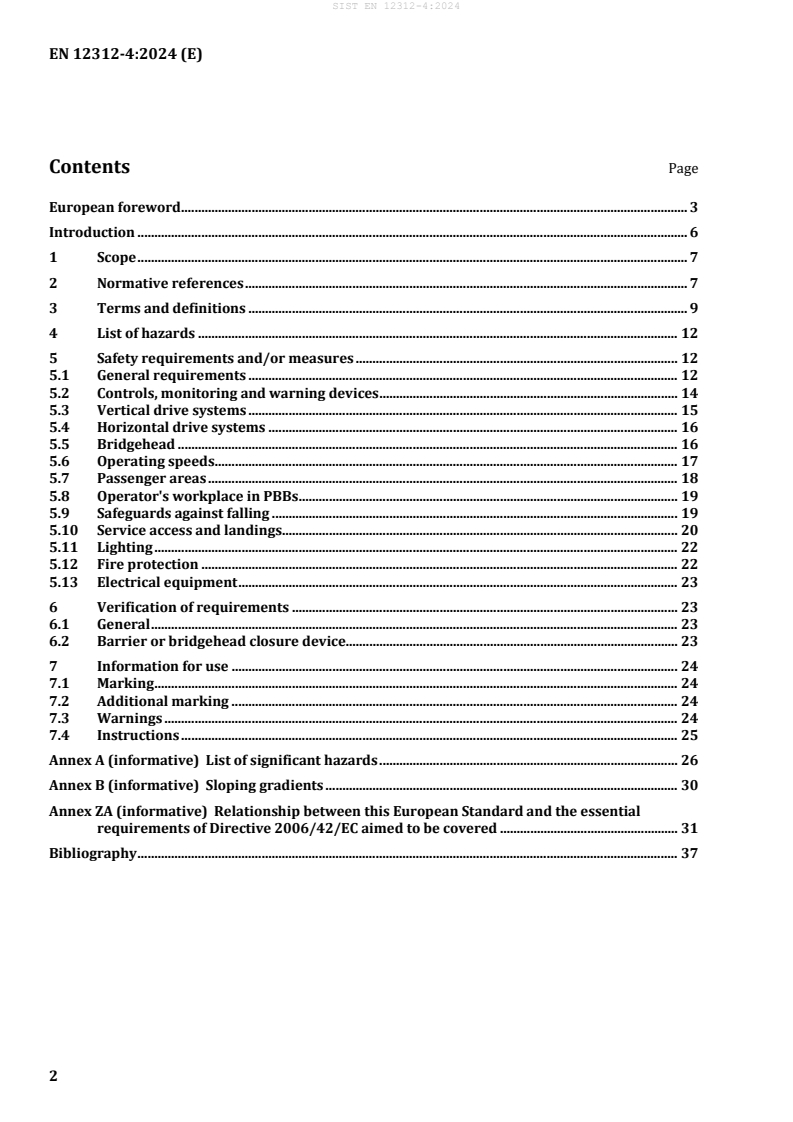
Contents Page
European foreword . 3
Introduction . 6
1 Scope . 7
2 Normative references . 7
3 Terms and definitions . 9
4 List of hazards . 12
5 Safety requirements and/or measures . 12
5.1 General requirements . 12
5.2 Controls, monitoring and warning devices . 14
5.3 Vertical drive systems . 15
5.4 Horizontal drive systems . 16
5.5 Bridgehead . 16
5.6 Operating speeds . 17
5.7 Passenger areas . 18
5.8 Operator's workplace in PBBs . 19
5.9 Safeguards against falling . 19
5.10 Service access and landings . 20
5.11 Lighting . 22
5.12 Fire protection . 22
5.13 Electrical equipment . 23
6 Verification of requirements . 23
6.1 General . 23
6.2 Barrier or bridgehead closure device. 23
7 Information for use . 24
7.1 Marking . 24
7.2 Additional marking . 24
7.3 Warnings . 24
7.4 Instructions . 25
Annex A (informative) List of significant hazards . 26
Annex B (informative) Sloping gradients . 30
Annex ZA (informative) Relationship between this European Standard and the essential
requirements of Directive 2006/42/EC aimed to be covered . 31
Bibliography . 37
European foreword
This document (EN 12312-4:2024) has been prepared by Technical Committee CEN/TC 274 “Aircraft
ground support equipment”, the secretariat of which is held by DIN.
This European Standard shall be given the status of a national standard, either by publication of an
identical text or by endorsement, at the latest by April 2025 and conflicting national standards shall be
withdrawn at the latest by April 2025.
Attention is drawn to the possibility that some of the elements of this document may be the subject of
patent rights. CEN shall not be held responsible for identifying any or all such patent rights.
This document supersedes EN 12312-4:2014.
This document has been prepared under a standardization request addressed to CEN by the European
Commission. The Standing Committee of the EFTA States subsequently approves these requests for its
Member States.
For the relationship with EU Legislation, see informative Annex ZA, which is an integral part of this
document.
The main technical changes compared to the previous version are the following:
a) Clause 2, Normative references, was updated;
b) in Clause 3, Terms and definitions, the terms "auto-levelling mode", "autonomous mode", "remote
control mode", "pre-positioning", "GPU", "PCA", "mono control panel" and "remote multi control
panel" were added;
c) in Clause 3, Terms and definitions, the definitions for "service access" and "automatic mode" were
updated;
d) in 5.1.4 a) an example was added for clarification;
e) 5.1.6 and 5.1.7 added to improve safety on ground staff;
f) 5.2.1, 5.2.2 and 5.2.10 changed;
g) 5.2.3 and 5.2.13 added to improve safety while operating the PBB;
h) old subclauses 5.2.3, 5.2.4, 5.2.5, 5.2.6, 5.2.7,5.2.8, 5.2.9, 5.2.11, 5.5.1, 5.5.2, 5.5.4, 5.6.5, 5.10.5,
5.10.6, 6.2 b) and 6.2 c) renumbered;
i) 5.3.1 and 5.3.2 changed;
j) 5.4.1 changed;
k) 5.4.6 added to improve safety in case of synchronization system fails;
l) 5.5.1 added to improve safety while auto-levelling;
m) previous subclause 5.5.3 renumbered and changed;
n) 5.6.2 changed;
o) 5.6.4, 5.10.4, 5.12.5, 6.2 a) and 6.3 c) deleted;
p) 5.7.3 changed;
q) 5.8.6 and 5.8.8 changed;
r) 5.2.14 added to improve safety of people entering into the PBB while it is moving;
s) 5.9.5, NOTE changed;
t) 5.9.6 and 5.9.7 changed;
u) 5.10.1, 5.10.2 and 5.10.3 changed;
v) 5.11.4 and 5.11.8 changed;
w) 5.11.11 added to improve safety under remote operations;
x) 5.12.6 renumbered and changed;
y) Clause 6 and Clause 7 were switched;
z) previous subclauses 6.3 b) and 6.3 d) changed
aa) subclause 7.3 g) added to improve safety of passengers while boarding / disembarking;
bb) previous subclauses 6.4 c) and 6.4 d) changed;
cc) Annex A, Table A.1, items 1,7,8,9 and10 updated.
EN 12312, Aircraft ground support equipment – Specific requirements consists of the following parts:
— Part 1: Passenger stairs;
— Part 2: Catering vehicles;
— Part 3: Conveyor belt vehicles;
— Part 4: Passenger boarding bridges; (this document)
— Part 5: Aircraft fuelling equipment;
— Part 6: Deicers and deicing/antiicing equipment;
— Part 7: Aircraft movement equipment;
— Part 8: Maintenance or service stairs and platforms;
— Part 9: Container/Pallet loaders;
— Part 10: Container/Pallet transfer transporters;
— Part 11: Container/Pallet dollies and loose load trailers;
— Part 12: Potable water service equipment;
— Part 13: Lavatory service equipment;
— Part 14: Disabled/incapacitated passenger boarding vehicles;
— Part 15: Baggage and equipment tractors;
— Part 16: Air start equipment;
— Part 17: Air conditioning equipment;
— Part 18: Nitrogen or Oxygen units;
— Part 19: Aircraft jacks, axle jacks and hydraulic tail stanchions;
— Part 20: Electrical ground power units.
Any feedback and questions on this document should be directed to the users’ national standards body.
A complete listing of these bodies can be found on the CEN website.
According to the CEN-CENELEC Internal Regulations, the national standards organizations of the
following countries are bound to implement this European Standard: Austria, Belgium, Bulgaria,
Croatia, Cyprus, Czech Republic, Denmark, Estonia, Finland, France, Germany, Greece, Hungary, Iceland,
Ireland, Italy, Latvia, Lithuania, Luxembourg, Malta, Netherlands, Norway, Poland, Portugal, Republic of
North Macedonia, Romania, Serbia, Slovakia, Slovenia, Spain, Sweden, Switzerland, Türkiye and the
United Kingdom.
Introduction
This document specifies health and safety requirements, as well as some functional and performance
requirements, for passenger boarding bridges (PBB) intended for passenger embarking/disembarking
of all aircraft types commonly in service in civil air transport.
The minimum essential criteria are considered to be of primary importance in providing safe,
serviceable, economical and practical PBB. Deviations from the recommended criteria should occur only
after careful consideration, extensive testing, risk assessment and thorough service evaluation have
shown alternative methods or conditions to be satisfactory. Such deviations are outside the Scope of
this document and a manufacturer should be able to demonstrate an equivalent level of protection.
The machinery concerned and the extent to which hazards, hazardous situations and events are
covered are indicated in the Scope of this document.
This document is a Type C standard as stated in EN ISO 12100:2010.
This document is of relevance, in particular, for the following stakeholder groups representing the
market players with regard to machinery safety:
— machine manufacturers (small, medium and large enterprises);
— health and safety bodies (regulators, accident prevention organizations, market surveillance, etc.).
Others can be affected by the level of machinery safety achieved with the means of the document by the
above-mentioned stakeholder groups:
— machine users/employers (small, medium and large enterprises);
— machine users/employees (e.g. trade unions, organizations for people with special needs);
— service providers, e.g. for maintenance (small, medium and large enterprises);
— consumers (in case of machinery intended for use by consumers).
The above-mentioned stakeholder groups have been given the possibility to participate at the drafting
process of this document.
When requirements of this type-C standard are different from those which are stated in type-A or type-
B standards, the requirements of this type-C standard take precedence over the requirements of the
other standards for machines that have been designed and built according to the requirements of this
type-C standard.
1 Scope
This document specifies the technical requirements to minimize the hazards listed in Clause 4 which
can arise during the commissioning, operation and maintenance of passenger boarding bridges (PBBs)
when used as intended, including misuse reasonably foreseeable by the manufacturer, when carried out
in accordance with the specifications given by the manufacturer or their authorized representative. It
also takes into account some requirements recognized as essential by authorities, aircraft and ground
support equipment (GSE) manufacturers as well as airlines and handling agencies.
This document applies to:
a) apron-drive bridges;
b) fixed-head bridges (also referred to as nose-loaders) or pedestal bridges;
c) suspended bridges
for embarking/disembarking of passengers. It is applicable from the interface with the terminal
building, which can be movable, e.g. on two levels to separate arrival and departure level to the
connection with the aircraft including fixed tunnels.
This document does not apply to:
d) elevating lounges;
e) passenger stairs;
f) other form of aircraft access equipment;
g) autonomous PBB positioning.
No extra requirements on noise are provided other than those in EN 1915-4:2004+A1:2009.
NOTE EN 1915-4:2004+A1:2009 provides the general noise requirements.
This part of EN 12312 is not applicable to PBBs which were manufactured before the date of publication
of this document by CEN.
This part of EN 12312 when used in conjunction with EN 1915-1:2023 and EN 1915-2:2001+A1:2009
provides the requirements for PBBs.
2 Normative references
The following documents are referred to in the text in such a way that some or all of their content
constitutes requirements of this document. For dated references, only the edition cited applies. For
undated references, the latest edition of the referenced document (including any amendments) applies.
EN 3-7:2004+A1:2007, Portable fire extinguishers - Part 7: Characteristics, performance requirements
and test methods
EN 1915-1:2023, Aircraft ground support equipment - General requirements - Part 1: Basic safety
requirements
EN 1915-2:2001+A1:2009, Aircraft ground support equipment - General requirements - Part 2: Stability
and strength requirements, calculations and test methods
EN 1915-4:2004+A1:2009, Aircraft ground support equipment - General requirements - Part 4: Noise
measurement methods and reduction
EN 16165:2021, Determination of slip resistance of pedestrian surfaces - Methods of evaluation
EN 60332-1-1:2004, Tests on electric and optical fibre cables under fire conditions - Part 1-1: Test for
vertical flame propagation for a single insulated wire or cable - Apparatus (IEC 60332-1-1:2004)
EN 60332-1-2:2004, Tests on electric and optical fibre cables under fire conditions - Part 1-2: Test for
vertical flame propagation for a single insulated wire or cable - Procedure for 1 kW pre-mixed flame
(IEC 60332-1-2:2004)
EN 60332-1-3:2004, Tests on electric and optical fibre cables under fire conditions - Part 1-3: Test for
vertical flame propagation for a single insulated wire or cable - Procedure for determination of flaming
droplets/particles (IEC 60332-1-3:2004)
EN 60332-2-1:2004, Tests on electric and optical fibre cables under fire conditions - Part 2-1: Test for
vertical flame propagation for a single small insulated wire or cable - Apparatus (IEC 60332-2-1:2004)
EN 60332-2-2:2004, Tests on electric and optical fibre cables under fire conditions - Part 2-2: Test for
vertical flame propagation for a single small insulated wire or cable - Procedure for diffusion flame
(IEC 60332-2-2:2004)
EN IEC 60332-3-10:2018, Tests on electric and optical fibre cables under fire conditions - Part 3-10: Test
for vertical flame spread of vertically-mounted bunched wires or cables - Apparatus
(IEC 60332-3-10:2018)
EN IEC 60332-3-21:2018, Tests on electric and optical fibre cables under fire conditions - Part 3-21: Test
for vertical flame spread of vertically-mounted bunched wires or cables - Category A F/R
(IEC 60332-3-21:2018)
EN IEC 60332-3-22:2018, Tests on electric and optical fibre cables under fire conditions - Part 3-22: Test
for vertical flame spread of vertically-mounted bunched wires or cables - Category A
(IEC 60332-3-22:2018)
EN IEC 60332-3-23:2018, Tests on electric and optical fibre cables under fire conditions - Part 3-23: Test
for vertical flame spread of vertically-mounted bunched wires or cables - Category B
(IEC 60332-3-23:2018)
EN IEC 60332-3-24:2018, Tests on electric and optical fibre cables under fire conditions - Part 3-24: Test
for vertical flame spread of vertically-mounted bunched wires or cables - Category C
(IEC 60332-3-24:2018)
As impacted by EN 60332-1-1:2004/A1:2015.
As impacted by EN 60332-1-2:2004/A1:2015, EN 60332-1-2:2004/A11:2016, EN 60332-1-2:2004/A12:2020.
As impacted by EN 60332-1-3:2004/A1:2015.
As impacted by EN IEC 60332-3-10:2018/AC:2018 and EN IEC 60332-3-10:2018/A11:2020.
EN IEC 60332-3-25:2018, Tests on electric and optical fibre cables under fire conditions - Part 3-25: Test
for vertical flame spread of vertically-mounted bunched wires or cables - Category D
(IEC 60332-3-25:2018)
EN ISO 7010:2020, Graphical symbols - Safety colours and safety signs - Registered safety signs
(ISO 7010:2019, Corrected version 2020-06)
EN ISO 12100:2010, Safety of machinery - General principles for design - Risk assessment and risk
reduction (ISO 12100:2010)
EN ISO 13849-1:2023, Safety of machinery - Safety-related parts of control systems - Part 1: General
principles for design (ISO 13849-1:2023)
EN ISO 13850:2015, Safety of machinery - Emergency stop function - Principles for design
(ISO 13850:2015)
EN ISO 14122-3:2016, Safety of machinery - Permanent means of access to machinery - Part 3: Stairs,
stepladders and guard-rails (ISO 14122-3:2016)
ISO 3795:1989, Road vehicles, and tractors and machinery for agriculture and forestry - Determination of
burning behaviour of interior materials
ISO 7718-1:2016, Aircraft - Passenger doors interface requirements for connection of passenger boarding
bridge or passenger transfer vehicle - Part 1: Main deck doors
ISO 7718-2:2016, Aircraft - Passenger doors interface requirements for connection of passenger boarding
bridge or passenger transfer vehicle - Part 2: Upper deck doors
ISO 16004:2017, Aircraft ground equipment - Passenger boarding bridge or transfer vehicle - Interface
requirements with aircraft doors
3 Terms and definitions
For the purposes of this document, the terms and definitions given in EN ISO 12100:2010,
EN 1915-1:2023, EN 1915-2:2001+A1:2009 and the following apply.
ISO and IEC maintain terminology databases for use in standardization at the following addresses:
— ISO Online browsing platform: available at https://www.iso.org/obp/
— IEC Electropedia: available at https://www.electropedia.org/
3.1
passenger boarding bridge
PBB
enclosed adjustable passenger walkway connecting the terminal building to the aircraft
3.2
apron-drive bridge
PBB with a drive unit that can be driven across the apron within its operating range
3.3
pedestal bridge
PBB without an apron drive unit
3.4
suspended bridge
PBB which is driven from a cantilevered structure
3.5
rotunda
enclosed structure about which the PBB rotates for radial movement and hinges for vertical movement
3.6
rotunda column
supporting structure for the rotunda
3.7
tunnel
enclosed walkway section
3.8
elevating leg
assembly for raising and lowering the PBB
3.9
drive unit
wheeled carriage of apron-drive bridges on which elevating legs are mounted
3.10
bridgehead
transitional area at the aircraft end of the PBB
3.11
canopy
flexible weather protection between the aircraft and the PBB, consisting of at least folding bellows,
motor(s), and extendable system
3.12
service access
means allowing access from the apron to the PBB
3.13
auto-levelling
device which ensures automatic vertical adjustment of the PBB, corresponding to vertical movement of
the aircraft
3.14
vertical drive system
means of adjusting the height of the PBB
3.15
horizontal drive system
means of adjusting the position of the PBB in the horizontal plane
3.16
telescoping system
system used to extend or retract the PBB
3.17
bridgehead rotation system
means to adjust the bridgehead sill towards the fuselage of the aircraft
3.18
translation
movement of the PBB at an airfield apron
Note 1 to entry: Movement involves only elements of rotation and/or extension.
3.19
inter-ramp
short ramp providing a smooth transition between telescoping tunnel floors, or where a step might
otherwise occur
3.20
emergency lowering
means of coping automatically with a sudden aircraft vertical movement exceeding the capability of
normal auto-levelling
3.21
manual mode
mode, which allows operator-initiated control of all PBB movements
3.22
auto-levelling mode
mode that initiates control of vertical PBB movements without intervention by the operator
Note 1 to entry: Mode triggered by the operator.
3.23
automatic mode
mode that initiates control of all PBB movements without intervention by the operator
Note 1 to entry: Mode triggered and supervised by the operator.
3.24
autonomous mode
mode that initiates control of all PBB movements without intervention or supervision by the operator
3.25
remote control mode
mode that initiates control of all PBB movements from a location outside the PBB
3.26
pre-positioning
functionality that initiates control of all PBB required movements to predefined positions, in safe
clearance with aircraft, without intervention by the operator
Note 1 to entry: Movements triggered and supervised by the operator.
3.27
mono control panel
control panel assigned to only one PBB
3.28
remote multi control panel
control panel assigned to several PBBs
3.29
safety shoe
pressure-sensitive switch placed underneath the open door of an aircraft to detect excessive downward
motion of the aircraft
3.30
bridgehead closure device
door or equivalent device (e.g. shutter) closing the bridgehead opening on the side intended for
connection to the aircraft
3.31
barrier
movable element to prevent access into an area
3.32
terminal
terminal building
building or building extension, to which an aircraft is connected via the passenger boarding bridge
3.33
fixed tunnel
bridge link
PBB element connecting the rotunda of the PBB to airport terminal building
3.34
ground power unit
GPU
powered unit, used to deliver external electrical power to aircraft on the ground
3.35
pre conditioned air / air conditioning unit
PCA / ACU
powered unit, used to cool, heat or ventilate the inside of an aircraft on the ground
4 List of hazards
The list of risks and hazards (given in Annex A) is based on EN ISO 12100:2010 and contains the
hazards and hazardous situations, as far as they are dealt with in this document, identified by risk
assessment as significant for PBBs and which require action to eliminate or reduce risks. Not covered
are hazards due to the traffic and repair.
5 Safety requirements and/or measures
5.1 General requirements
5.1.1 PBBs shall conform to the relevant requirements of EN 1915-1:2023, EN 1915-2:2001+A1:2009
and EN 1915-4:2004+A1:2009 unless otherwise specified in this document.
PBBs shall comply with the safety requirements and/or protective measures of this clause. In addition,
the PBBs shall be designed according to the principles of EN ISO 12100:2010 for relevant but not
significant hazards, which are not dealt with by this document.
5.1.2 Stability and strength calculations shall be carried out in accordance with
EN 1915-2:2001+A1:2009. Resonance shall be taken into account.
5.1.3 PBB shall be designed so that the stability and strength are ensured during intended use. The
basis for calculation shall be the most unfavourable combination of static and dynamic loads defined
according to EN 1915-2:2001+A1:2009 except as provided in 5.1.5 for the most unfavourable PBB
situation.
5.1.4 The lower parts of drive units of bridges with drive units shall be fitted with a device(s) to
prevent the running over of persons and contact with dangerous parts of machinery. This is achieved if
the protective device fulfils the following requirements:
a) the protective device shall prevent access to dangerous parts of the drive unit, e.g. wheels and belt
chain driven transmission;
b) the protective device shall be designed so as to prevent persons from reaching over the protective
device into the danger zone when the device is touching persons. This can be achieved e.g. if the
protective device has a minimum height above ground level of 1 000 mm;
c) the distance of the protective device from ground level shall not exceed 200 mm at all positions and
under all operating conditions;
d) the distance between protective device and parts of the wheels or drive unit shall be at least
200 mm;
e) the protective device shall be equipped with at least one trip (switch) bar at the bottom;
f) the bar shall detect the presence of a person in all directions of movement of the PBB and stop
movement before the danger zone is reached;
g) the safety related parts of the interlocking system shall achieve Performance Level “c” according to
EN ISO 13849-1:2023;
As an alternative to a physical barrier and trip bar, contactless protective devices may be used.
These devices shall meet the following requirements:
h) they shall ensure the detection of a person at a minimum distance of 0,5 m from any point of the
drive unit;
i) when moving at maximum speed in any direction, detection of a person shall stop the movement of
the PBB before contact is achieved between any point of the drive unit and the person;
j) access to dangerous parts of the drive unit shall be prevented unless other protective devices have
been fitted to achieve this;
k) detection and interlocking systems shall achieve Performance Level “d” according to
EN ISO 13849-1:2023.
5.1.5 As an exception from EN 1915-2:2001+A1:2009, 5.2.2.7, the following minimum wind speeds
shall be taken into account for stability and strength calculations:
a) PBB operation under rated load, fully erected and extended under the most unfavourable
combination of loads: 27,8 m/s (100 km/h);
b) PBB in parking position without rated load: 41,7 m/s (150 km/h).
Where, based on local weather records, the wind speed defined in (b) can exceptionally be exceeded,
the PBB shall include provisions to tie it down to the ground up to a wind speed determined by the local
authorities.
Tie-down provisions should also be needed on the ground in the immediate vicinity of the PBB, with
their number, geometry and strength sufficient to guarantee PBB restraint up to the same wind speed.
5.1.6 Protrusions such as hydraulic tank, service access wheel trolley, and auxiliary equipment hang
on the PBB such as PCA, GPU, hose basket shall be covered with protective cushion and/or marked in
warning signal colours to warn ground staff.
5.1.7 Drive unit in apron drive bridges shall be fitted with solid tyres. Pneumatic tyres shall not be
installed.
5.2 Controls, monitoring and warning devices
5.2.1 Positioning controls shall be provided to control the movement and speed of the PBB. The
control devices shall ensure that appropriate approach/docking speeds and direction of travel can be
maintained by the operator, e.g. marking of joy stick position, switch speed selector, separate control
devices. In automatic mode, it shall not be possible to modify PBB speed or PBB movements.
Remote multi control panels shall control not more than one PBB simultaneously.
The communication channel for movement orders between the remote multi control panels and the
PBB shall achieve a performance level “d” according to EN ISO 13849-1:2023.
The remote multi control panels shall include an emergency stop button which stops only the PBB
connected to it. The control system shall achieve a performance level “d” according to
EN ISO 13849-1:2023.
5.2.2 An emergency stop shall be provided in each control panel. Emergency stops shall meet the
requirements of EN ISO 13850:2015, 4.1.4. The emergency stop shall not de-activate the braking
system. In addition, at least two emergency stops on opposite sides of the elevating system traverse in a
safe position and easily accessible from the apron, e.g. between 1,0 m and 1,5 m high and maximum
0,5 m from outer contour of the drive unit of apron drive PBBs.
5.2.3 Emergency stops shall achieve a performance level according to EN ISO 13849-1:2023 equal or
greater than the most critical performance level provided in any safety control of the PBB.
5.2.4 For apron-drive PBB, a monitoring system shall be provided. This system shall have a monitor
display at the control panel allowing visibility of the area surrounding the drive unit and bottom of the
service access and stabilizers (if installed). It shall be possible to distinguish a human form. For remote
controlled PBB, means shall be installed in order to assure safe docking and that nobody is inside the
PBB while moving. For example, camera systems shall be installed in order to provide to the operator
the required field of view of hazardous zones.
For remote control operations, PBB interior and exterior surroundings shall be monitored.
5.2.5 Where cameras are provided, they shall be mounted below the PBB in a position to conform to
5.2.4. They shall be installed in such a manner as to ensure no misting of the camera lenses.
Camera systems shall be equipped and installed in such a way that visibility restrictions due to weather
or surrounding conditions are minimized.
5.2.6 The monitoring system shall remain on, while the PBB is moving in manual, pre-positioning,
automatic or maintenance mode.
5.2.7 Intermittent amber warning light(s) shall be positioned so as to be clearly visible from all
directions by persons on the apron. The minimum luminous flux of lamps shall be 250 lm.
5.2.8 The warning light(s) shall be activated prior to, and during any movement of, the PBB, except
when moved by auto-levelling.
5.2.9 An audible warning device shall be activated automatically before the PBB starts moving, except
when moved by auto-levelling.
5.2.10 Where an audible warning device is used to indicate height adjustment while in auto-levelling
mode, this signal shall be clearly identifiable as separate to the signal used during other movements.
5.2.11 Signals shall be clearly audible by persons on the apron, e.g. in the vicinity of the drive unit.
Acoustic signals should be minimum 80 dB(A) at 1 m, but never exceeding 100 dB(A).
5.2.12 During auto-levelling, the canopy shall be automatically fully deployed. If an electrical function
is required for this, it shall achieve Performance level “b” according to EN ISO 13849-1:2023. The
canopy shall be automatically readjusted.
5.2.13 If a PBB can be controlled both locally and remotely, local control panel shall supersede the
remote one. In case of remote control, aircraft standard operational procedure should be agreed with
the customer.
In case of disconnection of the remote control, all movements of the PBB shall stop automatically, with
the exception of the auto-levelling system. The automatic stop shall achieve Performance Level “d”
according to EN ISO 13849-1:2023.
5.2.14 PBB access points in rotunda, service door and service access shall be fitted with means to stop
PBB movement in case anyone gets into the PBB while it is being manoeuvred. The related interlocking
system shall achieve Performance Level “c” according to EN ISO 13849-1:2023.
5.3 Vertical drive systems
5.3.1 Vertical drive systems for PBBs shall be designed so that the supporting structures withstand all
stresses which may occur during operation or when safety devices are tripped including an evenly
distributed working load of 3 200 N/m applied to all passenger areas, without permanent
deformation.
Loads that are dependent on local conditions, e.g. wind loads, snow loads, should be determined by the
manufacturer taking into account information provided by the user.
5.3.2 PBB shall be supported by two lifting devices. Each lifting device shall be capable of supporting
the PBB under full load conditions in the event of failure of one lifting device. Consideration shall also be
given to the effect on the whole structure of the failure of one lifting device. This loading condition shall
be considered as exceptional.
5.3.3 The lowering distance of 100 mm in case of failure as given in EN 1915-1:2023, 5.21.2 shall be
measured at the bridgehead sill.
5.4 Horizontal drive systems
5.4.1 Where GPU, PCA and/or their cable, hose retrievers are mounted on the PBB, they shall be
interlocked to the horizontal drive system to prevent movement of the PBB whenever the aircraft is
connected to these services. In addition, means shall be provided for ground staff to allow PBB
movement. Signals from both ancillary equipment and ground staff confirmation are required to move
the PBB. The safety related parts of the interlocking system shall achieve Performance Level “b”
according to EN ISO 13849-1:2023. The interlock may be overridden only at low PBB speed under
intentional operator action on a specific hold-to-run control at the control panel.
5.4.2 Telescoping systems shall be designed so that:
a) correct alignment of the tunnels is ensured;
b) the tunnel end positions are secured by fixed buffered mechanical limit stops in such a way as to
prevent separation of the tunnels.
Any crushing or shearing points shall be prevented in accordance with EN 1915-1:2023, 5.15. This shall
preferably be achieved by mechanical protection. Where ultimately this cannot be achieved by
mechanical means, movement shall cease should a person be detected at a crushing or shearing point.
The safety related parts of the interlocking system shall achieve Performance Level “c” according to
EN ISO 13849-1:2023.
5.4.3 Telescoping systems shall be designed such that when stopped the tunnel elements remain in
their set position. These systems shall stop the telescoping movement in normal operation. In an
emergency situation, e.g. activation of an emergency stop or a safety detector, the telescopic movement
shall stop within 100 mm.
Telescoping movement may be measured at the drive unit.
5.4.4 With the exception of hydrostatic drive translation systems shall be equipped with a braking
system that is applied automatically if the PBB is without power or not being driven. In the case of
power failure, it shall be possible to release the braking system to allow the PBB to be moved to a safe
position by auxiliary means, e.g. using a tractor. A specific coupling shall be provided for towing. It shall
be ensured that the PBB cannot be operated before resetting the braking system.
5.4.5 Where the possibility of collision between PBBs exists, preventative safety measures shall be
taken by distance detection systems. Where distance detection systems are selected, the related
interlocking systems shall achieve Performance Level “b” according to EN ISO 13849-1:2023.
5.4.6 PBBs with 3 or more tunnels shall be fitted with a synchronization system. In addition, a backup
system shall be provided to prevent middle tunnels being loosed in case the primary system breaks
down.
5.5 Bridgehead
5.5.1 PBB shall be provided with an auto-levelling system, capable of modifying PBB height according
to aircraft height variations. The related auto-levelling system shall achieve Performance Level “b”
according to EN ISO 13849-1:2023.
The auto-levelling system shall initiate adjustment when door sill height change reaches maximum
50 mm measured at the leading edge of the platform so that the relative position of the aircraft and the
platform remains in the range of ±50 mm of the initial position. The auto-levelling system shall work as
a safety shutdown having a time limit function for the time of vertical movement of the PBB. The related
time limit function shall achieve Performance Level “b” according to EN ISO 13849-1:2023.
5.5.2 The bridgehead rotation system shall be designed so that its end positions are secured by fixed
buffered mechanical limit stops in such a way as to prevent rotation beyond the intended limits.
5.5.3 The bridgehead rotation system shall be equipped with a mechanical brake or equivalent that is
applied automatically when intended movement has stopped. This brake shall also be applied
automatically in case of power failure to the PBB and/or to the brake system. Any braking system shall
stop the rotation within 1°. In the event of a mechanical system failure, no uncontrolled movement of
the bridgehead shall result. Braking system shall be designed to withstand a full bridgehead dead load.
5.5.4 Bridgehead platform shall be designed in a way where:
a) the drive unit stops the PBB with a final gap of a minimum of 100 mm between the leading edge of
the bridgehead and the aircraft fuselage;
b) final approach of bridgehead platform towards the aircraft shall be with the drive unit stopped, the
gap between the bridgehead leading edge and the aircraft fuselage shall be less than 120 mm, when
the PBB is in its final docked position to the aircraft;
c) the platform shall be automatically readjusted to counterbalance vertical changes of the aircraft
fuselage while boarding and disembarking;
d) the leading edge of the bridgehead shall be entirely covered by a full width bumper designed to
protect the aircraft;
e) maximum bumper pressure exerted to aircraft fuselage shall not exceed 20 kPa (e.g. 1 500 N on a
surface of 3 m × 25 mm);
f) the bumper is of a non-marking semi-soft material.
The aircraft interface device shall include a contact detection feature able to provide an electrical signal
when contact with the aircraft is achieved and which can be used to stop movement. In this case, the
related interlocking systems shall achieve Performance Level “a” according to EN ISO 13849-1:2023. In
addition, the leading edge of the bridgehead shall conform to the interface requirements given in
ISO 7718-1:2016 and if applicable ISO 7718-2:2016.
5.5.5 The bridgehead platform shall be designed so that damage to the aircraft door, which is open
while the PBB is docked, is avoided. This can be achieved by a mechanism, e.g. sensor or safety shoe,
which prevents the aircraft door from setting upon the platform while the PBB is connected. In this
case, the related interlocking systems shall achieve Performance Level “b” according to
EN ISO 13849-1:2023.
5.6 Operating speeds
5.6.1 The translational and built-in telescoping speed of the PBB, measured at the drive unit and the
bridgehead respectively, shall be limited to a speed not exceeding 0,5 m/s. A slow speed not exceeding
0,1 m/s shall be provided for safe final approach to the aircraft.
5.6.2 In any mode, the raising and lowering speed of the PBB measured at the bridgehead platform in
extended position shall be limited to a maximum of 0,05 m/s.
5.6.3 Rotational speed of the bridgehead shall be limited to a maximum of 3°/s.
5.6.4 The speed for lowering of the PBB, initiated by the safety shoe or equivalent detection device
underneath the aircraft door, measured at the bridgehead platform in extended position, shall be
limited between 0,1 m/s and 0,2 m/s and movement shall stop after one second.
5.7 Passenger areas
5.7.1 Areas for passenger movement within a PBB, i.e. the rotunda, tunnel sections and bridgehead
shall be free from tripping hazards. Steps shall be avoided. The cover material of walking areas in the
bridgehead and bridge sections shall provide easy elimination of water and snow, and be selected to
minimize wear and comply with cleaning requirements. The flooring materials shall also provide a
durable slip-resistant surface, with a minimum R10 slip resistance in the walking direction and R11 slip
resistance for slopes over 10° (see EN 1915-1:2023, Annex H, Table H.1). Slip resistance shall be
measured in accordance with EN 16165:2021, Annex B.
5.7.2 Slopes with respect to a horizontal plane should not exceed 10 % under intended operating
conditions, and shall not exceed 12,5 % ov
...
Questions, Comments and Discussion
Ask us and Technical Secretary will try to provide an answer. You can facilitate discussion about the standard in here.
Loading comments...