


SIST EN 12312-15:2020+A2:2025
(Main + Amendment)Aircraft ground support equipment - Specific requirements - Part 15: Baggage and equipment tractors
Aircraft ground support equipment - Specific requirements - Part 15: Baggage and equipment tractors
This document specifies the technical requirements to minimize the hazards listed in Clause 4 which can arise during the commissioning, the operation and the maintenance of baggage and equipment tractors when used as intended, including misuse reasonably foreseeable by the manufacturer, when carried out in accordance with the specifications given by the manufacturer or his authorized representative. It also takes into account some requirements recognized as essential by authorities, aircraft and ground support equipment (GSE) manufacturers as well as airlines and handling agencies.
This document applies to self-propelled baggage and equipment tractors with driver accommodation.
This document does not apply to pedestrian controlled equipment.
This document deals with vibrations which are considered as significant. Vibration measurements are dealt with in EN 1915-3.
No extra requirements on noise are provided other than those given in EN 1915-4.
NOTE EN 1915-4 provides the general GSE noise requirements.
This part of EN 12312 is not applicable to baggage and equipment tractors manufactured before the date of its publication.
This part of EN 12312 when used in conjunction with EN 1915-1, EN 1915-2, EN 1915-3 and EN 1915-4 provides the requirements for baggage and equipment tractors.
Luftfahrt-Bodengeräte - Besondere Anforderungen - Teil 15: Gepäck- und Geräteschlepper
Dieses Dokument legt die technischen Anforderungen zur Minimierung der in Abschnitt 4 aufgelisteten Gefährdungen fest, die bei Inbetriebnahme, Betrieb und Wartung von Gepäck- und Geräteschleppern bei vorgesehener Verwendung, einschließlich vom Hersteller vernünftigerweise vorhersehbarer Fehlanwendung, auftreten können, wenn diese in Übereinstimmung mit den Anweisungen des Herstellers oder seines Beauftragten ausgeführt werden. Es berücksichtigt auch einige Anforderungen, die von offiziellen Stellen, den Herstellern von Luftfahrzeugen und Bodengeräten (GSE, en: ground support equipment) sowie von Luftverkehrs- und Abfertigungsgesellschaften als wesentlich erachtet wurden.
Dieses Dokument ist anwendbar für Gepäck- und Geräteschlepper mit Eigenantrieb und Fahrerplatz.
Dieses Dokument ist nicht anwendbar für mitgängergeführte Geräte.
Dieses Dokument behandelt Schwingungen, die als signifikant betrachtet werden. Schwingungs-messverfahren werden in EN 1915 3 behandelt.
Neben den Anforderungen in EN 1915 4 werden keine weiteren Anforderungen zu Lärm behandelt.
ANMERKUNG EN 1915 4 umfasst allgemeine Lärmanforderungen für Bodengeräte.
Dieser Teil von EN 12312 ist nicht anwendbar für Gepäck- und Geräteschlepper, die hergestellt wurden, bevor diese Europäische Norm veröffentlicht wurde.
Dieser Teil von EN 12312 stellt bei Anwendung in Verbindung mit EN 1915 1, EN 1915 2, EN 1915 3 und EN 1915 4 die Anforderungen an Gepäck- und Geräteschlepper bereit.
Matériel au sol pour aéronefs - Exigences particulières - Partie 15 : Tracteurs à bagages et matériel
Le présent document spécifie les exigences techniques destinées à réduire les phénomènes dangereux énumérés à l’Article 4 qui peuvent survenir lors des opérations de mise en service, d’exploitation et de maintenance des tracteurs à bagages et matériel, selon leur utilisation prévue, y compris avec les erreurs d’utilisation raisonnablement prévisibles par le fabricant, lorsqu’elles sont réalisées conformément aux spécifications données par le fabricant ou son représentant légal. Il prend également en compte certaines exigences reconnues comme essentielles par les autorités, les constructeurs d’aéronefs et de matériel au sol (GSE, ground support equipment), ainsi que par les compagnies aériennes et les organismes d’assistance.
Le présent document s’applique aux tracteurs à bagages et matériel autotractés avec poste de conduite.
Ce document ne s’applique pas aux matériels à conducteur accompagnant.
Le présent document traite des vibrations considérées comme significatives. Les mesures des vibrations sont abordées dans l’EN 1915-3.
La présente norme ne spécifie pas d'exigences relatives au bruit autres que celles de l’EN 1915 4.
NOTE L’EN 1915 4 fournit les exigences générales relatives au bruit pour les GSE.
La présente partie de l’EN 12312 n’est pas applicable aux tracteurs à bagages et matériel fabriqués avant sa date de publication.
La présente partie de l’EN 12312, lorsqu’elle est utilisée conjointement avec les EN 1915-1, EN 1915-2, EN 1915-3 et EN 1915-4, fournit les exigences pour les tracteurs à bagages et matériel.
Podporna oprema na tleh za letalski promet - Posebne zahteve - 15. del: Vlečni traktorji za prtljago in opremo (vključno z dopolnilom A2)
Ta dokument določa tehnične zahteve za zmanjšanje nevarnosti, navedenih v točki 4, do katerih lahko pride pri začetku uporabe, upravljanju ter vzdrževanju vlečnih traktorjev za prtljago in opremo ter pri namenski uporabi, vključno s pričakovano nepravilno uporabo, ki jo določi proizvajalec, ko te postopke v skladu s specifikacijami izvaja proizvajalec ali njegov zakoniti zastopnik. Upoštevane so tudi nekatere zahteve, ki jih vladni organi, proizvajalci letal in podporne opreme na tleh (GSE), letalske družbe in agencije za oskrbo letal priznavajo za bistvene. Ta dokument se uporablja za vlečne traktorje za prtljago in opremo z lastnim pogonom ter prostorom za voznika. Ta dokument se ne uporablja za opremo, ki jo upravljajo pešci. V tem dokumentu so obravnavane vibracije, ki se štejejo za znatne. Merjenje vibracij je obravnavano v standardu EN 1915-3. Dodatne zahteve glede hrupa niso podane, razen tistih, ki so navedene v standardu EN 1915-4. OPOMBA: Standard EN 1915-4 določa splošne zahteve glede hrupa pri podporni opremi na tleh za letalski promet. Ta del standarda EN 12312 se ne uporablja za vlečne traktorje za prtljago in opremo, izdelane pred datumom njegove objave. Ta del standarda EN 12312 skupaj s standardi EN 1915-1, EN 1915-2, EN 1915-3 in EN 1915-4 določa zahteve za vlečne traktorje za prtljago in opremo.
General Information
- Status
- Published
- Publication Date
- 19-Aug-2025
- Technical Committee
- I13 - Imaginarni 13
- Current Stage
- 6060 - National Implementation/Publication (Adopted Project)
- Start Date
- 31-Jul-2025
- Due Date
- 05-Oct-2025
- Completion Date
- 20-Aug-2025
Relations
- Effective Date
- 14-May-2025
Overview
EN 12312-15:2020+A2:2025 is the CEN (European) standard that sets specific safety and technical requirements for aircraft ground support equipment (GSE) - specifically baggage and equipment tractors. It applies to self‑propelled tractors with driver accommodation used to tow baggage and equipment trailers on airports. The document updates the 2020 edition with Amendment 2 (A2, 2025) and is intended to reduce hazards during commissioning, operation and maintenance when equipment is used as intended (including reasonably foreseeable misuse).
Key scope points:
- Applies only to self‑propelled tractors with driver accommodation - not to pedestrian‑controlled equipment.
- Addresses significant whole‑body vibration issues (measurement methods are covered in EN 1915‑3).
- Refers to existing noise requirements in EN 1915‑4 (no additional noise limits beyond that standard).
- Not applicable to tractors manufactured before its publication date.
Key topics and technical requirements
This part of EN 12312 defines practical safety measures and verification methods. Major technical topics include:
- List of significant hazards (Clause 4) and required risk reduction measures.
- Driver’s accommodation and cabin design criteria (visibility, ingress/egress, enclosures).
- Seats and restraint systems (ergonomics and whole‑body vibration considerations).
- Controls, monitoring devices and displays - human‑machine interface and emergency stop design.
- Chassis, body and stability - strength, stability calculations and a tilting‑platform verification test.
- Electrical equipment requirements consistent with truck standards.
- Vibration mitigation - identification of significant vibration sources and measures to reduce operator exposure (see informative Annex C).
- Options and additional operating positions, plus marking and user instructions for safe operation.
- Verification procedures including tests and annexes (e.g., examples of towing couplings, recommended restraint/gate designs).
Applications and who uses it
This standard is essential for:
- GSE manufacturers designing and certifying baggage/equipment tractors.
- Airlines, ground handling companies and airport operators specifying purchase and acceptance criteria.
- Regulators, safety inspectors and market surveillance authorities assessing compliance with EU Directive 2006/42/EC (machinery).
- Maintenance and service providers applying safe maintenance procedures and retrofits (for units placed on market after publication).
Practical uses:
- Product design guidance to meet safety and ergonomic requirements.
- Contract specifications for procurement of compliant tractors.
- Basis for conformity assessment, testing protocols and operator training.
Related standards
This part should be used in conjunction with:
- EN 1915‑1, EN 1915‑2, EN 1915‑3, EN 1915‑4 (general GSE requirements: basic safety, stability, vibration and noise)
- EN ISO 12100, EN ISO 13849‑1 and other referenced ISO/CEN standards for machinery safety, electrical and ergonomic requirements.
Keywords: EN 12312‑15:2020+A2:2025, baggage and equipment tractors, aircraft ground support equipment, GSE standard, vibration, stability, driver accommodation, CEN.

Frequently Asked Questions
SIST EN 12312-15:2020+A2:2025 is a standard published by the Slovenian Institute for Standardization (SIST). Its full title is "Aircraft ground support equipment - Specific requirements - Part 15: Baggage and equipment tractors". This standard covers: This document specifies the technical requirements to minimize the hazards listed in Clause 4 which can arise during the commissioning, the operation and the maintenance of baggage and equipment tractors when used as intended, including misuse reasonably foreseeable by the manufacturer, when carried out in accordance with the specifications given by the manufacturer or his authorized representative. It also takes into account some requirements recognized as essential by authorities, aircraft and ground support equipment (GSE) manufacturers as well as airlines and handling agencies. This document applies to self-propelled baggage and equipment tractors with driver accommodation. This document does not apply to pedestrian controlled equipment. This document deals with vibrations which are considered as significant. Vibration measurements are dealt with in EN 1915-3. No extra requirements on noise are provided other than those given in EN 1915-4. NOTE EN 1915-4 provides the general GSE noise requirements. This part of EN 12312 is not applicable to baggage and equipment tractors manufactured before the date of its publication. This part of EN 12312 when used in conjunction with EN 1915-1, EN 1915-2, EN 1915-3 and EN 1915-4 provides the requirements for baggage and equipment tractors.
This document specifies the technical requirements to minimize the hazards listed in Clause 4 which can arise during the commissioning, the operation and the maintenance of baggage and equipment tractors when used as intended, including misuse reasonably foreseeable by the manufacturer, when carried out in accordance with the specifications given by the manufacturer or his authorized representative. It also takes into account some requirements recognized as essential by authorities, aircraft and ground support equipment (GSE) manufacturers as well as airlines and handling agencies. This document applies to self-propelled baggage and equipment tractors with driver accommodation. This document does not apply to pedestrian controlled equipment. This document deals with vibrations which are considered as significant. Vibration measurements are dealt with in EN 1915-3. No extra requirements on noise are provided other than those given in EN 1915-4. NOTE EN 1915-4 provides the general GSE noise requirements. This part of EN 12312 is not applicable to baggage and equipment tractors manufactured before the date of its publication. This part of EN 12312 when used in conjunction with EN 1915-1, EN 1915-2, EN 1915-3 and EN 1915-4 provides the requirements for baggage and equipment tractors.
SIST EN 12312-15:2020+A2:2025 is classified under the following ICS (International Classification for Standards) categories: 49.100 - Ground service and maintenance equipment. The ICS classification helps identify the subject area and facilitates finding related standards.
SIST EN 12312-15:2020+A2:2025 has the following relationships with other standards: It is inter standard links to SIST EN 12312-15:2020+A1:2023. Understanding these relationships helps ensure you are using the most current and applicable version of the standard.
SIST EN 12312-15:2020+A2:2025 is associated with the following European legislation: EU Directives/Regulations: 2006/42/EC; Standardization Mandates: M/396. When a standard is cited in the Official Journal of the European Union, products manufactured in conformity with it benefit from a presumption of conformity with the essential requirements of the corresponding EU directive or regulation.
SIST EN 12312-15:2020+A2:2025 is available in PDF format for immediate download after purchase. The document can be added to your cart and obtained through the secure checkout process. Digital delivery ensures instant access to the complete standard document.
Standards Content (Sample)
SLOVENSKI STANDARD
01-september-2025
Podporna oprema na tleh za letalski promet - Posebne zahteve - 15. del: Vlečni
traktorji za prtljago in opremo (vključno z dopolnilom A2)
Aircraft ground support equipment - Specific requirements - Part 15: Baggage and
equipment tractors
Luftfahrt-Bodengeräte - Besondere Anforderungen - Teil 15: Gepäck- und
Geräteschlepper
Matériel au sol pour aéronefs - Exigences particulières - Partie 15 : Tracteurs à bagages
et matériel
Ta slovenski standard je istoveten z: EN 12312-15:2020+A2:2025
ICS:
49.100 Oprema za servis in Ground service and
vzdrževanje na tleh maintenance equipment
2003-01.Slovenski inštitut za standardizacijo. Razmnoževanje celote ali delov tega standarda ni dovoljeno.
EN 12312-15:2020+A2
EUROPEAN STANDARD
NORME EUROPÉENNE
July 2025
EUROPÄISCHE NORM
ICS 49.100 Supersedes EN 12312-15:2020+A1:2022
English Version
Aircraft ground support equipment - Specific
requirements - Part 15: Baggage and equipment tractors
Matériel au sol pour aéronefs - Exigences particulières Luftfahrt-Bodengeräte - Besondere Anforderungen -
- Partie 15 : Tracteurs à bagages et matériel Teil 15: Gepäck- und Geräteschlepper
This European Standard was approved by CEN on 17 August 2022 and includes Amendment 2 approved by CEN on 23 April
2025.
CEN members are bound to comply with the CEN/CENELEC Internal Regulations which stipulate the conditions for giving this
European Standard the status of a national standard without any alteration. Up-to-date lists and bibliographical references
concerning such national standards may be obtained on application to the CEN-CENELEC Management Centre or to any CEN
member.
This European Standard exists in three official versions (English, French, German). A version in any other language made by
translation under the responsibility of a CEN member into its own language and notified to the CEN-CENELEC Management
Centre has the same status as the official versions.
CEN members are the national standards bodies of Austria, Belgium, Bulgaria, Croatia, Cyprus, Czech Republic, Denmark, Estonia,
Finland, France, Germany, Greece, Hungary, Iceland, Ireland, Italy, Latvia, Lithuania, Luxembourg, Malta, Netherlands, Norway,
Poland, Portugal, Republic of North Macedonia, Romania, Serbia, Slovakia, Slovenia, Spain, Sweden, Switzerland, Türkiye and
United Kingdom.
EUROPEAN COMMITTEE FOR STANDARDIZATION
COMITÉ EUROPÉEN DE NORMALISATION
EUROPÄISCHES KOMITEE FÜR NORMUNG
CEN-CENELEC Management Centre: Rue de la Science 23, B-1040 Brussels
© 2025 CEN All rights of exploitation in any form and by any means reserved Ref. No. EN 12312-15:2020+A2:2025 E
worldwide for CEN national Members.
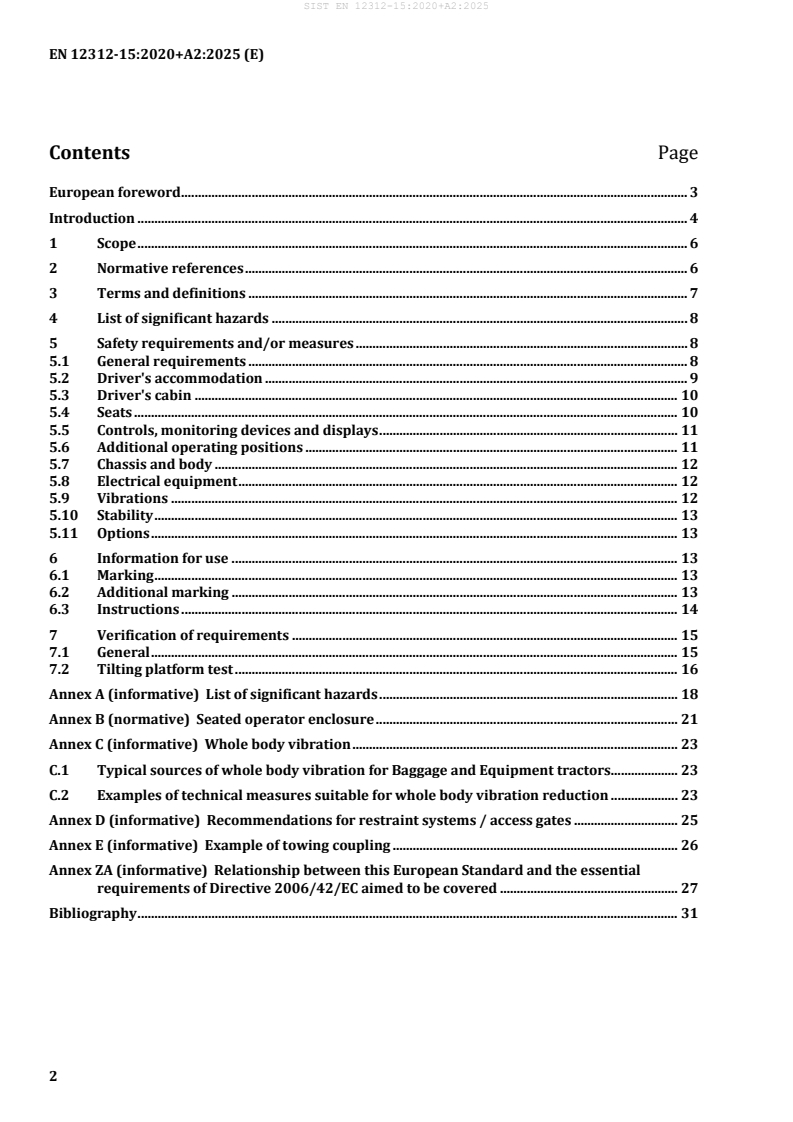
Contents Page
European foreword . 3
Introduction . 4
1 Scope . 6
2 Normative references . 6
3 Terms and definitions . 7
4 List of significant hazards . 8
5 Safety requirements and/or measures . 8
5.1 General requirements . 8
5.2 Driver's accommodation . 9
5.3 Driver's cabin . 10
5.4 Seats . 10
5.5 Controls, monitoring devices and displays . 11
5.6 Additional operating positions . 11
5.7 Chassis and body . 12
5.8 Electrical equipment . 12
5.9 Vibrations . 12
5.10 Stability . 13
5.11 Options . 13
6 Information for use . 13
6.1 Marking . 13
6.2 Additional marking . 13
6.3 Instructions . 14
7 Verification of requirements . 15
7.1 General . 15
7.2 Tilting platform test . 16
Annex A (informative) List of significant hazards . 18
Annex B (normative) Seated operator enclosure . 21
Annex C (informative) Whole body vibration . 23
C.1 Typical sources of whole body vibration for Baggage and Equipment tractors. 23
C.2 Examples of technical measures suitable for whole body vibration reduction . 23
Annex D (informative) Recommendations for restraint systems / access gates . 25
Annex E (informative) Example of towing coupling . 26
Annex ZA (informative) Relationship between this European Standard and the essential
requirements of Directive 2006/42/EC aimed to be covered . 27
Bibliography . 31
European foreword
This document (EN 12312-15:2020+A2:2025) has been prepared by Technical Committee CEN/TC 274
“Aircraft ground support equipment”, the secretariat of which is held by DIN.
This European Standard shall be given the status of a national standard, either by publication of an
identical text or by endorsement, at the latest by Janvier 2026, and conflicting national standards shall
be withdrawn at the latest by Janvier 2026.
Attention is drawn to the possibility that some of the elements of this document may be the subject of
patent rights. CEN shall not be held responsible for identifying any or all such patent rights.
This document includes Amendment 1 approved by CEN on 17 August 2022.
This document includes Amendment 2 approved by CEN on 23 April 2025.
This document supersedes #EN 12312-15:2020+A1:2022$.
The start and finish of text introduced or altered by amendment is indicated in the text by tags !".
The start and finish of text introduced or altered by amendment is indicated in the text by tags #$.
This document has been prepared under a mandate given to CEN by the European Commission and the
European Free Trade Association, and supports essential requirements of EU Directive 2006/42/EC on
machinery.
For relationship with EU Directive 2006/42/EC on machinery, see informative Annex ZA, which is an
integral part of this document.
EN 12312, Aircraft ground support equipment ― Specific requirements consists of the following parts:
— Part 1: Passenger stairs;
— Part 2: Catering vehicles;
— Part 3: Conveyor belt vehicles;
— Part 4: Passenger boarding bridges;
— Part 5: Aircraft fuelling equipment;
— Part 6: Deicers and deicing/anti-icing equipment;
— Part 7: Aircraft movement equipment;
— Part 8: Maintenance or service stairs and platforms;
— Part 9: Container/Pallet loaders;
— Part 10: Container/Pallet transfer transporters;
— Part 11: Container/Pallet dollies and loose load trailers;
— Part 12: Potable water service equipment;
— Part 13: Lavatory service equipment;
— Part 14: Disabled/incapacitated passenger boarding vehicles;
— Part 15: Baggage and equipment tractors (the present document);
— Part 16: Air start equipment;
— Part 17: Air conditioning equipment;
— Part 18: Nitrogen or Oxygen units;
— Part 19: Aircraft jacks, axle jacks and hydraulic tail stanchions;
— Part 20: Electrical ground power units.
#Deleted paragraphs$
Any feedback and questions on this document should be directed to the users’ national standards body.
A complete listing of these bodies can be found on the CEN website.
According to the CEN-CENELEC Internal Regulations, the national standards organizations of the
following countries are bound to implement this European Standard: Austria, Belgium, Bulgaria,
Croatia, Cyprus, Czech Republic, Denmark, Estonia, Finland, France, Germany, Greece, Hungary, Iceland,
Ireland, Italy, Latvia, Lithuania, Luxembourg, Malta, Netherlands, Norway, Poland, Portugal, Republic of
North Macedonia, Romania, Serbia, Slovakia, Slovenia, Spain, Sweden, Switzerland, Türkiye and the
United Kingdom.
Introduction
This European Standard defines health and safety requirements for baggage and equipment tractors
intended for towing equipment and baggage/cargo trailers on airports.
The minimum essential criteria are considered to be of primary importance in providing safe,
serviceable, economical and practical baggage and equipment tractors. Deviations should occur only
after careful consideration, extensive testing, risk assessment and service evaluation have shown
alternative methods or conditions to be satisfactory. Such deviations are outside the scope of this
standard and a manufacturer should be able to demonstrate an equivalent level of protection.
This European Standard is a type-C standard as stated in EN ISO 12100.
This document is of relevance, in particular, for the following stakeholder groups representing the
market players with regard to machinery safety:
— machine manufacturers (small, medium and large enterprises);
— health and safety bodies (regulators, accident prevention organizations, market surveillance etc.)
Others can be affected by the level of machinery safety achieved with the means of the document by the
above-mentioned stakeholder groups:
— machine users/employers (small, medium and large enterprises);
— machine users/employees (e.g. trade unions, organizations for people with special needs);
— service providers, e.g. for maintenance (small, medium and large enterprises).
The above-mentioned stakeholder groups have been given the possibility to participate at the drafting
process of this document.
The machinery concerned and the extent to which hazards, hazardous situations or hazardous events
are covered are indicated in the Scope of this document.
When requirements of this type-C standard are different from those which are stated in type-A or type-
B standards, the requirements of this type-C standard take precedence over the requirements of the
other standards for machines that have been designed and built according to the requirements of this
type-C standard. Deviations from requirements do not fall within the presumption of conformity given
by the standard.
1 Scope
This document specifies the technical requirements to minimize the hazards listed in Clause 4 which
can arise during the commissioning, the operation and the maintenance of baggage and equipment
tractors when used as intended, including misuse reasonably foreseeable by the manufacturer, when
carried out in accordance with the specifications given by the manufacturer or his authorized
representative. It also takes into account some requirements recognized as essential by authorities,
aircraft and ground support equipment (GSE) manufacturers as well as airlines and handling agencies.
This document applies to self-propelled baggage and equipment tractors with driver accommodation.
This document does not apply to pedestrian controlled equipment.
This document deals with vibrations which are considered as significant. Vibration measurements are
dealt with in EN 1915-3.
No extra requirements on noise are provided other than those given in EN 1915-4.
NOTE EN 1915-4 provides the general GSE noise requirements.
This part of EN 12312 is not applicable to baggage and equipment tractors manufactured before the
date of its publication.
This part of EN 12312 when used in conjunction with EN 1915-1, EN 1915-2, EN 1915-3 and EN 1915-4
provides the requirements for baggage and equipment tractors.
2 Normative references
The following documents are referred to in the text in such a way that some or all of their content
constitutes requirements of this document. For dated references, only the edition cited applies. For
undated references, the latest edition of the referenced document (including any amendments) applies.
EN 1175-1:1998+A1:2010, Safety of industrial trucks — Electrical requirements — Part 1: General
requirements for battery powered trucks
EN 1175-2:1998+A1:2010, Safety of industrial trucks — Electrical requirements — Part 2: General
requirements of internal combustion engine powered trucks
EN 1175-3:1998+A1:2010, Safety of industrial trucks — Electrical requirements — Part 3: Specific
requirements for the electric power transmission systems of internal combustion engine powered trucks
EN 1915-1:2013, Aircraft ground support equipment — General requirements — Part 1: Basic safety
requirements
EN 1915-2:2001+A1:2009, Aircraft ground support equipment — General requirements — Part 2:
Stability and strength requirements, calculations and test methods
EN 1915-3:2004+A1:2009, Aircraft ground support equipment — General requirements — Part 3:
Vibration measurement methods and reduction
EN 1915-4:2004+A1:2009, Aircraft ground support equipment — General requirements — Part 4: Noise
measurement methods and reduction
EN 13490:2001+A1:2008, Mechanical vibration — Industrial trucks — Laboratory evaluation and
specification of operator seat vibration
EN ISO 2860:2008, Earth-moving machinery — Minimum access dimensions (ISO 2860:1992)
EN ISO 2867:2011, Earth-moving machinery — Access systems (ISO 2867:2011)
EN ISO 3411:2007, Earth-moving machinery — Physical dimensions of operators and minimum operator
space envelope (ISO 3411:2007)
EN ISO 3691-1:2015, Industrial trucks — Safety requirements and verification — Part 1: Self-propelled
industrial trucks, other than driverless trucks, variable-reach trucks and burden-carrier trucks (ISO 3691-
1:2011, including Cor 1:2013)
EN ISO 10326-1:2016, Mechanical vibration — Laboratory method for evaluating vehicle seat vibration -
Part 1: Basic requirements (ISO 10326-1:2016, Corrected version 2017-02)
EN ISO 12100:2010, Safety of machinery — General principles for design — Risk assessment and risk
reduction (ISO 12100:2010)
EN ISO 13849-1:2015, Safety of machinery — Safety-related parts of control systems — Part 1: General
principles for design (ISO 13849-1:2015)
EN ISO 13850:2015, Safety of machinery — Emergency stop function — Principles for design (ISO
13850:2015)
EN ISO 21281:2005, Construction and layout of pedals of self-propelled sit-down rider-controlled
industrial trucks — Rules for the construction and layout of pedals (ISO 21281:2005)
ISO 24135-1:2006, Industrial trucks — Specifications and test methods for operator restraint systems —
Part 1: Lap-type seat belts
3 Terms and definitions
For the purposes of this document, the terms and definitions given in EN ISO 12100:2010,
EN 1915-1:2013, EN 1915-3:2004+A1:2009 and the following apply.
ISO and IEC maintain terminology databases for use in standardization at the following addresses:
— IEC Electropedia: available at https://www.electropedia.org/
— ISO Online browsing platform: available at https://www.iso.org/obp
3.1
baggage and equipment tractor
industrial truck, travelling on the ground, intended for use on airports, fitted with coupling means and
specially designed to draw trailers
3.2
maximum drawbar pull
maximum reached horizontal towing capacity at stall
Note 1 to entry: When establishing the maximum drawbar pull, an operator’s mass of 80 kg is taken into
account.
3.3
whole body vibration
vibration transmitted to the body as a whole through the buttocks of a seated operator
3.4
SEAT factor
Seat Effective Amplitude Transmissibility factor
ratio of the frequency-weighted root mean square (r.m.s) acceleration on the seat divided by the
frequency-weighted r.m.s acceleration at the platform
Note 1 to entry: See EN 13490:2001+A1:2008.
3.5
Categories
3.5.1
category A
tractor with wheel (mean) diameter equal or below 800 mm and solid rubber or pneumatic tyres
3.5.2
category B
tractor with wheel (mean) diameter above 800 mm and rubber solid or pneumatic tyres
3.6
restraint system
restraint device, system, or enclosure intended to reduce the risk of entrapment of the operator’s head
and/or torso between the tractor and ground in the event of a tip-over
3.7
SIP
Seat Index Point
point on the central vertical plane of the seat as determined by ISO 5353
[SOURCE: EN ISO 3164:2013, 3.2]
Note 1 to entry: See EN ISO 3411:2007.
3.8
OPC
operator presence control
control device that automatically interrupts the power, e.g. to a drive or an engine, when the operator's
actuating force is removed
4 List of significant hazards
The list of risks and hazards (given at Annex A) is based on EN ISO 12100:2010 and contains the
hazards and hazardous situations as far as they are dealt with in this European standard, identified by
risk assessment as significant for baggage and equipment tractors and which require action to eliminate
or reduce the risk. Not covered are hazards due to the traffic and repair.
5 Safety requirements and/or measures
5.1 General requirements
5.1.1 Baggage and equipment tractors shall conform to the requirements of this standard and the
relevant requirements of EN 1915-1:2013, EN 1915-2:2001+A1:2009, EN 1915-3:2004+A1:2009 and
EN 1915-4:2004+A1:2009 unless otherwise specified in this standard. The specific requirements of this
European standard take precedence over those of the EN 1915 series.
Machinery shall comply with the safety requirements and/or measures of this clause. In addition, the
machine shall be designed according to the principles of EN ISO 12100:2010 for relevant but not
significant hazards which are not dealt with by this document.
5.1.2 Stability and strength calculations shall be carried out in accordance with
EN 1915-2:2001+A1:2009.
5.1.3 The overall dimensions of baggage and equipment tractors shall be kept to a minimum,
consistent with their function, taking into account site operational requirements.
The following information shall be determined by the manufacturer through consultation with the user:
a) overall dimensions;
b) speeds;
c) maximum drawbar pull;
d) drawbar interface heights;
e) maximum-braked train mass.
5.1.4 Internal combustion engine powered baggage and equipment tractors using liquefied petroleum
gas (LPG) shall be in accordance with the requirements of EN ISO 3691-1:2015, 4.5.4.
5.2 Driver's accommodation
5.2.1 Baggage and equipment tractors shall be equipped with seated driver accommodation.
5.2.2 The operator's seat shall be so located that the operator has sufficient room while operating the
baggage and equipment tractor so as to remain within the plan view outline of the tractor. The
minimum dimensions given in Annex B shall be applied. The dimensions shall be of suitable and
ergonomic shape to accommodate at least a 5th percentile to a 95th percentile of the population, as
shown in EN ISO 3411:2007, Figures 1 to 3, within the plan view outline of the tractor. The seat shall
not extend beyond the plan view outline of the tractor.
5.2.3 Provision shall be made for the storage of operating instructions in the vicinity of the driver’s
accommodation. This shall not obstruct the driver’s usual field of operation and view nor constitute a
dangerous obstacle in case of a frontal impact.
5.2.4 In addition to seat belts (see 5.4.5), lateral restraint systems shall be provided on each side
exposed to a risk of tipping over. Such means shall not unduly restrict the operation of the tractor, e.g.
the driver’s access, egress, movement, and/or visibility (see Annex D for recommendations). The lateral
restraint system shall:
a) be provided to reduce the risk of entrapment of the operator's head and/or torso between the
tractor and the ground in the event of a tip-over. For this purpose it shall be designed so that the
driver’s shoulders are under the top level of the protection, whatever the adjustment of the seat;
b) be latched in the protective position;
c) prevent the whole body of the operator passing through the lateral opening;
d) not unlatch when submitted to a horizontal force of 200 daN applied at the most unfavourable
point.
5.2.5 An access gate fixed on both sides or a fully enclosed cabin with doors, both complying with the
requirements of 5.2.4 are considered as a restraint system.
5.2.6 Instructions on the use of lateral restraint systems shall be provided and visible in the tractor.
Actions to be taken to reduce the risk of a tip-over shall be described in the instruction manual, see 6.3.
5.2.7 When the lateral restraint system function is achieved with a door (closed cabin), a gate, or with
movable part(s), it shall not be possible to drive the tractor, or to drive it at a speed higher than 6 km/h,
if the restraint system is not secured. The related interlocking systems shall achieve Performance Level
“b” according to EN ISO 13849-1:2015.
5.3 Driver's cabin
5.3.1 For fully enclosed cabins, in addition to the requirements in EN 1915-1:2013, 5.3.1, the rear
windscreen shall have at least one power-operated wiper.
A rear windscreen washing unit should be provided if agreed between manufacturer and user.
5.3.2 A fully enclosed cabin shall have at least one door conforming to the requirements of
EN ISO 2867:2011, plus an emergency exit conforming to the requirements of EN ISO 2860:2008,
allowing escape in another direction, which may be a window. It shall be positioned as far as possible
away from the normal exit.
5.3.3 The air intake of a heater/de-mister for a fully enclosed cabin shall be connected to a fresh air
inlet. The position of the air intake shall prevent the intake of emissions, e.g. exhaust gas or electrolytic
gas.
5.4 Seats
5.4.1 Baggage and equipment tractors shall be equipped with an adjustable seat for the driver in
order to minimize fatigue during the intended work period, see also EN 1915-1:2013, 5.2.1.
5.4.2 Seat mountings shall withstand the forces which may occur during operation, e.g. braking or
coupling forces, minor collisions with trailers/dollies.
5.4.3 It shall be possible to adjust the driver’s seat without using tools.
5.4.4 Where a weight adjustable suspension seat is fitted (see 5.9.5), the adjustment shall cater for a
weight range of at least 55 kg to 110 kg. The correct adjustment of the seat to the driver’s weight shall
be easily performed and clearly visible for the seated driver, e.g. a weight scale, an index or an
automatic means (e.g. pneumatic seat).
5.4.5 A seat belt shall be fitted to all seats and comply with ISO 24135-1:2006 when of a lap type.
5.4.6 The driver suspension seat shall be selected to achieve the requirements specified in Table 1.
Input spectral classes (IT) and SEAT factors are specified in EN 13490:2001+A1:2008.
Table 1 — IT Class and SEAT factor
Category Wheel (mean) diameter Input spectral classes SEAT factor
A D ≤ 800 mm IT 2 < 0,8
B 800 mm < D IT 3 < 0,9
5.5 Controls, monitoring devices and displays
5.5.1 Internal combustion engine powered baggage and equipment tractors with automatic
transmission shall be fitted with a device preventing the engine from being started whilst the
transmission is engaged.
5.5.2 Internal combustion engine powered baggage and equipment tractors with automatic gear box
shall not move faster than 3 km/h on a paved and even area when the transmission is engaged and the
engine is running at idle speed.
5.5.3 Pedal operated travel and braking controls shall conform to EN ISO 21281:2005 as shown in
pedal layout, Table 1.
5.5.4 Battery powered baggage and equipment tractors shall be equipped with means to prevent
powered travel when the driver dismounts from the tractor. Such a means can be e.g. an operator
presence control (OPC).
5.5.5 Movement of battery powered baggage and equipment tractors shall not be possible while the
safeguard against unauthorized use is activated, see EN 1915-1:2013, 5.4.2.
5.6 Additional operating positions
5.6.1 Where additional operating positions are provided, e.g. push-button operation at the rear or
front of the baggage and equipment tractor, the initiated movement per activation shall be limited to a
maximum of a horizontal straight distance of 300 mm.
5.6.2 Where operating positions in addition to that required by 5.2 are provided, the maximum speed
of the tractor during operation of this control shall be restricted to 3 km/h.
5.6.3 The controls, e.g. rear push-button device, shall be arranged so that the operator does not have
to step between tractor and trailer/dolly for activation and provide the observation of all activated
movements.
5.6.4 Where a travel control outside the baggage and equipment tractor is provided, it shall be
enabled by means of a separate switch, overriding the requirements of 5.5.4. Travel controls provided
inside and outside the tractor shall be interlocked, see EN 1915-1:2013, 5.4.3. As soon as the control
actuator of the travel control is released, it shall automatically return to the “off” position and a parking
brake or equivalent device shall be engaged. The related interlocking systems shall achieve
Performance Level “b” according to EN ISO 13849-1:2015
5.6.5 While operating the outside trave
...
Questions, Comments and Discussion
Ask us and Technical Secretary will try to provide an answer. You can facilitate discussion about the standard in here.
Loading comments...