


SIST EN ISO 3826-1:2019
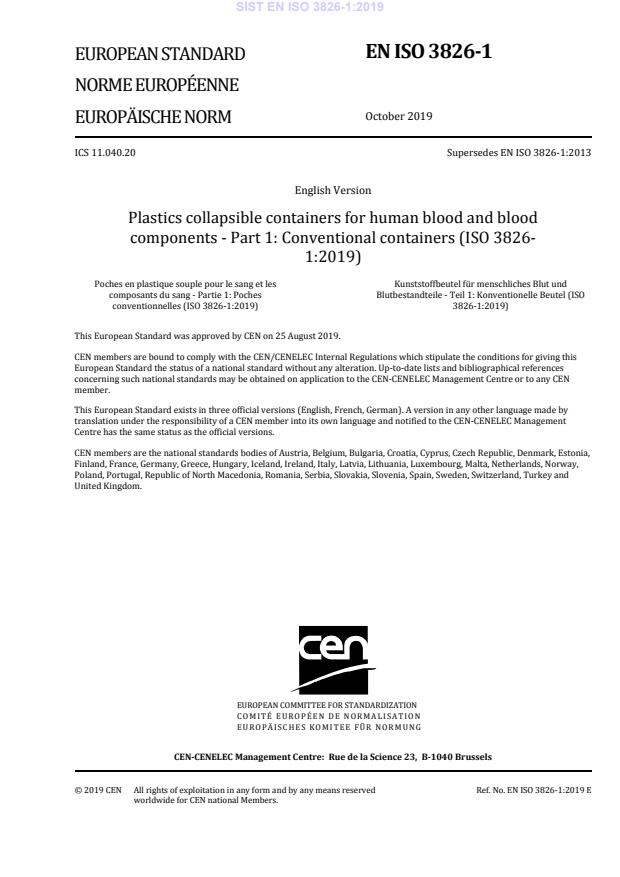
(Main)Plastics collapsible containers for human blood and blood components - Part 1: Conventional containers (ISO 3826-1:2019)
Plastics collapsible containers for human blood and blood components - Part 1: Conventional containers (ISO 3826-1:2019)
This document specifies requirements, including performance requirements, for plastics collapsible, non-vented, sterile containers (known as plastics containers) complete with collecting tube outlet port(s), integral needle, and with optional transfer tube(s), for the collection, storage, processing, transport, separation, and administration of blood and blood components. The plastics containers can contain anticoagulant and/or preservative solutions, depending on the application envisaged.
This document is also applicable to multiple units of plastics containers, e.g. to double, triple, quadruple, or multiple units.
Unless otherwise specified, all tests specified in this document apply to the plastics container as prepared ready for use.
This document is not applicable to plastics containers with an integrated filter.
Kunststoffbeutel für menschliches Blut und Blutbestandteile - Teil 1: Konventionelle Beutel (ISO 3826-1:2019)
Dieses Dokument legt Anforderungen einschließlich der geforderten Leistungsmerkmale fest für nicht belüftete, sterile Beutel (bekannt als Kunststoffbeutel), die mit Entnahmeschlauch, einem oder mehreren Einstechstutzen, integrierter Blutentnahmekanüle und wahlweise mit Überleitungsschlauch oder schläuchen ausgestattet sind und die zur Aufnahme, Lagerung, Aufbereitung, zum Transport, zur Trennung und Verabreichung von Blut und Blutbestandteilen bestimmt sind. Die Kunststoffbeutel können, je nach vorgesehener Verwendung, Antikoagulans und/oder Stabilisatorlösungen enthalten.
Dieses Dokument ist auch anwendbar auf Mehrfachsysteme von Kunststoffbeuteln, die sich z. B. aus zwei, drei, vier oder mehr Einheiten zusammensetzen.
Soweit nichts anderes vorgegeben ist, gelten alle in diesem Dokument festgelegten Prüfungen für den gebrauchsfertigen Kunststoffbeutel.
Dieses Dokument gilt nicht für Kunststoffbeutel mit einem integrierten Filter.
Poches en plastique souple pour le sang et les composants du sang - Partie 1: Poches conventionnelles (ISO 3826-1:2019)
Le présent document spécifie les exigences, y compris les exigences de performance, des poches en plastique souple, sans prise d'air, stériles (appelées poches en plastique), présentées complètes avec tubulure de prélèvement à aiguille solidaire, raccord(s) de sortie, et, éventuellement, tubulure(s) de transfert, destinées au prélèvement, au stockage, au traitement, au transport, à la séparation et à la transfusion du sang et des composants du sang. Les poches en plastique peuvent contenir des solutions anticoagulantes et/ou de conservation, selon l'usage prévu.
Les exigences spécifiées dans le présent document sont également applicables aux poches en plastique multiples, par exemple les poches doubles, triples ou quadruples.
Sauf indication contraire, tous les essais spécifiés dans le présent document sont applicables aux poches en plastique prêtes à l'emploi.
Le présent document n'est pas applicable aux poches en plastique comportant un filtre intégré.
Plastični zložljivi vsebniki za človeško kri in krvne komponente - 1. del: Običajni vsebniki (ISO 3826-1:2019)
Ta dokument določa zahteve, vključno z zahtevami glede lastnosti, za plastične zložljive nezračene sterilne vsebnike (z drugim imenom plastične vsebnike) z izhodnimi priključki zbirne cevke, vdelano iglo in dodatnimi prenosnimi cevkami za odvzem, shranjevanje, obdelavo, transport, ločevanje ter dovajanje krvi in krvnih komponent. Plastični vsebniki lahko vsebujejo antikoagulant in/ali konzervans, odvisno od predvidene uporabe. Ta dokument se uporablja tudi za enote z več plastičnimi vsebniki, npr. za dvojne, trojne, četverne ali večje enote. Če ni navedeno drugače, se vsi preskusi, navedeni v tem dokumentu, uporabljajo za plastične vsebnike, pripravljene za uporabo. Ta dokument se ne uporablja za plastične vsebnike z vgrajenim filtrom.
General Information
- Status
- Published
- Public Enquiry End Date
- 24-Jun-2018
- Publication Date
- 12-Nov-2019
- Technical Committee
- VAZ - Healthcare
- Current Stage
- 6060 - National Implementation/Publication (Adopted Project)
- Start Date
- 24-Oct-2019
- Due Date
- 29-Dec-2019
- Completion Date
- 13-Nov-2019
Relations
- Effective Date
- 01-Dec-2019
- Effective Date
- 01-Jun-2023
Overview - EN ISO 3826-1:2019 (Plastics collapsible containers / blood bags)
EN ISO 3826-1:2019 specifies requirements for plastics collapsible, non‑vented, sterile containers used for human blood and blood components - commonly referred to as blood bags or plastics containers (conventional). The standard covers single and multiple‑unit assemblies (double, triple, quadruple, etc.) complete with collection tube outlet port(s), integral blood‑taking needle and optional transfer tube(s). It applies to containers as supplied ready for use and excludes plastics containers with an integrated filter. EN ISO 3826-1:2019 replaces the 2013 edition and is adopted as a CEN European Standard.
Key topics and technical requirements
- Design and dimensions: specifications for container geometry, suspension points, outlet ports, and tube/needle integration to support safe collection and transfusion.
- Physical performance: tests for transparency, colouration, thermal stability, water‑vapour transmission, air content, emptying under pressure and resistance to leakage.
- Chemical requirements: evaluation of raw container materials and behaviour with test fluids; guidance on anticoagulant and preservative solutions.
- Biological safety: sterilization, impermeability to microorganisms and biological compatibility (cytotoxicity/interaction risks).
- Collection performance: pilot sample requirements, rate of collection, particulate contamination limits and handling for multiple‑unit packs.
- Packaging and labelling: requirements for primary container labels, over‑packs and shipping boxes - including barcoding and traceability elements.
- Normative test methods: annexes describe chemical, physical and biological test procedures used to verify compliance.
Practical applications and who uses the standard
- Manufacturers of blood bags and plastics sheeting use the standard to design, test and certify products for blood collection, processing, storage and transfusion.
- Blood establishments, transfusion services and hospital blood banks rely on the standard when specifying procurement to ensure compatibility with processing systems and regulatory compliance.
- Regulatory bodies and notified authorities reference EN ISO 3826-1:2019 for conformity assessment and safety oversight.
- Quality assurance and testing laboratories apply the normative tests (physical, chemical, biological) to validate batch releases.
- Procurement and clinical engineering teams use the standard to evaluate multi‑unit sets and to mitigate risks like contamination or air embolism.
Benefits and keywords
Adoption of EN ISO 3826-1:2019 helps ensure product safety, maintain blood/component quality, improve traceability and reduce risks from microbiological contamination, air embolism, or identification errors. Relevant keywords: EN ISO 3826-1:2019, plastics collapsible containers, blood bags, blood components, sterile containers, blood collection, transfusion equipment, blood bag standards.
Related standards
Refer to other parts of the ISO 3826 series and national CEN/ISO publications for complementary requirements and technical innovations (e.g., filters, additive solutions); EN ISO 3826-1:2019 supersedes EN ISO 3826-1:2013.



Frequently Asked Questions
SIST EN ISO 3826-1:2019 is a standard published by the Slovenian Institute for Standardization (SIST). Its full title is "Plastics collapsible containers for human blood and blood components - Part 1: Conventional containers (ISO 3826-1:2019)". This standard covers: This document specifies requirements, including performance requirements, for plastics collapsible, non-vented, sterile containers (known as plastics containers) complete with collecting tube outlet port(s), integral needle, and with optional transfer tube(s), for the collection, storage, processing, transport, separation, and administration of blood and blood components. The plastics containers can contain anticoagulant and/or preservative solutions, depending on the application envisaged. This document is also applicable to multiple units of plastics containers, e.g. to double, triple, quadruple, or multiple units. Unless otherwise specified, all tests specified in this document apply to the plastics container as prepared ready for use. This document is not applicable to plastics containers with an integrated filter.
This document specifies requirements, including performance requirements, for plastics collapsible, non-vented, sterile containers (known as plastics containers) complete with collecting tube outlet port(s), integral needle, and with optional transfer tube(s), for the collection, storage, processing, transport, separation, and administration of blood and blood components. The plastics containers can contain anticoagulant and/or preservative solutions, depending on the application envisaged. This document is also applicable to multiple units of plastics containers, e.g. to double, triple, quadruple, or multiple units. Unless otherwise specified, all tests specified in this document apply to the plastics container as prepared ready for use. This document is not applicable to plastics containers with an integrated filter.
SIST EN ISO 3826-1:2019 is classified under the following ICS (International Classification for Standards) categories: 11.040.20 - Transfusion, infusion and injection equipment. The ICS classification helps identify the subject area and facilitates finding related standards.
SIST EN ISO 3826-1:2019 has the following relationships with other standards: It is inter standard links to SIST EN ISO 3826-1:2013, SIST EN ISO 3826-1:2019/A1:2023. Understanding these relationships helps ensure you are using the most current and applicable version of the standard.
SIST EN ISO 3826-1:2019 is associated with the following European legislation: EU Directives/Regulations: 93/42/EEC; Standardization Mandates: M/023. When a standard is cited in the Official Journal of the European Union, products manufactured in conformity with it benefit from a presumption of conformity with the essential requirements of the corresponding EU directive or regulation.
SIST EN ISO 3826-1:2019 is available in PDF format for immediate download after purchase. The document can be added to your cart and obtained through the secure checkout process. Digital delivery ensures instant access to the complete standard document.
Standards Content (Sample)
SLOVENSKI STANDARD
01-december-2019
Nadomešča:
SIST EN ISO 3826-1:2013
Plastični zložljivi vsebniki za človeško kri in krvne komponente - 1. del: Običajni
vsebniki (ISO 3826-1:2019)
Plastics collapsible containers for human blood and blood components - Part 1:
Conventional containers (ISO 3826-1:2019)
Kunststoffbeutel für menschliches Blut und Blutbestandteile - Teil 1: Konventionelle
Beutel (ISO 3826-1:2019)
Poches en plastique souple pour le sang et les composants du sang - Partie 1: Poches
conventionnelles (ISO 3826-1:2019)
Ta slovenski standard je istoveten z: EN ISO 3826-1:2019
ICS:
11.040.20 Transfuzijska, infuzijska in Transfusion, infusion and
injekcijska oprema injection equipment
2003-01.Slovenski inštitut za standardizacijo. Razmnoževanje celote ali delov tega standarda ni dovoljeno.
EN ISO 3826-1
EUROPEAN STANDARD
NORME EUROPÉENNE
October 2019
EUROPÄISCHE NORM
ICS 11.040.20 Supersedes EN ISO 3826-1:2013
English Version
Plastics collapsible containers for human blood and blood
components - Part 1: Conventional containers (ISO 3826-
1:2019)
Poches en plastique souple pour le sang et les Kunststoffbeutel für menschliches Blut und
composants du sang - Partie 1: Poches Blutbestandteile - Teil 1: Konventionelle Beutel (ISO
conventionnelles (ISO 3826-1:2019) 3826-1:2019)
This European Standard was approved by CEN on 25 August 2019.
CEN members are bound to comply with the CEN/CENELEC Internal Regulations which stipulate the conditions for giving this
European Standard the status of a national standard without any alteration. Up-to-date lists and bibliographical references
concerning such national standards may be obtained on application to the CEN-CENELEC Management Centre or to any CEN
member.
This European Standard exists in three official versions (English, French, German). A version in any other language made by
translation under the responsibility of a CEN member into its own language and notified to the CEN-CENELEC Management
Centre has the same status as the official versions.
CEN members are the national standards bodies of Austria, Belgium, Bulgaria, Croatia, Cyprus, Czech Republic, Denmark, Estonia,
Finland, France, Germany, Greece, Hungary, Iceland, Ireland, Italy, Latvia, Lithuania, Luxembourg, Malta, Netherlands, Norway,
Poland, Portugal, Republic of North Macedonia, Romania, Serbia, Slovakia, Slovenia, Spain, Sweden, Switzerland, Turkey and
United Kingdom.
EUROPEAN COMMITTEE FOR STANDARDIZATION
COMITÉ EUROPÉEN DE NORMALISATION
EUROPÄISCHES KOMITEE FÜR NORMUNG
CEN-CENELEC Management Centre: Rue de la Science 23, B-1040 Brussels
© 2019 CEN All rights of exploitation in any form and by any means reserved Ref. No. EN ISO 3826-1:2019 E
worldwide for CEN national Members.
Contents Page
European foreword . 3
European foreword
This document (EN ISO 3826-1:2019) has been prepared by Technical Committee ISO/TC 76
"Transfusion, infusion and injection, and blood processing equipment for medical and pharmaceutical
use" in collaboration with Technical Committee CEN/TC 205 “Non-active medical devices” the
secretariat of which is held by DIN.
This European Standard shall be given the status of a national standard, either by publication of an
identical text or by endorsement, at the latest by April 2020, and conflicting national standards shall be
withdrawn at the latest by April 2020.
Attention is drawn to the possibility that some of the elements of this document may be the subject of
patent rights. CEN shall not be held responsible for identifying any or all such patent rights.
This document supersedes EN ISO 3826-1:2013.
According to the CEN-CENELEC Internal Regulations, the national standards organizations of the
following countries are bound to implement this European Standard: Austria, Belgium, Bulgaria,
Croatia, Cyprus, Czech Republic, Denmark, Estonia, Finland, France, Germany, Greece, Hungary, Iceland,
Ireland, Italy, Latvia, Lithuania, Luxembourg, Malta, Netherlands, Norway, Poland, Portugal, Republic of
North Macedonia, Romania, Serbia, Slovakia, Slovenia, Spain, Sweden, Switzerland, Turkey and the
United Kingdom.
Endorsement notice
The text of ISO 3826-1:2019 has been approved by CEN as EN ISO 3826-1:2019 without any
modification.
INTERNATIONAL ISO
STANDARD 3826-1
Third edition
2019-09
Plastics collapsible containers
for human blood and blood
components —
Part 1:
Conventional containers
Poches en plastique souple pour le sang et les composants du sang —
Partie 1: Poches conventionnelles
Reference number
ISO 3826-1:2019(E)
©
ISO 2019
ISO 3826-1:2019(E)
© ISO 2019
All rights reserved. Unless otherwise specified, or required in the context of its implementation, no part of this publication may
be reproduced or utilized otherwise in any form or by any means, electronic or mechanical, including photocopying, or posting
on the internet or an intranet, without prior written permission. Permission can be requested from either ISO at the address
below or ISO’s member body in the country of the requester.
ISO copyright office
CP 401 • Ch. de Blandonnet 8
CH-1214 Vernier, Geneva
Phone: +41 22 749 01 11
Fax: +41 22 749 09 47
Email: copyright@iso.org
Website: www.iso.org
Published in Switzerland
ii © ISO 2019 – All rights reserved
ISO 3826-1:2019(E)
Contents Page
Foreword .iv
Introduction .v
1 Scope . 1
2 Normative references . 1
3 Terms and definitions . 1
4 Dimensions . 2
5 Design . 2
5.1 General . 2
5.2 Air content . 3
5.3 Emptying under pressure . 3
5.4 Pilot samples . 3
5.5 Rate of collection . 3
5.6 Collection and transfer tube(s) . 5
5.7 Blood-taking needle . . 6
5.8 Outlet port(s) . 6
5.9 Suspension . 7
6 Requirements . 7
6.1 General . 7
6.2 Physical requirements . 7
6.2.1 Conditions of manufacture . 7
6.2.2 Sterilization . 7
6.2.3 Transparency . 7
6.2.4 Coloration . 8
6.2.5 Thermal stability. 8
6.2.6 Water vapour transmission . 8
6.2.7 Resistance to leakage . 8
6.2.8 Particulate contamination . 8
6.3 Chemical requirements. 9
6.3.1 Requirements for the raw container or sheeting. 9
6.3.2 Requirements for the test fluid . 9
6.4 Biological requirements .10
6.4.1 General.10
6.4.2 Impermeability for microorganisms .10
6.4.3 Compatibility .10
7 Packaging .10
8 Labelling .10
8.1 General .10
8.2 Label on plastics container .11
8.3 Label on over-package .11
8.4 Label on shipping box .12
8.5 Label requirements .12
9 Anticoagulant and/or preservative solution .12
Annex A (normative) Chemical tests .13
Annex B (normative) Physical tests .18
Annex C (normative) Biological tests .20
Bibliography .23
ISO 3826-1:2019(E)
Foreword
ISO (the International Organization for Standardization) is a worldwide federation of national standards
bodies (ISO member bodies). The work of preparing International Standards is normally carried out
through ISO technical committees. Each member body interested in a subject for which a technical
committee has been established has the right to be represented on that committee. International
organizations, governmental and non-governmental, in liaison with ISO, also take part in the work.
ISO collaborates closely with the International Electrotechnical Commission (IEC) on all matters of
electrotechnical standardization.
The procedures used to develop this document and those intended for its further maintenance are
described in the ISO/IEC Directives, Part 1. In particular, the different approval criteria needed for the
different types of ISO documents should be noted. This document was drafted in accordance with the
editorial rules of the ISO/IEC Directives, Part 2 (see www .iso .org/directives).
Attention is drawn to the possibility that some of the elements of this document may be the subject of
patent rights. ISO shall not be held responsible for identifying any or all such patent rights. Details of
any patent rights identified during the development of the document will be in the Introduction and/or
on the ISO list of patent declarations received (see www .iso .org/patents).
Any trade name used in this document is information given for the convenience of users and does not
constitute an endorsement.
For an explanation of the voluntary nature of standards, the meaning of ISO specific terms and
expressions related to conformity assessment, as well as information about ISO's adherence to the
World Trade Organization (WTO) principles in the Technical Barriers to Trade (TBT), see www .iso
.org/iso/foreword .html.
This document was prepared by Technical Committee ISO/TC 76, Transfusion, infusion and injection, and
blood processing equipment for medical and pharmaceutical use.
This third edition cancels and replaces the second edition (ISO 3826-1:2013), which has been technically
revised.
The main changes compared to the previous edition are as follows:
— in Clause 3 'Terms and definitions' four new entries have been added;
— in Clause 4, the designation example has been removed;
— Clause 5 'Design' has been revised, especially regarding the pilot samples, collection and transfer
tube(s), blood-taking needle and outlet port(s);
— the physical requirements in 6.2 have been slightly amended;
— Clause 8 'Labelling' has been reviewed and amended with barcoding information;
— the normative references in Clause 2 and the Bibliography have been updated.
A list of all parts in the ISO 3826 series can be found on the ISO website.
Any feedback or questions on this document should be directed to the user’s national standards body. A
complete listing of these bodies can be found at www .iso .org/members .html.
iv © ISO 2019 – All rights reserved
ISO 3826-1:2019(E)
Introduction
The manufacturers, or the suppliers, of plastics containers are expected to disclose in confidence to
control authorities, if requested by them, full details of the plastics material(s) and the components
of the materials and their methods of manufacture, details of manufacture of the plastics containers,
including the chemical names and quantities of any additives, whether incorporated by the
manufacturer of the plastics containers or present in the raw material, as well as full details of any
additives that have been used.
Universal leucocyte depletion is mandatory in various countries. This document is considered as a basic
for other standards which include technical innovations.
The requirements in this document are intended to
a) ensure that the quality of blood and blood components is maintained as high as necessary,
b) make possible efficient and safe collection, identification, storage, separation, and transfusion of
the contents, with special attention to reducing or minimizing the risks resulting from
— contamination, in particular, microbiological contamination,
— air embolism,
— errors in identification of plastics containers and any representative samples of contents,
— interaction between the plastics container and its contents,
c) ensure functional compatibility when used in combination with transfusion sets as specified in
ISO 1135-4 or ISO 1135-5,
d) provide a package with appropriate resistance to breakage and deterioration.
INTERNATIONAL STANDARD ISO 3826-1:2019(E)
Plastics collapsible containers for human blood and blood
components —
Part 1:
Conventional containers
1 Scope
This document specifies requirements, including performance requirements, for plastics collapsible,
non-vented, sterile containers (known as plastics containers) complete with collecting tube outlet
port(s), integral needle, and with optional transfer tube(s), for the collection, storage, processing,
transport, separation, and administration of blood and blood components. The plastics containers can
contain anticoagulant and/or preservative solutions, depending on the application envisaged.
This document is also applicable to multiple units of plastics containers, e.g. to double, triple, quadruple,
or multiple units.
Unless otherwise specified, all tests specified in this document apply to the plastics container as
prepared ready for use.
This document is not applicable to plastics containers with an integrated filter.
2 Normative references
The following documents are referred to in the text in such a way that some or all of their content
constitutes requirements of this document. For dated references, only the edition cited applies. For
undated references, the latest edition of the referenced document (including any amendments) applies.
ISO 1135-4, Transfusion equipment for medical use — Part 4: Transfusion sets for single use, gravity feed
ISO 1135-5, Transfusion equipment for medical use — Part 5: Transfusion sets for single use with pressure
infusion apparatus
ISO 3696, Water for analytical laboratory use — Specification and test methods
ISO 10993-4, Biological evaluation of medical devices — Part 4: Selection of tests for interactions with blood
ISO 10993-5, Biological evaluation of medical devices — Part 5: Tests for in vitro cytotoxicity
ISO 10993-10, Biological evaluation of medical devices — Part 10: Tests for irritation and skin sensitization
ISO 10993-11, Biological evaluation of medical devices — Part 11: Tests for systemic toxicity
3 Terms and definitions
For the purposes of this document, the following terms and definitions apply.
ISO and IEC maintain terminological databases for use in standardization at the following addresses:
— IEC Electropedia: available at http: //www .electropedia .org/
— ISO Online browsing platform: available at http: //www .iso .org/obp
ISO 3826-1:2019(E)
3.1
plastics container
bag, of plastics material, complete with collecting tube and needle, port(s) and where applicable
anticoagulant, preservative solutions, transfer tube(s) and associated container(s)
3.2
shelf life
period between the date of sterilization and the use-by date (expiry date) of the
plastics collapsible container for human blood and blood components after which the plastics container
shall not be used for the collection of blood
3.3
sheeting
plastics material intended for the production of empty containers
[SOURCE: ISO 15747:2018, 3.12]
3.4
raw container
empty container that has not yet been sterilized and has no identification
[SOURCE: ISO 15747:2018, 3.11]
3.5
empty container
raw container with identification, which is suitable for the acceptance and storage of fluids where
applicable and to be used for testing purposes
[SOURCE: ISO 15747:2018, 3.3, modified — "and administration of the injection solution" has been
replaced by "of fluids where applicable and to be used for testing purposes".]
3.6
gauge pressure
pressure zero-referenced against local atmospheric pressure
Note 1 to entry: Container internal gauge pressure is:
— positive when the container is pressurized above the surrounding atmospheric pressure, and is
— negative when the container is subjected to suction.
[SOURCE: ISO 15747:2018, 3.4]
4 Dimensions
Figure 1 illustrates the components of a plastics container. The values of the dimensions shown in
Figure 1 are binding and form part of the requirements of this document; the dimensions given in
Table 1 are for guidance only.
5 Design
5.1 General
The design and manufacture of the plastics container shall provide for the safe and convenient collection,
storage, processing, transport, separation, and administration of whole blood and blood components.
The plastics container shall permit the collection of blood and the preparation of plasma or centrifuged
or resuspended cellular components with a minimal hazard of contamination by microorganisms. The
plastics container shall be functionally compatible with the transfusion set specified in ISO 1135-4 or
ISO 1135-5. Its design shall also ensure that it can be used in a centrifuge cup.
2 © ISO 2019 – All rights reserved
ISO 3826-1:2019(E)
5.2 Air content
5.2.1 The total volume of air contained in the plastics container system divided by the number of
containers shall not exceed 15 ml.
NOTE Typical plastics container systems are described in ISO 3826-3.
5.2.2 When used in accordance with the manufacturer's instructions, the plastics container shall be
capable of being filled with blood without air being introduced.
5.3 Emptying under pressure
The plastics container, when filled with a volume of water at a temperature of (23 ± 5) °C equal to its
nominal capacity and connected to a transfusion set as specified in ISO 1135-4 or ISO 1135-5 inserted
in an outlet port (see 5.8), shall empty without visual leakage (see 6.2.7) within 2 min when gradually
squeezed between two plates to a gauge pressure of 50 kPa.
5.4 Pilot samples
The plastics container shall be designed so that pilot samples of unmistakable identity can be collected
for the performance of blood tests in the blood centre without the closed system of the plastics
container being penetrated. This may be accomplished, e.g. by using an unmistakable numbering
system on the tubing.
The tubing shall be designed so that stripping of the tubing up to 5 times with a tube stripper is possible
and if applicable will not remove the existing numbering system when following the plastics containers
instruction for use concerning tube stripping.
5.5 Rate of collection
The plastics container shall be designed so that it is capable of being filled to its nominal capacity in less
than 8 min when tested in accordance with B.2.
ISO 3826-1:2019(E)
Dimensions in millimetres
Key
1 tamper evident protector(s) 8 tamper evident protective cap
2 transfer tube 9 blood-taking needle
3 means of closure (optional) 10 needle hub
4 outlet port(s) 11 eyelets
5 collection tube 12 puncturable non-resealable closure(s)
6 tear line of protector 13 side slits
7 label area
a
Length ≥ 200 mm, internal diameter ≥ 2,7 mm, wall thickness ≥ 0,5 mm.
4 © ISO 2019 – All rights reserved
ISO 3826-1:2019(E)
b
Length ≥ 800 mm if used for gravitational collection, internal diameter ≥ 2,7 mm, wall thickness ≥ 0,5 mm.
c
External view.
d
Cross-sectional view.
NOTE See Table 1 for explanation of dimensions.
Figure 1 — Schematic representation of plastics container
Table 1 — Dimensions for plastics containers, label areas, and nominal capacity
Dimensions in millimetres
Size of label area
Nominal capacity Inside width Inside height
ml w h
1 1 w ± 5 h ± 5
2 2
100 75 120 60 85
250 120 130 90 85
400 120 170 105 105
500/600 120 185 105 105
5.6 Collection and transfer tube(s)
5.6.1 The plastics container may be provided with one or more collection or transfer tube(s) to allow
the collection and separation of blood and blood components.
If a transfer tube is present, and if necessary to avoid unexpected flow between containers, it shall be
fitted with a device which first acts as a seal and then, when opened, permits the free flow of blood
components.
5.6.2 The tubes shall be such that they can be sealed hermetically and do not collapse under normal use.
5.6.3 The plastics container, filled with water to its nominal capacity and sealed, and the tubes
connected to the plastics container shall form a hermetic tight leakproof connection (see 6.2.7) which
will withstand, without leakage occurring, a tensile force of 20 N applied to the tubing for 15 s. The
tensile force shall be applied at right angles to the edge of the joint and along the longitudinal axis of the
plane of the plastics container at a temperature of (23 ± 2) °C.
There shall be no leakage at the connection and the plastics container shall also conform to the
requirements specified in 6.2.7.
5.6.4 Under visual inspection, the tubing shall not display cracks, blisters, kinks, or other defects.
5.6.5 Requirements for sterile connection of transfer tubing. Tubing design shall allow the efficient
transfer of blood and blood components between packs. Design should also allow the joining of tubes
supplied by a single manufacturer or from different manufacturers using a sterile tube welding device.
Typically, this is to enable the connection of separate satellite packs when preparing blood components
by a ‘secondary process’. Sterile tube welding devices join the two opposing ends of the tube while
maintaining a sterile fluid pathway.
Manufacturers of sterile tube welding devices typically specify acceptable tube dimensions (external
and/or internal diameter and wall thickness) for use on their equipment. Blood bag manufacturers
shall specify in their product documentation the material, internal and external diameters, and wall
thickness of all their tubing to allow blood transfusion services to assess the suitability for tube welding.
ISO 3826-1:2019(E)
When a blood transfusion service wishes to weld tubing of different specifications, a validation should
be carried out before proceeding. A protocol is provided (see B.5) as a minimum requirement for such
validations (see also Reference [5]).
5.7 Blood-taking needle
The blood-taking needle shall be integral with the collection tube and covered by a protective cap. The
protective cap shall prevent leakage of anticoagulant and/or preservative solution from the plastics
container during storage, shall maintain the sterility of the fluid path, and shall be readily removable.
The protective cap shall be tamper-evident and manufactured so that either it is impossible to replace
or any attempt at manipulating it is blatantly obvious.
The internal and external surfaces of the blood-taking needle shall be clean and smooth. The bevel of
the needle shall be sharp and free from ridges, burrs, and barbs.
The joint between the blood-taking needle and the needle hub shall withstand a static tensile (pull)
force and compressive (push) force of 20 N for 15 s along the longitudinal axis.
The joint between the needle hub and the connected tubing shall withstand a static tensile (pull) force
of 20 N for 15 s along the longitudinal axis.
The blood-taking needle may contain a needle-stick protection device in accordance with ISO 3826-3.
5.8 Outlet port(s)
5.8.1 The plastics container shall be provided with one or more outlet ports for the administration of
blood and blood components through a transfusion set. The port(s), which shall have a puncturable non-
resealable closure port septum placed (14 +1/−2) mm from the top of the port, shall allow connection
of a transfusion set having a closure-piercing device in accordance with ISO 1135-4 and 1135-5 without
leakage (see 6.2.7) on insertion or during conditions of use, including emptying under pressure (see 5.3).
Before the closure is pierced by the point of the closure-piercing device, the outlet port(s) shall be tightly
occluded by the closure-piercing device. When used in accordance with manufacturer's instructions, the
piercing device shall not damage the plastic film of the plastics container on insertion.
NOTE Dimensions of the closure-piercing device can be found in ISO 1135-4 and ISO 1135-5.
When designing the outlet port to ensure good compatibility with closure-piercing devices,
manufacturers should avoid the use of tubing that is highly inflexible. Thin-walled tubing (<1 mm)
should also be avoided as this tends to twist and collapse on insertion.
5.8.2 Each outlet port shall be fitted with a hermetically sealed, tamper-evident protector to maintain
the sterility of the internal surface.
5.8.3 When a closure-piercing device conforming to ISO 1135-4 or ISO 1135-5 is inserted into the
blood bag port, this shall resist a static pull force of 15 N for 15 s and shall remain in place.
It shall be possible to pierce the insertion point with a closure-piercing device conforming to ISO 1135-4
or ISO 1135-5.
A reference spike is described in ISO 15747:2018, Annex D (metal version).
[16]
NOTE ISO/TS 23128 provides a general procedure for spike insertion force test method.
5.8.4 When tested in accordance with 5.3, the connection between the closure-piercing device and the
blood bag port shall show no visible evidence of leakage (see 6.2.7).
6 © ISO 2019 – All rights reserved
ISO 3826-1:2019(E)
5.9 Suspension
The plastics container shall have adequate means of suspension or positioning (see, for example, eyelets
in Figure 1) which do not interfere with the use of the plastics container during collection, storage,
processing, transport, and administration. The means of suspending or positioning the empty container
shall be capable of withstanding a tensile force of 20 N applied along the longitudinal axis of the outlet
port(s) for 60 min at a temperature of (23 ± 2) °C without breaking.
6 Requirements
6.1 General
The plastics container shall be transparent, virtually colourless (see 6.2.4), flexible, sterile, non-
pyrogenic, biologically safe (see 6.4), and non-frangible under conditions of use (see 6.2.5). It shall be
compatible with the contents under normal conditions of storage. The plastics container shall meet the
requirements for terminal sterilization and shall not become tacky during sterilization and storage for
its shelf life at temperatures not exceeding 40 °C.
The plastics container shall be stable biologically, chemically, and physically with respect to its contents
during its shelf life and shall not permit penetration of microorganisms. Any substances leached from
the plastics container by the contained anticoagulant and/or preservative solution, blood, and blood
components by either chemical interaction or physical dissolution, shall be within the limits specified.
In many countries, national pharmacopoeias specify formulations of different plastics materials, such
as flexible PVC with different plasticizers and other plastics materials, while government regulations or
standards may detail suitable tests for assessing chemical or physical interactions.
6.2 Physical requirements
6.2.1 Conditions of manufacture
All processes involved in the manufacture, assembly, and storage of the plastics container shall be
carried out under clean and hygienic conditions. Every practicable precaution shall be taken at all
stages to reduce the risk of adventitious contamination by microorganisms or foreign matter.
6.2.2 Sterilization
6.2.2.1 The plastics container shall have been sterilized by steam sterilization or any other
validated method.
6.2.2.2 The method of sterilization used shall not adversely affect the materials or contents, nor cause
any loosening of joints and deterioration of welds in the plastics material nor any major alteration in the
shape of the plastics container.
6.2.2.3 The manufacturer shall be able to produce evidence of the effectiveness of the sterilization
process actually used. If required, positive controls to check the effectiveness of sterilization shall be
included in each sterilization lot.
6.2.3 Transparency
When tested as specified in B.1, the opalescence of the suspension shall be perceptible when viewed
through the plastics container as compared with a similar plastics container filled with water.
ISO 3826-1:2019(E)
6.2.4 Coloration
The material of the sterilized plastics container shall not be coloured to such an extent that assessment
of the colour of the blood is adversely affected.
6.2.5 Thermal stability
This requirement refers primarily to plasma-freezing bags.
The plastics container, filled to half of its nominal capacity with water as specified in ISO 3696,
shall withstand a slow freezing to and storage at −80 °C for 24 h, subsequent immersion in water at
(37 ± 2) °C for 60 min, and returning to a temperature of (23 ± 2) °C. The plastics container shall meet
the requirements of 5.6.3, 5.9, 6.2.7, and 6.2.8. Plastics containers intended to be shock-frozen (blast-
frozen) or irradiated shall be validated for those specific applications.
The instructions for use should indicate if the plastics container is designed for shock-frozen or
irradiation applications. If a refrigerant solution is used, the plastics container may be enclosed in a
protective bag to avoid direct contact between the refrigerant solution and the plastics container.
6.2.6 Water vapour transmission
The plastics container, without an over-package, shall be filled to its nominal capacity with water as
specified in ISO 3696, sealed, and labelled ready for use. The plastics container shall then be capable of
being stored for 42 days at a temperature of (4 ± 2) °C without loss of a mass fraction of more than 2 %
of water from the solution.
The storage of certain blood components, such as platelet concentrates, may require specific gas
exchange rates for oxygen and carbon dioxide.
6.2.7 Resistance to leakage
When filled to nominal capacity with water as specified in ISO 3696 and sealed, the plastics container
shall not develop leaks under conditions of centrifugation at 5 000 g at 37 °C for 10 min. The plastics
container is then squeezed between two plates to a gauge pressure of 50 kPa at (23 ± 2) °C for 10 min.
No leakage shall be found on visual inspection.
For containers of flexible poly(vinyl chloride) (PVC), both tests should be repeated at 4 °C. Plastics
containers that are normally centrifuged without being filled with solution shall be subjected to the
same centrifugation conditions as noted above without being filled with any more solution. Following
this, the plastics container shall withstand a gauge pressure of 50 kPa after filling to nominal capacity.
When the plastics container is filled with anticoagulant solution, such as an ACD solution or other
solutions with similar pH, leakage can be detected by pressing the plastics container against sheets
of blue litmus paper and observing the development of pink spots on the paper. For solutions of other
pH, the same method with an appropriate indicator can be used. Alternative methods with at least the
same degree of sensitivity may be used.
6.2.8 Particulate contamination
Plastics containers shall be manufactured so that contamination with particles is minimized.
When tested as described in B.4, the fluid path within the plastics container should be free from visible
particles.
Limits and test procedures given in pharmacopoeias, for example, those specified in the European
Pharmacopoeia for parenteral solutions, can be used.
8 © ISO 2019 – All rights reserved
ISO 3826-1:2019(E)
6.3 Chemical requirements
6.3.1 Requirements for the raw container or sheeting
The sheeting shall fulfil the requirements given in the relevant pharmacopoeias. Alternatively, it may
be tested as described in Table 2.
Table 2 — Ignition residues for polyolefins and PVC
Maximum
Test Plastics material Test as specified in
permissible residue
Polyolefins 0,5 mg/g
Residue on ignition A.2
PVC
1 mg/g
containing plasticizers
6.3.2 Requirements for the test fluid
The limits specified in Table 3 shall not be exceeded when the appropriate tests are carried out on the
extract obtained in accordance with Annex A.
Table 3 — Chemical limits on extracts from plastics container
Characteristics Maximum permissible value Test method in
Oxidizable constituents 1,5 ml A.4.1
Ammonia 0,8 mg/l A.4.2
–
Chloride ions (Cl ) 4 mg/l A.4.3
Metals: Ba, Cr, Cu, Pb For each metal: 1 mg/l
Sn, Cd For each metal: 0,1 mg/l A.4.4.1
Al 0,05 mg/l
Heavy metals 2 mg/l A.4.4.2
Acidity or alkalinity 0,4 ml sodium hydroxide solution, c(NaOH) = 0,01 mol/l or
A.4.5
0,8 ml hydrochloric acid, c(HCl) = 0,01 mol/l
Residue on evaporation 5 mg or 50 mg/l A.4.6
Opalescence Slightly opalescent, but not more pronounced than that of
A.4.7
reference suspension
Coloration No coloration A.4.8
UV absorbance In the range of 230 nm to 360 nm
0,25 for plastics containers with a nominal capacity ≤ 100 ml A.4.9
and 0,2 for plastics containers with a nominal capacity > 100 ml
Extractable plasticizer, e.g. 15 mg/100 ml
di(2-ethylhexyl) phthalate A.4.10
a
(DEHP)
a
Only for flexible PVC containing DEHP.
Materials used in the manufacture of plastics containers for human blood and blood components shall
be carefully chosen so as to minimize the risks arising from leaching of chemical constituents into
the product. Particular attention shall be given to the toxicity of the materials used and the biological
compatibility of the plastics container with the product.
NOTE National pharmacopoeias have monographs on plastic materials which specify the composition
and limit of different constituents, as well as limits of metals such as Ba, Pb, Cd, Sn, Cr, and e.g. vinyl chloride
monomers, where applicable.
ISO 3826-1:2019(E)
6.4 Biological requirements
6.4.1 General
The plastics container shall not adversely affect the therapeutic effectiveness of blood and blood
components and not release substances which may exhibit undue toxic, cytotoxic, bacteriostatic,
bactericidal, pyrogenic, or haemolytic reactions.
Typical biological safety tests are given in the ISO 10993 series.
6.4.2 Impermeability for microorganisms
The plastics container shall be impermeable to microorganisms when tested as specified in C.3.
6.4.3 Compatibility
When tested as specified in C.4, C.5, and C.6, the plastics containers shall not release to the anticoagulant/
preservative solution and/or blood or blood components any substances in such quantities that they
have a pyrogenic, toxic, or haemolytic effect.
7 Packaging
7.1 The requirements in 7.2 to 7.6 are related to the plastics container in its sealed over-package.
7.2 The shelf life (see 3.2) of the plastics container shall be established by the manufacturer on the
basis of stability data. When containing anticoagulant and/or preservative solution, the container shall
have a shelf life of not greater than the time during which the water loss from the container equals a
mass fraction of 5 % at defined storage conditions of temperature and humidity.
7.3 The materials of the over-package or any treatment to its interior surface should neither interact
with the plastic of the container or its contents nor support mould growth. If chemical fungicides are
used, evidence shall be provided to show there has been no harmful penetration of, or effect on, the
plastics container and its contents.
7.4 The over-package shall be sealed in such a manner as to be tamper-evident and to prevent opening
or reclosing without displaying signs that the seal has been destroyed.
7.5 The over-package shall be strong enough to resist damage under conditions of normal handling
and use.
7.6 The plastics container and components shall be arranged in the over-package in a manner which
will minimize the collecting tube and transfer tube(s) from kinking and acquiring a permanent set.
8 Labelling
8.1 General
The labelling shall include the requirements as specified in 8.2 to 8.5. If graphical symbols are used,
then refer to ISO 3826-2 and ISO 15223-1.
NOTE The European Medical Device Directive (93/42/EEC as amend
...
Questions, Comments and Discussion
Ask us and Technical Secretary will try to provide an answer. You can facilitate discussion about the standard in here.
Loading comments...