


oSIST prEN 13040-2:2026
(Amendment)Soil improvers and growing media - Sample preparation - Part 2: Sample preparation for microbiological examination
Soil improvers and growing media - Sample preparation - Part 2: Sample preparation for microbiological examination
This document specifies the general requirements for the preparation of samples, initial suspensions and further dilutions prior to microbiological examinations of soil improvers and growing media. This method is intended especially for sample preparation prior to microbiological examinations of e.g. Escherichia coli (E. coli), Salmonella spp. and enterococci.
If a laboratory receives a material/product that is not listed in Annex B but has external characteristics (i.e. hardness, fibrous nature, particle size) like one of the materials/products listed in Annex B, then the procedural steps for sample preparation (pre-treatment, treatment and dilution) are carried out in the same way as listed for the material/product which has comparable external characteristics.
Any special diluents or practices required for particular materials or microorganisms in specific standard methods take priority over the general requirements listed in this document.
Bodenverbesserungsmittel und Kultursubstrate - Probenvorbereitung - Teil 2: Probenvorbereitung für mikrobiologische Untersuchungen
Dieses Dokument legt die allgemeinen Anforderungen an die Vorbereitung von Proben sowie die Herstellung von Ausgangsverdünnungen und weiteren Verdünnungen vor mikrobiologischen Untersuchungen von Bodenverbesserungsmitteln und Kultursubstraten fest. Dieses Verfahren ist insbesondere für die Probenvorbereitung vor mikrobiologischen Untersuchungen von z. B. Escherichia coli (E. coli), Salmonella spp. und Enterokokken bestimmt.
Wenn ein Labor ein Material/Produkt erhält, das nicht in Anhang B aufgeführt ist, aber äußere Eigenschaften (d. h. Härte, Faserartigkeit, Partikelgröße) wie die in Anhang B aufgeführten Materialien/Produkte aufweist, werden die Verfahrensschritte zur Probenvorbereitung (Vorbehandlung, Behandlung und Verdünnung) in der gleichen Weise durchgeführt, wie für das Material/Produkt, das vergleichbare äußere Eigenschaften aufweist, angegeben.
Alle speziellen Verdünnungsmittel oder Vorgehensweisen, die für bestimmte Materialien oder Mikroorganismen in spezifischen Standardverfahren erforderlich sind, haben gegenüber den in diesem Dokument aufgeführten allgemeinen Anforderungen Vorrang.
Amendements du sol et supports de culture - Préparation des échantillons - Partie 2 : Préparation des échantillons pour l’examen microbiologique
Le présent document spécifie les exigences générales pour la préparation des échantillons, des suspensions mères et des dilutions ultérieures avant les examens microbiologiques des amendements du sol et supports de culture. Cette méthode est en particulier destinée à la préparation des échantillons avant les examens microbiologiques, par exemple, d’Escherichia coli (E. coli), de Salmonella spp. et d’entérocoques.
Si un laboratoire reçoit un matériau/produit qui n’est pas répertorié dans l’Annexe B mais qui présente des caractéristiques externes (c’est-à-dire dureté, nature fibreuse, taille des particules) similaires à l’un des matériaux/produits énumérés dans l’Annexe B, alors les étapes du mode opératoire de préparation de l’échantillon (prétraitement, traitement et dilution) sont effectuées de la même manière que celle indiquée pour le matériau/produit qui présente des caractéristiques externes comparables.
Toute pratique ou tout diluant spécial requis pour des matériaux ou des microorganismes particuliers indiqué(e) dans des méthodes normalisées spécifiques est à appliquer en priorité par rapport aux exigences générales indiquées dans le présent document.
Izboljševalci tal in rastni substrati - Priprava vzorcev - 2. del: Priprava vzorcev za mikrobiološke preskuse
General Information
- Status
- Not Published
- Public Enquiry End Date
- 14-Apr-2026
- Technical Committee
- KAT - Soil quality
- Current Stage
- 4020 - Public enquire (PE) (Adopted Project)
- Start Date
- 17-Mar-2026
- Due Date
- 04-Aug-2026
Overview
The oSIST prEN 13040-2:2026:2024 standard, developed by CEN Technical Committee 223, defines the requirements for sample preparation of soil improvers and growing media specifically for microbiological examination. This standard ensures consistent and reliable sample handling prior to microbiological testing, such as for Escherichia coli (E. coli), Salmonella spp., and enterococci. The document focuses on preparing samples, initial suspensions, and subsequent dilutions to enable accurate detection and enumeration of microorganisms.
The standard addresses the complexity and diversity of soil improvers and growing media by providing general guidelines adaptable to materials with varying characteristics, including fibrous nature, hardness, and particle size. It highlights the importance of aseptic technique, correct sample handling, and appropriate use of reagents and equipment to safeguard laboratory personnel and maintain sample integrity.
Key Topics
Sample Preparation
Detailed procedures for preparing test portions from different soil improvers and growing media, considering material types such as rigid solids, pre-shaped materials, and those requiring size reduction or homogenization.Initial Suspension and Dilutions
Methods to create uniform initial suspensions and further dilutions that allow for accurate enumeration or detection of microbial populations. Typically, a 1:10 ratio of sample to diluent is used, with adjustments for specific materials that swell or have unique pH properties.Aseptic Handling and Equipment
Steps to ensure aseptic conditions during sample opening, processing, and dilution preparation, utilizing appropriate apparatus such as sterile scissors, homogenizers (e.g., paddle blenders, orbital shakers), and precise weighing devices to prevent contamination or loss of microbial viability.Reagents and Buffers
Specification of culture media and buffers, including phosphate and double-buffered phosphate solutions, for stabilizing pH and viability of microbes during sample suspensions. The choice of reagents aligns with related ISO standards ensuring quality and consistency.Sample Transport and Storage
Guidelines for transporting and storing samples to prevent physical or microbiological alterations-recommending storage at 5 °C ± 3 °C without freezing and minimizing delays to maintain microbiome stability before analysis.Safety Considerations
Emphasizes the necessity of skilled microbiological supervision and well-equipped laboratories to mitigate health risks. Appropriate disposal of incubated materials and adherence to standard laboratory safety practices are mandated.
Applications
The oSIST prEN 13040-2:2026:2024 standard is essential for laboratories analyzing a wide array of soil improvers and growing media for microbiological safety and quality control. Key applications include:
Microbiological Quality Assurance
Ensuring that soil amendments and growing media meet safety standards by testing for harmful microorganisms, contributing to safer agricultural and horticultural practices.Regulatory Compliance
Supporting laboratories and manufacturers in meeting European regulatory requirements for microbiological testing of soil and growing media products.Product Development and Research
Providing a standardized method for researchers and product developers to prepare and test samples consistently, facilitating innovation in soil and growing substrates.Environmental Monitoring
Helping assess microbial contamination in soil improvers and substrates used in environmental remediation and landscaping projects.
Related Standards
- prEN 13040-1: Soil improvers and growing media - Sample preparation for chemical and physical tests, including moisture content and bulk density determination.
- EN 12579: Sampling of soil improvers and growing media, establishing methods for collecting representative samples.
- CEN/TS 17732: Terminology related to soil improvers and growing media ensuring consistent definitions.
- ISO 7218: General requirements and guidance for microbiological examinations in laboratories.
- EN ISO 11133: Protocols for preparation, production, and performance testing of culture media used in microbiological analysis.
This standard is a crucial resource for microbiologists, laboratory technicians, and quality control specialists working with soil improvers and growing media. By following oSIST prEN 13040-2:2026:2024, laboratories can ensure accuracy in microbiological testing, support sustainable agriculture, and protect public health.

Get Certified
Connect with accredited certification bodies for this standard

Control Union Certifications
Global certification for agriculture and sustainability.

ECOCERT
Organic and sustainability certification.

Rainforest Alliance Certification
Sustainable agriculture and forestry certification.
Sponsored listings
Frequently Asked Questions
oSIST prEN 13040-2:2026 is a draft published by the Slovenian Institute for Standardization (SIST). Its full title is "Soil improvers and growing media - Sample preparation - Part 2: Sample preparation for microbiological examination". This standard covers: This document specifies the general requirements for the preparation of samples, initial suspensions and further dilutions prior to microbiological examinations of soil improvers and growing media. This method is intended especially for sample preparation prior to microbiological examinations of e.g. Escherichia coli (E. coli), Salmonella spp. and enterococci. If a laboratory receives a material/product that is not listed in Annex B but has external characteristics (i.e. hardness, fibrous nature, particle size) like one of the materials/products listed in Annex B, then the procedural steps for sample preparation (pre-treatment, treatment and dilution) are carried out in the same way as listed for the material/product which has comparable external characteristics. Any special diluents or practices required for particular materials or microorganisms in specific standard methods take priority over the general requirements listed in this document.
This document specifies the general requirements for the preparation of samples, initial suspensions and further dilutions prior to microbiological examinations of soil improvers and growing media. This method is intended especially for sample preparation prior to microbiological examinations of e.g. Escherichia coli (E. coli), Salmonella spp. and enterococci. If a laboratory receives a material/product that is not listed in Annex B but has external characteristics (i.e. hardness, fibrous nature, particle size) like one of the materials/products listed in Annex B, then the procedural steps for sample preparation (pre-treatment, treatment and dilution) are carried out in the same way as listed for the material/product which has comparable external characteristics. Any special diluents or practices required for particular materials or microorganisms in specific standard methods take priority over the general requirements listed in this document.
oSIST prEN 13040-2:2026 is classified under the following ICS (International Classification for Standards) categories: 65.080 - Fertilizers. The ICS classification helps identify the subject area and facilitates finding related standards.
oSIST prEN 13040-2:2026 is associated with the following European legislation: EU Directives/Regulations: 2019/1009; Standardization Mandates: M/564, M/564 AMD 1, M/564 AMD 2. When a standard is cited in the Official Journal of the European Union, products manufactured in conformity with it benefit from a presumption of conformity with the essential requirements of the corresponding EU directive or regulation.
oSIST prEN 13040-2:2026 is available in PDF format for immediate download after purchase. The document can be added to your cart and obtained through the secure checkout process. Digital delivery ensures instant access to the complete standard document.
Standards Content (Sample)
SLOVENSKI STANDARD
01-april-2026
Izboljševalci tal in rastni substrati - Priprava vzorcev - 2. del: Priprava vzorcev za
mikrobiološke preskuse
Soil improvers and growing media - Sample preparation - Part 2: Sample preparation for
microbiological examination
Bodenverbesserungsmittel und Kultursubstrate - Probenvorbereitung - Teil 2:
Probenvorbereitung für mikrobiologische Untersuchungen
Amendements du sol et supports de culture - Préparation des échantillons - Partie 2 :
Préparation des échantillons pour l’examen microbiologique
Ta slovenski standard je istoveten z: prEN 13040-2
ICS:
65.080 Gnojila Fertilizers
2003-01.Slovenski inštitut za standardizacijo. Razmnoževanje celote ali delov tega standarda ni dovoljeno.
DRAFT
EUROPEAN STANDARD
NORME EUROPÉENNE
EUROPÄISCHE NORM
December 2025
ICS 65.080
English Version
Soil improvers and growing media - Sample preparation -
Part 2: Sample preparation for microbiological
examination
Amendements du sol et supports de culture - Bodenverbesserungsmittel und Kultursubstrate -
Préparation des échantillons - Partie 2 : Préparation Probenvorbereitung - Teil 2: Probenvorbereitung für
des échantillons pour l'examen microbiologique mikrobiologische Untersuchungen
This draft European Standard is submitted to CEN members for second enquiry. It has been drawn up by the Technical
Committee CEN/TC 223.
If this draft becomes a European Standard, CEN members are bound to comply with the CEN/CENELEC Internal Regulations
which stipulate the conditions for giving this European Standard the status of a national standard without any alteration.
This draft European Standard was established by CEN in three official versions (English, French, German). A version in any other
language made by translation under the responsibility of a CEN member into its own language and notified to the CEN-CENELEC
Management Centre has the same status as the official versions.
CEN members are the national standards bodies of Austria, Belgium, Bulgaria, Croatia, Cyprus, Czech Republic, Denmark, Estonia,
Finland, France, Germany, Greece, Hungary, Iceland, Ireland, Italy, Latvia, Lithuania, Luxembourg, Malta, Netherlands, Norway,
Poland, Portugal, Republic of North Macedonia, Romania, Serbia, Slovakia, Slovenia, Spain, Sweden, Switzerland, Türkiye and
United Kingdom.
Recipients of this draft are invited to submit, with their comments, notification of any relevant patent rights of which they are
aware and to provide supporting documentation.
Warning : This document is not a European Standard. It is distributed for review and comments. It is subject to change without
notice and shall not be referred to as a European Standard.
EUROPEAN COMMITTEE FOR STANDARDIZATION
COMITÉ EUROPÉEN DE NORMALISATION
EUROPÄISCHES KOMITEE FÜR NORMUNG
CEN-CENELEC Management Centre: Rue de la Science 23, B-1040 Brussels
© 2025 CEN All rights of exploitation in any form and by any means reserved Ref. No. prEN 13040-2:2025 E
worldwide for CEN national Members.
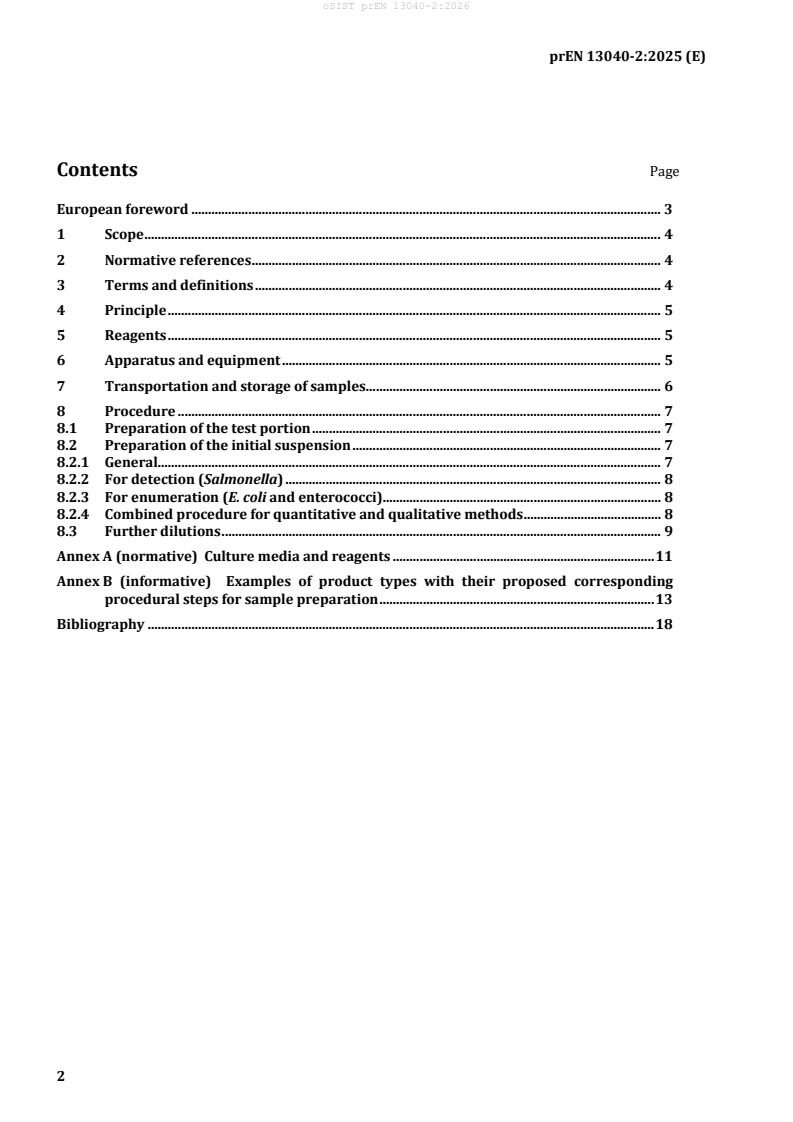
Contents Page
European foreword . 3
1 Scope . 4
2 Normative references . 4
3 Terms and definitions . 4
4 Principle . 5
5 Reagents . 5
6 Apparatus and equipment . 5
7 Transportation and storage of samples . 6
8 Procedure . 7
8.1 Preparation of the test portion . 7
8.2 Preparation of the initial suspension . 7
8.2.1 General. 7
8.2.2 For detection (Salmonella) . 8
8.2.3 For enumeration (E. coli and enterococci) . 8
8.2.4 Combined procedure for quantitative and qualitative methods . 8
8.3 Further dilutions . 9
Annex A (normative) Culture media and reagents . 11
Annex B (informative) Examples of product types with their proposed corresponding
procedural steps for sample preparation . 13
Bibliography . 18
European foreword
This document (prEN 13040-2:2025) has been prepared by Technical Committee CEN/TC 223 “Soil
improvers and growing media”, the secretariat of which is held by NEN.
nd
This document is currently submitted to the CEN 2 Enquiry.
This document has been prepared under a standardization request addressed to CEN by the European
Commission. The Standing Committee of the EFTA States subsequently approves these requests for its
Member States.
A list of all parts in this series can be found on the CEN website: www.cencenelec.eu.
EN 13040, Soil improvers and growing media — Sample preparation, is currently composed with the
following parts:
— Part 1: Sample preparation for chemical and physical tests, determination of dry matter content,
moisture content and laboratory bulk density;
— Part 2: Sample preparation for microbiological examination.
1 Scope
This document specifies the general requirements for the preparation of samples, initial suspensions and
further dilutions prior to microbiological examinations of soil improvers and growing media. This
method is intended especially for sample preparation prior to microbiological examinations of e.g.
Escherichia coli (E. coli), Salmonella spp. and enterococci.
If a laboratory receives a material/product that is not listed in Annex B but has external characteristics
(i.e. hardness, fibrous nature, particle size) like one of the materials/products listed in Annex B, then the
procedural steps for sample preparation (pre-treatment, treatment and dilution) are carried out in the
same way as listed for the material/product which has comparable external characteristics.
Any special diluents or practices required for particular materials or microorganisms in specific standard
methods take priority over the general requirements listed in this document.
2 Normative references
The following documents are referred to in the text in such a way that some or all of their content
constitutes requirements of this document. For dated references, only the edition cited applies. For
undated references, the latest edition of the referenced document (including any amendments) applies.
EN 12579, Soil improvers and growing media - Sampling
EN ISO 7218, Microbiology of the food chain - General requirements and guidance for microbiological
examinations (ISO 7218)
prEN 17732, Soil improvers and growing media - Terminology
3 Terms and definitions
For the purposes of this document, the terms and definitions given in EN 12579, prEN 17732 and the
following apply.
ISO and IEC maintain terminology databases for use in standardization at the following addresses:
— ISO Online browsing platform: available at https://www.iso.org/obp/
— IEC Electropedia: available at https://www.electropedia.org/
3.1
laboratory sample
in relation to chemical and physical testing, a final sample intended for laboratory testing and in relation
to microbiological testing, each separate segment sample intended for laboratory testing
3.2
test sample
sample prepared from the laboratory sample (3.1) and from which test portions (3.3) are taken
Note 1 to entry: A test sample is only necessary when the laboratory sample is used for multiple analysis (e.g.
microbiological and chemical analysis). When multiple analyses are performed (e.g. microbiological and chemical
analysis), appropriately sized test sample needs to be taken first for microbiological analysis in order to avoid
contamination. The remaining test sample material shall be stored in a cool place for possible subsequent analyses.
The remaining laboratory sample is thereafter passed on for chemical analyses, if necessary.
Under preparation. Stage at time of publication: prEN 17732:2025.
3.3
test portion
quantity of material drawn from the test sample or directly from the laboratory sample and on which the
tests and observations are actually carried out
3.4
initial suspension
primary dilution obtained after the test portion (3.2) has been treated with, normally, a nine-fold quantity
of diluent
Note 1 to entry: A closer ratio between the diluent and the quantity of material is often not recommended because
of possible inhibiting influences of the matrix.
3.5
further dilution
suspension or solution obtained by mixing a measured volume of the initial suspension (3.4) with an x-
fold volume of diluent and by repeating this operation with further dilutions until a dilution series is
obtained that is suitable for the inoculation of culture media
Note 1 to entry: Normally ten-fold dilutions are used to yield a decimal dilution series, but other ratios may be
required for specific purposes.
4 Principle
Sample preparation prior to microbiologal examination consists of two consecutive steps, for which the
second step depends on the intent of the subsequent microbiological examination, meaning enumeration
or detection.
1) Removal of a representative test portion (3.3) out of the test sample (3.2) or laboratory sample (3.1)
after thorough homogenisation
2) Addition of the homogenic test portion to the dilution or enrichment medium and homogenisation
2a) For detection: Preparation of a suspension for the first enrichment in a way to obtain an as
uniform as possible distribution of microorganisms contained in the test portion
2b) For enumeration: Preparation of an initial suspension in a way to obtain an as uniform as
possible distribution of microorganisms contained in the test portion. Preparation, if necessary,
of further dilutions in order to reduce the number of microorganisms per unit volume to allow
counting of colonies on enumeration plates after incubation
5 Reagents
Follow current laboratory practices in accordance with standards comparable to EN ISO 7218. The
composition of culture media and reagents and their preparation are specified in Annex A. For
performance testing of culture media, it is advised to follow the procedures of EN ISO 11133.
6 Apparatus and equipment
Disposable equipment is an acceptable alternative to reusable glassware if it has suitable specifications.
The usual microbiological laboratory equipment (see EN ISO 7218) and, in particular, the following shall
be used.
6.1 Apparatus for dry sterilization (oven) or wet sterilization (autoclave).
6.2 Equipment for size reduction; apparatuses (aseptic) may include:
— scissors;
— tweezers;
— spoons;
— scalpels;
— knives;
— hammers (used with a sterile bag around the sample);
— saws;
— spatulas;
— mortar and pestle.
6.3 Homogenization devices; apparatuses (aseptic) may include:
— a magnetic stirrer with vessels and stirring bars ;
— orbital shaker, with bottles (glass beads may be used in the case of viscous or thick materials);
— peristaltic blender (paddle blender), with sterile plastic bags, preferable with a filter;
— vortex mixer (for dilutions).
6.4 Other laboratory equipment; may include:
— pipettes or pipettor and sterile tips, to dispense 1 ml to 10 ml with tips (with large opening if
necessary);
— scales and gravimetric dilution controllers, capable of weighing to 1 % of the mass;
— aseptic containers (bowls, wide-mouth containers, developing tray) for homogenization of the
laboratory sample.
7 Transportation and storage of samples
Sampling is not part of the method specified in this document. EN 12579 shall be followed for sampling
soil improvers and growing media for microbiological examination. It is important that the laboratory
receives a sample that is representative of the product under consideration. The sample shall not have
been damaged or changed during transport or storage.
The samples as submitted to the laboratory, shall be stored and treated so that they shall not undergo
any further decomposition, physical damage, hydration or dehydration. Samples shall be stored at
5 °C ± 3 °C, but not frozen.
It is recommended to examine the samples within 72 h after reception as the microbiome can change
over time.
8 Procedure
8.1 Preparation of the test portion
WARNING — In order to safeguard the health of laboratory personnel, it is essential that the procedures
described in this document are only undertaken in properly equipped laboratories, under the supervision
of a skilled microbiologist, and that great care is taken in the disposal of all incubated materials. Persons
using this document shall be familiar with normal laboratory practice. This document does not purport
to address all of the safety aspects, if any, associated with its use. It is the responsibility of the user to
establish appropriate safety and health practices.
All operations before and after opening the packaged material shall be carried out under aseptic
conditions, to avoid any external contamination.
The types of packaged materials sent to the laboratory can be in flexible packaging. This shall be removed
or opened aseptically.
NOTE There is no need to disinfect the packaging if the contents can be removed aseptically after opening
without any risk of external contamination.
Before taking the test portion, the sample material of the laboratory sample or test sample shall be
thoroughly homogenized so that representative sampling is possible. Liquid samples should be
homogenized by shaking the container or stirring with an aseptic object. If possible, solid samples should
be mixed in the packaging with an aseptic device. If this is not possible, the laboratory sample shall be
transferred to an aseptic container (bowl, developing tray) and mixed.
Remove any incidental pieces (e.g. stones, glass, plastic pieces) aseptically.
The following special features shall be used:
— For pre-shaped materials (e.g. mineral wool slabs, plugs): The test portion (3.3) is taken directly
from the material, without “reconstitution” by addition of water.
— For solid rigid materials (e.g. compost, bark): Solid materials shall be reduced in size to obtain a
representative test portion (3.3) under aseptic conditions (6.1). The dimension of the pieces shall not
exceed approximately 2 cm in all dimensions.
— For block form (compressed non-pre shaped) materials (e.g. blocks of compressed coir,
blocks of compressed peat): The material shall be crushed and homogenized using suitable tools
and weighed out in its original dry state. It shall not be reconstituted (EN 12579).
8.2 Preparation of the initial suspension
8.2.1 General
Table B.1 provides an overview of exemplary materials and recommended equipment as well as a
description of the operating procedure for sample preparation.
To avoid damage to microorganisms by sudden temperature changes, the temperature of all diluents shall
be approximately equal to the ambient temperature of the laboratory, unless otherwise specified for
particular materials.
Some materials can significantly change the pH value of the initial suspension, which can negatively affect
the viability of the microorganisms under investigation. In general, a phosphate buffer or buffered
peptone water is sufficient to prepare the initial suspension.
When testing bog peat, Sphagnum, alk
...
Questions, Comments and Discussion
Ask us and Technical Secretary will try to provide an answer. You can facilitate discussion about the standard in here.
Loading comments...