


SIST EN 18103:2026
(Main)Inorganic fertilizers - Determination of nutrient polymers nitrogen in the presence of other nitrogenous forms
Inorganic fertilizers - Determination of nutrient polymers nitrogen in the presence of other nitrogenous forms
This document specifies a method for the determination of nutrient polymers nitrogen in presence of the other forms of nitrogen in inorganic fertilizers.
The method is applicable to all fertilizers which do not contain interfering organic compounds.
NOTE Nutrient polymers are methylen-urea (MU), in liquid and in solid form.
Anorganische Düngemittel - Bestimmung von Nährstoff-Polymer-Stickstoff in Anwesenheit anderer stickstoffhaltiger Formen
Dieses Dokument legt ein Verfahren zur Bestimmung von Nährstoff-Polymer-Stickstoff in Anwesenheit anderer stickstoffhaltiger Formen in anorganischen Düngemitteln fest.
Das Verfahren ist anwendbar für alle Düngemittel, die keine störenden organischen Verbindungen enthalten.
ANMERKUNG Zu den Nährstoffpolymeren gehört Methylenharnstoff (MU, en: methylen-urea) in flüssiger und fester Form.
Engrais inorganiques - Détermination de l’azote des polymères nutritifs en présence d’autres formes azotées
Le présent document spécifie une méthode pour le dosage de l’azote des polymères nutritifs en présence des autres formes d’azote dans les engrais inorganiques.
La méthode est applicable à tous les engrais qui ne contiennent pas de composés organiques interférents.
NOTE Les polymères nutritifs sont le méthylène-urée (MU), sous forme liquide et solide.
Anorganska gnojila - Določanje dušika v polimerih hranil v prisotnosti drugih oblik dušika
Ta dokument določa metodo za določanje dušika v polimerih hranil v prisotnosti drugih oblik dušika v anorganskih gnojilih. Metoda se uporablja za vsa gnojila, ki ne vsebujejo motilnih organskih spojin. OPOMBA: Polimeri hranil vključujejo metilen ureo (MU) v tekoči in trdni obliki.
General Information
- Status
- Published
- Public Enquiry End Date
- 19-Aug-2024
- Publication Date
- 19-Jan-2026
- Technical Committee
- KAT - Soil quality
- Current Stage
- 6060 - National Implementation/Publication (Adopted Project)
- Start Date
- 08-Jan-2026
- Due Date
- 15-Mar-2026
- Completion Date
- 20-Jan-2026

Relations
- Effective Date
- 28-Jan-2026
- Effective Date
- 28-Jan-2026
- Effective Date
- 28-Jan-2026
- Effective Date
- 28-Jan-2026
- Effective Date
- 28-Jan-2026
- Effective Date
- 28-Jan-2026
- Effective Date
- 28-Jan-2026
Overview
SIST EN 18103:2026 specifies a standardized method for the determination of nutrient polymers nitrogen, such as methylen-urea (MU) in both liquid and solid forms, in the presence of other nitrogenous forms in inorganic fertilizers. This European standard is essential for ensuring accurate nitrogen quantification in mineral fertilizers that contain multiple forms of nitrogen, supporting both product quality control and regulatory compliance across the fertilizer industry. The method is applicable to all inorganic fertilizers that do not contain interfering organic compounds.
Key Topics
- Nutrient Polymers Nitrogen Determination: Focuses on accurate measurement of methylen-urea nitrogen, vital for controlled-release fertilizer products.
- Multiple Nitrogen Forms: Addresses the presence of nitrate, ammoniacal, urea, cyanamide, isobutylidenediurea (IBDU), and crotonylidenediurea (CDU) nitrogen, requiring differentiation and precise analytical methods.
- Standardized Analytical Approach: Utilizes established techniques such as Kjeldahl digestion, titrimetric determination, high-performance liquid chromatography (HPLC), and specialized calculations for nutrient polymer nitrogen determination.
- Sampling Procedures: Provides referenced guidance on representative sampling and sample preparation to ensure reliable test results.
- Applicability: Suitable for all inorganic fertilizers free from interfering organic substances, enhancing versatility for laboratory and industrial use.
Applications
SIST EN 18103:2026 is highly relevant for:
- Fertilizer Manufacturers: Optimizes product formulation and labeling by quantifying each nitrogen source, especially slow-release forms like methylen-urea, in compliance with European market requirements.
- Quality Control Laboratories: Supports routine analysis, batch release, and regulatory reporting through validated methods for individual nitrogenous compounds.
- Regulatory Authorities: Ensures harmonized, reproducible nitrogen determination for conformity assessment across national and EU fertilizer regulations.
- Research & Development: Provides methodological foundation for R&D activities focused on the innovation of controlled-release fertilizers by accurately assessing the contribution of nutrient polymers.
- Environmental Compliance: Assists in monitoring fertilizer compositions to reduce environmental nitrogen leaching linked to improper formulation or mislabeling.
Related Standards
To ensure a comprehensive approach to fertilizer analysis and compliance, SIST EN 18103:2026 references and aligns with several related standards:
- EN 1482 Series: Sampling and sample preparation procedures for fertilizers and liming materials, critical for obtaining representative test material.
- EN 15562: Determination of cyanamide nitrogen in inorganic fertilizers.
- EN 17864: Determination of nitrogen content in IBDU and CDU forms, key for controlled-release fertilizer evaluation.
- ISO 19746:2017: Determination of urea content in urea-based fertilizers using HPLC, supporting the accurate differentiation of nitrogen forms.
- EN 12944 Series: Fertilizer and liming materials vocabulary, ensuring consistency in terminology.
- CEN/TS 17771, EN 15604, EN 15750, ISO 20620: Various methods for total and specific forms of nitrogen determination, underpinning the analytical methods outlined in this standard.
Practical Value
Implementing SIST EN 18103:2026 enables the fertilizer industry and laboratories to:
- Achieve reliable and repeatable nitrogen measurements in complex inorganic fertilizer matrices.
- Meet strict EU and international regulatory requirements for fertilizer composition and labeling.
- Support environmental sustainability by ensuring appropriate nutrient management and minimizing excess nitrogen release.
- Enhance product innovation in slow-release fertilizers with well-characterized nutrient profiles.
By adhering to this method, stakeholders can ensure their fertilizer products deliver intended agronomic performance while maintaining compliance and contributing to the responsible use of nitrogen sources.
Get Certified
Connect with accredited certification bodies for this standard

Control Union Certifications
Global certification for agriculture and sustainability.

ECOCERT
Organic and sustainability certification.

FSC International
Forest Stewardship Council certification.
Sponsored listings
Frequently Asked Questions
SIST EN 18103:2026 is a standard published by the Slovenian Institute for Standardization (SIST). Its full title is "Inorganic fertilizers - Determination of nutrient polymers nitrogen in the presence of other nitrogenous forms". This standard covers: This document specifies a method for the determination of nutrient polymers nitrogen in presence of the other forms of nitrogen in inorganic fertilizers. The method is applicable to all fertilizers which do not contain interfering organic compounds. NOTE Nutrient polymers are methylen-urea (MU), in liquid and in solid form.
This document specifies a method for the determination of nutrient polymers nitrogen in presence of the other forms of nitrogen in inorganic fertilizers. The method is applicable to all fertilizers which do not contain interfering organic compounds. NOTE Nutrient polymers are methylen-urea (MU), in liquid and in solid form.
SIST EN 18103:2026 is classified under the following ICS (International Classification for Standards) categories: 65.080 - Fertilizers. The ICS classification helps identify the subject area and facilitates finding related standards.
SIST EN 18103:2026 has the following relationships with other standards: It is inter standard links to SIST EN 1482-1:2025, SIST EN 15562:2024, SIST EN 17864:2024, SIST EN 1482-3:2025, SIST EN 12944-2:2002, SIST EN 12944-1:2002, SIST EN 1482-2:2025. Understanding these relationships helps ensure you are using the most current and applicable version of the standard.
SIST EN 18103:2026 is available in PDF format for immediate download after purchase. The document can be added to your cart and obtained through the secure checkout process. Digital delivery ensures instant access to the complete standard document.
Standards Content (Sample)
SLOVENSKI STANDARD
01-marec-2026
Anorganska gnojila - Določanje dušika v polimerih hranil v prisotnosti drugih oblik
dušika
Inorganic fertilizers - Determination of nutrient polymers nitrogen in the presence of other
nitrogenous forms
Anorganische Düngemittel - Bestimmung von Nährstoff-Polymer-Stickstoff in
Anwesenheit anderer stickstoffhaltiger Formen
Engrais inorganiques - Détermination de l’azote des polymères nutritifs en présence
d’autres formes azotées
Ta slovenski standard je istoveten z: EN 18103:2025
ICS:
65.080 Gnojila Fertilizers
2003-01.Slovenski inštitut za standardizacijo. Razmnoževanje celote ali delov tega standarda ni dovoljeno.
EN 18103
EUROPEAN STANDARD
NORME EUROPÉENNE
September 2025
EUROPÄISCHE NORM
ICS 65.080
English Version
Inorganic fertilizers - Determination of nutrient polymers
nitrogen in the presence of other nitrogenous forms
Engrais inorganiques - Détermination de l'azote des Anorganische Düngemittel - Bestimmung von
polymères nutritifs en présence d'autres formes Nährstoff-Polymer-Stickstoff in Anwesenheit anderer
azotées stickstoffhaltiger Formen
This European Standard was approved by CEN on 27 July 2025.
CEN members are bound to comply with the CEN/CENELEC Internal Regulations which stipulate the conditions for giving this
European Standard the status of a national standard without any alteration. Up-to-date lists and bibliographical references
concerning such national standards may be obtained on application to the CEN-CENELEC Management Centre or to any CEN
member.
This European Standard exists in three official versions (English, French, German). A version in any other language made by
translation under the responsibility of a CEN member into its own language and notified to the CEN-CENELEC Management
Centre has the same status as the official versions.
CEN members are the national standards bodies of Austria, Belgium, Bulgaria, Croatia, Cyprus, Czech Republic, Denmark, Estonia,
Finland, France, Germany, Greece, Hungary, Iceland, Ireland, Italy, Latvia, Lithuania, Luxembourg, Malta, Netherlands, Norway,
Poland, Portugal, Republic of North Macedonia, Romania, Serbia, Slovakia, Slovenia, Spain, Sweden, Switzerland, Türkiye and
United Kingdom.
EUROPEAN COMMITTEE FOR STANDARDIZATION
COMITÉ EUROPÉEN DE NORMALISATION
EUROPÄISCHES KOMITEE FÜR NORMUNG
CEN-CENELEC Management Centre: Rue de la Science 23, B-1040 Brussels
© 2025 CEN All rights of exploitation in any form and by any means reserved Ref. No. EN 18103:2025 E
worldwide for CEN national Members.
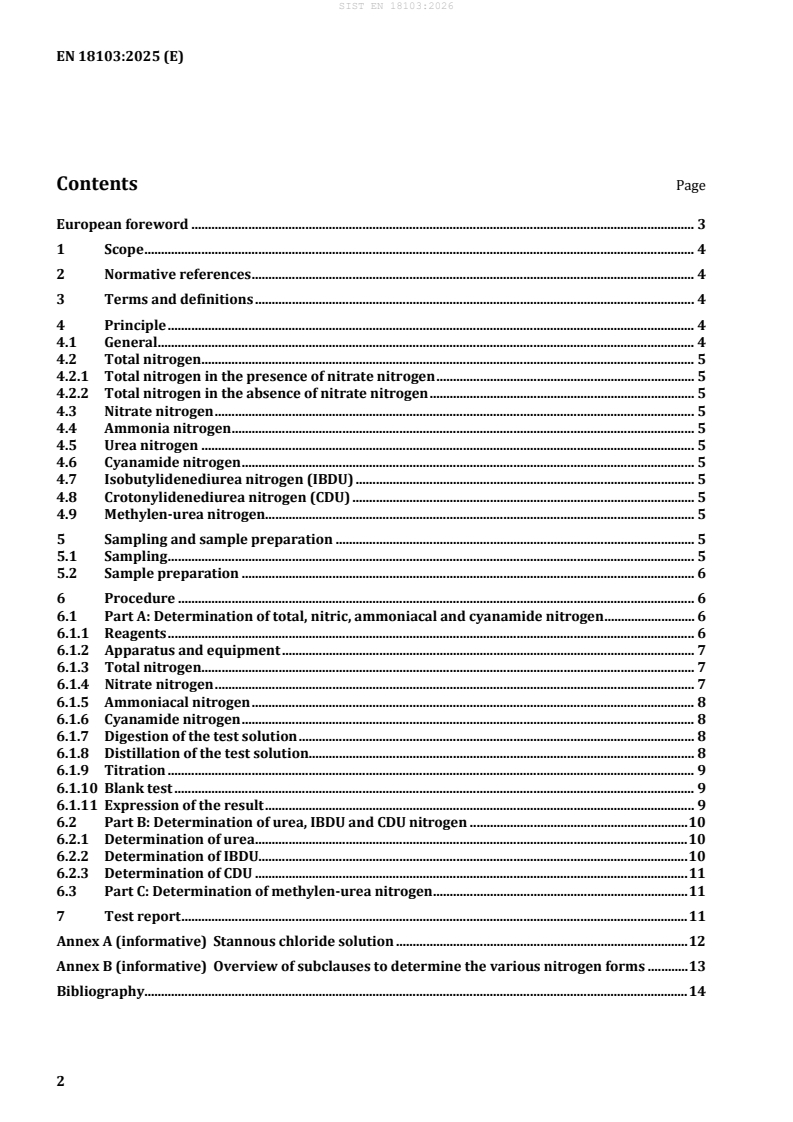
Contents Page
European foreword . 3
1 Scope . 4
2 Normative references . 4
3 Terms and definitions . 4
4 Principle . 4
4.1 General . 4
4.2 Total nitrogen. 5
4.2.1 Total nitrogen in the presence of nitrate nitrogen . 5
4.2.2 Total nitrogen in the absence of nitrate nitrogen . 5
4.3 Nitrate nitrogen . 5
4.4 Ammonia nitrogen . 5
4.5 Urea nitrogen . 5
4.6 Cyanamide nitrogen . 5
4.7 Isobutylidenediurea nitrogen (IBDU) . 5
4.8 Crotonylidenediurea nitrogen (CDU) . 5
4.9 Methylen-urea nitrogen. 5
5 Sampling and sample preparation . 5
5.1 Sampling . 5
5.2 Sample preparation . 6
6 Procedure . 6
6.1 Part A: Determination of total, nitric, ammoniacal and cyanamide nitrogen . 6
6.1.1 Reagents . 6
6.1.2 Apparatus and equipment . 7
6.1.3 Total nitrogen. 7
6.1.4 Nitrate nitrogen . 7
6.1.5 Ammoniacal nitrogen . 8
6.1.6 Cyanamide nitrogen . 8
6.1.7 Digestion of the test solution . 8
6.1.8 Distillation of the test solution. 8
6.1.9 Titration . 9
6.1.10 Blank test . 9
6.1.11 Expression of the result . 9
6.2 Part B: Determination of urea, IBDU and CDU nitrogen . 10
6.2.1 Determination of urea . 10
6.2.2 Determination of IBDU. 10
6.2.3 Determination of CDU . 11
6.3 Part C: Determination of methylen-urea nitrogen . 11
7 Test report . 11
Annex A (informative) Stannous chloride solution . 12
Annex B (informative) Overview of subclauses to determine the various nitrogen forms . 13
Bibliography. 14
European foreword
This document (EN 18103:2025) has been prepared by Technical Committee CEN/TC 260 “Fertilizers
and liming materials”, the secretariat of which is held by DIN.
This European Standard shall be given the status of a national standard, either by publication of
an identical text or by endorsement, at the latest by March 2026, and conflicting national standards
shall be withdrawn at the latest by March 2026.
Attention is drawn to the possibility that some of the elements of this document may be the subject of
patent rights. CEN shall not be held responsible for identifying any or all such patent rights.
Any feedback and questions on this document should be directed to the users’ national standards body.
A complete listing of these bodies can be found on the CEN website.
According to the CEN-CENELEC Internal Regulations, the national standards organisations of the
following countries are bound to implement this European Standard: Austria, Belgium, Bulgaria,
Croatia, Cyprus, Czech Republic, Denmark, Estonia, Finland, France, Germany, Greece, Hungary, Iceland,
Ireland, Italy, Latvia, Lithuania, Luxembourg, Malta, Netherlands, Norway, Poland, Portugal, Republic of
North Macedonia, Romania, Serbia, Slovakia, Slovenia, Spain, Sweden, Switzerland, Türkiye and the
United Kingdom.
1 Scope
This document specifies a method for the determination of nutrient polymers nitrogen in presence of
the other forms of nitrogen in inorganic fertilizers.
The method is applicable to all fertilizers which do not contain interfering organic compounds.
NOTE Nutrient polymers are methylen-urea (MU), in liquid and in solid form.
2 Normative references
The following documents are referred to in the text in such a way that some or all of their content
constitutes requirements of this document. For dated references, only the edition cited applies. For
undated references, the latest edition of the referenced document (including any amendments) applies.
EN 1482-1, Fertilizers, liming materials and inhibitors — Sampling and sample preparation — Part 1:
General sampling provisions
EN 1482-2, Fertilizers, liming materials and inhibitors — Sampling and sample preparation — Part 2:
General sample preparation provisions
EN 1482-3, Fertilizers, liming materials and inhibitors — Sampling and sample preparation — Part 3:
Sampling of static heaps
EN 12944-1, Fertilizers and liming materials — Vocabulary — Part 1: General terms
EN 12944-2, Fertilizers and liming materials — Vocabulary — Part 2: Terms relating to fertilizers
EN 15562, Inorganic fertilizers — Determination of cyanamide nitrogen
EN 17864, Inorganic fertilizers — Determination of nitrogen content in IBDU (isobutylidenediurea) and
CDU (crotonylidenediurea)
ISO 19746:2017, Determination of urea content in urea-based fertilizers by high performance liquid
chromatography (HPLC)
3 Terms and definitions
For the purposes of this document, the terms and definitions given in EN 12944-1 and EN 12944-2
apply.
ISO and IEC maintain terminology databases for use in standardization at the following addresses:
— ISO Online browsing platform: available at https://www.iso.org/obp
— IEC Electropedia: available at https://www.electropedia.org/
4 Principle
4.1 General
The test sample is treated in different ways depending on the parameter to be determined.
4.2 Total nitrogen
4.2.1 Total nitrogen in the presence of nitrate nitrogen
The test sample is mineralized by Kjeldahl digestion after reduction of nitrate nitrogen to ammonia
nitrogen with the aid of metallic iron and stannous chloride. The resultant ammonia is determined by a
titrimetric method.
Alternatively, a combustion method can be used.
4.2.2 Total nitrogen in the absence of nitrate nitrogen
The test sample is mineralized by Kjeldahl digestion. The resultant ammonia is determined by a
titrimetric method.
Alternatively, a combustion method can be used.
4.3 Nitrate nitrogen
The nitric nitrogen is determined by calculating the difference between the nitrogen determined by
Kjeldahl digestion after reduction of nitrate nitrogen to ammonia with the aid of metallic iron and
stannous chloride and that determined by Kjeldahl digestion after elimination of nitrate nitrogen with
ferrous sulfate in a strong acid medium.
In both cases the resulting ammonia is determined by a titrimetric method.
4.4 Ammonia nitrogen
Ammonia nitrogen is determined by steam distillation after making the solution slightly alkaline by
means of magnesium oxide. The resulting ammonia is determined by a titrimetric method.
4.5 Urea nitrogen
Urea nitrogen is determined by high liquid performance chromatography (HPLC).
4.6 Cyanamide nitrogen
Cyanamide nitrogen is determined by precipitation as a silver compound; the nitrogen being
determined in the precipitate by the Kjeldahl method.
4.7 Isobutylidenediurea nitrogen (IBDU)
IBDU nitrogen is determined by HPLC.
4.8 Crotonylidenediurea nitrogen (CDU)
CDU nitrogen is determined by HPLC.
4.9 Methylen-urea nitrogen
Methylen-urea nitrogen is determined by calculation, subtracting the sum of all other nitrogen forms
from the total nitrogen.
5 Sampling and sample preparation
5.1 Sampling
Samples taken for quality control purposes shall be representative and in accordance with EN 1482-1.
Sampling of static heaps shall be performed in accordance with EN 1482-3.
5.2 Sample preparation
The sample preparation for quality control purposes shall be performed in accordance with EN 1482-2.
6 Procedure
6.1 Part A: Determination of total, nitric, ammoniacal and cyanamide nitrogen
6.1.1 Reagents
Use only reagents of recognized analytical grade and distilled or de-mineralized water. The electrical
conductivity shall at least be < 0,5 mS/m (at 25 °C).
6.1.1.1 Sulfuric acid 96 %, density at 20 °C, ρ = 1,84 g/ml.
6.1.1.2 Acetic acid 96 %, density at 20 °C, ρ = (1,049 to 1,051 g/ml).
6.1.1.3 Iron powder, reduced with hydrogen.
6.1.1.4 Stannous chloride solution (SnCl ·2H O, c = 0,532 mol/l).
2 2
Dissolve 24 g of SnCl ·2H O (…) in 80 ml of concentrated hydrochloric acid (6.1.1.13) and make up to
2 2
200 ml with water. The solution shall be pr
...