


SIST EN 196-2:2026
(Main)Methods of testing cement - Part 2: Chemical analysis of cement
Methods of testing cement - Part 2: Chemical analysis of cement
This document specifies the methods for the chemical analysis of cement.
This document describes the reference methods and, in certain cases, an alternative method which can be considered to be equivalent. In the case of a dispute, only the reference methods are used.
An alternative performance-based method using X-ray fluorescence (XRF) is described for SiO2, Al2O3, Fe2O3, CaO, MgO, SO3, K2O, Na2O, TiO2, P2O5, Mn2O3, SrO, Cl and Br. This method is based on beads of fused sample and analytical validation using certified reference materials, together with performance criteria. A method based on pressed pellets of un-fused sample can be considered as equivalent, providing that the analytical performance satisfies the same criteria.
An alternative performance-based method using inductively coupled plasma optical emission spectroscopy (ICP-OES) is described for SO3.
When correctly calibrated according to the specified procedures and reference materials, XRF and ICP-OES provides methods equivalent to the reference methods but has not been validated for use yet as a reference procedure for conformity and dispute purposes. They can be applied to other relevant elements when adequate calibrations have been established.
Any other methods can be used provided they are calibrated, either against the reference methods or against internationally accepted reference materials, in order to demonstrate their equivalence.
This document describes methods which apply principally to cements, but which can also be applied to their constituent materials. They can also be applied to other materials, the standards for which call up these methods. Standard specifications state which methods are to be used.
Prüfverfahren für Zement - Teil 2: Chemische Analyse von Zement
Dieses Dokument legt die Verfahren zur chemischen Analyse von Zement fest.
Dieses Dokument beschreibt die Referenzverfahren und in einigen Fällen Alternativverfahren, deren Ergebnisse denen des Referenzverfahrens entsprechen. Im Streitfall sind die Referenzverfahren maßgebend.
Ein alternatives leistungsbasiertes Verfahren unter Anwendung der Röntgenfluoreszenzanalyse (XRF, en: X ray fluorescence) wird für SiO2, Al2O3, Fe2O3, CaO, MgO, SO3, K2O, Na2O, TiO2, P2O5, Mn2O3, SrO, Cl und Br beschrieben. Dieses Verfahren beruht auf Schmelztabletten der Probe und der analytischen Validierung mit H464ilfe zertifizierter Referenzmaterialien in Kombination mit Leistungskriterien. Ein Verfahren auf der Grundlage von Pulverpresslingen aus unaufgeschlossenen Proben kann als gleichwertig angesehen werden, sofern die analytische Leistung dieselben Kriterien erfüllt.
Ein alternatives leistungsbasiertes Verfahren unter Anwendung der optischen Emissionsspektroskopie mit induktiv gekoppeltem Plasma (ICP OES, en: inductively coupled plasma optical emission spectroscopy) wird für SO3 beschrieben.
Wenn die Kalibrierung vorschriftsmäßig entsprechend den festgelegten Verfahren und mit den festgelegten Referenzmaterialien durchgeführt wurde, sind die mit Röntgenfluoreszenzanalyse und optischer Emissionsspektrometrie mit induktiv gekoppeltem Plasma möglichen Verfahren gleichwertig zu den Referenzverfahren, wurden jedoch hinsichtlich Konformität und Streitfällen noch nicht für die Anwendung als Referenzverfahren validiert. Nach Festlegung angemessener Kalibrierungen können sie für andere maßgebende Elemente angewendet werden.
Es können andere Verfahren angewendet werden, sofern diese gegen die Referenzverfahren oder gegen international anerkannte Referenzmaterialien kalibriert werden, um ihre Gleichwertigkeit nachzuweisen.
Dieses Dokument beschreibt Verfahren, die in erster Linie für Zemente gelten; diese Verfahren können jedoch auch auf deren Bestandteile angewendet werden. Die Verfahren sind auch auf andere Stoffe, sofern in den entsprechenden Normen darauf verwiesen wird, anwendbar. In den Standardspezifikationen ist festgelegt, welche Verfahren anzuwenden sind.
Méthodes d'essais des ciments - Partie 2: Analyse chimique des ciments
Le présent document spécifie les méthodes d'analyse chimique des ciments.
Le présent document décrit les méthodes de référence et, dans certains cas, une variante qui peut être considérée comme une méthode équivalente. En cas de litige, seules les méthodes de référence sont utilisées.
Une variante fondée sur la performance, utilisant la fluorescence X (XRF) est décrite pour SiO2, Al2O3, Fe2O3, CaO, MgO, SO3, K2O, Na2O, TiO2, P2O5, Mn2O3, SrO, Cl et Br. Cette méthode est basée sur des perles d'échantillon fondu et la validation analytique au moyen de matériaux de référence certifiés, ainsi que sur des critères de performance. Une méthode fondée sur des pastilles compactées d'échantillon non fondu peut être considérée comme équivalente, sous réserve que les performances analytiques répondent aux mêmes critères.
Une méthode alternative basée sur la performance utilisant la spectroscopie d'émission optique à plasma à couplage inductif (ICP-OES) est décrite pour le SO3.
Lorsqu'elle est correctement étalonnée par rapport aux méthodes et aux matériaux de référence spécifiés, Les méthodes XRF et ICP-OES sont équivalentes aux méthodes de référence, mais elles n'ont pas encore été validées comme méthode de référence à des fins de conformité ou en cas de litige. Ces méthodes peuvent être appliquées à d'autres éléments pertinents, lorsque des étalonnages corrects ont été effectués.
D'autres méthodes encore peuvent être utilisées, à condition qu’elles soient étalonnées, soit par rapport à des méthodes de référence, soit par rapport à des matériaux de référence acceptés internationalement, pour démontrer leur équivalence.
Le présent document décrit les méthodes qui s’appliquent principalement aux ciments, mais qui peuvent être aussi appliquées à leurs constituants. Elles peuvent être également appliquées à d’autres matériaux, pour lesquels les normes prescrivent ces méthodes. Les spécifications des normes indiquent les méthodes qui doivent être utilisées.
Metode preskušanja cementa - 2. del: Kemijska analiza cementa
Ta dokument določa metode za kemijsko analizo cementa. V tem dokumentu so opisane referenčne metode in v nekaterih primerih alternativna metoda, s katero je mogoče pridobiti enakovredne rezultate. V primeru spora se uporabijo le referenčne metode. Alternativna rentgenska fluorescenčna metoda (XRF), ki temelji na rezultatih, je opisana za SiO2, Al2O3, Fe2O3, CaO, MgO, SO3, K2O, Na2O, TiO2, P2O5, Mn2O3, SrO, Cl in Br. Ta metoda temelji na kroglicah taljenega vzorca in analitični validaciji s certificiranimi referenčnimi materiali in merili delovanja. Z metodo, ki temelji na stisnjenih peletih netaljenega vzorca, je mogoče pridobiti enakovredne rezultate, če analitično delovanje ustreza enakim merilom. Alternativna metoda, ki temelji na rezultatih in vključuje optično emisijsko spektroskopijo z induktivno sklopljeno plazmo (ICP-OES) je opisana za SO3. Ob ustreznem umerjanju v skladu z določenimi postopki in referenčnimi materiali sta rentgenska fluorescenčna metoda in metoda z optično emisijsko spektroskopijo z induktivno sklopljeno plazmo enakovredni referenčnim metodam, vendar še nista bili potrjeni za uporabo kot referenčni postopek za namene skladnosti in razrešitve sporov. Uporabiti ju je mogoče za druge ustrezne elemente, ko so izvedena ustrezna umerjanja. Uporabiti je mogoče tudi druge metode, če so umerjene glede na referenčne metode ali mednarodno sprejete referenčne materiale, s čimer se dokaže njihova enakovrednost. V tem dokumentu so opisane metode, ki se v osnovi uporabljajo za cemente, vendar jih je mogoče uporabiti tudi za njihove sestavne materiale. Uporabiti jih je mogoče tudi za druge materiale, katerih standardi vključujejo te metode. Standardne specifikacije določajo, katere metode morajo biti uporabljene.
General Information
- Status
- Published
- Public Enquiry End Date
- 17-Oct-2024
- Publication Date
- 14-Dec-2025
- Technical Committee
- CAA - Mineral binders and masonry
- Current Stage
- 6060 - National Implementation/Publication (Adopted Project)
- Start Date
- 05-Dec-2025
- Due Date
- 09-Feb-2026
- Completion Date
- 15-Dec-2025
Relations
- Effective Date
- 28-Jan-2026
- Effective Date
- 28-Jan-2026
- Effective Date
- 28-Jan-2026
- Effective Date
- 28-Jan-2026
- Effective Date
- 28-Jan-2026
- Effective Date
- 28-Jan-2026
- Referred By
SIST EN 15743:2010 - Supersulfated cement - Composition, specifications and conformity criteria - Effective Date
- 28-Jan-2026
- Effective Date
- 28-Jan-2026
- Effective Date
- 28-Jan-2026
- Effective Date
- 28-Jan-2026
- Effective Date
- 28-Jan-2026
- Effective Date
- 28-Jan-2026
- Referred By
SIST-TP CEN/TR 17365:2019 - Method for the determination of C3A in the clinker from cement analysis - Effective Date
- 28-Jan-2026
- Effective Date
- 28-Jan-2026
- Referred By
SIST EN 206:2013+A1:2016 - Concrete - Specification, performance, production and conformity - Effective Date
- 28-Jan-2026
Overview
SIST EN 196-2:2026 - Methods of testing cement - Part 2: Chemical analysis of cement specifies standardized procedures for the elemental and oxide-based chemical analysis of cements and their constituent materials. The standard defines reference (wet chemistry) methods and describes performance‑based alternative methods - notably X‑ray fluorescence (XRF) and ICP‑OES - including requirements for calibration, validation and use of certified reference materials. In cases of conformity disputes, only the reference methods are accepted.
Key topics and technical requirements
- Scope and applicability: Applies principally to cements (and constituent materials such as clinker, fly ash, slag, pozzolans) and may be called up by other standards.
- Reference vs alternative methods:
- Reference methods are the normative wet‑chemistry procedures used for dispute resolution.
- Alternative methods (XRF and ICP‑OES) are performance‑based and can be considered equivalent when validated and calibrated according to the document’s criteria.
- XRF method: Performance‑based procedure for SiO2, Al2O3, Fe2O3, CaO, MgO, SO3, K2O, Na2O, TiO2, P2O5, Mn2O3, SrO, Cl and Br. Based on fused beads (and optional pressed pellets) with analytical validation against certified reference materials and defined performance criteria.
- ICP‑OES method: Described as an alternative for determination of SO3 (sulfate).
- Wet chemistry procedures: Detailed reagents, apparatus, sample preparation, ignition/loss on ignition determination, titrations and classical volumetric analyses.
- Quality requirements: Calibration procedures, use of stock and calibration solutions, blank solutions, expression of results, repeatability and reproducibility, and minimum number of tests per determination.
- Data handling: Rules for expression of masses, volumes and results (precision and reporting), and procedures for factoring results (e.g., corrections for sulfides/halides).
Practical applications and users
- Who uses it: Cement manufacturers, independent testing laboratories, quality control teams, R&D labs, regulatory bodies and standards organizations involved in cement conformity and product certification.
- Use cases:
- Routine quality control of cement production and raw material inputs.
- Compliance testing for standards and product specifications.
- Method validation, laboratory accreditation and proficiency testing.
- Rapid multi‑element screening with XRF or ICP‑OES when validated against reference procedures.
- Forensic or dispute investigations (using reference wet‑chemistry methods).
Related standards
- Part of the EN 196 series (e.g., EN 196‑1, EN 196‑3, EN 196‑7). Normative references include digestion and laboratory glassware standards and guidance on reference materials (ISO Guide 30, ISO 33401).
Keywords: SIST EN 196-2:2026, chemical analysis of cement, XRF, ICP‑OES, wet chemistry, fused beads, pressed pellets, certified reference materials, cement testing, quality control.

Get Certified
Connect with accredited certification bodies for this standard

ECOCERT
Organic and sustainability certification.

ICC Evaluation Service
Building products evaluation and certification.

QAI Laboratories
Building and construction product testing and certification.
Sponsored listings
Frequently Asked Questions
SIST EN 196-2:2026 is a standard published by the Slovenian Institute for Standardization (SIST). Its full title is "Methods of testing cement - Part 2: Chemical analysis of cement". This standard covers: This document specifies the methods for the chemical analysis of cement. This document describes the reference methods and, in certain cases, an alternative method which can be considered to be equivalent. In the case of a dispute, only the reference methods are used. An alternative performance-based method using X-ray fluorescence (XRF) is described for SiO2, Al2O3, Fe2O3, CaO, MgO, SO3, K2O, Na2O, TiO2, P2O5, Mn2O3, SrO, Cl and Br. This method is based on beads of fused sample and analytical validation using certified reference materials, together with performance criteria. A method based on pressed pellets of un-fused sample can be considered as equivalent, providing that the analytical performance satisfies the same criteria. An alternative performance-based method using inductively coupled plasma optical emission spectroscopy (ICP-OES) is described for SO3. When correctly calibrated according to the specified procedures and reference materials, XRF and ICP-OES provides methods equivalent to the reference methods but has not been validated for use yet as a reference procedure for conformity and dispute purposes. They can be applied to other relevant elements when adequate calibrations have been established. Any other methods can be used provided they are calibrated, either against the reference methods or against internationally accepted reference materials, in order to demonstrate their equivalence. This document describes methods which apply principally to cements, but which can also be applied to their constituent materials. They can also be applied to other materials, the standards for which call up these methods. Standard specifications state which methods are to be used.
This document specifies the methods for the chemical analysis of cement. This document describes the reference methods and, in certain cases, an alternative method which can be considered to be equivalent. In the case of a dispute, only the reference methods are used. An alternative performance-based method using X-ray fluorescence (XRF) is described for SiO2, Al2O3, Fe2O3, CaO, MgO, SO3, K2O, Na2O, TiO2, P2O5, Mn2O3, SrO, Cl and Br. This method is based on beads of fused sample and analytical validation using certified reference materials, together with performance criteria. A method based on pressed pellets of un-fused sample can be considered as equivalent, providing that the analytical performance satisfies the same criteria. An alternative performance-based method using inductively coupled plasma optical emission spectroscopy (ICP-OES) is described for SO3. When correctly calibrated according to the specified procedures and reference materials, XRF and ICP-OES provides methods equivalent to the reference methods but has not been validated for use yet as a reference procedure for conformity and dispute purposes. They can be applied to other relevant elements when adequate calibrations have been established. Any other methods can be used provided they are calibrated, either against the reference methods or against internationally accepted reference materials, in order to demonstrate their equivalence. This document describes methods which apply principally to cements, but which can also be applied to their constituent materials. They can also be applied to other materials, the standards for which call up these methods. Standard specifications state which methods are to be used.
SIST EN 196-2:2026 is classified under the following ICS (International Classification for Standards) categories: 71.040.40 - Chemical analysis; 91.100.10 - Cement. Gypsum. Lime. Mortar. The ICS classification helps identify the subject area and facilitates finding related standards.
SIST EN 196-2:2026 has the following relationships with other standards: It is inter standard links to SIST EN ISO 835:2007, SIST EN ISO 385:2005, SIST EN 13656:2020, SIST EN 196-7:2008, SIST EN 13242:2013, SIST EN 934-4:2009, SIST EN 15743:2010, SIST EN 14227-4:2013, SIST EN 14216:2015, SIST EN 12715:2002, SIST EN 16622:2016, SIST EN 480-1:2023, SIST-TP CEN/TR 17365:2019, SIST EN 13282-3:2015, SIST EN 206:2013+A1:2016. Understanding these relationships helps ensure you are using the most current and applicable version of the standard.
SIST EN 196-2:2026 is available in PDF format for immediate download after purchase. The document can be added to your cart and obtained through the secure checkout process. Digital delivery ensures instant access to the complete standard document.
Standards Content (Sample)
SLOVENSKI STANDARD
01-januar-2026
Nadomešča:
SIST EN 196-2:2013
Metode preskušanja cementa - 2. del: Kemijska analiza cementa
Methods of testing cement - Part 2: Chemical analysis of cement
Prüfverfahren für Zement - Teil 2: Chemische Analyse von Zement
Méthodes d'essais des ciments - Partie 2: Analyse chimique des ciments
Ta slovenski standard je istoveten z: EN 196-2:2025
ICS:
71.040.40 Kemijska analiza Chemical analysis
91.100.10 Cement. Mavec. Apno. Malta Cement. Gypsum. Lime.
Mortar
2003-01.Slovenski inštitut za standardizacijo. Razmnoževanje celote ali delov tega standarda ni dovoljeno.
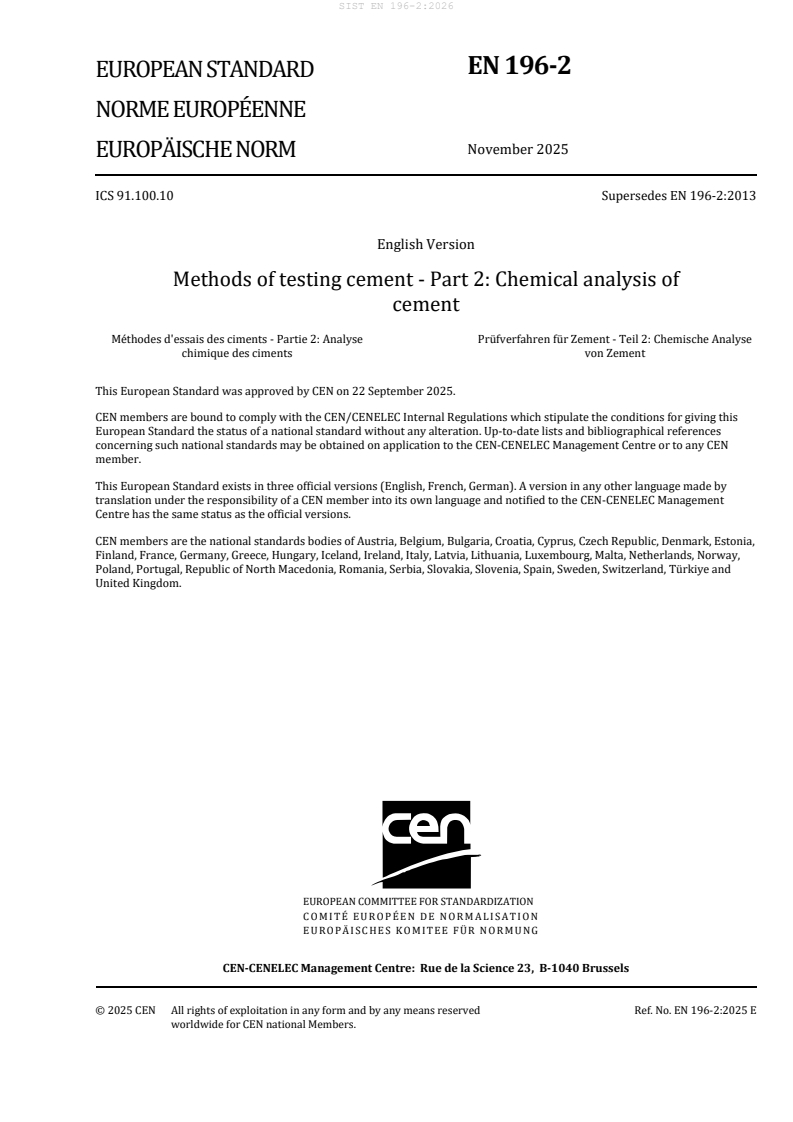
EN 196-2
EUROPEAN STANDARD
NORME EUROPÉENNE
November 2025
EUROPÄISCHE NORM
ICS 91.100.10 Supersedes EN 196-2:2013
English Version
Methods of testing cement - Part 2: Chemical analysis of
cement
Méthodes d'essais des ciments - Partie 2: Analyse Prüfverfahren für Zement - Teil 2: Chemische Analyse
chimique des ciments von Zement
This European Standard was approved by CEN on 22 September 2025.
CEN members are bound to comply with the CEN/CENELEC Internal Regulations which stipulate the conditions for giving this
European Standard the status of a national standard without any alteration. Up-to-date lists and bibliographical references
concerning such national standards may be obtained on application to the CEN-CENELEC Management Centre or to any CEN
member.
This European Standard exists in three official versions (English, French, German). A version in any other language made by
translation under the responsibility of a CEN member into its own language and notified to the CEN-CENELEC Management
Centre has the same status as the official versions.
CEN members are the national standards bodies of Austria, Belgium, Bulgaria, Croatia, Cyprus, Czech Republic, Denmark, Estonia,
Finland, France, Germany, Greece, Hungary, Iceland, Ireland, Italy, Latvia, Lithuania, Luxembourg, Malta, Netherlands, Norway,
Poland, Portugal, Republic of North Macedonia, Romania, Serbia, Slovakia, Slovenia, Spain, Sweden, Switzerland, Türkiye and
United Kingdom.
EUROPEAN COMMITTEE FOR STANDARDIZATION
COMITÉ EUROPÉEN DE NORMALISATION
EUROPÄISCHES KOMITEE FÜR NORMUNG
CEN-CENELEC Management Centre: Rue de la Science 23, B-1040 Brussels
© 2025 CEN All rights of exploitation in any form and by any means reserved Ref. No. EN 196-2:2025 E
worldwide for CEN national Members.
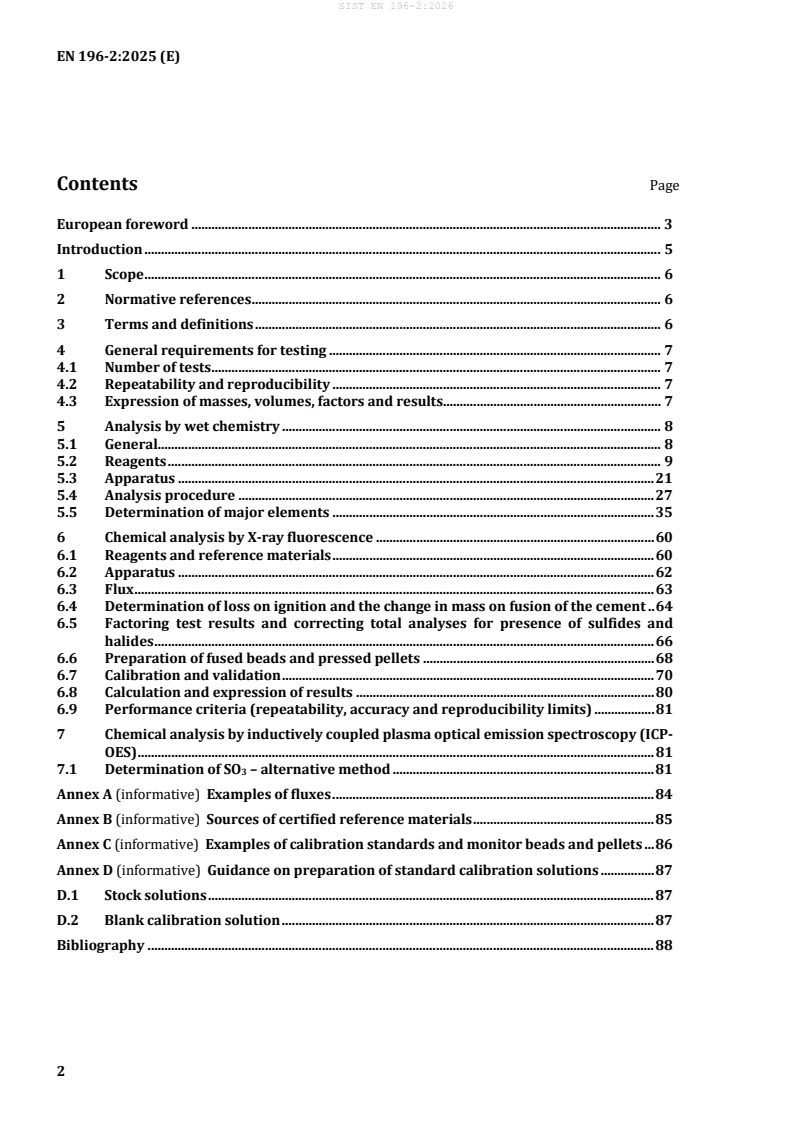
Contents Page
European foreword . 3
Introduction . 5
1 Scope . 6
2 Normative references . 6
3 Terms and definitions . 6
4 General requirements for testing . 7
4.1 Number of tests . 7
4.2 Repeatability and reproducibility . 7
4.3 Expression of masses, volumes, factors and results. 7
5 Analysis by wet chemistry . 8
5.1 General. 8
5.2 Reagents . 9
5.3 Apparatus . 21
5.4 Analysis procedure . 27
5.5 Determination of major elements . 35
6 Chemical analysis by X-ray fluorescence . 60
6.1 Reagents and reference materials . 60
6.2 Apparatus . 62
6.3 Flux . 63
6.4 Determination of loss on ignition and the change in mass on fusion of the cement . 64
6.5 Factoring test results and correcting total analyses for presence of sulfides and
halides . 66
6.6 Preparation of fused beads and pressed pellets . 68
6.7 Calibration and validation . 70
6.8 Calculation and expression of results . 80
6.9 Performance criteria (repeatability, accuracy and reproducibility limits) . 81
7 Chemical analysis by inductively coupled plasma optical emission spectroscopy (ICP-
OES) . 81
7.1 Determination of SO – alternative method . 81
Annex A (informative) Examples of fluxes . 84
Annex B (informative) Sources of certified reference materials . 85
Annex C (informative) Examples of calibration standards and monitor beads and pellets . 86
Annex D (informative) Guidance on preparation of standard calibration solutions . 87
D.1 Stock solutions . 87
D.2 Blank calibration solution . 87
Bibliography . 88
European foreword
This document (EN 196-2:2025) has been prepared by Technical Committee CEN/TC 51 “Cement and
building limes”, the secretariat of which is held by NBN.
This European Standard shall be given the status of a national standard, either by publication of an
identical text or by endorsement, at the latest by May 2026, and conflicting national standards shall be
withdrawn at the latest by May 2026.
Attention is drawn to the possibility that some of the elements of this document may be the subject of
patent rights. CEN shall not be held responsible for identifying any or all such patent rights.
This document supersedes EN 196-2:2013.
— redefinition of the introduction;
— introduction of concept;
— determination of reactive silica;
— introduction of the concept of determination of total carbonate content instead of determination of
CO ;
— determination of chloride by potentiometric titration as alternative method;
— determination of total carbonate content by gas volumetric method as alternative method;
— determination of total carbonate content by infrared detection system (method A and B) as
alternative method;
— determination of SO by inductively coupled plasma optical emission spectroscopy as alternative
method.
This European Standard series, under the general title Methods of testing cement, comprises the following
parts:
— Part 1: Determination of strength;
— Part 2: Chemical analysis of cement;
— Part 3: Determination of setting times and soundness;
— Part 5: Pozzolanicity test for pozzolanic cement;
— Part 6: Determination of fineness;
— Part 7: Methods of taking and preparing samples of cement;
— Part 8: Heat of hydration — Solution method;
— Part 9: Heat of hydration — Semi-adiabatic method;
— Part 10: Determination of the water-soluble chromium (VI) content of cement;
— Part 11: Heat of hydration — Isothermal conduction calorimetry method.
NOTE Another document, CEN/TR 196-4 Methods of testing cement — Part 4: Quantitative determination of
constituents, has been published as a CEN Technical Report.
Any feedback and questions on this document should be directed to the users’ national standards body.
A complete listing of these bodies can be found on the CEN website.
According to the CEN-CENELEC Internal Regulations, the national standards organisations of the
following countries are bound to implement this European Standard: Austria, Belgium, Bulgaria, Croatia,
Cyprus, Czech Republic, Denmark, Estonia, Finland, France, Germany, Greece, Hungary, Iceland, Ireland,
Italy, Latvia, Lithuania, Luxembourg, Malta, Netherlands, Norway, Poland, Portugal, Republic of North
Macedonia, Romania, Serbia, Slovakia, Slovenia, Spain, Sweden, Switzerland, Türkiye and the United
Kingdom.
Introduction
In this document, the elemental chemical analysis of a clinker or cement, as of any natural or artificial
mineral material (volcanic pozzolan, blast furnace slag, fly ash, etc.) is expressed in a conventional
manner in the form of the mass proportions of the common oxides corresponding to the most frequent
and stable degree of oxidation (Si: SiO ; Al: Al O , etc.). This expression of the chemical analysis does not
2 2 3
indicate how these elements are combined into minerals such as silicates, oxides, carbonates, sulphates
or sulphides.
This means that the presence of SiO in a chemical analysis sheet does not necessarily imply the presence
of crystalline silica e.g. quartz or cristobalite, but most likely silicates. Moreover, even if quartz is detected
in the material, this does not necessarily imply an inhalation hazard if the particle size is larger than the
inhalable fraction. Similarly, the presence of TiO in a chemical analysis report does not necessarily imply
the presence of the mineralogical phase(s) corresponding to this formula (rutile, anatase, brookite),
although the presence of the mineralogical phase(s) does not necessarily imply an inhalation hazard if
the particle size is larger than the inhalable fraction. In the same way, determination of total carbonate
content (TCC) can be done by dosing CO induced by acid attack, which does not mean, in any case, that
the material contains CO .
The only way to identify mineralogical phases in a powdered mineral material is by X-ray diffraction,
which is the only analytical technique that is sensitive to the crystalline character of minerals. For an
accurate quantification of inhalable fractions, it advisable be necessary to perform a quantitative particle
size selection (e.g. by aerosolization technique) in order to eliminate coarse fractions that could reduce
the quantitative character of the X-ray diffraction analysis.
Standardization to 100 made it possible to know if no constituent element had been left out. Hence the
expression “percentage by mass of oxides” in the chemical analysis.
1 Scope
This document specifies the methods for the chemical analysis of cement.
This document describes the reference methods and, in certain cases, an alternative method which can
be considered to be equivalent. In the case of a dispute, only the reference methods are used.
An alternative performance-based method using X-ray fluorescence (XRF) is described for SiO , Al O ,
2 2 3
Fe O , CaO, MgO, SO , K O, Na O, TiO , P O , Mn O , SrO, Cl and Br. This method is based on beads of fused
2 3 3 2 2 2 2 5 2 3
sample and analytical validation using certified reference materials, together with performance criteria.
A method based on pressed pellets of un-fused sample can be considered as equivalent, providing that
the analytical performance satisfies the same criteria.
An alternative performance-based method using inductively coupled plasma optical emission
spectroscopy (ICP-OES) is described for SO .
When correctly calibrated according to the specified procedures and reference materials, XRF and ICP-
OES provides methods equivalent to the reference methods but has not been validated for use yet as a
reference procedure for conformity and dispute purposes. They can be applied to other relevant elements
when adequate calibrations have been established.
Any other methods can be used provided they are calibrated, either against the reference methods or
against internationally accepted reference materials, in order to demonstrate their equivalence.
This document describes methods which apply principally to cements, but which can also be applied to
their constituent materials. They can also be applied to other materials, the standards for which call up
these methods. Standard specifications state which methods are to be used.
2 Normative references
The following documents are referred to in the text in such a way that some or all of their content
constitutes requirements of this document. For dated references, only the edition cited applies. For
undated references, the latest edition of the referenced document (including any amendments) applies.
EN 196-7, Methods of testing cement — Part 7: Methods of taking and preparing samples of cement
EN 13656, Soil, treated biowaste, sludge and waste — Digestion with a hydrochloric (HCl), nitric (HNO3)
and tetrafluoroboric (HBF4) or hydrofluoric (HF) acid mixture for subsequent determination of elements
EN ISO 385, Laboratory glassware — Burettes (ISO 385)
EN ISO 835, Laboratory glassware — Graduated pipettes (ISO 835)
ISO 33401, Reference materials — Contents of certificates, labels and accompanying documentation
ISO Guide 30, Reference materials — Selected terms and definitions
3 Terms and definitions
For the purposes of this document, the following terms and definitions apply.
ISO and IEC maintain terminology databases for use in standardization at the following addresses:
— ISO Online browsing platform: available at https://www.iso.org/obp/
— IEC Electropedia: available at https://www.electropedia.org/
3.1
analyte
element to be determined
3.2
calibration solution
solution used (at least two) to calibrate the instrument, prepared from stock solutions by adding acids,
buffer, reference element and salts as needed
3.3
stock solution
solution with accurately known analyte concentration(s), prepared from pure chemicals
Note 1 to entry: Certified commercial standard solutions can be used.
Note 2 to entry: Stock solutions are reference materials within the meaning of ISO Guide 30.
3.4
blank test solution
solution prepared in the same way as the test sample solution but omitting the test portion
4 General requirements for testing
4.1 Number of tests
Analysis of a cement can require the determination of a number of its chemical properties. For each
determination, one or more tests shall be carried out in which the number of measurements to be taken
shall be as specified in the relevant clause of this document.
Where the analysis is one of a series subject to statistical control, the determination of each chemical
property by a single test shall be the minimum required.
Where the analysis is not part of a series subject to statistical control, the number of tests for
determination of each chemical property shall be two (see also 4.3 and 6.8).
In the case of a dispute, the number of tests for determination of each chemical property shall be two (see
also 4.3 and 6.8).
4.2 Repeatability and reproducibility
Repeatability: Precision under repeatability conditions where independent test results are obtained with
the same method on identical test items (material) in the same laboratory by the same operator using the
same equipment within short intervals of time.
Reproducibility: Precision under reproducibility conditions where test results are obtained with the
same method on identical test items (material) in different laboratories with different operators using
different equipment.
Repeatability and reproducibility in this document are expressed as repeatability standard deviation (S )
r
and reproducibility standard deviation (S ) in e.g. absolute percent, grams, according to the property
R
tested.
4.3 Expression of masses, volumes, factors and results
Express masses in grams to the nearest 0,000 1 g and volumes from burettes in millilitres to the nearest
0,05 ml.
Express the factors of solutions, given by the mean of three measurements, to three decimal places.
Express the results, where a single test result has been obtained, as a percentage generally to two decimal
places.
Express the results, where two test results have been obtained, as the mean of the results, as a percentage
generally to two decimal places.
If the two test results differ by more than twice the standard deviation of repeatability, repeat the test
and take the mean of the two closest test results.
The results of all individual tests shall be recorded.
5 Analysis by wet chemistry
5.1 General
5.1.1 Ignitions
Carry out ignitions as follows.
Place the ashless filter paper and its contents into a crucible which has been previously ignited and tared.
Dry it, then incinerate slowly in an oxidising atmosphere in order to avoid immediate flaming, while
ensuring complete combustion. Ignite the crucible and its contents at the stated temperature then allow
to cool to the laboratory temperature in a desiccator. Weigh the crucible and its contents.
5.1.2 Determination of constant mass
Determine constant mass by making successive 15 min ignitions followed each time by cooling and then
weighing. Constant mass is reached when the difference between two successive weighings is less than
0,000 5 g.
5.1.3 Check for absence of chloride ions (silver nitrate test)
After generally five to six washes of a precipitate, rinse the base of the filter stem with a few drops of
water. Wash the ashless filter paper and its contents with several millilitres of water and collect this in a
test tube. Add several drops of silver nitrate solution (5.2.44). Check the absence of turbidity or
precipitate in the solution. If present, continue washing while carrying out periodic checks until the silver
nitrate test is negative.
5.1.4 Blank determinations
Carry out a blank determination without a sample, where relevant, following the same procedure and
using the same amounts of reagents. Correct the results obtained for the analytical determination
accordingly.
5.1.5 Preparation of a test sample of cement
Before chemical analysis, treat the laboratory sample, taken in accordance with EN 196-7, as follows to
obtain a homogeneous test sample.
Take approximately 100 g of the laboratory sample by means of a sample divider or by quartering. Sieve
this portion on a 150 μm or 125 μm sieve until the residue remains constant. Remove metallic iron from
the material retained on the sieve by means of a magnet.
Where the analysis is one of a series subject to statistical control and the level of the metallic iron content
has been shown to be insignificant in relation to the chemical properties to be determined then it is not
necessary to remove metallic iron.
Then grind the iron-free fraction of the retained material so that it completely passes the 150 μm or
125 μm sieve.
Where the sample is to be used for XRF analysis and it contains quartz, it advisable be necessary to grind
the sample to pass a 90 µm sieve in order to obtain a satisfactory fusion (see 6.6). The time and
temperature required to obtain a satisfactory fusion is affected by the fineness of the sample.
Where the sample is to be used for XRF analysis using pressed pellets, accuracy can be improved by
grinding the sample more finely.
Transfer the sample to a clean dry container with an airtight closure and shake vigorously to mix it
thoroughly.
Carry out all operations as quickly as possible to ensure that the test sample is exposed to ambient air
only for the minimum time.
5.2 Reagents
5.2.1 General
Use only reagents of analytical quality. References to water mean distilled or de-ionized water having an
electrical conductivity ≤ 0,5 mS/m.
Unless otherwise stated, percent means percent by mass.
Unless otherwise stated, the concentrated liquid reagents used in this document have the following
densities (ρ) (in g/cm at 20 °C):
hydrochloric acid 1,18 to 1,19 acetic acid 1,05 to 1,06
nitric acid 1,40 to 1,42 phosphoric acid 1,71 to 1,75
perchloric acid 1,60 to 1,67 ammonium hydroxide 0,88 to 0,91
The degree of dilution is always given as a volumetric sum, for example: dilute hydrochloric acid 1 + 2
means that 1 volume of concentrated hydrochloric acid is to be mixed with 2 volumes of water.
5.2.2 Concentrated hydrochloric acid (HCl)
5.2.3 Dilute hydrochloric acid (1 + 1)
5.2.4 Dilute hydrochloric acid (1 + 2)
5.2.5 Dilute hydrochloric acid (1 + 3)
5.2.6 Dilute hydrochloric acid (1 + 9)
5.2.7 Dilute hydrochloric acid (1 + 11)
5.2.8 Dilute hydrochloric acid (1 + 19)
5.2.9 Dilute hydrochloric acid (1 + 99)
5.2.10 Dilute hydrochloric acid of pH (1,60 ± 0,05)
Prepare by adjusting the pH of two litres of water to (1,60 ± 0,05) by adding five or six drops of
concentrated hydrochloric acid (5.2.2). Control using the pH meter (5.3.18.1). Store the solution in a
polyethylene container.
5.2.11 Concentrated hydrofluoric acid (>40 %) (HF)
5.2.12 Dilute hydrofluoric acid (1 + 3)
5.2.13 Concentrated nitric acid (HNO )
5.2.14 Dilute nitric acid (1 + 2)
5.2.15 Dilute nitric acid (1 + 100)
5.2.16 Concentrated sulfuric acid (>98 %) (H SO )
2 4
5.2.17 Dilute sulfuric acid (1 + 1)
5.2.18 Dilute sulfuric acid (1 + 4)
5.2.19 Concentrated perchloric acid (HClO )
5.2.20 Concentrated phosphoric acid (H PO )
3 4
5.2.21 Dilute phosphoric acid (1 + 19)
Store this solution in a polyethylene container.
5.2.22 Boric acid (H BO )
3 3
5.2.23 Concentrated acetic acid (CH COOH)
5.2.24 Amino-acetic acid (NH CH COOH)
2 2
5.2.25 Metallic chromium (Cr), in powder form
5.2.26 Concentrated ammonium hydroxide (NH OH)
5.2.27 Dilute ammonium hydroxide (1 + 1)
5.2.28 Dilute ammonium hydroxide (1 + 10)
5.2.29 Dilute ammonium hydroxide (1 + 16)
5.2.30 Sodium hydroxide (NaOH)
5.2.31 Sodium hydroxide solution (4 mol/l)
Dissolve 160 g of sodium hydroxide (5.2.30) in water and make up to 1 000 ml. Store in a polyethylene
container.
5.2.32 Sodium hydroxide solution (2 mol/l)
Dissolve 80 g of sodium hydroxide (5.2.30) in water and make up to 1 000 ml. Store in a polyethylene
container.
5.2.33 Ammonium chloride (NH Cl)
5.2.34 Tin (II) chloride (SnCl .2H O)
2 2
5.2.35 Potassium iodate (KIO ) dried to constant mass at (120 ± 5) °C
5.2.36 Potassium periodate (KIO )
5.2.37 Sodium peroxide (Na O ) in powder form
2 2
5.2.38 Sodium chloride (NaCl) dried to constant mass at (110 ± 5) °C
5.2.39 Potassium chloride (KCl) dried to constant mass at (110 ± 5) °C
5.2.40 Sodium carbonate (Na CO ) dried to constant mass at (250 ± 10) °C
2 3
5.2.41 Mixture of sodium carbonate and sodium chloride
Mix 7 g of sodium carbonate (5.2.40) with 1 g sodium chloride (NaCl) (5.2.38).
5.2.42 Barium chloride solution
Dissolve 120 g of barium chloride (BaCl .2H O) in water and make up to 1 000 ml.
2 2
5.2.43 Silver nitrate (AgNO ) dried to constant mass at (150 ± 5) °C
5.2.44 Silver nitrate solution
Dissolve 5 g of silver nitrate (AgNO ) (5.2.43) in water, add 10 ml of concentrated nitric acid (HNO )
3 3
(5.2.13) and make up to 1 000 ml with water.
5.2.45 Silver nitrate solution (0,05 mol/l)
Dissolve (8,494 0 ± 0,000 5) g of silver nitrate (AgNO ) (5.2.43) in water in a 1 000 ml volumetric flask
and make up to the mark. Store in a brown glass container and protect from the light.
5.2.46 Sodium carbonate solution
Dissolve 50 g of anhydrous sodium carbonate (5.2.40) in water and make up to 1 000 ml.
5.2.47 Potassium hydroxide solution
Dissolve 250 g of potassium hydroxide (KOH) in water and make up to 1 000 ml. Store in a polyethylene
container.
5.2.48 Ammoniacal zinc sulfate solution
Dissolve 50 g of zinc sulfate (ZnSO .7H O) in 150 ml water and add 350 ml of concentrated ammonium
4 2
hydroxide (5.2.26). Leave to stand for at least 24 h and filter.
5.2.49 Lead acetate solution
Dissolve approximately 0,2 g of lead acetate (Pb(CH COO) .3H O) in water and make up to 100 ml.
3 2 2
5.2.50 Starch solution
To 1 g of starch (water soluble), add 1 g of potassium iodide (KI), dissolve in water and make up to 100 ml.
Use within two weeks.
The starch solution needs to boil the solution briefly (about 5 min) to make the blue coloration rich and
visible.
5.2.51 Polyethylene oxide solution
Dissolve 0,25 g of polyethylene oxide (-CH2-CH2-O-) of average molecular mass 200 000 to 600 000, in
n
100 ml water while stirring vigorously. Use within two weeks.
5.2.52 Boric acid solution, saturated
Dissolve approximately 50 g of boric acid (H BO ) (5.2.22) in water and make up to 1 000 ml.
3 3
5.2.53 Citric acid solution
Dissolve 10 g of citric acid (C H O .H O) in water and make up to 100 ml.
6 8 7 2
5.2.54 Calcium carbonate (CaCO ) dried to constant mass at (200 ± 10) °C (of purity > 99,9 %)
5.2.55 Ammonium molybdate solution
5.2.55.1 Ammonium molybdate: solution a)
Dissolve 10 g of ammonium molybdate (NH ) Mo O .4H O in water and make up to 100 ml. Store the
4 6 7 24 2
solution in a polyethylene flask. Use within one week.
5.2.55.2 Ammonium molybdate: solution b)
Dissolve 63 g of ammonium molybdate (NH ) Mo O .4H O in water and make up to 500 ml. Prepare
4 6 7 24 2
500 ml of sulphuric acid 1+4 (5.2.18) and add the 500 ml of the molybdate solution.
5.2.56 Copper sulfate solution
Dissolve 0,45 g of copper sulfate (CuSO .5H O) in water and make up to 50 ml in a volumetric flask.
4 2
5.2.57 Ammonium acetate solution
Dissolve 250 g of ammonium acetate (CH COONH ) in water and make up to 1 000 ml.
3 4
5.2.58 Triethanolamine [N(CH CH OH) ], (>99 %) diluted to (1 + 4) solution
2 2 3
5.2.59 Reducing solution
Dissolve 1 g of tin (II) chloride (SnCl .2H O) (5.2.34) in water to which has been added 1 ml of
2 2
concentrated hydrochloric acid (5.2.2). Make up to 100 ml with water. Use within one day.
5.2.60 Buffer solution of pH 1,40
Dissolve (7,505 ± 0,001) g of amino-acetic acid (5.2.24) and (5,850 ± 0,001) g of sodium chloride (NaCl)
(5.2.38) in water and make up to 1 000 ml. Dilute 300 ml of this solution to 1 000 ml with hydrochloric
acid 1 + 99 (5.2.9).
5.2.61 Standard potassium iodate solution, approximately 0,016 6 mol/l
Weigh, to ±0,000 5 g, (3,6 ± 0,1) g, of potassium iodate (KIO ) (5.2.35) (m1) and place in a 1 000 ml
volumetric flask. Add 0,2 g of sodium hydroxide (5.2.30), 25 g of potassium iodide (KI), dissolve all the
solids in freshly boiled and cooled water and make up to the mark using the same water.
Calculate the factor F of the potassium iodate solution from the following formula:
m
F= (1)
where
m is the mass of the portion of potassium iodate, in grams.
5.2.62 Sodium thiosulfate solution, approximately 0,1 mol/l
5.2.62.1 Preparation
Dissolve (24,82 ± 0,01) g of sodium thiosulfate (Na S O .5H O) in water and make up to 1 000 ml. Before
2 2 3 2
each test series, determine the factor f of this solution as described in 5.2.62.2.
5.2.62.2 Standardization
5.2.62.2.1 Standardization using potassium iodate solution
This standardization is carried out preferably using the standard potassium iodate solution (5.2.61). For
this standardization, pipette 20 ml of the standard potassium iodate solution (5.2.61) into a 500 ml
conical flask and dilute with approximately 150 ml of water. Acidify with 25 ml of hydrochloric acid 1+1
(5.2.3) and titrate with the approximately 0,1 mol/l sodium thiosulfate solution (5.2.62.1) to a pale-
yellow colour. Add 2 ml of the starch solution (5.2.50) and continue the titration until the colour changes
from blue to colourless.
Calculate the factor f of the sodium thiosulfate solution from the formula:
20 × 0,16 67 ××214,01 FF
(2)
f 20 ×
3,566 8 ×VV
1 1
where
F is the factor of the standard potassium iodate solution (5.2.61);
V is the volume of the approximately 0,1 mol/l sodium thiosulfate solution used for the
titration, in millilitres;
3,566 8 is the mass of potassium iodate corresponding to a solution with exactly
0,016 67 mol/l of potassium iodate, in grams;
214,01 is the molecular mass of KIO , in grams.
5.2.62.2.2 Standardization using a known quantity of potassium iodate
The standardization may alternatively be carried out using a known quantity of potassium iodate. For
this standardization, weigh, to ±0,000 5 g, (0,070 ± 0,005) g of potassium iodate (5.2.35) (m2) and place
in a 500 ml conical flask. Dissolve in approximately 150 ml of water. Add about 1 g of potassium iodide
(KI), acidify with 25 ml of hydrochloric acid (1+1) (5.2.3) and titrate with the approximately 0,1 mol/l
sodium thiosulfate solution (5.2.62.1) until a pale-yellow colour is obtained. Then add 2 ml of the starch
solution (5.2.50) and titrate until the colour changes from blue to colourless.
Calculate the factor f of the sodium thiosulfate solution from the formula:
1000× m
m
f 280,3634× (3)
3,566 8× VV
==
= =
where
m is the mass of potassium iodate, in grams;
V is the volume of the approximately 0,1 mol/l sodium thiosulfate solution used for the
titration, in millilitres;
3,566 8 is the mass of potassium iodate corresponding to a solution with exactly
0,016 67 mol/l of potassium iodate, in grams.
5.2.63 Standard manganese solution
5.2.63.1 Anhydrous manganese sulfate
Dry hydrated manganese sulfate (MnSO4.nH2O) to constant mass at (250 ± 10) °C. The composition of the
.
product obtained corresponds to the formula MnSO4
5.2.63.2 Preparation
Into a 1 000 ml volumetric flask, weigh, to ±0,000 5 g, (2,75 ± 0,05) g of anhydrous manganese sulfate
(m ); dissolve in water and make up to the mark. Calculate the content G of manganese (II) ions of this
2+
solution, expressed in milligrams of Mn per millilitre, from the formula:
m
G= (4)
2,7485
where
m is the mass of anhydrous manganese sulfate, in grams.
5.2.63.3 Construction of the calibration curve
Into each of two volumetric flasks, respectively 500 ml (No. 1) and 1 000 ml (No. 2), pipette 20 ml of the
standard manganese solution. Make up to the mark with water. Into each of three volumetric flasks,
respectively 200 ml (No. 3), 500 ml (No. 4) and 1 000 ml (No. 5) pipette 100 ml of the solution from flask
No. 2 and make up to the mark with water.
Take 100 ml of each solution from flasks 1 to 5 and pipette each portion into a 400 ml beaker. Add 20 ml
of concentrated nitric acid (5.2.13), 1,5 g of potassium periodate (5.2.36) and 10 ml of phosphoric acid
(5.2.20), heat to boiling and boil gently for 30 min.
Allow to cool to room temperature and transfer the contents of each beaker to a 200 ml volumetric flask
and make up to the mark with water. Measure the absorbance of the solutions using a photometer
(5.3.10) at a wavelength of around 525 nm, against water (use one or more cells (5.3.11) of appropriate
sizes). Record the absorbance values to three decimal places.
For each cell optical length, construct a separate curve of the absorbance of these calibration solutions
E1 to E5 as a function of the corresponding manganese concentrations in milligrams of Mn per 200 ml.
The corresponding manganese concentrations are given in Table 1. They can be used as given if the
content G obtained in accordance with 5.2.63.2 has the value 1,000 0. Otherwise, multiply the manganese
concentrations in Table 1 by the value of G calculated from Formula (4).
Table 1 — Concentrations of manganese calibration solutions
Calibration solution E1 E2 E3 E4 E5
Concentration of manganese in mg of Mn 4,0 2,0 1,0 0,4 0,2
per 200 ml
5.2.64 Standard silica solution
5.2.64.1 Silica (SiO ), of purity > 99,9 % after ignition to constant mass at (1 175 ± 25) °C
5.2.64.2 Basic solution
Weigh (0,200 0 ± 0,000 5) g of freshly ignited silica (5.2.64.1), in a platinum crucible (5.3.2.1) already
containing (2,0 ± 0,1) g of anhydrous sodium carbonate (5.2.40).
Heat the mixture and fuse it at a bright-red heat for at least 15 min. After cooling to room temperature,
place the fused solid in a polyethylene beaker and dissolve it in water, then transfer the solution
quantitatively to a 200 ml volumetric flask and make up to the mark with water.
Store the solution in a polyethylene container.
This solution contains 1 mg of SiO per millilitre.
Alternatively use a commercially available silica stock solution with a concentration of 1 mg of SiO per
millilitre.
5.2.64.3 Standard solution
Pipette 5 ml of the basic solution into a 250 ml volumetric flask and make up to the mark with water.
Store the solution in a polyethylene container. This solution contains 0,02 mg silica per millilitre. Use
within one week.
5.2.64.4 Compensating solutions
Prepare the compensating solutions according to the procedure adopted in the determination of silica
content (5.5.3 to 5.5.5) by dissolving the amounts of the reagents given in Table 2 in water and making
up to 500 ml.
5.2.64.5 Construction of the calibration curve
Add from a burette the volumes of the silica calibration solutions given in Table 3 into 100 ml
polyethylene beakers each containing a magnetic stirrer bar. Add 20 ml of the compensating solution by
pipette and make up to 40 ml with water from a burette. The volumes required for this are also given in
Table 3. While stirring with a magnetic stirrer, add 15 drops of dilute hydrofluoric acid 1+3 (5.2.12). Stir
for at least 1 min. Then pipette 15 ml of the boric acid solution (5.2.52) into the solution.
Table 2 — Composition of the compensating solutions for a volume of 500 ml
Precipitation by Precipitation by Decomposition by
double evaporation polyethylene oxide HCl and NH Cl
(5.5.3) (5.5.4) (5.5.5)
HCl conc. ml 75 70 15
H2SO4 1 + 1 ml 1 1 -
HNO conc. ml - - 1
Polyethylene oxide solution ml - 5 -
NH4Cl g - - 1
Na2CO3 g 1,75 1,75 1,75
NaCl g 0,25 0,25 0,25
Na2O2 g 3 3 -
Table 3 — Composition of the silica calibration solutions and their silica content
Serial No. Blank 1 2 3 4
Standard SiO solution (ml) 0 2 5 10 20
Water (ml) 20 18 15 10 0
Silica content (mg SiO /100 ml) 0 0,04 0,10 0,20 0,40
Add from a pipette 5 ml of the ammonium molybdate solution (5.2.55). Adjust the pH of this solution to
(1,60 ± 0,05) by adding, drop by drop, sodium hydroxide solution (4 mol/l) (5.2.31) or dilute
hydrochloric acid (1 + 2) (5.2.4) using the pH meter (5.3.18.1) calibrated with a buffer solution of similar
pH (e.g. 1,40 see 5.2.60). Transfer the solution to a 100 ml volumetric flask and rinse the beaker with
dilute hydrochloric acid of pH (1,60 ± 0,05) (5.2.10). After 20 min, add from a pipette 5 ml of the citric
acid solution (5.2.53), stir and leave to stand for 5 min. Then add from a pipette 2 ml of the reducing
solution (5.2.59). (Time 0).
Make up to the mark with dilute hydrochloric acid of pH (1,60 ± 0,05) (5.2.10) and mix. At time (0 + 30)
min, measure the absorbance with the photometer (5.3.10) using a cell (5.3.11) of 1 cm optical length
against the blank solution prepared in the same way, using the wavelength 815 nm. Construct a curve
giving the measured absorbance as a function of the corresponding silica contents given in Table 3.
The blank solution used in constructing the calibration curve may be used as the blank solution here. The
calibration curve enables the silica content in mg SiO /100 ml to be determined.
5.2.65 Standard calcium ion solution, approximately 0,01 mol/l
Weigh, to ±0,000 5 g, (1,00 ± 0,01) g of calcium carbonate (5.2.54) (m ) and place it in a 400 ml beaker
with approximately 100 ml of water. Cover the beaker with a watch glass and carefully introduce
approximately 10 ml of dilute hydrochloric acid (1 + 2) (5.2.4). Stir with a glass rod and ensure that
dissolution is complete, bring to the boil in order to expel the dissolved carbon dioxide. Cool to room
temperature, transfer to a 1 000 ml volumetric flask, washing the beaker and watch glass carefully, and
make up to the mark with water.
5.2.66 EDTA solution, approximately 0,03 mol/l
5.2.66.1 Ethylenediaminetetraacetic acid disodium salt dihydrate (EDTA)
5.2.66.2 Preparation
Dissolve (11,17 ± 0,01) g of EDTA (5.2.66.1) in water and make up to 1 000 ml. Store in a polyethylene
container.
5.2.66.3 Standardization
5.2.66.3.1 General
Pipette 50 ml of the standard calcium ion solution (5.2.65) into a beaker suitable for the measuring
apparatus for measuring the absorbance (5.3.12). Then dilute with water to a volume suitable for the
operation of the apparatus.
Using the pH meter (5.3.18.1), adjust the pH of this solution to (12,5 ± 0,2) with either of the sodium
hydroxide solutions (5.2.31 or 5.2.32).
Determine the end point using one of the following two methods.
5.2.66.3.2 Photometric determination of the end point (reference method)
Add, without weighing, about 0,1 g of murexide indicator (5.2.70) or of mixed calcein and methylthymol
blue indicator (5.2.76). Place the beaker in the apparatus for measuring the absorbance (5.3.12), set at
620 nm when using murexide indicator (5.2.70) or at 520 nm when using the mixed indicator (5.2.76)
and, while stirring continuously, titrate with the approximately 0,03 mol/l EDTA solution (5.2.66.2). In
the vicinity of the indicator colour change, construct a curve giving the absorbance values as a function
of the volume of EDTA added. The volume V used is determined from the intersection of the line of
greatest slope near the colour change and the line of almost constant absorbance after the colour change.
Calculate the factor f of the EDTA solution from the formula:
D
50× mm
f 16,652× (5)
D
100,,09× 0 03× V V
where
m is the mass of calcium carbonate taken to prepare the standard calcium ion solution
(5.2.65), in grams;
V is the volume of the EDTA solution used for the titration, in millilitres.
5.2.66.3.3 Visual determination of the end point (alternative method)
Add, without weighing, about 0,1 g of either the Calcon indicator (5.2.72) or the Patton and Reeder’s
indicator (5.2.77). Stir and titrate with the approximately 0,03 mol/l EDTA solution (5.2.66.2) until the
colour changes from pink to blue (Calcon) or purple to blue (Patton and Reeder’s), volume V , and one
drop in excess does not further increase the intensity of the blue colour. Calculate the standardization
factor f of the EDTA solution using Formula (5).
D
5.2.67 Copper EDTA solution
Pipette 25 ml of the copper sulfate solution (5.2.56) into a 400 ml beaker and add from a burette an
equivalent volume V of the approximately 0,03 mol/l EDTA solution (5.2.66). Determine the required
volume V of EDTA solution as follows.
Pipette 10 ml of the copper sulfate solution (5.2.56) into a 600 ml beaker. Dilute to approximately 200 ml
with water and add 10 ml of concentrated ammonium hydroxide (5.2.26) and, without weighing, about
0,1 g of murexide indicator (5.2.70). Titrate with the approximately 0,03 mol/l EDTA solution (5.2.66)
until the colour changes from pink to violet (V ).
Calculate the volume V of the approximately 0,03 mol/l EDTA solution to be added to 25 ml of the copper
sulfate solution to obtain copper EDTA from the formula:
VV25,× (6)
where
V is the volume of the approximately 0,03 mol/l EDTA solution for the titration, in millilitres.
5.2.68 EGTA solution, approximately 0,03 mol/l
5.2.68.1 Ethylene glycol-bis(2-aminoethylether)-N,N,N,N-tetraacetic acid (EGTA)
5.2.68.2 Preparation
Dissolve (11,4 ± 0,01) g of EGTA (5.2.68.1) in 400 ml of water and 30 ml of the sodium hydroxide solution
(2 mol/l) (5.2.32) in a 600 ml beaker. Heat the mixture until the EGTA is completely dissolved. Allow to
cool to room temperature. Using the pH meter (5.3.18.1), adjust the pH to (7,0 ± 0,5), by adding, drop by
=
= =
drop, dilute hydrochloric acid (1 + 2) (5.2.4). Transfer the solution quantitatively to a 1 000 ml volumetric
flask and make up to the mark with water. Store the solution in a polyethylene container.
5.2.68.3 Standardization
Pipette 50 ml of the standard calcium ion solution (5.2.65) into a beaker suitable for the measuring
apparatus (5.3.12). Then dilute with water to a volume suitable for the correct operation of the apparatus.
Add 25 ml of the triethanolamine (1 + 4) solution (5.2.58).
Using the pH meter (5.3.18.1), adjust the pH of this solution to (12,5 ± 0,2) with either of the sodium
hydroxide solutions (5.2.31 or 5.2.32).
Add, without weighing, about 0,1 g of murexide indicator (5.2.70) or of calcein indicator (5.2.71). Place
the beaker in the apparatus for measuring the absorbance (5.3.12) set at 620 nm when using murexide
indicator or at 520 nm when using calcein and, while stirring continuously, titrate with the approximately
0,03 mol/l EGTA solution. In the vicinity of the indicator colour change, take note of the absorbance
values and the correspondent volumes of EGTA added and construct a curve of absorbance versus volume
of titrant. The volume V used is determined from the intersection of the line of greatest slope near the
colour change and the line of almost constant absorbance after the colour change.
Calculate the factor f of the EGTA solution from the formula:
G
50× mm
5 5
f 16,652× (7)
G
100,,09× 0 03× VV
6 6
where
m
...
Questions, Comments and Discussion
Ask us and Technical Secretary will try to provide an answer. You can facilitate discussion about the standard in here.
Loading comments...