


SIST EN 50980-1:2020
(Main)Remote alcohol monitoring devices - Test methods and performance requirements - Part 1: Instruments for assessment programmes
Remote alcohol monitoring devices - Test methods and performance requirements - Part 1: Instruments for assessment programmes
This document specifies performance requirements and test methods for remote alcohol monitoring devices that use breath alcohol testing technology. It covers remote alcohol monitoring devices having a mouthpiece and which are intended to be used by participants in programmes designed to monitor alcohol consumption.
This document is directed at test laboratories and manufacturers of remote alcohol monitoring devices. It defines requirements and test procedures for type testing.
Several parameter settings (such as alcohol concentration, breath volume or units of measurement) are specified in this document for the purpose of type testing according to this standard only. However, it may be necessary due to national regulations or depending on user requests to set the values of the prescribed parameter settings differently when the remote alcohol monitoring devices are in use.
Geräte zur Fernüberwachung von Alkoholkonsum - Prüfverfahren und Anforderungen an das Betriebsverhalten - Teil 1: Geräte in Beurteilungsprogrammen
Dispositifs de contrôle à distance de l'alcoolémie - Méthodes d'essai et exigences de performance - Partie 1: Instruments pour les programmes d'évaluation
Le présent document spécifie les exigences de performance, ainsi que les méthodes d'essai relatives aux dispositifs de contrôle à distance de l'alcoolémie qui utilisent des technologies d'essai du taux d'alcoolémie. Il couvre les dispositifs de contrôle à distance de l'alcoolémie équipés d'un embout et destinés à être utilisés par les participants à des programmes de contrôle de la consommation d'alcool.
Le présent document s'adresse aux laboratoires d'essais et aux fabricants de dispositifs de contrôle à distance de l'alcoolémie. Il définit les exigences et les procédures d'essai relatives aux essais de type.
Plusieurs réglages de paramètres (tels que la concentration d'alcool, le volume d'air expiré et les unités de mesure) sont spécifiés dans le présent document pour les besoins des essais de type dans le cadre de la présente norme seulement. Toutefois, en raison de réglementations nationales ou selon les demandes des utilisateurs, il peut être nécessaire de définir les réglages de paramètres prescrits sur des valeurs différentes lorsque les dispositifs de contrôle à distance de l'alcoolémie sont utilisés.
Naprave za daljinsko nadzorovanje alkohola - Preskusne metode in zahtevane lastnosti - 1. del: Instrumenti za ocenjevalne programe
Namen tega novega standarda je določanje preskusnih metod in zahtevanih lastnosti za naprave za daljinsko nadzorovanje alkohola v izdihanem zraku. Zajema naprave za daljinsko nadzorovanje alkohola, ki so namenjene udeležencem programov, zasnovanim za nadzorovanje abstinence ali omejenega uživanja alkohola.
General Information
- Status
- Published
- Public Enquiry End Date
- 31-Jan-2019
- Publication Date
- 24-Nov-2019
- Technical Committee
- I09 - Imaginarni 09
- Current Stage
- 6060 - National Implementation/Publication (Adopted Project)
- Start Date
- 20-Nov-2019
- Due Date
- 25-Jan-2020
- Completion Date
- 25-Nov-2019
Overview
EN 50980-1:2019 - published by CLC/CENELEC - specifies test methods and performance requirements for remote alcohol monitoring devices that use breath alcohol testing and are fitted with a mouthpiece. Titled Remote alcohol monitoring devices - Part 1: Instruments for assessment programmes, the standard is intended primarily for type testing of instruments used in assessment or monitoring programmes and is directed at test laboratories and manufacturers.
Key topics and technical requirements
The standard defines a comprehensive test and performance framework covering:
- General requirements: device objectives, mouthpiece integrity, breath alcohol concentration limits, user interface and retry/ repeat test behaviour.
- Type testing procedures: sequences for preparing samples, classifying functional status (Classes A–E), and normal test conditions.
- Analytical and calibration: calibration curve verification and calibration interval requirements for accurate breath alcohol measurement.
- Breath sample characteristics: required breath volume, flow, exhalation time and device response time.
- Durability and environmental tests: temperature cycles, humidity/condensation resistance, vibration, drop and shock testing to verify long-term performance.
- Electrical and EMC tests: excess voltage, short-circuit, reverse polarity, electrostatic discharge and electromagnetic compatibility assessments.
- Tampering and circumvention detection: tests for pressurized air, sample provision with/without mouthpiece, obstruction, filters, condensation and water exposure.
- Data, communications and security: data memory records, communication integrity and service/programme notifications.
- Documentation and identity verification: requirements for image capture, face detection and environmental lighting for user identification.
- User and service instructions: labelling, instructions for use and servicing, and test reporting requirements.
Note: several parameter settings (e.g., breath alcohol concentration, breath volume, units) are specified for type testing only and may be altered for operational use to meet national regulations or programme requirements.
Applications and users
EN 50980-1:2019 is practical for:
- Manufacturers designing and validating breath-based remote alcohol-monitoring instruments.
- Accredited test laboratories performing type testing and conformity assessments.
- Programme administrators (probation services, healthcare/rehabilitation programmes) who procure devices for participant monitoring.
- Regulators and certification bodies assessing device compliance with European testing protocols.
Adopting this standard helps ensure device reliability, tamper resistance, accurate alcohol detection and consistent reporting in remote monitoring programmes.
Related standards
- Part of the EN 50980 series (this is Part 1); further parts or revisions may address additional technologies or use-cases. Check CENELEC/CLC publications for updates and national adoptions.



Frequently Asked Questions
SIST EN 50980-1:2020 is a standard published by the Slovenian Institute for Standardization (SIST). Its full title is "Remote alcohol monitoring devices - Test methods and performance requirements - Part 1: Instruments for assessment programmes". This standard covers: This document specifies performance requirements and test methods for remote alcohol monitoring devices that use breath alcohol testing technology. It covers remote alcohol monitoring devices having a mouthpiece and which are intended to be used by participants in programmes designed to monitor alcohol consumption. This document is directed at test laboratories and manufacturers of remote alcohol monitoring devices. It defines requirements and test procedures for type testing. Several parameter settings (such as alcohol concentration, breath volume or units of measurement) are specified in this document for the purpose of type testing according to this standard only. However, it may be necessary due to national regulations or depending on user requests to set the values of the prescribed parameter settings differently when the remote alcohol monitoring devices are in use.
This document specifies performance requirements and test methods for remote alcohol monitoring devices that use breath alcohol testing technology. It covers remote alcohol monitoring devices having a mouthpiece and which are intended to be used by participants in programmes designed to monitor alcohol consumption. This document is directed at test laboratories and manufacturers of remote alcohol monitoring devices. It defines requirements and test procedures for type testing. Several parameter settings (such as alcohol concentration, breath volume or units of measurement) are specified in this document for the purpose of type testing according to this standard only. However, it may be necessary due to national regulations or depending on user requests to set the values of the prescribed parameter settings differently when the remote alcohol monitoring devices are in use.
SIST EN 50980-1:2020 is classified under the following ICS (International Classification for Standards) categories: 13.200 - Accident and disaster control. The ICS classification helps identify the subject area and facilitates finding related standards.
SIST EN 50980-1:2020 is available in PDF format for immediate download after purchase. The document can be added to your cart and obtained through the secure checkout process. Digital delivery ensures instant access to the complete standard document.
Standards Content (Sample)
SLOVENSKI STANDARD
01-januar-2020
Naprave za daljinsko nadzorovanje alkohola - Preskusne metode in zahtevane
lastnosti - 1. del: Instrumenti za ocenjevalne programe
Remote alcohol monitoring devices - Test methods and performance requirements - Part
1: Instruments for assessment programmes
Geräte zur Fernüberwachung von Alkoholkonsum - Prüfverfahren und Anforderungen an
das Betriebsverhalten - Teil 1: Geräte in Beurteilungsprogrammen
Dispositifs de contrôle à distance de l'alcoolémie - Méthodes d'essai et exigences de
performance - Partie 1: Instruments pour les programmes d'évaluation
Ta slovenski standard je istoveten z: EN 50980-1:2019
ICS:
13.200 Preprečevanje nesreč in Accident and disaster control
katastrof
2003-01.Slovenski inštitut za standardizacijo. Razmnoževanje celote ali delov tega standarda ni dovoljeno.
EUROPEAN STANDARD EN 50980-1
NORME EUROPÉENNE
EUROPÄISCHE NORM
November 2019
ICS 71.040.40
English Version
Remote alcohol monitoring devices - Test methods and
performance requirements - Part 1: Instruments for assessment
programmes
Dispositifs de contrôle à distance de l'alcoolémie - Geräte zur Fernüberwachung von Alkoholkonsum -
Méthodes d'essai et exigences de performance - Partie 1: Prüfverfahren und Anforderungen an das Betriebsverhalten
Instruments pour les programmes d'évaluation - Teil 1: Geräte in Beurteilungsprogrammen
This European Standard was approved by CENELEC on 2019-09-09. CENELEC members are bound to comply with the CEN/CENELEC
Internal Regulations which stipulate the conditions for giving this European Standard the status of a national standard without any alteration.
Up-to-date lists and bibliographical references concerning such national standards may be obtained on application to the CEN-CENELEC
Management Centre or to any CENELEC member.
This European Standard exists in three official versions (English, French, German). A version in any other language made by translation
under the responsibility of a CENELEC member into its own language and notified to the CEN-CENELEC Management Centre has the
same status as the official versions.
CENELEC members are the national electrotechnical committees of Austria, Belgium, Bulgaria, Croatia, Cyprus, the Czech Republic,
Denmark, Estonia, Finland, France, Germany, Greece, Hungary, Iceland, Ireland, Italy, Latvia, Lithuania, Luxembourg, Malta, the
Netherlands, Norway, Poland, Portugal, Republic of North Macedonia, Romania, Serbia, Slovakia, Slovenia, Spain, Sweden, Switzerland,
Turkey and the United Kingdom.
European Committee for Electrotechnical Standardization
Comité Européen de Normalisation Electrotechnique
Europäisches Komitee für Elektrotechnische Normung
CEN-CENELEC Management Centre: Rue de la Science 23, B-1040 Brussels
© 2019 CENELEC All rights of exploitation in any form and by any means reserved worldwide for CENELEC Members.
Ref. No. EN 50980-1:2019 E
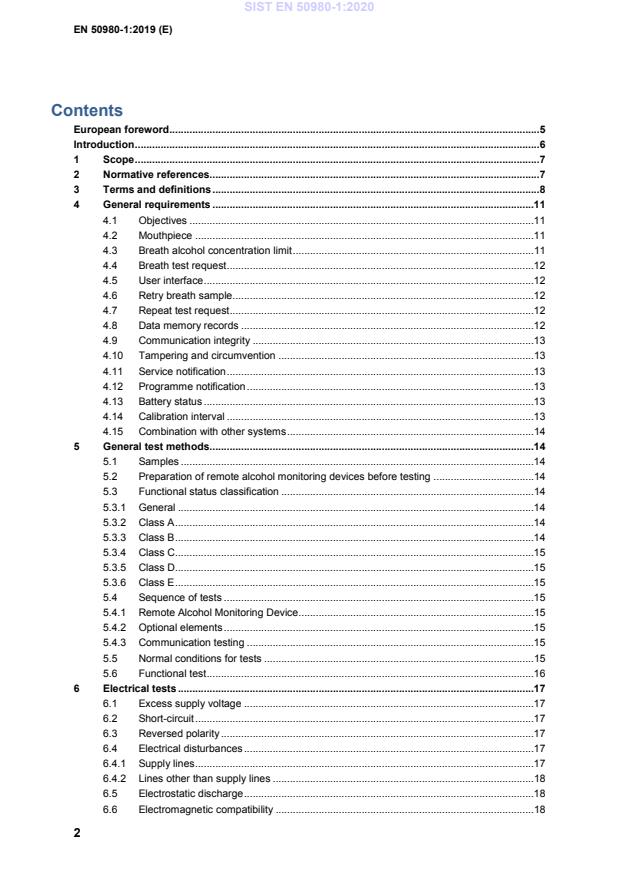
Contents
European foreword . 5
Introduction . 6
1 Scope . 7
2 Normative references. 7
3 Terms and definitions . 8
4 General requirements .11
4.1 Objectives .11
4.2 Mouthpiece .11
4.3 Breath alcohol concentration limit .11
4.4 Breath test request .12
4.5 User interface .12
4.6 Retry breath sample .12
4.7 Repeat test request .12
4.8 Data memory records .12
4.9 Communication integrity .13
4.10 Tampering and circumvention .13
4.11 Service notification .13
4.12 Programme notification .13
4.13 Battery status .13
4.14 Calibration interval .13
4.15 Combination with other systems .14
5 General test methods.14
5.1 Samples .14
5.2 Preparation of remote alcohol monitoring devices before testing .14
5.3 Functional status classification .14
5.3.1 General .14
5.3.2 Class A .14
5.3.3 Class B .14
5.3.4 Class C.15
5.3.5 Class D.15
5.3.6 Class E .15
5.4 Sequence of tests .15
5.4.1 Remote Alcohol Monitoring Device .15
5.4.2 Optional elements .15
5.4.3 Communication testing .15
5.5 Normal conditions for tests .15
5.6 Functional test .16
6 Electrical tests .17
6.1 Excess supply voltage .17
6.2 Short-circuit .17
6.3 Reversed polarity .17
6.4 Electrical disturbances .17
6.4.1 Supply lines .17
6.4.2 Lines other than supply lines .18
6.5 Electrostatic discharge .18
6.6 Electromagnetic compatibility .18
7 Calibration curve .18
8 Durability tests .19
8.1 General .19
8.2 Temperature cycles .19
8.3 Condensed water .20
8.4 Vibrations .20
8.4.1 General .20
8.4.2 Random vibrations .20
8.4.3 Vibration at fixed frequency .20
8.5 Drop test.21
8.6 Mechanical shock .21
9 Environmental tests .21
9.1 General .21
9.2 Temperature .22
9.2.1 General .22
9.2.2 Operation within the specified temperature range .22
9.2.3 Operation outside the specified temperature range .22
9.3 Temperature and humidity .22
9.4 Start-up time .22
9.5 Battery life .23
9.6 Pressure .23
9.7 Protection by enclosure .23
10 Breath sample .23
10.1 Volume .23
10.2 Flow .24
10.3 Exhalation time .24
10.4 Response time .24
11 Analytical specificity .24
11.1 Test gases .24
11.2 Cigarette smoke .25
12 Circumvention and tampering .25
12.1 General .25
12.2 Pressurized air .25
12.3 Provision of the sample with a mouthpiece attached .25
12.4 Provision of the sample without a mouthpiece attached .26
12.5 Obstruction of the mouthpiece .26
12.6 Filter .26
12.7 Condensation .27
12.8 Water .27
12.9 Low power behaviour .28
12.10 Disconnection of components .29
13 Documentation and identity verification.29
13.1 Documentation .29
13.1.1 Image capture .29
13.1.2 Characteristics of the image .29
13.1.3 Environmental lighting conditions .31
13.2 Image processing .31
13.2.1 General .31
13.2.2 Face detection .31
13.2.3 Missing face on image .31
13.3 Identification .31
14 Timer and intervals .31
14.1 Test schedule .31
14.1.1 User initiated test .31
14.1.2 Scheduled test .31
14.1.3 Test on demand .31
14.2 Service reminder .31
14.3 Calibration interval .32
15 Long term behaviour.32
16 Instructions .32
16.1 Instructions for use .32
16.2 Instructions for servicing the remote alcohol monitoring device .34
17 Test report .34
18 Labelling and marking .34
Annex A (normative) Description of events .35
Annex B (informative) Performance testing .38
Bibliography .39
European foreword
This document (EN 50980-1:2019) has been prepared by CLC/BTTF 116-2 “Alcohol Interlocks”.
The following dates are fixed:
• latest date by which this document has (dop) 2020-09-09
to be implemented at national level by
publication of an identical national
standard or by endorsement
• latest date by which the national (dow) 2022-09-09
standards conflicting with this document
have to be withdrawn
Introduction
The purpose of remote alcohol monitoring devices is to monitor the compliance of persons subject to
mandatory or voluntary programmes focused on monitoring alcohol consumption.
The purpose of EN 50980-1 is to specify essential performance requirements and to provide the
respective test methods for available technologies. The technology of remote alcohol monitoring
devices continues to evolve, and further innovations can be expected. These could be considered in
new parts or revisions of this European Standard.
1 Scope
This document specifies performance requirements and test methods for remote alcohol monitoring
devices that use breath alcohol testing technology. It covers remote alcohol monitoring devices having
a mouthpiece and which are intended to be used by participants in programmes designed to monitor
alcohol consumption.
This document is directed at test laboratories and manufacturers of remote alcohol monitoring devices.
It defines requirements and test procedures for type testing.
Several parameter settings (such as alcohol concentration, breath volume or units of measurement)
are specified in this document for the purpose of type testing according to this standard only. However,
it may be necessary due to national regulations or depending on user requests to set the values of the
prescribed parameter settings differently when the remote alcohol monitoring devices are in use.
2 Normative references
The following documents are referred to in the text in such a way that some or all of their content
constitutes requirements of this document. For dated references, only the edition cited applies. For
undated references, the latest edition of the referenced document (including any amendments) applies.
EN 50436-6, Alcohol interlocks — Test methods and performance requirements — Part 6: Data
security
EN 60068-2-1:2007, Environmental testing — Part 2-1: Tests — Test A: Cold (IEC 60068-2-1:2007)
EN 60068-2-2:2007, Environmental testing — Part 2-2: Tests — Test B: Dry heat (IEC 60068-2-
2:2007)
EN 60068-2-6, Environmental testing — Part 2-6: Tests — Test Fc: Vibration (sinusoidal) (IEC 60068-
2-6)
EN 60068-2-27, Environmental testing — Part 2-27: Tests — Test Ea and guidance: Shock (IEC
60068-2-27)
EN 60068-2-30:2005, Environmental testing — Part 2-30: Tests — Test Db: Damp heat, cyclic (12 h +
12 h cycle) (IEC 60068-2-30:2005)
EN 60068-2-31, Environmental testing — Part 2-31: Tests — Test Ec: Rough handling shocks,
primarily for equipment-type specimens (IEC 60068-2-31)
EN 60068-2-64, Environmental testing — Part 2-64: Tests — Test Fh: Vibration, broadband random
and guidance (IEC 60068-2-64)
EN 60068-2-78, Environmental testing — Part 2-78: Tests — Test Cab: Damp heat, steady state (IEC
60068-2-78)
EN 60529, Degrees of protection provided by enclosures (IP Code) (IEC 60529)
ISO 7637-2, Road vehicles — Electrical disturbances from conduction and coupling — Part 2:
Electrical transient conduction along supply lines only
ISO 7637-3, Road vehicles — Electrical disturbances from conduction and coupling — Part 3:
Electrical transient transmission by capacitive and inductive coupling via lines other than supply lines
ISO 10605, Road vehicles — Test methods for electrical disturbances from electrostatic discharge
3 Terms and definitions
For the purposes of this document, the following terms and definitions apply.
ISO and IEC maintain terminological databases for use in standardization at the following addresses:
— IEC Electropedia: available at http://www.electropedia.org/
— ISO Online browsing platform: available at http://www.iso.org/obp
3.1
remote alcohol monitoring device
device or system that measures the breath alcohol concentration of a person in an unsupervised
environment and which provides means for identification of the person providing the breath sample
and means of data communication in a secure format
Note 1 to entry: Devices can be fixed, mobile or portable and may be a system consisting of more than one
element.
3.2
breath alcohol concentration
mass concentration of ethanol, expressed in mg/l (milligram ethanol per litre breath), in a breath
sample delivered into a remote alcohol monitoring device
3.3
breath alcohol concentration limit
set value of the breath alcohol concentration at or above which the remote alcohol monitoring device
will register a failed breath test
3.4
mouthpiece
part that is fitted to the remote alcohol monitoring device through which the subject under test provides
the breath specimen
Note 1 to entry: A mouthpiece is used to prevent the breath sample from being mixed with ambient air and
thus diluting the alcohol concentration.
3.5
breath sample
breath sample taken under forced expiration
3.6
accepted breath sample
breath sample fulfilling set requirements for volume, flow, exhalation time and other human breath
sample characteristics
Note 1 to entry: The acceptance of a breath sample is independent from its alcohol concentration.
3.7
breath test
provision of an accepted breath sample to a remote alcohol monitoring device
3.8
passed breath test
breath test whereby the subject under test has provided an accepted breath sample with a breath
alcohol concentration below the breath alcohol concentration limit
3.9
failed breath test
breath test whereby the subject under test has provided an accepted breath sample with a breath
alcohol concentration equal to or above the breath alcohol concentration limit
3.10
test time interval
period of time following a test request within which the subject under test shall provide an accepted
breath sample
3.11
missed breath test
absence of the provision of an accepted breath sample within the test time interval
3.12
ready for test
condition whereby the remote alcohol monitoring device is able to accept a breath test
3.13
error state
condition whereby the remote alcohol monitoring device detects an internal system non conformity
that may cause the device not to function according to specification and normal function is suspended
3.14
breath test request
signal to alert the subject that a breath test is required
3.14.1
repeat test request
additional breath test request following a failed breath test
3.14.2
subject initiated test request
breath test request initiated by the subject
3.14.3
test on demand request
breath test request initiated by an external authority through communication with the remote alcohol
monitoring device
3.14.4
scheduled test request
breath test request initiated according to a fixed or random time schedule
3.15
retry breath sample
additional breath sample request following a not accepted breath sample
3.16
programme authority
responsible authority for monitoring the compliance of the subject using a remote alcohol monitoring
device
3.17
compliance
act of conformance of the subject to the requirements of the programme
3.18
non-compliance
act of non-conformance of the subject to the requirements of the programme
3.19
circumvention
manipulation of a breath test, subject identification and/or data communication for the purpose of
achieving programme compliance
3.20
tampering
unauthorised change to or interference with the remote alcohol monitoring device or its function
3.21
supply voltage
voltage as obtained from the electrical power source (mains or battery) for the operation of the remote
alcohol monitoring device
3.22
nominal operation voltage
supply voltage as specified by the manufacturer for the normal operation of the device
3.23
calibration interval
set time period after calibration, verification or adjustment following which the remote alcohol
monitoring device will request the next calibration, verification or adjustment
3.24
calibration adjustment
set of operations carried out on a remote alcohol monitoring device so that it provides correct breath
alcohol concentration results within the accepted tolerances
3.25
service
service is the sum of actions that are necessary to maintain the proper function of the remote alcohol
monitoring device
3.26
verification test
test of the remote alcohol monitoring device with a gas sample of known alcohol concentration to
determine the proper function of the device and the accuracy of the alcohol sensor response within the
stability requirements
3.27
service notification
notification to alert the subject that a service or inspection of the remote alcohol monitoring device is
required
3.28
programme notification
notification to alert a subject of a special request from the programme authorities
3.29
data memory record
record of breath test results and other events with date, time and other parameters stored in the
memory of the remote alcohol monitoring device
3.30
data communication
transmission of data to or from the remote alcohol monitoring device
3.31
manufacturer
person or organisation responsible for the design, construction and production of the remote alcohol
monitoring device
3.32
g
n
standard acceleration due to the earth gravitational field, which varies with altitude and geographical
latitude
Note 1 to entry: For the purposes of this standard, the value of gn is rounded to the nearest whole number, that
is 10 m/s .
3.33
operational state
state in which the remote alcohol device is powered and ready to operate and to communicate. It may
be in a low power consumption mode
4 General requirements
4.1 Objectives
The remote alcohol monitoring device shall monitor the compliance of persons participating in
mandatory or voluntary programmes focused on monitoring alcohol consumption. This shall be
achieved through the recurrent measurement of breath alcohol concentration as well as means for
subject identification and data communication.
4.2 Mouthpiece
The remote alcohol monitoring device shall have an exchangeable mouthpiece for the delivery of the
breath sample that shall prevent the breath sample from mixing with ambient air.
The mouthpiece shall be hygienically wrapped.
4.3 Breath alcohol concentration limit
The nominal breath alcohol concentration limit of the remote alcohol monitoring device shall not be
lower than 0,09 mg/l.
NOTE There is a limitation for the lower limit of the detection of alcohol concentrations in breath due to
technological and physiological reasons. Consequently, the lowest limit for a reliable measurement of breath
alcohol concentration is 0,09 mg/l.
4.4 Breath test request
The remote alcohol monitoring device shall be capable of requesting breath tests by visual and/or
audible signals. A breath sample shall only be accepted after a breath test request which includes
scheduled tests, tests on demand and subject initiated tests.
NOTE This requirement covers each of the breath test types itemized under 3.14.
4.5 User interface
The remote alcohol monitoring device shall guide the user through the test procedure. At least the
following shall be indicated:
— test requested;
— ready for test;
— not accepted breath sample;
— test completed.
The indication may be audible and/or visible and/or a text display.
NOTE Programmes could require that certain indications are not made available to the user.
4.6 Retry breath sample
The remote alcohol monitoring device shall be capable of requesting a retry breath sample as a result
of a not accepted breath sample by visual and/or audible signals.
The remote alcohol monitoring device shall be capable of limiting the number of retry breath sample
requests within the test time interval.
Not providing an accepted breath sample within the test time interval shall result in a missed breath
test.
4.7 Repeat test request
The remote alcohol monitoring device shall be capable of requesting a repeat test as a result of a
failed breath test by visual and/or audible signals.
4.8 Data memory records
The remote alcohol monitoring device shall be capable of recording events, breath alcohol test data
and subject images, together with date and time and optional geo-positioning data. These events shall
be stored in the internal memory of the device, at least until securely transmitted to a database. As a
minimum these events shall include the following:
— test requests with internal battery voltage at the time of test request;
— breath alcohol test results;
— breath sample attempts;
— missed breath tests;
— connections and disconnections of power;
— changing of parameters;
— results of calibration verification and adjustment;
— digital images;
— tampering or circumvention attempts.
The logged data shall include:
— the designation of series or type;
— the serial number;
— if applicable, the International Mobile Station Equipment Identity (IMEI);
— if applicable, the media access control address (MAC address) of the device.
Data shall be stored in such a way that it will not be lost, corrupted or modified.
Access to the data shall only be possible by an authorized person.
NOTE 1 For an extended list of events see Annex A.
NOTE 2 There could be national regulations on data storage, transmission, access and evaluation.
4.9 Communication integrity
If the remote alcohol monitoring device comprises separate elements, they shall communicate in
accordance with EN 50436-6.
NOTE Separate elements can be for example, a sensing device and a transmitting unit or a device and parts
of the communication to a database that provide functionality (without the data broker which is excluded in
EN 50436-6).
4.10 Tampering and circumvention
The remote alcohol monitoring device shall be designed and manufactured so that it can be neither
opened nor modified without visible or recorded evidence of such attempts.
The access to the data memory or to means for setting parameters or to making adjustments shall be
designed so as to deter unauthorised or inadvertent interference.
4.11 Service notification
The remote alcohol monitoring device shall be capable of providing a service notification by visual
and/or audible signals (e.g. calibration verification or device maintenance request).
4.12 Programme notification
The remote alcohol monitoring device shall be capable of providing a programme notification by visual
and/or audible signals.
NOTE Any message the programme authority wants to communicate to the subject.
4.13 Battery status
Remote alcohol monitoring devices being powered from batteries shall be capable of providing an
indication of the battery status, including a notification to the subject that recharging or replacement of
the batteries is required.
4.14 Calibration interval
The calibration interval for the remote alcohol monitoring device shall be at minimum 180 days or the
calibration interval as given by the manufacturer whichever is greater.
4.15 Combination with other systems
The performance requirements of this European Standard apply to remote alcohol monitoring devices
that are fixed, mobile or portable, combined with other systems or integrated into them.
Tests of different parts of the remote alcohol monitoring device may be performed separately, as to be
agreed between the manufacturer and the testing laboratory.
5 General test methods
5.1 Samples
All the tests except 8.5 shall be carried out on two remote alcohol monitoring devices. However,
subject to the functional status classification in 5.3, at the discretion of the test laboratory, additional
devices may be tested in parallel in whole or in part if this is not considered to affect the results of the
other tests.
Batteries may be replaced or recharged before individual tests unless otherwise stated.
All parts of the remote alcohol monitoring device which are intended to be used during operation shall
be tested according to this European Standard.
Optional elements authorized by the manufacturer to extend the function of the remote alcohol
monitoring device shall be tested according to this European Standard.
NOTE National regulations have the option to define which optional elements require type testing.
All the tests shall be carried out on two samples of each optional element. However, at the discretion
of the test laboratory additional optional elements may be tested separately if this is not considered to
affect the results of the other tests.
5.2 Preparation of remote alcohol monitoring devices before testing
The remote alcohol monitoring devices shall be calibrated and adjustments shall be carried out, if
needed, at the beginning of the test procedure and before the long-term stability test (see Clause 15)
by the manufacturer or according to the manufacturer’s instructions for calibration and adjustment.
If the calibration interval given by the manufacturer expires during the test procedure, the remote
alcohol monitoring device may be readjusted after the expiry, if necessary, with the exception of the
durability tests (see Clause 8) and the long-term stability test (see Clause 15).
With the exception of the tests for circumvention and tampering (see Clause 12), the measures
against circumvention and tampering may be de-activated for the tests.
5.3 Functional status classification
5.3.1 General
This clause describes the functional status of a device during and after a test.
The minimum functional status shall be given in each test.
Unwanted operations of the device are not allowed in any of the following classes (see 5.3.2 to 5.3.6).
5.3.2 Class A
All functions of a device or a system perform as designed during and after the test.
5.3.3 Class B
All functions of a device or a system perform as designed during the test. However, one or more of
them may go beyond the specified tolerance. All functions return automatically to within normal limits
after the test. Memory functions shall remain class A.
It shall be specified by the device manufacturer which function of the device shall perform as designed
and which function can be beyond the specified tolerance.
5.3.4 Class C
One or more functions of a device or a system do not perform as designed during the test but return
automatically to normal operation after the test.
5.3.5 Class D
One or more functions of a device or a system do not perform as designed during the test and do not
return to normal operation after the test until the device or system is reset by a simple “operator/use”
action.
5.3.6 Class E
One or more functions of a device or a system do not perform as designed during and after the test
and cannot be returned to proper operation without repairing or replacing the device or system.
5.4 Sequence of tests
5.4.1 Remote Alcohol Monitoring Device
The remote alcohol monitoring device shall be tested according to the respective test procedures in
the following sequence: electrical tests (Clause 6), calibration curve (Clause 7), durability tests
(Clause 8).
The sequence of the remaining tests Clause 9 to Clause 15 may be agreed between the test
laboratory and the manufacturer.
The tests according to 8.5 may be performed with three additional remote alcohol monitoring devices
in parallel.
The tests according to Clause 10 to Clause 14 may be performed with two additional remote alcohol
monitoring devices in parallel.
The long-term stability test of Clause 15 may be performed with two additional remote alcohol
monitoring devices in parallel.
5.4.2 Optional elements
The following tests shall be performed with the optional elements:
— tampering (4.11), to be tested together with the remote alcohol monitoring device;
— data memory records (4.9), where applicable;
— electrical tests (Clause 6) to be tested together with the remote alcohol monitoring device;
— durability (Clause 8), with drop test (8.5);
— environmental tests (Clause 9), to be tested together with the remote alcohol monitoring device.
After having passed the tests according 5.4.2 the optional elements shall perform as specified by the
manufacturer.
5.4.3 Communication testing
Communication testing shall be performed by transferring data from the device and to the device.
Special applications are acceptable for this test.
5.5 Normal conditions for tests
All tests shall be performed with the remote alcohol monitoring device powered on under the following
normal conditions, unless otherwise stated:
— voltage: as specified by the manufacturer (nominal operating voltage ± 5 %) or with sufficiently
charged batteries;
— ambient temperature: T = 23 °C ± 5 °C;
— ambient pressure: 98 kPa ± 20 kPa;
— test gases:
— dry gases, dry gas temperature 23 °C ± 5 °C, or
— wet gases, test gas temperature 34 °C ± 0,5 °C;
— test gas flow: 0,25 l/s ± 0,05 l/s;
— uncertainty of test gas concentration: ± 0,01 mg/l or ± 1/6 of the maximum permissible error
whichever is greater;
— test gas volume: 1,5 l ± 10 %.
5.6 Functional test
As stated in the respective clauses, tests shall be performed according to one of the following three
test types.
The limit value at or above which the remote alcohol monitoring device records a failed breath test
shall be adjusted to 0,25 mg/l for these tests.
NOTE The limit value of 0,25 mg/l is chosen to facilitate the test procedures and to differentiate between the
influence of disturbances and the uncertainty of the measurement results. Because the test of the calibration
curve is additionally performed at different concentrations and the related requirements have to be fulfilled, the
test results of a type testing according to this European Standard are also applicable to remote alcohol monitoring
devices having a different limit value in the range of 0,09 mg/l up to 0,4 mg/l.
Test type 1
Test gas with an alcohol concentration of 0,30 mg/l shall be applied to the remote alcohol
monitoring device successively ten times in intervals of at least 3 min. The remote alcohol
monitoring device shall register a failed breath test in each test and record and/or transmit the
results.
Test gas with an alcohol concentration of 0,20 mg/l shall be applied to the remote alcohol
monitoring device successively ten times in intervals of at least 3 min. The remote alcohol
monitoring device shall register a passed breath test in each test and record and/or transmit the
results.
Test type 2
Test gas with an alcohol concentration of 0,35 mg/l shall be applied to the remote alcohol
monitoring device successively ten times in intervals of at least 3 min. The remote alcohol
monitoring device shall register a failed breath test in each test and record and/or transmit the
results.
Test gas with an alcohol concentration of 0,15 mg/l shall be applied to the remote alcohol
monitoring device successively ten times in intervals of at least 3 min. The remote alcohol
monitoring device shall register a passed breath test in each test and record and/or transmit the
results.
Test type 3
Test gas consisting of air shall be applied to the remote alcohol monitoring device successively
ten times in intervals of at least 3 min. The remote alcohol monitoring device shall register a
passed breath test in each test with no individual indication higher than 0,03 mg/l and record
and/or transmit the results.
6 Electrical tests
6.1 Excess supply voltage
A remote alcohol monitoring device that uses an external power supply shall be subjected at 40 °C
ambient temperature to an excess supply voltage of 10 % above the nominal supply voltage for 60 min.
The remote alcohol monitoring device shall meet functional status Class A as defined in 5.3.2 and
shall fulfil the requirements of functional test type 1 in 5.6 when tested under normal conditions.
6.2 Short-circuit
The remote alcohol monitoring device shall be tested for the short circuit protection of power input to
the following test conditions:
If the remote alcohol monitoring device has batteries, the batteries shall be inserted.
Connect all relevant power inputs of the remote alcohol monitoring device in sequence for duration of
60 s ± 10 %.
All unused inputs remain open unless otherwise agreed between customer and supplier.
The remote alcohol monitoring device shall meet functional status Class C as defined in 5.3.4 and
shall fulfil the requirements of functional test type 1 in 5.6 when tested under normal conditions.
Dedicated Communication lin
...
Questions, Comments and Discussion
Ask us and Technical Secretary will try to provide an answer. You can facilitate discussion about the standard in here.
Loading comments...