


SIST EN ISO 10855-2:2025
(Main)Offshore containers and associated lifting sets - Part 2: Design, manufacture and marking of lifting sets (ISO 10855-2:2024)
Offshore containers and associated lifting sets - Part 2: Design, manufacture and marking of lifting sets (ISO 10855-2:2024)
This document specifies requirements for lifting sets for use with containers in offshore service, including technical requirements, marking and statements of conformity for single and multi-leg slings, including chain slings and wire rope slings.
Offshore-Container und dazugehörige Anschlaggarnituren - Teil 2: Auslegung, Herstellung und Kennzeichnung von Anschlaggarnituren (ISO 10855-2:2024)
Dieses Dokument legt Anforderungen für Anschlaggarnituren zur Verwendung mit Containern im Offshore-Betrieb fest, einschließlich technischen Anforderungen und Anforderungen an die Kennzeichnung sowie Konformitätserklärungen für einsträngige und mehrsträngige Anschlagmittel, einschließlich Kettengehänge und Seilgehänge.
Conteneurs offshore et dispositifs de levage associés - Partie 2: Conception, fabrication et marquage des dispositifs de levage associés (ISO 10855-2:2024)
Le présent document spécifie les exigences relatives aux dispositifs de levage destinés à être utilisés avec les conteneurs pour une utilisation en mer, y compris les exigences techniques, le marquage et les déclarations de conformité des élingues à un ou plusieurs brins, comprenant les élingues en chaînes et les élingues de câbles en acier.
Plavajoče kontejnerske enote in z njimi povezan dvižni pribor - 2. del: Načrtovanje, izdelava in označevanje dvižnih priborov (ISO 10855-2:2024)
Ta dokument določa zahteve za dvižni pribor za uporabo s plavajočimi kontejnerskimi enotami, vključno s tehničnimi zahtevami, označevanjem in izjavami o skladnosti za enojne in večkrake obese, vključno z verižnimi in vrvnimi obesami.
General Information
- Status
- Published
- Public Enquiry End Date
- 23-Apr-2024
- Publication Date
- 11-Dec-2024
- Technical Committee
- I13 - Imaginarni 13
- Current Stage
- 6060 - National Implementation/Publication (Adopted Project)
- Start Date
- 10-Dec-2024
- Due Date
- 14-Feb-2025
- Completion Date
- 12-Dec-2024
Relations
- Effective Date
- 19-Jan-2023
Overview
EN ISO 10855-2:2024 - titled Offshore containers and associated lifting sets – Part 2: Design, manufacture and marking of lifting sets (ISO 10855-2:2024) - specifies technical requirements, marking and conformity statements for lifting sets used with offshore containers. It covers single- and multi-leg slings including chain slings, wire rope slings, and associated shackles used in offshore lifting operations. The standard is intended for the offshore industry (oil & gas, lower carbon energy) and is adopted by CEN as EN ISO 10855-2:2024.
Key topics and technical requirements
- Scope and terminology: Defines lifting set, sling, assembly-secured components and related symbols (e.g., WLL values and sling angles).
- Design and strength: Requirements for dimensions and structural strength of lifting sets and individual sling legs.
- Chain and wire rope slings: Specific criteria for chain slings (short link) and wire rope slings used in offshore service.
- Shackles and fittings: Requirements for forgings and fitment, including provisions for assembly-secured shackles.
- Materials and testing:
- Impact testing and Charpy references (ISO 148-1)
- Hardness requirements (recently clarified for chain and link components)
- Welding procedure qualification (ISO 15613)
- Corrosion protection and material certificates (ISO 10474)
- Certificates and conformity:
- Preparation of component and sling certificates, plus required documentation
- Statements of conformity for manufactured lifting sets
- Marking: Mandatory marking details (WLL, identification tags), with an example tag for chain slings included in Annex B.
- Calculation guidance: Annex A provides the method to determine minimum required working load limit (WLL,min) of a lifting set.
- Regulatory context: Annex C lists regulations relevant to offshore containers; ISO 10855 series aligns with IMO MSC/Circ.860.
Practical applications
- Use ISO 10855-2 when specifying or procuring offshore lifting sets, to ensure design, manufacture and marking meet recognized international requirements.
- Apply the standard for product certification, quality control, and preparation of conformity documentation.
- Reference during design reviews and supplier audits to verify material testing, welding qualification and corrosion protection practices.
- Use the marking and WLL calculation provisions to ensure safe selection of lifting equipment during offshore lifts.
Who should use this standard
- Manufacturers of offshore containers, chain and wire rope slings, and shackles
- Offshore lifting designers and structural engineers
- Purchase, inspection and certification bodies (third‑party inspectors)
- Offshore operations, rigging and lifting supervisors, and safety managers
Related standards (examples referenced)
- ISO 148‑1 (Charpy impact), ISO 2415 (forged shackles), ISO 10474 (material certificates), ISO 15613 (welding), EN 818‑4 (chain slings), EN 13414‑1 (wire rope slings).
Keywords: ISO 10855-2, EN ISO 10855-2, offshore containers, lifting sets, chain slings, wire rope slings, shackles, working load limit, offshore lifting, design and marking.

Frequently Asked Questions
SIST EN ISO 10855-2:2025 is a standard published by the Slovenian Institute for Standardization (SIST). Its full title is "Offshore containers and associated lifting sets - Part 2: Design, manufacture and marking of lifting sets (ISO 10855-2:2024)". This standard covers: This document specifies requirements for lifting sets for use with containers in offshore service, including technical requirements, marking and statements of conformity for single and multi-leg slings, including chain slings and wire rope slings.
This document specifies requirements for lifting sets for use with containers in offshore service, including technical requirements, marking and statements of conformity for single and multi-leg slings, including chain slings and wire rope slings.
SIST EN ISO 10855-2:2025 is classified under the following ICS (International Classification for Standards) categories: 53.020.99 - Other lifting equipment; 55.180.10 - General purpose containers; 75.180.10 - Exploratory, drilling and extraction equipment. The ICS classification helps identify the subject area and facilitates finding related standards.
SIST EN ISO 10855-2:2025 has the following relationships with other standards: It is inter standard links to SIST EN ISO 10855-2:2018. Understanding these relationships helps ensure you are using the most current and applicable version of the standard.
SIST EN ISO 10855-2:2025 is available in PDF format for immediate download after purchase. The document can be added to your cart and obtained through the secure checkout process. Digital delivery ensures instant access to the complete standard document.
Standards Content (Sample)
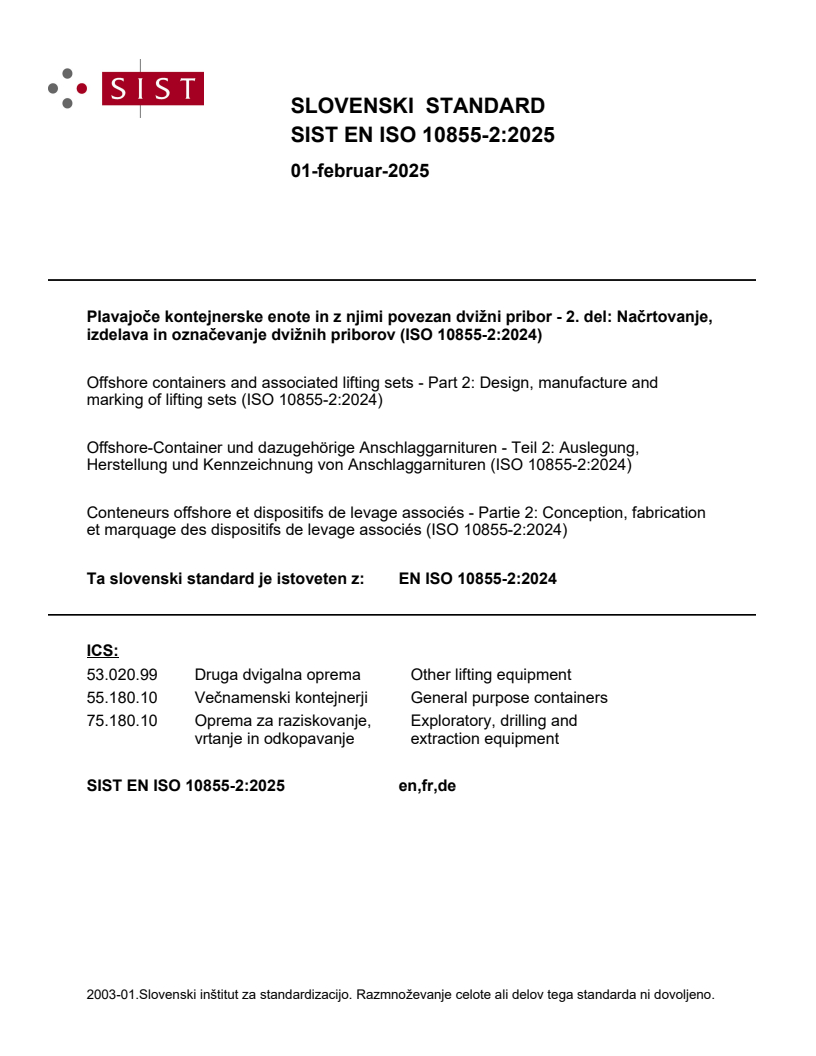
SLOVENSKI STANDARD
01-februar-2025
Plavajoče kontejnerske enote in z njimi povezan dvižni pribor - 2. del: Načrtovanje,
izdelava in označevanje dvižnih priborov (ISO 10855-2:2024)
Offshore containers and associated lifting sets - Part 2: Design, manufacture and
marking of lifting sets (ISO 10855-2:2024)
Offshore-Container und dazugehörige Anschlaggarnituren - Teil 2: Auslegung,
Herstellung und Kennzeichnung von Anschlaggarnituren (ISO 10855-2:2024)
Conteneurs offshore et dispositifs de levage associés - Partie 2: Conception, fabrication
et marquage des dispositifs de levage associés (ISO 10855-2:2024)
Ta slovenski standard je istoveten z: EN ISO 10855-2:2024
ICS:
53.020.99 Druga dvigalna oprema Other lifting equipment
55.180.10 Večnamenski kontejnerji General purpose containers
75.180.10 Oprema za raziskovanje, Exploratory, drilling and
vrtanje in odkopavanje extraction equipment
2003-01.Slovenski inštitut za standardizacijo. Razmnoževanje celote ali delov tega standarda ni dovoljeno.
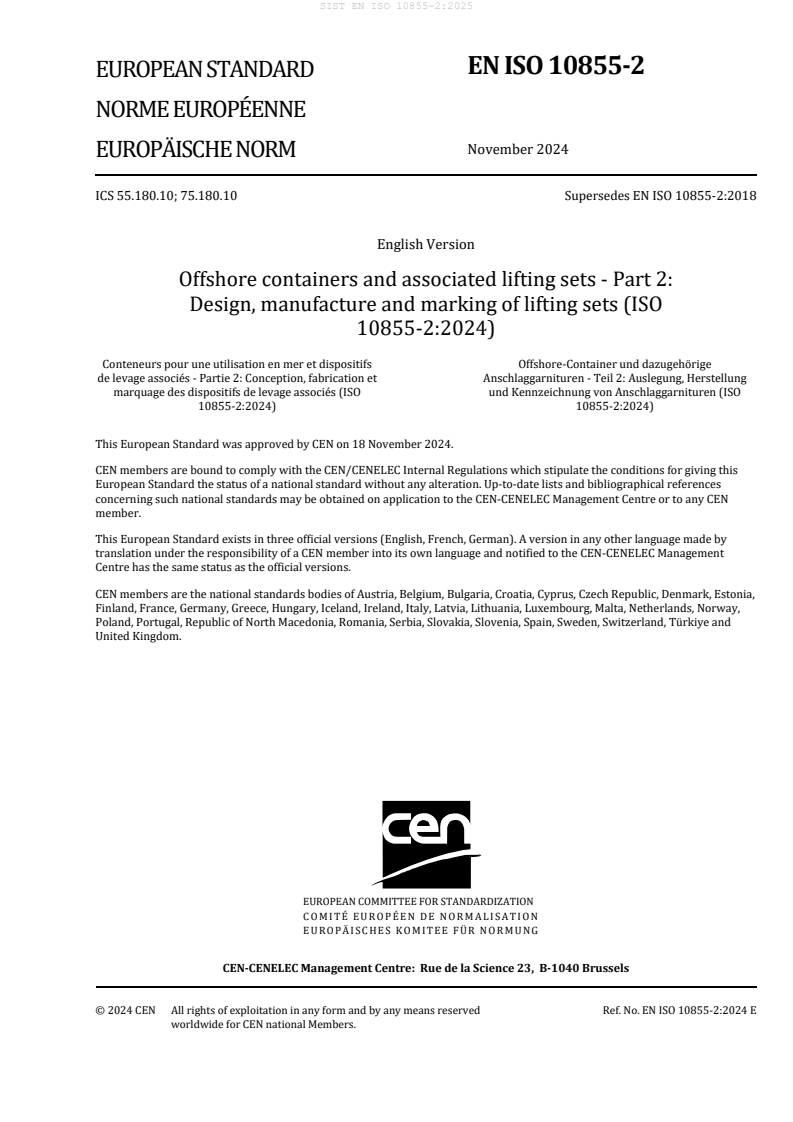
EN ISO 10855-2
EUROPEAN STANDARD
NORME EUROPÉENNE
November 2024
EUROPÄISCHE NORM
ICS 55.180.10; 75.180.10 Supersedes EN ISO 10855-2:2018
English Version
Offshore containers and associated lifting sets - Part 2:
Design, manufacture and marking of lifting sets (ISO
10855-2:2024)
Conteneurs pour une utilisation en mer et dispositifs Offshore-Container und dazugehörige
de levage associés - Partie 2: Conception, fabrication et Anschlaggarnituren - Teil 2: Auslegung, Herstellung
marquage des dispositifs de levage associés (ISO und Kennzeichnung von Anschlaggarnituren (ISO
10855-2:2024) 10855-2:2024)
This European Standard was approved by CEN on 18 November 2024.
CEN members are bound to comply with the CEN/CENELEC Internal Regulations which stipulate the conditions for giving this
European Standard the status of a national standard without any alteration. Up-to-date lists and bibliographical references
concerning such national standards may be obtained on application to the CEN-CENELEC Management Centre or to any CEN
member.
This European Standard exists in three official versions (English, French, German). A version in any other language made by
translation under the responsibility of a CEN member into its own language and notified to the CEN-CENELEC Management
Centre has the same status as the official versions.
CEN members are the national standards bodies of Austria, Belgium, Bulgaria, Croatia, Cyprus, Czech Republic, Denmark, Estonia,
Finland, France, Germany, Greece, Hungary, Iceland, Ireland, Italy, Latvia, Lithuania, Luxembourg, Malta, Netherlands, Norway,
Poland, Portugal, Republic of North Macedonia, Romania, Serbia, Slovakia, Slovenia, Spain, Sweden, Switzerland, Türkiye and
United Kingdom.
EUROPEAN COMMITTEE FOR STANDARDIZATION
COMITÉ EUROPÉEN DE NORMALISATION
EUROPÄISCHES KOMITEE FÜR NORMUNG
CEN-CENELEC Management Centre: Rue de la Science 23, B-1040 Brussels
© 2024 CEN All rights of exploitation in any form and by any means reserved Ref. No. EN ISO 10855-2:2024 E
worldwide for CEN national Members.
Contents Page
European foreword . 3
European foreword
This document (EN ISO 10855-2:2024) has been prepared by Technical Committee ISO/TC 67 "Oil and
gas industries including lower carbon energy" in collaboration with Technical Committee CEN/TC 12
“Oil and gas industries including lower carbon energy” the secretariat of which is held by NEN.
This European Standard shall be given the status of a national standard, either by publication of an
identical text or by endorsement, at the latest by May 2025, and conflicting national standards shall be
withdrawn at the latest by May 2025.
Attention is drawn to the possibility that some of the elements of this document may be the subject of
patent rights. CEN shall not be held responsible for identifying any or all such patent rights.
This document supersedes EN ISO 10855-2:2018.
Any feedback and questions on this document should be directed to the users’ national standards
body/national committee. A complete listing of these bodies can be found on the CEN website.
According to the CEN-CENELEC Internal Regulations, the national standards organizations of the
following countries are bound to implement this European Standard: Austria, Belgium, Bulgaria,
Croatia, Cyprus, Czech Republic, Denmark, Estonia, Finland, France, Germany, Greece, Hungary, Iceland,
Ireland, Italy, Latvia, Lithuania, Luxembourg, Malta, Netherlands, Norway, Poland, Portugal, Republic of
North Macedonia, Romania, Serbia, Slovakia, Slovenia, Spain, Sweden, Switzerland, Türkiye and the
United Kingdom.
Endorsement notice
The text of ISO 10855-2:2024 has been approved by CEN as EN ISO 10855-2:2024 without any
modification.
International
Standard
ISO 10855-2
Second edition
Offshore containers and associated
2024-11
lifting sets —
Part 2:
Design, manufacture and marking
of lifting sets
Conteneurs pour une utilisation en mer et dispositifs de levage
associés —
Partie 2: Conception, fabrication et marquage des dispositifs de
levage associés
Reference number
ISO 10855-2:2024(en) © ISO 2024
ISO 10855-2:2024(en)
© ISO 2024
All rights reserved. Unless otherwise specified, or required in the context of its implementation, no part of this publication may
be reproduced or utilized otherwise in any form or by any means, electronic or mechanical, including photocopying, or posting on
the internet or an intranet, without prior written permission. Permission can be requested from either ISO at the address below
or ISO’s member body in the country of the requester.
ISO copyright office
CP 401 • Ch. de Blandonnet 8
CH-1214 Vernier, Geneva
Phone: +41 22 749 01 11
Email: copyright@iso.org
Website: www.iso.org
Published in Switzerland
ii
ISO 10855-2:2024(en)
Contents Page
Foreword .iv
Introduction .v
1 Scope . 1
2 Normative references . 1
3 Terms and definitions . 1
4 Symbols and abbreviated terms. 2
5 Technical requirements . 2
5.1 General requirements .2
5.2 Dimensions and strength of lifting sets .3
5.3 Chain slings . .3
5.4 Wire rope slings.3
5.5 Shackles .3
5.6 Materials .4
5.6.1 Impact testing .4
5.6.2 Hardness testing.4
5.6.3 Welding .4
5.6.4 Corrosion protection .4
5.6.5 Material certificates .4
6 Certificates . 4
6.1 Preparation of certificates .4
6.2 Single component certificates .4
6.3 Sling certificates.5
7 Marking . . 5
Annex A (normative) Determination of minimum required working load limit (m ) of the
WLL,min
lifting set . . 7
Annex B (informative) Example of identification tag for chain slings . 9
Annex C (informative) Regulations for offshore containers .11
Bibliography .13
iii
ISO 10855-2:2024(en)
Foreword
ISO (the International Organization for Standardization) is a worldwide federation of national standards
bodies (ISO member bodies). The work of preparing International Standards is normally carried out through
ISO technical committees. Each member body interested in a subject for which a technical committee
has been established has the right to be represented on that committee. International organizations,
governmental and non-governmental, in liaison with ISO, also take part in the work. ISO collaborates closely
with the International Electrotechnical Commission (IEC) on all matters of electrotechnical standardization.
The procedures used to develop this document and those intended for its further maintenance are described
in the ISO/IEC Directives, Part 1. In particular, the different approval criteria needed for the different types
of ISO document should be noted. This document was drafted in accordance with the editorial rules of the
ISO/IEC Directives, Part 2 (see www.iso.org/directives).
ISO draws attention to the possibility that the implementation of this document may involve the use of (a)
patent(s). ISO takes no position concerning the evidence, validity or applicability of any claimed patent
rights in respect thereof. As of the date of publication of this document, ISO had not received notice of (a)
patent(s) which may be required to implement this document. However, implementers are cautioned that
this may not represent the latest information, which may be obtained from the patent database available at
www.iso.org/patents. ISO shall not be held responsible for identifying any or all such patent rights.
Any trade name used in this document is information given for the convenience of users and does not
constitute an endorsement.
For an explanation of the voluntary nature of standards, the meaning of ISO specific terms and expressions
related to conformity assessment, as well as information about ISO's adherence to the World Trade
Organization (WTO) principles in the Technical Barriers to Trade (TBT), see www.iso.org/iso/foreword.html.
This document was prepared by Technical Committee ISO/TC 67, Oil and gas industries including lower
carbon energy, Subcommittee SC 7, Offshore structures, in collaboration with the European Committee for
Standardization (CEN) Technical Committee CEN/TC 12, Oil and gas industries including lower carbon energy,
in accordance with the Agreement on technical cooperation between ISO and CEN (Vienna Agreement).
This second edition cancels and replaces the first edition (ISO 10855-2:2018), which has been technically
revised.
The main changes are as follows:
— hardness requirements have been defined for chain and link components.
A list of all parts in the ISO 10855 series can be found on the ISO website.
Any feedback or questions on this document should be directed to the user’s national standards body. A
complete listing of these bodies can be found at www.iso.org/members.html.
iv
ISO 10855-2:2024(en)
Introduction
The ISO 10855 series meets the requirements of IMO MSC/Circ.860 (1998) for the design, construction,
inspection, testing and in-service examination of offshore containers and the associated lifting sets which
are handled in open seas.
The ISO 10855 series does not cover operational use or maintenance.
Under conditions in which offshore containers are often transported and handled, the 'normal' rate of wear
and tear is high, and damage necessitating repair can occur. However, containers designed and manufactured
according to the ISO 10855 series have sufficient strength to withstand the normal forces encountered in
offshore operations and to not suffer from complete failure even if subject to extreme loads.
v
International Standard ISO 10855-2:2024(en)
Offshore containers and associated lifting sets —
Part 2:
Design, manufacture and marking of lifting sets
1 Scope
This document specifies requirements for lifting sets for use with containers in offshore service, including
technical requirements, marking and statements of conformity for single and multi-leg slings, including
chain slings and wire rope slings.
2 Normative references
The following documents are referred to in the text in such a way that some or all of their content constitutes
requirements of this document. For dated references, only the edition cited applies. For undated references,
the latest edition of the referenced document (including any amendments) applies.
ISO 148-1, Metallic materials — Charpy pendulum impact test — Part 1: Test method
ISO 2415, Forged shackles for general lifting purposes — Dee shackles and bow shackles
ISO 10474, Steel and steel products — Inspection documents
ISO 15613, Specification and qualification of welding procedures for metallic materials — Qualification based
on pre-production welding test
EN 818-4:1996, Short link chain for lifting purposes. Safety Chain slings - Grade 8
EN 13414-1, Steel wire rope slings — Safety — Part 1: Slings for general lifting service
3 Terms and definitions
For the purposes of this document, the following terms and definitions apply.
ISO and IEC maintain terminology databases for use in standardization at the following addresses:
— ISO Online browsing platform: available at https:// www .iso .org/ obp
— IEC Electropedia: available at https:// www .electropedia .org/
3.1
lifting set
items of integrated lifting equipment used to connect the offshore container to the lifting appliance
Note 1 to entry: This can comprise one or multi-leg wire rope or chain slings (with or without a top leg) and shackles,
whether assembly secured or not.
3.2
sling
one leg of a lifting set
ISO 10855-2:2024(en)
3.3
assembly secured
fitted to a sling leg and secured by a seal or similar device so as to signal unambiguously whether or not the
shackle has been exchanged
Note 1 to entry: Shackles that are assembly secured, i.e. cannot be separated from the lifting set, are considered to be
part of the lifting set.
4 Symbols and abbreviated terms
m minimum working load limit of each shackle, in t
WLL,s
m minimum calculated working load limit from Annex A, in t
WLL,min
m maximum lifting capacity of a lifting set to be used on an offshore container, in t
WLL,off
NOTE 1 m is the value that is to be marked on the lifting sets and may be higher than m .
WLL,off R
ϑ is the angle between a sling leg and the vertical, in degrees
m rating [i.e. the maximum gross mass (MGM), of the container including permanent
R
equipment and its cargo], in kg, but excluding the lifting set
m tare mass (i.e. the mass of an empty container including any permanent equipment but
T
excluding cargo and lifting set), in kg
m payload (i.e. the maximum permissible mass of cargo which can be safely transported
...
Questions, Comments and Discussion
Ask us and Technical Secretary will try to provide an answer. You can facilitate discussion about the standard in here.
Loading comments...