


SIST EN 10228-3:2016
(Main)Non-destructive testing of steel forgings - Part 3: Ultrasonic testing of ferritic or martensitic steel forgings
Non-destructive testing of steel forgings - Part 3: Ultrasonic testing of ferritic or martensitic steel forgings
This European Standard describes techniques to be used for the manual, pulse-echo, ultrasonic testing of forgings manufactured from ferritic and martensitic steel. Mechanized scanning techniques, such as immersion testing, may be used but should be agreed between the purchaser and supplier (see Clause 4).
This part of EN 10228 applies to four types of forgings, classified according to their shape and method of production. Types 1, 2 and 3 are essentially simple shapes. Type 4 covers complex shapes.
This part of EN 10228 does not apply to:
- closed die forgings;
- turbine rotor and generator forgings.
Ultrasonic testing of austenitic and austenitic-ferritic stainless steel forgings is the subject of EN 10228-4.
Zerstörungsfreie Prüfung von Schmiedestücken aus Stahl - Teil 3: Ultraschallprüfung von Schmiedestücken aus ferritischem oder martensitischem Stahl
La présente norme européenne décrit la méthode manuelle par réflexion d'ondes ultrasonores utilisée pour le contrôle par ultrasons des pièces forgées en aciers ferritique et martensitique. Les méthodes de balayage automatique telles que l'essai par immersion peuvent être également utilisées, mais il convient qu’elles fassent l'objet d'un accord entre l’acheteur et le fournisseur (voir article 4).
La présente partie de l'EN 10228 porte sur les pièces forgées, classées en quatre familles suivant leur forme et leur mode de forgeage. Les familles 1, 2, et 3 recouvrent essentiellement les formes simples. La famille 4 concerne les formes complexes.
La présente partie de l'EN 10228 ne s'applique pas :
aux pièces estampées ;
aux rotors de turbine et aux alternateurs.
Le contrôle par ultrasons des pièces forgées en aciers inoxydables austénitiques et austéno-ferritiques fait l'objet de l'EN 10228-4.
Essais non destructifs des pièces forgées en acier - Partie 3: Contrôle par ultrasons des pièces forgées en aciers ferritiques et martensitiques
La présente norme européenne décrit la méthode manuelle par réflexion d'ondes ultrasonores utilisée pour le contrôle par ultrasons des pièces forgées en aciers ferritique et martensitique. Les méthodes de balayage automatique telles que l'essai par immersion peuvent être également utilisées, mais feront l'objet d'un accord entre fournisseur et client (voir article 4).
La présente partie de l'EN 10228 porte sur les pièces forgées, classées en quatre familles suivant leur forme et leur mode de forgeage. Les types 1, 2, et 3 recouvrent essentiellement les formes simples. Le type 4 concerne les formes complexes.
La présente partie de l'EN 10228 ne s'applique pas :
- aux pièces estampées ;
- aux rotors de turbine et aux alternateurs.
Le contrôle par ultrasons des pièces forgées en acier inoxydable austénitique et austéno-ferritique fait l'objet de l'EN 10228-4.
Neporušitveno preskušanje jeklenih izkovkov - 3. del: Ultrazvočno preskušanje feritnih ali martenzitnih jeklenih izkovkov
Ta del standarda EN 10228 opisuje tehnike, ki se uporabljajo za ročno pulzno-odbojno ultrazvočno preskušanje izkovkov, izdelanih iz feritnega in martenzitnega jekla. Mehanizirane tehnike skeniranja, kot so preskusi s potopitvijo, se lahko uporabljajo, vendar naj bi se kupec in dobavitelj o tem predhodno strinjala (glej točko 4).
Ta del standarda EN 10228 se uporablja za štiri tipe izkovkov, ki so klasificirani glede na njihovo obliko in metodo izdelave. Tipi 1, 2 in 3 imajo preprosto obliko. Tip 4 zajema kompleksne oblike.
Ta del standarda EN 10228 se ne uporablja za:
– izkovke, proizvedene z zaprtimi kokilami,
– izkovke turbinskih rotorjev in generatorjev.
Ultrazvočno preskušanje izkovkov iz avstenitnega in feritno-avstenitnega nerjavnega jekla je predmet 4. dela standarda EN 10228.
General Information
- Status
- Published
- Public Enquiry End Date
- 06-Nov-2014
- Publication Date
- 03-Jul-2016
- Technical Committee
- IFEK - Ferrous metals
- Current Stage
- 6060 - National Implementation/Publication (Adopted Project)
- Start Date
- 14-Jun-2016
- Due Date
- 19-Aug-2016
- Completion Date
- 04-Jul-2016
- Directive
- Not Harmonized97/23/EC - Pressure equipment

Relations
- Effective Date
- 08-Jun-2016
- Effective Date
- 28-Jan-2026
- Effective Date
- 28-Jan-2026
- Effective Date
- 28-Jan-2026
- Effective Date
- 28-Jan-2026
- Effective Date
- 28-Jan-2026
- Effective Date
- 28-Jan-2026
- Effective Date
- 28-Jan-2026
- Refers
SIST EN ISO 5577:2026 - Non-destructive testing - Ultrasonic testing - Vocabulary (ISO 5577:2025) - Effective Date
- 28-Jan-2026
- Effective Date
- 28-Jan-2026
- Effective Date
- 28-Jan-2026
- Effective Date
- 28-Jan-2026
- Effective Date
- 28-Jan-2026
- Effective Date
- 28-Jan-2026
- Effective Date
- 28-Jan-2026
Overview
SIST EN 10228-3:2016 specifies requirements for non-destructive testing (NDT) of steel forgings, focusing on the manual, pulse-echo, ultrasonic testing of ferritic or martensitic steels. This European Standard, adopted by the Slovenski inštitut za standardizacijo (SIST), establishes standardized methods to detect internal discontinuities in steel forgings, supporting consistency and product quality across the European metals industry. Mechanized scanning techniques, such as immersion testing, may also be applied if mutually agreed upon by the purchaser and supplier.
The standard addresses four types of steel forgings, categorized by their geometry and production method, and covers both simple and complex shapes. It does not apply to closed die forgings or to turbine rotor and generator forgings. Ultrasonic inspection techniques for austenitic and austenitic-ferritic stainless steel forgings are covered by a related standard, EN 10228-4.
Key Topics
Core elements of SIST EN 10228-3:2016 include:
- Test Techniques: Defines procedures for manual pulse-echo ultrasonic testing, including grid scanning and 100% coverage depending on the forging type.
- Forging Types: Applies to four types, ranging from simple shapes (Types 1 to 3) to complex geometries (Type 4).
- Equipment Requirements: Details on ultrasonic instruments, probes (normal-beam, angle-beam, dual-element), calibration and reference blocks, and suitable couplants.
- Personnel Qualification: Operators must be qualified in line with EN ISO 9712 standards for NDT personnel.
- Test Sensitivity & Calibration: Outlines methods for setting sensitivity (Distance-Amplitude Curve - DAC, or Distance-Gain-Size - DGS), and the need for routine calibration and performance checks.
- Acceptance Criteria: Establishes recording levels, evaluation criteria, and quality classes, with more stringent requirements for higher quality classifications.
- Reporting: Specifies detailed requirements for test documentation, including scope, equipment, results, and operator certifications.
Applications
The ultrasonic non-destructive testing methods detailed in SIST EN 10228-3:2016 are essential in industries where steel forgings must meet stringent safety and performance criteria, such as:
- Automotive Manufacturing: Ensuring the integrity of shafts, gears, and other critical components made from ferritic or martensitic steel.
- Power Generation: Assessing structural steel forgings in plant equipment, excluding turbine rotors and generator forgings.
- Heavy Machinery: Verifying the soundness of large, complex forged parts prior to final assembly.
- General Engineering: Providing assurance of material quality for a variety of machine parts and structural applications.
Ultrasonic testing per this standard helps detect internal flaws early, reducing the risk of in-service failures and supporting compliance with regulatory and contractual requirements.
Related Standards
SIST EN 10228-3:2016 is part of a broader family of standards for non-destructive testing of steel forgings:
- EN 10228-1: Magnetic particle inspection of steel forgings
- EN 10228-2: Penetrant testing of steel forgings
- EN 10228-4: Ultrasonic testing of austenitic and austenitic-ferritic stainless steel forgings
Additional referenced standards relevant to ultrasonic testing include:
- EN ISO 9712: Qualification and certification of NDT personnel
- EN 12668 (Parts 1-3): Characterization and verification of ultrasonic testing equipment
- EN ISO 2400: Calibration blocks for ultrasonic testing
- EN ISO 16811 and EN ISO 16827: Methods for sensitivity, range setting, and characterization of discontinuities
By aligning with SIST EN 10228-3:2016, manufacturers and inspectors ensure standardized, reliable ultrasonic testing procedures, enhancing product quality, safety, and traceability in steel forging applications.
Get Certified
Connect with accredited certification bodies for this standard

Element Materials Technology
Materials testing and product certification.

Inštitut za kovinske materiale in tehnologije
Institute of Metals and Technology. Materials testing, metallurgical analysis, NDT.
Sponsored listings
Frequently Asked Questions
SIST EN 10228-3:2016 is a standard published by the Slovenian Institute for Standardization (SIST). Its full title is "Non-destructive testing of steel forgings - Part 3: Ultrasonic testing of ferritic or martensitic steel forgings". This standard covers: This European Standard describes techniques to be used for the manual, pulse-echo, ultrasonic testing of forgings manufactured from ferritic and martensitic steel. Mechanized scanning techniques, such as immersion testing, may be used but should be agreed between the purchaser and supplier (see Clause 4). This part of EN 10228 applies to four types of forgings, classified according to their shape and method of production. Types 1, 2 and 3 are essentially simple shapes. Type 4 covers complex shapes. This part of EN 10228 does not apply to: - closed die forgings; - turbine rotor and generator forgings. Ultrasonic testing of austenitic and austenitic-ferritic stainless steel forgings is the subject of EN 10228-4.
This European Standard describes techniques to be used for the manual, pulse-echo, ultrasonic testing of forgings manufactured from ferritic and martensitic steel. Mechanized scanning techniques, such as immersion testing, may be used but should be agreed between the purchaser and supplier (see Clause 4). This part of EN 10228 applies to four types of forgings, classified according to their shape and method of production. Types 1, 2 and 3 are essentially simple shapes. Type 4 covers complex shapes. This part of EN 10228 does not apply to: - closed die forgings; - turbine rotor and generator forgings. Ultrasonic testing of austenitic and austenitic-ferritic stainless steel forgings is the subject of EN 10228-4.
SIST EN 10228-3:2016 is classified under the following ICS (International Classification for Standards) categories: 77.040.20 - Non-destructive testing of metals; 77.140.85 - Iron and steel forgings. The ICS classification helps identify the subject area and facilitates finding related standards.
SIST EN 10228-3:2016 has the following relationships with other standards: It is inter standard links to SIST EN 10228-3:2000, SIST EN ISO 9712:2022, SIST EN ISO 2400:2025, SIST EN ISO 22232-3:2021, SIST EN ISO 16827:2025, SIST EN 1330-1:2015, SIST EN ISO 22232-2:2020, SIST EN ISO 16811:2025, SIST EN ISO 5577:2026, SIST EN ISO 22232-1:2020, SIST EN 10253-2:2021+A1:2026, SIST EN 10222-1:1998, SIST EN 10253-2:2021, SIST EN 13001-3-5:2016, SIST EN 13001-3-5:2016+A1:2021. Understanding these relationships helps ensure you are using the most current and applicable version of the standard.
SIST EN 10228-3:2016 is associated with the following European legislation: EU Directives/Regulations: 97/23/EC. When a standard is cited in the Official Journal of the European Union, products manufactured in conformity with it benefit from a presumption of conformity with the essential requirements of the corresponding EU directive or regulation.
SIST EN 10228-3:2016 is available in PDF format for immediate download after purchase. The document can be added to your cart and obtained through the secure checkout process. Digital delivery ensures instant access to the complete standard document.
Standards Content (Sample)
2003-01.Slovenski inštitut za standardizacijo. Razmnoževanje celote ali delov tega standarda ni dovoljeno.Zerstörungsfreie Prüfung von Schmiedestücken aus Stahl - Teil 3: Ultraschallprüfung von Schmiedestücken aus ferritischem oder martensitischem StahlEssais non destructifs des pièces forgées en acier - Partie 3: Contrôle par ultrasons des pièces forgées en aciers ferritiques et martensitiquesNon-destructive testing of steel forgings - Part 3: Ultrasonic testing of ferritic or martensitic steel forgings77.140.85Železni in jekleni kovani izdelkiIron and steel forgings77.040.20Neporušitveno preskušanje kovinNon-destructive testing of metalsICS:Ta slovenski standard je istoveten z:EN 10228-3:2016SIST EN 10228-3:2016en,fr,de01-september-2016SIST EN 10228-3:2016SLOVENSKI
STANDARDSIST EN 10228-3:20001DGRPHãþD
EUROPEAN STANDARD NORME EUROPÉENNE EUROPÄISCHE NORM
EN 10228-3
June
t r s x ICS
y yä r v rä t râ
y yä s v rä z w Supersedes EN
s r t t zæ uã s { { zEnglish Version
Nonædestructive testing of steel forgings æ Part
uã Ultrasonic testing of ferritic or martensitic steel forgings Essais non destructifs des pièces forgées en acier æ Partie
u ã Contrôle par ultrasons des pièces forgées en aciers ferritiques et martensitiques
Zerstörungsfreie Prüfung von Schmiedestücken aus Stahl æ Teil
uã Ultraschallprüfung von Schmiedestücken aus ferritischem oder martensitischem Stahl This European Standard was approved by CEN on
u October
t r s wä
egulations which stipulate the conditions for giving this European Standard the status of a national standard without any alterationä Upætoædate lists and bibliographical references concerning such national standards may be obtained on application to the CENæCENELEC Management Centre or to any CEN memberä
translation under the responsibility of a CEN member into its own language and notified to the CENæCENELEC Management Centre has the same status as the official versionsä
CEN members are the national standards bodies of Austriaá Belgiumá Bulgariaá Croatiaá Cyprusá Czech Republicá Denmarká Estoniaá Finlandá Former Yugoslav Republic of Macedoniaá Franceá Germanyá Greeceá Hungaryá Icelandá Irelandá Italyá Latviaá Lithuaniaá Luxembourgá Maltaá Netherlandsá Norwayá Polandá Portugalá Romaniaá Slovakiaá Sloveniaá Spainá Swedená Switzerlandá Turkey andUnited Kingdomä
EUROPEAN COMMITTEE FOR STANDARDIZATION COMITÉ EUROPÉEN DE NORMALISATION EUROPÄISCHES KOMITEE FÜR NORMUNG
CEN-CENELEC Management Centre:
Avenue Marnix 17,
B-1000 Brussels
t r s x CEN All rights of exploitation in any form and by any means reserved worldwide for CEN national Membersä Refä Noä EN
s r t t zæ uã t r s x ESIST EN 10228-3:2016
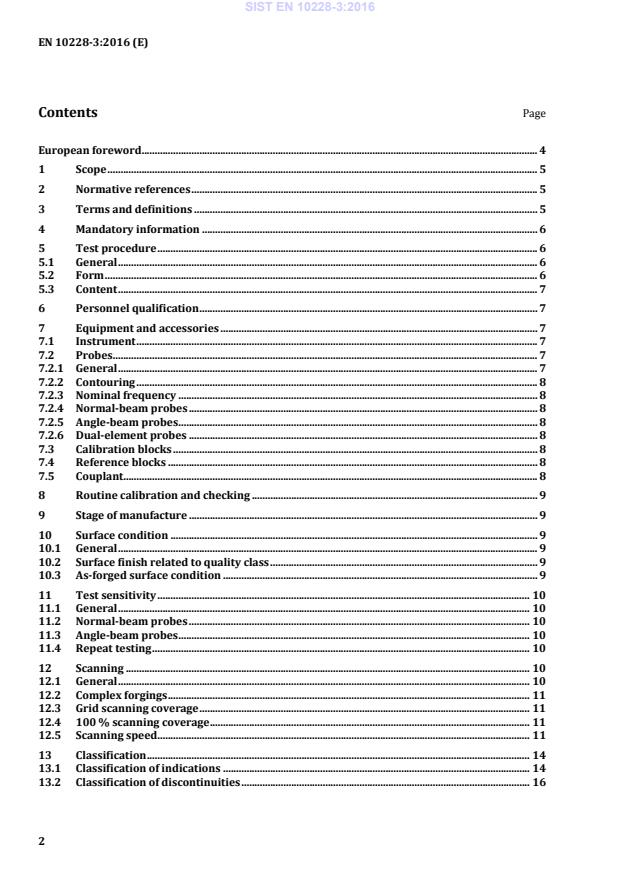
European foreword . 4 1 Scope . 5 2 Normative references . 5 3 Terms and definitions . 5 4 Mandatory information . 6 5 Test procedure . 6 5.1 General . 6 5.2 Form . 6 5.3 Content . 7 6 Personnel qualification . 7 7 Equipment and accessories . 7 7.1 Instrument . 7 7.2 Probes. 7 7.2.1 General . 7 7.2.2 Contouring . 8 7.2.3 Nominal frequency . 8 7.2.4 Normal-beam probes . 8 7.2.5 Angle-beam probes . 8 7.2.6 Dual-element probes . 8 7.3 Calibration blocks . 8 7.4 Reference blocks . 8 7.5 Couplant. 8 8 Routine calibration and checking . 9 9 Stage of manufacture . 9 10 Surface condition . 9 10.1 General . 9 10.2 Surface finish related to quality class . 9 10.3 As-forged surface condition . 9 11 Test sensitivity . 10 11.1 General . 10 11.2 Normal-beam probes . 10 11.3 Angle-beam probes . 10 11.4 Repeat testing . 10 12 Scanning . 10 12.1 General . 10 12.2 Complex forgings . 11 12.3 Grid scanning coverage . 11 12.4 100 % scanning coverage . 11 12.5 Scanning speed . 11 13 Classification . 14 13.1 Classification of indications . 14 13.2 Classification of discontinuities . 16 SIST EN 10228-3:2016
Maximum testable depth and corresponding beam path range for circumferential angle beam scans . 22 Annex B (informative)
Amplitude of indication in dB relative to % DAC . 23 Annex C (informative)
Significant technical changes to the version EN 10228-3:1998 . 24
...