

SIST EN 1999-1-3:2023/kprA1:2026
(Amendment)Eurocode 9 - Design of aluminium structures - Part 1-3: Structures susceptible to fatigue
- Abstract
1.1 Scope of EN 1999-1-3
(1) This document gives the basis for the design of aluminium alloy structures subject to fatigue in the ultimate limit state.
(2) This document gives rules for:
- safe life design;
- damage tolerant design;
- design assisted by testing.
(3) This document does not cover pressurized containment vessels or pipework.
1.2 Assumptions
(1) The general assumptions of EN 1990 apply.
(2) The provisions of EN 1999-1-1 apply.
(3) EN 1999-1-3 is intended to be used in conjunction with EN 1990, EN 1991 (all parts), relevant parts in EN 1992 to EN 1999, EN 1090-1 and EN 1090-3 for requirements for execution, and ENs, EADs and ETAs for construction products relevant to aluminium structures.
- Status
- Not Published
- Public Enquiry End Date
- 28-May-2026
- Technical Committee
- KON - Structures
- Current Stage
- 5020 - Formal vote (FV) (Adopted Project)
- Start Date
- 02-Nov-2026
- Due Date
- 21-Dec-2026

SIST EN 1999-1-3:2023/kprA1:2026 is the Slovenian adoption of a CEN draft amendment to Eurocode 9, Part 1-3, on aluminium structures susceptible to fatigue. It updates the rules used by engineers, designers and reviewers for fatigue design of aluminium alloy structures in the ultimate limit state, including safe life design, damage tolerant design and design assisted by testing. This amendment is prepared by CEN/TC 250 and is circulating for enquiry before it becomes part of the standard.
What does SIST EN 1999-1-3:2023/kprA1:2026 specify?
SIST EN 1999-1-3:2023/kprA1:2026 specifies the basis for designing aluminium alloy structures subject to fatigue. It focuses on how to verify fatigue performance, what design approaches may be used, and how this part of Eurocode 9 is meant to be used with the rest of the Eurocodes.
The scope covers:
- safe life design
- damage tolerant design
- design assisted by testing
The document excludes pressurized containment vessels and pipework. It also states that the general assumptions of EN 1990 apply, together with the provisions of EN 1999-1-1 and the other referenced Eurocodes, execution standards and product documents.
In practice, that means a designer must not use this part in isolation. Fatigue design is tied to the broader structural basis in EN 1990-1, the action rules in EN 1991, and the relevant aluminium design and execution standards.
What are the key requirements of SIST EN 1999-1-3:2026?
SIST EN 1999-1-3:2026 is mainly an amendment document, so its technical content is about updating existing design rules and references. The most important changes clarify how fatigue design is linked to the revised Eurocode framework and how reliability is to be achieved in service.
Fatigue design basis
The amended clause 4.2.1 requires fatigue design of aluminium structures to follow the general provisions in EN 1990-1, the loads given in clause 4.3, and the specific aluminium design provisions in the relevant parts of EN 1999. In practice, this ties fatigue checks to the same reliability framework used elsewhere in Eurocode design.
Safe life design (SLD)
The safe life design approach is described as one that should give a suitable level of reliability so that the structure performs for its design service life without routine inspection or monitoring for fatigue cracks. It is intended for cases where a crack in one component could quickly lead to failure. For the reader, this means details, materials and stress levels must be chosen conservatively enough that the structure can remain safe without depending on frequent crack detection.
Damage tolerant design (DTD)
The damage tolerant design approach is updated so that, by the end of each in-service inspection interval, the structure still meets the required reliability level. The amendment highlights three ways this can be achieved: slow crack growth and detectability, multiple load paths, or crack-arresting details. In practice, this is the route to follow when a structure can tolerate a crack for a period, but only if inspection and detail design are planned accordingly.
Fatigue loading and factors
Clause 4.3.1 now points fatigue loading to EN 1991 for loads covered there, and to other relevant European Standards for loads outside EN 1991. Clause 4.4 updates the notes on partial factors for fatigue loads to align with EN 1990-1. This matters because fatigue checks depend on the correct action model and factor format.
Detailed design data
Annex D is updated by replacing Figure D.1 on stress concentration factors for rounded corners in flat plate, and Annex E is updated by deleting wording in a note to 6. This means the amendment also affects detailed fatigue verification data, not only the main design clauses.
What terms does SIST EN 1999-1-3:2026 use?
- Safe life design (SLD) - A design approach that aims for the structure to remain safe for its design life without regular fatigue crack monitoring.
- Damage tolerant design (DTD) - A design approach that accepts the possibility of cracks, provided the structure can tolerate them until detection or arrest.
- Ultimate limit state (ULS) - The safety state used to check that the structure will not fail under the design actions.
- Fatigue loading - Repeated or fluctuating loading that can cause crack initiation and growth over time.
- Stress concentration factor - A factor that describes how local geometry, such as a corner or opening, increases stress.
- In-service inspection interval - The period between planned inspections used to support damage tolerant design.
Who uses SIST EN 1999-1-3:2026?
SIST EN 1999-1-3:2026 is used by structural engineers, detail designers, checking engineers, and organizations responsible for fatigue-sensitive aluminium structures. It is also relevant to fabricators and project teams that must align design, execution and inspection planning.
In practice, these users apply it when they need to:
- choose between safe life and damage tolerant design
- define fatigue loads and partial factors
- assess detail geometry and stress concentrations
- plan inspections where fatigue cracking must be managed
- coordinate design with EN 1990-1, EN 1991 and the relevant execution standards
What changed in SIST EN 1999-1-3:2026 from the previous edition?
This draft amendment modifies EN 1999-1-3:2023. The changes stated in the document include:
- replacement of references to EN 1990 with EN 1990-1
- replacement of references to EN 1999-1-1:2023 with EN 1999-1-1:2023+A1:2026
- replacement of references to EN 1999-1-4:2023 with EN 1999-1-4:2023+A1:2026
- updated Eurocode list in the introduction
- updated statement on direct use of EN 1999 with EN 1990-1 and the other Eurocodes
- updated scope wording in 1.1
- updated normative reference in Clause 2
- revised wording for safe life design and damage tolerant design
- updated source of fatigue loading in 4.3.1
- updated note references for fatigue load partial factors in 4.4
- replacement of Figure D.1
- deletion of note wording in E.2
Which standards are used with SIST EN 1999-1-3:2026?
SIST EN 1999-1-3:2026 is intended to be used with these documents:
- EN 1990-1:2023+A1:2026 - provides the basis of structural and geotechnical design for new structures.
- EN 1991 (all parts) - provides the actions on structures used for fatigue loading.
- Relevant parts of EN 1992 to EN 1999 - provide the companion design rules needed when aluminium design interfaces with other structural materials or Eurocode parts.
- EN 1090-1 - provides execution requirements linked to structural aluminium work.
- EN 1090-3 - provides execution requirements specifically relevant to aluminium structures.
- ENs, EADs and ETAs - provide product-related requirements for construction products used in aluminium structures.
What does the SIST EN 1999-1-3:2026 document contain?
SIST EN 1999-1-3:2026 contains a foreword, a contents list, and 11 modification items that update the parent standard EN 1999-1-3:2023. The amendment revises the introduction to the Eurocodes, the scope, the normative references, the fatigue design clauses, and selected annex material.
It also replaces Figure D.1 in Annex D, so the document includes updated graphical guidance for stress concentration factors in fatigue design. The amendments are meant to keep the document aligned with EN 1990-1 and the current Eurocode structure, while preserving the existing fatigue design framework.
Relations
- Effective Date
- 30-Jul-2025
Get Certified
Connect with accredited certification bodies for this standard

DIBt (Deutsches Institut für Bautechnik)
German Institute for Building Technology.

DIN CERTCO
DIN Group product certification.

Aboma Certification B.V.
Specialized in construction, metal, and transport sectors.
Sponsored listings
Frequently Asked Questions
SIST EN 1999-1-3:2023/kprA1:2026 is a draft published by the Slovenian Institute for Standardization (SIST). Its full title is "Eurocode 9 - Design of aluminium structures - Part 1-3: Structures susceptible to fatigue". This standard covers: 1.1 Scope of EN 1999-1-3 (1) This document gives the basis for the design of aluminium alloy structures subject to fatigue in the ultimate limit state. (2) This document gives rules for: - safe life design; - damage tolerant design; - design assisted by testing. (3) This document does not cover pressurized containment vessels or pipework. 1.2 Assumptions (1) The general assumptions of EN 1990 apply. (2) The provisions of EN 1999-1-1 apply. (3) EN 1999-1-3 is intended to be used in conjunction with EN 1990, EN 1991 (all parts), relevant parts in EN 1992 to EN 1999, EN 1090-1 and EN 1090-3 for requirements for execution, and ENs, EADs and ETAs for construction products relevant to aluminium structures.
1.1 Scope of EN 1999-1-3 (1) This document gives the basis for the design of aluminium alloy structures subject to fatigue in the ultimate limit state. (2) This document gives rules for: - safe life design; - damage tolerant design; - design assisted by testing. (3) This document does not cover pressurized containment vessels or pipework. 1.2 Assumptions (1) The general assumptions of EN 1990 apply. (2) The provisions of EN 1999-1-1 apply. (3) EN 1999-1-3 is intended to be used in conjunction with EN 1990, EN 1991 (all parts), relevant parts in EN 1992 to EN 1999, EN 1090-1 and EN 1090-3 for requirements for execution, and ENs, EADs and ETAs for construction products relevant to aluminium structures.
SIST EN 1999-1-3:2023/kprA1:2026 is classified under the following ICS (International Classification for Standards) categories: 91.010.30 - Technical aspects; 91.080.17 - Aluminium structures. The ICS classification helps identify the subject area and facilitates finding related standards.
SIST EN 1999-1-3:2023/kprA1:2026 has the following relationships with other standards: It is inter standard links to kSIST FprEN 1999-1-3:2022. Understanding these relationships helps ensure you are using the most current and applicable version of the standard.
SIST EN 1999-1-3:2023/kprA1:2026 is available in PDF format for immediate download after purchase. The document can be added to your cart and obtained through the secure checkout process. Digital delivery ensures instant access to the complete standard document.
Standards Content (Sample)
SLOVENSKI STANDARD
SIST EN 1999-1-3:2023/oprA1:2026
01-maj-2026
Evrokod 9 - Projektiranje konstrukcij iz aluminijevih zlitin - 1-3. del: Konstrukcije,
občutljive na utrujanje
Eurocode 9 - Design of aluminium structures - Part 1-3: Structures susceptible to fatigue
Eurocode 9 - Bemessung und Konstruktion von Aluminiumtragwerken - Teil 1-3:
Ermüdungsbeanspruchte Tragwerke
Eurocode 9 - Calcul des structures en aluminium - Partie 1-3 : Structures sensibles à la
fatigue
Ta slovenski standard je istoveten z: EN 1999-1-3:2023/prA1
ICS:
91.010.30 Tehnični vidiki Technical aspects
91.080.17 Aluminijaste konstrukcije Aluminium structures
SIST EN 1999-1-3:2023/oprA1:2026 en,fr,de
2003-01.Slovenski inštitut za standardizacijo. Razmnoževanje celote ali delov tega standarda ni dovoljeno.
SIST EN 1999-1-3:2023/oprA1:2026
SIST EN 1999-1-3:2023/oprA1:2026
DRAFT
EUROPEAN STANDARD
EN 1999-1-3:2023
NORME EUROPÉENNE
EUROPÄISCHE NORM
prA1
March 2026
ICS
English Version
Eurocode 9 - Design of aluminium structures - Part 1-3:
Structures susceptible to fatigue
Eurocode 9 - Calcul des structures en aluminium - Eurocode 9 - Bemessung und Konstruktion von
Partie 1-3 : Structures sensibles à la fatigue Aluminiumtragwerken - Teil 1-3:
Ermüdungsbeanspruchte Tragwerke
This draft amendment is submitted to CEN members for enquiry. It has been drawn up by the Technical Committee CEN/TC 250.
This draft amendment A1, if approved, will modify the European Standard EN 1999-1-3:2023. If this draft becomes an
amendment, CEN members are bound to comply with the CEN/CENELEC Internal Regulations which stipulate the conditions for
inclusion of this amendment into the relevant national standard without any alteration.
This draft amendment was established by CEN in three official versions (English, French, German). A version in any other
language made by translation under the responsibility of a CEN member into its own language and notified to the CEN-CENELEC
Management Centre has the same status as the official versions.
CEN members are the national standards bodies of Austria, Belgium, Bulgaria, Croatia, Cyprus, Czech Republic, Denmark, Estonia,
Finland, France, Germany, Greece, Hungary, Iceland, Ireland, Italy, Latvia, Lithuania, Luxembourg, Malta, Netherlands, Norway,
Poland, Portugal, Republic of North Macedonia, Romania, Serbia, Slovakia, Slovenia, Spain, Sweden, Switzerland, Türkiye and
United Kingdom.
Recipients of this draft are invited to submit, with their comments, notification of any relevant patent rights of which they are
aware and to provide supporting documentation.
Warning : This document is not a European Standard. It is distributed for review and comments. It is subject to change without
notice and shall not be referred to as a European Standard.
EUROPEAN COMMITTEE FOR STANDARDIZATION
COMITÉ EUROPÉEN DE NORMALISATION
EUROPÄISCHES KOMITEE FÜR NORMUNG
CEN-CENELEC Management Centre: Rue de la Science 23, B-1040 Brussels
© 2026 CEN All rights of exploitation in any form and by any means reserved Ref. No. EN 1999-1-3:2023/prA1:2026 E
worldwide for CEN national Members.
SIST EN 1999-1-3:2023/oprA1:2026
EN 1999-1-3:2023/prA1:2026 (E)
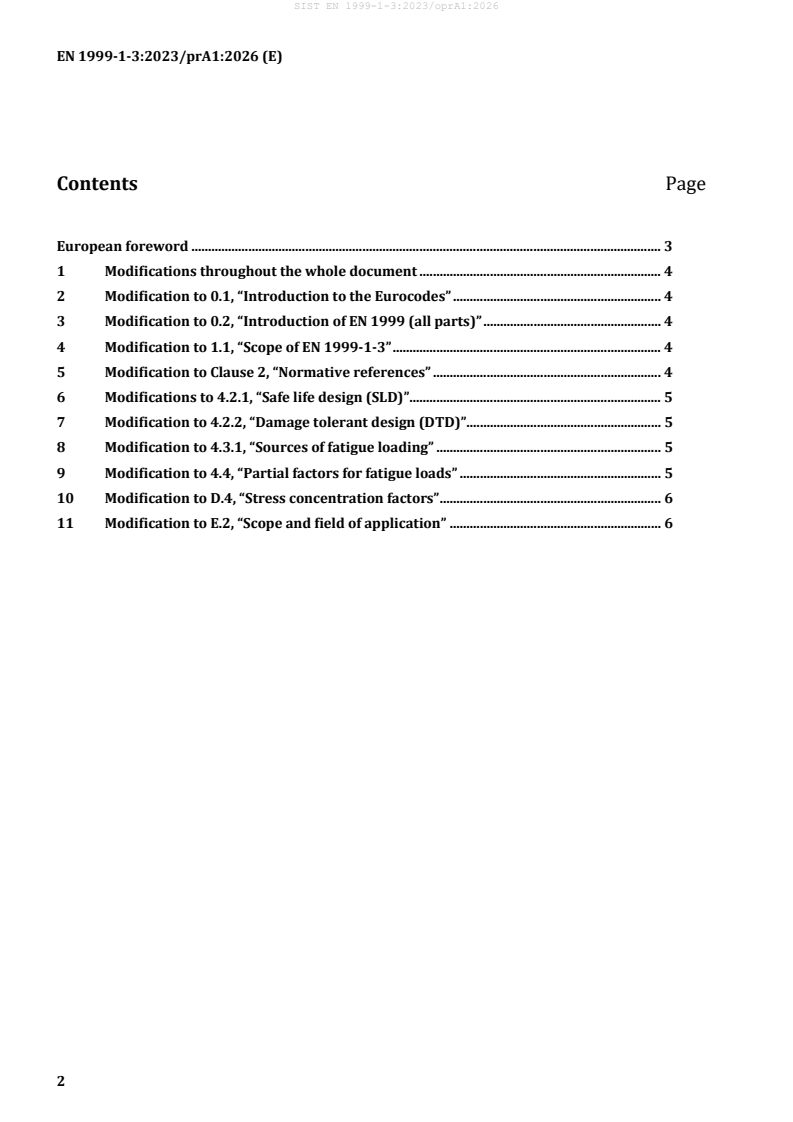
Contents Page
European foreword . 3
1 Modifications throughout the whole document . 4
2 Modification to 0.1, “Introduction to the Eurocodes” . 4
3 Modification to 0.2, “Introduction of EN 1999 (all parts)” . 4
4 Modification to 1.1, “Scope of EN 1999-1-3” . 4
5 Modification to Clause 2, “Normative references” . 4
6 Modifications to 4.2.1, “Safe life design (SLD)”. 5
7 Modification to 4.2.2, “Damage tolerant design (DTD)”. 5
8 Modification to 4.3.1, “Sources of fatigue loading” . 5
9 Modification to 4.4, “Partial factors for fatigue loads” . 5
10 Modification to D.4, “Stress concentration factors” . 6
11 Modification to E.2, “Scope and field of application” . 6
SIST EN 1999-1-3:2023/oprA1:2026
EN 1999-1-3:2023/prA1:2026 (E)
European foreword
This document (EN 1999-1-3:2023/prA1:2026) has been prepared by Technical Committee CEN/TC 250
“Structural Eurocodes”, the secretariat of which is held by BSI. CEN/TC 250 is responsible for all
Structural Eurocodes and has been assigned responsibility for structural and geotechnical design matters
by CEN.
This document is currently submitted to the CEN Enquiry.
The first generation of EN Eurocodes was published between 2002 and 2007. This document forms part
of the second generation of the Eurocodes, which have been prepared under Mandate M/515 i
...