


SIST EN 1337-3:2005
(Main)Structural bearings - Part 3: Elastomeric bearings
Structural bearings - Part 3: Elastomeric bearings
This part of EN 1337 applies to elastomeric bearings with or without complementary bearing devices to extend their field of use such as flat sliding elements covered by EN 1337-2 or sliding surface described in 4.4.4, as used in bridge structures or any other structure with comparable support conditions.
This part of EN 1337 applies to elastomeric bearings with dimensions in plan up to (1200 x 1200) mm and does not cover elastomeric bearings made with other elastomers materials than those specified in 4.4.1. It applies to laminated bearings types A, B, C, laminated sliding bearings types E and D, plain pad and strip bearings type F.
This part deals with bearings for use in operating temperatures ranging from - 25 °C to + 50 °C and for short periods up to + 70 °C.
It is recognised that the air temperature in some regions of Northern Europe is lower than -25 °C.
In this case of very low operating temperature (down to - 40 °C), it is essential that bearing characteristics comply also with the shear modulus at very low temperature (see 4.3.1.3. and annex F)
Lager im Bauwesen - Teil 3: Elastomerlager
Dieser Teil von EN 1337 gilt für Elastomerlager mit oder ohne zusätzliche Vorrichtungen zur Erweiterung des Anwendungsgebietes der Lager, wie z.B. flache Gleitteile nach EN 1337-2 oder Gleitflächen nach 4.4.4, zur Verwendung im Brückenbau oder in Bauwerken mit vergleichbaren Auflagerbedingungen.
Dieser Teil von EN 1337 gilt für Elastomerlager mit einer Grundfläche bis (1200 x 1200) mm aus den unter 4.4.1 festgelegten Elastomeren. Er gilt für bewehrte Lager vom Typ A, B und C, bewehrte Lager vom Typ E und D sowie für Streifenlager vom Typ F.
Dieser Teil der Norm regelt die Anwendung in einem Temperaturbereich von -25 °C bis +50 °C, kurzzeitig bis +70 °C.
Es ist bekannt, dass in einigen Regionen Nordeuropas die Lufttemperatur niedriger als
-25 °C ist.
Im Falle der Anwendung bei sehr niedrigen Temperaturen (bis -40°C) müssen die Eigenschaften der Lager unbedingt ebenfalls dem Schubmodul bei sehr niedrigen Temperaturen (4.3.1.3 und Anhang F) entsprechen.
Appareils d'appui structuraux - Partie 3: Appareils d'appui en élastomere
La présente partie de l'EN 1337 s'applique aux appareils d'appui en élastomère avec ou sans dispositifs d'appui complémentaires pour étendre leur domaine d'utilisation, tels que les éléments plans de glissement couverts par l'EN 1337-2 ou les surfaces de glissement décrites en 4.4.4, comme utilisées dans des structures de pont ou dans toute autre structure présentant des conditions d'appui comparables.
La présente partie de l'EN 1337 s'applique aux appareils d'appui en élastomère dont les dimensions dans le plan sont inférieures à (1200 x 1200) mm et ne couvre pas les appareils d'appui en élastomère à base d'élastomères autres que ceux qui sont indiqués en 4.4.1. Elle s'applique aux appareils d'appui frettés des types A, B, C, aux appareils d'appui glissants frettés des types E et D, aux appareils d'appui non frettés et en bande du type F.
La présente partie traite des appareils d'appui à utiliser dans une plage de températures de service allant de - 25 °C à + 50 °C et pendant de courtes périodes jusqu'à + 70 °C.
Il est admis que la température de l'air dans certaines régions d'Europe du Nord est inférieure à - 25 °C.
Dans le cas de températures de service très basses (jusqu'à - 40 °C), il est essentiel que les caractéristiques de ces appareils d'appui soient également conformes au module de cisaillement à très basses températures (voir 4.3.1.3. et Annexe F).
Konstrukcijska ležišča – 3. del: Elastomerna ležišča
General Information
- Status
- Published
- Publication Date
- 31-May-2005
- Technical Committee
- BBB - Concrete, reinforced concrete and prestressed concrete
- Current Stage
- 6060 - National Implementation/Publication (Adopted Project)
- Start Date
- 01-Jun-2005
- Due Date
- 01-Jun-2005
- Completion Date
- 01-Jun-2005
- Directive
- 89/106/EEC - Construction products
Relations
- Effective Date
- 18-Jan-2023
- Effective Date
- 01-Mar-2018
Overview
EN 1337-3:2005 - Structural bearings, Part 3: Elastomeric bearings (CEN) specifies requirements, design rules and test methods for elastomeric bearings used in bridge structures and other structures with comparable support conditions. The standard covers laminated bearings (types A, B, C), laminated sliding bearings (types D, E) and plain pad/strip bearings (type F) with plan dimensions up to 1200 × 1200 mm. It addresses materials, performance limits and manufacturing, and is applicable for operating temperatures from −25 °C to +50 °C (short periods up to +70 °C); special provisions apply for very low temperatures down to −40 °C (see Annex F).
Key topics and technical requirements
- Material and performance requirements
- Specified elastomer materials and physical/mechanical properties (see Clause 4.4.1).
- Steel reinforcing plates and sliding surfaces requirements.
- Mechanical performance
- Shear modulus and shear bond strength requirements (Clause 4.3; Annexes F, G, M).
- Compression stiffness and resistance to repeated compression (Annexes H, I).
- Static rotation capability, restoring moment and eccentric loading tests (Annexes J, K).
- Durability
- Ozone resistance and ageing tests (Clause 4.3.6; Annex L).
- Limits for short-term elevated temperatures and low-temperature shear properties.
- Design and geometry
- Design rules for laminated, plain pad and strip bearings including sizes, shear strain and stability criteria (Clause 5).
- Manufacturing tolerances for plan size, layer thickness, edge cover and reinforcing plates (Clause 6).
- Quality assurance
- Conformity assessment, factory production control and sampling, plus criteria for in-service inspection (Clause 8 and 9; Annex N).
Applications
- Primary use: bridge bearings-supporting superstructure loads, accommodating movements and rotations.
- Other uses: any structural support with comparable support conditions (buildings, elevated decks, precast structures).
- Typical applications: selection and design of laminated elastomeric bearings for new bridges, replacement bearings during refurbishment, specification for bridge contractors and bearing manufacturers.
Who uses this standard
- Structural and bridge engineers (design and specification)
- Bearing manufacturers and material suppliers
- Testing laboratories and certification bodies
- Contractors and maintenance teams responsible for installation, inspection and replacement
Related standards
- EN 1337-1 (General design rules), EN 1337-2 (Sliding elements), EN 1337-4 to EN 1337-11 (other bearing types, protection, inspection, installation)
- Referenced material/test standards (ISO series cited in Clauses and Annexes)
Keywords: EN 1337-3:2005, elastomeric bearings, structural bearings, bridge bearings, laminated bearings, shear modulus, bearing design, CEN standard.

Frequently Asked Questions
SIST EN 1337-3:2005 is a standard published by the Slovenian Institute for Standardization (SIST). Its full title is "Structural bearings - Part 3: Elastomeric bearings". This standard covers: This part of EN 1337 applies to elastomeric bearings with or without complementary bearing devices to extend their field of use such as flat sliding elements covered by EN 1337-2 or sliding surface described in 4.4.4, as used in bridge structures or any other structure with comparable support conditions. This part of EN 1337 applies to elastomeric bearings with dimensions in plan up to (1200 x 1200) mm and does not cover elastomeric bearings made with other elastomers materials than those specified in 4.4.1. It applies to laminated bearings types A, B, C, laminated sliding bearings types E and D, plain pad and strip bearings type F. This part deals with bearings for use in operating temperatures ranging from - 25 °C to + 50 °C and for short periods up to + 70 °C. It is recognised that the air temperature in some regions of Northern Europe is lower than -25 °C. In this case of very low operating temperature (down to - 40 °C), it is essential that bearing characteristics comply also with the shear modulus at very low temperature (see 4.3.1.3. and annex F)
This part of EN 1337 applies to elastomeric bearings with or without complementary bearing devices to extend their field of use such as flat sliding elements covered by EN 1337-2 or sliding surface described in 4.4.4, as used in bridge structures or any other structure with comparable support conditions. This part of EN 1337 applies to elastomeric bearings with dimensions in plan up to (1200 x 1200) mm and does not cover elastomeric bearings made with other elastomers materials than those specified in 4.4.1. It applies to laminated bearings types A, B, C, laminated sliding bearings types E and D, plain pad and strip bearings type F. This part deals with bearings for use in operating temperatures ranging from - 25 °C to + 50 °C and for short periods up to + 70 °C. It is recognised that the air temperature in some regions of Northern Europe is lower than -25 °C. In this case of very low operating temperature (down to - 40 °C), it is essential that bearing characteristics comply also with the shear modulus at very low temperature (see 4.3.1.3. and annex F)
SIST EN 1337-3:2005 is classified under the following ICS (International Classification for Standards) categories: 91.010.30 - Technical aspects. The ICS classification helps identify the subject area and facilitates finding related standards.
SIST EN 1337-3:2005 has the following relationships with other standards: It is inter standard links to oSIST prEN 1337-3:2018, oSIST prEN 1337-3:2018. Understanding these relationships helps ensure you are using the most current and applicable version of the standard.
SIST EN 1337-3:2005 is associated with the following European legislation: EU Directives/Regulations: 305/2011, 89/106/EEC, EUR-PUB; Standardization Mandates: M/104. When a standard is cited in the Official Journal of the European Union, products manufactured in conformity with it benefit from a presumption of conformity with the essential requirements of the corresponding EU directive or regulation.
SIST EN 1337-3:2005 is available in PDF format for immediate download after purchase. The document can be added to your cart and obtained through the secure checkout process. Digital delivery ensures instant access to the complete standard document.
Standards Content (Sample)
2003-01.Slovenski inštitut za standardizacijo. Razmnoževanje celote ali delov tega standarda ni dovoljeno.Structural bearings - Part 3: Elastomeric bearingsAppareils d'appui structuraux - Partie 3: Appareils d'appui en élastomereLager im Bauwesen - Teil 3: Elastomerlager91.010.30Technical aspectsICS:SIST EN 1337-3:2005enTa slovenski standard je istoveten z:EN 1337-3:200501-junij-2005SIST EN 1337-3:2005SLOVENSKI
STANDARD
EUROPEAN STANDARDNORME EUROPÉENNEEUROPÄISCHE NORMEN 1337-3March 2005ICS 91.010.30English versionStructural bearings - Part 3: Elastomeric bearingsAppareils d'appui structuraux - Partie 3: Appareils d'appuien élastomèreLager im Bauwesen - Teil 3: ElastomerlagerThis European Standard was approved by CEN on 4 June 2004.CEN members are bound to comply with the CEN/CENELEC Internal Regulations which stipulate the conditions for giving this EuropeanStandard the status of a national standard without any alteration. Up-to-date lists and bibliographical references concerning such nationalstandards may be obtained on application to the Central Secretariat or to any CEN member.This European Standard exists in three official versions (English, French, German). A version in any other language made by translationunder the responsibility of a CEN member into its own language and notified to the Central Secretariat has the same status as the officialversions.CEN members are the national standards bodies of Austria, Belgium, Cyprus, Czech Republic, Denmark, Estonia, Finland, France,Germany, Greece, Hungary, Iceland, Ireland, Italy, Latvia, Lithuania, Luxembourg, Malta, Netherlands, Norway, Poland, Portugal, Slovakia,Slovenia, Spain, Sweden, Switzerland and United Kingdom.EUROPEAN COMMITTEE FOR STANDARDIZATIONCOMITÉ EUROPÉEN DE NORMALISATIONEUROPÄISCHES KOMITEE FÜR NORMUNGManagement Centre: rue de Stassart, 36
B-1050 Brussels© 2005 CENAll rights of exploitation in any form and by any means reservedworldwide for CEN national Members.Ref. No. EN 1337-3:2005: E
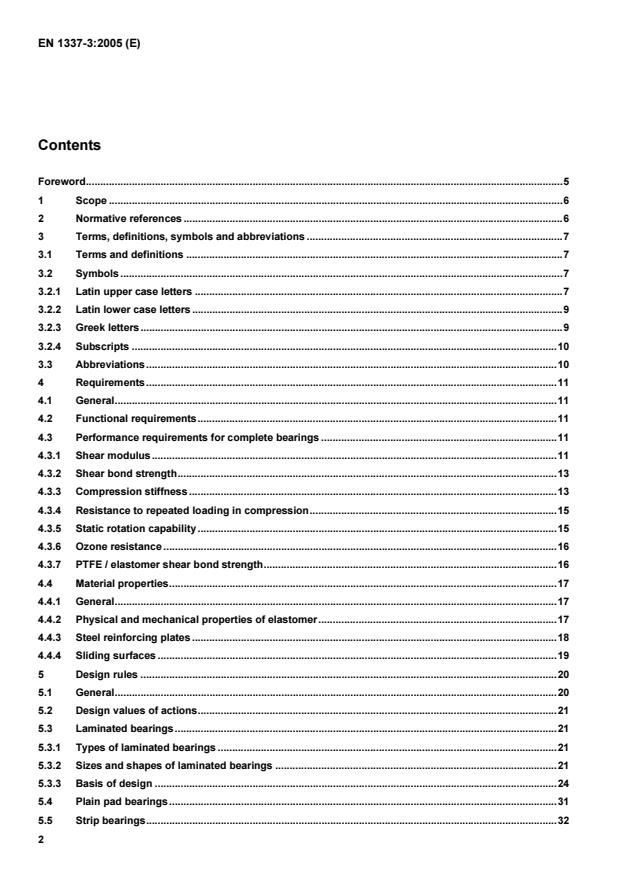
Elliptical bearings.42 Annex B (normative)
Rotational limitation factor.43 Annex C (normative)
Maximum design strain in laminated bearings.44 Annex D (informative)
Shear modulus comments.45 Annex E (informative)
Typical bearing schedule.46 Annex F (normative)
Shear modulus test method.49 Annex G (normative)
Shear bond test method.53
Compression test method.57 Annex I (normative)
Repeated Loading Compression Test Method.61 Annex J (normative)
Eccentric loading test method.64 Annex K (normative)
Restoring Moment Test Method.68 Annex L (normative)
Resistance to ozone test method.71 Annex M (normative)
Shear bond test method for PTFE/elastomer interface.76 Annex N (normative)
Factory production control.80 Annex ZA (informative) Clauses of this European Standard addressing the provisions of the EU Construction Products Directive.83 Bibliography.94
General design rules Part 2
Sliding elements Part 3
Elastomeric bearings Part 4
Roller bearings Part 5
Pot bearings Part 6
Rocker bearings Part 7
Spherical and cylindrical PTFE bearings Part 8
Guide bearings and restrain bearings
Part 9
Protection Part 10 Inspection and maintenance
Part 11
Transport, storage, and installation According to the CEN/CENELEC Internal Regulations, the national standards organizations of the following countries are bound to implement this European Standard: Austria, Belgium, Cyprus, Czech Republic, Denmark, Estonia, Finland, France, Germany, Greece, Hungary, Iceland, Ireland, Italy, Latvia, Lithuania, Luxembourg, Malta, Netherlands, Norway, Poland, Portugal, Slovakia, Slovenia, Spain, Sweden, Switzerland and United Kingdom.
EN 1337-1:2000, Structural bearings - Part 1: General design rules. EN 1337-2:2004, Structural bearings - Part 2: Sliding elements. prEN 1337-8, Structural bearings - Part 8: Guide bearings and restrain bearings. EN 1337-9:1997, Structural bearings - Part 9: Protection. EN 1337-10; Structural Bearings - Part 10: Inspection and maintenance. EN 1337-11; Structural bearings - Part 11: Transport, storage and installation. EN 10025-1, Hot rolled products of structural steels - Part 1: General technical delivery conditions. EN 10025-2, Hot rolled products of structural steels - Part 2: Technical delivery conditions for non-alloy structural steels ISO 34-1, Rubber, vulcanized or thermoplastic - Determination of tear strength - Part 1: Trouser, angle
and crescent test pieces. ISO 37, Rubber, vulcanized or thermoplastic - Determination of tensile stress-strain properties. ISO 48, Rubber, vulcanized or thermoplastic - Determination of hardness (hardness between 10 IRHD
and 100 IRHD). ISO 188, Rubber, vulcanized or thermoplastic - Accelerated ageing and heat resistance tests. ISO 815, Rubber, vulcanized or thermoplastic - Determination of compression set at ambient, elevated or low temperatures. ISO 1431-1, Rubber, vulcanized or thermoplastic - Resistance to ozone cracking - Part 1: Static strain testing.
Stress correction factor for the steel reinforcing plates Kr Rotation factor Ks Factor for restoring moment Me Experimental value of restoring moment.N x mm: kN x m
Md Design value of restoring moment.N x mm: kN x m
Rd Design value of resistance
forces or moments To Average total initial thickness of bearing ignoring top and bottom covers.mm
Tb Total nominal thickness of bearing.mm
Tbo Mean total initial thickness of bearing.mm
Te Total nominal thickness of elastomer.mm
Tq
The average total initial thickness of elastomer in shear, including the top and bottom
covers when these are not restrained for shearing.mm
3.2.2 Latin lower case letters a Overall width of bearing (shorter dimension of rectangular bearing).mm ae Minor axis of elliptic bearing a' Effective width of laminated bearing (width of the steel reinforcing plates).mm b Overall length of a bearing (longer dimension of a rectangular bearing).mm be Major axis of elliptical bearing b' Effective length of a laminated bearing (length of the steel reinforcing plates).mm c compression stiffness.N/mm fy Yield stress of steel.N/mm² lp Force free perimeter of elastomeric bearing n Number of elastomer layers t Thickness of plain pad or strip bearing.mm te Effective thickness of elastomer in compression.mm ti Thickness of an individual elastomer layer in a laminated bearing.mm tp Thickness of PTFE sheet.mm ts Thickness of steel reinforcing plate.mm tso Thickness of outer steel reinforcing plate.mm vcd Total vertical deflection.mm vx Maximum horizontal relative displacement in direction of dimension a.mm vy Maximum horizontal relative displacement in direction of dimension b.mm vz Vertical movement/deflection.mm vxy Maximum resultant horizontal relative displacement obtained by vectorial addition
of vx and vy .mm 3.2.3 Greek letters α Angular rotation of a bearing.rad
- part 9 Protection - part 10 Inspection and maintenance - part 11 Transport, storage, and installation 4.2 Functional requirements Elastomeric bearings shall be designed and manufactured to accommodate translational movements in any direction and rotational movements about any axis by elastic deformation, in order to transmit in a correct manner, from one structural component to another, the design forces and accommodate the design movements derived from the structural analysis. They can be combined with complementary bearing devices to extend their field of use, such as a sliding system, either temporary or permanent, or a constraining system in any direction. Elastomeric bearings shall function correctly when they are subject to normal environmental conditions and maintenance, during an economically reasonable designed working life. Where exceptional environmental and application conditions are encountered additional precautions shall be taken (see EN 1337-9). The conditions shall then be precisely defined. Although elastomeric bearings are designed to accommodate shear movements, they shall not be used to provide permanent resistance to a constantly applied external shear force. 4.3 Performance requirements for complete bearings This section defines all quantifiable characteristics of complete bearings. It specifies also the type of test either type test or routine test, their frequency and the type of the samples (see clause 8). NOTE
The laboratory temperature range for testing has been enlarged from that normally specified, taking into account that the properties of elastomers suitable for bearings do not change significantly between 15 °C and 30 °C. In the event of a conflict between test results from two different laboratories the range 23 °C ± 2 °C should take precedence. 4.3.1 Shear modulus The shear modulus (Gg) is the apparent "conventional shear modulus" of elastomeric bearings determined by testing at different temperatures or after ageing in accordance with the method specified in annex F (normative). NOTE See informative annex D.
Gg * = 0,7 MPa Gg = 0,9 MPa Gg * = 1,15 MPa *Only if specified by the structure designer. The test shall be performed for type tests at a temperature of 23 °C ± 2 °C, and for routine test at a temperature of 23 °C ± 5 °C. - Requirements: The value of shear modulus Gg obtained by test shall comply with the following tolerances: Gg
= 0,9 MPa ± 0,15 MPa
Gg* = 0,7 MPa ± 0,10 MPa
Gg* = 1,15 MPa ± 0,20 MPa *Only if specified by the structure designer. The sample surfaces shall be free from voids, cracks or faults for example arising from moulding or bonding defects. - Testing conditions: The tests shall be performed not earlier than one day after vulcanisation. 4.3.1.2 Shear modulus at low temperature At low temperature the conventional shear modulus shall comply with the following requirement: Gg low temperature ≤ 3 Gg The test shall be performed as a type test. - Samples conditioning:
The uncompressed bearing shall be air-cooled in a chamber at
-25 °C ± 2 °C for 7 days.
- It shall be supported in such a way as to allow free circulation of air around it. - Testing conditions: - In a chamber at –25 °C + 2 °C or
- At a maximum temperature of 25 °C provided that, during the test, the edge surface
temperature shall not be higher than –18 °C.
- Mean pressure: 6 MPa. 4.3.1.3 Shear modulus at very low temperature At very low temperature the conventional shear modulus shall comply with the following requirement: Gg very low temperature ≤ 3 Gg The test shall be performed as a type test.
The uncompressed bearing shall be air-cooled in a chamber at –40 °C + 3 °C for 7 days.
- It shall be supported in such a way as to allow free circulation of air around it. - Testing conditions: - In a chamber at –40 °C + 3 °C or
- At a maximum temperature of 25 °C provided that, during the test, the edge
surface temperature shall not be higher than –18 °C.
- Mean pressure : 6 MPa. 4.3.1.4 Shear modulus after ageing (3 days at 70 °C) This test determines the variation of conventional shear modulus after accelerated ageing and shall be performed as a type test. Gg after ageing ≤ Gg before ageing + 0,15 MPa - Conditioning of the samples : the uncompressed bearing shall be stored in a heated chamber at :
70 °C ± 2 °C
for 3 days
- It shall be supported in such a way as to allow free circulation of air around it. - Testing conditions: The test shall be performed at laboratory temperature (23 °C ± 5 °C), not earlier than 2 days after the end of the ageing procedure. 4.3.2 Shear bond strength The shear bond strength of elastomeric bearings shall determined in accordance with the method specified in annex G. 4.3.2.1 Shear bond strength at ambient temperature At a temperature of 23 °C + 5 °C the shear bond test shall be performed as a type and a routine test. - Requirements : The slope of the force-deflection curve shall not show a maximum or a minimum value up to the maximum shear strain of 2. At maximum strain the edge of the bearing shall be free from splitting within the rubber due to moulding or bonding defects. - Testing conditions : Mean pressure : 12 MPa 4.3.2.2 Shear bond strength after ageing (3 days at 70 °C) After ageing the shear bond test shall be performed as a type test. - Requirements:
as in 4.3.2.1. - Conditioning of the samples and testing conditions:
as in 4.3.1.4. 4.3.3 Compression stiffness The compression stiffness of elastomeric bearings shall be determined in accordance with the method specified in annex H.
- The slope of the force-deflection curve shall not show a maximum or a minimum value of up to the maximum design load (5.G A’ S / 1,5)
- At the maximum load the edge of the bearing shall be free from splits within the rubber for example due to moulding or bonding defects.
- No misplaced reinforcing plates.
-The conventional intersecting modulus (Ecs) shall be recorded. - Testing conditions : At ambient temperature: Conventional intersecting modulus (Ecs) shall be determined at 23 °C ± 5 °C between 30 % and 100 % of the maximum load (5.GA’.S / 1,5). 4.3.3.2 Routine test : Quick compressive test (level 2 of the testing method) This test is normally made on bearings by the manufacturer, to check for misplaced reinforcing plates, bond failures at the steel/elastomer interface, surface defects and out of tolerance stiffness under the maximum load for the application. - Requirements:
There shall be no visual evidence of bond failure, misaligned reinforcing plates, or splits in the surface of the elastomer. The corrugations due to the restraining effects of the plates shall be uniform.
- Testing conditions: The serviceability limit state load specified, at ambient temperature (23 °C ± 5 °C) is applied to the bearing and held constant during a visual examination for the above defects. Where defects are suspected they shall be proved by other appropriate tests.
During this test, the deflection between 30 % and 100 % of the maximum load for the application shall be recorded and used to check the consistency of the stiffness values.
4.3.3.3 Inspection under compressive load (level 3 of the testing method) When specified, this test is carried out on every bearing as part of the normal production process. Its main objective is to eliminate by visual inspection poorly made bearings in a quick and efficient way. - Requirements:
There shall be no visual evidence of bond failure, misaligned reinforcing plates, or defects developing during testing in the surface of the elastomer under the maximum load for the application. The corrugations due to the restraining effects of the plates shall be uniform. - Testing conditions: The serviceability limit state load is applied. The temperature of the room in which the bearings are tested shall not vary more than 10 °C throughout the test.
The resistance to repeated loading in compression of elastomeric bearings shall be determined in accordance with the method specified in annex I. - Requirements: The intersecting compression modulus after dynamic fatigue shall be less than or equal to the intersecting modulus prior to dynamic fatigue + 12 %.
No faults accepted: bonding defects, cracks, etc. - Testing conditions: At laboratory temperature 23 °C ± 2 °C. The temperature rise in the bearing during the test should not exceed: 42 °C and the frequency may be adjusted to achieve this requirement.
Numbers of cycles: 2 000 000
Frequency: < 3 Hz
During the test, the variation of stress shall be between the two following values:
Minimum mean pressure: 7,5 MPa
Maximum mean pressure: 25 MPa NOTE It is essential to carry out the test at higher stresses than those which occur in practice, because the number of cycles is much less than expected during the life of bearing. 4.3.5 Static rotation capability 4.3.5.1 General The static rotation capability of elastomeric bearings shall be determined on the base of the eccentric loading test and/or restoring moment, in accordance with test methods indicated in the following clauses. The purpose of these tests is to determine the performance of elastomeric bearings under static rotation conditions. For most purposes the static rotation behaviour calculated from the equation in 5.3.3.6 and 5.3.3.7 is adequate, but if rotational performance is critical and the main reason for using the bearing is to provide rotation for elastomeric bearing type E and D a type test shall be carried out. Two aspects of rotational performance may be assessed, the maximum angle of rotation and the restoring moment exerted by the bearing on the structure. These two aspects can be determined respectively by the eccentric loading test or restoring moment test. NOTE For a given bearing construction the manufacturer can only change the value of the shear modulus of the rubber to influence the rotational performance so it may be necessary to waive the requirements of 4.3.1
to achieve the desired performance. The consequence of such a change is that the vertical deflection (5.3.3.7.) will be affected. 4.3.5.2 Eccentric loading test This test shall be performed to verify the maximum angle of rotation by determination of the area and mean pressure at the contact surface under imposed eccentricity or by determination of the maximum eccentricity to produce a specified contact area. It shall be determined in accordance with the method specified in annex J. - Requirements: Neither the uplift contact area, nor the mean contact pressure, shall exceed the values specified.
When no value has been specified the following requirement shall be satisfied:
The ozone resistance of elastomeric bearings shall be determined in accordance with the method specified in annex L. The purpose of this test is to determine the ozone resistance of a complete bearing under compression and shear deformation. - Requirements: No cracks in rubber.
No cracks or bonding failure on the edge surface of the bearing. - Testing conditions: Mean pressure: 1,3 G.S
Shear deformation:
vx = 0,7 . Tq
Testing temperature:
40 °C ± 2 °C
Ozone concentration:
NR : 25 pphm
CR : 50 pphm
Testing time:
72 h 4.3.7 PTFE / elastomer shear bond strength The PTFE/elastomer shear bond strength of elastomeric bearings shall be determined in accordance with the method specified in annex M. The purpose of this test is to verify the correct bonding of the PTFE sheet of the sliding surface onto the external elastomer layer. - Requirements: The slope of the force-deflection curve shall not show a maximum or a minimum value up to the maximum shear strain of 2. At maximum strain the PTFE / elastomer interfaces shall be free from bonding defects. - Testing conditions: This test shall be performed at a temperature of 23 °C + 5 °C.
Mean pressure: 6 MPa 4.4 Material properties 4.4.1 General The elastomer used in the manufacture of Elastomeric Bearings should be specified in the project documentation as either natural rubber (NR) or chloroprene rubber (CR) as the raw polymer. Blending with up to 5 % of another polymer, which may be added to aid processing, is permitted. No reclaimed or ground vulcanised rubber shall be used. NOTE Natural rubber bearings can be protected by a cover of polychloroprene, both parts being vulcanised simultaneously. 4.4.2 Physical and mechanical properties of elastomer The physical and mechanical properties of the elastomer shall comply with the requirements given in Table 1, depending upon the raw polymer used. In case of a natural rubber bearing having a polychloroprene cover, the natural rubber does not have to be tested for ozone resistance. The polychloroprene compound for the cover shall meet the requirements for polychloroprene and the core shall meet the requirements for NR, except for ozone resistance. The frequency of the tests is given in clause 8. The specifications are given for moulded test pieces or samples taken from complete finished bearings. In this case they shall be taken from the top and bottom surfaces or first internal layer, and from the internal layer at the centre of the bearing.
Table 1 — Physical and mechanical properties of elastomer
Characteristics
Requirements
Test methods G Modulus (MPa) 0,7 0,9a 1,15
Tensile strength (MPa) Moulded Test Piece Test Piece from Bearing
≥ 16 ≥ 14
≥≥≥≥ 16 ≥≥≥≥ 14
≥ 16 ≥ 14
ISO 37
type 2 Minimum Elongation at break
...
Questions, Comments and Discussion
Ask us and Technical Secretary will try to provide an answer. You can facilitate discussion about the standard in here.
Loading comments...