


SIST EN 15056:2026
(Main)Cranes - Requirements for container handling spreaders
General Information
- Abstract
This document specifies safety requirements for spreaders used with cranes designed for the purpose of handling freight containers, e.g. those based on ISO 668:2020. The connection between the spreader and the container is by the use of twistlocks that engage into the container’s upper corner castings.
This document deals with all significant hazards, hazardous situations or hazardous events relevant to container handling spreaders, when it is used as intended and under conditions of misuse which are reasonably foreseeable by the manufacturer.
The spreader is interfaced to the crane’s control and safety system.
This document does not cover the following types of spreaders:
- hand operated spreaders (without external power supply);
- bottom lift grapple spreaders used for swap bodies and road trailers.
This document does not deal with the lifting of persons.
This document is not applicable to container handling spreaders manufactured before the date of its publication.
- Status
- Published
- Public Enquiry End Date
- 11-May-2025
- Publication Date
- 13-Sep-2026
- Technical Committee
- DTN - Lift and transport appliances
- Current Stage
- 6060 - National Implementation/Publication (Adopted Project)
- Start Date
- 08-Jun-2026
- Due Date
- 13-Aug-2026
- Completion Date
- 14-Sep-2026


Overview
SIST EN 15056:2026 - Cranes: Requirements for Container Handling Spreaders establishes essential safety requirements for spreaders used with cranes in handling freight containers. Developed by the Slovenski inštitut za standardizacijo (SIST), this European standard addresses significant hazards and operational risks associated with container handling spreaders, focusing on those integrated with crane systems and interfacing through twistlocks to container corner castings, as specified in ISO 668:2020.
The standard applies to all powered container handling spreaders intended for lifting freight containers, ensuring safety during intended use and reasonably foreseeable misuse. It does not cover hand-operated spreaders, bottom lift grapple spreaders for swap bodies or trailers, or any equipment for lifting persons.
Key Topics
SIST EN 15056:2026 covers a wide range of safety and design aspects crucial for modern logistics and intermodal transport operations:
- Design and Structural Requirements
- Focuses on fatigue, wear, and load-bearing integrity of spreaders.
- Considers dynamic loads, uneven cargo, and extensive lifting cycles.
- Twistlock and Mechanical Safety Systems
- Defines requirements for twistlock performance, landing indication, and mechanical blockading to prevent unsafe detachment of containers.
- Describes the use of landing pins for safe alignment.
- Control and Electrical Systems
- Details integration into crane safety systems, including requirements for emergency stop and spreader-stop systems.
- Outlines specifications for cableless control, electromagnetic compatibility (EMC), and communication networks.
- Hydraulic Systems
- References compliance with relevant hydraulic safety standards for components and systems.
- Guarding and Maintenance Access
- Requires safe access for inspection and maintenance, clear identification of hazard zones, and guarding of moving components such as flippers.
- Verification and Marking
- Specifies methods for performance verification, such as test loading and conformity checks.
- Provides requirements for durable marking of load ratings, manufacturer information, and warning labels.
Applications
SIST EN 15056:2026 is tailored for organizations involved in container handling at ports, freight terminals, and intermodal transfer facilities. Practical applications include:
- Container Terminal Operations
- Ensuring that spreaders attached to quay cranes, ship-to-shore cranes, or stacking cranes meet rigorous safety and performance criteria.
- Intermodal Transport
- Supporting the safe transfer of ISO containers between ships, trucks, and trains using compliant spreaders.
- Crane Manufacturing
- Informing the design and specification process for OEMs producing container handling equipment, integrating required safety functions and controls.
- Maintenance and Inspection
- Providing guidance to service providers and facility operators on safe maintenance practices and inspection routines to maintain operational integrity.
By following this standard, organizations can achieve regulatory compliance, improve operator safety, avoid equipment failures, and ensure the reliable handling of freight containers across supply chains.
Related Standards
SIST EN 15056:2026 references and complements several key international and European standards relevant to container handling and crane systems, including:
- ISO 668:2020: Series 1 freight containers - Classification, dimensions, and ratings
- EN ISO 12100:2010: Safety of machinery - General design principles for risk assessment and risk reduction
- EN 13001 series: Cranes - General design and structural safety
- EN 60204-32:2008: Safety of machinery - Electrical equipment for hoisting machines
- EN ISO 13849-1:2023: Safety-related parts of control systems
- EN IEC 61000-6 series: Electromagnetic compatibility standards
- EN 13586:2020: Cranes - Access
- EN ISO 4413:2010: Hydraulic fluid power safety
For a full list and application-specific cross-references, consult Annex C of the standard.
Keywords: container handling spreaders, crane safety, twistlock systems, freight container handling, intermodal lifting, spreader design requirements, maintenance access, European crane standards, SIS EN 15056:2026 compliance.
Relations
- Effective Date
- 24-Jun-2026
- Effective Date
- 24-Jun-2026
- Effective Date
- 24-Jun-2026
- Effective Date
- 24-Jun-2026
- Effective Date
- 24-Jun-2026
- Effective Date
- 24-Jun-2026
- Effective Date
- 24-Jun-2026
- Effective Date
- 24-Jun-2026
- Effective Date
- 24-Jun-2026
- Effective Date
- 24-Jun-2026
- Effective Date
- 24-Jun-2026
- Effective Date
- 24-Jun-2026
- Effective Date
- 24-Jun-2026
- Effective Date
- 24-Jun-2026
- Effective Date
- 24-Jun-2026
Frequently Asked Questions
SIST EN 15056:2026 is a standard published by the Slovenian Institute for Standardization (SIST). Its full title is "Cranes - Requirements for container handling spreaders". This standard covers: This document specifies safety requirements for spreaders used with cranes designed for the purpose of handling freight containers, e.g. those based on ISO 668:2020. The connection between the spreader and the container is by the use of twistlocks that engage into the container’s upper corner castings. This document deals with all significant hazards, hazardous situations or hazardous events relevant to container handling spreaders, when it is used as intended and under conditions of misuse which are reasonably foreseeable by the manufacturer. The spreader is interfaced to the crane’s control and safety system. This document does not cover the following types of spreaders: - hand operated spreaders (without external power supply); - bottom lift grapple spreaders used for swap bodies and road trailers. This document does not deal with the lifting of persons. This document is not applicable to container handling spreaders manufactured before the date of its publication.
This document specifies safety requirements for spreaders used with cranes designed for the purpose of handling freight containers, e.g. those based on ISO 668:2020. The connection between the spreader and the container is by the use of twistlocks that engage into the container’s upper corner castings. This document deals with all significant hazards, hazardous situations or hazardous events relevant to container handling spreaders, when it is used as intended and under conditions of misuse which are reasonably foreseeable by the manufacturer. The spreader is interfaced to the crane’s control and safety system. This document does not cover the following types of spreaders: - hand operated spreaders (without external power supply); - bottom lift grapple spreaders used for swap bodies and road trailers. This document does not deal with the lifting of persons. This document is not applicable to container handling spreaders manufactured before the date of its publication.
SIST EN 15056:2026 is classified under the following ICS (International Classification for Standards) categories: 53.020.20 - Cranes. The ICS classification helps identify the subject area and facilitates finding related standards.
SIST EN 15056:2026 has the following relationships with other standards: It is inter standard links to SIST EN 13001-3-1:2025, SIST EN ISO 14120:2016, SIST EN 62745:2017/A11:2020, SIST EN IEC 61000-6-4:2019, SIST EN ISO 13850:2016, SIST ISO 4306-1:2012, SIST EN 13586:2021, SIST EN 13001-1:2015, SIST EN 61000-6-7:2015, SIST EN 13001-3-6:2026, SIST EN IEC 62061:2021, SIST EN ISO 13849-1:2023, SIST EN ISO 12100:2011, SIST EN ISO 4413:2011, SIST EN IEC 61000-6-2:2019. Understanding these relationships helps ensure you are using the most current and applicable version of the standard.
SIST EN 15056:2026 is associated with the following European legislation: EU Directives/Regulations: 2006/42/EC, 2023/1230; Standardization Mandates: M/396, M/605, M/BC/CEN/91/1. When a standard is cited in the Official Journal of the European Union, products manufactured in conformity with it benefit from a presumption of conformity with the essential requirements of the corresponding EU directive or regulation.
SIST EN 15056:2026 is available in PDF format for immediate download after purchase. The document can be added to your cart and obtained through the secure checkout process. Digital delivery ensures instant access to the complete standard document.
Standards Content (Sample)
SLOVENSKI STANDARD
01-oktober-2026
Žerjavi - Zahteve za kontejnerska prijemala
Cranes - Requirements for container handling spreaders
Cranes - Requirements for container handling spreaders
Appareils de levage à charge suspendue - Exigences pour les spreaders
manutentionnant des conteneurs
Ta slovenski standard je istoveten z: EN 15056:2026
ICS:
53.020.20 Dvigala Cranes
2003-01.Slovenski inštitut za standardizacijo. Razmnoževanje celote ali delov tega standarda ni dovoljeno.
EN 15056
EUROPEAN STANDARD
NORME EUROPÉENNE
May 2026
EUROPÄISCHE NORM
ICS 53.020.20 Supersedes EN 15056:2006+A1:2009
English Version
Cranes - Requirements for container handling spreaders
Appareils de levage à charge suspendue - Exigences Krane - Anforderungen an Spreader zum Umschlag von
pour les palonniers pour conteneurs (spreaders) Containern
This European Standard was approved by CEN on 20 April 2026.
CEN members are bound to comply with the CEN/CENELEC Internal Regulations which stipulate the conditions for giving this
European Standard the status of a national standard without any alteration. Up-to-date lists and bibliographical references
concerning such national standards may be obtained on application to the CEN-CENELEC Management Centre or to any CEN
member.
This European Standard exists in three official versions (English, French, German). A version in any other language made by
translation under the responsibility of a CEN member into its own language and notified to the CEN-CENELEC Management
Centre has the same status as the official versions.
CEN members are the national standards bodies of Austria, Belgium, Bulgaria, Croatia, Cyprus, Czech Republic, Denmark, Estonia,
Finland, France, Germany, Greece, Hungary, Iceland, Ireland, Italy, Latvia, Lithuania, Luxembourg, Malta, Netherlands, Norway,
Poland, Portugal, Republic of North Macedonia, Romania, Serbia, Slovakia, Slovenia, Spain, Sweden, Switzerland, Türkiye and
United Kingdom.
EUROPEAN COMMITTEE FOR STANDARDIZATION
COMITÉ EUROPÉEN DE NORMALISATION
EUROPÄISCHES KOMITEE FÜR NORMUNG
CEN-CENELEC Management Centre: Rue de la Science 23, B-1040 Brussels
© 2026 CEN All rights of exploitation in any form and by any means reserved Ref. No. EN 15056:2026 E
worldwide for CEN national Members.
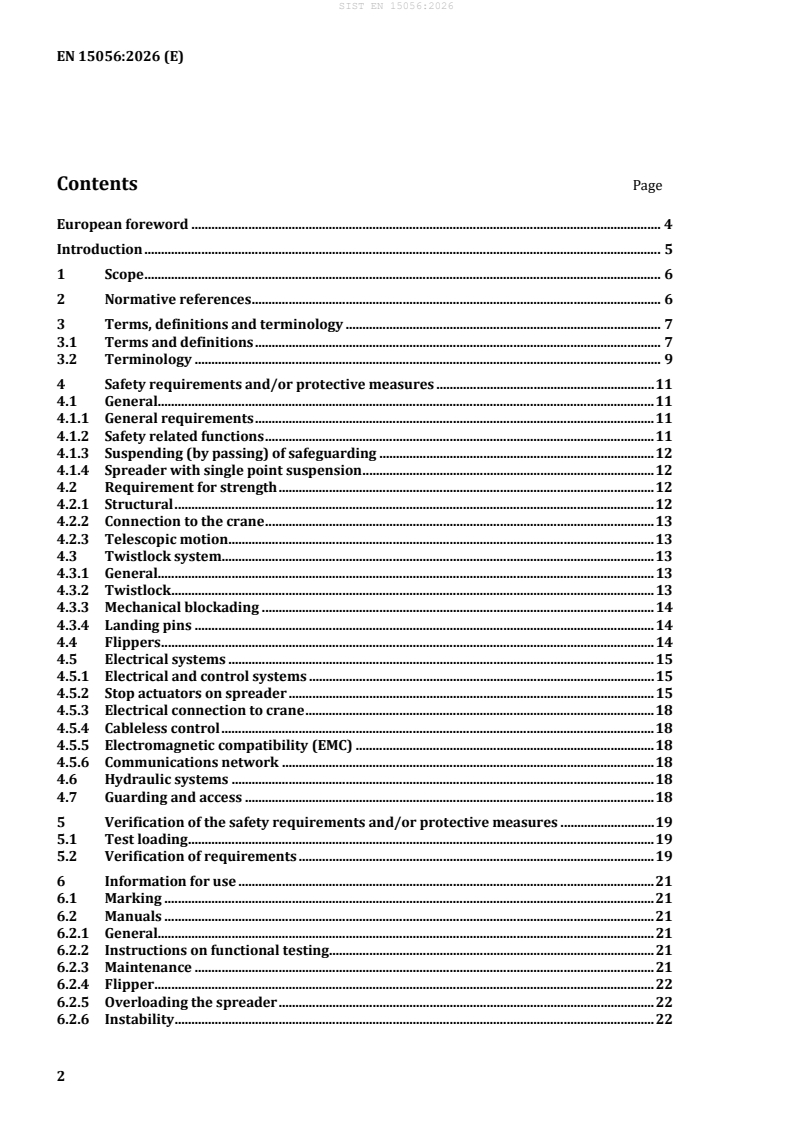
Contents Page
European foreword . 4
Introduction . 5
1 Scope . 6
2 Normative references . 6
3 Terms, definitions and terminology . 7
3.1 Terms and definitions . 7
3.2 Terminology . 9
4 Safety requirements and/or protective measures . 11
4.1 General. 11
4.1.1 General requirements . 11
4.1.2 Safety related functions . 11
4.1.3 Suspending (by passing) of safeguarding . 12
4.1.4 Spreader with single point suspension . 12
4.2 Requirement for strength . 12
4.2.1 Structural . 12
4.2.2 Connection to the crane . 13
4.2.3 Telescopic motion . 13
4.3 Twistlock system. 13
4.3.1 General. 13
4.3.2 Twistlock . 13
4.3.3 Mechanical blockading . 14
4.3.4 Landing pins . 14
4.4 Flippers . 14
4.5 Electrical systems . 15
4.5.1 Electrical and control systems . 15
4.5.2 Stop actuators on spreader . 15
4.5.3 Electrical connection to crane . 18
4.5.4 Cableless control . 18
4.5.5 Electromagnetic compatibility (EMC) . 18
4.5.6 Communications network . 18
4.6 Hydraulic systems . 18
4.7 Guarding and access . 18
5 Verification of the safety requirements and/or protective measures . 19
5.1 Test loading . 19
5.2 Verification of requirements . 19
6 Information for use . 21
6.1 Marking . 21
6.2 Manuals . 21
6.2.1 General. 21
6.2.2 Instructions on functional testing. 21
6.2.3 Maintenance . 21
6.2.4 Flipper . 22
6.2.5 Overloading the spreader . 22
6.2.6 Instability . 22
6.2.7 Electrical and control systems . 22
6.2.8 Multiple lifting operations . 22
6.2.9 Damaged containers or containers out of standard . 22
6.2.10 Inspection . 22
Annex A (informative) List of significant hazards . 23
Annex B (informative) Example of loading specifications . 25
Annex C (informative) Overview of standards published by CEN/TC 147 . 27
C.1 General . 27
C.2 Selecting a suitable standard . 27
Annex ZA (informative) Relationship between this European Standard and the essential
requirements of Regulation (EU) 2023/1230 aimed to be covered . 29
Bibliography . 31
European foreword
This document (EN 15056:2026) has been prepared by Technical Committee CEN/TC 147 “Cranes -
Safety”, the secretariat of which is held by SFS.
This European Standard shall be given the status of a national standard, either by publication of an
identical text or by endorsement, at the latest by November 2026, and conflicting national standards shall
be withdrawn at the latest by November 2026.
Attention is drawn to the possibility that some of the elements of this document may be the subject of
patent rights. CEN shall not be held responsible for identifying any or all such patent rights.
This document supersedes EN 15056:2006+A1:2009.
EN 15056:2006+A1:2009:
— updating of reference documents and cross-references;
— revision of List of significant hazards and moved it to Annex A;
— revision of Annex ZA and addition of Bibliography;
— revision and update of Clause 2 and Clause 3;
— addition of new subclauses 4.1.3, 4.1.4, 4.2.3, 4.5.4, 4.5.5, 4.5.6 and 4.7;
— revision and update of subclauses 4.1.2, 4.2.1, 4.3, 4.4, 4.5.1, 4.5.2, 4.6, 5.1, 5.2, 6.1, 6.2.1, 6.2.7 and
6.2.10;
— revision and update of Table A.1;
— revision and update of Annex C.
This document has been prepared under a standardization request addressed to CEN by the European
Commission. The Standing Committee of the EFTA States subsequently approves these requests for its
Member States.
For the relationship with EU Legislation, see informative Annex ZA, which is an integral part of this
document.
For relationship with other European standards for cranes, see Annex C.
Any feedback and questions on this document should be directed to the users’ national standards body.
A complete listing of these bodies can be found on the CEN website.
According to the CEN-CENELEC Internal Regulations, the national standards organisations of the
following countries are bound to implement this European Standard: Austria, Belgium, Bulgaria, Croatia,
Cyprus, Czech Republic, Denmark, Estonia, Finland, France, Germany, Greece, Hungary, Iceland, Ireland,
Italy, Latvia, Lithuania, Luxembourg, Malta, Netherlands, Norway, Poland, Portugal, Republic of North
Macedonia, Romania, Serbia, Slovakia, Slovenia, Spain, Sweden, Switzerland, Türkiye and the United
Kingdom.
Introduction
This document is a harmonized standard to provide one means for container handling spreaders for
cranes to conform with the essential health and safety requirements of the Machinery Regulation, as
mentioned in Annex ZA.
This standard is a type-C standard as stated in EN ISO 12100:2010.
This document is of relevance, in particular, for the following stakeholder groups representing the market
players with regard to machinery safety:
— machine manufacturers (small, medium and large enterprises);
— health and safety bodies (regulators, accident prevention organizations, market surveillance, etc.).
Others can be affected by the level of machinery safety achieved with the means of the document by the
above-mentioned stakeholder groups:
— machine users/employers (small, medium and large enterprises);
— machine users/employees (e.g. trade unions, organizations for people with special needs);
— service providers, e.g. for maintenance (small, medium and large enterprises);
— consumers (in case of machinery intended for use by consumers).
The above-mentioned stakeholder groups have been given the possibility to participate at the drafting
process of this document.
The machinery concerned and the extent to which hazards, hazardous situations and hazardous events
are covered are indicated in the scope of this document.
When requirements of this type-C standard are different from those which are stated in type-A or type-B
standards, the requirements of this type-C standard take precedence over the requirements of the other
standards, for machines that have been designed and built according to the requirements of this type-C
standard.
1 Scope
This document specifies safety requirements for spreaders used with cranes designed for the purpose of
handling freight containers, e.g. those based on ISO 668:2020. The connection between the spreader and
the container is by the use of twistlocks that engage into the container’s upper corner castings.
This document deals with all significant hazards, hazardous situations or hazardous events relevant to
container handling spreaders, when it is used as intended and under conditions of misuse which are
reasonably foreseeable by the manufacturer.
The spreader is interfaced to the crane’s control and safety system.
This document does not cover the following types of spreaders:
— hand operated spreaders (without external power supply);
— bottom lift grapple spreaders used for swap bodies and road trailers.
This document does not deal with the lifting of persons.
This document is not applicable to container handling spreaders manufactured before the date of its
publication.
2 Normative references
The following documents are referred to in the text in such a way that some or all of their content
constitutes requirements of this document. For dated references, only the edition cited applies. For
undated references, the latest edition of the referenced document (including any amendments) applies.
EN 12077-2:2024, Cranes safety — Requirements for health and safety — Part 2: Limiting and indicating
devices
EN 13001-1:2015, Cranes — General design — Part 1: General principles and requirements
EN 13001-2:2021, Crane safety — General design — Part 2: Load actions
EN 13001-3-1:2025, Cranes — General design — Part 3-1: Limit states and proof competence of steel
structure
EN 13001-3-6:2026, Cranes — General design — Part 3-6: Limit states and proof of competence of
machinery — Hydraulic cylinders
EN 13135:2013+A1:2018, Cranes — Safety — Design — Requirements for equipment
EN 13586:2020, Cranes — Access
EN IEC 60204-32:2025, Safety of machinery — Electrical equipment of machines — Part 32: Requirements
for hoisting machines (IEC 60204-32:2023)
EN IEC 61000-6-2:2019, Electromagnetic compatibility (EMC) — Part 6-2: Generic standards — Immunity
standard for industrial environments (IEC 61000-6-2:2016)
EN IEC 61000-6-4:2019, Electromagnetic compatibility (EMC) — Part 6-4: Generic standards — Emission
standard for industrial environments (IEC 61000-6-4:2018)
EN 61000-6-7:2015, Electromagnetic compatibility (EMC) — Part 6-7: Generic standards — Immunity
requirements for equipment intended to perform functions in a safety-related system (functional safety) in
industrial locations (IEC 61000-6-7:2014)
EN 62745:2017, Safety of machinery — Requirements for cableless control systems of machinery
(IEC 62745:2017)
EN ISO 4413:2010, Hydraulic fluid power — General rules and safety requirements for systems and their
components (ISO 4413:2010)
EN ISO 12100:2010, Safety of machinery — General principles for design — Risk assessment and risk
reduction (ISO 12100:2010)
EN ISO 13849-1:2023, Safety of machinery — Safety-related parts of control systems — Part 1: General
principles for design (ISO 13849-1:2023)
EN ISO 13850:2015, Safety of machinery — Emergency stop function — Principles for design
(ISO 13850:2015)
EN ISO 14120:2015, Safety of machinery — Guards — General requirements for the design and
construction of fixed and movable guards (ISO 14120:2015)
EN ISO 20607:2019, Safety of machinery — Instruction handbook — General drafting principles
(ISO 20607:2019)
EN IEC 62061:2021, Safety of machinery — Functional safety of safety-related control systems
(IEC 62061:2021)
ISO 4306-1:2007, Cranes — Vocabulary — Part 1: General
3 Terms, definitions and terminology
3.1 Terms and definitions
For the purposes of this document, the terms and definitions given in EN ISO 12100:2010,
ISO 4306-1:2007 and the following apply.
ISO and IEC maintain terminology databases for use in standardization at the following addresses:
— ISO Online browsing platform: available at https://www.iso.org/obp/
— IEC Electropedia: available at https://www.electropedia.org/
3.1.1
mid frame
middle section of a container handling spreader
3.1.2
telescopic beam
extending frame of a container handling spreader which slides in and out of the mid frame
As impacted by EN 62745:2017/A11:2020.
As impacted by EN IEC 62061:2021/A1:2024.
3.1.3
end beam
outer end beam of a container handling spreader extending frame
3.1.4
telescopic motion
adjusting the length of the container handling spreader to different container sizes
3.1.5
tare weight
spreader’s own weight in operation
3.1.6
twistlock
rotating locking device for connecting a container handling spreader to a container corner casting
(Figure 3)
3.1.7
mechanical blockading
action of mechanically blocking the twistlock in order to prevent unsafe rotation
3.1.8
single lift operation
lifting one container with one spreader
3.1.9
twin lift operation
lifting two containers with one spreader
3.1.10
expandable twin lift
twin lift operation with the ability to expand or retract two containers from each other
3.1.11
flipper (gather guide)
guidance device to align the spreader to a container which can be moved between the down “in-use”
position and up “not in use” positions manually or by remote control
3.1.12
lock(ed)
twistlocks in corner castings in position which ensure safe lifting of the container
3.1.13
unlock(ed)
twistlocks in corner castings in position which ensure safe removal from the container
3.1.14
land(ed)
spreader landed correctly with all twistlocks in the corner castings
3.1.15
landing pin(s)
mechanical device(s) with electrical indication on correct landing of the spreader on the container
3.1.16
headblock
part of the crane to which the spreader(s) is(are) attached
3.1.17
headblock connection
connection between the spreader and the headblock
3.1.18
twin unit
additional twistlock housings and mechanism fitted to a container handling spreader that enables it to
perform twin lift operations
3.1.19
freight container
article of transport equipment:
a) of a permanent character and accordingly strong enough to be suitable for repeated use;
b) designed to facilitate the carriage of goods by one or more modes of transport, without intermediate
reloading;
c) fitted with devices permitting its ready handling, particularly its transfer from one mode of transport
to another;
d) designed so as to be easy to fill and empty;
e) having an internal volume of 1 m (35,3ft3) or more
Note 1 to entry: The term “freight container” does not include vehicles or conventional packing.
[SOURCE: ISO 668:2020 and ISO 668:2020/Amd 1:2022, 3.1]
3.2 Terminology
The terms that are used in this standard for the main parts of a spreader are indicated in Figure 1. The
fine positioning movements are shown in Figure 2.
NOTE In the Figure 1 the headblock design is for reference only and varies based on application.
Key
1 mid frame
2 headblock connection
3 headblock
4 telescopic beam
5 end beam
6 flipper
7 twistlock
8 expandable twin lift
9 twin unit
Figure 1 — Main parts of a spreader
Key
1 trim
2 tilt/list
3 skew
Figure 2 — Fine positioning movements of the spreader
4 Safety requirements and/or protective measures
4.1 General
4.1.1 General requirements
The spreader shall comply with the safety requirements and/or protective measures of this clause. In
addition, the spreader shall be designed according to the principles of EN ISO 12100:2010 for relevant
but not significant hazards, which are not dealt with by this document.
4.1.2 Safety related functions
All safety functions shall be designed in accordance with EN ISO 13849-1:2023 or EN IEC 62061:2021 .
The required safety integrity shall be achieved as follows:
— For safety functions implemented using electromechanical, hydraulic, or pneumatic components, the
function shall achieve:
o Performance Level (PL) c, Category 1, or
o Safety Integrity Level (SIL) 1, with Hardware Fault Tolerance (HFT) = 0 and Safe Failure Fraction
(SFF) ≥ 90%
— For safety functions implemented using electronic, e.g. inductive sensors, or programmable
electronic components, the function shall achieve:
o Performance Level (PL) c, Category 2, or
o Safety Integrity Level (SIL) 1, with HFT = 0 and SFF ≥ 90%
NOTE For spreaders in high-risk applications, as specified in 5.9 of EN 13135:2013+A1:2018 and
EN 13001-2:2021, a higher performance level can be required.
Container handling spreaders shall include the following safety related functions:
— detection of spreader twist lock condition “locked” and “unlocked” and providing an indication to the
crane when twist lock positions are not equal in all twistlocks;
— detection of landing of spreader on the container and prevention of twistlock rotation when the
spreader is not in the landed condition.
4.1.3 Suspending (by passing) of safeguarding
Suspending a safety function or protective measure may be temporarily applied for setting, testing,
maintenance and emergency purposes.
The provisions specified in EN IEC 60204-32:2025, 9.2.4 shall apply.
Where means for temporary suspension of safeguarding is provided, the device for suspending shall be
located inside an enclosure, access to which requires special tools, or other device not available for
normal operation, such as a key-operated switch, shall be provided.
4.1.4 Spreader with single point suspension
Spreaders with single point suspension shall have a possibility to horizontal shift to avoid loss of stability
and avoid inclination of spreader and container.
4.2 Requirement for strength
4.2.1 Structural
Container handling spreader shall be designed and constructed in such a way as to prevent failure from
fatigue and wear, taking due account of their intended use and any reasonably foreseeable misuse.
Structural failure as a cause of dropping the load shall be prevented by design of the load carrying
elements in accordance with EN 13001-1:2015, EN 13001-2:2021 and EN 13001-3-1:2025.
When designing the spreader, the effect of various loading and container length shall be taken into
account.
The spreader shall be designed in accordance with the following parameters, which shall be specified:
— container type(s) to lift;
— maximum load;
— dynamic coefficient when hoisting the load;
— load spectrum;
— number of lifting cycles;
— degree of unevenly loaded containers;
— maximum operating position deviation from horizontal level, e.g. trim, list/tilt (Figure 2);
— the description of the intended use of the spreader (see EN 13001-1:2015, 4.3.2 and Figure B.1 in
Annex B of this document) including features e.g. micro motion, skew (Figure 2).
If no other specifications for loading are available, the assumptions of loading given in Annex B can be
used.
4.2.2 Connection to the crane
The mechanical connection system between sheaves or head block and spreader shall have a manual
positive locking device (e.g. a pin thru holes secured by a retained socket) or a powered locking device
with electrical indication of connection. Electrical indication shall be placed on the spreader when the
connecting action is done from the spreader.
4.2.3 Telescopic motion
Proof of competence of hydraulic cylinders shall be in accordance with EN 13001-3-6:2026.
For other components, the load effects and required life (number of cycles) shall be derived from the
service and load conditions mentioned in 4.2.1 and they shall not exceed the specified limit states.
NOTE For information regarding bearings, see EN 13001-3-4:2018.
4.3 Twistlock system
4.3.1 General
The spreader condition “landed” shall be indicated. Landing indication means that all twistlocks are in
the correct position in the corner castings.
The spreader twistlock condition locked and unlocked shall be indicated. Locked and unlocked indication
means that all twistlocks are in the indicated position. This is achieved by indicators at each twistlock or
by indicat
...