


SIST-TP CLC/TR 50750:2025
(Main)Report on the use of EN 45545-2 and EN 45545-5 for electronic equipment on board rolling stock
Report on the use of EN 45545-2 and EN 45545-5 for electronic equipment on board rolling stock
This document reports the experience of the users of EN 45545 2 and EN 45545 5, particularly when applying these standards to the design and compliance evaluation of electronic equipment on board of trains for their fire protection measures.
This document excludes any new requirements, considering only the requirements stated by the above listed standards.
However, since these requirements are generic and not specifically referred to electronic equipment, this document clarifies the application of EN 45445 to the complex case of electronic components and associated assemblies.
Bericht über die Verwendung von EN 45545-2 und EN 45545-5 für elektronische Einrichtungen an Bord von Bahnfahrzeugen
Rapport concernant l’utilisation de l’EN 45545-2 et de l’EN 45545-5 pour le matériel électronique à bord du matériel roulant
Poročilo o uporabi EN 45545-2 in EN 45545-5 za elektronsko opremo na tirnih vozilih
Ta dokument vsebuje poročilo o izkušnjah uporabnikov standardov EN 45545-2 in EN 45545-5, zlasti pri uporabi teh standardov za načrtovanje in vrednotenje skladnosti elektronske opreme na vlakih v zvezi z njihovimi ukrepi požarne zaščite. Ta dokument ne vključuje novih zahtev, temveč upošteva le zahteve, navedene v zgoraj omenjenih standardih. Ker so te zahteve splošne in se ne sklicujejo posebej na elektronsko opremo, ta dokument pojasnjuje uporabo standarda EN 45445 v kompleksnem primeru elektronskih komponent in povezanih sestavov.
General Information
- Status
- Published
- Publication Date
- 21-Jul-2025
- Technical Committee
- ŽEN - Electrical applications for railways
- Current Stage
- 6060 - National Implementation/Publication (Adopted Project)
- Start Date
- 11-Jun-2025
- Due Date
- 16-Aug-2025
- Completion Date
- 22-Jul-2025
Overview
CLC/TR 50750:2025 is a CENELEC technical report that documents user experience and best practice when applying EN 45545-2 and EN 45545-5 to electronic equipment on board rolling stock. Approved June 2025, this report does not introduce new requirements - it clarifies how the existing fire‑protection requirements in the EN 45545 series apply to complex electronic components, printed board assemblies (PBAs), enclosures and racks used in trains.
Key Topics
- Clarification of scope for electronic equipment vs. general electrical equipment; focus on components, PBAs, cables, technical cabinets and rack-mounted systems.
- Guidance on compliance evaluation across product lifecycle phases: design, manufacturing, integration/installation and maintenance.
- Component-level considerations including active/passive devices, integrated circuits, capacitors and discrete parts and how their weight, location and materials affect fire classification.
- Printed Board Assembly (PBA) guidance for single boards, piggy‑back boards and boards with connectors or cabling.
- Enclosure and mounting cases: sealed equipment, multi‑board enclosures, rack‑mount and standalone box types - with mitigation measures aligned to EN 45545-5 clauses.
- Grouping rules and FCIL (Fire Certificate Inventory List) templates to support classification and documentation of assemblies and spare parts.
- Equivalence analysis between flammability tests, comparing vertical‑burn test classifications (UL 94 V‑0) with EN 60695‑11‑10 to help justify test evidence for electronic materials (see informative Annex A).
Applications and Who Uses It
This report is practical for:
- Railway electronics designers and OEMs who need to interpret EN 45545 requirements for boards, modules and enclosures.
- Compliance engineers and assessors performing conformity evaluation and preparing FCILs.
- System integrators and installation teams implementing safe mounting, cabling and enclosure solutions on trains.
- Maintenance planners and spare‑parts managers using grouping rules to define acceptable replacements and lifecycle practices.
- Certification bodies and purchasers seeking harmonized interpretation of EN 45545-2 and EN 45545-5 for electronic equipment.
Practical value: use the report to reduce ambiguity in fire protection assessments, apply consistent grouping/weighting rules for components and PBAs, and to justify test equivalence where appropriate.
Related Standards
- EN 45545-1 (general)
- EN 45545-2 (hazard assessment / requirements)
- EN 45545-5 (electrical/electronic equipment guidance)
- EN 50155 (railway electronic equipment standard)
- EN 60695-11-10 (flammability testing) and UL 94 (vertical burn classifications)
Keywords: CLC/TR 50750:2025, EN 45545-2, EN 45545-5, electronic equipment, rolling stock, fire protection, PCB, PBA, UL 94, EN 60695-11-10, FCIL, railway standards.

Frequently Asked Questions
SIST-TP CLC/TR 50750:2025 is a technical report published by the Slovenian Institute for Standardization (SIST). Its full title is "Report on the use of EN 45545-2 and EN 45545-5 for electronic equipment on board rolling stock". This standard covers: This document reports the experience of the users of EN 45545 2 and EN 45545 5, particularly when applying these standards to the design and compliance evaluation of electronic equipment on board of trains for their fire protection measures. This document excludes any new requirements, considering only the requirements stated by the above listed standards. However, since these requirements are generic and not specifically referred to electronic equipment, this document clarifies the application of EN 45445 to the complex case of electronic components and associated assemblies.
This document reports the experience of the users of EN 45545 2 and EN 45545 5, particularly when applying these standards to the design and compliance evaluation of electronic equipment on board of trains for their fire protection measures. This document excludes any new requirements, considering only the requirements stated by the above listed standards. However, since these requirements are generic and not specifically referred to electronic equipment, this document clarifies the application of EN 45445 to the complex case of electronic components and associated assemblies.
SIST-TP CLC/TR 50750:2025 is classified under the following ICS (International Classification for Standards) categories: 13.220.20 - Fire protection; 45.060.01 - Railway rolling stock in general. The ICS classification helps identify the subject area and facilitates finding related standards.
SIST-TP CLC/TR 50750:2025 is available in PDF format for immediate download after purchase. The document can be added to your cart and obtained through the secure checkout process. Digital delivery ensures instant access to the complete standard document.
Standards Content (Sample)
SLOVENSKI STANDARD
01-september-2025
Poročilo o uporabi EN 45545-2 in EN 45545-5 za elektronsko opremo na tirnih
vozilih
Report on the use of EN 45545-2 and EN 45545-5 for electronic equipment on board
rolling stock
Bericht über die Verwendung von EN 45545-2 und EN 45545-5 für elektronische
Einrichtungen an Bord von Bahnfahrzeugen
Rapport concernant l’utilisation de l’EN 45545-2 et de l’EN 45545-5 pour le matériel
électronique à bord du matériel roulant
Ta slovenski standard je istoveten z: CLC/TR 50750:2025
ICS:
13.220.20 Požarna zaščita Fire protection
45.060.01 Železniška vozila na splošno Railway rolling stock in
general
2003-01.Slovenski inštitut za standardizacijo. Razmnoževanje celote ali delov tega standarda ni dovoljeno.
TECHNICAL REPORT CLC/TR 50750
RAPPORT TECHNIQUE
TECHNISCHER REPORT June 2025
ICS 13.220.20; 45.060.01
English Version
Report on the use of EN 45545-2 and EN 45545-5 for electronic
equipment on board rolling stock
Rapport concernant l'utilisation de l'EN 45545-2 et de l'EN Bericht über die Verwendung von EN 45545-2 und EN
45545-5 pour le matériel électronique à bord du matériel 45545-5 für elektronische Einrichtungen an Bord von
roulant Bahnfahrzeugen
This Technical Report was approved by CENELEC on 2025-06-02.
CENELEC members are the national electrotechnical committees of Austria, Belgium, Bulgaria, Croatia, Cyprus, the Czech Republic,
Denmark, Estonia, Finland, France, Germany, Greece, Hungary, Iceland, Ireland, Italy, Latvia, Lithuania, Luxembourg, Malta, the
Netherlands, Norway, Poland, Portugal, Republic of North Macedonia, Romania, Serbia, Slovakia, Slovenia, Spain, Sweden, Switzerland,
Türkiye and the United Kingdom.
European Committee for Electrotechnical Standardization
Comité Européen de Normalisation Electrotechnique
Europäisches Komitee für Elektrotechnische Normung
CEN-CENELEC Management Centre: Rue de la Science 23, B-1040 Brussels
© 2025 CENELEC All rights of exploitation in any form and by any means reserved worldwide for CENELEC Members.
Ref. No. CLC/TR 50750:2025 E
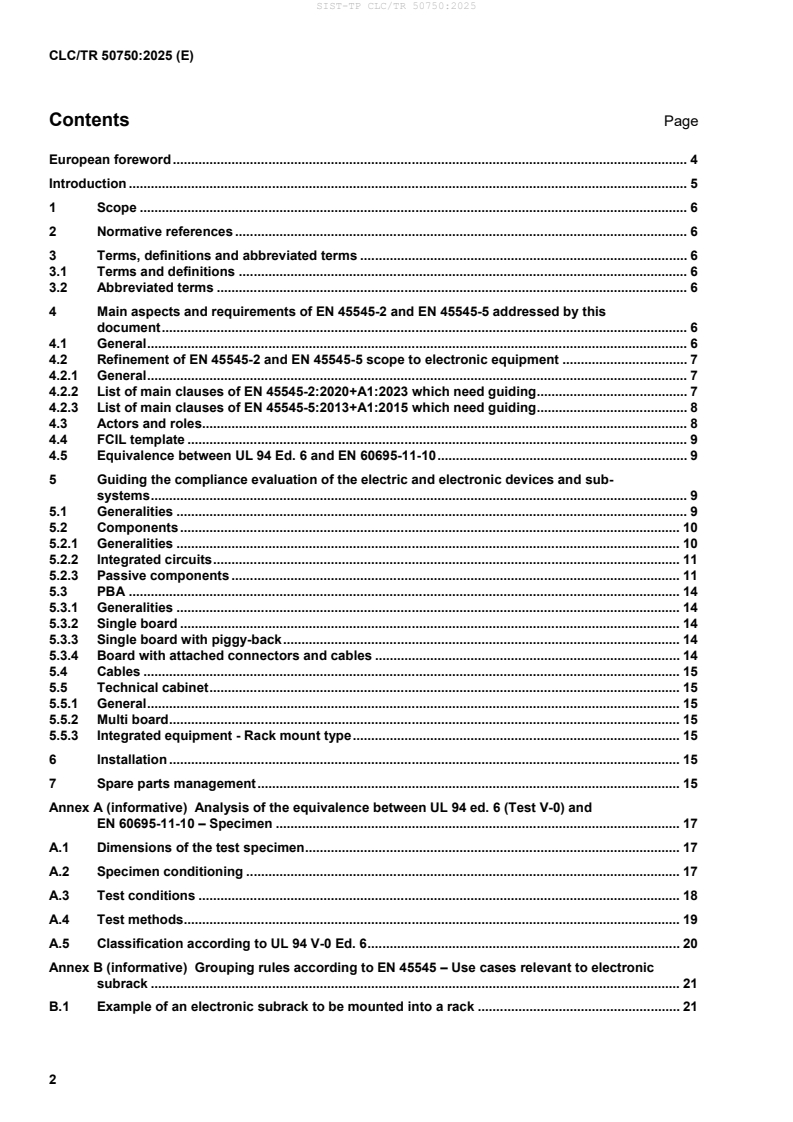
Contents Page
European foreword . 4
Introduction . 5
1 Scope . 6
2 Normative references . 6
3 Terms, definitions and abbreviated terms . 6
3.1 Terms and definitions . 6
3.2 Abbreviated terms . 6
4 Main aspects and requirements of EN 45545-2 and EN 45545-5 addressed by this
document . 6
4.1 General . 6
4.2 Refinement of EN 45545-2 and EN 45545-5 scope to electronic equipment . 7
4.2.1 General . 7
4.2.2 List of main clauses of EN 45545-2:2020+A1:2023 which need guiding . 7
4.2.3 List of main clauses of EN 45545-5:2013+A1:2015 which need guiding . 8
4.3 Actors and roles. 8
4.4 FCIL template . 9
4.5 Equivalence between UL 94 Ed. 6 and EN 60695-11-10 . 9
5 Guiding the compliance evaluation of the electric and electronic devices and sub-
systems . 9
5.1 Generalities . 9
5.2 Components . 10
5.2.1 Generalities . 10
5.2.2 Integrated circuits . 11
5.2.3 Passive components . 11
5.3 PBA . 14
5.3.1 Generalities . 14
5.3.2 Single board . 14
5.3.3 Single board with piggy-back . 14
5.3.4 Board with attached connectors and cables . 14
5.4 Cables . 15
5.5 Technical cabinet . 15
5.5.1 General . 15
5.5.2 Multi board . 15
5.5.3 Integrated equipment - Rack mount type . 15
6 Installation . 15
7 Spare parts management . 15
Annex A (informative) Analysis of the equivalence between UL 94 ed. 6 (Test V-0) and
EN 60695-11-10 – Specimen . 17
A.1 Dimensions of the test specimen . 17
A.2 Specimen conditioning . 17
A.3 Test conditions . 18
A.4 Test methods . 19
A.5 Classification according to UL 94 V-0 Ed. 6 . 20
Annex B (informative) Grouping rules according to EN 45545 – Use cases relevant to electronic
subrack . 21
B.1 Example of an electronic subrack to be mounted into a rack . 21
B.2 Grouping rules applied to some boards contained in the considered example of subrack . 24
B.3 Grouping rules applied to rack and motherboard in the considered example of rack
mount . 28
Bibliography . 32
Tables
Table 1 — Examples of weight of some discrete electronic components . 11
Table 2 — Examples of weight of some disc units . 11
Table 3 — Examples of weight of some integrated circuits . 11
Table 4 — Examples of weight of electrolytic capacitors . 12
Table 5 — Examples of weight of some capacitors . 12
Table 6 — Examples of weight of some resistors . 13
Table 7 — Examples of weight of some miscellaneous passive components . 13
Table A.1 — Comparison of dimensions of the test specimen . 17
Table A.2 — Comparison of specimen conditioning . 17
Table A.3 — Comparison of laboratory atmosphere . 18
Table A.4 — Comparison of cotton conditioning . 18
Table A.5 — Comparison of test arrangements . 19
Table A.6 — Comparison of flame application and observations . 19
Table A.7 — Comparison of evaluation of results . 19
Table A.8 — Comparison of retest criteria. 20
Table A.9 — Comparison of criteria for vertical burning classification . 20
Table A.10 — Comparison of classification according to UL 94 V-0 . 20
Figures
Figure B.1 — Picture of a subrack mounted solution . 21
Figure B.2 — Schematic drawing of the subrack mounted solution . 23
Figure B.3 — Internal view of the electronic subrack . 23
Figure B.4 — Example of analogue inputs board . 25
Figure B.5 — Example of CPU board . 26
Figure B.6 — Example RS485 board . 28
Figure B.7 — Example of analysis of motherboard connectors and plastic guides . 29
Figure B.8 — Example of analysis of small electronic components placed on the PCB of the
motherboard . 30
Figure B.9 — Example of analysis of the backplane PCB . 31
European foreword
This document (CLC/TR 50750:2025) has been prepared by CLC/TC 9X “Electrical and electronic applications
for railways”.
Attention is drawn to the possibility that some of the elements of this document may be the subject of patent
rights. CENELEC shall not be held responsible for identifying any or all such patent rights.
Any feedback and questions on this document should be directed to the users’ national committee. A complete
listing of these bodies can be found on the CENELEC website.
Introduction
The design, verification and testing of electronic equipment on board rolling stock is standardized by EN 50155.
This document refers to EN 45545-2 and EN 45545-5 in the clause “Fire behaviour requirements”.
However, the referred series deals with the electronic equipment in a generic and limited way:
— EN 45545-2:2020+A1:2023 deals with electronic equipment only in Table 2 – Requirements of listed
products, at EL9 and EL10 entries.
— EN 45545-5:2013+A1:2015 states requirements only for electrical equipment without any explicit reference
to electronic equipment.
As a consequence, the application of EN 45545-2 and EN 45545-5 to the case of electronic equipment on board
of trains opens the door to very different interpretations.
The return of experience reports that designers, assessors, suppliers and customers sometimes reach different
points of view; this results in problems which are difficult to resolve.
In order to overcome such situation, TC9X decided to set up the CLC TC9X WG29 with the task to prepare
guidelines for the application of EN 45545-2 and EN 45545-5 in case of electronic equipment on board rolling
stock.
This document has been prepared according to the decision 58/12 taken during the TC 9X plenary meeting and
the following approved NWIP, see document CLC/TC9X/Sec1431/INF.
This document is not a standard, it is the reporting of the available experience and best practice in applying
EN 45545-2 and EN 45545-5 to the case of electronic equipment on board rolling stock.
1 Scope
This document reports the experience of the users of EN 45545-2 and EN 45545-5, particularly when applying
these standards to the design and compliance evaluation of electronic equipment on board of trains for their fire
protection measures.
This document excludes any new requirements, considering only the requirements stated by the above listed
standards.
However, since these requirements are generic and not specifically referred to electronic equipment, this
document clarifies the application of EN 45445 to the complex case of electronic components and associated
assemblies.
2 Normative references
The following documents are referred to in the text in such a way that some or all of their content constitutes
requirements of this document. For dated references, only the edition cited applies. For undated references, the
latest edition of the referenced document (including any amendments) applies.
EN 45545-1:2013, Railway applications - Fire protection on railway vehicles - Part 1: General
3 Terms, definitions and abbreviated terms
3.1 Terms and definitions
For the purposes of this document, the terms and definitions given of EN 45545-1:2013 apply.
ISO and IEC maintain terminology databases for use in standardization at the following addresses:
— IEC Electropedia: available at https://www.electropedia.org/
— ISO Online browsing platform: available at https://www.iso.org/obp
3.2 Abbreviated terms
For the purposes of this document, the following abbreviations apply.
FCIL Fire Certificate Inventory List
PCB Printed Circuit Board
PBA Printed Board Assembly
4 Main aspects and requirements of EN 45545-2 and EN 45545-5 addressed by this
document
4.1 General
The general approach consists in guiding the users of EN 45545-2 and EN 45545-5, when evaluating the
conformity of electronic product to the requirements of the above referenced norms, and taking into
consideration the different cases of implementation of such product during the different phases of the product
lifecycle, e.g. design, manufacturing, integration/installation and maintenance.
This Clause reports the list of aspects and requirements which are stated by EN 45545-2 and EN 45545-5 that
require guidance for applications to electric and electronic components and equipment.
This Clause also suggests a methodological approach to the compliance evaluation in case of electronic
equipment on board rolling stock.
Furthermore, the equivalence of the UL 94 Ed. 7 (test V-0) and EN 60695-11-10 are considered and their
applicability and use are justified in 4.5.
4.2 Refinement of EN 45545-2 and EN 45545-5 scope to electronic equipment
4.2.1 General
EN 45545-5:2013+A1:2015 refers to electrical equipment without distinguishing between electronic and
electric/electrotechnical equipment.
In particular, EN 45545-5:2013+A1:2015, 5.4 and 5.8 need to be clarified and guidance offered for the mitigation
which is applicable for fulfilling these subclauses, for the following enclosures/mounting cases:
— sealed equipment;
— multi board;
— integrated equipment - Rack mount type;
— integrated equipment - standalone box type.
Furthermore, a clarification is needed to address the potential difficulty in interpreting
EN 45545-5:2013+A1:2015, 5.4 and 5.8 in comparison with EN 45545-2:2020+A1:2023+A1:2023, 4.2.
EN 45545-2 considers the electronic product from a point of view which is limited to EL9 and EL10 in
EN 45545-2:2020+A1:2023, Table 2.
The reality is much complex and the following electronic products are considered:
— at component level:
✓ active components (e.g. transistors, diodes, led);
✓ integrated circuits (e.g. logic ports, CPU, PLD, PAL, memories);
✓ passive components (e.g. capacitors, resistors, miniature relays, coils, transformers);
— at printed board assembly level:
✓ single board;
✓ single board with piggy-back;
✓ board and interface connectors.
4.2.2 List of main clauses of EN 45545-2:2020+A1:2023 which need guiding
The following subclauses and annex need guiding:
a) 4.2 General - Particularly h). See 5.5.
b) 4.3 Grouping rules - Figure 1. See 5.3.1 and Annex B.
c) 4.4 listed products Table 2
— EL9 Printed circuit board. See 5.3.
— EL10 Low power electrotechnical and electronic products (EN 50155) – components UL 94. See 5.2
and 5.3.
d) 4.5 Non-listed products. See 5.2.3.9 and 5.4.
e) 4.6 Refurbishment and maintenance requirements (only subclause 4.6.1 General). See 5.1 and Clause 7.
f) 4.7 Product to be approved for functional necessity. See 5.5.1 and Clause 7.
g) 4.8 Set of material requirements – Table 5 entries R24, R25, R26. See 5.2 and 5.3.
h) Annex B (Informative) – Product classification guidance. See A.1.4.4 and A.1.5.
4.2.3 List of main clauses of EN 45545-5:2013+A1:2015 which need guiding
Sublause 5.4 “Enclosure for electrical equipment” needs guiding relevant to the mitigation actions which are
applicable for fulfilling the above-mentioned clause.
4.3 Actors and roles
The following considerations are useful to understand the roles played by the different actors involved in the
application of EN 45545-2 and EN 45545-5.
Typically, the integrator verifies the fulfilment of the fire behaviour requirement of the actual configuration
installed on the vehicle.
Typically, the manufacturer of the equipment has no hints about the actual installation on-board and the PBA
itself is not a “technical cabinet”, so the compliance evaluation is considered a multi-step process as listed
below, the list is not necessarily to be intended as a sequence:
a) The compliance evaluation of the PBA as standalone element.
b) The compliance evaluation of the configuration of the equipment that fit the requested functional
requirement (e.g. group of PBAs in a defined configuration).
c) The compliance evaluation of the equipment in the installation configuration related the onboard location
(e.g. Standalone box, rack mount).
d) The compliance evaluation of the technical cabinet used to host such equipment.
Typically, the integrator or/and the user ask the manufacturer for a compliance certification of the equipment
with the fire integrity requirement of EN 45545-2:2020+A1:2023, 5.3.7 or asks to verify the fulfilment of the
requirements of the technical cabinet containing the rack supporting the equipment in rackmount configuration
as per EN 45545-2:2020+A1:2023, 4.2 h).
In a sub-rackmount configuration, the separation between the different PBA is ensured by the PCB itself and
the sub-rackmount configuration itself is not a “technical cabinet”.
The following considerations are based on the grouping rules listed in EN 45545-2:2020+A1:2023, 4.3.1.
Products compliant to EN 45545-2:2020+A1:2023, Table 2 or Table 3 are excluded from the grouping
compliance evaluation:
— Most of the materials used for the packaging of components, are mainly in the V-0 class and they refer to
the declaration of conformity of the manufacturer of the component or the “yellow pages” information.
— No requirements apply to products with a combustible mass of ≤ 10 g in touching contact only with a
product compliant to EN 45545-2:2020+A1:2023, Table 2 and Table 3.
— Most of the components are in contact with the PCB only, the PCB is normally compliant to
EN 45545-2:2020+A1:2023, Table 2 EL9. See Tables 1 to 7 in 5.2 for weight examples of different kind of
components.
— The parameters to be considered to evaluate compliance of products to the grouping rules are barely
applicable to the components placed on the PCB as the PCB itself is a listed product.
4.4 FCIL template
UNIFE set up the Fire Safety Technical Group which contributed and followed the development of the fire safety
requirements which will now be found the Rolling Stock TSI; furthermore, this group followed the preparation of
the first issue of EN 45545-2 and EN 45545-5 and follows the activities of revision and extension of EN 45545-2
and EN 45545-5.
The Fire Safety Technical Group has developed the FCIL, a template intended to be completed initially by the
relevant manufacturer according to the EN 45545-2 requirements, and subsequently regularly updated as
necessary.
For the time being, FCIL document has been extensively used with positive results, being able to define the list
of supplied products in a hierarchical mode, defining the structure father-child with related mass, material,
exposed surface, containment criteria. This is guiding to the identify the applicable requirements.
Once the requirements are identified, it is necessary to populate some dedicated columns with the values
extracted from the test reports.
UNIFE published the template of the “Manufacturer Declaration – Fire Behavior of Supplied Products” as a
result of the outcomes of the EU funded project SafeInteriors. The document aims to serve as input towards the
European Standardization and Regulation framework regarding the development of common European
requirements for Interior Passive Safety in Railway Vehicles and it is an FCIL companion.
The FCIL document together with the list of applicable certificates are part of the so-called Fire&Smoke dossier.
Examples of the fire and smoke analysis, which shows the case of grouping rules, is provided by the Annex B.
In order to learn more, it is suggested to visit the link in [1].
4.5 Equivalence between UL 94 Ed. 7 and EN 60695-11-10
The equivalence of UL 94 Ed. 7 and EN 60695-11-10 is indicated in EN 45545-2:2020+A1:2023, Table 6, note.
This clause reports some considerations which help to understand the equivalence between the relevant
clauses of EN 60695-11-10:2013 and UL 94 Ed. 7 with reference to the vertical burn test V-0.
This equivalence is very useful considering that electronic components, available on the market, are usually
specified with reference to “UL 94 V-0” or “UL V0”. While EN 45545-2:2020+A1:2023, Table 2 at line EL10 recall
the requirement R26, as defined in EN 60695-11-10.
UL (Underwriters Laboratories) provides the “Yellow cards” in the form of yellow-coloured pieces of card which
reports the details of the components or products that had been investigated and tested by UL.
The use of Yellow cards for certifying products and materials presents the following problems:
— The yellow cards report only few data relevant to the investigation and testing. It is not a full and
comprehensive test report.
— There is no evidence that the testing procedure is performed satisfying the requirement of ISO 17025.
— For the time being, yellow cards are available only for some plastic components and plastic product.
A detailed analysis between UL 94 Ed. 7 (test V-0) and EN 60695-11-10 is reported in the Annex A, which is
informative.
5 Guiding the compliance evaluation of the electric and electronic devices and sub-
systems
5.1 Generalities
The application of the requirements of EN 45545-2 and EN 45545-5 is guided taking into consideration the
phase of design and production and in the various configurations of electric and electronic
components/subsystems.
The compliance evaluation of such configurations, in case of new installations on-board of trains and in case of
maintenance, is considered by Clause 6.
The configurations, considered by subclauses 5.2 to 5.5, are:
a) components;
b) PBA;
c) cables;
d) apparatus.
All the considerations reported in 5.2 refer to components as stand-alone elements, nevertheless grouping rules,
listed in 4.3 of EN 45545-2:2020+A1:2023, are to be considered when such components are placed on a PBA.
The herein above sentence applies also to 5.4, which deals with cables.
There are cases when EN 45545-2:2020+A1:2023, 4.7 can be invoked for a certain electronic component and/or
subsystem element. In such a case it is suggested to collect, as much as possible, information from the
manufacturer which are relevant to the materials and structure of the considered component/element. This
information is used to produce a report having the aim to demonstrate that:
— there are no other solutions available to fulfil the requested function;
— the chosen solution contributes to the requested level of functional safety;
— the impact on the passengers in term of smoke and fire is acceptable or sufficiently mitigated.
The data sheets reporting the characteristics of the electronic components are not considered as certification
and/or test report, however they are useful to demonstrate the reason why they were chosen in the design
phase.
5.2 Components
5.2.1 Generalities
In general components are placed on the PCB and the points of connection to the PCB itself are ensured by
the soldered terminals and/or press-fit terminals.
In case of components which have a mass that, because of vibrations possibly leads to destruction of
component terminals, it is common to glue the component to PCB or several components together, in order to
increase resistance to shock and vibrations. In such case it is suggested:
— to use a quantity of glue less than 10 g, paying attention that the sum of flammable mass between the mass
of the component and the mass of the glue is less than 10 g;
— to use glue which is certified UL-V0 or R24. This is particularly useful in case that the mass of the glue
exceeds 10 g.
If the glue is certified UL-V0 or R24, the components glued together are not to be considered as grouped.
The following considerations apply in case of stand-alone components; when such components are placed on
PCB, the considerations in 5.3 apply.
It is recommended that the components, selected by the designer, are certified according to the requirements
in line EL10 of EN 45545-2:2020+A1:2023, Table 2.
If they are not EL10 certified, such active electronic components, like transistors, diodes, led etc, have a
combustible mass which is less than 10 g and consequently they satisfy the requirements stated by
EN 45545-2:2020+A1:2023, 4.3.1.
Table 1 shows the typical values of weight of some discrete electronic components.
Table 1 — Examples of weight of some discrete electronic components
Total weight Combustible
Electronic component Dimensions
(g) mass weight (g)
diode case SMC 0,03 0,03
semiconductors case sot23 2,5 × 3 mm h = 1 mm 0,01 0,01
transistor case DPAK 7 × 10 mm h = 2,5 mm 1,4 1,4
transistor case D2PAK 10 × 15 mm h = 4,5 mm 1,8 1,8
5.2.2 Integrated circuits
Generally, the same consideration which are reported above for discrete electronic components are applicable
to integrated circuits, e.g. logic ports, CPU, PLD, PAL, memories.
It is underlined that the combustible mass is the net component mass excluding any non-combustible mass,
e.g. mass of pins and die.
If the combustible mass is greater than 10 g, having such components high technological functionalities,
EN 45545-2:2020+A1:2023, 4.7 is applicable.
Table 2 provides examples of disc weight.
Table 2 — Examples of weight of some disc units
Disc type weight (g)
DOM SATA 6,96
DOM IDE 9,36
SSD 2,5” (total disc weigh) 53,73
NOTE A larger range of weight can be found on the market.
Table 3 shows the typical values of weight of some of integrated circuits, listed according to their case.
Table 3 — Examples of weight of some integrated circuits
Total weight Combustible
Electronic component Dimensions
(g) mass weight (g)
integrated circuit case SOIC-8 6 × 8 mm h = 1 mm 0,077 0,077
integrated circuit case TSOP-48 12 × 20 mm h = 1 mm 0,52 0,52
integrated circuit case BGA 256 18 × 18 mm h = 1 mm 0,6 0,6
integrated circuit case HBGA 20 × 20 mm h = 2 mm 1,5 1,5
5.2.3 Passive components
5.2.3.1 General
Generally, the same consideration which are reported above for discrete electronic components and integrated
circuits apply to small capacitors, small resistors, miniature relays, small coils, transformers, and connectors.
Transformer and connectors, typically, have a weight more than 10 g, See 5.2.3.8, 5.2.3.9 and 5.3.1.
5.2.3.2 Electrolytic capacitors
It is suggeste
...
Questions, Comments and Discussion
Ask us and Technical Secretary will try to provide an answer. You can facilitate discussion about the standard in here.
Loading comments...