


SIST EN 13160-4:2016+A1:2025
(Main + Amendment)Leak detection systems - Part 4: Requirements and test/assessment methods for sensor based leak detection systems
Leak detection systems - Part 4: Requirements and test/assessment methods for sensor based leak detection systems
This European Standard gives requirements and the corresponding test/assessment methods applicable to leak detection kits based on the detection of the presence of liquid and/or vapour in interstitial spaces, leakage containments or monitoring wells. The kits are usually composed by:
- sensing device(s);
- evaluation device;
- alarm device.
Leckanzeigesysteme - Teil 4: Anforderungen und Prüf-/Bewertungsmethoden für sensorbasierte Leckanzeigesysteme
Diese Europäische Norm legt Anforderungen an und die einschlägigen Prüf-/Bewertungsverfahren für sensorbasierte Leckanzeigesysteme (Leckanzeiger) fest. Die Leckanzeiger sind für die Verwendung in Überwachungsräumen, Leckageräumen oder Überwachungsschächten bestimmt. Die Leckanzeiger bestehen in der Regel aus:
Messfühlereinrichtung(en);
Auswerteeinrichtung;
Alarmeinrichtung.
Systèmes de détection de fuites - Partie 4: Exigences et méthodes d'essai/d'évaluation des systèmes de détection de fuites par capteur
La présente Norme spécifie les exigences et les méthodes d'essai/d'évaluation correspondantes applicables aux kits de détection de fuites, fondées sur la présence de liquide et/ou de vapeur dans les espaces interstitiels, les espaces de confinement des fuites ou les puits piézométriques. Les kits sont généralement constitués des éléments suivants :
- dispositif(s) de mesurage ;
- dispositif d'évaluation ;
- dispositifs d'alarme ;
Sistemi za kontrolo tesnosti - 4. del: Zahteve in metode za preskušanje in ocenjevanje senzorskih sistemov za zaznavanje netesnosti (vključno z dopolnilom A1)
Ta evropski standard določa zahteve ter ustrezne metode za preskušanje in ocenjevanje, ki se uporabljajo za komplete za kontrolo tesnosti, ki temeljijo na zaznavanju prisotnosti tekočine in/ali hlapov v vmesnih prostorih, zadrževalnikih ali nadzornih jaških. Kompleti so običajno sestavljeni iz:
– senzorjev;
– naprave za ocenjevanje;
– alarmne naprave.
General Information
- Status
- Published
- Publication Date
- 11-Dec-2024
- Technical Committee
- TLP - Pressure vessels
- Current Stage
- 6060 - National Implementation/Publication (Adopted Project)
- Start Date
- 08-Oct-2024
- Due Date
- 13-Dec-2024
- Completion Date
- 12-Dec-2024
Relations
- Effective Date
- 01-Jan-2025
- Effective Date
- 01-Nov-2025
Overview
EN 13160-4:2016+A1:2024 (CEN) specifies requirements and test/assessment methods for sensor‑based leak detection systems (leak detection kits). It applies to kits used in interstitial spaces, leakage containments (e.g., sumps, bunds) and monitoring wells. Typical kits include sensing device(s), an evaluation device and an alarm device. This Part 4 is one element of the EN 13160 series and includes Amendment A1 (approved 2024).
Key topics and requirements
- Scope and classification
- Covers sensor-based kits intended to detect presence of liquid and/or vapour in containment spaces. Classified as Class III per EN 13160-1:2016.
- Sensor categories
- Category 1 (non‑discriminating): detects any liquid (product or water).
- Category 2 (discriminating): distinguishes product vs water (2A) or detects thin film of product floating on water (2B).
- Vapour detection
- Sensors must detect specified vapours from flammable liquids (vapour pressure ≥ 30 kPa at 20 °C) when concentration is a volume fraction “less than or equal to 1000 × 10⁻⁶” (as given in the standard).
- Re‑usability / recovery time
- Vapour sensors: recovery ≤ 24 hours after removal of vapour.
- Liquid sensors (or vapour sensors after water removal) without manual reset: recovery ≤ 7 days.
- Durability
- Temperature classes: Type 1 (−20 °C to +60 °C), Type 2 (0 °C to +40 °C), Type 3 (−40 °C to +40 °C).
- Components exposed to liquids/vapours/air must resist chemical attack.
- Software
- Where provided, software must perform self‑diagnostics at start‑up and periodically; failures must generate a distinguishable alarm.
- Testing & conformity
- Specifies sample, documentation and test procedures for effectiveness (liquid and vapour detection, re‑usability), durability (temperature, chemical attack), and provisions for AVCP (assessment and verification of constancy of performance) and factory production control (FPC).
- Other requirements
- Marking, labelling, packaging and environmental aspects are covered.
Applications and users
- Practical applications:
- Underground/aboveground storage tanks, pump sumps, dispenser/pipework containment, monitoring wells and leak containment areas where early detection of product or vapour is required.
- Typical users:
- Manufacturers and designers of leak detection kits and sensors, test laboratories, installation contractors, facility owners (fuel stations, chemical storage), regulators and certification bodies.
Related standards
- EN 13160 series (Parts 1–7), e.g. EN 13160-1:2016 (general principles) and EN 13160-3 (liquid systems).
- Normative references cited include EN 228, EN 12285-1, EN 60079-29-1, EN 14879-4.
Keywords: EN 13160-4, leak detection systems, sensor based leak detection, leak detection kits, interstitial spaces, monitoring wells, vapour sensors, liquid sensors, CEN, testing methods.

Frequently Asked Questions
SIST EN 13160-4:2016+A1:2025 is a standard published by the Slovenian Institute for Standardization (SIST). Its full title is "Leak detection systems - Part 4: Requirements and test/assessment methods for sensor based leak detection systems". This standard covers: This European Standard gives requirements and the corresponding test/assessment methods applicable to leak detection kits based on the detection of the presence of liquid and/or vapour in interstitial spaces, leakage containments or monitoring wells. The kits are usually composed by: - sensing device(s); - evaluation device; - alarm device.
This European Standard gives requirements and the corresponding test/assessment methods applicable to leak detection kits based on the detection of the presence of liquid and/or vapour in interstitial spaces, leakage containments or monitoring wells. The kits are usually composed by: - sensing device(s); - evaluation device; - alarm device.
SIST EN 13160-4:2016+A1:2025 is classified under the following ICS (International Classification for Standards) categories: 23.020.01 - Fluid storage devices in general; 23.040.99 - Other pipeline components; 29.260.20 - Electrical apparatus for explosive atmospheres. The ICS classification helps identify the subject area and facilitates finding related standards.
SIST EN 13160-4:2016+A1:2025 has the following relationships with other standards: It is inter standard links to SIST EN 13160-4:2016, oSIST prEN 13160-4:2025. Understanding these relationships helps ensure you are using the most current and applicable version of the standard.
SIST EN 13160-4:2016+A1:2025 is available in PDF format for immediate download after purchase. The document can be added to your cart and obtained through the secure checkout process. Digital delivery ensures instant access to the complete standard document.
Standards Content (Sample)
SLOVENSKI STANDARD
01-januar-2025
Nadomešča:
SIST EN 13160-4:2016
Sistemi za kontrolo tesnosti - 4. del: Zahteve in metode za preskušanje in
ocenjevanje senzorskih sistemov za zaznavanje netesnosti (vključno z dopolnilom
A1)
Leak detection systems - Part 4: Requirements and test/assessment methods for sensor
based leak detection systems
Leckanzeigesysteme - Teil 4: Anforderungen und Prüf-/Bewertungsmethoden für
sensorbasierte Leckanzeigesysteme
Systèmes de détection de fuites - Partie 4: Exigences et méthodes d'essai/d'évaluation
des systèmes de détection de fuites par capteur
Ta slovenski standard je istoveten z: EN 13160-4:2016+A1:2024
ICS:
23.020.01 Vsebniki za shranjevanje Fluid storage devices in
tekočin na splošno general
23.040.99 Drugi sestavni deli za Other pipeline components
cevovode
2003-01.Slovenski inštitut za standardizacijo. Razmnoževanje celote ali delov tega standarda ni dovoljeno.
EN 13160-4:2016+A1
EUROPEAN STANDARD
NORME EUROPÉENNE
November 2024
EUROPÄISCHE NORM
ICS 23.020.01; 23.040.99; 29.260.20 Supersedes EN 13160-4:2016
English Version
Leak detection systems - Part 4: Requirements and
test/assessment methods for sensor based leak detection
systems
Systèmes de détection de fuites - Partie 4: Exigences et Leckanzeigesysteme - Teil 4: Anforderungen und Prüf-
méthodes d'essai/d'évaluation des systèmes de /Bewertungsmethoden für sensorbasierte
détection de fuites par capteur Leckanzeigesysteme
This European Standard was approved by CEN on 8 April 2016 and includes Amendment 1 approved by CEN on 11 September
2024.
CEN members are bound to comply with the CEN/CENELEC Internal Regulations which stipulate the conditions for giving this
European Standard the status of a national standard without any alteration. Up-to-date lists and bibliographical references
concerning such national standards may be obtained on application to the CEN-CENELEC Management Centre or to any CEN
member.
This European Standard exists in three official versions (English, French, German). A version in any other language made by
translation under the responsibility of a CEN member into its own language and notified to the CEN-CENELEC Management
Centre has the same status as the official versions.
CEN members are the national standards bodies of Austria, Belgium, Bulgaria, Croatia, Cyprus, Czech Republic, Denmark, Estonia,
Finland, France, Germany, Greece, Hungary, Iceland, Ireland, Italy, Latvia, Lithuania, Luxembourg, Malta, Netherlands, Norway,
Poland, Portugal, Republic of North Macedonia, Romania, Serbia, Slovakia, Slovenia, Spain, Sweden, Switzerland, Türkiye and
United Kingdom.
EUROPEAN COMMITTEE FOR STANDARDIZATION
COMITÉ EUROPÉEN DE NORMALISATION
EUROPÄISCHES KOMITEE FÜR NORMUNG
CEN-CENELEC Management Centre: Rue de la Science 23, B-1040 Brussels
© 2024 CEN All rights of exploitation in any form and by any means reserved Ref. No. EN 13160-4:2016+A1:2024 E
worldwide for CEN national Members.
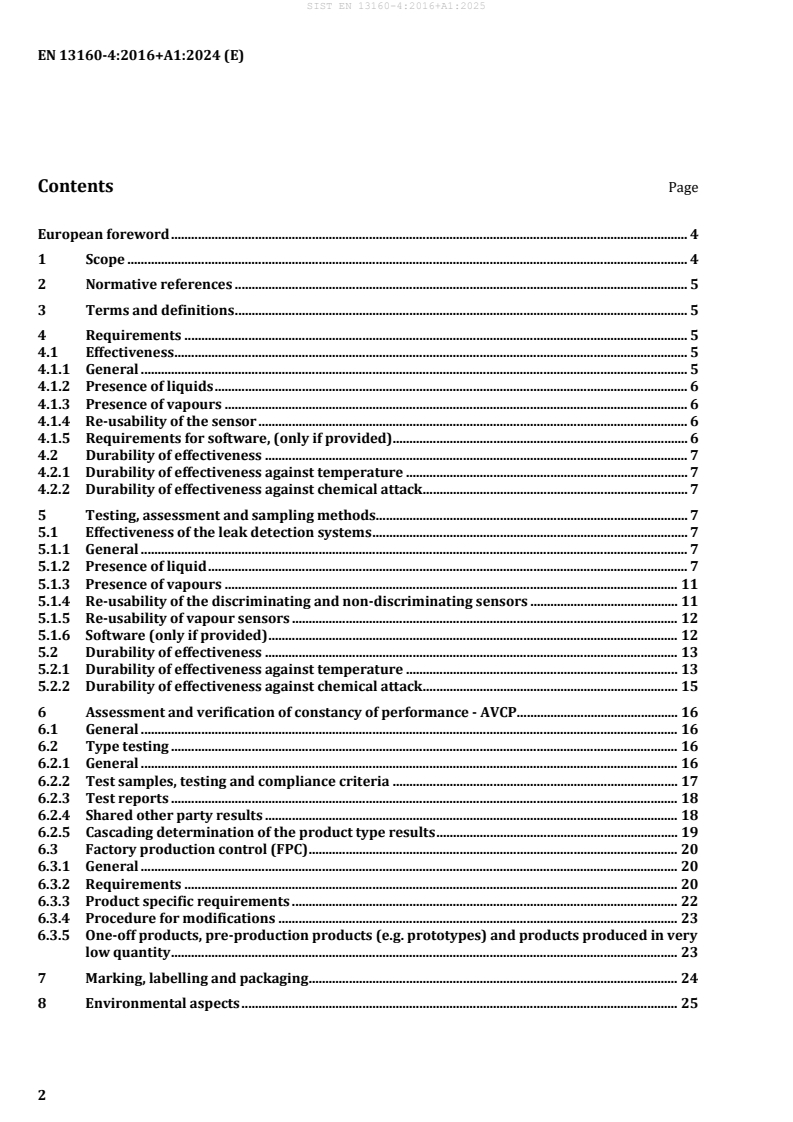
Contents Page
European foreword . 4
1 Scope . 4
2 Normative references . 5
3 Terms and definitions . 5
4 Requirements . 5
4.1 Effectiveness . 5
4.1.1 General . 5
4.1.2 Presence of liquids . 6
4.1.3 Presence of vapours . 6
4.1.4 Re-usability of the sensor . 6
4.1.5 Requirements for software, (only if provided) . 6
4.2 Durability of effectiveness . 7
4.2.1 Durability of effectiveness against temperature . 7
4.2.2 Durability of effectiveness against chemical attack . 7
5 Testing, assessment and sampling methods . 7
5.1 Effectiveness of the leak detection systems . 7
5.1.1 General . 7
5.1.2 Presence of liquid . 7
5.1.3 Presence of vapours . 11
5.1.4 Re-usability of the discriminating and non-discriminating sensors . 11
5.1.5 Re-usability of vapour sensors . 12
5.1.6 Software (only if provided) . 12
5.2 Durability of effectiveness . 13
5.2.1 Durability of effectiveness against temperature . 13
5.2.2 Durability of effectiveness against chemical attack . 15
6 Assessment and verification of constancy of performance - AVCP . 16
6.1 General . 16
6.2 Type testing . 16
6.2.1 General . 16
6.2.2 Test samples, testing and compliance criteria . 17
6.2.3 Test reports . 18
6.2.4 Shared other party results . 18
6.2.5 Cascading determination of the product type results . 19
6.3 Factory production control (FPC) . 20
6.3.1 General . 20
6.3.2 Requirements . 20
6.3.3 Product specific requirements . 22
6.3.4 Procedure for modifications . 23
6.3.5 One-off products, pre-production products (e.g. prototypes) and products produced in very
low quantity . 23
7 Marking, labelling and packaging . 24
8 Environmental aspects . 25
Annex A (informative) Environmental aspects . 26
Bibliography . 28
European foreword
This document (EN 13160-4:2016+A1:2024) has been prepared by Technical Committee CEN/TC 393
“Equipment for tanks and filling stations”, the secretariat of which is held by DIN.
This European Standard shall be given the status of a national standard, either by publication of an
identical text or by endorsement, at the latest by May 2025, and conflicting national standards shall be
withdrawn at the latest by August 2026.
Attention is drawn to the possibility that some of the elements of this document may be the subject of
patent rights. CEN shall not be held responsible for identifying any or all such patent rights.
This document includes Amendment 1 approved by CEN on 11 September 2024.
This document supersedes !EN 13160-4:2016".
The start and finish of text introduced or altered by amendment is indicated in the text by tags !".
!deleted text"
According to edition 2003 the following fundamental changes are given:
— requirements from EN 13160-1:2003 included, which are no longer contained in EN 13160-1:2016;
— new structure — requirements, testing, marking divided;
— new test procedure for vapour sensors and reusability of vapour sensors;
— test liquids revised.
This European Standard Leak detection systems consists of 7 parts:
— Part 1: General principles
— Part 2: Requirements and test/assessment methods for pressure and vacuum systems
— Part 3: Requirements and test/assessment methods for liquid systems for tanks
— Part 4: Requirements and test/assessment methods for sensor based leak detection systems
— Part 5: Requirements and test/assessment methods for in-tank gauge systems and pressurized pipe
work systems
— Part 6: Sensors in monitoring wells
— Part 7: Requirements and test/assessment methods for leak detection linings
Any feedback and questions on this document should be directed to the users’ national standards body. A
complete listing of these bodies can be found on the CEN website.
According to the CEN-CENELEC Internal Regulations, the national standards organizations of the
following countries are bound to implement this European Standard: Austria, Belgium, Bulgaria, Croatia,
Cyprus, Czech Republic, Denmark, Estonia, Finland, France, Germany, Greece, Hungary, Iceland, Ireland,
Italy, Latvia, Lithuania, Luxembourg, Malta, Netherlands, Norway, Poland, Portugal, Republic of North
Macedonia, Romania, Serbia, Slovakia, Slovenia, Spain, Sweden, Switzerland, Türkiye and the United
Kingdom.
1 Scope
This European Standard gives requirements and the corresponding test/assessment methods applicable
to sensor based leak detection systems (leak detection kits). The leak detection kits are intended to be
used in interstitial spaces, leakage containments or monitoring wells. The leak detection kits are usually
composed by:
— sensing device(s);
— evaluation device;
— alarm device.
2 Normative references
The following documents are referred to in the text in such a way that some or all of their content
constitutes requirements of this document. For dated references, only the edition cited applies. For
undated references, the latest edition of the referenced document (including any amendments) applies.
EN 228, Automotive fuels — Unleaded petrol — Requirements and test methods
EN 12285-1, Workshop fabricated steel tanks — Part 1: Horizontal cylindrical single skin and double skin
tanks for the underground storage of flammable and non-flammable water polluting liquids
EN 13160-1:2016, Leak detection systems — Part 1: General principles
!EN 13160-3:2016+A1:2024", Leak detection systems — Part 3: Requirements and test/assessment
methods for liquid systems for tanks
EN 14879-4:2007, Organic coating systems and linings for protection of industrial apparatus and plants
against corrosion caused by aggressive media — Part 4: Linings on metallic components
EN 60079-29-1, Explosive atmospheres — Part 29-1: Gas detectors — Performance requirements of
detectors for flammable gases (IEC 60079-29-1)
3 Terms and definitions
For the purposes of this document, the terms and definitions given in EN 13160-1:2016 and the following
apply.
3.1
re-usability of the sensor
capability of a sensor to be used again after already detected liquid or vapour
4 Requirements
4.1 Effectiveness
4.1.1 General
This type of leak detection kit is classified according to EN 13160-1:2016 as class III.
The general requirements on leak detection systems according to Clause 5 of EN 13160-1:2016 shall be
met.
Liquid or vapour sensors shall be installed in such a way that they can detect specific liquids or their
vapours present in or entering the leakage containment, interstitial space or monitoring wells. The sensor
shall react within a time specified by the manufacturer.
The leakage containment can take the form of a
— sump or riser designed to contain spills from leaks originating from pipework or pumps/dispensers;
— bund, designed to contain leakage from an above ground storage tank or from any other above
ground facility containing liquids;
— other facilities in which sensors can be installed to detect the presence of liquids or vapours.
An alarm device according to !EN 13160-3:2016+A1:2024", 4.1.3.5, shall be provided.
In the event of a sensor disconnection of the power supply an alarm condition shall result.
In case of a short circuit between two conductors in the connection between sensor and evaluation device
an alarm shall be triggered.
4.1.2 Presence of liquids
Liquid sensors shall detect specific liquids they may come into contact with (e.g. stored/conveyed
product, water), according to the following requirements:
Category 1: Non-discriminating sensor.
The sensor shall detect the presence of any liquid (stored/conveyed product and water).
Category 2: Discriminating sensor.
Category 2A: The sensor shall detect the presence of liquid stored/conveyed product or water and
discriminates between the two aforementioned.
Category 2B: The sensor shall detect the presence of a film of liquid (stored/conveyed product) with a
vapour pressure ≥ 30 kPa at 20 °C floating on water.
4.1.3 Presence of vapours
The sensor shall detect specific vapours from flammable liquids with a vapour pressure ≥ 30 kPa at 20 °C
−6
when their concentration is a volume fraction less than or equal to 1000 × 10 .
4.1.4 Re-usability of the sensor
Any re-useable sensor shall be able to detect a new leak condition after removal of liquid or vapour. The
recovery time shall be:
— not higher than 24 h from after the removal of the vapour leak conditions for any vapour sensors;
— not higher than 7 days from after the removal of the liquid leak conditions for any liquid sensor (or
after the removal of the water for the vapour sensors) that doesn't need any manual reset procedure.
4.1.5 Requirements for software, (only if provided)
The software, where provided, shall have a facility for self-checking by fulfilling the following
requirements:
— a self-diagnostic mode to test the integrity of the system at start up and periodically during use. A
negative result of self-diagnostic mode shall result in a distinguishable alarm condition;
— a facility to check the consistency of the input and output data, malfunction shall result in a
distinguishable alarm condition.
4.2 Durability of effectiveness
4.2.1 Durability of effectiveness against temperature
The working temperature ranges for leak detection sensors shall be as follows:
— Type 1: −20 °C to +60 °C
— Type 2: 0 °C to +40 °C
— Type 3: −40 °C to +40 °C
4.2.2 Durability of effectiveness against chemical attack
Parts of leak detection kits which can come into contact with the stored/conveyed liquid/water or its
vapour and air shall be resistant.
5 Testing, assessment and sampling methods
5.1 Effectiveness of the leak detection systems
5.1.1 General
For the tests minimum one sample shall be provided by the manufacturer.
For the tests the following documentation shall be provided by the manufacturer:
— documentation according to Clause 7;
— datasheet of the parts of the leak detection kit;
— electrical diagrams of the parts of the leak detection kit;
— design and application drawings;
— lists of the parts used including material data.
Leak detection kits shall be inspected visually to confirm that the sample complies with the
documentation.
5.1.2 Presence of liquid
5.1.2.1 Non-discriminating liquid sensors (Category 1)
5.1.2.1.1 Test equipment
— mounting device for fixing the sensor;
— temperature sensor with an accuracy of ± 1 K;
— vessel with a diameter of 100 mm and with a volume of at least 1 l;
— time measuring device with an accuracy of ± 1 s;
— according to the signal of the sensor a measuring device regarding measuring current or voltage or
an oscilloscope with an accuracy of 1 %;
— number of test samples (sensor or sensor with evaluation and alarm device);
— potable water;
— stored/conveyed product or the following test liquids:
a) for unleaded petrol according to EN 228
1) with maximum 5 % ethanol
47,5 % (V/V) toluene
30,4 % (V/V) isooctane (2,2,4-trimethylpentane)
17,1 % (V/V) n-heptane
3,0 % (V/V) methanol
2,0 % (V/V) butanol
2) with > 5 % (V/V) and ≤ 20 % (V/V) ethanol
20 % (V/V) ethanol
37,7 % (V/V) toluene
24,2 % (V/V) isooctane (2,2,4- trimethylpentane)
13,5 % (V/V) n-heptane
3 % (V/V) methanol
1,6 % (V/V) butanol
The tolerance for the component of the test liquid shall be 0,1 %.
b) for other petroleum products: liquids according to EN 14879-4:2007, Annex C.
5.1.2.1.2 Preparation
The tests shall be carried out at a temperature of (20 ± 5) °C.
The output values of the current or voltage or the signal frequency for sensors without evaluation/alarm
device shall be measured at the beginning of the test.
When using an evaluation device this shall indicate the operation condition.
a) The sensor shall be installed in the mounting device.
The vessel shall be filled with potable water up to 75 %.
b) The sensor shall be installed in the mounting device.
The vessel shall be filled with test liquid up to 75 %.
5.1.2.1.3 Procedure
a) The test shall be carried out with at least 3 samples. The sensor shall be lowered into the potable
water until the alarm condition is reached and the alarm device activates an alarm accordingly. When
testing an analogue sensor the measured signal shall change accordingly.
b) According to the test procedure a) but the test shall be carried out with test liquid.
5.1.2.1.4 Evaluation
The test shall be deemed to have passed if:
— the times according to 4.1.1 for reaching the activation point when lowering the test samples into
potable water or test liquid are met;
— the measured immersion depth complies with the test liquid height required to activate an alarm as
specified by the manufacturer.
The actual reaction times, the test liquid height and water height shall be recorded and given in the test
report.
5.1.2.2 Discriminating liquid sensors of Category 2A
5.1.2.2.1 Test equipment
According to 5.1.2.1.1.
5.1.2.2.2 Preparation
According to 5.1.2.1.2.
5.1.2.2.3 Procedure
According to 5.1.2.1.3.
5.1.2.2.4 Evaluation
The test shall be deemed to have passed if:
— the times according to 4.1.1 for reaching the activation point when lowering the test samples into test
liquid are met;
— the test liquid height measured is in accordance with the specification of the manufacturer and
resulting in a test liquid alarm;
— the potable water height measured is in accordance with the specification of the manufacturer and
resulting in a water alarm.
The actual reaction times, the test liquid height and water height shall be recorded and given in the test
report.
5.1.2.3 Discriminating liquid sensors of category 2B
5.1.2.3.1 Test equipment
According to 5.1.2.1.1 and additional a pipette with a scale with an accuracy of 1 %.
5.1.2.3.2 Preparation
The tests shall be carried out at a temperature of (20 ± 5) °C.
The output values of the current or voltage or the signal frequency for sensors without evaluation/alarm
device shall be measured at the beginning of the test.
When using an evaluation device this shall indicate the operation condition.
a) Test with potable water:
The sensor shall be installed in the mounting device.
The vessel shall be filled with potable water up to 75 %.
b) Test with test liquid film on water:
The sensor shall be installed in the mounting device.
The vessel shall be filled with potable water up to 75 %.
The sensor shall be lowered into the vessel. The immersion depth into the potable water shall be chosen
in a way that a covering with potable water is reached according to the specification of the manufacturer.
The pipette with the test liquid shall be prepared.
5.1.2.3.3 Procedure
a) Test with potable water:
The sensor shall be suspended in air and the alarm device shall be activated accordingly.
When the sensor is immersed into the potable water the alarm device shall be de-activated.
The test shall be carried out with at least 3 samples.
b) Test with test liquid film on water:
With a pipette, test liquid shall be put on the potable water drop by drop until the sensor activates an
alarm. The quantity of the test liquid shall be recorded and shall be calculated into a film thickness.
The test shall be carried out with at least 3 samples.
5.1.2.3.4 Evaluation
The test shall be deemed to have passed if:
a) Test with potable water:
— an alarm condition appears in air and ceases after immersion in potable water.
b) Test with test liquid film on water:
— the calculated film thickness is smaller or equal to the film thickness given by the manufacturer.
5.1.3 Presence of vapours
5.1.3.1 General
Test equipment, preparation and procedure according to EN 60079-29-1 at three samples for any vapour
or test gas. The selection of the vapour or test gas shall be done in agreement with the manufacturer.
5.1.3.2 Evaluation
The test shall be deemed to have passed if the reaction time given by the manufacturer according to 4.1.1
is met and the alarm condition according to 4.1.3 appears for any sample.
5.1.4 Re-usability of the discriminating and non-discriminating sensors
5.1.4.1 Test equipment
— Test rig with a vertical mobile lifting device for moving the sensor;
— temperature sensor with an accuracy of ± 1 K;
— vessel with a volume of at least 1 l;
— at least 1 l of potable water, if required;
— time measuring device with an accuracy of ± 1 s;
— according to the signal of the sensor a measuring device regarding measuring current or voltage or
an oscilloscope with an accuracy of 1 %;
— number of test samples (sensor or sensor with evaluation and alarm device);
— at least 1 l of stored/conveyed product or the following test liquids:
a) for unleaded petrol according to EN 228
1) with maximum 5 % ethanol
47,5 % (V/V) toluene,
30,4 % (V/V) isooctane (2,2,4-trimethylpentane)
17,1 % (V/V) n-heptane
3,0 % (V/V) methanol
2,0 % (V/V) butanol
2) with > 5 % (V/V) and ≤ 20 % (V/V) ethanol
20 % (V/V) ethanol
37,7 % (V/V) toluene
24,2 % (V/V) isooctane (2,2,4-trimethylpentane)
13,5 % (V/V) n-heptane
3 % (V/V) methanol
1,6 % (V/V) butanol
The tolerance for the component of the test liquid shall be 0,1 %.
b) for other petroleum products: liquids according to EN 14879-4:2007, Annex C.
5.1.4.2 Preparation
The test shall be carried out at a temperature of (20 ± 5) °C.
At the beginning of the test, the sensor shall be installed above the test liquid.
The output values of the current or voltage or the signal frequency for sensors without evaluation/alarm
device shall be measured at the beginning of the test.
When using an evaluation device this shall indicate the operation condition.
5.1.4.3 Procedure
The sensor shall be lowered into a test liquid until the alarm condition is reached or until the signal
values have reached the value for the alarm.
After removal of the sensor from the test liquid or for liquid sensors of category 2B, when lowered into
the potable water the alarm shall cease. The time taken for the alarm condition to cease shall be recorded
and given in the test report.
5.1.4.4 Evaluation
The test shall be deemed to have passed if the times elapsed for alarm condition to cease does not exceed
the value according to 4.1.4.
5.1.5 Re-usability of vapour sensors
5.1.5.1 General
Test equipment, preparation and procedure according to 5.1.3.1.
5.1.5.2 Evaluation
The test shall be deemed to have passed if for each sample and vapour or test gas, the recovery time
is < 24 h after the removal of the leak conditions.
5.1.6 Software (only if provided)
5.1.6.1 Test equipment
Transformer (variable power supply)
Measuring device for current/voltage
5.1.6.2 Preparation
Test set-up according to Figure 1.
Key
1 test sample
2 variable power supply
3 measuring device
Figure 1 — Test setup for software
The power supply is done over a transformer to vary the power supply.
5.1.6.3 Test method
The test shall be carried out at (20 ± 5) °C.
Check of the software documentation whether and for which situations the self-diagnostic is defined.
Followed by a check on the hardware.
The input data are modified and in the result shall be an alarm/error message. This alarm condition shall
be different from the alarm coming out of the intended use.
5.1.6.4 Evaluation
The test deemed to have been passed if the software
— provides an alarm condition in case of a negative result of self-diagnostic mode;
— has a facility to check the consistency of the input and output data, malfunction shall result in an
alarm condition.
5.2 Durability of effectiveness
5.2.1 Durability of effectiveness against temperature
5.2.1.1 Test equipment
— An environmental chamber with an opening on the top, the temperature of which can be varied over
the range from −40 °C to +60 °C;
— test rack with vertical hub to move the sensor;
— basin;
— cycle counter;
— temperature sensor;
— suitable quantities of test liquid or water according to manufacturer’s instruction.
5.2.1.2 Preparation
For the test the sensor should install in the test rack over the environmental chamber. The test liquid
should fill in the basin so the sensor could be dip in the liquid. Depending upon requirement the chamber
will be heating or cooling with the liquid or with the sensor
5.2.1.3 Test method
5.2.1.3.1 General
During one cycle the sensor shall be immersed in the liquid until the alarm is triggered. Then the sensor
shall be removed from the liquid until the alarm condition is cleared.
200 cycles or 4 weeks, whichever is shorter at each minimum and maximum temperature of each
temperature type shall be carried out.
5.2.1.3.2 Test of the minimum temperature durability
Test 1
— The liquid shall be cooled in the chamber to the minimum temperature range of the temperature
type.
— The sensor shall be brought to ambient temperature.
— Then the cycles shall be started.
— After the end of each cycle the sensor shall be brought back to ambient temperature.
Test 2
— The liquid and the sensor shall be cooled together in the chamber to the minimum temperature range
of the temperature type.
— The sensor position shall remain in the chamber for all cycles.
— Then the cycles shall be started.
5.2.1.3.3 Test of the maximum temperature durability
Test 1 –
— The liquid shall be heated in the chamber to the maximum temperature range of the temperature
type.
— The sensor shall be brought to ambient temperature.
— Then the cycles shall be st
...
Questions, Comments and Discussion
Ask us and Technical Secretary will try to provide an answer. You can facilitate discussion about the standard in here.
Loading comments...