


SIST EN 10088-4:2009
Stainless steels - Part 4: Technical delivery conditions for sheet/plate and strip of corrosion resisting steels for construction purposes
Stainless steels - Part 4: Technical delivery conditions for sheet/plate and strip of corrosion resisting steels for construction purposes
1.1 The scope of this part of EN 10088 is to specify the technical delivery conditions for hot or cold rolled sheet/plate and strip of standard and special grades of corrosion resisting stainless steels for construction purposes in addition to the general technical delivery conditions specified in EN 10021.
1.2 This European Standard does not apply to components manufactured by further processing of the product forms listed in 1.1 with quality characteristics altered as a result of such further processing.
Nichtrostende Stähle - Teil 4: Technische Lieferbedingungen für Blech und Band aus korrosionsbeständigen Stählen für das Bauwesen
Dieser Teil der EN 10088 enthält die technischen Lieferbedingungen für warm- oder kaltgewalztes Blech und
Band aus Standardgüten und Sondergüten korrosionsbeständiger nichtrostender Stähle für das Bauwesen in
Ergänzung zu den in EN 10021 festgelegten allgemeinen technischen Lieferbedingungen.
Diese Europäische Norm gilt nicht für die durch Weiterverarbeitung der oben genannten Erzeugnisformen
hergestellten Teile mit fertigungsbedingt abweichenden Gütemerkmalen.
Aciers inoxydables - Partie 4: Conditions techniques de livraison des tôles et bandes en acier de résistance a la corrosion pour usage de construction
Le domaine d’application de la présente partie de l’EN 10088 vise à spécifier les conditions techniques de
livraison des tôles/bandes et feuillards laminés à chaud ou à froid, produits dans des nuances standardisées
et dans des nuances spéciales d’aciers inoxydables résistant à la corrosion pour usage de construction, en
plus des conditions générales techniques de livraison spécifiées dans l’EN 10021.
La présente Norme européenne ne s'applique pas aux composants fabriqués par transformation ultérieure
des produits énumérés en 1.1, avec les modifications des caractéristiques de qualité qui en résultent.
Nerjavna jekla - 4. del: Tehnični dobavni pogoji za tanko in debelo pločevino in trakove iz korozijsko odpornih konstrukcijskih jekel
General Information
- Status
- Published
- Public Enquiry End Date
- 05-Mar-2006
- Publication Date
- 19-May-2009
- Technical Committee
- IFEK - Ferrous metals
- Current Stage
- 6060 - National Implementation/Publication (Adopted Project)
- Start Date
- 08-May-2009
- Due Date
- 13-Jul-2009
- Completion Date
- 20-May-2009
- Directive
- 89/106/EEC - Construction products
Overview
EN 10088-4:2009 - "Stainless steels - Part 4: Technical delivery conditions for sheet/plate and strip of corrosion resisting steels for construction purposes" is a CEN European Standard that defines the technical delivery requirements for hot- or cold-rolled sheet, plate and strip of corrosion‑resisting stainless steels when used in construction. It supplements the general delivery requirements of EN 10021 and applies to standard and special stainless steel grades intended for structural and building applications. It does not cover components whose quality is changed by further processing.
Key topics and technical requirements
- Product scope: Hot- and cold-rolled sheet/plate and strip for construction purposes; excludes further-processed components with altered characteristics.
- Order designation: Orders must specify quantity, product form, nominal dimensions and relevant EN standard, steel name/number, heat‑treatment or cold‑worked condition, process route, internal soundness verification (if required), inspection certificate type (EN 10204), and regulatory marking (e.g., CE).
- Classification of grades: Ferritic, martensitic, precipitation‑hardening, austenitic, and austenitic‑ferritic (duplex) steels.
- Chemical composition & corrosion properties: Cast and product analysis limits, with intergranular corrosion testing referenced to EN ISO 3651‑2 for many grades; martensitic and precipitation‑hardening steels are excluded from that specific test.
- Mechanical properties: Tensile, proof strength and hardness levels for specified heat‑treatment conditions; procedures for simulated heat treatment for non‑heat‑treated deliveries.
- Quality & inspection: Surface quality, internal soundness (ultrasonic testing per EN 10307 for flat products ≥ 6 mm), dimensions/tolerances, sampling and testing methods (EN and ISO references), inspection documents per EN 10168/EN 10204, and factory production control (FPC).
- Ancillary requirements: Marking, dangerous substances, guidance on further fabrication and heat treatment (Annex A), and relationship to EU Construction Products Directive (Annex ZA).
- Patent note: The standard identifies potential patent claims covering specific steel grades (notified by holders - see foreword).
Applications and typical users
- Who uses it: Steel producers, mill product sales, structural engineers, architects, fabricators, procurement/specification teams, testing laboratories, and conformity bodies.
- Typical uses: Specification and procurement of stainless steel sheets, plates and strips for building façades, cladding, roofing, structural components, handrails, and other construction elements requiring corrosion resistance and documented delivery conditions.
- Why it matters: Ensures consistent material quality, traceability, test methods, and regulatory compliance (including CE marking where applicable).
Related standards
- EN 10021 (general technical delivery requirements)
- EN 10088 series (Part 1, Part 2)
- EN 10002 (tensile testing), EN ISO 3651‑2 (intergranular corrosion), EN 10307 (UT for flat products), EN 10168 / EN 10204 (inspection documents)
- Annex ZA links to EU Construction Products Directive (89/106/EEC)
Keywords: EN 10088-4:2009, stainless steels, technical delivery conditions, sheet plate strip, corrosion resisting steels, construction standard, EN 10021, EN 10204, austenitic, duplex, inspection and testing.

Frequently Asked Questions
SIST EN 10088-4:2009 is a standard published by the Slovenian Institute for Standardization (SIST). Its full title is "Stainless steels - Part 4: Technical delivery conditions for sheet/plate and strip of corrosion resisting steels for construction purposes". This standard covers: 1.1 The scope of this part of EN 10088 is to specify the technical delivery conditions for hot or cold rolled sheet/plate and strip of standard and special grades of corrosion resisting stainless steels for construction purposes in addition to the general technical delivery conditions specified in EN 10021. 1.2 This European Standard does not apply to components manufactured by further processing of the product forms listed in 1.1 with quality characteristics altered as a result of such further processing.
1.1 The scope of this part of EN 10088 is to specify the technical delivery conditions for hot or cold rolled sheet/plate and strip of standard and special grades of corrosion resisting stainless steels for construction purposes in addition to the general technical delivery conditions specified in EN 10021. 1.2 This European Standard does not apply to components manufactured by further processing of the product forms listed in 1.1 with quality characteristics altered as a result of such further processing.
SIST EN 10088-4:2009 is classified under the following ICS (International Classification for Standards) categories: 77.140.20 - Stainless steels; 77.140.50 - Flat steel products and semi-products. The ICS classification helps identify the subject area and facilitates finding related standards.
SIST EN 10088-4:2009 is associated with the following European legislation: EU Directives/Regulations: 305/2011, 89/106/EEC, EUR-PUB; Standardization Mandates: M/120. When a standard is cited in the Official Journal of the European Union, products manufactured in conformity with it benefit from a presumption of conformity with the essential requirements of the corresponding EU directive or regulation.
SIST EN 10088-4:2009 is available in PDF format for immediate download after purchase. The document can be added to your cart and obtained through the secure checkout process. Digital delivery ensures instant access to the complete standard document.
Standards Content (Sample)
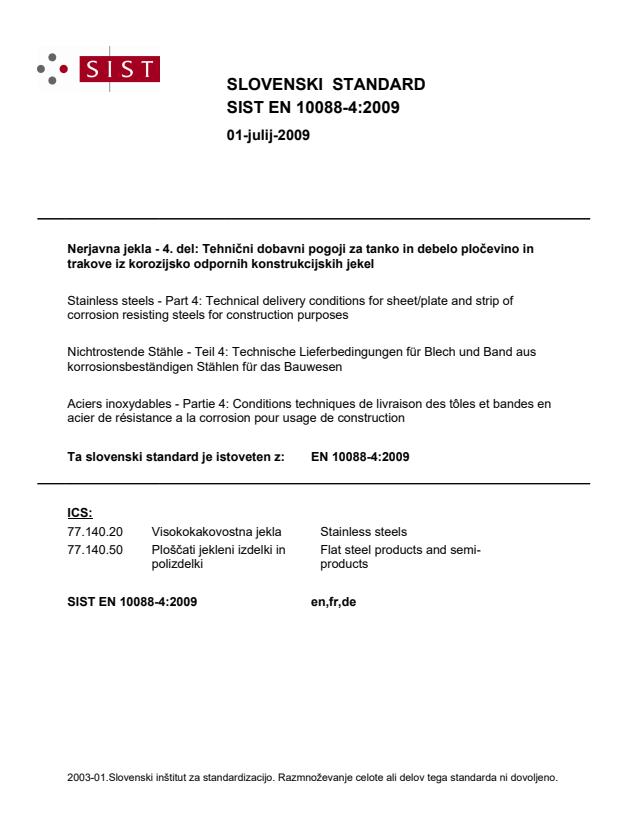
2003-01.Slovenski inštitut za standardizacijo. Razmnoževanje celote ali delov tega standarda ni dovoljeno.Nichtrostende Stähle - Teil 4: Technische Lieferbedingungen für Blech und Band aus korrosionsbeständigen Stählen für das BauwesenAciers inoxydables - Partie 4: Conditions techniques de livraison des tôles et bandes en acier de résistance a la corrosion pour usage de constructionStainless steels - Part 4: Technical delivery conditions for sheet/plate and strip of corrosion resisting steels for construction purposes77.140.50SROL]GHONLFlat steel products and semi-products77.140.20Visokokakovostna jeklaStainless steelsICS:Ta slovenski standard je istoveten z:EN 10088-4:2009SIST EN 10088-4:2009en,fr,de01-julij-2009SIST EN 10088-4:2009SLOVENSKI
STANDARD
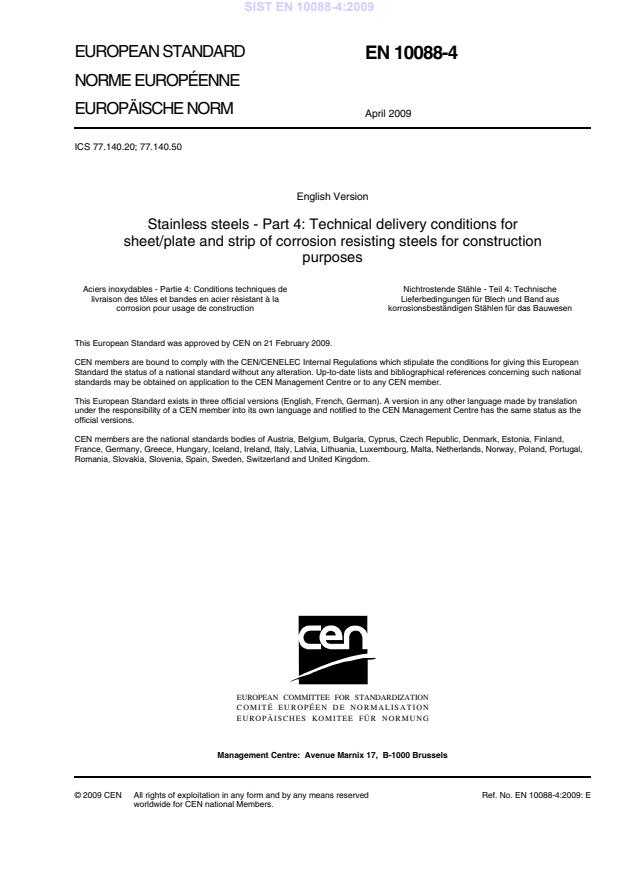
EUROPEAN STANDARDNORME EUROPÉENNEEUROPÄISCHE NORMEN 10088-4April 2009ICS 77.140.20; 77.140.50 English VersionStainless steels - Part 4: Technical delivery conditions forsheet/plate and strip of corrosion resisting steels for constructionpurposesAciers inoxydables - Partie 4: Conditions techniques delivraison des tôles et bandes en acier résistant à lacorrosion pour usage de constructionNichtrostende Stähle - Teil 4: TechnischeLieferbedingungen für Blech und Band auskorrosionsbeständigen Stählen für das BauwesenThis European Standard was approved by CEN on 21 February 2009.CEN members are bound to comply with the CEN/CENELEC Internal Regulations which stipulate the conditions for giving this EuropeanStandard the status of a national standard without any alteration. Up-to-date lists and bibliographical references concerning such nationalstandards may be obtained on application to the CEN Management Centre or to any CEN member.This European Standard exists in three official versions (English, French, German). A version in any other language made by translationunder the responsibility of a CEN member into its own language and notified to the CEN Management Centre has the same status as theofficial versions.CEN members are the national standards bodies of Austria, Belgium, Bulgaria, Cyprus, Czech Republic, Denmark, Estonia, Finland,France, Germany, Greece, Hungary, Iceland, Ireland, Italy, Latvia, Lithuania, Luxembourg, Malta, Netherlands, Norway, Poland, Portugal,Romania, Slovakia, Slovenia, Spain, Sweden, Switzerland and United Kingdom.EUROPEAN COMMITTEE FOR STANDARDIZATIONCOMITÉ EUROPÉEN DE NORMALISATIONEUROPÄISCHES KOMITEE FÜR NORMUNGManagement Centre:
Avenue Marnix 17,
B-1000 Brussels© 2009 CENAll rights of exploitation in any form and by any means reservedworldwide for CEN national Members.Ref. No. EN 10088-4:2009: ESIST EN 10088-4:2009
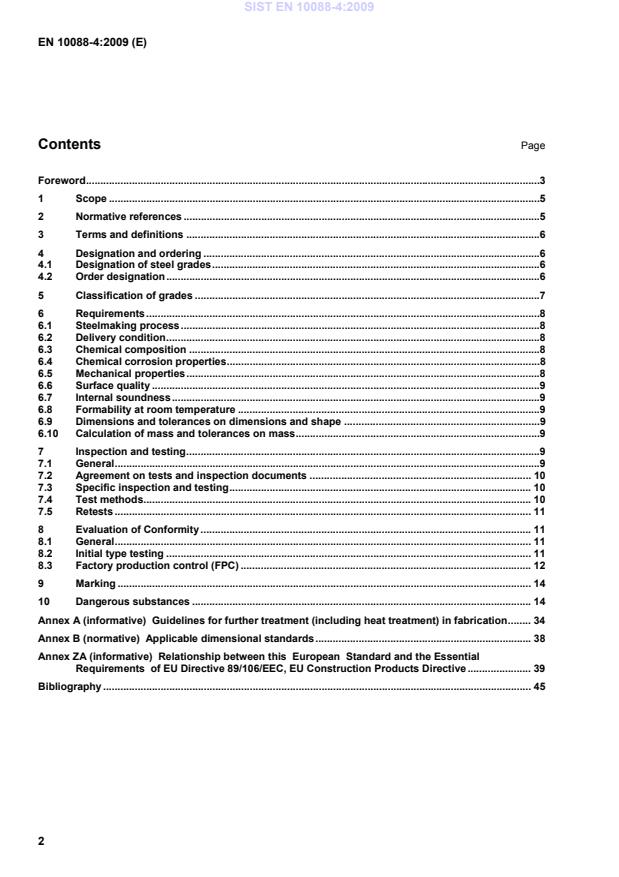
Guidelines for further treatment (including heat treatment) in fabrication . 34 Annex B (normative)
Applicable dimensional standards . 38 Annex ZA (informative)
Relationship between this
European
Standard and the Essential Requirements
of EU Directive 89/106/EEC, EU Construction Products Directive . 39 Bibliography . 45
Part 1: List of stainless steels (including a table of European Standards, in which these stainless steels are further specified, see Annex D); Part 2: Technical delivery conditions for sheet/plate and strip of corrosion resisting steels for general purposes; Part 3: Technical delivery conditions for semi-finished products, bars, rods, wire, sections and bright products of corrosion resisting steels for general purposes; Part 4: Technical delivery conditions for sheet/plate and strip of corrosion resisting steels for construction purposes; Part 5: Technical delivery conditions for bars, rods, wire, sections and bright products of corrosion resisting steels for construction purposes. The European Committee for Standardisation (CEN) draws attention to the fact that it is claimed that compliance with this document may involve the use of patents concerning two steel grades. The holder of these patent rights has assured the CEN that he/she is willing to negotiate licences under reasonable and non-discriminatory terms and conditions with applicants throughout the world. In this respect, the statement of the holder of this patent right is registered with CEN [and/or] CENELEC. Information may be obtained from: Sandvik AB SE-811 81 SANDVIKEN Sweden for grade 1.4477 Outokumpu Stainless AB SE-77480 AVESTA Sweden for grade 1.4162
CEN takes no position concerning the evidence, validity and scope of this patent right. Attention is drawn to the possibility that some of the elements of this document may be the subject of patent rights other than those identified above. CEN shall not be held responsible for identifying any or all such patent rights. This document has been prepared under a mandate given to CEN by the European Commission and the European Free Trade Association, and supports essential requirements of EC Directive(s). SIST EN 10088-4:2009
3.4 types of heat-treatment the definitions in EN 10052:1993 apply
3.5 standard grades
grades with a relatively good availability and a wider range of application
3.6 special grades
grades for special use and/or with limited availability
4 Designation and ordering 4.1 Designation of steel grades The steel names and steel numbers (see Tables 1 to 4) are allocated in accordance with EN 10027-1 and EN 10027-2 respectively. 4.2 Order designation The complete designation for ordering a product according to this European Standard shall contain the following information: a) the desired quantity; b) the product form (e.g.: strip or sheet/plate); SIST EN 10088-4:2009
d) the type of material (steel); e) the number of this European Standard; f) the steel name or steel number; g) the symbol for the desired heat treatment or cold worked condition, if for the relevant steel in the tables for the mechanical properties more than one treatment condition is covered; h) the desired process route (see symbols in Table 6); i) verification of internal soundness, if required (flat products with thickness ≥ 6 mm shall be tested in accordance with EN 10307); j) the type of inspection certificate (3.1 or 3.2) according to EN 10204; k) regulatory marking requirements (see Annex ZA). EXAMPLE 10 plates of a steel grade with the name X5CrNi18-10 and the number 1.4301 as specified in
EN 10088-4 with nominal dimensions thickness = 8 mm, width = 2000 mm, length = 5000 mm; tolerances on dimensions, shape and mass as specified in EN 10029 with thickness tolerance class B and "normal" flatness tolerance class, in process route 1D (see Table 6), inspection certificate 3.1 as specified in EN 10204 and declaration of conformity: 10 plates EN 10029-8B x 2000 x 5000 Steel EN 10088-4 - X5CrNi18-10+1D Inspection certificate 3.1, CE or 10 plates EN 10029-8B x 2000 x 5000 Steel EN 10088-4 - 1.4301+1D Inspection certificate 3.1, CE 5 Classification of grades Steels covered in this European Standard are classified according to their structure into a) ferritic steels; b) martensitic steels; c) precipitation hardening steels; d) austenitic steels; e) austenitic-ferritic steels. See also Annex B to EN 10088-1:2005. SIST EN 10088-4:2009
Referring to resistance to intergranular corrosion as defined in EN ISO 3651-2, for ferritic, austenitic and austenitic-ferritic steels the specification in Tables 7, 10 and 11 shall apply. EN ISO 3651-2 shall not be applicable for testing martensitic and precipitation hardening steels. NOTE The corrosion resistance of stainless steels is very dependant on the type of environment and can therefore not always be clearly ascertained through laboratory tests. It is therefore advisable to draw on the available experience of the use of the steels. 6.5 Mechanical properties 6.5.1 The mechanical properties at room temperature as specified in Tables 7 to 11 shall apply for the relevant specified heat treatment condition. This does not apply to the process route 1U (hot rolled, not heat treated, not descaled). If the products are to be supplied in a non-heat-treated condition, the mechanical properties specified in 7 to 11 shall be obtained from reference test pieces which have received the appropriate heat treatment (simulated heat treatment). For cold worked products, the tensile strength levels at ambient temperature as specified in Table 13 shall apply. The available tensile strength levels in the cold worked condition are indicated in Table 15. Alternatively, cold worked products can be ordered according to their 0,2%-proof strength as given in Tables 14 and 16. NOTE Austenitic steels are insensitive to brittle fracture in the solution annealed condition. Because they do not have a pronounced transition temperature, which is characteristic of other steels, they are also useful for application at cryogenic temperatures. 6.5.2 The values in Table 12 shall apply for the 0,2 %- and 1 %-proof strength of austenitic steels at elevated temperatures. SIST EN 10088-4:2009
EN 10088-1 shall be used as a basis for the density of the steel concerned. 6.10.2
If the tolerances on mass are not specified in the dimensional standard listed in Annex B, they may be agreed at the time of enquiry and order. 7 Inspection and testing 7.1 General The process control, inspection and testing shall be carried out according to 8.3 to ensure that the product complies with the requirements of both this European Standard and the order.
This includes the following: a) A suitable frequency of verification of the dimensions of the products; b) An adequate intensity of visual examination of the surface quality of the products; c) An appropriate frequency and type of test to ensure that the correct grade of steel is used. The nature and frequency of these verifications, examinations and tests shall be in accordance with the manufacturer's written procedures in compliance with 8.3. SIST EN 10088-4:2009
The specific inspection described in 7.3 shall be carried out and confirmed together with the following information in the inspection certificate with the code numbers and details required by EN 10168:2004. a) the information groups A, B and Z of EN 10168:2004; b) the results of the cast analysis in accordance with the code numbers C71 to C92 in EN 10168:2004; c) the results of the tests marked in Table 17, second column, by "m"; d) the result of any optional test or inspections agreed at the time of enquiry and order; e) the regulatory information (see Annex ZA). 7.3 Specific inspection and testing 7.3.1 Extent of testing The tests to be carried out and the composition and size of the test units and the number of sample products, samples and test pieces to be taken shall be as in Table 17. 7.3.2 Selection and preparation of samples and test pieces 7.3.2.1 Sampling and sample preparation shall be in accordance with the requirements of EN ISO 14284 and EN ISO 377. In addition, the stipulations in 7.3.2.2 apply for the mechanical tests. 7.3.2.2 The samples for the tensile test shall be taken in accordance with Figure 1 in such a way that they are located halfway between the centre and a longitudinal edge. Impact test samples shall be taken from the same location. The samples shall be taken from products in the delivery condition. If agreed, the samples may be taken before flattening. For samples to be given a simulated heat treatment the conditions for annealing, hardening and tempering shall be agreed. 7.3.2.3 Samples for the hardness test and for the resistance to intergranular corrosion test shall be taken from the same locations as those for the mechanical tests. For direction of bending the test piece in the resistance to intergranular corrosion test, see Figure 2. 7.4 Test methods 7.4.1 The chemical analysis shall be carried out using the appropriate European Standard for the element being analysed. In the absence of an appropriate European Standard, the choice of a suitable physical or chemical analytical method for the analysis shall be at the discretion of the manufacturer. The manufacturer shall declare the test method used, if required. The list of available European Standards on chemical analysis is given in CEN/TR 10261. 7.4.2 The tensile test at room temperature shall be carried out in accordance with EN 10002-1 taking into account the additional or deviating conditions specified in Figure 1, footnote a. The tensile strength, elongation after fracture and the 0,2 % proof strength shall be determined. In addition for austenitic steels only, the 1 %-proof strength shall be determined. SIST EN 10088-4:2009
b) in accordance with the rules for families and/or direct or extended application of test results. 8.2.2 Characteristics All characteristics of Clause 6 shall be subject to initial type testing, with following exceptions: a) Weldability is covered by chemical composition; b) Durability is covered by chemical composition; c) Fracture toughness is covered by impact strength, no additional test available; d) Cold formability is covered by elongation, no additional test available; e) Release of dangerous substances is covered by chemical composition. 8.2.3 Use of historical data Tests previously performed on the same steel product in accordance with the provisions of this European Standard (same characteristic(s), test method, sampling procedure, system of attestation of conformity, etc.) may be taken into account. 8.2.4 Sampling, testing and conformity criteria 8.2.4.1 Sampling Initial type testing shall be performed on samples of steel products representative for the manufactured steel product type. 8.2.4.2 Testing and conformity criteria lntensive testing shall be specific inspection and testing in accordance with 7.3 carried out on the first five casts produced. However, for tensile and impact testing, at least 6 products from each of the five casts shall be tested and where this is not possible test pieces shall be taken from opposite ends of the products being tested. The results of all type tests shall be recorded and held by the manufacturer for at least 10 years after the date when the last product to which they apply was delivered. 8.3 Factory production control (FPC) 8.3.1 General The manufacturer shall establish, document and maintain an FPC system to ensure that the products placed on the market conform to the declared performance characteristics. The FPC system shall consist of written SIST EN 10088-4:2009
The specifications of all incoming raw materials shall be documented, as shall the inspection scheme for ensuring their conformity. The verification of conformity of the raw material with the specification shall be in accordance with EN ISO 9001:2008, 7.4.3. SIST EN 10088-4:2009
Type of test piece Product thickness t Direction of the longitudinal axis of the test piece in relation to the principal direction of rolling at a final rolling width of Distance of the test piece from the rolled surface
mm < 300 mm ≥ 300 mm mm
Tensilea
≤ 30
longitudinal
transverse
> 30
Impactb
> 10
longitudinal
transverse
a In cases of doubt the gauge length shall be Lo = 5,65 √So
for test pieces from products t ≥ 3 mm. For products t < 3 mm thickness, non proportional test pieces with a gauge length of 80 mm and a width of 20 mm shall be used, but test pieces with a gauge length of 50 mm and a width of 12,5 mm may also be applied. For products with a thickness 3 mm < t ≤ 10 mm, flat proportional test pieces with two rolled surfaces and a maximum width of 30 mm shall be used. For products with a thickness t > 10 mm, one of the following proportional test pieces shall be used:
- either a flat test piece with a maximum thickness of 30 mm; the thickness may be reduced to 10 mm by machining, but one rolled
surface must be preserved.
- or a round test piece with a diameter of ≥ 5 mm the axis of which shall be located as close as possible to a plane in the outer sixth of
the product thickness t. b The longitudinal axis of the notch shall always be perpendicular to the rolled surface of the product. c In the case of product thickness greater than 30 mm, the impact test piece may be taken at quarter of the product thickness. Key 1
Rolled surface Figure 1 — Position of test pieces for flat products
Key
1 Rolling direction Figure 2 — Direction of bending the test piece in relation to the rolling direction in the resistance to intergranular corrosion test
All precautions shall be taken to avoid the addition of such elements not quoted in the table from scrap and other materials used in production which would impair mechanical properties and the
suitability of the steel. a Particular ranges of sulphur content can provide improvement of particular properties. For machinability a controlled sulphur content of 0,015 % to 0,030 % is recommended and shall be permitted.
For weldability, a controlled sulphur content of 0,008 % to 0,015 % is recommended. For polishability, a controlled sulphur content of 0,015 % max. is recommended.
b The stabilisation may be by use of titanium or niobium or zirconium. According to the atomic mass of these elements and the content of carbon and nitrogen, the equivalence shall be the following:
Nb
(% by mass) = Zr (% by mass) = 7/4 Ti (% by mass).
Table 2 — Chemical composition (cast analysis) of martensitic and precipitation hardening corrosion resisting steels Steel designation % by mass Name Number C
Si max. Mn max P max. S max. Cr Cu Mo Ni Others Standard grades (martensitic steels) X12Cr13 1.4006 0,08 to 0,15 1,00 1,50 0,040 0,015a 11,5 to 13,5 - - ≤ 0,75 - X20Cr13 1.4021 0,16 to 0,25 1,00 1,50 0,040 0,015a 12,0 to 14,0 - - - - X4CrNiMo16-5-1 1.4418 ≤ 0,06 0,70 1,50 0,040 0,015a 15,0 to 17,0 - 0,80 to 1,50 4,0 to 6,0 N: ≥ 0,020 Special grades (precipitation hardening steels) X5CrNiCuNb16-4 1.4542 ≤ 0,07 0,70 1,50 0,040 0,015a 15,0 to 17,0 3,0 to 5,0 ≤ 0,60 3,0 to 5,0 Nb: 5xC to 0,45 X7CrNiAI17-7 1.4568 ≤ 0,09 0,70 1,00 0,040 0,015 16,0 to 18,0 - - 6,5 to 7,8b AI: 0,70 to 1,50
All precautions shall be taken to avoid the addition of such elements not quoted in the table from scrap and other materials used in production which would impair mechanical properties and the
suitability of the steel. a Particular ranges of sulphur content can provide improvement of particular properties. For machinability a controlled sulphur content of 0,015 % to 0,030 % is recommended and shall be permitted.
For weldability, a controlled sulphur content of 0,008 % to 0,015 % is recommended. For polishability, a controlled sulphur content of 0,015 % max. is recommended.
b For better cold deformability, the upper limit may be increased to 8,3 %.
1.4401 ≤ 0,07 ≤ 1,00 ≤ 2,00 0,045 ≤ 0,015a≤ 0,10 16,5 to 18,5 - 2,00 to 2,50 - 10,0 to 13,0 - X6CrNiMoTi17-12-2 1.4571 ≤ 0,08 ≤ 1,00 ≤ 2,00 0,045 ≤ 0,015a- 16,5 to 18,5 - 2,00 to 2,50 - 10,5 to 13,5 Ti: 5 x C to 0,70 X2CrNiMo17-12-3 1.4432 ≤ 0,030 ≤ 1,00 ≤ 2,00 0,045 ≤ 0,015a≤ 0,10 16,5 to 18,5 - 2,50 to 3,00 - 10,5 to 13,0 - X2CrNiMo18-14-3 1.4435 ≤ 0,030 ≤ 1,00 ≤ 2,00 0,045 ≤ 0,015a≤ 0,10 17,0 to 19,0 - 2,50 to 3,00 - 12,5 to15,0 - X2CrNiMoN17-13-5 1.4439 ≤ 0,030 ≤ 1,00 ≤ 2,00 0,045 ≤ 0,015a0,12 to 0,22 16,5 to18,5 - 4,0 to 5,0 - 12,5 to 14,5 - X1NiCrMoCu25-20-5 1.4539 ≤ 0,020 ≤ 0,70 ≤ 2,00 0,030 ≤ 0,010 ≤ 0,15 19,0 to 21,0 1,20 to 2,00 4,0 to 5,0 - 24,0 to 26,0 - Special grades X1CrNi25-21 1.4335 ≤ 0,020 ≤ 0,25 ≤ 2,00 0,025 ≤ 0,010 ≤ 0,10 24,0 to 26,0 - ≤ 0,20 - 20,0 to 22,0 - X1CrNiMoN25-22-2 1.4466 ≤ 0,020 ≤ 0,70 ≤ 2,00 0,025 ≤ 0,010 0,10 to 0,16 24,0 to 26,0 - 2,00 to 2,50 - 21,0 to 23,0 - X2CrNiMoN17-13-3 1.4429 ≤ 0,030 ≤ 1,00 ≤ 2,00 0,045 ≤ 0,015 0,12 to 0,22 16,5 to 18,5 - 2,50 to 3,00 - 11,0 to 14,0 - X3CrNiMo17-13-3 1.4436 ≤ 0,05 ≤ 1,00 ≤ 2,00 0,045 ≤ 0,015a≤ 0,10 16,5 to 18,5 - 2,50 to 3,00 - 10,5 to 13,0 - X2CrNiMo18-15-4 1.4438 ≤ 0,030 ≤ 1,00 ≤ 2,00 0,045 ≤ 0,015a≤ 0,10 17,5 to 19,5 - 3,0 to 4,0 - 13,0 to 16,0 - X12CrMnNiN17-7-5 1.4372 ≤ 0,15 ≤ 1,00 5,5 to 7,5 0,045 ≤ 0,015 0,05 to 0,25 16,0 to 18,0 - - - 3,5 to 5,5 - X1NiCrMoCu31-27-4 1.4563 ≤ 0,020 ≤ 0,70 ≤ 2,00 0,030 ≤ 0,010 ≤ 0,10 26,0 to 28,0 0,70 to 1,50 3,0 to 4,0 - 30,0 to 32,0 - X1CrNiMoCuN20-18-7 1.4547 ≤ 0,020 ≤ 0,70 ≤ 1,00 0,030 ≤ 0,010 0,18 to 0,25 19,5 to 20,5 0,50 to 1,00 6,0 to 7,0 - 17,5 to 18,5 - X1NiCrMoCuN25-20-7 1.4529 ≤ 0,020 ≤ 0,50 ≤ 1,00 0,030 ≤ 0,010 0,15 to 0,25 19,0 to 21,0 0,50 to 1,50 6,0 to 7,0 - 24,0 to 26,0 - X2CrNiMnMoN25-18-6-5 1.4565 ≤ 0,030 ≤ 1,00 5,0 to 7,0 0,030 ≤ 0,015 0,30 to 0,60 24,0 to 26,0 - 4,0 to 5,0 ≤ 0,15 16,0 to 19,0 -
All precautions shall be taken to avoid the addition of such elements not quoted in the table from scrap and other materials used in production which would impair mechanical properties and the
suitability of the steel. a Particular ranges of sulphur content can provide improvement of particular properties. For machinability a controlled sulphur content of 0,015 % to 0,030 % is recommended and shall be permitted. For weldability, a
controlled sulphur content of 0,008 % to 0,015 % is recommended. For polishability, a controlled sulphur content of 0,015 % max. is recommended.
Mn
P max. S max. N Cr Cu Mo Ni Standard grades X2CrNiN23-4 1.4362 0,030 ≤ 1,00 ≤ 2,00 0,035 0,015 0,05 to 0,20 22,0 to 24,0 0,10 to 0,60 0,10 to 0,60 3,5 to 5,5 X2CrNiMoN22-5-3a 1.4462a 0,030 ≤ 1,00 ≤ 2,00 0,035 0,015 0,10 to 0,22 21,0 to 23,0 - 2,50 to 3,5 4,5 to 6,5 Special grades X2CrNiMoN29-7-2*) 1.4477*) 0,030 ≤ 0,50
...
Questions, Comments and Discussion
Ask us and Technical Secretary will try to provide an answer. You can facilitate discussion about the standard in here.
Loading comments...