


SIST EN 212:2004
(Main)Wood preservatives - General guidance on sampling and preparation for analysis of wood preservatives and treated timber
General Information
- Abstract
This European Standard gives guidance on the general procedures to be followed in the sampling and preparation for analysis of wood preservatives and preservative-treated timber.
This European Standard is applicable to the provision of appropriate samples for analysis which can be used to check the content of active and other ingredients in preservative formulations, and the content of active and other ingredients of wood preservatives in treated timber, either before, during or after the service life of the timber.
NOTE 1 Methods of sampling creosote and creosote-treated timber are described in EN 1014-1, 1014-2 and EN 12490. These are to be used in preference to the recommendations in this European Standard.
NOTE 2 No attempt has been made in this document to lay down detailed procedures to be adopted for control purposes at manufacturing plants where large volumes of preservatives are to be sampled. Nor does it attempt to establish procedures for checking the compliance of batches of treated timber with specifications demanding a defined level of treatment (see 6.2).
- Status
- Withdrawn
- Publication Date
- 31-Dec-2003
- Withdrawal Date
- 03-Sep-2026
- Technical Committee
- LLZ - Les, lesni izdelki in zaščita lesa
- Current Stage
- 9900 - Withdrawal (Adopted Project)
- Start Date
- 04-Sep-2026
- Due Date
- 27-Sep-2026
- Completion Date
- 04-Sep-2026
- Directive
- Harmonized Standard305/2011 - Regulation (eu) No 305/2011 of the European Parliament and of the Council of 9 march 2011 laying down harmonised conditions for the marketing of construction products and repealing council directive 89/106/eec
Not Harmonized89/106/EEC - Construction products

EN 212:2003 - Wood preservatives: sampling & preparation (CEN)
Overview
EN 212:2003, published by CEN, provides general guidance on the sampling and sample preparation required for the analysis of wood preservatives and preservative-treated timber. It covers how to obtain representative samples for checking the content of active and other ingredients in preservative formulations and in treated timber - before, during or after the service life of the timber. The standard is advisory: it sets general procedures and safety precautions rather than detailed factory control protocols.
Key topics and technical requirements
- Scope and purpose: Guidance for producing representative samples suitable for chemical analysis of preservatives and treated timber.
- Sampling strategy: Recommendations on selection of containers to sample (minimum number ≈ nearest whole number to the square root of half the total containers in a consignment).
- Sample containers & inert materials: Use container materials inert to the preservative (e.g., glass for many solvents; polyethylene for some boron/fluorine preservatives). Avoid polyethylene with hydrocarbon solvents.
- Solid, paste and liquid sampling:
- Solid preservatives: use a sampling spear (internal diameter ≈ 30 mm), take five spear samples per drum and combine; reduce by coning and quartering to a ~200 g test sample; sieve if required (nominal 2.00 mm).
- Paste preservatives: homogenize, take multiple depths (surface, middle, near base) with a wide‑mouthed can, combine and mix.
- Liquid sampling: (guidance provided in the standard - follow inert container and representative withdrawal principles).
- Treated timber sampling: General procedures for selecting and taking wood samples; methods for moisture content determination of treated timber and guidance on thin-section coring (specific borers for thin sections).
- Safety: Treat all preservatives as potentially toxic; use PPE when handling wet or solvent-containing timber; use dust extraction and respiratory protection when machining treated timber; observe flammable-liquid regulations.
- Documentation: Include a sampling report specifying lot/consignment, sampling plan, storage conditions and any irregularities.
Applications and users
- Quality control and R&D laboratories analyzing preservative formulations and retained active ingredient levels.
- Timber treatment plants and manufacturers preparing samples for external testing.
- Certification bodies, inspectors and forensic labs performing arbitration or compliance checks.
- Researchers studying preservative distribution, penetration and long-term performance of treated timber.
Related standards
- EN 351-1 / EN 351-2 - Preservative-treated wood (penetration/retention classification and sampling guidance)
- EN 1014-1, EN 1014-2 and EN 12490 - Specific sampling rules for creosote and creosote-treated timber (use in preference to EN 212 where applicable)
- ISO 6206 - Sampling vocabulary and concepts
EN 212:2003 is a practical reference for ensuring representative, safely handled samples for accurate chemical analysis of wood preservatives and treated timber.
Relations
- Effective Date
- 01-Jan-2004
- Effective Date
- 25-Aug-2026
- Effective Date
- 28-Jan-2026
- Effective Date
- 28-Jan-2026
- Effective Date
- 28-Jan-2026
- Effective Date
- 28-Jan-2026
- Effective Date
- 28-Jan-2026
- Effective Date
- 28-Jan-2026
- Effective Date
- 28-Jan-2026
- Effective Date
- 28-Jan-2023
Get Certified
Connect with accredited certification bodies for this standard

ECOCERT
Organic and sustainability certification.

Eurofins Food Testing Global
Global leader in food, environment, and pharmaceutical product testing.

Intertek Bangladesh
Intertek certification and testing services in Bangladesh.
Sponsored listings
Frequently Asked Questions
SIST EN 212:2004 is a standard published by the Slovenian Institute for Standardization (SIST). Its full title is "Wood preservatives - General guidance on sampling and preparation for analysis of wood preservatives and treated timber". This standard covers: This European Standard gives guidance on the general procedures to be followed in the sampling and preparation for analysis of wood preservatives and preservative-treated timber. This European Standard is applicable to the provision of appropriate samples for analysis which can be used to check the content of active and other ingredients in preservative formulations, and the content of active and other ingredients of wood preservatives in treated timber, either before, during or after the service life of the timber. NOTE 1 Methods of sampling creosote and creosote-treated timber are described in EN 1014-1, 1014-2 and EN 12490. These are to be used in preference to the recommendations in this European Standard. NOTE 2 No attempt has been made in this document to lay down detailed procedures to be adopted for control purposes at manufacturing plants where large volumes of preservatives are to be sampled. Nor does it attempt to establish procedures for checking the compliance of batches of treated timber with specifications demanding a defined level of treatment (see 6.2).
This European Standard gives guidance on the general procedures to be followed in the sampling and preparation for analysis of wood preservatives and preservative-treated timber. This European Standard is applicable to the provision of appropriate samples for analysis which can be used to check the content of active and other ingredients in preservative formulations, and the content of active and other ingredients of wood preservatives in treated timber, either before, during or after the service life of the timber. NOTE 1 Methods of sampling creosote and creosote-treated timber are described in EN 1014-1, 1014-2 and EN 12490. These are to be used in preference to the recommendations in this European Standard. NOTE 2 No attempt has been made in this document to lay down detailed procedures to be adopted for control purposes at manufacturing plants where large volumes of preservatives are to be sampled. Nor does it attempt to establish procedures for checking the compliance of batches of treated timber with specifications demanding a defined level of treatment (see 6.2).
SIST EN 212:2004 is classified under the following ICS (International Classification for Standards) categories: 71.100.50 - Wood-protecting chemicals. The ICS classification helps identify the subject area and facilitates finding related standards.
SIST EN 212:2004 has the following relationships with other standards: It is inter standard links to SIST EN 212:1995, SIST ISO 6206:1995, SIST EN 351-1:2023, SIST EN 351-2:2023, SIST EN 1998-6:2005, SIST-TP CEN/TR 16420:2013, SIST EN 14229:2011, SIST-TR CEN/TR 14823:2004, SIST-TS CEN/TS 12037:2005, SIST EN 212:2026. Understanding these relationships helps ensure you are using the most current and applicable version of the standard.
SIST EN 212:2004 is associated with the following European legislation: EU Directives/Regulations: 305/2011, 89/106/EEC. When a standard is cited in the Official Journal of the European Union, products manufactured in conformity with it benefit from a presumption of conformity with the essential requirements of the corresponding EU directive or regulation.
SIST EN 212:2004 is available in PDF format for immediate download after purchase. The document can be added to your cart and obtained through the secure checkout process. Digital delivery ensures instant access to the complete standard document.
Standards Content (Sample)
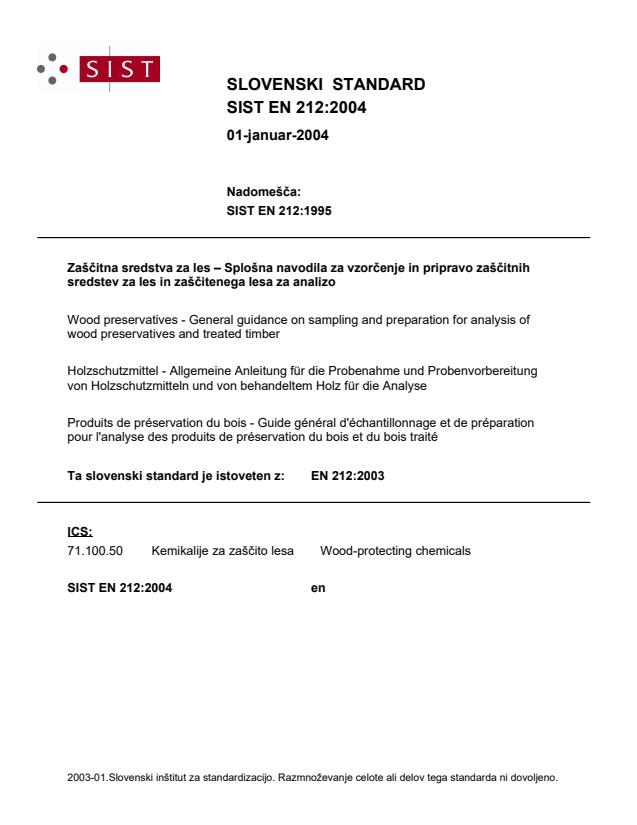
2003-01.Slovenski inštitut za standardizacijo. Razmnoževanje celote ali delov tega standarda ni dovoljeno.Holzschutzmittel - Allgemeine Anleitung für die Probenahme und Probenvorbereitung von Holzschutzmitteln und von behandeltem Holz für die AnalyseProduits de préservation du bois - Guide général d'échantillonnage et de préparation pour l'analyse des produits de préservation du bois et du bois traitéWood preservatives - General guidance on sampling and preparation for analysis of wood preservatives and treated timber71.100.50Wood-protecting chemicalsICS:Ta slovenski standard je istoveten z:EN 212:2003SIST EN 212:2004en01-januar-2004SIST EN 212:2004SLOVENSKI
STANDARDSIST EN 212:19951DGRPHãþD
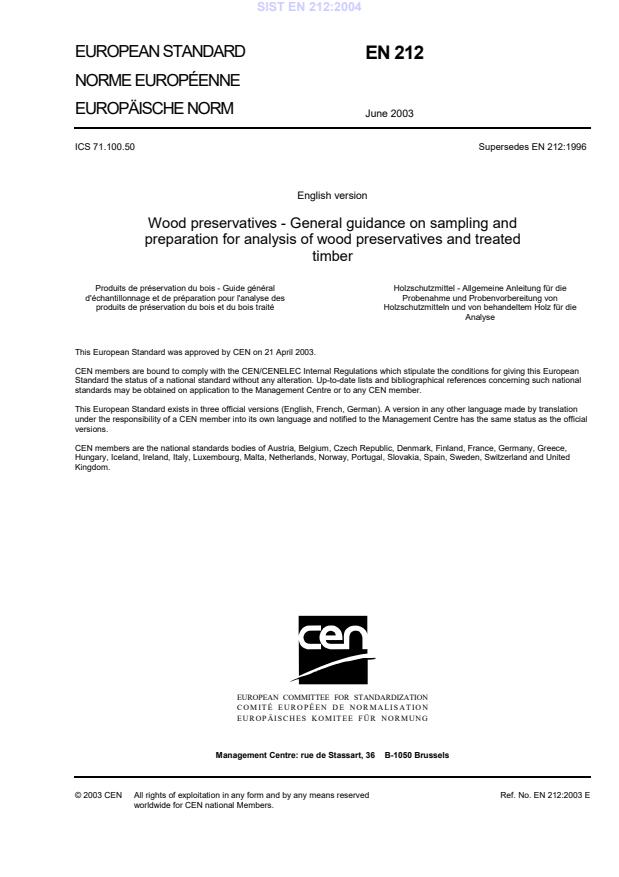
EUROPEAN STANDARDNORME EUROPÉENNEEUROPÄISCHE NORMEN 212June 2003ICS 71.100.50Supersedes EN 212:1996English versionWood preservatives - General guidance on sampling andpreparation for analysis of wood preservatives and treatedtimberProduits de préservation du bois - Guide générald'échantillonnage et de préparation pour l'analyse desproduits de préservation du bois et du bois traitéHolzschutzmittel - Allgemeine Anleitung für dieProbenahme und Probenvorbereitung vonHolzschutzmitteln und von behandeltem Holz für dieAnalyseThis European Standard was approved by CEN on 21 April 2003.CEN members are bound to comply with the CEN/CENELEC Internal Regulations which stipulate the conditions for giving this EuropeanStandard the status of a national standard without any alteration. Up-to-date lists and bibliographical references concerning such nationalstandards may be obtained on application to the Management Centre or to any CEN member.This European Standard exists in three official versions (English, French, German). A version in any other language made by translationunder the responsibility of a CEN member into its own language and notified to the Management Centre has the same status as the officialversions.CEN members are the national standards bodies of Austria, Belgium, Czech Republic, Denmark, Finland, France, Germany, Greece,Hungary, Iceland, Ireland, Italy, Luxembourg, Malta, Netherlands, Norway, Portugal, Slovakia, Spain, Sweden, Switzerland and UnitedKingdom.EUROPEAN COMMITTEE FOR STANDARDIZATIONCOMITÉ EUROPÉEN DE NORMALISATIONEUROPÄISCHES KOMITEE FÜR NORMUNGManagement Centre: rue de Stassart, 36
B-1050 Brussels© 2003 CENAll rights of exploitation in any form and by any means reservedworldwide for CEN national Members.Ref. No. EN 212:2003 ESIST EN 212:2004
...