


SIST EN 1370:2026
(Main)Founding - Examination of surface condition
General Information
- Abstract
This document specifies methods for the examination of surface condition (roughness and surface discontinuities) of castings on surfaces that remain as-cast.
This document is applicable to all cast metals and all casting processes except die casting.
This document is not applicable to machined surfaces.
- Status
- Published
- Public Enquiry End Date
- 09-Oct-2025
- Publication Date
- 09-Sep-2026
- Technical Committee
- IFEK - Ferrous metals
- Current Stage
- 6060 - National Implementation/Publication (Adopted Project)
- Start Date
- 04-Sep-2026
- Due Date
- 09-Nov-2026
- Completion Date
- 10-Sep-2026

Overview
SIST EN 1370:2026 is the key European standard for the examination of surface condition-specifically surface roughness and surface discontinuities-on as-cast surfaces of metal castings. Developed by the Slovenian Institute for Standardization (SIST), this standard ensures uniform procedures and criteria for assessing the as-cast surfaces of metal components produced via all casting methods, except die casting. It is not applicable to machined surfaces.
Consistent surface quality is crucial for both the functional and aesthetic performance of cast products. SIST EN 1370:2026 provides guidance for manufacturers and purchasers, enabling clear agreements on acceptance criteria, inspection methods, and documentation for surface conditions.
Key Topics
- Scope: Applies to all cast metals and all casting processes, with the exception of die casting. Excludes surfaces that have undergone machining.
- Surface Condition Types:
- Surface Roughness: Relates to the texture and micro-geometry of the as-cast surface.
- Surface Discontinuities: Includes irregularities such as laps, cold shuts, inclusions, gas porosity, scabs, and welding indications.
- Examination Methods:
- Visual-Tactile Comparators: Reference strips that are direct replicas of casting surfaces (e.g., BNIF and SCRATA comparators).
- Contact or Optical Instruments: Devices that measure surface profiles for more precise quantification, as agreed between manufacturer and purchaser.
- Severity Levels:
- Defined levels for roughness and discontinuities, tailored to different casting applications and sizes.
- Guidance for classification by dimension and by comparator assessment.
- Documentation and Reporting:
- Requirements for records including casting identification, examiner qualifications, methods used, and results of examination.
Applications
SIST EN 1370:2026 is widely used across sectors where metallic castings are essential, including:
- Automotive and Transport: Ensures components like engine blocks and suspension parts meet strict safety and reliability requirements.
- Industrial Machinery: Facilitates the production of robust machinery parts with consistent surface integrity.
- Aerospace: Supports high-quality standards for cast metal parts subjected to critical loads or environmental exposure.
- Construction and Infrastructure: Assures the performance and appearance of architectural and structural cast metal elements.
- General Foundry Operations: Enables standardization in quality control, production, and procurement processes for foundries of all sizes.
Employing this standard helps manufacturers and clients avoid ambiguity, reduce non-conformances, and minimize costly rework related to surface finish issues. It also enhances communication regarding expectations for as-cast surface quality.
Related Standards
For a complete quality assurance regime, consider the following related standards:
- EN 1559-3: Founding - Technical conditions of delivery - Additional requirements for iron castings
- EN 13018: Non-destructive testing - Visual testing - General principles
- BNIF 359: Characterization of as-cast surfaces for all metals using standardized tactile comparators
- SCRATA Comparators: Used for steel and iron casting surface quality assessment
- BS 7900: Specification for examination of surface texture in precision steel castings
SIST EN 1370:2026 integrates well with these documents to reinforce inspection processes, supporting quality, compliance, and customer satisfaction in metal casting industries.
Keywords: surface condition, as-cast surface, casting examination, surface roughness, surface discontinuities, visual comparators, foundry standards, SIST EN 1370, metal casting, non-destructive testing, quality control, comparator strips, casting processes.
Relations
- Effective Date
- 02-Sep-2026
- Effective Date
- 02-Sep-2026
- Effective Date
- 02-Sep-2026
- Effective Date
- 02-Sep-2026
- Effective Date
- 02-Sep-2026
- Effective Date
- 02-Sep-2026
- Effective Date
- 02-Sep-2026
- Referred By
SIST EN 1371-2:2000 - Founding - Liquid penetrant inspection - Part 2: Investment castings - Effective Date
- 02-Sep-2026
- Effective Date
- 02-Sep-2026
- Effective Date
- 02-Sep-2026
- Effective Date
- 02-Sep-2026
- Effective Date
- 02-Feb-2023
Get Certified
Connect with accredited certification bodies for this standard

Element Materials Technology
Materials testing and product certification.

BSMI (Bureau of Standards, Metrology and Inspection)
Taiwan's standards and inspection authority.
Inštitut za kovinske materiale in tehnologije
Institute of Metals and Technology. Materials testing, metallurgical analysis, NDT.
Sponsored listings
Frequently Asked Questions
SIST EN 1370:2026 is a standard published by the Slovenian Institute for Standardization (SIST). Its full title is "Founding - Examination of surface condition". This standard covers: This document specifies methods for the examination of surface condition (roughness and surface discontinuities) of castings on surfaces that remain as-cast. This document is applicable to all cast metals and all casting processes except die casting. This document is not applicable to machined surfaces.
This document specifies methods for the examination of surface condition (roughness and surface discontinuities) of castings on surfaces that remain as-cast. This document is applicable to all cast metals and all casting processes except die casting. This document is not applicable to machined surfaces.
SIST EN 1370:2026 is classified under the following ICS (International Classification for Standards) categories: 17.040.20 - Properties of surfaces; 77.180 - Equipment for the metallurgical industry. The ICS classification helps identify the subject area and facilitates finding related standards.
SIST EN 1370:2026 has the following relationships with other standards: It is inter standard links to SIST EN 1371-2:2015, SIST EN 1559-2:2000, SIST EN 15776:2011, SIST EN 15551:2017, SIST EN 15689:2012, SIST EN 1559-5:2017, SIST EN 1559-3:2011, SIST EN 1371-2:2000, SIST EN 12680-2:2026, SIST EN 15551:2009+A1:2010, SIST EN 1559-2:2014, SIST EN 1370:2012. Understanding these relationships helps ensure you are using the most current and applicable version of the standard.
SIST EN 1370:2026 is available in PDF format for immediate download after purchase. The document can be added to your cart and obtained through the secure checkout process. Digital delivery ensures instant access to the complete standard document.
Standards Content (Sample)
SLOVENSKI STANDARD
01-oktober-2026
Livarstvo - Preiskave hrapavosti površine
Founding - Examination of surface condition
Gießereiwesen - Bewertung des Oberflächenzustandes
Fonderie - Contrôle de l'état de surface
Ta slovenski standard je istoveten z: EN 1370:2026
ICS:
17.040.20 Lastnosti površin Properties of surfaces
77.180 Oprema za metalurško Equipment for the
industrijo metallurgical industry
2003-01.Slovenski inštitut za standardizacijo. Razmnoževanje celote ali delov tega standarda ni dovoljeno.
EN 1370
EUROPEAN STANDARD
NORME EUROPÉENNE
August 2026
EUROPÄISCHE NORM
ICS 17.040.20; 77.180 Supersedes EN 1370:2011
English Version
Founding - Examination of surface condition
Fonderie - Contrôle de l'état de surface Gießereiwesen - Bewertung des Oberflächenzustandes
This European Standard was approved by CEN on 19 July 2026.
CEN members are bound to comply with the CEN/CENELEC Internal Regulations which stipulate the conditions for giving this
European Standard the status of a national standard without any alteration. Up-to-date lists and bibliographical references
concerning such national standards may be obtained on application to the CEN-CENELEC Management Centre or to any CEN
member.
This European Standard exists in three official versions (English, French, German). A version in any other language made by
translation under the responsibility of a CEN member into its own language and notified to the CEN-CENELEC Management
Centre has the same status as the official versions.
CEN members are the national standards bodies of Austria, Belgium, Bulgaria, Croatia, Cyprus, Czech Republic, Denmark, Estonia,
Finland, France, Germany, Greece, Hungary, Iceland, Ireland, Italy, Latvia, Lithuania, Luxembourg, Malta, Netherlands, Norway,
Poland, Portugal, Republic of North Macedonia, Romania, Serbia, Slovakia, Slovenia, Spain, Sweden, Switzerland, Türkiye and
United Kingdom.
EUROPEAN COMMITTEE FOR STANDARDIZATION
COMITÉ EUROPÉEN DE NORMALISATION
EUROPÄISCHES KOMITEE FÜR NORMUNG
CEN-CENELEC Management Centre: Rue de la Science 23, B-1040 Brussels
© 2026 CEN All rights of exploitation in any form and by any means reserved Ref. No. EN 1370:2026 E
worldwide for CEN national Members.
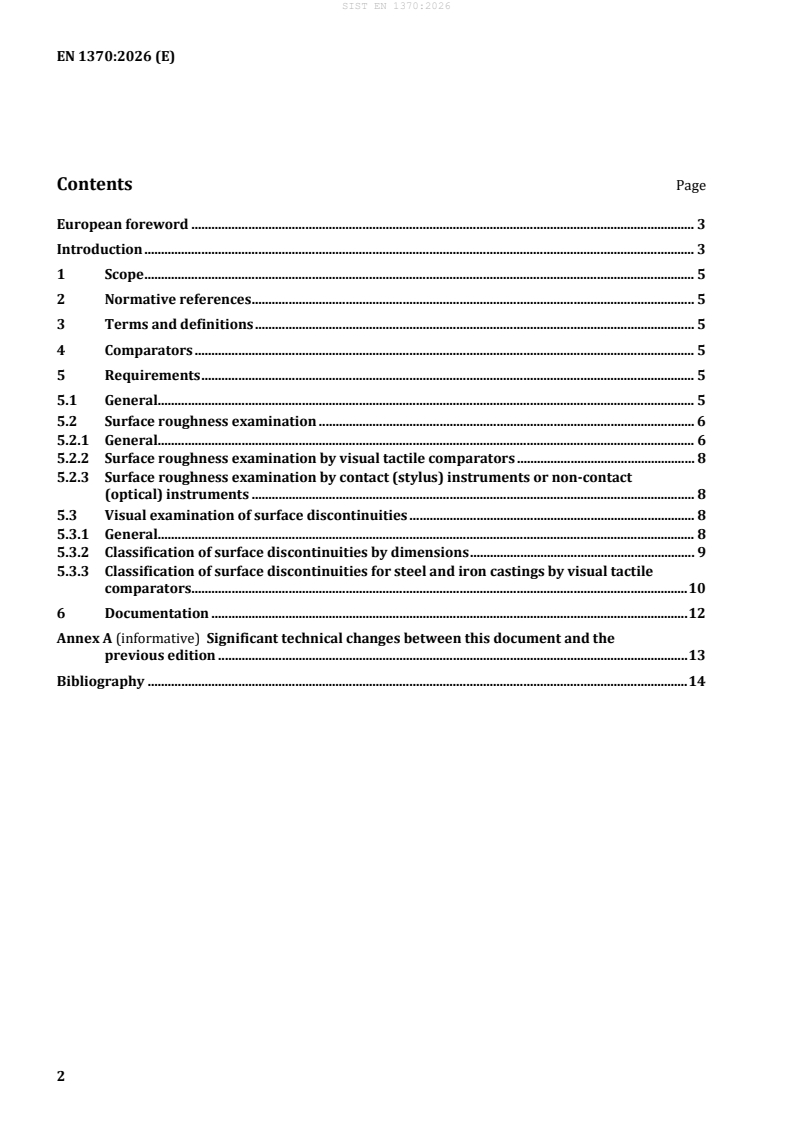
Contents Page
European foreword . 3
Introduction . 3
1 Scope . 5
2 Normative references . 5
3 Terms and definitions . 5
4 Comparators . 5
5 Requirements . 5
5.1 General. 5
5.2 Surface roughness examination . 6
5.2.1 General. 6
5.2.2 Surface roughness examination by visual tactile comparators . 8
5.2.3 Surface roughness examination by contact (stylus) instruments or non-contact
(optical) instruments . 8
5.3 Visual examination of surface discontinuities . 8
5.3.1 General. 8
5.3.2 Classification of surface discontinuities by dimensions . 9
5.3.3 Classification of surface discontinuities for steel and iron castings by visual tactile
comparators. 10
6 Documentation . 12
Annex A (informative) Significant technical changes between this document and the
previous edition . 13
Bibliography . 14
European foreword
This document (EN 1370:2026) has been prepared by Technical Committee CEN/TC 190 “Foundry
technology”, the secretariat of which is held by DIN.
This European Standard shall be given the status of a national standard, either by publication of an
identical text or by endorsement, at the latest by February 2027 and conflicting national standards shall
be withdrawn at the latest by February 2027.
Attention is drawn to the possibility that some of the elements of this document may be the subject of
patent rights. CEN shall not be held responsible for identifying any or all such patent rights.
This document supersedes EN 1370:2011.
Annex A, Table A.1 provides details of significant technical changes between this document and the
previous edition.
Any feedback and questions on this document should be directed to the users’ national standards body.
A complete listing of these bodies can be found on the CEN website.
According to the CEN-CENELEC Internal Regulations, the national standards organizations of the
following countries are bound to implement this European Standard: Austria, Belgium, Bulgaria, Croatia,
Cyprus, Czech Republic, Denmark, Estonia, Finland, France, Germany, Greece, Hungary, Iceland, Ireland,
Italy, Latvia, Lithuania, Luxembourg, Malta, Netherlands, Norway, Poland, Portugal, Republic of North
Macedonia, Romania, Serbia, Slovakia, Slovenia, Spain, Sweden, Switzerland, Türkiye and the United
Kingdom.
Introduction
The surface roughness of a casting is influenced by the manufacturing process (moulding, grinding,
finishing, etc.), the moulding materials used (sand, coating, etc.), the production equipment available and
the alloy cast.
Depending on the applications of the casting, the surface requirements are related to mechanical
loadings, appearance, surface treatment, etc.
Since cast surfaces do not exhibit the same cyclic character as machined surfaces, it is difficult to evaluate
their roughness using conventional mechanical, optical, or pneumatic devices. Other optical/electronic
means are now available for measuring surface roughness of cast surfaces. For the ease of use, visual
tactile comparators are preferred.
Moreover, in order to take into account the irregularities on as-cast surfaces, ground surfaces or other
means of finishing of castings, comparators should have relatively large dimensions in order to make
them more reliable and their results repeatable and consistent.
Two sets of comparators are in widespread use:
— “BNIF 359 Recommandation technique du Bureau de Normalisation des Industries de la Fonderie.
Caractérisation d'états de surface des pièces moulées — Utilisation des échantillons types
de 110 × 160 mm”, available from CETIM, KMØ - 30 rue François Spoerry, 68100 Mulhouse,
France [1];
— “SCRATA comparators for the definition of surface quality of steel and iron castings”, ASTM A 802
Shorter Set, available from Castings Technology International, Advanced Manufacturing Park, Brunel
Way, Rotherham, S60 5WG, South Yorkshire, United Kingdom [2].
A third set of comparators, for precision steel castings, is also available:
— “SCRATA surface comparators for the definition of surface texture of precision steel castings”,
precision set, available from Castings Technology International, Advanced Manufacturing Park,
Brunel Way, Rotherham, S60 5WG, South Yorkshire, United Kingdom [3].
This document also specifies 8 levels of surface imperfections based on maximum dimensions to be
detected by visual examination.
The SCRATA comparators shorter set [2], can also be used for the classification of surface discontinuities
on steel and iron castings.
BNIF N°359 comparators can be used for all cast metals.
100 mm × 150 mm for SCRATA comparators; 110 mm × 160 mm for BNIF comparators.
1 Scope
This document specifies methods for the examination of surface condition (roughness and surface
discontinuities) of castings on surfaces that remain as-cast.
This document is applicable to all cast metals and all casting processes except die casting.
This document is not applicable to machined surfaces.
2 Normative references
There are no normative references in this document.
3 Terms and definitions
No terms and definitions are listed in this document.
ISO and IEC maintain terminology databases for use in standardization at the following addresses:
— ISO Online browsing platform: available at https://www.iso.org/obp/
— IEC Electropedia: available at https://www.electropedia.org/
4 Comparators
The comparators are essentially positive replicas of actual casting surfaces: as-cast or after further
fettling treatment such as shot blasted or ground.
Full size photographs of the comparators can be used to assist in making a rapid evaluation of the overall
roughness of the comparators. These can give preliminary information for the appropriate selection of a
moulding or finishing process.
It is emphasized however that the comparators, and not the photographs, shall be used to form the basis
of an agreement at the time of ordering.
An overview and a comparison of the different categories and levels of the three sets of comparators are
given in Tables 1, 2 and 4.
5 Requirements
5.1 General
When examination of surface conditions is required, the following shall be as agreed at the time of
ordering:
— category and s
...