


SIST-TP CEN ISO/ASTM TR 52913-1:2026
(Main)Additive manufacturing - Feedstock materials - Part 1: Guidelines for the selection of measurement methods for characterization of powder flow properties (ISO/ASTM TR 52913-1:2025)
Additive manufacturing - Feedstock materials - Part 1: Guidelines for the selection of measurement methods for characterization of powder flow properties (ISO/ASTM TR 52913-1:2025)
The document offers guidance on the selection of an appropriate method(s) to measure the flow properties of powders for powder feedstock based additive manufacturing processes. This document offers several definitions and parameters that affect powder flowability, in addition to several references for additional definitions and parameters.
It is intended that the guidance provided in this document not only applies to the virgin condition of the powder but also the used powder as a result of any number of successive builds. It is well known that the physical behaviour of the powder is also affected by the manufacturing process itself during the recovery and sieving cycles of the powder during the production processes. This condition of the powder going back into the system can be called out and monitored from successive builds to detect any drift of the powder properties.
This document applies to:
— the conditions that have an influence on flow properties, and
— the necessary information in a test report.
This document is aimed for test equipment manufacturers, material suppliers, additive machine manufacturers, and additive manufacturing machine users.
Additive Fertigung - Ausgangsmaterialien - Teil 1: Parameter für die Charakterisierung von Pulverfließeigenschaften (ISO/ASTM TR 52913-1:2025)
Fabrication additive - Matières premières - Partie 1: Lignes directrices pour la caractérisation des propriétés d'écoulement de la poudre (ISO/ASTM TR 52913-1:2025)
Le présent document fournit des recommandations sur la sélection d'une (de) méthode(s) appropriée(s) pour mesurer les propriétés d'écoulement des poudres pour les procédés de fabrication additive utilisant la poudre comme matière première. Le présent document propose plusieurs définitions et paramètres affectant l'écoulement de la poudre, en plus de plusieurs références pour des définitions et paramètres supplémentaires.
Il est prévu que les recommandations fournies dans le présent document ne s'appliquent pas seulement à la condition vierge de la poudre, mais aussi aux poudres utilisées suite à un nombre de fabrications successives. Il est bien connu que le comportement physique de la poudre est également affecté par le procédé de fabrication additive lui-même pendant les cycles de récupération et de tamisage durant les processus de production. La condition de la poudre retournant dans le système peut être reprise et surveillée depuis des fabrications successives pour détecter toute dérivation des propriétés de la poudre.
Le présent document s'applique:
— aux conditions ayant une influence sur les propriétés d'écoulement,
— aux informations nécessaires dans un rapport d'essai.
Le présent document s'adresse aux fabricants d'équipements d'essai, aux fournisseurs de matériaux, aux fabricants de machines de fabrication additive et aux utilisateurs de machines de fabrication additive.
Dodajalna izdelava - Surovine - 1. del: Smernice za izbiro merilnih metod za karakterizacijo lastnosti sipkosti prahu (ISO/ASTM TR 52913-1:2025)
Dokument ponuja smernice za izbiro ustrezne metode(-d) za merjenje lastnosti pretoka prahov za aditivne proizvodne procese s praškovnim materialom. Ta dokument ponuja več definicij in parametrov, ki vplivajo na pretočnost prahu, poleg tega pa tudi več referenc za dodatne definicije in parametre.
Namen smernic v tem dokumentu je, da se uporabljajo ne le za prvotno stanje prahu, temveč tudi za uporabljeni prah kot rezultat več zaporednih izdelav. Dobro je znano, da na fizikalno obnašanje prahu vpliva tudi sam proizvodni proces med cikli obnavljanja in sejanja prahu med proizvodnimi procesi. To stanje prahu, ki se vrača v sistem, se lahko spremlja in nadzoruje iz zaporednih izdelav, da se zazna morebitno odstopanje lastnosti prahu.
Ta dokument se nanaša na:
- pogoje, ki vplivajo na lastnosti pretoka, in
- potrebne informacije v poročilu o preskusu.
Ta dokument je namenjen proizvajalcem preskusne opreme, dobaviteljem materialov, proizvajalcem aditivnih strojev in uporabnikom strojev za aditivno proizvodnjo.
General Information
- Status
- Published
- Public Enquiry End Date
- 09-Sep-2025
- Publication Date
- 06-Apr-2026
- Technical Committee
- VAR - Welding
- Current Stage
- 6060 - National Implementation/Publication (Adopted Project)
- Start Date
- 23-Jan-2026
- Due Date
- 30-Mar-2026
- Completion Date
- 07-Apr-2026


Relations
- Effective Date
- 28-Jan-2026
Overview
SIST-TP CEN ISO/ASTM TR 52913-1:2026 provides comprehensive guidelines for the selection of measurement methods to characterize the flow properties of powders used in additive manufacturing (AM). Accurate characterization of powder flowability is pivotal for ensuring reliability and part quality in powder feedstock-based AM processes, covering both virgin and reused powders. This technical report serves as a reference for manufacturers, suppliers, test equipment developers, and end-users in the additive manufacturing industry, ensuring consistency and accuracy in powder handling, measurement, and reporting.
Key Topics
Powder Flowability
The standard defines powder flowability as the ability of a bulk material to flow, influenced by factors such as powder size distribution, shape, cohesion, rheology, and environmental conditions (temperature, humidity, consolidation).Critical Variables Affecting Flow
- Particle size and shape
- Moisture and gas content
- Electrostatic and electromagnetic interactions
- Storage and handling conditions
Measurement Methods
The document outlines guidance for selecting appropriate measurement techniques, linking test conditions to real process situations:- Funnel flowmeter
- Flow through orifice
- Shear cell test
- Avalanche and rotating drum
- Angle of repose
Application Scope
Guidelines apply not only to new (virgin) powders but also to powders that have undergone multiple build and recycle cycles, ensuring consistent monitoring of material performance over time.Reporting Requirements
Recommendations include specifying sample identification, measurement procedure, environment, apparatus used, test parameters, and any deviations or anomalies observed during testing.
Applications
Test Equipment Manufacturers:
Use the guidelines to develop and calibrate instruments tailored for AM powder characterization under various conditions.Material Suppliers and Additive Machine Manufacturers:
Ensure that the supplied powders or machines align with industry-standard characterization practices, supporting robust quality assurance and traceability across the AM supply chain.Additive Manufacturing Machine Users:
Monitor powder properties throughout storage, handling, and re-use cycles, enabling the detection of drift in powder behavior and ensuring process reliability and consistent part quality.Laboratory Reporting:
Follow standardized protocols for test reports, supporting reproducibility and regulatory compliance across international operations.
Related Standards
For comprehensive powder characterization and testing, consider referencing these associated standards:
- ISO/ASTM 52900 - Additive manufacturing - General principles - Fundamentals and vocabulary
- ISO/ASTM 52907 - Additive manufacturing - Feedstock materials - Methods to characterize metal powders
- ISO 14488 - Particulate materials - Sampling and sample splitting for the determination of particulate properties
- ASTM B215, ASTM F3049 - Sampling and characterization methods for metallic powders
- ISO 4324, ASTM B212, ASTM B213 - Determination of apparent density, flow rate, and related physical parameters
Summary
SIST-TP CEN ISO/ASTM TR 52913-1:2026 establishes a critical foundation for the selection, application, and reporting of powder flow characterization methods in additive manufacturing. By standardizing the evaluation of powder properties under multiple conditions, this guideline enhances quality control, process reliability, and interoperability across the AM supply chain, making it a valuable resource for all stakeholders in the powder-based additive manufacturing industry.
Get Certified
Connect with accredited certification bodies for this standard

DVS-ZERT GmbH
German welding certification society.
CARES (UK Certification Authority for Reinforcing Steels)
UK certification for reinforcing steels and construction.
EWF/IIW (European/International Welding Federation)
International welding personnel certification.
Sponsored listings
Frequently Asked Questions
SIST-TP CEN ISO/ASTM TR 52913-1:2026 is a technical report published by the Slovenian Institute for Standardization (SIST). Its full title is "Additive manufacturing - Feedstock materials - Part 1: Guidelines for the selection of measurement methods for characterization of powder flow properties (ISO/ASTM TR 52913-1:2025)". This standard covers: The document offers guidance on the selection of an appropriate method(s) to measure the flow properties of powders for powder feedstock based additive manufacturing processes. This document offers several definitions and parameters that affect powder flowability, in addition to several references for additional definitions and parameters. It is intended that the guidance provided in this document not only applies to the virgin condition of the powder but also the used powder as a result of any number of successive builds. It is well known that the physical behaviour of the powder is also affected by the manufacturing process itself during the recovery and sieving cycles of the powder during the production processes. This condition of the powder going back into the system can be called out and monitored from successive builds to detect any drift of the powder properties. This document applies to: — the conditions that have an influence on flow properties, and — the necessary information in a test report. This document is aimed for test equipment manufacturers, material suppliers, additive machine manufacturers, and additive manufacturing machine users.
The document offers guidance on the selection of an appropriate method(s) to measure the flow properties of powders for powder feedstock based additive manufacturing processes. This document offers several definitions and parameters that affect powder flowability, in addition to several references for additional definitions and parameters. It is intended that the guidance provided in this document not only applies to the virgin condition of the powder but also the used powder as a result of any number of successive builds. It is well known that the physical behaviour of the powder is also affected by the manufacturing process itself during the recovery and sieving cycles of the powder during the production processes. This condition of the powder going back into the system can be called out and monitored from successive builds to detect any drift of the powder properties. This document applies to: — the conditions that have an influence on flow properties, and — the necessary information in a test report. This document is aimed for test equipment manufacturers, material suppliers, additive machine manufacturers, and additive manufacturing machine users.
SIST-TP CEN ISO/ASTM TR 52913-1:2026 is classified under the following ICS (International Classification for Standards) categories: 25.030 - Additive manufacturing. The ICS classification helps identify the subject area and facilitates finding related standards.
SIST-TP CEN ISO/ASTM TR 52913-1:2026 has the following relationships with other standards: It is inter standard links to SIST EN 16116-2:2024. Understanding these relationships helps ensure you are using the most current and applicable version of the standard.
SIST-TP CEN ISO/ASTM TR 52913-1:2026 is available in PDF format for immediate download after purchase. The document can be added to your cart and obtained through the secure checkout process. Digital delivery ensures instant access to the complete standard document.
Standards Content (Sample)
SLOVENSKI STANDARD
01-maj-2026
Dodajalna izdelava - Surovine - 1. del: Smernice za izbiro merilnih metod za
karakterizacijo lastnosti sipkosti prahu (ISO/ASTM TR 52913-1:2025)
Additive manufacturing - Feedstock materials - Part 1: Guidelines for the selection of
measurement methods for characterization of powder flow properties (ISO/ASTM TR
52913-1:2025)
Additive Fertigung - Ausgangsmaterialien - Teil 1: Parameter für die Charakterisierung
von Pulverfließeigenschaften (ISO/ASTM TR 52913-1:2025)
Fabrication additive - Matières premières - Partie 1: Lignes directrices pour la
caractérisation des propriétés d'écoulement de la poudre (ISO/ASTM TR 52913-1:2025)
Ta slovenski standard je istoveten z: CEN ISO/ASTM TR 52913-1:2025
ICS:
25.030 3D-tiskanje Additive manufacturing
SIST-TP CEN ISO/ASTM TR 52913- en,fr,de
1:2026
2003-01.Slovenski inštitut za standardizacijo. Razmnoževanje celote ali delov tega standarda ni dovoljeno.
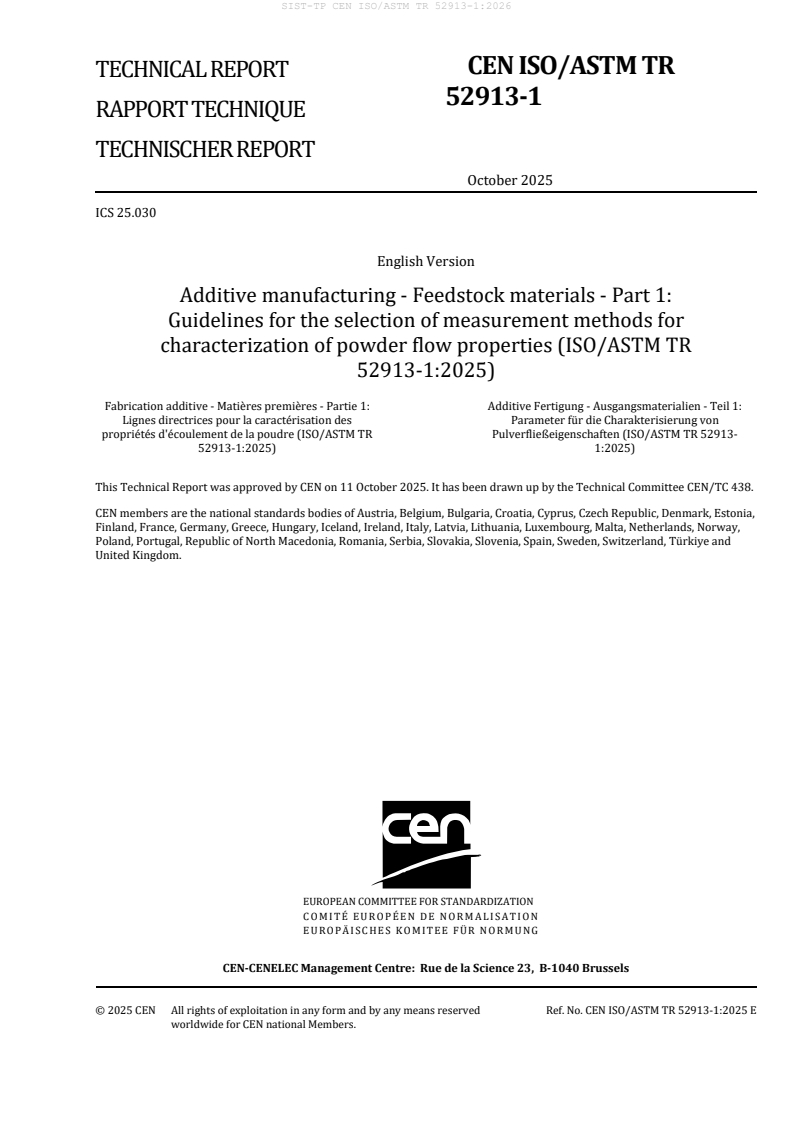
CEN ISO/ASTM TR
TECHNICAL REPORT
52913-1
RAPPORT TECHNIQUE
TECHNISCHER REPORT
October 2025
ICS 25.030
English Version
Additive manufacturing - Feedstock materials - Part 1:
Guidelines for the selection of measurement methods for
characterization of powder flow properties (ISO/ASTM TR
52913-1:2025)
Fabrication additive - Matières premières - Partie 1: Additive Fertigung - Ausgangsmaterialien - Teil 1:
Lignes directrices pour la caractérisation des Parameter für die Charakterisierung von
propriétés d'écoulement de la poudre (ISO/ASTM TR Pulverfließeigenschaften (ISO/ASTM TR 52913-
52913-1:2025) 1:2025)
This Technical Report was approved by CEN on 11 October 2025. It has been drawn up by the Technical Committee CEN/TC 438.
CEN members are the national standards bodies of Austria, Belgium, Bulgaria, Croatia, Cyprus, Czech Republic, Denmark, Estonia,
Finland, France, Germany, Greece, Hungary, Iceland, Ireland, Italy, Latvia, Lithuania, Luxembourg, Malta, Netherlands, Norway,
Poland, Portugal, Republic of North Macedonia, Romania, Serbia, Slovakia, Slovenia, Spain, Sweden, Switzerland, Türkiye and
United Kingdom.
EUROPEAN COMMITTEE FOR STANDARDIZATION
COMITÉ EUROPÉEN DE NORMALISATION
EUROPÄISCHES KOMITEE FÜR NORMUNG
CEN-CENELEC Management Centre: Rue de la Science 23, B-1040 Brussels
© 2025 CEN All rights of exploitation in any form and by any means reserved Ref. No. CEN ISO/ASTM TR 52913-1:2025 E
worldwide for CEN national Members.
Contents Page
European foreword . 3
European foreword
This document (CEN ISO/ASTM TR 52913-1:2025) has been prepared by Technical Committee ISO/TC
261 "Additive manufacturing" in collaboration with Technical Committee CEN/TC 438 “Additive
Manufacturing” the secretariat of which is held by AFNOR.
Attention is drawn to the possibility that some of the elements of this document may be the subject of
patent rights. CEN shall not be held responsible for identifying any or all such patent rights.
Any feedback and questions on this document should be directed to the users’ national standards
body/national committee. A complete listing of these bodies can be found on the CEN website.
Endorsement notice
The text of ISO/ASTM TR 52913-1:2025 has been approved by CEN as CEN ISO/ASTM TR 52913-
1:2025 without any modification.
Technical
Report
ISO/ASTM TR
52913-1
First edition
Additive manufacturing —
2025-10
Feedstock materials —
Part 1:
Guidelines for the selection
of measurement methods for
characterization of powder flow
properties
Fabrication additive — Matières premières —
Partie 1: Lignes directrices pour la caractérisation des propriétés
d'écoulement de la poudre
Reference number
ISO/ASTM TR 52913-1:2025(en) © ISO/ASTM International 2025
ISO/ASTM TR 52913-1:2025(en)
© ISO/ASTM International 2025
All rights reserved. Unless otherwise specified, or required in the context of its implementation, no part of this publication may
be reproduced or utilized otherwise in any form or by any means, electronic or mechanical, including photocopying, or posting on
the internet or an intranet, without prior written permission. Permission can be requested from either ISO at the address below
or ISO’s member body in the country of the requester. In the United States, such requests should be sent to ASTM International.
ISO copyright office ASTM International
CP 401 • Ch. de Blandonnet 8 100 Barr Harbor Drive, PO Box C700
CH-1214 Vernier, Geneva West Conshohocken, PA 19428-2959, USA
Phone: +41 22 749 01 11 Phone: +610 832 9634
Fax: +610 832 9635
Email: copyright@iso.org Email: khooper@astm.org
Website: www.iso.org Website: www.astm.org
Published in Switzerland
© ISO/ASTM International 2025 – All rights reserved
ii
ISO/ASTM TR 52913-1:2025(en)
Contents Page
Foreword .iv
Introduction .v
1 Scope . 1
2 Normative references . 1
3 Terms and definitions . 1
4 Principle . 2
4.1 General .2
4.2 Measurement procedure conditions .4
5 Apparatus and materials . 5
6 Procedure . 5
7 Test report . 5
Bibliography . 6
© ISO/ASTM International 2025 – All rights reserved
iii
ISO/ASTM TR 52913-1:2025(en)
Foreword
ISO (the International Organization for Standardization) is a worldwide federation of national standards
bodies (ISO member bodies). The work of preparing International Standards is normally carried out through
ISO technical committees. Each member body interested in a subject for which a technical committee
has been established has the right to be represented on that committee. International organizations,
governmental and non-governmental, in liaison with ISO, also take part in the work. ISO collaborates closely
with the International Electrotechnical Commission (IEC) on all matters of electrotechnical standardization.
The procedures used to develop this document and those intended for its further maintenance are described
in the ISO/IEC Directives, Part 1. In particular, the different approval criteria needed for the different types
of ISO document should be noted. This document was drafted in accordance with the editorial rules of the
ISO/IEC Directives, Part 2 (see www.iso.org/directives).
ISO draws attention to the possibility that the implementation of this document may involve the use of (a)
patent(s). ISO takes no position concerning the evidence, validity or applicability of any claimed patent
rights in respect thereof. As of the date of publication of this document, ISO had not received notice of (a)
patent(s) which may be required to implement this document. However, implementers are cautioned that
this may not represent the latest information, which may be obtained from the patent database available at
www.iso.org/patents. ISO shall not be held responsible for identifying any or all such patent rights.
Any trade name used in this document is information given for the convenience of users and does not
constitute an endorsement.
For an explanation of the voluntary nature of standards, the meaning of ISO specific terms and expressions
related to conformity assessment, as well as information about ISO's adherence to the World Trade
Organization (WTO) principles in the Technical Barriers to Trade (TBT), see www.iso.org/iso/foreword.html.
This document was prepared by Technical Committee ISO/TC 261, Additive manufacturing, in cooperation
with ASTM Committee F42, Additive Manufacturing Technologies, on the basis of a partnership agreement
between ISO and ASTM International with the aim to create a common set of ISO/ASTM standards on
Additive Manufacturing, in collaboration with the European Committee for Standardization (CEN) Technical
Committee CEN/TC 438, Additive manufacturing, in accordance with the Agreement on technical cooperation
between ISO and CEN (Vienna Agreement).
Any feedback or questions on this document should be directed to the user’s national standards body. A
complete listing of these bodies can be found at www.iso.org/members.html
© ISO/ASTM International 2025 – All rights reserved
iv
ISO/ASTM TR 52913-1:2025(en)
Introduction
The increased application of additive manufacturing creates a demand by stakeholders for a guidance
document which describes process characteristics and performance regarding general test methods for
the characterization of powder flow properties. In powder feedstock based processes, the flow properties
of the powder are of decisive importance related to the process reliability of an additive manufacturing
process and the quality of the manufactured parts. Characterization of powder flow properties is subject
to numerous variables. The meaningfulness of the results of the measurement therefore depends on these
variables. However, complete consideration of all variables might be neither cost-effective or time effective.
Therefore, when measuring the flow properties, the nature and scope of the measurements to be conducted
is an important issue.
The information contained in the document is applicable to the conditions that have an influence on flow
properties, and the necessary information in a test report.
This information is provided is of interest to test equipment manufacturers, material suppliers, additive
machine manufacturers, and additive manufacturing machine users.
© ISO/ASTM International 2025 – All rights reserved
v
Technical Report ISO/ASTM TR 52913-1:2025(en)
Additive manufacturing — Feedstock materials —
Part 1:
Guidelines for the selection of measurement methods for
characterization of powder flow properties
1 Scope
The document offers guidance on the selection of an appropriate method(s) to measure the flow properties
of powders for powder feedstock based additive manufacturing processes. This document offers several
definitions and parameters that affect powder flowability, in addition to several references for additional
definitions and parameters.
It is intended that the guidance provided in this document not only applies to the virgin condition of the
powder but also the used powder as a result of any number of successive builds. It is well known that the
physical behaviour of the powder is also affected by the manufacturing process itself during the recovery
and sieving cycles of the powder during the production processes. This condition of the powder going back
into the system can be called out and monitored from successive builds to detect any drift of the powder
properties.
This document applies to:
— the conditions that have an influence on flow properties, and
— the necessary information in a test report.
This document is aimed for test equipment manufacturers, material suppliers, additive machine
manufacturer
...