


SIST-TP CEN/TR 16931-9:2025
(Main)Electronic invoicing - Part 9: VAT reporting and gap analysis with current e-invoicing standardization deliverables
Electronic invoicing - Part 9: VAT reporting and gap analysis with current e-invoicing standardization deliverables
The European Commission will in its project “VAT in the digital age” mandate that VAT reporting on intra-EU transactions is performed in near real time and based on EN 16931. This document defines the impact of this legislation on the various deliverables of CEN/TC 434, with a focus on the subset to be sent to tax authorities and how EN 16931-1 will need to be changed.
NOTE 1 The ViDA proposal only applies to EU member states.
This document does not define the subset of the electronic invoice to be sent to the authorities.
NOTE 2 The definition of that subset is a task of the European Commission. As the subset message is not an invoice, but a VAT report, it is not regarded as a Core Invoice Usage Specification (CIUS). The subset therefore needs not to obey the rules for developing a CIUS. For example, not all mandatory elements in the invoice need to be part of the subset.
Elektronische Rechnungsstellung - Mehrwertsteuer-Berichterstattung und Lückenanalyse bei der derzeitigen Standardisierung der elektronischen Rechnungsstellung
Facturation électronique - Partie 9: déclaration de la TVA et analyse des écarts avec les livrables actuels relatifs à la normalisation de la facturation électronique
Elektronsko izdajanje računov - 9. del: Poročanje o DDV in analiza vrzeli s trenutnimi rezultati standardizacije e-računov
Evropska komisija bo v svojem projektu »DDV v digitalni dobi« zahtevala, da se poročanje o DDV pri transakcijah znotraj EU izvaja skoraj v realnem času in na podlagi standarda EN 16931. Ta dokument opredeljuje vpliv te zakonodaje na različne dokumente CEN/TC 434, s poudarkom na podsklopu, ki ga je treba poslati davčnim organom, ter določa vsebino in obseg sprememb standarda EN 16931-1.
OPOMBA 1: Predlog o DDV v digitalni dobi (ViDA) se uporablja samo za države članice EU.
Ta dokument ne opredeljuje podsklopa elektronskega računa, ki ga je treba poslati organom.
OPOMBA 2: Za opredelitev tega podsklopa je odgovorna Evropska komisija. Sporočilo o podsklopu ni račun, ampak poročilo o DDV, zato se ne šteje za specifikacijo uporabe osrednjega računa (CIUS). Podsklopu torej ni treba upoštevati pravil za razvoj specifikacije uporabe osrednjega računa. Tako npr. ni nujno, da so vsi obvezni elementi v računu del podsklopa.
General Information
- Status
- Withdrawn
- Public Enquiry End Date
- 08-Oct-2024
- Publication Date
- 07-Jan-2025
- Withdrawal Date
- 02-Mar-2026
- Technical Committee
- ITC - Information technology
- Current Stage
- 9900 - Withdrawal (Adopted Project)
- Start Date
- 04-Feb-2026
- Due Date
- 27-Feb-2026
- Completion Date
- 03-Mar-2026
Relations
- Effective Date
- 01-Apr-2026
- Effective Date
- 28-Jan-2026
- Effective Date
- 28-Jan-2026
- Effective Date
- 28-Jan-2026

Get Certified
Connect with accredited certification bodies for this standard

BSI Group
BSI (British Standards Institution) is the business standards company that helps organizations make excellence a habit.

Bureau Veritas
Bureau Veritas is a world leader in laboratory testing, inspection and certification services.

DNV
DNV is an independent assurance and risk management provider.
Sponsored listings
Frequently Asked Questions
SIST-TP CEN/TR 16931-9:2025 is a technical report published by the Slovenian Institute for Standardization (SIST). Its full title is "Electronic invoicing - Part 9: VAT reporting and gap analysis with current e-invoicing standardization deliverables". This standard covers: The European Commission will in its project “VAT in the digital age” mandate that VAT reporting on intra-EU transactions is performed in near real time and based on EN 16931. This document defines the impact of this legislation on the various deliverables of CEN/TC 434, with a focus on the subset to be sent to tax authorities and how EN 16931-1 will need to be changed. NOTE 1 The ViDA proposal only applies to EU member states. This document does not define the subset of the electronic invoice to be sent to the authorities. NOTE 2 The definition of that subset is a task of the European Commission. As the subset message is not an invoice, but a VAT report, it is not regarded as a Core Invoice Usage Specification (CIUS). The subset therefore needs not to obey the rules for developing a CIUS. For example, not all mandatory elements in the invoice need to be part of the subset.
The European Commission will in its project “VAT in the digital age” mandate that VAT reporting on intra-EU transactions is performed in near real time and based on EN 16931. This document defines the impact of this legislation on the various deliverables of CEN/TC 434, with a focus on the subset to be sent to tax authorities and how EN 16931-1 will need to be changed. NOTE 1 The ViDA proposal only applies to EU member states. This document does not define the subset of the electronic invoice to be sent to the authorities. NOTE 2 The definition of that subset is a task of the European Commission. As the subset message is not an invoice, but a VAT report, it is not regarded as a Core Invoice Usage Specification (CIUS). The subset therefore needs not to obey the rules for developing a CIUS. For example, not all mandatory elements in the invoice need to be part of the subset.
SIST-TP CEN/TR 16931-9:2025 is classified under the following ICS (International Classification for Standards) categories: 03.100.20 - Trade. Commercial function. Marketing; 35.240.20 - IT applications in office work; 35.240.63 - IT applications in trade. The ICS classification helps identify the subject area and facilitates finding related standards.
SIST-TP CEN/TR 16931-9:2025 has the following relationships with other standards: It is inter standard links to SIST-TP CEN/TR 16931-9:2026, SIST EN 16931-1:2017+A1:2020, SIST-TS CEN/TS 14632:2023, SIST EN ISO 23856:2021. Understanding these relationships helps ensure you are using the most current and applicable version of the standard.
SIST-TP CEN/TR 16931-9:2025 is associated with the following European legislation: EU Directives/Regulations: 2014/55/EU. When a standard is cited in the Official Journal of the European Union, products manufactured in conformity with it benefit from a presumption of conformity with the essential requirements of the corresponding EU directive or regulation.
SIST-TP CEN/TR 16931-9:2025 is available in PDF format for immediate download after purchase. The document can be added to your cart and obtained through the secure checkout process. Digital delivery ensures instant access to the complete standard document.
Standards Content (Sample)
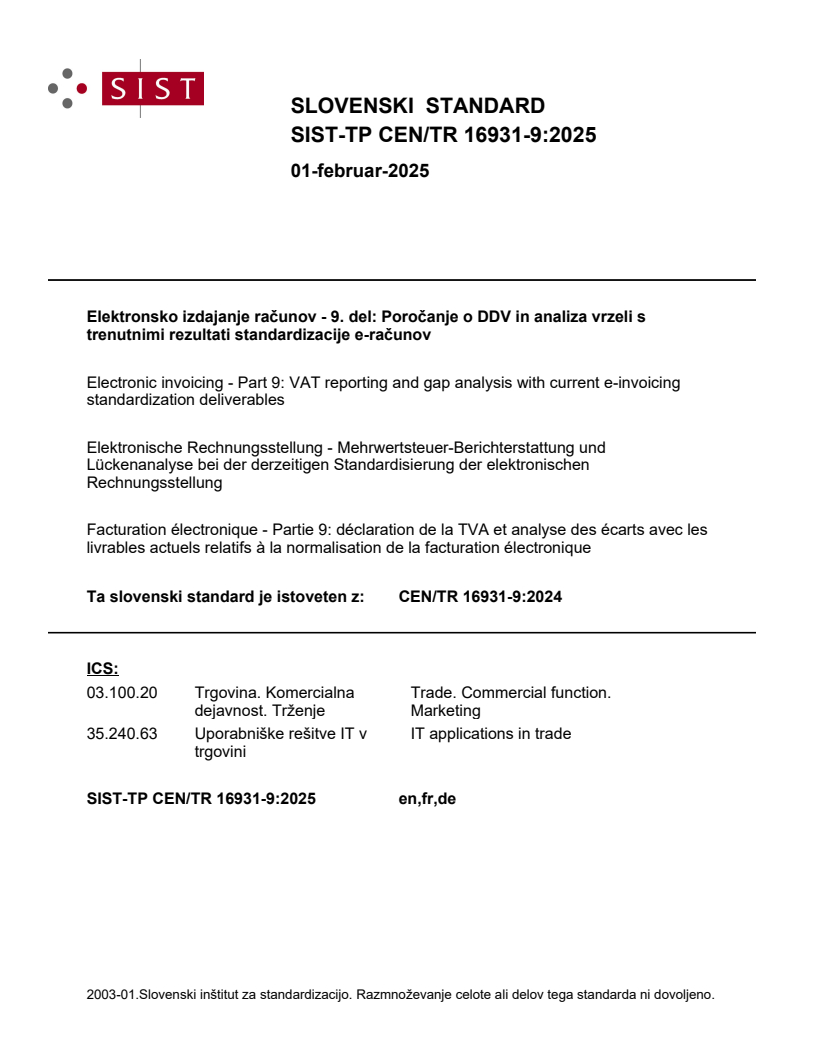
SLOVENSKI STANDARD
01-februar-2025
Elektronsko izdajanje računov - 9. del: Poročanje o DDV in analiza vrzeli s
trenutnimi rezultati standardizacije e-računov
Electronic invoicing - Part 9: VAT reporting and gap analysis with current e-invoicing
standardization deliverables
Elektronische Rechnungsstellung - Mehrwertsteuer-Berichterstattung und
Lückenanalyse bei der derzeitigen Standardisierung der elektronischen
Rechnungsstellung
Facturation électronique - Partie 9: déclaration de la TVA et analyse des écarts avec les
livrables actuels relatifs à la normalisation de la facturation électronique
Ta slovenski standard je istoveten z: CEN/TR 16931-9:2024
ICS:
03.100.20 Trgovina. Komercialna Trade. Commercial function.
dejavnost. Trženje Marketing
35.240.63 Uporabniške rešitve IT v IT applications in trade
trgovini
2003-01.Slovenski inštitut za standardizacijo. Razmnoževanje celote ali delov tega standarda ni dovoljeno.
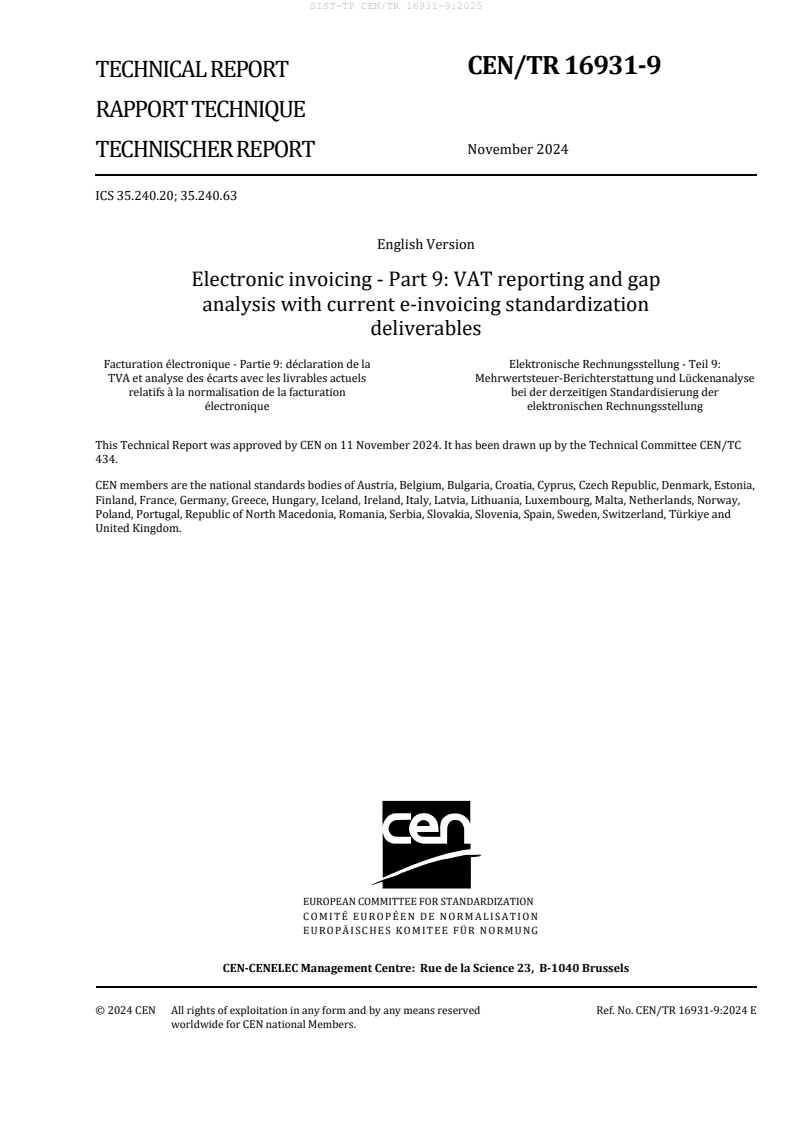
CEN/TR 16931-9
TECHNICAL REPORT
RAPPORT TECHNIQUE
November 2024
TECHNISCHER REPORT
ICS 35.240.20; 35.240.63
English Version
Electronic invoicing - Part 9: VAT reporting and gap
analysis with current e-invoicing standardization
deliverables
Facturation électronique - Partie 9: déclaration de la Elektronische Rechnungsstellung - Teil 9:
TVA et analyse des écarts avec les livrables actuels Mehrwertsteuer-Berichterstattung und Lückenanalyse
relatifs à la normalisation de la facturation bei der derzeitigen Standardisierung der
électronique elektronischen Rechnungsstellung
This Technical Report was approved by CEN on 11 November 2024. It has been drawn up by the Technical Committee CEN/TC
434.
CEN members are the national standards bodies of Austria, Belgium, Bulgaria, Croatia, Cyprus, Czech Republic, Denmark, Estonia,
Finland, France, Germany, Greece, Hungary, Iceland, Ireland, Italy, Latvia, Lithuania, Luxembourg, Malta, Netherlands, Norway,
Poland, Portugal, Republic of North Macedonia, Romania, Serbia, Slovakia, Slovenia, Spain, Sweden, Switzerland, Türkiye and
United Kingdom.
EUROPEAN COMMITTEE FOR STANDARDIZATION
COMITÉ EUROPÉEN DE NORMALISATION
EUROPÄISCHES KOMITEE FÜR NORMUNG
CEN-CENELEC Management Centre: Rue de la Science 23, B-1040 Brussels
© 2024 CEN All rights of exploitation in any form and by any means reserved Ref. No. CEN/TR 16931-9:2024 E
worldwide for CEN national Members.
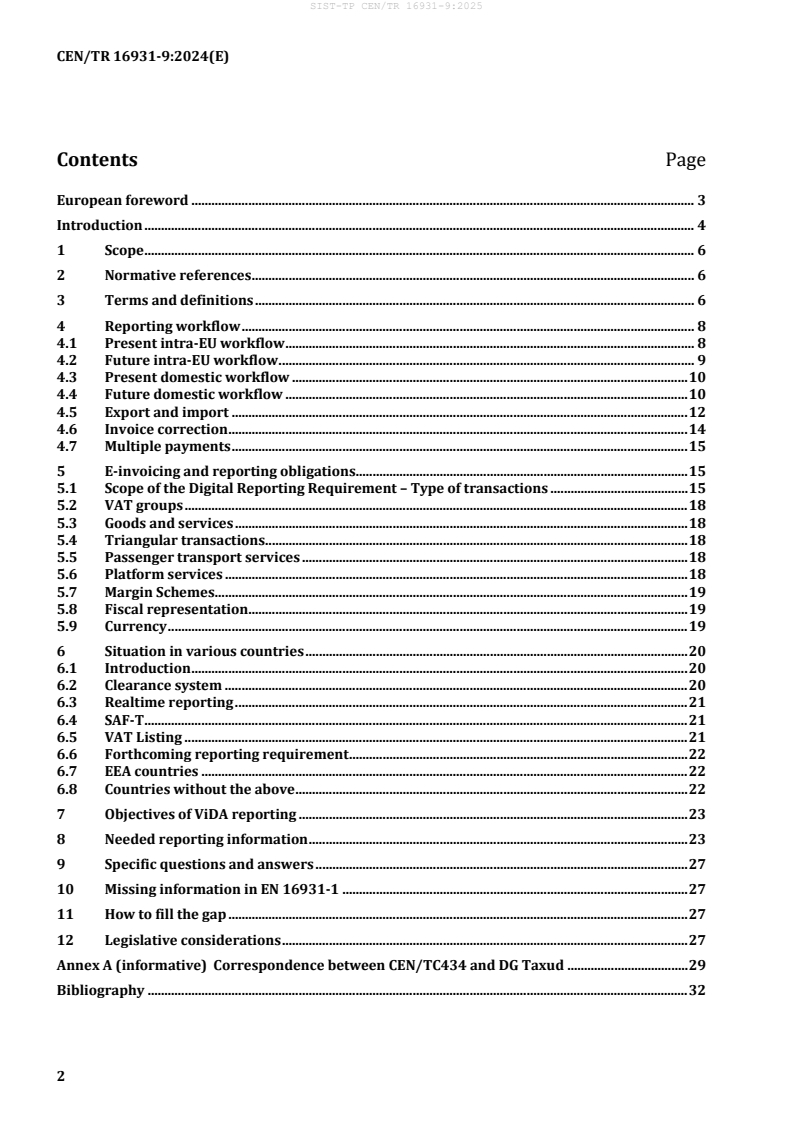
Contents Page
European foreword . 3
Introduction . 4
1 Scope . 6
2 Normative references . 6
3 Terms and definitions . 6
4 Reporting workflow . 8
4.1 Present intra-EU workflow . 8
4.2 Future intra-EU workflow . 9
4.3 Present domestic workflow . 10
4.4 Future domestic workflow . 10
4.5 Export and import . 12
4.6 Invoice correction . 14
4.7 Multiple payments . 15
5 E-invoicing and reporting obligations . 15
5.1 Scope of the Digital Reporting Requirement – Type of transactions . 15
5.2 VAT groups . 18
5.3 Goods and services . 18
5.4 Triangular transactions . 18
5.5 Passenger transport services . 18
5.6 Platform services . 18
5.7 Margin Schemes . 19
5.8 Fiscal representation . 19
5.9 Currency . 19
6 Situation in various countries . 20
6.1 Introduction . 20
6.2 Clearance system . 20
6.3 Realtime reporting . 21
6.4 SAF-T . 21
6.5 VAT Listing . 21
6.6 Forthcoming reporting requirement . 22
6.7 EEA countries . 22
6.8 Countries without the above . 22
7 Objectives of ViDA reporting . 23
8 Needed reporting information . 23
9 Specific questions and answers . 27
10 Missing information in EN 16931-1 . 27
11 How to fill the gap . 27
12 Legislative considerations . 27
Annex A (informative) Correspondence between CEN/TC434 and DG Taxud . 29
Bibliography . 32
European foreword
This document (CEN/TR 16931-9:2024) has been prepared by Technical Committee CEN/TC 434
“Electronic invoicing”, the secretariat of which is held by NEN.
Attention is drawn to the possibility that some of the elements of this document may be the subject of
patent rights. CEN shall not be held responsible for identifying any or all such patent rights.
This document has been prepared under a standardization request addressed to CEN by the European
Commission.
This document is part of a set of documents, consisting of:
, Electronic invoicing — Part 1: Semantic data model of the core
— EN 16931-1:2017+A1:2019
elements of an electronic invoice; https://www.nen.nl/nen-en-16931-1-2017-a1-2019-en-265627;
— CEN/TS 16931-2:2017, Electronic invoicing — Part 2: List of syntaxes that comply with EN 16931-
1; https://www.nen.nl/nvn-cen-ts-16931-2-2017-en-235733;
— CEN/TS 16931-3-1:2017, Electronic invoicing — Part 3-1: Methodology for syntax bindings of the
core elements of an electronic invoice;
— CEN/TS 16931-3-2:2020, Electronic invoicing — Part 3-2: Syntax binding for ISO/IEC 19845
(UBL 2.1) invoice and credit note;
— CEN/TS 16931-3-3:2020, Electronic invoicing — Part 3-3: Syntax binding for UN/CEFACT XML
Industry Invoice D16B;
— CEN/TS 16931-3-4:2020, Electronic invoicing — Part 3-4: Syntax binding for UN/EDIFACT
INVOIC D16B;
— CEN/TR 16931-4:2017, Electronic invoicing — Part 4: Guidelines on interoperability of electronic
invoices at the transmission level;
— CEN/TR 16931-5:2017, Electronic invoicing — Part 5: Guidelines on the use of sector or country
extensions in conjunction with EN 16931-1, methodology to be applied in the real environment.
Any feedback and questions on this document should be directed to the users’ national standards body.
A complete listing of these bodies can be found on the CEN website.
As impacted by EN 16931-1:2017+A1:2019/AC:2020.
Introduction
In its Communication, Reaping the benefits of electronic invoicing for Europe , the European Commission
expected electronic invoicing to become the predominant method of invoicing in Europe by 2020, setting
out the necessary actions to achieve this objective, such as promoting the development of an eInvoicing
standard, monitoring and setting targets for eInvoicing adoption.
Directive 2014/55/EU on electronic invoicing in public procurement (the ‘Directive’) aimed at removing
obstacles to cross-border trade deriving from the co-existence of several legal requirements and technical
eInvoicing formats and from the lack of interoperability.
To achieve this objective, the Commission requested the relevant European standardization organization
to draft a European standard for the semantic data model of the core elements of an electronic invoice
(the ‘European standard on electronic invoicing’). In October 2017, the reference to EN 16931-1:2017,
Electronic invoicing — Part 1: Semantic data model of the core elements of an electronic invoice and to
the list of syntaxes CEN/TS 16931-2:2017, Electronic invoicing — Part 2 were published in the Official
Journal of the European Union.
The Directive requires EU member states to ensure that contracting authorities and contracting entities
could receive and process electronic invoices compliant with the European eInvoicing standard and with
the list of syntaxes published in the OJEU. Central contracting authorities had until April 2019 to comply
with the provisions of the Directive, while member states could delay the implementation until April 2020
at the latest for sub-central contracting authorities. The Directive leaves member states free to extend
the scope of the mandate and addresses legal barriers and interoperability issues, mainly at the semantic
and syntax level.
The CEN Technical Committee 434 is the standardization body responsible for the development and
maintenance of the European eInvoicing standard (EN 16931). Regulation (EU) No 1025/2012 on
European standardization establishes rules with regard to the cooperation between European
standardization organisations, national standardization bodies, member states and the Commission. It
encourages contact between European standardization organisations and private forums and consortia,
while maintaining the primacy of European standardization.
In its new mandate, DG GROW has requested the CEN/TC 434 to reflect the European Commission’s main
policy priorities in the evolution of EN 16931, especially the requirements stemming from the re-use of
EN 16931 for Digital VAT Reporting Requirements (DRR) for intra-EU transactions.
Digital reporting requirements as proposed in VAT in the Digital Age (ViDA) imply that taxable persons
use electronic invoicing using EN 16931. Though EN 16931-1 has been developed keeping both B2G and
B2B requirements in mind, the focus has been on B2G. EN 16931-1 therefore needs to be assessed against
the requirements of specific B2B environments. This can result in amendments or in the specification of
extensions.
This proposal aims at modernising the current EU VAT system and reducing the EU-27 VAT revenue loss
that in 2019 was estimated at EUR 134 billion, with missing trader intra-community (MTIC) fraud
ranging between EUR 40-60 billion. To address these issues, the Commission’s action plan for fair and
simple taxation announced a legislative proposal for 2022 on VAT in the Digital Age. In the related public
consultation, DG TAXUD clarified that the problems concern the application and control of VAT rules in
relation to cross-border sales of goods and services, and the need for a common European solution for
digital VAT reporting.
https://eur-lex.europa.eu/legal-content/EN/TXT/?uri=celex:52010DC0712
https://eur-lex.europa.eu/legal-content/EN/TXT/?uri=CELEX%3A32014L0055
https://eur-lex.europa.eu/LexUriServ/LexUriServ.do?uri=OJ:L:2012:316:0012:0033:EN:PDF
https://eur-lex.europa.eu/legal-content/EN/TXT/?uri=CELEX%3A52022PC0701
The objective is to ensure a quicker, near real-time, and more detailed exchange of information on VAT
intra-EU transactions while streamlining the mechanisms that can be applied for domestic transactions.
DG TAXUD expects that, depending on the required infrastructure, the implementation runs until 2030.
The European Commission is considering the introduction of mandatory use of eInvoicing between
businesses for cross-border transactions and the implementation of digital VAT reporting requirements
(DRR) for B2B intra-EU transactions using eInvoicing. In particular, a subset of the European eInvoicing
standard is to be defined and used for VAT DRR. Member states are to allow taxable persons (or third
parties) to re-use the solution implemented for B2B cross-border eInvoicing also for B2B at the domestic
level, in particular if a national solution is not in place.
The successful deployment of an EU-solution for VAT DRR will require rules at the semantic and syntax
level (as foreseen by the EN 16931). This will ensure coherence of the EU policy and technical framework,
contributing to the establishment of the digital single market.
The current reporting system of intra-Community transactions (referred to in the VAT Directive as
‘recapitulative statements’) does not allow member states to effectively tackle VAT fraud linked to these
transactions. The current recapitulative statements date from 1993 and have not substantially changed
since then. They are ill-prepared for the digital economy and can hardly be compared to the much more
modern digital reporting systems implemented by some member states for domestic transactions.
Among other shortcomings,
• Recapitulative statements only provide aggregated data for each taxable person, and not transaction-
by-transaction data;
• They do not allow data from supplies to be cross-matched with that of acquisitions, as the VAT
Directive leaves the reporting of intra-Community acquisitions optional for member states and fewer
than half of the member states have introduced this obligation;
• This data may not be available to tax authorities in other member states at the right time, both
because of filing frequency because of the time it takes for local tax authorities to upload data onto
the system.
The information will feed into the risk analysis systems of the member states to help them counter the
VAT fraud linked with the intra-Community trade, in particular Missing Trader Intra-Community fraud.
1 Scope
The European Commission will in its project “VAT in the digital age” mandate that VAT reporting on intra-
EU transactions is performed in near real time and based on EN 16931. This document defines the impact
of this legislation on the various deliverables of CEN/TC 434, with a focus on the subset to be sent to tax
authorities and how EN 16931-1 will need to be changed.
NOTE 1 The ViDA proposal only applies to EU member states.
This document does not define the subset of the electronic invoice to be sent to the authorities.
NOTE 2 The definition of that subset is a task of the European Commission. As the subset message is not an
invoice, but a VAT report, it is not regarded as a Core Invoice Usage Specification (CIUS). The subset therefore needs
not to obey the rules for developing a CIUS. For examples, not all mandatory elements in the invoice need to be part
of the subset.
2 Normative references
The following documents are referred to in the text in such a way that some or all of their content
constitutes requirements of this document. For dated references, only the edition cited applies. For
undated references, the latest edition of the referenced document (including any amendments) applies.
EN 16931-1:2017+A1:2019 , Electronic invoicing - Part 1: Semantic data model of the core elements of an
electronic invoice, https://www.nen.nl/nen-en-16931-1-2017-a1-2019-en-265627
3 Terms and definitions
For the purposes of this document, the terms and definitions given in EN 16931-1:2017+A1:2019 and the
following apply.
ISO and IEC maintain terminology databases for use in standardization at the following addresses:
— ISO Online browsing platform: available at https://www.iso.org/obp/
— IEC Electropedia: available at https://www.electropedia.org/
3.1
B2B
business to business - transactions between businesses
3.2
B2C
business to consumer - transactions between private businesses and non taxable persons
3.3
B2G
business to government - transactions between private businesses and public institutions
3.4
compliant
some or all features of the core invoice model are used and all rules of the core invoice model are
respected
Note to entry: Based on TOGAF definition of a compliant specification.
3.5
conformant
all rules of the core invoice model are respected and some additional features not defined in the core
invoice model are also used
Note to entry: Based on TOGAF definition of a conformant specification.
3.6
core invoice instance document
instance of an electronic invoice that is compliant to the core invoice model (EN 16931-1)
3.7
DRR
digital reporting requirements - requirement of a business to report transactions subject to VAT
3.8
eInvoicing
electronic invoicing - exchanging invoices in a way that they can automatically be interpreted by
computer systems
3.9
eReceipt
receipt that has been issued in a structured electronic format which allows for its automatic and
electronic processing also to be transmitted and received by the customer if the customer so decides
3.10
Intra-EU transactions
sales of goods and/or services from one EU member state to another EU member state
3.11
OSS – One Stop Shop
procedure whereby a taxable person can pay VAT to another EU member state under his own VAT
number
3.12
Simplified invoice
invoice with a reduced number of data elements that can be issued under certain conditions
Note 1 to entry: Notably Art. 220a, 226b and 238 of council directive 2006/112/EC.
3.13
Transfer of own goods (TOOG)
transfer of own goods to another EU member state that were not yet sold, usually closer to the intended
customer
3.14
VAT in the Digital Age (ViDA)
set proposals by the European Commission to harmonise VAT reporting of intra-EU transactions, VAT
registration and VAT rules for platform businesses
https://vat-one-stop-shop.ec.europa.eu/one-stop-shop_en
https://eur-lex.europa.eu/legal-content/EN/TXT/?uri=CELEX%3A52022PC0701
3.15
VIES
central system of the European Commission for registration and reconciliation of VAT reports
4 Reporting workflow
4.1 Present intra-EU workflow
The present Invoice and VAT workflow of Intra-EU transactions is depicted in the following sequence
diagram (Figure 1):
Figure 1 — Present Intra-EU workflow
The recapitulative statement is sent by the seller monthly (or quarterly in some cases) to its tax
administration. It contains an aggregation of the net amounts invoiced per trading partner in other EU
countries. The seller and its trading partners are identified by their VAT numbers. The statement is
forwarded by the tax authorities (through the central VIES system of the EU) to the tax authorities of the
buyer. The buyer in most EU member states is however not obliged to send such statement. Seller and
buyer information therefore cannot be matched.
The buyer company that receives the goods from another member state in the EU is required to self-
account for VAT on their VAT return. Under this mechanism, the buyer company must account for VAT
on the purchase of goods from other member states. This means that they calculate the VAT due on the
intra-EU acquisition and enter this amount in their VAT return. However, if different conditions are
fulfilled, they are also entitled to a simultaneous credit for the VAT, so it is also entered in the VAT on the
VAT return. This means that while they account for VAT, they can also reclaim this same amount,
effectively resulting in no net VAT being paid.
There are however exceptions. Taxable persons without the right to deduct VAT (e.g. schools and
hospitals) will need to pay the VAT over the goods and services acquired from other member states.
4.2 Future intra-EU workflow
The workflow as proposed in the ViDA proposal is as follows (Figure 2):
Figure 2 — Future Intra-EU workflow
No recapitulative statements are sent to the tax authorities. Instead, a subset of the electronic invoice, is
sent within maximum two days after the sending of the invoice to the tax administration. The tax
administration then forwards the subset to the central VIES system of the EU. The buyer does the same,
upon receiving the invoice. The VIES system matches the invoices and alerts the tax administrations if no
match occurs.
In Intra EU transactions the VAT is reverse charged to the buyer. From the buyer’s perspective, they are
liable to pay that VAT, but - if they have the full right to deduct VAT and the transaction qualifies as such
- deducts it from the VAT over the products sold. In exceptional cases however VAT is to be paid by the
buyer. Note that the invoice does not contain the VAT amount as otherwise the seller would need to know
the VAT rate in the buyer’s country.
The invoice subset to be sent to the tax authorities is to be sent in near real time upon sending and
receiving of the invoice, cf. within two days. The subset sent by the buyer must be identical to the subset
sent by the seller, otherwise no match can be made. This means that the subset is not derived from the
accounting systems, but directly drawn from the raw invoice as sent.
As with electronic invoices, invoice subsets are to be validated by both senders and receivers. Especially
code values and in particular VAT exemption codes need to be checked. It is however not yet clear what
the consequences will be of subsets that fail validation.
4.3 Present domestic workflow
The present workflow for VAT administration in most EU member states is as follows (Figure 3):
Figure 3 — Present domestic workflow
4.4 Future domestic workflow
Domestic invoices are not part of the ViDA proposal, but the ViDA proposal foresees the option for EU
member states to implement DRR for domestic transactions and the ViDA proposal frames the conditions.
Member states are not obliged to implement, but if member states are to mandate DRR on an invoice-to-
invoice basis, member states are to organize such workflow similarly to the intra-EU DRR workflow.
EN 16931 then must be the basis (default) for electronic invoicing that is used for VAT administration.
Such workflow is then shaped according to Figure 4.
Figure 4 — Future domestic workflow
In Figure 4 the invoice is sent directly from seller to buyer. In some countries the invoice is sent to the tax
administration instead and forwarded to the buyer, this however is not allowed according to ViDA. The
invoice subset can be the same as the subset sent in intra-EU transactions. In some EU member states
also the buyer is to report the invoice subset.
4.5 Export and import
The workflow for exports outside the EU is as follows (Figure 5):
Figure 5 — Export
Export is exempt from VAT. Yet exporters are to send periodically a declaration of the amount invoiced
to buyers outside the EU to their tax administration. In the future, EU member states can require that the
invoice or a subset is sent to the tax administration.
Figure 6 — Import
For import, the Importer pays VAT over the imported goods or services. VAT over import is usually
collected by the Customs authorities. In most cases the Importer can deduct this amount from the VAT
they paid over their sales.
4.6 Invoice correction
The workflow for invoice correction in intra-EU transactions, by means of a credit note or a corrective
invoice, is as follows (Figure 7):
Figure 7 — Invoice correction
VIES in this case does not only match the subsets received from buyer and seller, but also matches the
subsets of the corrective invoices and credit notes with the original subset.
In principle there are two methods for correcting. Either the original invoice is cancelled by means of a
credit note with the same but negative amounts, followed by an invoice with the correct amounts, or the
difference between the original and the final invoice is stated in a corrective invoice or credit note. It is
important to realize that each invoice and credit note is an invoice in its own right and stays valid.
4.7 Multiple payments
In case of multiple payments, e.g. instalments, the present workflow is as depicted in Figure 8.
Figure 8 — Multiple payments
The VAT returns are for a large majority of transactions calculated over the amounts stated in the Invoice,
not over the paid amounts. In the future, however, the tax administrations need to be able to match
invoices and payments when investigating risky transactions. So, the information of the instalments
needs to be specified on the invoice.
5 E-invoicing and reporting obligations
5.1 Scope of the Digital Reporting Requirement – Type of transactions
5.1.1 Introduction
The key requirement for Digital Reporting Requirement is to detect unreported zero-rated goods
between EU member states. If the buyer is registered for VAT and registered on the VIES database , the
invoice is zero rated. The acquirer is then responsible for accounting for the VAT on his intra-community
acquisition using a legal mechanism similar to the reverse charge.
This applies to both B2B and B2G transactions. In the Member State of origin, the supply is VAT exempt.
On the invoice reference to the exemption must be made.
https://ec.europa.eu/taxation_customs/vies/
The proposed DRR will impose a digital reporting requirement on cross border (intra-EU) supplies of
goods and services between taxable persons (B2B and B2G). A taxable person is usually a business (but
can also be a public entity in this scenario if receiving supplies of intra-EU goods or services). DRR implies
standardized electronic invoicing. This will greatly enhance efficiency in transaction processing between
companies.
The DRR will greatly enhance member states ability to fight VAT fraud associated with the zero-rating of
intra-EU trade. The DRR will require both parties to submit details of all intra-EU sales and purchases on
a transactional basis in real-time to their national Tax Administration. This information in turn will be
sent on to a new Central VIES portal which will be maintained by the European Commission. The Central
VIES system will cross-check the data reported by the individual member states together with other
information to identify risky transactions. Details of the risky transactions will be provided to the national
Tax Administrations to enable them to act quickly in the case of possible frauds.
The following transactions are not subject to a DRR.
5.1.2 Business to Consumer (B2C)
There are no proposals contained in the DRR part of the ViDA package to transition the intra-EU DRR to
become applicable to a B2C regime. The requirement to issue an invoice in a B2C transaction is not
mandatory and there is no proposal to make it so.
The wording of the proposed Directive from 8th of December 2022 refers to a “Digital reporting
requirements for cross-border supplies of goods and services for consideration made between taxable
persons”. As B2C would not be supplies between “taxable persons” the proposals do not cover these
supplies.
5.1.3 eCommerce OSS (One Stop Shop)
For these transactions, the seller is likely to be using the OSS (One Stop Shop) system, whereby the seller
charges local VAT. The seller declares the VAT amount to the local tax authorities as part of their normal
VAT Return for local B2C supplies or via the OSS VAT return for B2C in other EU member states, but not
to VIES.
The eCommerce OSS or B2C procedure only applies to sales to non-taxable persons or persons who are
treated in the result as non-taxable persons. It is out of scope for ViDA DRR. There is also another type
OSS procedure, transfer of own goods OSS (see 5.1.5).
For cross-border B2C supplies (in excess of the threshold), the business supplier can either register and
account for VAT in each of the member states supplied or can register and use the Union OSS in their
country of establishment.
For example, a VAT registered Irish business established in Ireland sells goods to private customers in
France (€3,500), Germany (€3,000) and Spain (€4,500). Therefore, the trader’s total B2C sales to private
customers in other EU member states exceed the €10,000 threshold. The trader is obliged to register and
account for VAT in each of the member states (France, Germany and Spain) or they can register for the
Union OSS in Ireland and account for the VAT in that way.
If the supplies are below the €10,000 threshold, the Irish business can charge the customer Irish VAT and
this is to be returned on their Irish VAT return. As an alternative, the business is free to charge VAT of the
Member States of destination on a voluntary basis instead of domestic VAT and use the Union OSS.
5.1.4 Simplified invoices and Receipts
The DRR proposals only allow the use of structured electronic invoices in intra-EU transactions which
are EN 16931 compliant (supplies between taxable persons). Therefore, Simplified Invoices and
eReceipts are not allowed intra-EU. In simplified invoices the identification of the buyer is not mandatory
and therefore reverse charge is not possible with simplified invoices.
5.1.5 Transfer of own goods intra-EU (TOOG)
According to a survey on OSS, 60 % of respondents assessed the transfer of own goods intra-EU as the
most widespread transaction, representing a significant share of their turnover and one of the main
reasons requiring them to register for VAT in the country of arrival of the goods.
Transfer of own goods is where a supplier wants to move some stock closer to their customers in another
country. This part of the proposal is not yet voted on and it is likely there will be some change here. For
example, today a supply into Germany is a deemed supply where the Supplier requires a German VAT
number and must charge German VAT.
Therefore, the Commission plans to cover the transfer of own goods within the community under the OSS
scheme. This will encompass cross-border movements of goods that are currently covered by call-off
stock arrangements under Article 17a of the VAT Directive.
In relation to the “Transfers of Own Goods”:
— A special module is being created for transfers of own goods (TOOG).
— The scheme is optional.
— Registration is not required in the member state of arrival of the goods.
— When the transfer of own goods to another MS takes place, the supplier will declare this in the new
module of the OSS and does not have to make a DRR.
— When the goods are later supplied to the acquirer, then the transaction must be declared in the DRR.
In practice a VAT invoice not showing VAT still needs to be issued purely from a bookkeeping viewpoint,
or also be dealt with as a Stock Transfer document if the accounting system supports this.
Two types of movement of goods are usually defined; these are Call-Off Stocks and Consignment stocks.
For the former the buyer is known, whereas for the latter there is no specific buyer.
5.1.6 Call-off stocks
This is where the goods can be shipped to the buyer’s warehouse but remains the property of the seller
until call-off. Modifications to Article 194 would assign the buyer the responsibility of self-assessing VAT
on the domestic supply, provided that the seller is not established and not identified, but the buyer is
already identified in the Member State of destination. If the acquirer is liable for the payment of VAT the
invoice must contain the mention “reverse charge” (see point 8 below). As a consequence of the changes
to the OSS the current call-off stock simplification will become obsolete.
5.1.7 Consignment stocks
Consignment stocks are similar to call-off stocks, except there is no known or reserved buyer. When a
buyer is found and an invoice is created it is only then considered an intra-EU acquisition if the good is
sold subsequently cross-border. If the good in stock is not sold cross-border the rules for domestic
supplies apply, including the use of the reverse charge mechanism on basis of Article 194. If the acquirer
is liable for the payment of VAT the invoice must contain the mention “reverse charge”.
5.1.8 Transfer of own goods without using the OSS TOOG scheme
It is still possible that the TOOG scheme, as explained above, will not be approved by the Member States.
On top, TOOG remains a voluntary scheme and therefore the supplier of goods continues using the
current process.
Under the current process, DRR reporting applies on the actual transfer of goods where the Supplier will
also act as the buyer and have a VAT number for both jurisdictions. For the subsequent supply, if
domestically, currently, in some countries, such as in Germany, they will charge domestic VAT on the
invoice, whereas in others reverse charge rules apply. This is in contrast to TOOG, where the DRR will be
reported on the actual sale of the goods that followed the transfer. Without TOOG, there are two ways to
treat VAT charges. In some countries, such as in Germany, they will charge domestic VAT on the invoice,
whereas in others reverse charge rules apply. This will no longer be the case once ViDA is adopted, as
reverse charge will always apply.
5.1.9 Gifts to business partner or staff
Another situation where a business issues a deemed invoice to itself is when something is given for free
to a business partner or staff. A business must then pay VAT to the authorities on that self-supply (for the
free gift), often an invoice is issued only for bookkeeping purposes to get the VAT paid to the authorities.
There will be no need to submit data on such transactions to the EU-DRR.
5.2 VAT groups
A VAT group is a group of companies that operate under a single VAT number. Once different companies
enter a VAT group, they cannot use any longer their individual VAT numbers. The only VAT number they
are to use is that of the group.
Therefore, for invoicing, recapitulative statements, etc, all companies from the VAT group must use the
VAT number of the group and they cannot use the individual numbers they had before joining the group.
5.3 Goods and services
In the recapitulative statement a distinction is made between goods and services. This distinction is to be
retained in the DRR. In the invoice model a (mandatory) goods/service indicator is not present.
5.4 Triangular transactions
Triangular transactions are a particular situation whereby no VAT is charged by the supplier, but the VAT
is to be paid by the buyer (under reverse charge). Today it is reported in the recapitulative statement
with a specific indicator. There is no such indicator in the invoice model, however one could define a
specific invoice type code. Alternatively, a specific VAT exemption code could be used.
5.5 Passenger transport services
Presently, the VAT on passenger transport services is to be declared and paid to each member state in
which the transport takes place. For ViDA this means that for each of those countries an invoice is to be
issued. A subset is then to be sent to each of the authorities in the member states where the transport
takes place.
5.6 Platform services
5.6.1 Introduction
Under the ViDA (VAT in the Digital Age) proposal, there are specific changes proposed for both short-
term accommodation rental and passenger transport services. The proposals are still under technical
consideration by Member States.
5.6.2 Short-Term Accommodation Rental
A new regime, known as the “deemed supplier regime,” will be introduced. This regime applies when a
taxable person, through an electronic interface such as a platform facilitates the supply of short-term
accommodation rental.
The EU has clarified that the uninterrupted rental of accommodation for a maximum of 45 days will be
treated similarly to the hotel sector and, as such, cannot be exempt from VAT.
The deemed supply between a seller and a customer will be split into two transactions: the underlying
seller is deemed to have sold the short-term accommodation rental to the platform, exempt from VAT,
and the platform is deemed to have sold it to the customer. The platform will be responsible for collecting
VAT from the customer and remitting it to the tax authorities.
5.6.3 Passenger Transport Services
The deemed supplier regime will also apply to passenger transport services facilitated through electronic
platforms.
Similar to short-term accommodation rental, the supply of passenger transport services will be split into
two transactions for VAT purposes. First, the underlying service provider is deemed to have sold the
service to the platform, and then the platform is deemed to have sold it to the customer.
The platform will be responsible for handling VAT collection and remittance for these transactions,
thereby ensuring a uniform application of VAT rules and creating a level playing field between digital
platforms and traditional transport service providers such as Taxis.
These changes reflect the EU's efforts to adapt VAT regulations to the evolving digital economy and
ensure fair and efficient tax collection in sectors heavily influenced by digital platforms.
5.7 Margin Schemes
Margin schemes are a specific VAT scheme that applies in some cases (travel agents, works of art,
antiques, collector items, second hand goods). It is neither an exemption, nor a reverse charge. The base
amount for the VAT calculation is calculated in deviation from the general rules. It cannot be coded in the
present invoice, but it is to be reported in the subset.
Depending on the circumstances of the individual case, the invoice must contain the mention “Margin
scheme – Travel agents”, “Margin scheme – Works of art”, “Margin scheme – Collector`s items and
antiques” or “Margin scheme – Second-hand goods” (Article 226(14) VAT Directive). These data are not
part of the subset to be sent to the DRR (see point 8 below).
In some countries there are also other specific VAT schemes, like in Spain the ‘recargo de equivalencia’.
This is also not supported by the current version of EN 16931.
5.8 Fiscal representation
Sellers can assign a tax representative in another member state, who is responsible for VAT payments
and consequently for VAT reporting. The invoice must show the VAT identification number of the tax
representative together with his full name and address (Article 226(15) VAT Directive, see point 8
below).
5.9 Currency
In some cases, the Invoice currency is different from the accounting currency of the VAT amounts. The
total VAT amount is to be stated in both currencies. As for intra-EU transactions usually no VAT is
applicable, this means that no statistics can be collected in reporting currency by member states from the
VAT reporting.
6 Situation in various countries
6.1 Introduction
Various EU member states already introduced mandatory B2B e-invoicing in relation to VAT reporting.
Other member states are preparing legislation with that objective. By 2028 all member states are to have
legislation in pla
...
Questions, Comments and Discussion
Ask us and Technical Secretary will try to provide an answer. You can facilitate discussion about the standard in here.
Loading comments...