


SIST EN ISO 11642:2026
(Main)Leather - Tests for colour fastness - Colour fastness to water (ISO 11642:2025)
Leather - Tests for colour fastness - Colour fastness to water (ISO 11642:2025)
This document specifies a method for determining the colour fastness to water of leather of all kinds at all stages of processing.
Leder- Farbechtheitsprüfungen- Farbechtheit gegenüber Wasser (ISO 11642:2025)
Dieses Dokument legt ein Verfahren fest zur Bestimmung der Farbechtheit aller Arten von Leder in allen Verarbeitungsstufen gegenüber Wasser.
Cuir - Essais de solidité des coloris - Solidité des coloris à l'eau (ISO 11642:2025)
Le présent document spécifie une méthode permettant de déterminer la solidité des coloris à l’eau des cuirs de toutes catégories à toutes les phases du traitement.
Usnje - Preskusi obstojnosti barve - Obstojnost barve proti vodi (ISO 11642:2025)
Ta dokument določa metodo za določevanje obstojnosti barve proti vodi za usnje vseh vrst in na vseh stopnjah obdelave.
General Information
- Status
- Published
- Public Enquiry End Date
- 14-Dec-2024
- Publication Date
- 13-Jan-2026
- Technical Committee
- IUSN - Leather
- Current Stage
- 6060 - National Implementation/Publication (Adopted Project)
- Start Date
- 05-Jan-2026
- Due Date
- 12-Mar-2026
- Completion Date
- 14-Jan-2026

Relations
- Effective Date
- 09-Feb-2026
- Effective Date
- 28-Jan-2026
- Effective Date
- 28-Jan-2026
- Effective Date
- 28-Jan-2026
- Refers
SIST EN 1745:2004 - Masonry and masonry products - Methods for determining design thermal values - Effective Date
- 28-Jan-2026
- Effective Date
- 28-Jan-2026
- Effective Date
- 28-Jan-2026
- Effective Date
- 28-Jan-2026
- Effective Date
- 28-Jan-2026
- Effective Date
- 28-Jan-2026
- Effective Date
- 28-Jan-2026
- Effective Date
- 28-Jan-2026
- Referred By
SIST EN 13634:2011 - Protective footwear for motorcycle riders - Requirements and test methods - Effective Date
- 28-Jan-2026
- Effective Date
- 28-Jan-2026
- Referred By
SIST EN 13634:2018 - Protective footwear for motorcycle riders - Requirements and test methods - Effective Date
- 28-Jan-2026
Overview
SIST EN ISO 11642:2026 is a European and international standard that specifies a precise method for determining the colour fastness to water of leather. Prepared by the International Union of Leather Technologists and Chemists Societies (IULTCS) and adopted by the European Committee for Standardization (CEN), this standard applies to all types of leather at any stage of processing. Its primary objective is to ensure consistent, reliable assessments of colour fastness, an essential property that impacts the quality and durability of leather in various end uses.
The methods detailed in ISO 11642:2025 are applicable to finished and unfinished leather, supporting the quality control and product development requirements of the leather industry.
Keywords: Leather, colour fastness to water, ISO 11642, leather testing, colour fastness standard, SIST EN ISO 11642, water resistance leather, leather quality, EN ISO 11642, CEN
Key Topics
Core Elements of Colour Fastness Testing:
- Test Principle: Leather and adjacent fabric are soaked in demineralized water and pressed together under specified conditions. After treatment and drying, the colour change in leather and staining on the fabric are assessed using grey scales.
- Scope of Application: The methodology covers all kinds of leather at any processing stage, ensuring that both finished and unfinished leathers can be evaluated.
- Apparatus and Materials: Standardized equipment, such as a special press and grey scales for assessment, ensures repeatable and comparable results.
- Test Reporting: Detailed reporting essentials include the type and condition of the leather, description of adjacent fabrics, grey scale results for both staining and colour change, and any deviations from the standard procedure.
Importance of Consistency:
- Incorporates references to complementary ISO standards, such as ISO 7906 for general principles and ISO 105 series for assessment tools and adjacent fabrics, promoting methodological alignment and accuracy.
Applications
Quality Assurance and Product Development:
- Manufacturers of Finished Leather Goods: Footwear, furniture, automotive interiors, and fashion accessories all benefit from verifying that leather maintains its appearance and does not bleed or fade upon exposure to water.
- Leather Processors and Tanneries: Routine testing during manufacturing helps identify process adjustments required to enhance colour fastness, ensuring compliance with industry and customer standards.
- Testing Laboratories: Standardized methods enable independent labs to deliver comparable, reliable results to clients across different countries and applications.
- Retailers and Brand Owners: Ensuring products meet ISO 11642 requirements helps maintain brand reputation by reducing customer complaints and returns related to colour loss or staining.
International Market Access:
- Adoption of SIST EN ISO 11642:2026 facilitates global trade in leather and finished leather products by harmonizing test methods, supporting regulatory compliance and customer expectations worldwide.
Related Standards
For comprehensive leather testing and quality control, the following related standards are frequently referenced alongside SIST EN ISO 11642:2026:
- ISO 7906: Leather – Tests for colour fastness – General principles of testing
- ISO 105-A02 to A05: Textiles – Tests for colour fastness – Grey scales and instrumental assessment methods for change in colour and staining
- ISO 105-F01 to F10: Textiles – Tests for colour fastness – Specifications for different types of adjacent fabrics (e.g., cotton, polyester, multifibre)
- ISO 2418: Leather – Preparation of specimens for testing
- ISO 3696: Water for analytical laboratory use – Specification and test methods
Manufacturers, testing laboratories, and regulatory authorities rely on SIST EN ISO 11642 and these related standards to maintain rigorous quality, ensure product durability, and meet international benchmarks in leather production and evaluation.
Get Certified
Connect with accredited certification bodies for this standard

Control Union Certifications
Global certification for agriculture and sustainability.

Hohenstein Institut
Textile testing and certification.

Bureau Veritas Bangladesh
Bureau Veritas certification services in Bangladesh.
Sponsored listings
Frequently Asked Questions
SIST EN ISO 11642:2026 is a standard published by the Slovenian Institute for Standardization (SIST). Its full title is "Leather - Tests for colour fastness - Colour fastness to water (ISO 11642:2025)". This standard covers: This document specifies a method for determining the colour fastness to water of leather of all kinds at all stages of processing.
This document specifies a method for determining the colour fastness to water of leather of all kinds at all stages of processing.
SIST EN ISO 11642:2026 is classified under the following ICS (International Classification for Standards) categories: 59.140.30 - Leather and furs. The ICS classification helps identify the subject area and facilitates finding related standards.
SIST EN ISO 11642:2026 has the following relationships with other standards: It is inter standard links to SIST ISO 3696:1995, SIST EN ISO 25178-602:2010, SIST EN 772-19:2000, SIST EN 933-3:2012, SIST EN 1745:2004, SIST EN ISO 140-11:2005, PSIST prEN 1015-14:2001, SIST EN 933-6:2014, SIST EN 18037:2025, SIST EN 933-1:2012, SIST EN 1621-4:2013, SIST EN ISO 14931:2005, SIST EN 13634:2011, SIST EN 1621-1:2013, SIST EN 13634:2018. Understanding these relationships helps ensure you are using the most current and applicable version of the standard.
SIST EN ISO 11642:2026 is available in PDF format for immediate download after purchase. The document can be added to your cart and obtained through the secure checkout process. Digital delivery ensures instant access to the complete standard document.
Standards Content (Sample)
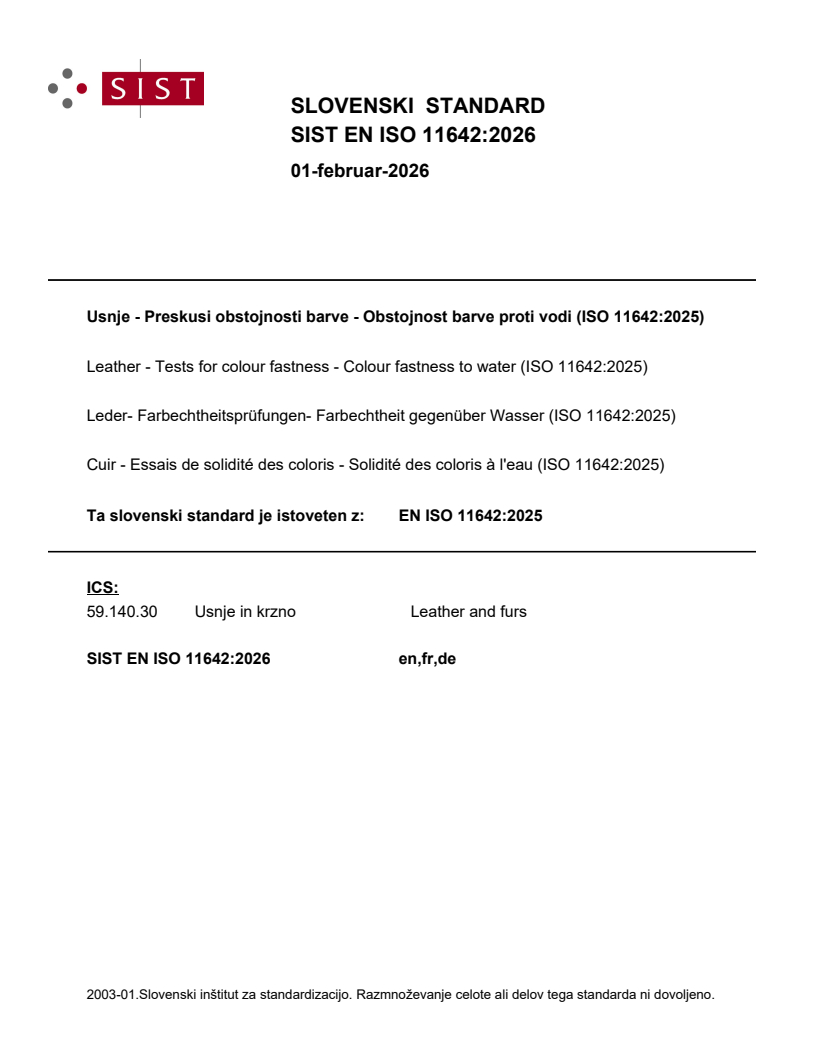
SLOVENSKI STANDARD
01-februar-2026
Usnje - Preskusi obstojnosti barve - Obstojnost barve proti vodi (ISO 11642:2025)
Leather - Tests for colour fastness - Colour fastness to water (ISO 11642:2025)
Leder- Farbechtheitsprüfungen- Farbechtheit gegenüber Wasser (ISO 11642:2025)
Cuir - Essais de solidité des coloris - Solidité des coloris à l'eau (ISO 11642:2025)
Ta slovenski standard je istoveten z: EN ISO 11642:2025
ICS:
59.140.30 Usnje in krzno Leather and furs
2003-01.Slovenski inštitut za standardizacijo. Razmnoževanje celote ali delov tega standarda ni dovoljeno.
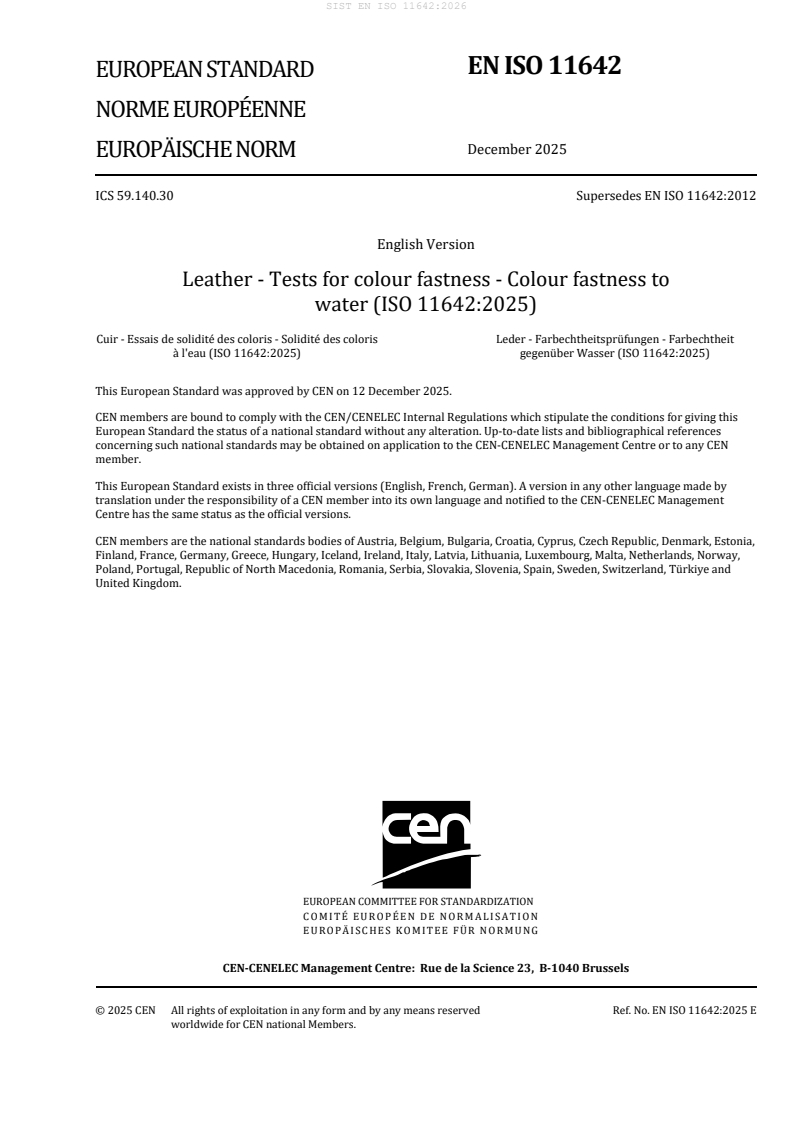
EN ISO 11642
EUROPEAN STANDARD
NORME EUROPÉENNE
December 2025
EUROPÄISCHE NORM
ICS 59.140.30 Supersedes EN ISO 11642:2012
English Version
Leather - Tests for colour fastness - Colour fastness to
water (ISO 11642:2025)
Cuir - Essais de solidité des coloris - Solidité des coloris Leder - Farbechtheitsprüfungen - Farbechtheit
à l'eau (ISO 11642:2025) gegenüber Wasser (ISO 11642:2025)
This European Standard was approved by CEN on 12 December 2025.
CEN members are bound to comply with the CEN/CENELEC Internal Regulations which stipulate the conditions for giving this
European Standard the status of a national standard without any alteration. Up-to-date lists and bibliographical references
concerning such national standards may be obtained on application to the CEN-CENELEC Management Centre or to any CEN
member.
This European Standard exists in three official versions (English, French, German). A version in any other language made by
translation under the responsibility of a CEN member into its own language and notified to the CEN-CENELEC Management
Centre has the same status as the official versions.
CEN members are the national standards bodies of Austria, Belgium, Bulgaria, Croatia, Cyprus, Czech Republic, Denmark, Estonia,
Finland, France, Germany, Greece, Hungary, Iceland, Ireland, Italy, Latvia, Lithuania, Luxembourg, Malta, Netherlands, Norway,
Poland, Portugal, Republic of North Macedonia, Romania, Serbia, Slovakia, Slovenia, Spain, Sweden, Switzerland, Türkiye and
United Kingdom.
EUROPEAN COMMITTEE FOR STANDARDIZATION
COMITÉ EUROPÉEN DE NORMALISATION
EUROPÄISCHES KOMITEE FÜR NORMUNG
CEN-CENELEC Management Centre: Rue de la Science 23, B-1040 Brussels
© 2025 CEN All rights of exploitation in any form and by any means reserved Ref. No. EN ISO 11642:2025 E
worldwide for CEN national Members.
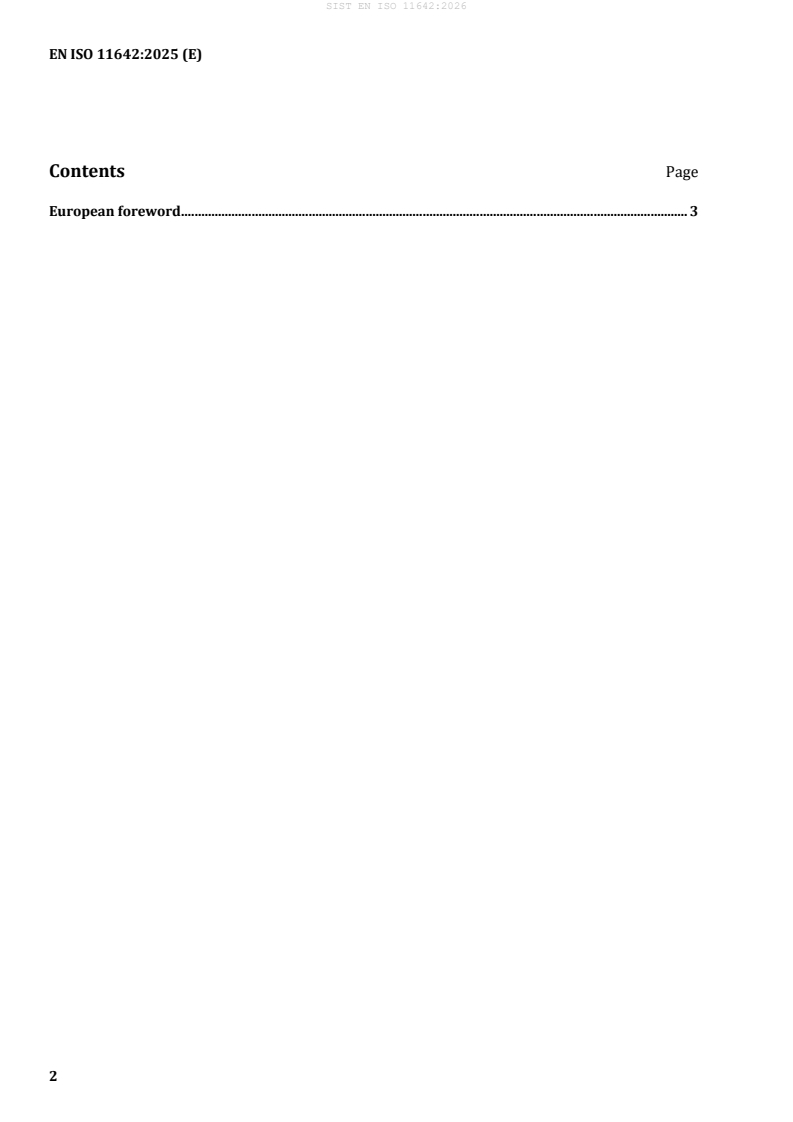
Contents Page
European foreword . 3
European foreword
This document (EN ISO 11642:2025) has been prepared by Technical Committee IULTCS "International
Union of Leather Technologists and Chemists Societies" in collaboration with Technical Committee
CEN/TC 289 “Leather” the secretariat of which is held by UNI.
This European Standard shall be given the status of a national standard, either by publication of an
identical text or by endorsement, at the latest by June 2026, and conflicting national standards shall be
withdrawn at the latest by June 2026.
Attention is drawn to the possibility that some of the elements of this document may be the subject of
patent rights. CEN shall not be held responsible for identifying any or all such patent rights.
This document supersedes EN ISO 11642:2012.
Any feedback and questions on this document should be directed to the users’ national standards
body/national committee. A complete listing of these bodies can be found on the CEN website.
According to the CEN-CENELEC Internal Regulations, the national standards organizations of the
following countries are bound to implement this European Standard: Austria, Belgium, Bulgaria,
Croatia, Cyprus, Czech Republic, Denmark, Estonia, Finland, France, Germany, Greece, Hungary, Iceland,
Ireland, Italy, Latvia, Lithuania, Luxembourg, Malta, Netherlands, Norway, Poland, Portugal, Republic of
North Macedonia, Romania, Serbia, Slovakia, Slovenia, Spain, Sweden, Switzerland, Türkiye and the
United Kingdom.
Endorsement notice
The text of ISO 11642:2025 has been approved by CEN as EN ISO 11642:2025 without any modification.
International
Standard
ISO
IULTCS
IUF 421
Third edition
Leather — Tests for colour fastness
2025-12
— Colour fastness to water
Cuir — Essais de solidité des coloris — Solidité des coloris à l'eau
Reference numbers
ISO 11642:2025(en)
IULTCS/IUF 421:2025(en) © ISO 2025
ISO 11642:2025(en)
IULTCS/IUF 421:2025(en)
© ISO 2025
All rights reserved. Unless otherwise specified, or required in the context of its implementation, no part of this publication may
be reproduced or utilized otherwise in any form or by any means, electronic or mechanical, including photocopying, or posting on
the internet or an intranet, without prior written permission. Permission can be requested from either ISO at the address below
or ISO’s member body in the country of the requester.
ISO copyright office
CP 401 • Ch. de Blandonnet 8
CH-1214 Vernier, Geneva
Phone: +41 22 749 01 11
Email: copyright@iso.org
Website: www.iso.org
Published in Switzerland
ii
ISO 11642:2025(en)
IULTCS/IUF 421:2025(en)
Contents Page
Foreword .iv
1 Scope . 1
2 Normative references . 1
3 Terms and definitions . 1
4 Principle . 2
5 Apparatus and materials . 2
6 Test pieces . 3
7 Procedure . 3
8 Evaluation . 4
9 Precision . 4
10 Test report . 4
Annex A (informative) Commercial sources for apparatus and materials . 5
iii
ISO 11642:2025(en)
IULTCS/IUF 421:2025(en)
Foreword
ISO (the International Organization for Standardization) is a worldwide federation of national standards
bodies (ISO member bodies). The work of preparing International Standards is normally carried out through
ISO technical committees. Each member body interested in a subject for which a technical committee
has been established has the right to be represented on that committee. International organizations,
governmental and non-governmental, in liaison with ISO, also take part in the work. ISO collaborates closely
with the International Electrotechnical Commission (IEC) on all matters of electrotechnical standardization.
The procedures used to develop this document and those intended for its further maintenance are described
in the ISO/IEC Directives, Part 1. In particular, the different approval criteria needed for the different types
of ISO documents should be noted. This document was drafted in accordance with the editorial rules of the
ISO/IEC Directives, Part 2 (see www.iso.org/directives).
ISO draws attention to the possibility that the implementation of this document may involve the use of (a)
patent(s). ISO takes no position concerning the evidence, validity or applicability of any claimed patent
rights in respect thereof. As of the date of publication of this document, ISO had not received notice of (a)
patent(s) which may be required to implement this document. However, implementers are cautioned that
this may not represent the latest information, which may be obtained from the patent database available at
www.iso.org/patents. ISO shall not be held responsible for identifying any or all such patent rights.
Any trade name used in this document is information given for the convenience of users and does not
constitute an endorsement.
For an explanation of the voluntary nature of standards, the meaning of ISO specific terms and expressions
related to conformity assessment, as well as information about ISO’s adherence to the World Trade
Organization (WTO) principles in the Technical Barriers to Trade (TBT), see www.iso.org/iso/foreword.html.
IULTCS, originally formed in 1897, is a world-wide organization of professional leather societies to further
the advancement of leather science and technology. IULTCS has three Commissions, which are responsible
for establishing international methods for the sampling and testing of leather. ISO recognizes IULTCS as an
international standardizing body for the preparation of test methods for leather.
This document was prepared by the Fastness Tests Commission of the International Union of Leather
Technologists and Chemists Societies (IUF Commission, IULTCS), in collaboration with the European
Committee for Standardization (CEN) Technical Committee CEN/TC 289, Leather, in accordance with the
Agreement on technical cooperation between ISO and CEN (Vienna Agreement).
This third edition cancels and replaces the second edition (ISO 11642:2012), which has been technically
revised.
The main changes are as follows:
— update of normative references, in particular to ISO 2418 and to ISO 7906.
Any feedback or questions on this document should be directed to the user’s national standards body. A
complete listing of these bodies can be found at www.iso.org/members.html.
iv
---------------
...