


oSIST prEN 18343:2026
(Main)Postal services - Methods for proof of delivery of parcels to replace the physical signature
Postal services - Methods for proof of delivery of parcels to replace the physical signature
This document describes methods and requirements for proof of delivery replacing the physical signature, while being as secure and trustworthy as physical signatures.
It applies to situations where the traditional, physical signature is required by the service to be provided and where this traditional physical signature is not required by regulation.
It applies to parcels delivered to recipients by postal operators and Logistic Service Providers (LSP).
This document aims to meet or exceed the level of confidence associated with traditional, physical signatures.
The new proof of delivery process will ascertain that the item is delivered to an authorized recipient or receiver and also prove that the recipient accepted the delivery.
This document includes only the delivery process (forward flow).
Postalische Dienstleistungen - Methoden zum Nachweis der Zustellung von Postsendungen ohne Unterschrift
Services postaux - Méthodes de preuve de livraison des colis pour remplacer la signature physique
Le présent document décrit les méthodes et les exigences relatives à la preuve de livraison remplaçant la signature physique, tout en étant aussi sûre et fiable que les signatures physiques.
Il s'applique aux situations où la signature physique traditionnelle est requise par le service à fournir et où cette signature physique traditionnelle n'est pas requise par la réglementation.
Il s'applique aux colis livrés aux réceptionnaires par les opérateurs postaux et les prestataires de services logistiques (LSP).
Le présent document a pour objectif d'atteindre ou de dépasser le niveau de confiance associé aux signatures physiques traditionnelles.
Le nouveau processus de preuve de livraison permettra de vérifier que l'article est livré à un destinataire ou à un réceptionnaire autorisé et prouvera également que le réceptionnaire a accepté la livraison.
Le présent document ne concerne que le processus de livraison (n’inclut pas le potentiel flux retour).
Poštne storitve - Metode za dokazovanje dostave pošiljk, ki nadomeščajo fizični podpis
Ta dokument opisuje metode in zahteve za dokazilo o dostavi, ki nadomešča fizični podpis, pri čemer je enako varen in zanesljiv kot fizični podpisi.
Uporablja se v situacijah, kjer je tradicionalni, fizični podpis zahtevan s strani storitve, ki se zagotavlja, in kjer ta tradicionalni fizični podpis ni zahtevan z regulativo.
Uporablja se za pakete, dostavljene prejemnikom s strani poštnih operaterjev in ponudnikov logističnih storitev (LSP).
Ta dokument si prizadeva doseči ali preseči raven zaupanja, povezano s tradicionalnimi, fizičnimi podpisi.
Novi proces dokazila o dostavi bo zagotovil, da je predmet dostavljen pooblaščenemu prejemniku ali sprejemniku in tudi dokazal, da je prejemnik sprejel dostavo.
Ta dokument vključuje samo proces dostave (naprej tekoči tok).
General Information
- Status
- Not Published
- Public Enquiry End Date
- 04-Jul-2026
- Technical Committee
- I13 - Imaginarni 13
- Current Stage
- 4020 - Public enquire (PE) (Adopted Project)
- Start Date
- 19-May-2026
- Due Date
- 06-Oct-2026

Overview
oSIST prEN 18343:2026 defines standardized methods and requirements for proof of delivery (POD) of parcels without the need for a physical signature. Developed by the Slovenian Institute for Standardization (SIST), this forthcoming European Standard responds to industry trends such as increased parcel volumes, the convenience of contactless methods, and the need for secure, trustworthy digital transactions in postal services.
This standard applies to postal operators and Logistic Service Providers (LSPs), covering situations where service requirements call for proof of delivery previously achieved through physical signatures, except where regulations mandate a signature. The goal is to maintain, or even enhance, the level of confidence and security associated with traditional signatures while supporting the digitalization and efficiency of postal services.
Key Topics
- Digital Proof of Delivery: Specifies alternative methods to physical signatures, such as digital identification, one-time codes, and barcodes, to validate receipt of parcels.
- Security and Trustworthiness: Outlines processes and requirements to ensure digital proofs are tamper-evident and verifiable, matching the reliability and legal weight of a handwritten signature.
- Process Requirements: Details what information must be recorded in proof of delivery, including:
- Validation of recipient’s digital ID or access code
- Record of recipient’s name, date, time, and location of delivery (with options for GPS)
- Secure, traceable event logging within LSP or operator systems
- Delivery Scenarios: Covers a range of delivery methods:
- Home Delivery: Secure code/barcode validation at the door
- Parcel Lockers: Unique access codes for secure, unattended pickup, with digital traceability
- Pick-up Points: Recipient or delegate provides a secure code/barcode to collect the parcel
- Delegation and Flexibility: Allows recipients to authorize others to collect parcels using secure digital credentials, supporting flexibility and convenience.
- Accessibility: Highlights the need for accessible ICT products and digital platforms, referencing EN 301 549 for compliance with accessibility standards.
Applications
oSIST prEN 18343:2026 is valuable for:
- Postal and Logistics Operators: Implementing secure and efficient digital POD methods reduces manual effort, minimizes risks of contact, and enhances service flexibility.
- e-Commerce Providers: Ensures verifiable delivery while integrating seamlessly with customer communications, enhancing the customer experience.
- Regulated and Cross-Border Deliveries: Addresses proof of delivery where physical signatures are not mandatory by law but required for service compliance.
- Customers and Recipients: Provides more convenient and secure receipt options, including the ability to delegate pick-up responsibly.
- Accessibility Stakeholders: Encourages adoption of inclusive, user-friendly digital interfaces across delivery platforms and communication channels.
Related Standards
- CEN/TR 18085:2024: Postal services - Safe, secured and contactless delivery of postal items
- EN 301 549 V3.2.1 (2021-03): Accessibility requirements for ICT products and services
- Directive 97/67/EC: Common rules for the development of the internal market of Community postal services and quality improvement
- Regulation (EU) 2018/644: Cross-border parcel delivery services
By providing a secure, digital alternative to physical signatures, oSIST prEN 18343:2026 contributes to sustainability, operational agility, and customer trust in the rapidly evolving postal and logistics sector.
Get Certified
Connect with accredited certification bodies for this standard

Great Wall Tianjin Quality Assurance Center
Established 1993, first batch to receive national accreditation with IAF recognition.
Hong Kong Quality Assurance Agency (HKQAA)
Hong Kong's leading certification body.

Innovative Quality Certifications Pvt. Ltd. (IQCPL)
Known for integrity, providing ethical & impartial Assessment & Certification. CMMI Institute Partner.
Sponsored listings
Frequently Asked Questions
oSIST prEN 18343:2026 is a draft published by the Slovenian Institute for Standardization (SIST). Its full title is "Postal services - Methods for proof of delivery of parcels to replace the physical signature". This standard covers: This document describes methods and requirements for proof of delivery replacing the physical signature, while being as secure and trustworthy as physical signatures. It applies to situations where the traditional, physical signature is required by the service to be provided and where this traditional physical signature is not required by regulation. It applies to parcels delivered to recipients by postal operators and Logistic Service Providers (LSP). This document aims to meet or exceed the level of confidence associated with traditional, physical signatures. The new proof of delivery process will ascertain that the item is delivered to an authorized recipient or receiver and also prove that the recipient accepted the delivery. This document includes only the delivery process (forward flow).
This document describes methods and requirements for proof of delivery replacing the physical signature, while being as secure and trustworthy as physical signatures. It applies to situations where the traditional, physical signature is required by the service to be provided and where this traditional physical signature is not required by regulation. It applies to parcels delivered to recipients by postal operators and Logistic Service Providers (LSP). This document aims to meet or exceed the level of confidence associated with traditional, physical signatures. The new proof of delivery process will ascertain that the item is delivered to an authorized recipient or receiver and also prove that the recipient accepted the delivery. This document includes only the delivery process (forward flow).
oSIST prEN 18343:2026 is classified under the following ICS (International Classification for Standards) categories: 03.240 - Postal services. The ICS classification helps identify the subject area and facilitates finding related standards.
oSIST prEN 18343:2026 is associated with the following European legislation: EU Directives/Regulations: 97/67/EC; Standardization Mandates: M/590. When a standard is cited in the Official Journal of the European Union, products manufactured in conformity with it benefit from a presumption of conformity with the essential requirements of the corresponding EU directive or regulation.
oSIST prEN 18343:2026 is available in PDF format for immediate download after purchase. The document can be added to your cart and obtained through the secure checkout process. Digital delivery ensures instant access to the complete standard document.
Standards Content (Sample)
SLOVENSKI STANDARD
01-julij-2026
Poštne storitve - Metode za dokazovanje dostave pošiljk, ki nadomeščajo fizični
podpis
Postal services - Methods for proof of delivery of parcels to replace the physical
signature
Postalische Dienstleistungen - Methoden zum Nachweis der Zustellung von
Postsendungen ohne Unterschrift
Services postaux - Méthodes de preuve de livraison des colis pour remplacer la
signature physique
Ta slovenski standard je istoveten z: prEN 18343
ICS:
03.240 Poštne storitve Postal services
2003-01.Slovenski inštitut za standardizacijo. Razmnoževanje celote ali delov tega standarda ni dovoljeno.
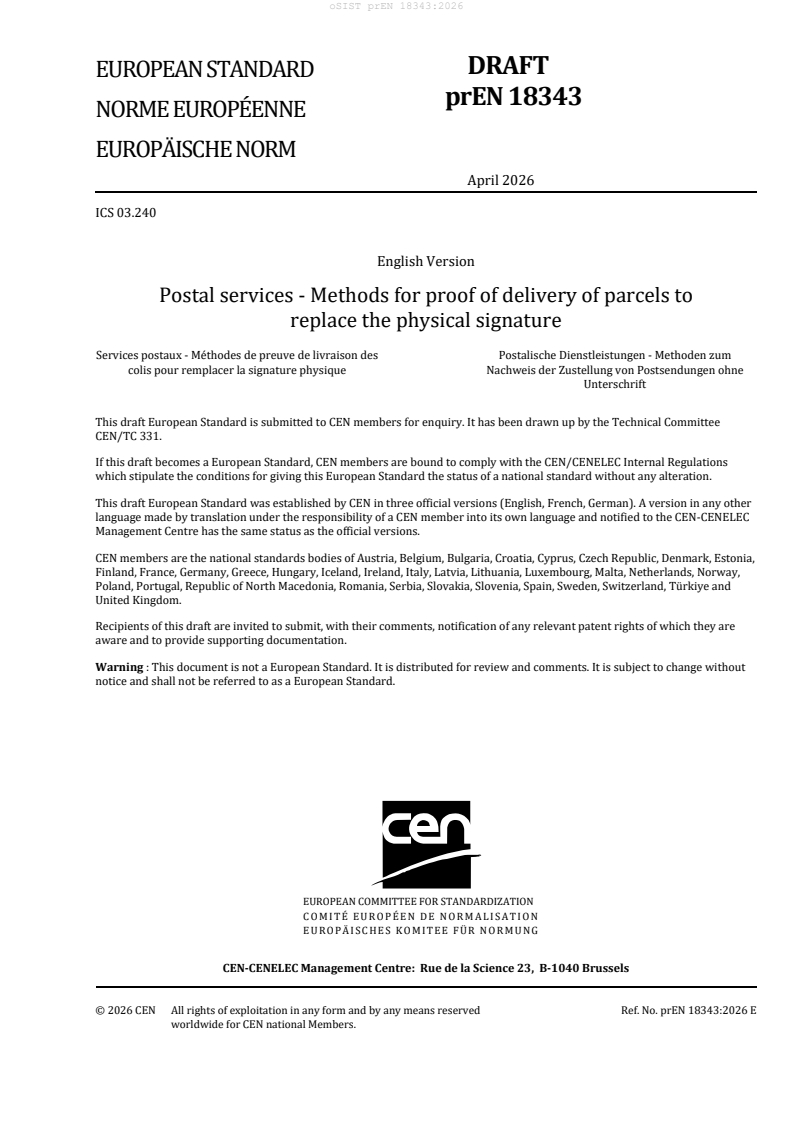
DRAFT
EUROPEAN STANDARD
NORME EUROPÉENNE
EUROPÄISCHE NORM
April 2026
ICS 03.240
English Version
Postal services - Methods for proof of delivery of parcels to
replace the physical signature
Services postaux - Méthodes de preuve de livraison des Postalische Dienstleistungen - Methoden zum
colis pour remplacer la signature physique Nachweis der Zustellung von Postsendungen ohne
Unterschrift
This draft European Standard is submitted to CEN members for enquiry. It has been drawn up by the Technical Committee
CEN/TC 331.
If this draft becomes a European Standard, CEN members are bound to comply with the CEN/CENELEC Internal Regulations
which stipulate the conditions for giving this European Standard the status of a national standard without any alteration.
This draft European Standard was established by CEN in three official versions (English, French, German). A version in any other
language made by translation under the responsibility of a CEN member into its own language and notified to the CEN-CENELEC
Management Centre has the same status as the official versions.
CEN members are the national standards bodies of Austria, Belgium, Bulgaria, Croatia, Cyprus, Czech Republic, Denmark, Estonia,
Finland, France, Germany, Greece, Hungary, Iceland, Ireland, Italy, Latvia, Lithuania, Luxembourg, Malta, Netherlands, Norway,
Poland, Portugal, Republic of North Macedonia, Romania, Serbia, Slovakia, Slovenia, Spain, Sweden, Switzerland, Türkiye and
United Kingdom.
Recipients of this draft are invited to submit, with their comments, notification of any relevant patent rights of which they are
aware and to provide supporting documentation.
Warning : This document is not a European Standard. It is distributed for review and comments. It is subject to change without
notice and shall not be referred to as a European Standard.
EUROPEAN COMMITTEE FOR STANDARDIZATION
COMITÉ EUROPÉEN DE NORMALISATION
EUROPÄISCHES KOMITEE FÜR NORMUNG
CEN-CENELEC Management Centre: Rue de la Science 23, B-1040 Brussels
© 2026 CEN All rights of exploitation in any form and by any means reserved Ref. No. prEN 18343:2026 E
worldwide for CEN national Members.
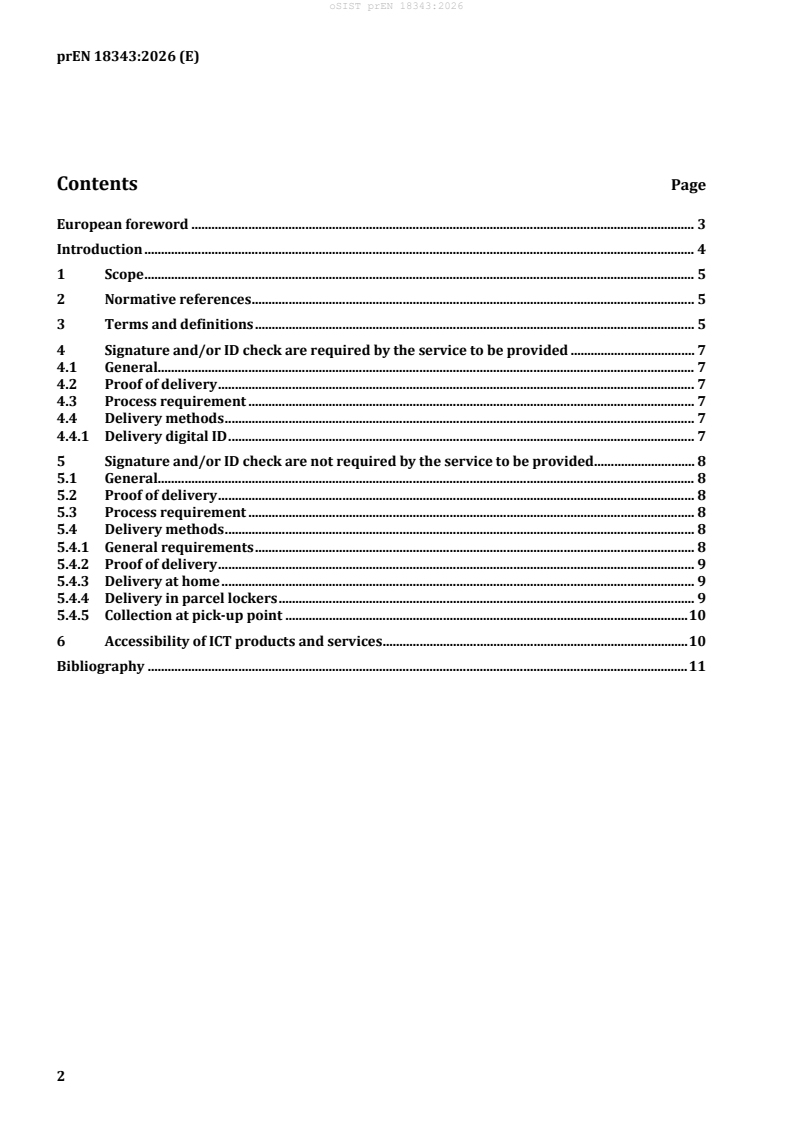
Contents Page
European foreword . 3
Introduction . 4
1 Scope . 5
2 Normative references . 5
3 Terms and definitions . 5
4 Signature and/or ID check are required by the service to be provided . 7
4.1 General. 7
4.2 Proof of delivery . 7
4.3 Process requirement . 7
4.4 Delivery methods . 7
4.4.1 Delivery digital ID . 7
5 Signature and/or ID check are not required by the service to be provided . 8
5.1 General. 8
5.2 Proof of delivery . 8
5.3 Process requirement . 8
5.4 Delivery methods . 8
5.4.1 General requirements . 8
5.4.2 Proof of delivery . 9
5.4.3 Delivery at home . 9
5.4.4 Delivery in parcel lockers . 9
5.4.5 Collection at pick-up point . 10
6 Accessibility of ICT products and services . 10
Bibliography . 11
European foreword
This document (prEN 18343:2026) has been prepared by Technical Committee CEN/TC 331 “Postal
services”, the secretariat of which is held by AFNOR.
This document is currently submitted to the CEN Enquiry.
Attention is drawn to the possibility that some of the elements of this document may be the subject of
patent rights other than those identified above. CEN shall not be held responsible for identifying any or
all such patent rights.
This document has been prepared under a standardization request addressed to CEN by the European
Commission. The Standing Committee of the EFTA States subsequently approves these requests for its
Member States.
Introduction
Due to growing concerns regarding the safety and security of deliveries, postal operators and logistic
service providers have been forced to find new methods for delivering parcels to the recipients. The
increasing volumes of parcels and a legitimate aspiration to more convenience also foster new delivery
options where recipients do not need to be present at the point and time of delivery.
In particular, the pandemic has created the need for new methods where the physical contacts between
the deliverer and the recipient are minimized or even eliminated but where sufficient information is
collected to prove that the delivery actually took place, without requiring the physical signature of the
recipient.
These new signature methods are relevant alternatives to the traditional handover of parcels where
today a physical signature is mandatory.
Physical signatures often involve time-consuming processes, such as handing over, scanning and
archiving. Enhancing electronic signatures allows for quicker, more efficient transactions, aligning with
the demands for speed and responsiveness in modern postal services.
As electronic transactions become increasingly prevalent, aligning electronic signatures with the
reliability of physical signatures is essential for legal acceptance. Ensuring compliance with existing and
emerging electronic signature regulations enhances the legal standing of digital transactions within the
postal sector.
Adopting more reliable electronic signature methods can contribute to significant cost savings associated
with paper, printing, postage, and manual handling. This aligns with the industry's push towards cost-
effectiveness and sustainability.
Offering electronic signatures that are as trustworthy as physical signatures provides customers with a
more convenient and flexible way to engage in postal transactions. This can lead to increased customer
satisfaction and loyalty.
Enhancing electronic signatures with advanced security measures, such as digital signatures and
biometric authentication, reduces the risk of fraud and tampering. This address concerns related to the
security of digital transactions and contributes to a more secure postal ecosystem.
Electronic signatures, when enhanced with features like timestamps and audit trails, provide better
tracking and accountability compared to physical signatures. This transparency can be valuable in
resolving disputes, ensuring the integrity of transactions, and maintaining trust in postal services.
One of the objectives of this document is also to contribute to the digitalization of postal services.
This process will be defined in accordance with the protection of personal data and might help as well to
protect personal data according to the GDPR.
The aim of this document will also be to help customers to recognize these methods.
Physical signature and/or ID control are sometime required by regulation.
In this case, it won’t be possible to use any other process until the regulatory context changes.
Nevertheless, digitalisation of all processes will supress little by little all need of physical signature or
physical check of ID.
Processes requiring physical signature or physical ID check will not be described in this document.
When a process requires physical signature and/or ID check for legal reason, it could be replaced, if
legally possible, by system providing digital ID validation like eIDAS 2.0 or other system already available
in some European countries, e.g. BankID is an electronic identification system in Sweden.
If physical signature and/or ID check is not required by regulation, it could be replaced by some processes
described in this document, providing the same level of requirement.
1 Scope
This document describes methods and requirements for proof of delivery replacing the physical
signature, while being as secure and trustworthy as physical signatures.
It applies to situations where the traditional, physical signature is required by the service to be provided
and where this traditional physical signature is not required by regulation.
It applies to parcels delivered to recipients by postal operators and Logistic Service Providers (LSP).
This document aims to meet or exceed the level of confidence associated with traditional, physical
signatures.
The new proof of delivery process will ascertain that the item is delivered to an authorized recipient or
receiver and also prove that the recipient accepted the delivery.
This document includes only the delivery process (forward flow).
2 Normative references
There are no normative references in this document.
3 Terms and definitions
For the purposes of this document, the following terms and definitions apply.
ISO and IEC maintain terminology databases for use in standardization at the following addresses:
— ISO Online browsing platform: available at https://www.iso.org/obp/
— IEC Electropedia: available at https://www.electropedia.org/
3.1
receiver
any natural or legal person who physically receives the parcel
[SOURCE: CEN/TR 18085:2024, 3.8]
3.2
recipient
any natural or legal person to whom the parcel is destined, whose name and address are written in the
addressee zone on the shipping label
EXAMPLE This can be a physical person or a legal entity (such as a company, an internal department, or a
family).
[SOURCE: CEN/TR 18085:2024, definition 3.1]
3.3
delivery person
person responsible for clearance, transporting and delivering parcels from the premises of the provider
or the distribution centre to the recipient’s address
Note 1 to entry: The delivery person is an individual employed by a company (LSP or postal operator) that
specializes in the transportation and delivery of parcels (packages, goods or documents).
Note 2 to entry: The company (LSP or postal operator) can outsource part of its logistics operations to another
company (the third party). This third-party supplier might be specialized in specific services, su
...