


oSIST prEN 12697-27:2025
(Main)Bituminous mixtures - Test methods - Part 27: Sampling
General Information
- Abstract
This document specifies test methods for sampling bituminous mixtures for roads and other paved areas to determine their physical properties and composition.
- Status
- Not Published
- Public Enquiry End Date
- 28-May-2025
- Technical Committee
- CES - Roads
- Current Stage
- 4020 - Public enquire (PE) (Adopted Project)
- Start Date
- 27-Mar-2025
- Due Date
- 14-Aug-2025
- Completion Date
- 06-Aug-2025

Overview
oSIST prEN 12697-27:2025: Bituminous Mixtures - Test Methods - Part 27: Sampling is a standard developed by CEN for specifying test methods for the sampling of bituminous mixtures. These mixtures are widely used in the construction and maintenance of roads and other paved areas. Accurate and representative sampling is critical for determining the physical properties and composition of the materials, which in turn affects quality control, compliance testing, and performance assessments. This document outlines approved procedures for collecting samples from fresh, laid, compacted, and stockpiled bituminous mixtures to ensure the reliability of test results.
Key Topics
Sampling Methods: The standard details multiple techniques for obtaining bulk and representative samples from a variety of sources, including:
- Lorry loads
- Mixer transporters (mastic asphalt)
- Around augers of pavers
- Workable material in stockpiles or heaps
- Laid but not rolled materials (e.g., cut trenches)
- Compacted materials (by coring or sawing slabs)
- Slat conveyors in continuous process plants
- Hoppers and material conveyance systems
Types of Samples Defined:
- Increment: A single portion taken from a larger mass.
- Bulk Sample: Combination of increments sufficient for all needed tests.
- Representative Sample: Specific quantities taken to reflect a certain volume or area.
- Spot Sample: Single-point sample, valid only if the material is homogeneous.
- Laboratory Sample: The portion forwarded for lab analysis.
Sampling Equipment
- Shovels, sampling scoops and tubes, core-cutting machines, sampling trays, and removable containers.
- Guidelines on apparatus selection based on aggregate size and sample type.
Packaging and Marking
- Procedures for sealing and labeling samples to prevent contamination or alteration.
- Specific recommendations for materials containing water, such as mixing with foamed bitumen or emulsions.
- Detailed reporting requirements for traceability (project details, sampler details, location, timestamp, etc.).
Applications
- Quality Control: Construction contractors, testing labs, and quality managers use this standard to ensure the sampled bituminous mixtures accurately reflect the material in use or storage, providing reliable basis for compliance and performance tests.
- Compliance Testing: Meeting national and international road construction standards requires following the specified sampling protocols to validate the properties and composition of asphalt and bituminous products.
- Research and Product Development: Laboratories conducting mix design studies or material investigations employ these methods to guarantee that their test results are not biased by unrepresentative samples.
- Project Documentation: Clear sampling records and procedures improve traceability, helping resolve disputes and verify conformity throughout a project's lifecycle.
Related Standards
- EN 58: Bitumen and bituminous binders - Sampling bituminous binders
- EN 12697-20: Bituminous mixtures - Test methods - Part 20: Indentation using cube or Marshall specimens
- BS 3388:1973: Specification for forks, shovels and spades (for sampling tool reference)
oSIST prEN 12697-27:2025 is part of the EN 12697 series, which covers a comprehensive range of laboratory and field test methods for bituminous mixtures, supporting harmonization and improved quality across the European construction industry.
For organizations involved in road construction materials, adhering to oSIST prEN 12697-27:2025 ensures that sampling practices are standardized, reproducible, and yield results that support the longevity and safety of paved surfaces. For more information and updates, check with your national standardization body or CEN.
Relations
- Effective Date
- 21-Feb-2024
Get Certified
Connect with accredited certification bodies for this standard

Zavod za gradbeništvo Slovenije (ZAG) - Inšpekcija
ZAG inspection body for construction products, structures, and materials.
Sponsored listings
Frequently Asked Questions
oSIST prEN 12697-27:2025 is a draft published by the Slovenian Institute for Standardization (SIST). Its full title is "Bituminous mixtures - Test methods - Part 27: Sampling". This standard covers: This document specifies test methods for sampling bituminous mixtures for roads and other paved areas to determine their physical properties and composition.
This document specifies test methods for sampling bituminous mixtures for roads and other paved areas to determine their physical properties and composition.
oSIST prEN 12697-27:2025 is classified under the following ICS (International Classification for Standards) categories: 93.080.20 - Road construction materials. The ICS classification helps identify the subject area and facilitates finding related standards.
oSIST prEN 12697-27:2025 has the following relationships with other standards: It is inter standard links to SIST EN 12697-27:2017. Understanding these relationships helps ensure you are using the most current and applicable version of the standard.
oSIST prEN 12697-27:2025 is available in PDF format for immediate download after purchase. The document can be added to your cart and obtained through the secure checkout process. Digital delivery ensures instant access to the complete standard document.
Standards Content (Sample)
SLOVENSKI STANDARD
01-maj-2025
Bitumenske zmesi - Preskusne metode - 27. del: Vzorčenje
Bituminous mixtures - Test methods - Part 27: Sampling
Asphalt - Prüfverfahren - Teil 27: Probenahme
Mélanges bitumineux - Méthodes d'essai - Partie 27: Prélèvements d'échantillonnage
Ta slovenski standard je istoveten z: prEN 12697-27
ICS:
93.080.20 Materiali za gradnjo cest Road construction materials
2003-01.Slovenski inštitut za standardizacijo. Razmnoževanje celote ali delov tega standarda ni dovoljeno.
DRAFT
EUROPEAN STANDARD
prEN 12697-27
NORME EUROPÉENNE
EUROPÄISCHE NORM
March 2025
ICS 93.080.20 Will supersede EN 12697-27:2017
English Version
Bituminous mixtures - Test methods - Part 27: Sampling
Mélanges bitumineux - Méthodes d'essai - Partie 27: Asphalt - Prüfverfahren - Teil 27: Probenahme
Prélèvements d'échantillonnage
This draft European Standard is submitted to CEN members for enquiry. It has been drawn up by the Technical Committee
CEN/TC 227.
If this draft becomes a European Standard, CEN members are bound to comply with the CEN/CENELEC Internal Regulations
which stipulate the conditions for giving this European Standard the status of a national standard without any alteration.
This draft European Standard was established by CEN in three official versions (English, French, German). A version in any other
language made by translation under the responsibility of a CEN member into its own language and notified to the CEN-CENELEC
Management Centre has the same status as the official versions.
CEN members are the national standards bodies of Austria, Belgium, Bulgaria, Croatia, Cyprus, Czech Republic, Denmark, Estonia,
Finland, France, Germany, Greece, Hungary, Iceland, Ireland, Italy, Latvia, Lithuania, Luxembourg, Malta, Netherlands, Norway,
Poland, Portugal, Republic of North Macedonia, Romania, Serbia, Slovakia, Slovenia, Spain, Sweden, Switzerland, Türkiye and
United Kingdom.
Recipients of this draft are invited to submit, with their comments, notification of any relevant patent rights of which they are
aware and to provide supporting documentation.
Warning : This document is not a European Standard. It is distributed for review and comments. It is subject to change without
notice and shall not be referred to as a European Standard.
EUROPEAN COMMITTEE FOR STANDARDIZATION
COMITÉ EUROPÉEN DE NORMALISATION
EUROPÄISCHES KOMITEE FÜR NORMUNG
CEN-CENELEC Management Centre: Rue de la Science 23, B-1040 Brussels
© 2025 CEN All rights of exploitation in any form and by any means reserved Ref. No. prEN 12697-27:2025 E
worldwide for CEN national Members.
prEN 12697-27:2025 (E)
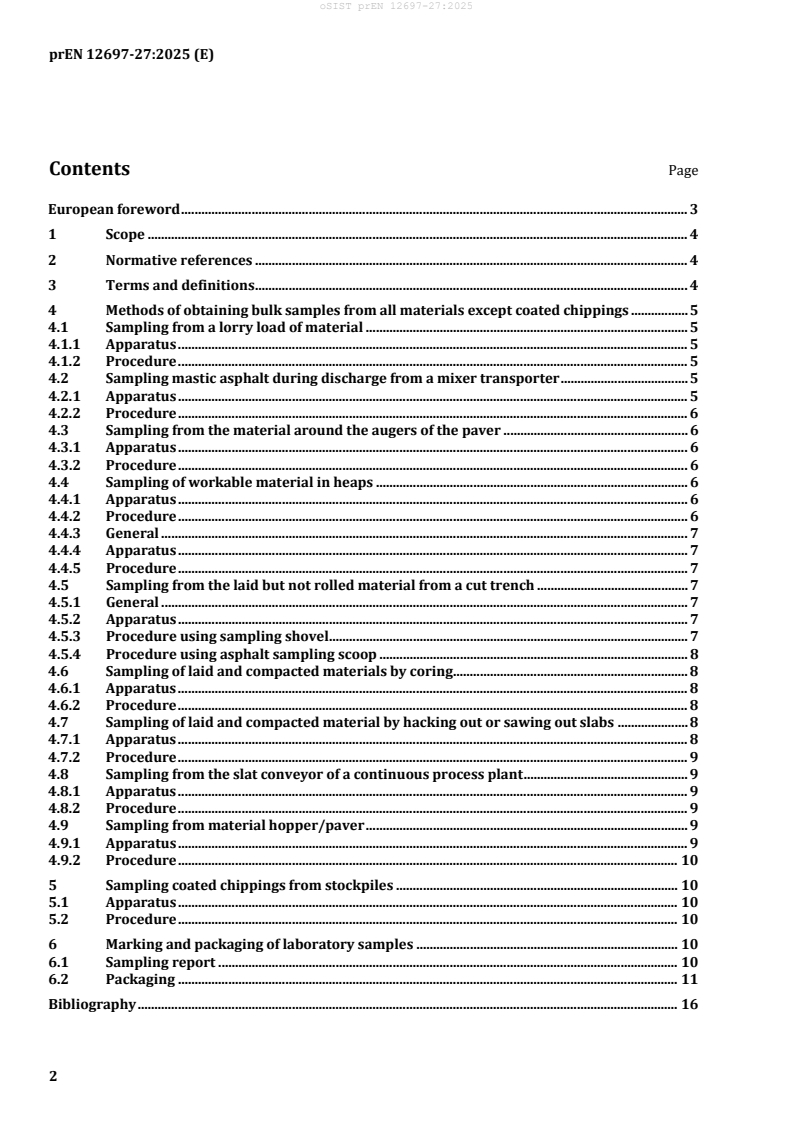
Contents Page
European foreword . 3
1 Scope . 4
2 Normative references . 4
3 Terms and definitions . 4
4 Methods of obtaining bulk samples from all materials except coated chippings . 5
4.1 Sampling from a lorry load of material . 5
4.1.1 Apparatus . 5
4.1.2 Procedure . 5
4.2 Sampling mastic asphalt during discharge from a mixer transporter . 5
4.2.1 Apparatus . 5
4.2.2 Procedure . 6
4.3 Sampling from the material around the augers of the paver . 6
4.3.1 Apparatus . 6
4.3.2 Procedure . 6
4.4 Sampling of workable material in heaps . 6
4.4.1 Apparatus . 6
4.4.2 Procedure . 6
4.4.3 General . 7
4.4.4 Apparatus . 7
4.4.5 Procedure . 7
4.5 Sampling from the laid but not rolled material from a cut trench . 7
4.5.1 General . 7
4.5.2 Apparatus . 7
4.5.3 Procedure using sampling shovel . 7
4.5.4 Procedure using asphalt sampling scoop . 8
4.6 Sampling of laid and compacted materials by coring . 8
4.6.1 Apparatus . 8
4.6.2 Procedure . 8
4.7 Sampling of laid and compacted material by hacking out or sawing out slabs . 8
4.7.1 Apparatus . 8
4.7.2 Procedure . 9
4.8 Sampling from the slat conveyor of a continuous process plant . 9
4.8.1 Apparatus . 9
4.8.2 Procedure . 9
4.9 Sampling from material hopper/paver . 9
4.9.1 Apparatus . 9
4.9.2 Procedure . 10
5 Sampling coated chippings from stockpiles . 10
5.1 Apparatus . 10
5.2 Procedure . 10
6 Marking and packaging of laboratory samples . 10
6.1 Sampling report . 10
6.2 Packaging . 11
Bibliography . 16
prEN 12697-27:2025 (E)
European foreword
This document (prEN 12697-27:2025) has been prepared by Technical Committee CEN/TC 227 “Road
materials”, the secretariat of which is held by BSI.
This document is currently submitted to the CEN Enquiry.
This document will supersede EN 12697-27:2017.
prEN 12697-27:2025 includes the following significant technical changes with respect to
EN 12697-27:2017.
— [European Foreword] deletion of paragraph describing the applicability of this document.
— [Clause 6.2] added description for packaging of bulk samples containing water.
prEN 12697-27:2025 (E)
1 Scope
This document specifies test methods for sampling bituminous mixtures for roads and other paved areas
to determine their physical properties and composition.
2 Normative references
The following documents are referred to in the text in such a way that some or all of their content
constitutes requirements of this document. For dated references, only the edition cited applies. For
undated references, the latest edition of the referenced document (including any amendments) applies.
EN 58, Bitumen and bituminous binders - Sampling bituminous binders
EN 12697-20, Bituminous mixtures - Test methods - Part 20: Indentation using cube or Marshall specimens
3 Terms and definitions
For the purposes of this document, the terms and definitions given in EN 58 and the following apply.
ISO and IEC maintain terminology databases for use in standardization at the following addresses:
ISO Online browsing platform: available at https://www.iso.org/obp/
IEC Electropedia: available at https://www.electropedia.org/
3.1
increment
single quantity of material taken from a larger body of the material under examination
3.2
bulk sample
sample obtained when increments from the material being sampled are combined to provide sufficient
material for all required purposes
3.3
representative sample
sample consisting of a specified number of increments purposely taken to represent a specific quantity
or area of material
Note 1 to entry: A representative sample is assumed to have the same composition as the material sampled,
within the limits of precision associated with the method of sampling.
3.4
spot sample
sample of material taken in a single operation at a single place and time of the material being sampled
Note 1 to entry: If it can be assumed that the material is homogeneous, a spot sample can be regarded as a
representative sample. If the material is not homogeneous, a spot sample only can be regarded as representative of
a limited region around the sampling point.
3.5
laboratory sample
sample despatched to the laboratory
Note 1 to entry: It can be the whole or part of the bulk or representative sample. A laboratory sample is assumed
to be of sufficient quantity for all tests required.
prEN 12697-27:2025 (E)
4 Methods of obtaining bulk samples from all materials except coated chippings
4.1 Sampling from a lorry load of material
4.1.1 Apparatus
a) sampling shovel (such as that shown in Figure 1); or
b) sampling scoop (such as that shown in Figure 2) for materials whose nominal size is 16 mm and
smaller; or
c) sampling tube of stainless steel (see Figure 3 and Figure 4). Pipe size M may not be used when the
nominal maximum size for aggregate is greater than 16 mm.
4.1.2 Procedure
4.1.2.1 Using a sampling shovel or scoop, take a minimum of four increments of approximately:
a) 2 kg each for material containing aggregate of nominal size equal or smaller than 16 mm;
b) 3 kg each for material containing aggregate of nominal size larger than 16 mm.
For mixtures with aggregate size ≥ 32 mm eight increments is recommended.
Take the increments from about 100 mm below the surface of the material from different positions as
widely spaced as practicable but not closer than 300 mm from the side of the lorry. Remove all the surface
material including any coarse material that may fall into the hole during sampling.
With some less cohesive materials the use of a metal plate, pushed into the material to facilitate digging
100 mm down is recommended to stop surface material falling into the hole.
4.1.2.2 Using a sampling tube (size M or N), take a minimum of three increments of approximately
4 kg.
To enable representative sampling the lorry should be loaded with at least half the volume with current
material.
Take the increments of the material from different positions as widely spaced as practicable but not
closer than 0,5 m from the side of the lorry. Push the tube horizontally in the mass and so far that the
entire tube is filled. Pull out the tube and empty the contents into the packaging.
NOTE When more than one bulk sample is needed, an example of sample drawing for three bulk samples is
given in Figure 9.
4.1.2.3 Combine the increments obtained to form the bulk sample.
The number of increments spe
...