


SIST EN 1762:2019
(Main)Rubber hoses and hose assemblies for liquefied petroleum gas, LPG (liquid or gaseous phase), and natural gas up to 25 bar (2,5 MPa) - Specification
Rubber hoses and hose assemblies for liquefied petroleum gas, LPG (liquid or gaseous phase), and natural gas up to 25 bar (2,5 MPa) - Specification
This European Standard specifies the requirements for rubber hoses and rubber hose assemblies used for the transfer of liquefied petroleum gas (LPG) in liquid or gaseous phase and natural gas with a maximum working pressure of 25 bar (2,5 MPa) and vacuum within the temperature range of −30 °C to +70 °C and, when designated -LT, −50 °C to +70 °C.
Gummischläuche und -schlauchleitungen für Flüssiggas LPG (flüssig oder gasförmig) und Erdgas bis 25 bar (2,5 MPa) - Spezifikation
Diese Europäische Norm legt die Anforderungen für Gummischläuche und Gummischlauchleitungen fest, die für den Transport von Flüssiggas (LPG) in der flüssigen oder gasförmigen Phase verwendet werden sowie für Erdgas mit einem maximalen Betriebsdruck von 25 bar (2,5 MPa) und einem Vakuum in einem Temperaturbereich von -30 °C bis +70 °C und, -50 °C bis +70 °C, wenn es mit -LT bezeichnet wird.
Tuyaux et flexibles en caoutchouc pour le gaz de pétrole liquéfié GPL (en phase liquide ou gazeuse) et le gaz naturel jusqu'à 25 bar (2,5 MPa) -Spécification
La présente Norme européenne spécifie les exigences relatives aux tuyaux et flexibles en caoutchouc destinés au transfert de gaz de pétrole liquéfié (GPL) en phase liquide ou gazeuse et de gaz naturel avec une pression maximale de service de 25 bar (2,5 MPa) et sous vide dans la plage de température de −30 °C à +70 °C, et pour le type LT de −50 °C à +70 °C.
Gumene cevi in cevni priključki za utekočinjeni naftni plin, LPG (tekoča ali plinska faza) in zemeljski plin do 25 barov (2,5 MPa) - Specifikacija
Ta evropski standard določa zahteve za gumene cevi in njihove priključke za prenos utekočinjenega naftnega plina (LPG) v tekočem ali plinskem stanju in zemeljskega plina z največjo vrednostjo delovnega tlaka 25 barov (2,5 MPa) ter vakuumom v temperaturnem območju od –30 ºC do 70 ºC in (kadar je določeno) –LT, od –50 ºC do 70 ºC.
General Information
- Status
- Published
- Public Enquiry End Date
- 31-Mar-2018
- Publication Date
- 07-Jan-2019
- Technical Committee
- IPMA - Polimer materials and products
- Current Stage
- 6060 - National Implementation/Publication (Adopted Project)
- Start Date
- 03-Jan-2019
- Due Date
- 10-Mar-2019
- Completion Date
- 08-Jan-2019



Relations
- Effective Date
- 26-Dec-2018
- Effective Date
- 28-Jan-2026
- Effective Date
- 28-Jan-2026
- Effective Date
- 28-Jan-2026
- Effective Date
- 28-Jan-2026
- Effective Date
- 28-Jan-2026
- Effective Date
- 28-Jan-2026
- Effective Date
- 28-Jan-2026
- Effective Date
- 28-Jan-2026
- Refers
SIST EN ISO 8330:2022 - Rubber and plastics hoses and hose assemblies - Vocabulary (ISO 8330:2022) - Effective Date
- 28-Jan-2026
- Effective Date
- 28-Jan-2026
- Effective Date
- 28-Jan-2026
- Effective Date
- 28-Jan-2026
- Effective Date
- 28-Jan-2026
- Effective Date
- 28-Jan-2026
Overview
SIST EN 1762:2019 outlines the European requirements for rubber hoses and hose assemblies used in the transfer of liquefied petroleum gas (LPG), in both liquid and gaseous phases, and natural gas. The standard applies to hoses with a maximum working pressure of 25 bar (2.5 MPa) and covers safe operation within a temperature range of −30°C to +70°C, or −50°C to +70°C for hoses designated with "-LT" classification. The standard is intended for manufacturers, installers, and end-users dealing with the handling and transfer of LPG and natural gas, ensuring safety, reliability, and compliance throughout Europe.
Key Topics
- Scope of Use
- Rubber hoses and hose assemblies for conveying LPG (liquid or gaseous phase) and natural gas
- Maximum working pressure: 25 bar (2.5 MPa)
- Temperature range: −30°C to +70°C (standard) or −50°C to +70°C (LT)
- Classification
- Hoses categorized into five types and three grades by function, construction, and electrical properties
- Delivery hoses, suction and delivery hoses (standard, smooth bore, rough bore), and their respective low-temperature versions
- Materials and Construction
- Hoses constructed with synthetic rubber linings and covers, reinforcing textile or steel wire layers, and, where required, metallic helix or anti-static wires
- Specific requirements for electrical conductivity and bonding for safe handling of flammable gases
- Testing and Performance
- Stringent physical, chemical, and electrical tests for tensile strength, elongation, abrasion, chemical resistance, flexibility, and electrical continuity
- Rigorous type, routine, and acceptance tests for finished hoses and assemblies
- Marking and Traceability
- Mandatory permanent markings with manufacturer details, type, nominal bore, working pressure, batch, and compliance indicators
- Assembly marking for installer or manufacturer and date of assembly
- Environmental Considerations
- Guidance on material selection, packaging, and lifecycle impacts to minimize environmental risks
Applications
SIST EN 1762:2019 is highly relevant for:
- Fuel stations and gas storage sites: Ensuring safe delivery and transfer of LPG and natural gas at filling stations, industrial plants, and storage terminals
- Transportation: Use in flexible connections for LPG tanker trucks, railcars, and ship-to-shore transfer systems
- Industrial use: Suitable for connections in heating, process gas supply, and fuel lines requiring compliance with European safety standards
- General gas handling: Any application where safe, reliable transfer of pressurized LPG or natural gas is required, especially under varying environmental and temperature conditions
The standard sets out clear criteria to ensure safety against high pressure, temperature fluctuations, and static electricity, protecting users and assets during handling of combustible gases.
Related Standards
For comprehensive compliance and compatibility, users should be aware of the following related standards:
- EN ISO 1402: Hydrostatic testing of hoses and hose assemblies
- EN ISO 4671: Measurement of hose dimensions and lengths
- EN ISO 6179: Determination of transmission rates of volatile liquids
- EN ISO 8031: Electrical resistance and conductivity of hoses
- EN ISO 8330: Vocabulary for rubber and plastics hoses
- EN 1360: Hoses for measured fuel dispensing systems (relevant for LPG dispensers)
These references provide guidance on complementary tests, terminology, and operational requirements to support compliance with SIST EN 1762:2019 and ensure operational safety in gas transfer and handling.
Keywords: rubber hoses, LPG hoses, gas hose assemblies, liquefied petroleum gas, natural gas, hose safety standard, SIST EN 1762, European hose standards, gas handling, industrial hoses, hose testing, hose marking, gas transfer safety.
Get Certified
Connect with accredited certification bodies for this standard

DIN CERTCO
DIN Group product certification.

Element Materials Technology
Materials testing and product certification.
ABS Group Brazil
ABS Group certification services in Brazil.
Sponsored listings
Frequently Asked Questions
SIST EN 1762:2019 is a standard published by the Slovenian Institute for Standardization (SIST). Its full title is "Rubber hoses and hose assemblies for liquefied petroleum gas, LPG (liquid or gaseous phase), and natural gas up to 25 bar (2,5 MPa) - Specification". This standard covers: This European Standard specifies the requirements for rubber hoses and rubber hose assemblies used for the transfer of liquefied petroleum gas (LPG) in liquid or gaseous phase and natural gas with a maximum working pressure of 25 bar (2,5 MPa) and vacuum within the temperature range of −30 °C to +70 °C and, when designated -LT, −50 °C to +70 °C.
This European Standard specifies the requirements for rubber hoses and rubber hose assemblies used for the transfer of liquefied petroleum gas (LPG) in liquid or gaseous phase and natural gas with a maximum working pressure of 25 bar (2,5 MPa) and vacuum within the temperature range of −30 °C to +70 °C and, when designated -LT, −50 °C to +70 °C.
SIST EN 1762:2019 is classified under the following ICS (International Classification for Standards) categories: 75.200 - Petroleum products and natural gas handling equipment; 83.140.40 - Hoses. The ICS classification helps identify the subject area and facilitates finding related standards.
SIST EN 1762:2019 has the following relationships with other standards: It is inter standard links to SIST EN 1762:2017, SIST EN 4855-02:2020, SIST EN ISO 1402:2021, SIST EN ISO 7233:2021, SIST EN ISO 7326:2016, SIST EN ISO 8031:2020, SIST EN ISO 8033:2017, SIST EN ISO 4671:2022, SIST EN ISO 10619-1:2018, SIST EN ISO 8330:2022, SIST EN ISO 6179:2017, SIST EN ISO 10619-2:2021, SIST EN 14678-1:2006+A1:2009, SIST EN 14678-1:2013, SIST EN 12252:2014. Understanding these relationships helps ensure you are using the most current and applicable version of the standard.
SIST EN 1762:2019 is available in PDF format for immediate download after purchase. The document can be added to your cart and obtained through the secure checkout process. Digital delivery ensures instant access to the complete standard document.
Standards Content (Sample)
2003-01.Slovenski inštitut za standardizacijo. Razmnoževanje celote ali delov tega standarda ni dovoljeno.Gummischläuche und -schlauchleitungen für Flüssiggas LPG (flüssig oder gasförmig) und Erdgas bis 25 bar (2,5 MPa) - SpezifikationTuyaux et flexibles en caoutchouc pour le gaz de pétrole liquéfié GPL (en phase liquide ou gazeuse) et le gaz naturel jusqu'à 25 bar (2,5 MPa) -SpécificationRubber hoses and hose assemblies for liquefied petroleum gas, LPG (liquid or gaseous phase), and natural gas up to 25 bar (2,5 MPa) - Specification83.140.40Gumene ceviHoses75.200Petroleum products and natural gas handling equipmentICS:Ta slovenski standard je istoveten z:EN 1762:2018SIST EN 1762:2019en,fr,de01-marec-2019SIST EN 1762:2019SLOVENSKI
STANDARDSIST EN 1762:20171DGRPHãþD
EUROPEAN STANDARD NORME EUROPÉENNE EUROPÄISCHE NORM
EN 1762
December
t r s z ICS
t uä r v rä y r Supersedes EN
s y x tã t r s yEnglish Version
Rubber hoses and hose assemblies for liquefied petroleum Tuyaux et flexibles en caoutchouc pour le gaz de
Gummischläuche und æschlauchleitungen für Flüssiggas This European Standard was approved by CEN on
{ November
t r s zä
egulations which stipulate the conditions for giving this European Standard the status of a national standard without any alterationä Upætoædate lists and bibliographical references concerning such national standards may be obtained on application to the CENæCENELEC Management Centre or to any CEN memberä
translation under the responsibility of a CEN member into its own language and notified to the CENæCENELEC Management Centre has the same status as the official versionsä
CEN members are the national standards bodies of Austriaá Belgiumá Bulgariaá Croatiaá Cyprusá Czech Republicá Denmarká Estoniaá Finlandá Former Yugoslav Republic of Macedoniaá Franceá Germanyá Greeceá Hungaryá Icelandá Irelandá Italyá Latviaá Lithuaniaá Luxembourgá Maltaá Netherlandsá Norwayá Polandá Portugalá Romaniaá Serbiaá Slovakiaá Sloveniaá Spainá Swedená Switzerlandá Turkey and United Kingdomä
EUROPEAN COMMITTEE FOR STANDARDIZATION COMITÉ EUROPÉEN DE NORMALISATION EUROPÄISCHES KOMITEE FÜR NORMUNG
CEN-CENELEC Management Centre:
Rue de la Science 23,
B-1040 Brussels
t r s z CEN All rights of exploitation in any form and by any means reserved worldwide for CEN national Membersä Refä Noä EN
s y x tã t r s z ESIST EN 1762:2019
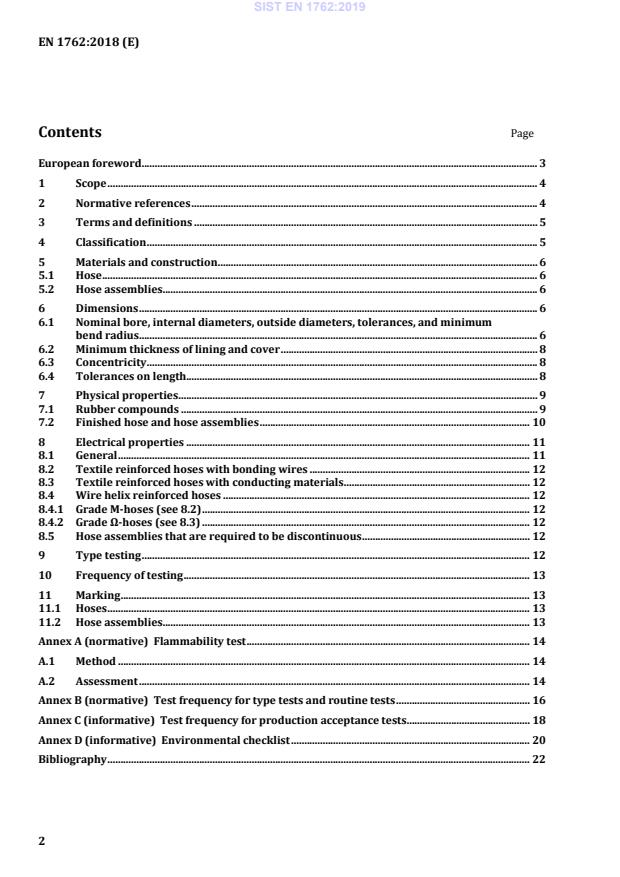
Flammability test . 14 A.1 Method . 14 A.2 Assessment . 14 Annex B (normative)
Test frequency for type tests and routine tests . 16 Annex C (informative)
Test frequency for production acceptance tests . 18 Annex D (informative)
Environmental checklist . 20 Bibliography . 22 SIST EN 1762:2019
« u r °C to +70 °C and, when designated -LTá
« w r °C to +70 °C. 2 Normative references The following documents are referred to in the text in such a way that some or all of their content constitutes requirements of this document. For dated references, only the edition cited applies. For undated references, the latest edition of the referenced document (including any amendments) applies. EN ISO 1402, Rubber and plastics hoses and hose assemblies — Hydrostatic testing (ISO 1402) EN ISO 4671, Rubber and plastics hoses and hose assemblies — Methods of measurement of the dimensions of hoses and the lengths of hose assemblies (ISO 4671) EN ISO 6179, Rubber, vulcanized or thermoplastic — Rubber sheets and rubber-coated fabrics — Determination of transmission rate of volatile liquids (gravimetric technique) (ISO 6179) EN ISO 7233, Rubber and plastics hoses and hose assemblies — Determination of resistance to vacuum (ISO 7233) EN ISO 7326, Rubber and plastics hoses — Assessment of ozone resistance under static conditions (ISO 7326) EN ISO 8031, Rubber and plastics hoses and hose assemblies — Determination of electrical resistance and conductivity (ISO 8031) EN ISO 8033, Rubber and plastics hoses — Determination of adhesion between components (ISO 8033:2016) EN ISO 8330, Rubber and plastics hoses and hose assemblies — Vocabulary (ISO 8330) EN ISO 10619-1, Rubber and plastics hoses and tubing — Measurement of flexibility and stiffness — Part 1: Bending tests at ambient temperature (ISO 10619-1) EN ISO 10619-2, Rubber and plastics hoses and tubing — Measurement of flexibility and stiffness — Part 2: Bending tests at sub-ambient temperatures (ISO 10619-2) ISO 37, Rubber, vulcanized or thermoplastic — Determination of tensile stress-strain properties ISO 188, Rubber, vulcanized or thermoplastic — Accelerated ageing and heat resistance tests ISO 1817, Rubber, vulcanized or thermoplastic — Determination of the effect of liquids ISO 4649, Rubber, vulcanized or thermoplastic — Determination of abrasion resistance using a rotating cylindrical drum device SIST EN 1762:2019
Electrically conductive using a conductive rubber layer Discontinuous Electrically discontinuous SIST EN 1762:2019
two or more low resistance electrical bonding wires (grade “M” only); — an outer cover of black or coloured synthetic rubber, resistant to abrasion and outdoor exposure; the cover may be pricked to allow gas permeation. If the cover is not pricked a comparative measurement of permeation between the rubber materials of cover and lining shall be carried out, see Table 3, item 6; — an internal, non-embedded stainless steel helical wire, suitable for use at –50 °C (type SD-LTR only). 5.2 Hose assemblies Hose assemblies shall incorporate metallic couplings attached to the hose by the assembler or built in by the manufacturer. In order to produce the required electrical properties, the couplings should be attached in accordance with Clause 8. Chlorinated materials shall not be used in contact with any stainless steel materials. 6 Dimensions 6.1 Nominal bore, internal diameters, outside diameters, tolerances, and minimum bend radius For hoses without built-in couplings, and when measured in accordance with method A of EN ISO 4671, the internal diameter and outside diameter and their tolerances shall conform to Table 1 or Table 2, depending on the type. For hoses with built-in couplings, the outside diameters in Tables 1 and 2 do not apply. When tested by the method described in EN ISO 10619-1, the value of the minimum bend radius shall be as given in Table 1 or Table 2, depending on the type. SIST EN 1762:2019
mm Tolerance
mm Outside diameter
mm Tolerance
mm Design min. bend radiusa
mm 12 12,7 ±0,5 22,7 ±1,0 100 15 15 ±0,5 25 ±1,0 120 16 15,9 ±0,5 25,9 ±1,0 125 19 19 ±0,5 31 ±1,0 160 25 25 ±0,5 38 ±1,0 200 32 32 ±0,5 45 ±1,0 250 38 38 ±0,5 52 ±1,0 320 50 50 ±0,6 66 ±1,2 400 51 51 ±0,6 67 ±1,2 400 63 63 ±0,6 81 ±1
...