


SIST EN 4458:2006
(Main)Aerospace series - Studs, MJ threads, in titanium alloy TI-P64001, MoS2 coated, with serrated locking ring in corrosion resisting steel - Strength class: 1 100 MPa (at ambient temperature) - Technical specification
Aerospace series - Studs, MJ threads, in titanium alloy TI-P64001, MoS2 coated, with serrated locking ring in corrosion resisting steel - Strength class: 1 100 MPa (at ambient temperature) - Technical specification
This standard specifies the characteristics, qualification and acceptance requirements for studs with MJ threads in TI-P64001, MoS2 coated, with serrated locking ring in corrosion resisting steel.
Strength class: 1 100 MPa
It is applicable whenever referenced.
Luft- und Raumfahrt - Stiftschrauben, MJ-Gewinde aus Titanlegierung TI-P64001, MoS2 beschichtet, mit Ringsicherung aus korrosionsbeständigem Stahl - Festigkeitsklasse: 1 100 MPa (bei Raumtemperatur) - Technische Lieferbedingungen
Diese Norm legt die Eigenschaften sowie die Qualifikations- und Annahmeanforderungen für Stiftschrauben mit MJ-Gewinde aus TI-P64001, MoS2-beschichtet, mit verzahntem Sicherungsring aus korrosionsbestän¬digem Stahl fest.
Festigkeitsklasse: 1 100 MPa )
Sie ist immer dann anzuwenden, wenn auf sie verwiesen wird.
Série aérospatiale - Goujons, filetage MJ, en alliage de titane TI-P64001, revetus MoS2, avec bague de verrouillage dentelée en acier résistant a la corrosion - Classe de résistance : 1 100 MPa (a température ambiante) - Spécification technique
Aeronavtika – Stebelni vijaki, navoj MJ, iz titanove zlitine TI-P64001, prevlečeni z MoS2, z nagubanim pritrdilnim obročem iz korozijsko odpornega jekla – Trdnostni razred: 1 100 MPa (pri temperaturi okolice) – Tehnična specifikacija
General Information
- Status
- Published
- Publication Date
- 31-Aug-2006
- Technical Committee
- I13 - Imaginarni 13
- Current Stage
- 6060 - National Implementation/Publication (Adopted Project)
- Start Date
- 01-Sep-2006
- Due Date
- 01-Sep-2006
- Completion Date
- 01-Sep-2006

Relations
- Effective Date
- 28-Jan-2026
- Effective Date
- 28-Jan-2026
- Effective Date
- 28-Jan-2026
- Effective Date
- 28-Jan-2026
- Effective Date
- 28-Jan-2026
Overview
SIST EN 4458:2006 is a European standard developed for the aerospace sector, specifying the technical requirements for studs with MJ threads made from titanium alloy TI-P64001. These studs feature a MoS₂ (molybdenum disulfide) coating and are equipped with a serrated locking ring of corrosion-resistant steel. With a strength class of 1,100 MPa at ambient temperature, this standard defines the characteristics, qualification, and acceptance criteria to ensure product performance and reliability in demanding aerospace applications.
Key Topics
- Material Specifications: TI-P64001 titanium alloy for studs, featuring high strength and resistance to corrosion.
- Surface and Coating: MoS₂ coating is applied for enhanced lubrication and reduced wear during assembly and service.
- Locking System: Serrated locking ring made from corrosion-resistant steel for improved fastening security.
- Thread Design: MJ threads designed for optimal strength and fatigue performance in aerospace fastener applications.
- Quality Assurance: Stringent qualification and acceptance processes, including sampling, testing, and inspections, as per aerospace requirements.
- Mechanical and Metallurgical Properties: Includes requirements for tensile strength, fatigue resistance, rotational resistance, hydrogen content, grain flow, microstructure, and permitted surface discontinuities.
- Product Identification and Traceability: Mandates marking, batch control, and labeling to ensure traceability throughout the supply chain.
Applications
The requirements set by SIST EN 4458:2006 are crucial wherever high-strength, reliable studs are needed in aerospace engineering and allied industries. Key application areas include:
- Aircraft Assembly: Used in airframes and engine components where high tensile strength, light weight, and corrosion resistance are critical.
- Spacecraft and Satellites: Preferred in applications demanding minimal maintenance and certainty of performance under extreme conditions.
- Military and Defense Projects: Ensures consistent quality and traceability in missions requiring uncompromised reliability.
- Other Transportation Sectors: Suitable for high-performance automotive and rail projects that adopt aerospace fastener technology for safety and durability.
Related Standards
Several other standards complement or are referenced within SIST EN 4458:2006, supporting consistent quality and harmonized manufacturing processes:
- ISO 2859-1: Sampling procedures for inspection by attributes - fundamental for acceptance quality limit (AQL) control.
- ISO 3452: Non-destructive testing - penetrant inspection methods for detecting surface discontinuities.
- ISO 7961: Aerospace fastener mechanical test methods, supporting product qualification.
- EN ISO 4288: Surface texture - rules and assessment procedures applicable to studs’ surface finish.
- EN 2638: Specification for aluminium alloy bar and section used in certain aerospace components.
- EN 4460: Aerospace procedures for installation and removal of titanium alloy studs with serrated locking rings.
- EN 9133: Aerospace series - qualification procedures for aerospace standard parts, underpinning quality management requirements.
By aligning with these international standards, organizations benefit from compatibility, regulatory compliance, and confidence in the performance of aerospace fasteners. Engineering, procurement, and quality assurance teams rely on SIST EN 4458:2006 to specify, audit, and validate high-strength, corrosion-resistant stud solutions for critical aerospace assemblies.
Keywords: aerospace stud standard, titanium alloy fasteners, MJ thread, MoS₂ coated studs, serrated locking ring, corrosion-resistant fastening, EN 4458, high strength aerospace fastener, qualification and acceptance requirements, SIST EN 4458:2006.
Get Certified
Connect with accredited certification bodies for this standard

BUREAU VERITAS Certification Germany
Bureau Veritas certification in Germany.

Element Materials Technology
Materials testing and product certification.

AQMS Ltd.
AQMS provides ISO certification to SMEs across the UK.
Sponsored listings
Frequently Asked Questions
SIST EN 4458:2006 is a standard published by the Slovenian Institute for Standardization (SIST). Its full title is "Aerospace series - Studs, MJ threads, in titanium alloy TI-P64001, MoS2 coated, with serrated locking ring in corrosion resisting steel - Strength class: 1 100 MPa (at ambient temperature) - Technical specification". This standard covers: This standard specifies the characteristics, qualification and acceptance requirements for studs with MJ threads in TI-P64001, MoS2 coated, with serrated locking ring in corrosion resisting steel. Strength class: 1 100 MPa It is applicable whenever referenced.
This standard specifies the characteristics, qualification and acceptance requirements for studs with MJ threads in TI-P64001, MoS2 coated, with serrated locking ring in corrosion resisting steel. Strength class: 1 100 MPa It is applicable whenever referenced.
SIST EN 4458:2006 is classified under the following ICS (International Classification for Standards) categories: 49.030.20 - Bolts, screws, studs. The ICS classification helps identify the subject area and facilitates finding related standards.
SIST EN 4458:2006 has the following relationships with other standards: It is inter standard links to SIST EN 9133:2018, SIST EN 196-1:1995, SIST EN 4460:2006, SIST EN ISO 21920-3:2022, SIST EN 4421:2009. Understanding these relationships helps ensure you are using the most current and applicable version of the standard.
SIST EN 4458:2006 is available in PDF format for immediate download after purchase. The document can be added to your cart and obtained through the secure checkout process. Digital delivery ensures instant access to the complete standard document.
Standards Content (Sample)
2003-01.Slovenski inštitut za standardizacijo. Razmnoževanje celote ali delov tega standarda ni dovoljeno.Aerospace series - Studs, MJ threads, in titanium alloy TI-P64001, MoS2 coated, with serrated locking ring in corrosion resisting steel - Strength class: 1 100 MPa (at ambient temperature) - Technical specificationLMDSérie aérospatiale - Goujons, filetage MJ, en alliage de titane TI-P64001, revetus MoS2, avec bague de verrouillage dentelée en acier résistant a la corrosion - Classe de résistance : 1 100 MPa (a température ambiante) - Spécification techniqueLuft- und Raumfahrt - Stiftschrauben, MJ-Gewinde aus Titanlegierung TI-P64001, MoS2 beschichtet, mit Ringsicherung aus korrosionsbeständigem Stahl - Festigkeitsklasse: 1 100 MPa (bei Raumtemperatur) - Technische LieferbedingungenTa slovenski standard je istoveten z:EN 4458:2005SIST EN 4458:2006en49.030.20ICS:SLOVENSKI
STANDARDSIST EN 4458:200601-september-2006
EUROPEAN STANDARDNORME EUROPÉENNEEUROPÄISCHE NORMEN 4458November 2005ICS 49.030.20 English VersionAerospace series - Studs, MJ threads, in titanium alloy TI-P64001, MoS2 coated, with serrated locking ring in corrosionresisting steel - Strength class: 1 100 MPa (at ambienttemperature) - Technical specificationSérie aérospatiale - Goujons, filetage MJ, en alliage detitane TI-P64001, revêtus MoS2, avec bague deverrouillage dentelée en acier résistant à la corrosion -Classe de résistance : 1 100 MPa (à températureambiante) - Spécification techniqueLuft- und Raumfahrt - Stiftschrauben, MJ-Gewinde ausTitanlegierung TI-P64001, MoS2 beschichtet, mitRingsicherung aus korrosionsbeständigem Stahl -Festigkeitsklasse: 1 100 MPa (bei Raumtemperatur) -Technische LieferbedingungenThis European Standard was approved by CEN on 26 September 2005.CEN members are bound to comply with the CEN/CENELEC Internal Regulations which stipulate the conditions for giving this EuropeanStandard the status of a national standard without any alteration. Up-to-date lists and bibliographical references concerning such nationalstandards may be obtained on application to the Central Secretariat or to any CEN member.This European Standard exists in three official versions (English, French, German). A version in any other language made by translationunder the responsibility of a CEN member into its own language and notified to the Central Secretariat has the same status as the officialversions.CEN members are the national standards bodies of Austria, Belgium, Cyprus, Czech Republic, Denmark, Estonia, Finland, France,Germany, Greece, Hungary, Iceland, Ireland, Italy, Latvia, Lithuania, Luxembourg, Malta, Netherlands, Norway, Poland, Portugal, Slovakia,Slovenia, Spain, Sweden, Switzerland and United Kingdom.EUROPEAN COMMITTEE FOR STANDARDIZATIONCOMITÉ EUROPÉEN DE NORMALISATIONEUROPÄISCHES KOMITEE FÜR NORMUNGManagement Centre: rue de Stassart, 36
B-1050 Brussels© 2005 CENAll rights of exploitation in any form and by any means reservedworldwide for CEN national Members.Ref. No. EN 4458:2005: E
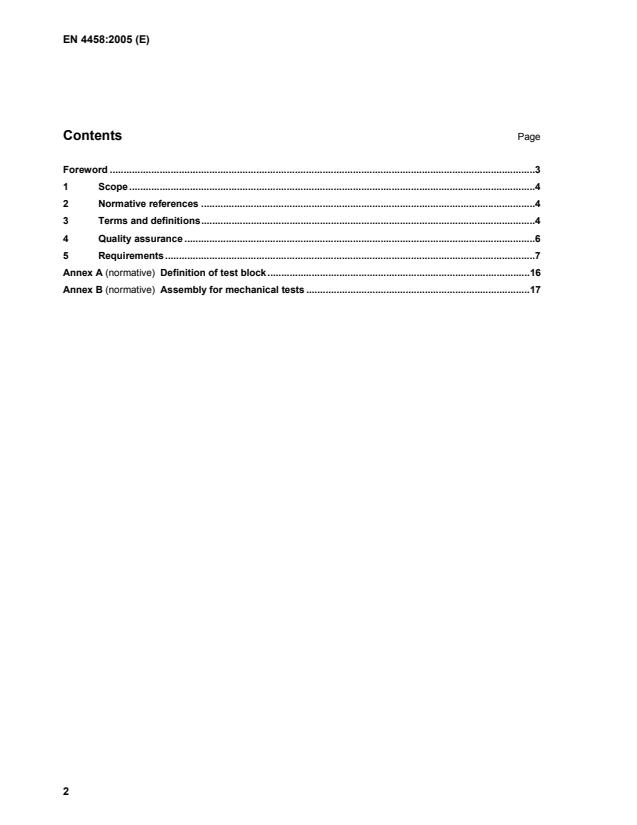
Definition of test block.16 Annex B (normative)
Assembly for mechanical tests.17
1) Minimum tensile strength of the material at ambient temperature. 2) Published as AECMA Prestandard at the date of publication of this standard.
3.2.1 crack rupture in the material which may extend in any direction and which may be intercrystalline or transcrystalline in character 3.2.2 seam open surface defect 3.2.3 lap surface defect caused by folding over metal fins or sharp corners and then compressing them into the surface 3.3 test temperature ambient temperature, unless otherwise specified 3.4 simple random sampling the taking of n items from a population of N items in such a way that all possible combinations of n items have the same probability of being chosen
3.5 critical defect a defect that, according to judgement and experience, is likely to result in hazardous or unsafe conditions for individuals using, maintaining, or depending upon the considered product, or that is likely to prevent performance of the function of a major end item 3.6 major defect a defect other than critical, that is likely to result in a failure or to reduce materially the usability of the considered product for its intended purpose
3.7 minor defect a defect that is not likely to reduce materially the usability of the considered product for its intended purpose, or that is a departure from established specification having little bearing on the effective use or operation of this product 3.8 sampling plan a plan according to which one or more samples are taken in order to obtain information and possibly to reach a decision
3.9 limiting quality in a sampling plan, the quality limit which corresponds to the specified 10 % probability of acceptance 3.10 acceptable quality limit (AQL) a quality limit which in a sampling plan corresponds to a specified but relatively high probability of acceptance It is the maximum per cent defective (or the maximum number of defects per hundred units) that, for purposes of sampling inspection can be considered satisfactory as a process average.
...