


oSIST prEN ISO 11135:2025
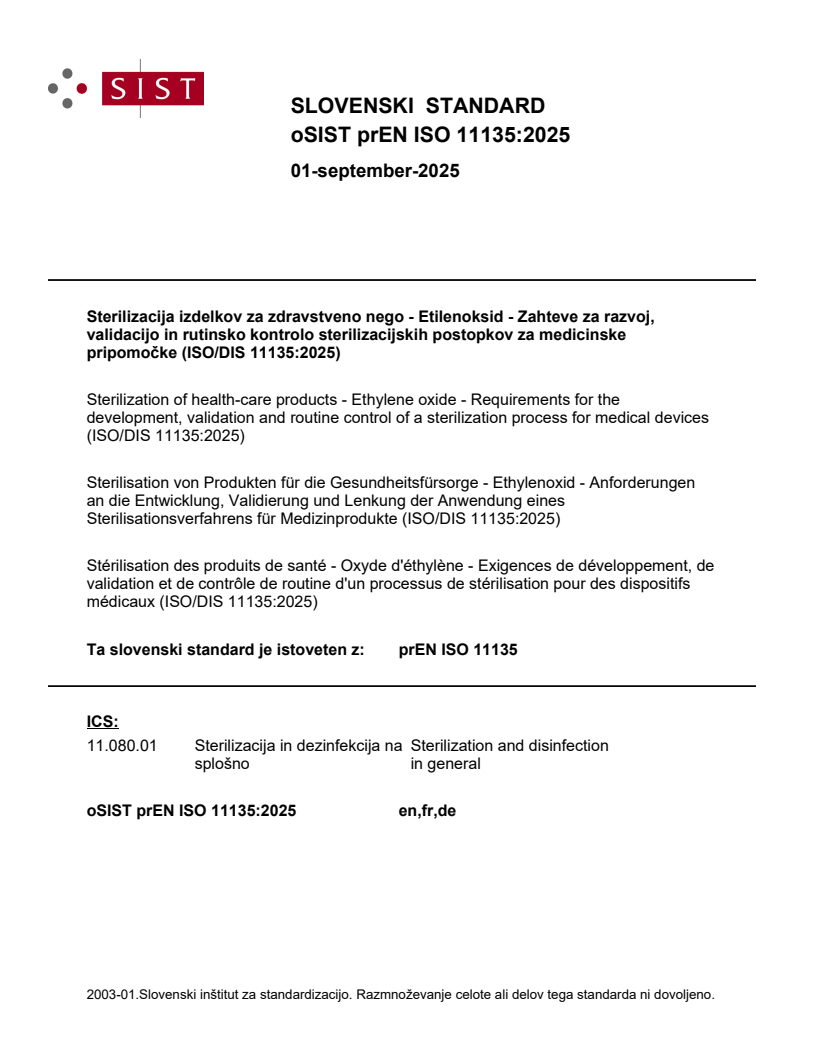
(Main)Sterilization of health-care products - Ethylene oxide - Requirements for the development, validation and routine control of a sterilization process for medical devices (ISO/DIS 11135:2025)
Sterilization of health-care products - Ethylene oxide - Requirements for the development, validation and routine control of a sterilization process for medical devices (ISO/DIS 11135:2025)
ISO 11135:2014 specifies requirements for the development, validation and routine control of an ethylene oxide sterilization process for medical devices in both the industrial and health care facility settings, and it acknowledges the similarities and differences between the two applications.
Sterilisation von Produkten für die Gesundheitsfürsorge - Ethylenoxid - Anforderungen an die Entwicklung, Validierung und Lenkung der Anwendung eines Sterilisationsverfahrens für Medizinprodukte (ISO/DIS 11135:2025)
Stérilisation des produits de santé - Oxyde d'éthylène - Exigences de développement, de validation et de contrôle de routine d'un processus de stérilisation pour des dispositifs médicaux (ISO/DIS 11135:2025)
L'ISO 11135:2014 spécifie les exigences relatives à la mise au point, à la validation et au contrôle de routine du procédé de stérilisation des dispositifs médicaux à l'oxyde d'éthylène dans l'industrie et dans les établissements de santé, et reconnaît les similitudes et différences entre les deux applications.
Sterilizacija izdelkov za zdravstveno nego - Etilenoksid - Zahteve za razvoj, validacijo in rutinsko kontrolo sterilizacijskih postopkov za medicinske pripomočke (ISO/DIS 11135:2025)
General Information
- Status
- Not Published
- Public Enquiry End Date
- 16-Sep-2025
- Technical Committee
- VAZ - Healthcare
- Current Stage
- 4020 - Public enquire (PE) (Adopted Project)
- Start Date
- 03-Jul-2025
- Due Date
- 20-Nov-2025
- Completion Date
- 18-Sep-2025
Relations
- Effective Date
- 24-Jul-2024
- Effective Date
- 24-Jul-2024
Overview
The oSIST prEN ISO 11135:2025:2025 standard, titled Sterilization of health-care products - Ethylene oxide, outlines comprehensive requirements for the careful development, validation, and routine control of ethylene oxide (EO) sterilization processes specifically designed for medical devices. Published by CEN and aligned with ISO/DIS 11135:2025, this standard is critical for ensuring the safety and effectiveness of EO sterilization in both industrial and healthcare facility environments. It recognizes the nuances and distinctions in sterilization practices across these settings, providing a harmonized framework for quality assurance in medical device sterilization.
This latest edition supersedes ISO 11135:2014 and incorporates technical revisions that reflect advancements and regulatory expectations. As ethylene oxide sterilization remains a widely-used method for processing delicate and complex medical devices, compliance with oSIST prEN ISO 11135:2025:2025 is essential for manufacturers and healthcare providers aiming to meet international safety and performance standards.
Key Topics
- Development of Sterilization Process: Establishes a structured approach to defining the EO sterilization cycle parameters, equipment qualification, and product-specific considerations.
- Validation Requirements: Detailed procedures for installation qualification (IQ), operational qualification (OQ), and performance qualification (PQ) to verify that sterilization processes achieve consistent and reliable microbial inactivation.
- Routine Monitoring and Control: Methods for ongoing control of sterilization cycles, including use of biological indicators (BIs), parametric release, and documentation protocols to guarantee process stability.
- Sterilizing Agent Characterization: Analysis of EO properties influencing microbicidal effectiveness, material compatibility, as well as environmental and safety factors.
- Product Definition and Documentation: Requirements for product safety, microbiological quality, and documentation to ensure traceability and regulatory compliance.
- Process and Equipment Characterization: Guidelines for evaluating sterilization equipment and cycles, emphasizing reproducibility and accurate process mapping.
- Change Management: Procedures for requalification and equivalence assessment when modifications to the sterilization process or product occur.
- Guidance Annexes: Informative annexes provide practical advice on selection and placement of process challenge devices (PCDs), sensor number and positioning, cycle specification, and regulatory alignment with EU Medical Device Regulations (MDR).
Applications
oSIST prEN ISO 11135:2025:2025 is critical in the following applications:
- Medical Device Manufacturing: For manufacturers requiring validated EO sterilization protocols that ensure product sterility without compromising device integrity.
- Healthcare Facilities: Hospitals and clinics employing in-house EO sterilization must adhere to the standard’s requirements to maintain consistent patient safety.
- Quality Management Systems: Integrated within ISO 13485-compliant quality systems to support regulatory audits and product certification.
- Regulatory Submissions: Assists in fulfilling sterilization process requirements stipulated by regulatory bodies such as the EU MDR and FDA.
- Environmental & Safety Compliance: Ensures EO sterilization operations conform to occupational health and environmental protection standards.
Related Standards
- ISO 13485: Medical devices - Quality management systems - For overarching quality system requirements in medical device manufacturing.
- ISO 14937: Sterilization of health care products - General requirements for sterilization methods - Covers general aspects applicable to all sterilization processes.
- ISO 11737 series: Sterilization of medical devices - Microbiological methods - For bioburden testing and sterility assurance validation.
- ISO 11607: Packaging for terminally sterilized medical devices - Standardizes packaging to maintain sterility post-EO sterilization.
- ISO 10993 series: Biological evaluation of medical devices - Addresses biocompatibility which may be impacted by sterilization residuals.
- European Union Medical Device Regulation (MDR 2017/745) - The oSIST prEN ISO 11135:2025:2025 includes annexes aligning sterilization standards with MDR requirements.
Keywords: ethylene oxide sterilization, oSIST prEN ISO 11135:2025, medical device sterilization, sterilization process validation, EO sterilization standards, healthcare product sterilization, sterilization quality control, medical device manufacturing standards, regulatory compliance for sterilization, ISO 11135 updates.


Frequently Asked Questions
oSIST prEN ISO 11135:2025 is a draft published by the Slovenian Institute for Standardization (SIST). Its full title is "Sterilization of health-care products - Ethylene oxide - Requirements for the development, validation and routine control of a sterilization process for medical devices (ISO/DIS 11135:2025)". This standard covers: ISO 11135:2014 specifies requirements for the development, validation and routine control of an ethylene oxide sterilization process for medical devices in both the industrial and health care facility settings, and it acknowledges the similarities and differences between the two applications.
ISO 11135:2014 specifies requirements for the development, validation and routine control of an ethylene oxide sterilization process for medical devices in both the industrial and health care facility settings, and it acknowledges the similarities and differences between the two applications.
oSIST prEN ISO 11135:2025 is classified under the following ICS (International Classification for Standards) categories: 11.080.01 - Sterilization and disinfection in general. The ICS classification helps identify the subject area and facilitates finding related standards.
oSIST prEN ISO 11135:2025 has the following relationships with other standards: It is inter standard links to SIST EN ISO 11135:2014/A1:2020, SIST EN ISO 11135:2014. Understanding these relationships helps ensure you are using the most current and applicable version of the standard.
oSIST prEN ISO 11135:2025 is associated with the following European legislation: EU Directives/Regulations: 2017/745, 2017/746; Standardization Mandates: M/575, M/575 AMD 2. When a standard is cited in the Official Journal of the European Union, products manufactured in conformity with it benefit from a presumption of conformity with the essential requirements of the corresponding EU directive or regulation.
oSIST prEN ISO 11135:2025 is available in PDF format for immediate download after purchase. The document can be added to your cart and obtained through the secure checkout process. Digital delivery ensures instant access to the complete standard document.
Standards Content (Sample)
SLOVENSKI STANDARD
01-september-2025
Sterilizacija izdelkov za zdravstveno nego - Etilenoksid - Zahteve za razvoj,
validacijo in rutinsko kontrolo sterilizacijskih postopkov za medicinske
pripomočke (ISO/DIS 11135:2025)
Sterilization of health-care products - Ethylene oxide - Requirements for the
development, validation and routine control of a sterilization process for medical devices
(ISO/DIS 11135:2025)
Sterilisation von Produkten für die Gesundheitsfürsorge - Ethylenoxid - Anforderungen
an die Entwicklung, Validierung und Lenkung der Anwendung eines
Sterilisationsverfahrens für Medizinprodukte (ISO/DIS 11135:2025)
Stérilisation des produits de santé - Oxyde d'éthylène - Exigences de développement, de
validation et de contrôle de routine d'un processus de stérilisation pour des dispositifs
médicaux (ISO/DIS 11135:2025)
Ta slovenski standard je istoveten z: prEN ISO 11135
ICS:
11.080.01 Sterilizacija in dezinfekcija na Sterilization and disinfection
splošno in general
2003-01.Slovenski inštitut za standardizacijo. Razmnoževanje celote ali delov tega standarda ni dovoljeno.
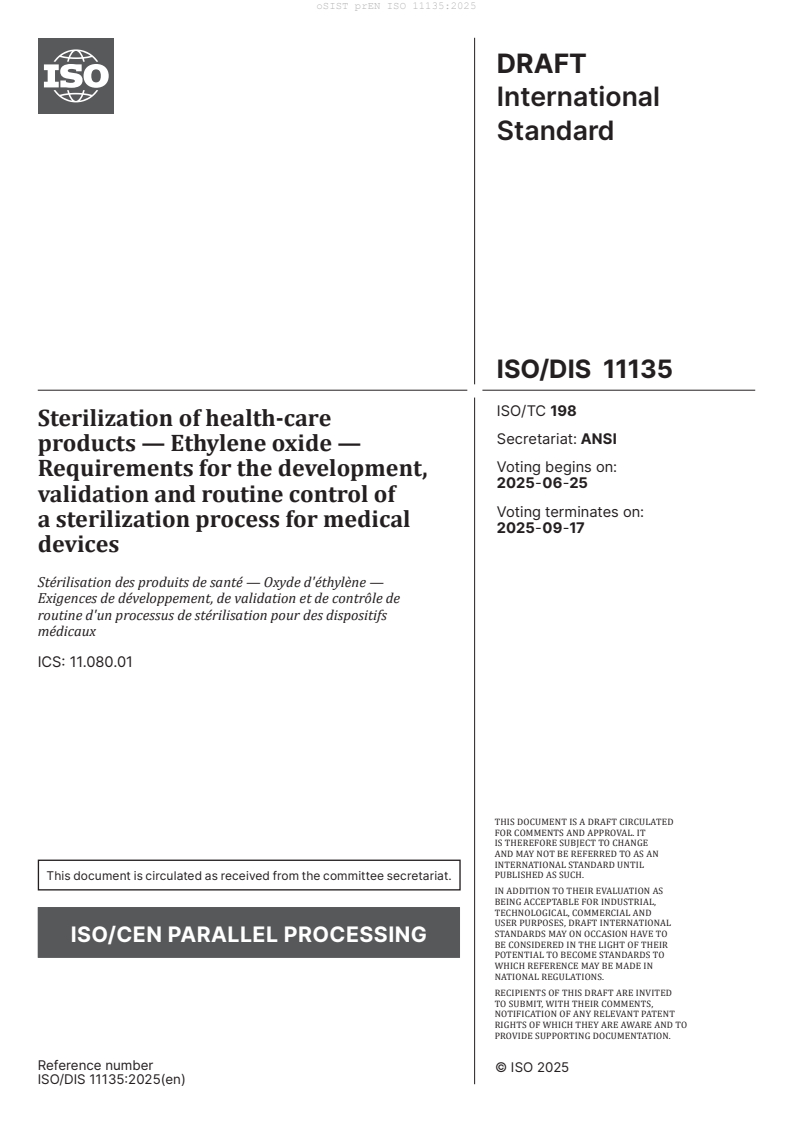
DRAFT
International
Standard
ISO/DIS 11135
ISO/TC 198
Sterilization of health-care
Secretariat: ANSI
products — Ethylene oxide —
Voting begins on:
Requirements for the development,
2025-06-25
validation and routine control of
Voting terminates on:
a sterilization process for medical
2025-09-17
devices
Stérilisation des produits de santé — Oxyde d'éthylène —
Exigences de développement, de validation et de contrôle de
routine d'un processus de stérilisation pour des dispositifs
médicaux
ICS: 11.080.01
THIS DOCUMENT IS A DRAFT CIRCULATED
FOR COMMENTS AND APPROVAL. IT
IS THEREFORE SUBJECT TO CHANGE
AND MAY NOT BE REFERRED TO AS AN
INTERNATIONAL STANDARD UNTIL
PUBLISHED AS SUCH.
This document is circulated as received from the committee secretariat.
IN ADDITION TO THEIR EVALUATION AS
BEING ACCEPTABLE FOR INDUSTRIAL,
TECHNOLOGICAL, COMMERCIAL AND
USER PURPOSES, DRAFT INTERNATIONAL
STANDARDS MAY ON OCCASION HAVE TO
ISO/CEN PARALLEL PROCESSING
BE CONSIDERED IN THE LIGHT OF THEIR
POTENTIAL TO BECOME STANDARDS TO
WHICH REFERENCE MAY BE MADE IN
NATIONAL REGULATIONS.
RECIPIENTS OF THIS DRAFT ARE INVITED
TO SUBMIT, WITH THEIR COMMENTS,
NOTIFICATION OF ANY RELEVANT PATENT
RIGHTS OF WHICH THEY ARE AWARE AND TO
PROVIDE SUPPORTING DOCUMENTATION.
Reference number
ISO/DIS 11135:2025(en)
DRAFT
ISO/DIS 11135:2025(en)
International
Standard
ISO/DIS 11135
ISO/TC 198
Sterilization of health-care
Secretariat: ANSI
products — Ethylene oxide
Voting begins on:
— Requirements for the
development, validation and
Voting terminates on:
routine control of a sterilization
process for medical devices
Stérilisation des produits de santé — Oxyde d'éthylène —
Exigences de développement, de validation et de contrôle de
routine d'un processus de stérilisation pour des dispositifs
médicaux
ICS: 11.080.01
THIS DOCUMENT IS A DRAFT CIRCULATED
FOR COMMENTS AND APPROVAL. IT
IS THEREFORE SUBJECT TO CHANGE
AND MAY NOT BE REFERRED TO AS AN
INTERNATIONAL STANDARD UNTIL
PUBLISHED AS SUCH.
This document is circulated as received from the committee secretariat.
IN ADDITION TO THEIR EVALUATION AS
BEING ACCEPTABLE FOR INDUSTRIAL,
© ISO 2025
TECHNOLOGICAL, COMMERCIAL AND
USER PURPOSES, DRAFT INTERNATIONAL
All rights reserved. Unless otherwise specified, or required in the context of its implementation, no part of this publication may
STANDARDS MAY ON OCCASION HAVE TO
ISO/CEN PARALLEL PROCESSING
be reproduced or utilized otherwise in any form or by any means, electronic or mechanical, including photocopying, or posting on
BE CONSIDERED IN THE LIGHT OF THEIR
the internet or an intranet, without prior written permission. Permission can be requested from either ISO at the address below
POTENTIAL TO BECOME STANDARDS TO
WHICH REFERENCE MAY BE MADE IN
or ISO’s member body in the country of the requester.
NATIONAL REGULATIONS.
ISO copyright office
RECIPIENTS OF THIS DRAFT ARE INVITED
CP 401 • Ch. de Blandonnet 8
TO SUBMIT, WITH THEIR COMMENTS,
CH-1214 Vernier, Geneva
NOTIFICATION OF ANY RELEVANT PATENT
Phone: +41 22 749 01 11
RIGHTS OF WHICH THEY ARE AWARE AND TO
PROVIDE SUPPORTING DOCUMENTATION.
Email: copyright@iso.org
Website: www.iso.org
Published in Switzerland Reference number
ISO/DIS 11135:2025(en)
ii
ISO/DIS 11135:2025(en)
Contents Page
Foreword .v
Introduction .vi
1 Scope . 1
1.1 Inclusions.1
1.2 Exclusions .1
2 Normative references . 1
3 Terms and definitions . 2
4 Quality management system .13
5 Sterilizing agent characterization . 14
5.1 General .14
5.2 Sterilizing agent .14
5.3 Microbicidal effectiveness . .14
5.4 Material effects .14
5.5 Safety and the environment .14
6 Process and equipment characterization .15
6.1 General . 15
6.2 Process characterization . 15
6.3 Equipment characterization .16
7 Product definition .16
7.1 General .16
7.2 Product safety, quality and performance .17
7.3 Microbiological quality .17
7.4 Documentation .17
8 Process definition . 17
9 Validation . .18
9.1 General .18
9.2 Installation qualification (IQ) .19
9.2.1 Equipment .19
9.2.2 Installation qualification (IQ) specifications . .19
9.3 Operational qualification (OQ) .19
9.4 Performance qualification (PQ) . 20
9.4.1 General . 20
9.4.2 Performance qualification (PQ) — Microbiological (MPQ) . 20
9.4.3 Performance qualification (PQ) — Physical (PPQ) .21
9.5 Review and approval of validation . 23
10 Routine monitoring and control.23
11 Product release from sterilization .25
12 Maintaining process effectiveness .25
12.1 General . 25
12.2 Maintenance of equipment . 25
12.3 Requalification . 26
12.4 Assessment of change . . 26
12.5 Assessment of equivalence . 26
12.5.1 Process equivalence . 26
12.5.2 Product equivalence .27
Annex A (informative) Guidance on the application of the requirements in this document .28
Annex B (informative) Guidance on selection of PCD and demonstration of appropriateness for
MPQ .54
iii
ISO/DIS 11135:2025(en)
Annex C (informative) Guidance on the number and placement of PCDs, temperature and
humidity sensors .59
Annex D (informative) Guidance on process equipment operational qualification (OQ) or
requalification . .64
Annex E (normative) Single batch release . .73
Annex F (normative) Determination of lethality of the sterilization process . 76
Annex G (informative) Guidance on establishing process D value for use in cycle calculation
methods (overkill and BI/bioburden) .78
Annex H (informative) Guidance on establishing specifications for parametric release .86
Annex I (informative) Guidance on establishing routine cycle specification and evaluation of
process deviations .90
Annex J (informative) Guidance on evaluating process and product equivalence .92
Annex ZA (informative) Relationship between this European standard and the General Safety
and Performance Requirements of Regulation (EU) 2017/745 aimed to be covered .99
Annex ZB (informative) Relationship between this European standard and the General Safety
and Performance Requirements of Regulation (EU) 2017/746 aimed to be covered .104
Bibliography .109
iv
ISO/DIS 11135:2025(en)
Foreword
ISO (the International Organization for Standardization) is a worldwide federation of national standards
bodies (ISO member bodies). The work of preparing International Standards is normally carried out through
ISO technical committees. Each member body interested in a subject for which a technical committee
has been established has the right to be represented on that committee. International organizations,
governmental and non-governmental, in liaison with ISO, also take part in the work. ISO collaborates closely
with the International Electrotechnical Commission (IEC) on all matters of electrotechnical standardization.
The procedures used to develop this document and those intended for its further maintenance are described
in the ISO/IEC Directives, Part 1. In particular, the different approval criteria needed for the different types
of ISO document should be noted. This document was drafted in accordance with the editorial rules of the
ISO/IEC Directives, Part 2 (see www.iso.org/directives).
ISO draws attention to the possibility that the implementation of this document may involve the use of (a)
patent(s). ISO takes no position concerning the evidence, validity or applicability of any claimed patent
rights in respect thereof. As of the date of publication of this document, ISO had not received notice of (a)
patent(s) which may be required to implement this document. However, implementers are cautioned that
this may not represent the latest information, which may be obtained from the patent database available at
www.iso.org/patents. ISO shall not be held responsible for identifying any or all such patent rights.
Any trade name used in this document is information given for the convenience of users and does not
constitute an endorsement.
For an explanation of the voluntary nature of standards, the meaning of ISO specific terms and expressions
related to conformity assessment, as well as information about ISO's adherence to the World Trade
Organization (WTO) principles in the Technical Barriers to Trade (TBT), see www.iso.org/iso/foreword.html.
This document was prepared by Technical Committee ISO/TC 198, Sterilization of health care products, in
collaboration with the European Committee for Standardization (CEN) Technical Committee CEN/TC 204,
Sterilization of medical devices, in accordance with the Agreement on technical cooperation between ISO and
CEN (Vienna Agreement).
This third edition cancels and replaces the second edition (ISO 11135:2014), which has been technically
revised. It also replaces Amendment ISO 11135:2014/Amd 1:2018.
The main changes are as follows:
— addition of guidance in informative annexes B, D, E, G, H, J and K;
— more defined requirements for microbiological performance qualification (MPQ) in Annex F;
— incorporation of relevant elements of ISO/TS 21387:2020 into annexes A and H.
Any feedback or questions on this document should be directed to the user’s national standards body. A
complete listing of these bodies can be found at www.iso.org/members.html.
v
ISO/DIS 11135:2025(en)
Introduction
A sterile medical device is one that is free of viable microorganisms. Medical devices produced under
standard manufacturing conditions in accordance with the requirements for quality management systems
(e.g. ISO 13485) can, prior to sterilization, have microorganisms on them. Such medical devices are non-
sterile. The purpose of sterilization is to inactivate the microorganisms and thereby transform the non-
sterile medical devices into sterile ones.
The kinetics of inactivation of a pure culture of microorganisms by physical and chemical agents used to
sterilize medical devices can generally best be described by an exponential relationship between the
numbers of microorganisms surviving and the extent of treatment with the sterilant, ethylene oxide (EO).
Inevitably this means that there is always a finite probability that a microorganism can survive regardless
of the extent of treatment applied. For a given treatment, the probability of survival is determined by the
number and resistance of microorganisms and by the environment in which the organisms exist during
treatment. It follows that the sterility of any one medical device in a population subjected to sterilization
processing cannot be guaranteed and the sterility of a processed population is defined in terms of the
probability of there being a single viable microorganism present on a medical device.
This document specifies the requirements that, if met, will provide an EO sterilization process intended to
sterilize medical devices, which has appropriate microbicidal activity. Furthermore, conformance with the
requirements ensures that validations conducted according to this document provide products that meet
the defined requirements for sterile products with a high degree of confidence. The specification for this
probability is a matter for regulatory authorities and can vary from country to country (see for example
EN 556-1 and ANSI/AAMI ST67).
Generic requirements of the quality management systems for design and development, production,
installation and servicing are given in ISO 9001 and particular requirements for quality management
systems for medical device production are given in ISO 13485. These standards for quality management
systems recognize that, for certain processes used in manufacturing or reprocessing, the effectiveness of
the process cannot be fully verified by subsequent inspection and testing of the product. Sterilization is an
example of such a process. For this reason, sterilization processes are validated for use, the performance of
the sterilization process monitored routinely, and the equipment is maintained and calibrated.
Exposure to a properly validated, accurately controlled sterilization process is not the only factor associated
with the provision of reliable assurance that the product is sterile and, in this regard, suitable for its intended
use. Other factors that should be considered include, but not limited to:
— the microbiological status of incoming raw materials or components, or both;
— the validation and routine control of any cleaning and disinfection procedures used on the product;
— the control of the environment in which the product is manufactured or reprocessed, assembled and
packaged;
— the control of equipment and processes;
— the control of personnel and their hygiene;
— the manner and materials in which the product is packaged;
— the conditions under which product is stored.
The type of contamination on a product to be sterilized varies and this impacts upon the effectiveness of
a sterilization process. Products that have been used in a health care setting and are being presented for
resterilization in accordance with the manufacturer's instructions (see ISO 17664-1) are a special case.
Health care facilities differ from medical device manufacturers in the physical design of processing areas, in
the equipment used, and in the availability of personnel with adequate levels of training and experience. The
primary function of the health care facility is to provide patient care; medical device reprocessing is just one
of a myriad of activities that are performed to support that function.
vi
ISO/DIS 11135:2025(en)
In terms of the initial condition of medical devices, medical device manufacturers generally sterilize
large numbers of similar single-use medical devices. Health care facilities, on the other hand, handle and
process both new medical devices and reusable medical devices of different types and with varying levels of
bioburden. They are, therefore, faced with the additional challenges of cleaning, evaluating, preparing and
packaging a medical device prior to sterilization. In this document, alternative approaches and guidance
specific to health care facilities are identified as such.
Clauses 1 through 12 and Annexes E and F of this document are the normative requirements with which
conformance is claimed. The guidance given in the informative annexes (A, B, C, D, G, H, I and J) is not
normative and is not provided as a checklist for auditors, nor is it intended to infer that the guidance is the
only means of achieving compliance.
The guidance provided is to improve understanding for the implementation of the requirements by
providing explanations and acceptable methods for achieving conformance. Methods other than those given
in the guidance can be used, providing their performance achieves conformance with requirements in this
document.
The development, validation and routine control of a sterilization process comprises a number of discrete
but interrelated activities, e.g. calibration, maintenance, product definition, process definition, installation
qualification (IQ), operational qualification (OQ) and performance qualification (PQ). While the activities
required by this document have been grouped together and are presented in a particular order, this
document does not require that the activities be performed in the order in which they are presented. The
activities required are not necessarily sequential, as the programme of development and validation can be
iterative. It is possible that performing these different activities will involve a number of separate individuals
or organizations, each of whom undertakes one or more of these activities. This document does not specify
the particular individuals or organizations to carry out the activities.
Patient safety should be considered by minimizing exposure to EO and its by-products during product use.
ISO 10993-7 specifies limits for EO and ethylene chlorohydrin (ECH).
vii
DRAFT International Standard ISO/DIS 11135:2025(en)
Sterilization of health-care products — Ethylene oxide —
Requirements for the development, validation and routine
control of a sterilization process for medical devices
1 Scope
1.1 Inclusions
This document specifies requirements for the development, validation and routine control of an ethylene
oxide (EO) sterilization process for medical devices in both the industrial and health care facility settings,
and it acknowledges the similarities and differences between the two applications.
Among the similarities are the common need for quality systems, staff training, and proper safety measures.
The major differences relate to the unique physical and organizational conditions in health care facilities,
and to the initial condition of reusable medical devices being presented for sterilization.
Although the scope of this document is limited to medical devices, the requirements and guidance can be
applicable to other health care products.
1.2 Exclusions
1.2.1 This document does not specify requirements for the development, validation and routine control
of a process for inactivating the causative agents of spongiform encephalopathies, such as scrapie, bovine
spongiform encephalopathy and Creutzfeldt-Jakob disease, which are addressed in ISO 22442-3.
1.2.2 This document does not detail a specified requirement for designating a medical device as sterile.
1.2.4 This document does not specify requirements for occupational safety associated with the design
and operation of EO sterilization facilities.
1.2.5 This document does not cover sterilization by injecting EO or mixtures containing EO directly into
packages or a flexible chamber.
NOTE See ISO 14937 for validation of these types of EO processes.
1.2.6 This document does not cover analytical methods for determining levels of residual EO and its
reaction products.
NOTE For further information see ISO 10993-7.
2 Normative references
The following documents are referred to in the text in such a way that some or all of their content constitutes
requirements of this document. For dated references, only the edition cited applies. For undated references,
the latest edition of the referenced document (including any amendments) applies.
ISO 10993-7, Biological evaluation of medical devices — Part 7: Ethylene oxide sterilization residuals
ISO 11138-2:2017, Sterilization of health care products — Biological indicators — Part 2: Biological indicators
for ethylene oxide sterilization processes
ISO/DIS 11135:2025(en)
ISO 11140-1, Sterilization of health care products — Chemical indicators — Part 1: General requirements
ISO 11737-1, Sterilization of health care products — Microbiological methods — Part 1: Determination of a
population of microorganisms on products
ISO 11737-2, Sterilization of health care products — Microbiological methods — Part 2: Tests of sterility
performed in the definition, validation and maintenance of a sterilization process
3 Terms and definitions
For the purposes of this document, the following terms and definitions apply.
ISO and IEC maintain terminology databases for use in standardization at the following addresses:
— ISO Online browsing platform: available at https:// www .iso .org/ obp
— IEC Electropedia: available at https:// www .electropedia .org/
3.1
aeration
part of the sterilization process during which either the sterilizing agent or its reaction products, or both,
desorb from the health care product until predetermined levels are reached
Note 1 to entry: This can be performed within the sterilization chamber or in a separate chamber or room.
[SOURCE: ISO 11139:2018, 3.7, modified — Note 1 to entry was added and deleted “and/or” to specify one or
the other or both.]
3.2
aeration area
either a chamber or a room in which aeration occurs
3.3
batch
defined quantity of a product intended or purported to be uniform in character and quality produced during
a specified cycle of manufacture
[SOURCE: ISO 11139:2018, 3.21]
3.4
bioburden
population of viable microorganisms on or in either a product or sterile barrier system, or both
[SOURCE: ISO 11139:2018, 3.23, modified — Deleted “and/or” and specified one or the other or both.]
3.5
biological indicator
BI
test system containing viable microorganisms providing a specified resistance to a specified sterilization process
[SOURCE: ISO 11139:2018, 3.29, modified — Added “BI” after biological indicator.]
3.6
calibration
operation that, under specified conditions, in a first step, establishes a relation between the quantity values
with measurement uncertainties provided by measurement standards and corresponding indications with
associated measurement uncertainties and, in a second step, uses this information to establish a relation for
obtaining a measurement result from an indication
[SOURCE: ISO 11139:2018, 3.31]
ISO/DIS 11135:2025(en)
3.7
chamber
part of equipment in which a load is processed
[SOURCE: ISO 11139:2018, 3.36]
3.8
chamber volume
enclosed space of a chamber, including the volume of nozzles to the first connection or weld, and excluding
the volume of permanent internal parts
[SOURCE: ISO 11139:2018, 3.318.1]
3.9
change control
assessment and determination of the appropriateness of a proposed alteration to product, process, or
equipment
[SOURCE: ISO 11139:2018, 3.39]
3.10
chemical indicator
test system that reveals a change in one or more pre-specified process variables based on a chemical or
physical change resulting from exposure to a process
[SOURCE: ISO 11139:2018, 3.43]
3.11
conditioning
treatment of product prior to the exposure phase to attain a specified temperature, relative humidity, or
other process variable throughout the load
Note 1 to entry: This part of the sterilization cycle can be carried out either at atmospheric pressure or under vacuum.
[SOURCE: ISO 11139:2018, 3.58, modified — Note 1 to entry was added.]
3.12
control
regulation of variables within specified limits
[SOURCE: ISO 11139:2018, 3.63]
3.13
corrective action
action to eliminate the cause of a nonconformity and to prevent recurrence
Note 1 to entry: There can be more than one cause for a nonconformity.
Note 2 to entry: Corrective action is taken to prevent recurrence whereas preventive action is taken to prevent
occurrence.
[SOURCE: ISO 11139:2018, 3.65]
3.14
cycle parameter
value of a cycle variable including its tolerance used for control, monitoring, indication, and recording of an
operating cycle
[SOURCE: ISO 11139:2018, 3.72]
ISO/DIS 11135:2025(en)
3.15
cycle variable
property used to control, monitor, indicate, or record an operating cycle
[SOURCE: ISO 11139:2018, 3.74]
3.16
D value
D value
time or dose required under stated conditions to achieve inactivation of 90 % of a population of the test
microorganisms
[SOURCE: ISO 11139:2018, 3.75]
3.17
dew point
temperature at which the saturation water vapour pressure is equal to the partial pressure of the water
vapour in the atmosphere
Note 1 to entry: Any cooling of the atmosphere below the dew point produces water condensation.
[SOURCE: ISO 11139:2018, 3.80, modified — Note 1 to entry was added.]
3.18
EO dwell time
ethylene oxide dwell time
holding time of an ethylene oxide (EO) process from the end of EO injection and inert gas (if used) to the
start of EO evacuation
f
Note 1 to entry: See Figure A.1, footnote .
3.19
EO injection time
duration of the stage beginning with the first introduction of the EO (mixture) into the chamber to the
completion of that injection.
3.20
equilibration time
period between the attainment of defined sterilization process parameters at the reference measurement
point and the attainment of the specified sterilization process parameters at all points within the load
[SOURCE: ISO 11139:2018, 3.105]
3.21
establish
determine by theoretical evaluation and confirm by experimentation
[SOURCE: ISO 11139:2018, 3.107]
3.22
exposure phase
cycle stage between the introduction of the sterilizing or disinfecting agent into the chamber and when the
agent is removed
Note 1 to entry: For the purposes of an ethylene oxide (EO) process, this is illustrated in Figure A.1, footnotes e through g.
[SOURCE: ISO 11139:2018, 3.111, modified — Note 1 to entry was added.]
ISO/DIS 11135:2025(en)
3.23
fault
situation in which one or more of the process or cycle parameters is/are outside its/their specified
tolerance(s)
[SOURCE: ISO 11139:2018, 3.116]
3.24
flushing
procedure by gas which ethylene oxide is removed from the load and chamber by either multiple alternate
admissions of filtered air, inert gas or steam evacuation of the chamber or continuous passage of filtered air,
inert gas or steam through the load and chamber
3.25
fractional cycle
operating cycle in which the exposure phase is reduced compared with that specified for the sterilization cycle
Note 1 to entry: For ethylene oxide (EO) processes, the EO dwell time within the exposure phase is reduced.
[SOURCE: ISO 11139:2018, 3.123, modified — Note 1 to entry was added.]
3.26
gas concentration
weight of a specific gas in a given volume
Note 1 to entry: Concentration can be expressed as mg/l or g/m .
[SOURCE: ISO 11139:2018, 3.125]
3.27
half cycle
test cycle in which the extent of treatment is reduced by 50 % as compared with an operating cycle
Note 1 to entry: A cycle in which the ethylene oxide (EO) dwell time is reduced by 50 % compared to that specified in
the sterilization process.
[SOURCE: ISO 11139:2018, 3.129]
3.28
health care facility
governmental, private organization or institution devoted to the promotion and maintenance of health, and
the prevention and treatment of diseases and injuries
EXAMPLE Hospital, nursing home, extended care facility, free-standing surgical centre, clinic, medical office,
dental office.
3.29
health care product
medical device, including in vitro diagnostic medical device, or medicinal product, including
biopharmaceutical
[SOURCE: ISO 11139:2018, 3.132]
3.30
holding time
period during which process parameters are maintained, within their specified tolerances
[SOURCE: ISO 11139:2018, 3.133]
ISO/DIS 11135:2025(en)
3.31
humidity
measure of water vapour present in a gas
Note 1 to entry: Humidity is usually expressed as absolute humidity (i.e. vapour pressure density), relative humidity,
or dew point.
[SOURCE: ISO 11139:2018, 3.136]
3.31.1
absolute humidity
AH
measure of water vapour in the air, regardless of temperature
Note 1 to entry: It is expressed as grams of moisture per cubic meter of air (g/m ).
[SOURCE: ISO 11139:2018, 3.136.1]
3.31.2
relative humidity
RH
measure of water vapour in the air expressed as a percentage of the maximum for a given temperature
Note 1 to entry: It is expressed as a percent.
[SOURCE: ISO 11139:2018, 3.136.2]
3.32
inoculated carrier
supporting material on or in which a specified number of viable test microorganisms has been deposited
[SOURCE: ISO 11139:2018, 3.144]
3.33
load
product, equipment, or materials to be processed together within an operating cycle
[SOURCE: ISO 11139:2018, 3.155]
3.34
load configuration
distribution and orientation of load
[SOURCE: ISO 11139:2018, 3.156]
3.35
load volume
space occupied by product and any packaging and carrier(s)
[SOURCE: ISO 11139:2018, 3.318.3]
3.36
master product
health care product or procedure set used to represent the most difficult to sterilize item in a product family
or processing category
[SOURCE: ISO 11139:2018, 3.160]
3.37
medical device
instrument, apparatus, implement, machine, appliance, implant, reagent for in vitro use, or software material,
or other similar or related article, intended by the manufacturer to be used, alone or in combination, for
human beings, for one or more of the specific medical purpose(s) of:
ISO/DIS 11135:2025(en)
— diagnosis, prevention, monitoring, treatment, or alleviation of disease;
— diagnosis, monitoring, treatment, alleviation of, or compensation for an injury;
— investigation, replacement, modification, or support of the anatomy, or of a physiological process;
— supporting or sustaining life;
— control of conception;
— disinfection of medical devices;
— providing information by means of in vitro examination of specimens derived from the human body;
and does not achieve its primary intended action by pharmacological, immunological, or metabolic means,
but which may be assisted in its intended function by such means
Note 1 to entry: Products which can be considered to be medical devices in some jurisdictions, but not in others
include:
— items specifically intended for cleaning or sterilization of medical devices;
— pouches, reel goods, sterilization wrap, and reusable containers for packaging of medical devices for sterilization;
— disinfection substances;
— aids for persons with disabilities;
— devices incorporating animal and/or human tissues;
— devices for in vitro fertilization or assisted reproduction technologies.
[SOURCE: ISO 11139:2018, 3.166, modified — Changed “may” to “can” in Note 1 to entry.]
3.38
microorganism
entity of microscopic size, encompassing bacteria, fungi, protozoa and viruses
[SOURCE: ISO 11139:2018, 3.176]
3.39
monitoring
continual checking, supervising, critically observing, or determining the status, in order to identify change
from the performance level required or expected
[SOURCE: ISO 11139:2018, 3.180]
3.40
operating cycle
complete set of stages of a process that is carried out, in a specified sequence
Note 1 to entry: Loading and unloading are not part of the operating cycle.
[SOURCE: ISO 11139:2018, 3.188]
3.41
overkill approach
method of defining a sterilization process that achieves a maximal sterility assurance level (SAL) for product
−6
substantially less than 10
[SOURCE: ISO 11139:2018, 3.190]
ISO/DIS 11135:2025(en)
3.42
parametric release
declaration that product is sterile based on records demonstrating that the sterilization process variables
were delivered within specified tolerances
Note 1 to entry: This method of process release does not include the use of biological indicators.
[SOURCE: ISO 11139:2018, 3.193, modified — Note 1 to entry was added.]
3.43
preconditioning
treatment of product, prior to the operating cycle, to attain specified values for temperature, relative
humidity, and/or other process variables
[SOURCE: ISO 11139:2018, 3.200]
3.44
process challenge device
PCD
item providing a defined resistance to a cleaning, disinfection, or sterilization process and used to assess
performance of the process
Note 1 to entry: For the purpose of this document, an item can be product, surrogate product or another device that is
inoculated directly or indirectly.
Note 2 to entry: In this document, a distinction is made between an internal PCD and an external PCD. An internal PCD
is used to demonstrate that the selected product SAL is achieved. A PCD located within the confines of the product or
product shipper case is an internal PCD, whereas a PCD located between shipper cases or on the exterior surfaces of
the load is an external PCD. An external PCD is an item designed to be used for microbiological monitoring of routine
production cycles.
[SOURCE: ISO 11139:2018, 3.205, modified — Notes to entry were added.]
3.45
process control
specific activities to ensure process requirements are achieved
[SOURCE: ISO 11139:2018, 3.209]
3.46
process parameter
specified value for a process variable
Note 1 to entry: The specification for a process includes the process parameters and their tolerances.
[SOURCE: ISO 11139:2018, 3.211]
3.47
process variable
chemical or physical attribute within a cleaning, disinfection, packaging, or sterilization process, changes in
which can alter its effectiveness
EXAMPLE Time, temperature, pressure, concentration, humidity, wavelength.
[SOURCE: ISO 11139:2018, 3.213]
3.48
processing category
collection of different products or product families that can be processed together
[SOURCE: ISO 11139:2018, 3.215]
ISO/DIS 11135:2025(en)
3.49
product
tangible result of a process
EXAMPLE Raw material(s), intermediate(s), sub-assembly(ies), health care product(s).
[SOURCE: ISO 11139:2018, 3.217]
3.50
product family
group or subgroup of product characterized by similar attributes determined to be equivalent for evaluation
and processing purposes
[SOURCE: ISO 11139:2018, 3.218]
3.51
qualification
activities undertaken to demonstrate that utilities, equipment, and methods or modes are suitable for their
intended use and perform
...
Questions, Comments and Discussion
Ask us and Technical Secretary will try to provide an answer. You can facilitate discussion about the standard in here.
Loading comments...