


oSIST prEN 15254-2:2005
Extended application of results from fire resistance tests - Non- loadbearing walls - Part 2: Masonry and Gypsum Blocks
Extended application of results from fire resistance tests - Non- loadbearing walls - Part 2: Masonry and Gypsum Blocks
This part provides guidance, and where appropriate defines procedures, for variations of certain parameters and factors with the design of internal and external non-loadbearing walls and made of clay units, calcium silicate units, aggregate concrete units, autoclaved aerated concrete units and gypsum blocks with different types of mortar that have been tested in accordance with EN 1364-1.
Erweiterter Anwendungsbereich der Ergebnisse von Feuerwiderstandsprüfungen - Nichttragende Wände - Teil 2: Mauersteine und Gips-Wandbauplatten
Application étendue des résultats obtenus lors d'essais de résistance au feu - Murs non porteurs - Partie 2 : Maçonnerie et carreaux de plâtre
Razširjena uporaba rezultatov preskusov požarne odpornosti – Nenosilne stene – 2. del: Zidovje in bloki iz mavca
General Information
- Status
- Not Published
- Technical Committee
- POZ - Požarna varnost
- Current Stage
- 98 - Abandoned project (Adopted Project)
- Start Date
- 11-Oct-2013
- Due Date
- 16-Oct-2013
- Completion Date
- 11-Oct-2013
- Directive
- Harmonized Standard305/2011 - Regulation (eu) No 305/2011 of the European Parliament and of the Council of 9 march 2011 laying down harmonised conditions for the marketing of construction products and repealing council directive 89/106/eec
Not Harmonized89/106/EEC - Construction products



Overview
oSIST prEN 15254-2:2005 provides essential guidance for the extended application of results from fire resistance tests on non-loadbearing walls, focusing specifically on masonry and gypsum block constructions. Developed by the Slovenian Institute for Standardization (SIST) and aligned with European standardization and test procedures, this standard outlines when and how fire test outcomes can be validly applied to similar wall constructions that differ in certain parameters.
The standard applies to both internal and external non-loadbearing walls made from:
- Clay units
- Calcium silicate units
- Aggregate concrete units
- Autoclaved aerated concrete units
- Gypsum blocks
It references fire testing as defined in EN 1364-1 and provides procedures to assess variations in wall design, mortar types, connection systems, and finishing materials, ultimately ensuring regulatory compliance and consistent fire safety performance.
Key Topics
- Extended Application Principles: How fire resistance results from tested wall constructions can be extrapolated to other constructions with varying units, mortar, geometry, and connection systems.
- Coverage of Materials: Guidance on applying fire test data to walls built with specified unit types (clay, calcium silicate, aggregate concrete, autoclaved aerated concrete, gypsum blocks) and mortars.
- Design Variations: Procedures for addressing differences in:
- Unit and block types (solid, perforated, dimensions, density)
- Mortar specifications and strength
- Joint filling and perpend joints (filled or unfilled)
- Wall height, thickness, and slenderness
- Connection to adjacent structural elements
- Test Procedure Alignment: Ensuring that any extrapolation is based on valid test results and methodologies consistent with EN 1363-1, EN 1363-2, and EN 1364-1.
- Limitations: Defines the bounds for valid extrapolations, ensuring safety is not compromised when applying test data to modified designs.
Applications
oSIST prEN 15254-2:2005 is highly practical for stakeholders involved in the design, assessment, and regulatory approval of non-loadbearing wall systems. Typical applications include:
- Architects and Structural Engineers: Enables the use of existing fire resistance test data for varied wall configurations within compliant boundaries, streamlining design and compliance workflows.
- Manufacturers of Wall Systems: Supports product development and certification by clarifying how fire test evidence can support extended product families.
- Fire Safety Assessors and Building Authorities: Provides a technical basis for evaluating alternative designs without the need for repeated fire testing, expediting approvals while maintaining safety standards.
- Building Contractors: Facilitates informed selection of wall systems and construction methods that meet fire resistance requirements efficiently.
Related Standards
Understanding and applying this standard requires reference to several interconnected European standards, including:
- EN 1364-1: Fire resistance tests for non-loadbearing elements.
- EN 1996-1-1 / -1-2: Design rules for masonry structures, including fire design.
- EN 771 Series: Specifications for masonry units (clay, calcium silicate, concrete, autoclaved aerated concrete).
- EN 998 Series: Specifications for mortars used in masonry.
- EN 12859: Gypsum blocks - definitions, requirements, and test methods.
- EN 12860: Gypsum-based adhesives for gypsum blocks.
These references ensure consistency in test methods, definitions, and performance criteria essential for the reliable extended application of fire test data.
By following oSIST prEN 15254-2:2005, construction professionals and regulatory bodies can confidently extend the use of fire resistance test results, promoting both efficiency and safety in the specification and approval of non-loadbearing masonry and gypsum block walls. This standard is crucial for harmonized fire safety compliance across European building projects.
Get Certified
Connect with accredited certification bodies for this standard

DIBt (Deutsches Institut für Bautechnik)
German Institute for Building Technology.
DIN CERTCO
DIN Group product certification.

Kiwa BDA Testing
Building and construction product certification.
Sponsored listings
Frequently Asked Questions
oSIST prEN 15254-2:2005 is a draft published by the Slovenian Institute for Standardization (SIST). Its full title is "Extended application of results from fire resistance tests - Non- loadbearing walls - Part 2: Masonry and Gypsum Blocks". This standard covers: This part provides guidance, and where appropriate defines procedures, for variations of certain parameters and factors with the design of internal and external non-loadbearing walls and made of clay units, calcium silicate units, aggregate concrete units, autoclaved aerated concrete units and gypsum blocks with different types of mortar that have been tested in accordance with EN 1364-1.
This part provides guidance, and where appropriate defines procedures, for variations of certain parameters and factors with the design of internal and external non-loadbearing walls and made of clay units, calcium silicate units, aggregate concrete units, autoclaved aerated concrete units and gypsum blocks with different types of mortar that have been tested in accordance with EN 1364-1.
oSIST prEN 15254-2:2005 is classified under the following ICS (International Classification for Standards) categories: 13.220.50 - Fire-resistance of building materials and elements; 91.060.10 - Walls. Partitions. Facades. The ICS classification helps identify the subject area and facilitates finding related standards.
oSIST prEN 15254-2:2005 is associated with the following European legislation: EU Directives/Regulations: 305/2011, 89/106/EEC; Standardization Mandates: M/117. When a standard is cited in the Official Journal of the European Union, products manufactured in conformity with it benefit from a presumption of conformity with the essential requirements of the corresponding EU directive or regulation.
oSIST prEN 15254-2:2005 is available in PDF format for immediate download after purchase. The document can be added to your cart and obtained through the secure checkout process. Digital delivery ensures instant access to the complete standard document.
Standards Content (Sample)
SLOVENSKI oSIST prEN 15254-2:2005
PREDSTANDARD
december 2005
Razširjena uporaba rezultatov preskusov požarne odpornosti – Nenosilne
stene – 2. del: Zidovje in bloki iz mavca
Extended application of results from fire resistance tests - Non-loadbearing walls -
Part 2: Masonry and gypsum blocks
ICS 13.220.50 Referenčna številka
© Standard je založil in izdal Slovenski inštitut za standardizacijo. Razmnoževanje ali kopiranje celote ali delov tega dokumenta ni dovoljeno
EUROPEAN STANDARD
DRAFT
NORME EUROPÉENNE
EUROPÄISCHE NORM
October 2005
ICS
English Version
Extended application of results from fire resistance tests - Non-
loadbearing walls - Part 2: Masonry and Gypsum Blocks
Application étendue des résultats obtenus lors d'essais de Erweiterter Anwendungsbereich der Ergebnisse von
résistance au feu - Murs non porteurs - Partie 2 : Feuerwiderstandsprüfungen - Nichttragende Wände - Teil
Maçonnerie et carreaux de plâtre 2: Mauersteine und Gips-Wandbauplatten
This draft European Standard is submitted to CEN members for enquiry. It has been drawn up by the Technical Committee CEN/TC 127.
If this draft becomes a European Standard, CEN members are bound to comply with the CEN/CENELEC Internal Regulations which
stipulate the conditions for giving this European Standard the status of a national standard without any alteration.
This draft European Standard was established by CEN in three official versions (English, French, German). A version in any other language
made by translation under the responsibility of a CEN member into its own language and notified to the Management Centre has the same
status as the official versions.
CEN members are the national standards bodies of Austria, Belgium, Cyprus, Czech Republic, Denmark, Estonia, Finland, France,
Germany, Greece, Hungary, Iceland, Ireland, Italy, Latvia, Lithuania, Luxembourg, Malta, Netherlands, Norway, Poland, Portugal, Slovakia,
Slovenia, Spain, Sweden, Switzerland and United Kingdom.
Recipients of this draft are invited to submit, with their comments, notification of any relevant patent rights of which they are aware and to
provide supporting documentation.
Warning : This document is not a European Standard. It is distributed for review and comments. It is subject to change without notice and
shall not be referred to as a European Standard.
EUROPEAN COMMITTEE FOR STANDARDIZATION
COMITÉ EUROPÉEN DE NORMALISATION
EUROPÄISCHES KOMITEE FÜR NORMUNG
Management Centre: rue de Stassart, 36 B-1050 Brussels
© 2005 CEN All rights of exploitation in any form and by any means reserved Ref. No. prEN 15254-2:2005: E
worldwide for CEN national Members.
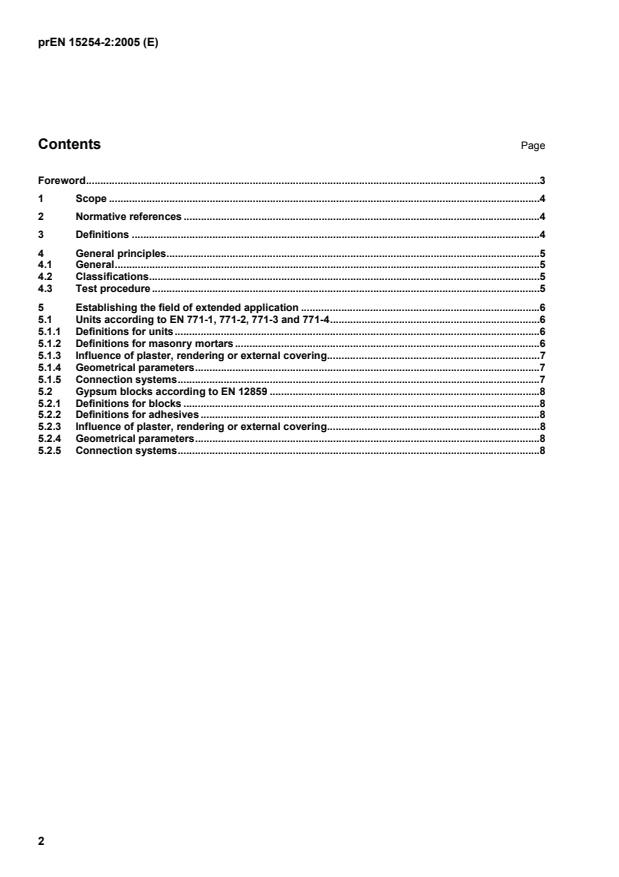
Contents Page
Foreword.3
1 Scope .4
2 Normative references .4
3 Definitions .4
4 General principles.5
4.1 General.5
4.2 Classifications.5
4.3 Test procedure.5
5 Establishing the field of extended application .6
5.1 Units according to EN 771-1, 771-2, 771-3 and 771-4.6
5.1.1 Definitions for units.6
5.1.2 Definitions for masonry mortars.6
5.1.3 Influence of plaster, rendering or external covering.7
5.1.4 Geometrical parameters.7
5.1.5 Connection systems.7
5.2 Gypsum blocks according to EN 12859 .8
5.2.1 Definitions for blocks .8
5.2.2 Definitions for adhesives .8
5.2.3 Influence of plaster, rendering or external covering.8
5.2.4 Geometrical parameters.8
5.2.5 Connection systems.8
Foreword
This document (prEN 15254-2:2005) has been prepared by Technical Committee CEN/TC 127 "Fire safety in
buildings", the secretariat of which is held by BSI.
This document is currently submitted to the CEN Enquiry.
1 Scope
(1) This part provides guidance, and where appropriate defines procedures, for variations of certain
parameters and factors with the design of internal and external non-loadbearing walls and made of clay units,
calcium silicate units, aggregate concrete units, autoclaved aerated concrete units and gypsum blocks with
different types of mortar that have been tested in accordance with EN 1364-1.
(2) Manufactured stone masonry units according to EN 771-5 are not covered.
2 Normative references
Additionally to the already listed references, the following apply:
EN 1991-1-2, Basis of design and actions on structures — Actions on structures exposed to fire
EN 1996-1-1, Design of masonry structures — General rules
EN 1996-1-2, Design of masonry structures — General rules — Structural fire design
EN 771-1, Specification for masonry units — Clay masonry units
EN 771-2, Specification for masonry units — Calcium silicate masonry
EN 771-3, Specification for masonry units — Aggregate concrete masonry units (Dense and light-weight
aggregates)
EN 771-4, Specification for masonry units — Autoclaved aerated concrete masonry units (AAC)
EN 771-5, Specification for masonry units — Manufactured stone units
EN 998-1, Specification for mortar for masonry — Rendering and plastering mortar
EN 998-2, Specification for mortar for masonry — Masonry mortar
EN 12859, Gypsum blocks — definitions, requirements and test methods
EN 12860, Gypsum based adhesive for gypsum blocks — definitions, requirements and test methods
prEN XXX, Design and installation of gypsum blocks
3 Definitions
(1) For the purpose of this part the definitions given in EN 15254-1 and EN 1996-1-2, together with the
following, apply:
3.1
(2) unit grouping
is defined in EN 1996-1-1
3.2
(3) unfilled perpend joints
are vertical plain joints or joints with tongue and groove, not filled with mortar or adhesive
4 General principles
4.1 General
(1) The fire behaviour of masonry mainly depends on:
the masonry unit material - clay, calcium silicate, autoclaved aerated concrete, dense/lightweight
aggregate concrete or gypsum;
the type of unit - solid or hollow (type of holes, percentage and direction of holes), shell and web
thickness;
the dimensions of units, especially the height;
the gross density of units;
the strength of units;
the type of mortar - general purpose, thin layer or lightweight mortar;
the type of perpend joint – filled or unfilled perpend joint, especially for unplastered walls;
the use of finishes;
the geometrical slenderness of the wall.as defined in EN 1996-1-1;
the length of the wall between vertical stiffeners.
(2) For the determination of values by consideration of test results, the interpretation of any existing fire test
results has to be based on the requirements for the relevant test method from EN 1363-1, EN 1363-2 and
EN 1364-1. For the evaluation of historic test data, differences between the test methods, in particular, fixed
ends, free ends or one fixed end and one partly free end with respect to both directions (horizontal and
vertical) have to be considered.
(3) Extrapolations are only possible within the same type of material – e.g. tests on clay unit masonry with
units according to EN 771-1 can only be used for extrapolations for clay unit masonry.
(4) To establish the extended application, the rules given in chapter 5 shall be followed for each of the given
parameters.
4.2 Classifications
(
...