


SIST EN 16647-2:2026
(Main)Alcohol powered flueless fireplaces - Safety requirements and test methods - Part 2: Automatically operated decorative fireplaces for domestic use
General Information
- Abstract
This document applies to decorative, automatically controlled fireplaces for domestic use, producing a flame using liquid alcohol, hereafter referred to as fuel, for decoration.
NOTE 1 The requirements outlined in this document can be applied even outside domestic settings. In that case additional or different rules on the use of the fireplaces can apply.
This document applies to decorative fireplaces that do not require manual user interaction during normal operation. These fireplaces include electric or electronic components that control the basic operation (incl. automatic filling system).
NOTE 2 These components control the safe operation and avoid hazards such as:
— Fuel spillage while filling
— Overfilling
— Fuel explosion while igniting
— Accidental ignition while refilling
— Overheating
— Unsuccessful extinguishing
The document applies only to fireplaces for use in indoor areas.
This document applies to free-standing, wall-mounted and built-in fireplaces.
This document applies to fireplaces ready for use, whose burner is an integral component of the fireplace.
This document does not apply to fireplaces specifically designed for heating food or keeping food warm (rechauds), as well as to fireplaces for use in boats, caravans, other.
This document does not apply to fireplaces with declared heating function.
This document does not apply to fireplaces, that are connected to a flue.
NOTE 3 Because of the safety component of automatically operated fireplaces this scope is not limited to a specific heat output or fuel consumption. Regarding heat output limits, national legislation can apply.
- Status
- Published
- Public Enquiry End Date
- 30-Jun-2025
- Publication Date
- 07-Sep-2026
- Technical Committee
- OGS - Heating for buildings
- Current Stage
- 6060 - National Implementation/Publication (Adopted Project)
- Start Date
- 02-Sep-2026
- Due Date
- 07-Nov-2026
- Completion Date
- 08-Sep-2026
- Directive
- Harmonized Standard2001/95/EC - General product safety

Overview
SIST EN 16647-2:2026 specifies the safety requirements and test methods for alcohol powered flueless fireplaces, focusing on automatically operated decorative fireplaces for domestic use. Developed by the Slovenian Institute for Standardization (SIST), this standard applies to decorative indoor fireplaces that use liquid alcohol as fuel and are operated via automatic or electronic controls, requiring no manual user interaction during normal operation.
The standard enhances safety, performance, and reliability for both manufacturers and end-users by stipulating how these devices should be designed, constructed, tested, and labeled. It addresses fireplaces that are free-standing, wall-mounted, or built-in, as long as the burner is an integral part of the unit and the appliance is not used for heating or cooking purposes.
Key Topics
Automatic Operation and Safety Controls
- Requirements for electric or electronic components that manage filling, ignition, combustion, and extinguishing.
- Safety circuits designed to automatically detect hazards such as fuel spillage, overfilling, overheating, and failed ignition or extinguishing.
- Automatic shutdown procedures triggered by abnormal conditions.
Fireplace Design and Construction
- Design specifications for extinguishing systems, flame supervision devices, and ignition devices.
- Materials and mechanical construction requirements, emphasizing use of corrosion-resistant, non-combustible materials for all fuel-contacting parts.
- Prevention of sharp edges and access to moving or hot parts during normal operation.
Testing Procedures
- Standardized tests for impact spillage, spill detector function, fuel tank tightness, fuel filling, temperature monitoring, and leakage control.
- Tests for combustion performance, including fuel consumption, thermal output, and emissions.
- Safety validation for operating conditions, label durability, and fire resistance.
User Information and Labeling
- Clear guidelines for marking appliances, packaging, and containers.
- Requirements for comprehensive user manuals covering installation, operation, maintenance, and safety warnings.
Applications
SIST EN 16647-2:2026 applies to the following product categories and use cases:
- Decorative Indoor Fireplaces: Automatically operated devices intended for aesthetic purposes in residential environments such as living rooms, lobbies, or lounges.
- Ready-to-Use Fireplaces: Models that are free-standing, wall-mounted, or built into structures, provided the burner unit is integral.
- Smart and Connected Appliances: Devices utilizing electronic controls for automation, remote operation, or fine control in modern home settings.
Non-applicable Areas:
- Appliances designed for cooking, heating food, or use in mobile dwellings (boats, caravans).
- Fireplaces intended for declared heating functions or those requiring a flue connection.
Manufacturers, designers, test laboratories, and installers who want to place compliant decorative fireplaces on the European market benefit from using this standard. It ensures easier market access, improved user safety, and alignment with consumer protection standards.
Related Standards
For a comprehensive compliance and product development approach, consider these related international and European standards:
- EN 16647-1: Alcohol powered flueless fireplaces - Part 1: Manually operated decorative fireplaces for domestic use
- EN 10088-3: Stainless steels - Technical delivery for corrosion resistant steels
- EN 13501-1: Fire classification of construction products and building elements
- EN 60335-1: Safety of household and similar electrical appliances - General requirements
- EN 60335-2-102: Safety requirements for appliances with electrical connections and burning fuel
- EN IEC/IEEE 82079-1: Preparation of information for use (instructions for use) of products
Applying these standards in conjunction with SIST EN 16647-2:2026 helps manufacturers ensure comprehensive safety and market compliance for automatic decorative alcohol fireplaces in residential environments.
Relations
- Effective Date
- 01-Oct-2026
Frequently Asked Questions
SIST EN 16647-2:2026 is a standard published by the Slovenian Institute for Standardization (SIST). Its full title is "Alcohol powered flueless fireplaces - Safety requirements and test methods - Part 2: Automatically operated decorative fireplaces for domestic use". This standard covers: This document applies to decorative, automatically controlled fireplaces for domestic use, producing a flame using liquid alcohol, hereafter referred to as fuel, for decoration. NOTE 1 The requirements outlined in this document can be applied even outside domestic settings. In that case additional or different rules on the use of the fireplaces can apply. This document applies to decorative fireplaces that do not require manual user interaction during normal operation. These fireplaces include electric or electronic components that control the basic operation (incl. automatic filling system). NOTE 2 These components control the safe operation and avoid hazards such as: — Fuel spillage while filling — Overfilling — Fuel explosion while igniting — Accidental ignition while refilling — Overheating — Unsuccessful extinguishing The document applies only to fireplaces for use in indoor areas. This document applies to free-standing, wall-mounted and built-in fireplaces. This document applies to fireplaces ready for use, whose burner is an integral component of the fireplace. This document does not apply to fireplaces specifically designed for heating food or keeping food warm (rechauds), as well as to fireplaces for use in boats, caravans, other. This document does not apply to fireplaces with declared heating function. This document does not apply to fireplaces, that are connected to a flue. NOTE 3 Because of the safety component of automatically operated fireplaces this scope is not limited to a specific heat output or fuel consumption. Regarding heat output limits, national legislation can apply.
This document applies to decorative, automatically controlled fireplaces for domestic use, producing a flame using liquid alcohol, hereafter referred to as fuel, for decoration. NOTE 1 The requirements outlined in this document can be applied even outside domestic settings. In that case additional or different rules on the use of the fireplaces can apply. This document applies to decorative fireplaces that do not require manual user interaction during normal operation. These fireplaces include electric or electronic components that control the basic operation (incl. automatic filling system). NOTE 2 These components control the safe operation and avoid hazards such as: — Fuel spillage while filling — Overfilling — Fuel explosion while igniting — Accidental ignition while refilling — Overheating — Unsuccessful extinguishing The document applies only to fireplaces for use in indoor areas. This document applies to free-standing, wall-mounted and built-in fireplaces. This document applies to fireplaces ready for use, whose burner is an integral component of the fireplace. This document does not apply to fireplaces specifically designed for heating food or keeping food warm (rechauds), as well as to fireplaces for use in boats, caravans, other. This document does not apply to fireplaces with declared heating function. This document does not apply to fireplaces, that are connected to a flue. NOTE 3 Because of the safety component of automatically operated fireplaces this scope is not limited to a specific heat output or fuel consumption. Regarding heat output limits, national legislation can apply.
SIST EN 16647-2:2026 is classified under the following ICS (International Classification for Standards) categories: 97.100.99 - Heaters using other sources of energy. The ICS classification helps identify the subject area and facilitates finding related standards.
SIST EN 16647-2:2026 has the following relationships with other standards: It is inter standard links to SIST EN 16647:2015. Understanding these relationships helps ensure you are using the most current and applicable version of the standard.
SIST EN 16647-2:2026 is associated with the following European legislation: EU Directives/Regulations: 2001/95/EC, 2023/988/EU; Standardization Mandates: M/xxx. When a standard is cited in the Official Journal of the European Union, products manufactured in conformity with it benefit from a presumption of conformity with the essential requirements of the corresponding EU directive or regulation.
SIST EN 16647-2:2026 is available in PDF format for immediate download after purchase. The document can be added to your cart and obtained through the secure checkout process. Digital delivery ensures instant access to the complete standard document.
Standards Content (Sample)
SLOVENSKI STANDARD
01-oktober-2026
Nadomešča:
SIST EN 16647:2015
Kamini na alkohol brez priključka na dimnik - Varnostne zahteve in preskusne
metode - 2. del: Dekorativni kamini z avtomatskim upravljanjem za domačo
uporabo
Alcohol powered flueless fireplaces - Safety requirements and test methods - Part 2:
Automatically operated decorative fireplaces for domestic use
Alkoholbetriebene abzugslose Feuerstätten - Sicherheitstechnische Anforderungen und
Prüfmethoden - Teil 2: Automatisch betriebene dekorative Feuerstätten für den
Haushaltsbereich
Foyers sans conduits alimentés par l'alcool - Exigences de sécurité et méthodes d'essai
- Partie 2 : Foyers décoratifs à fonctionnement automatique pour usage domestique
Ta slovenski standard je istoveten z: EN 16647-2:2026
ICS:
97.100.99 Grelniki, ki uporabljajo druge Heaters using other sources
vire energije of energy
2003-01.Slovenski inštitut za standardizacijo. Razmnoževanje celote ali delov tega standarda ni dovoljeno.
EN 16647-2
EUROPEAN STANDARD
NORME EUROPÉENNE
August 2026
EUROPÄISCHE NORM
ICS 97.100.99 Supersedes EN 16647:2015
English Version
Alcohol powered flueless fireplaces - Safety requirements
and test methods - Part 2: Automatically operated
decorative fireplaces for domestic use
Foyers sans conduits alimentés par l'alcool - Exigences Alkoholbetriebene abzugslose Feuerstellen -
de sécurité et méthodes d'essai - Partie 2 : Foyers Sicherheitstechnische Anforderungen und
décoratifs à fonctionnement automatique pour usage Prüfmethoden - Teil 2: Automatisch betriebene
domestique dekorative Feuerstellen für den Haushaltsbereich
This European Standard was approved by CEN on 15 June 2026.
CEN members are bound to comply with the CEN/CENELEC Internal Regulations which stipulate the conditions for giving this
European Standard the status of a national standard without any alteration. Up-to-date lists and bibliographical references
concerning such national standards may be obtained on application to the CEN-CENELEC Management Centre or to any CEN
member.
This European Standard exists in three official versions (English, French, German). A version in any other language made by
translation under the responsibility of a CEN member into its own language and notified to the CEN-CENELEC Management
Centre has the same status as the official versions.
CEN members are the national standards bodies of Austria, Belgium, Bulgaria, Croatia, Cyprus, Czech Republic, Denmark, Estonia,
Finland, France, Germany, Greece, Hungary, Iceland, Ireland, Italy, Latvia, Lithuania, Luxembourg, Malta, Netherlands, Norway,
Poland, Portugal, Republic of North Macedonia, Romania, Serbia, Slovakia, Slovenia, Spain, Sweden, Switzerland, Türkiye and
United Kingdom.
EUROPEAN COMMITTEE FOR STANDARDIZATION
COMITÉ EUROPÉEN DE NORMALISATION
EUROPÄISCHES KOMITEE FÜR NORMUNG
CEN-CENELEC Management Centre: Rue de la Science 23, B-1040 Brussels
© 2026 CEN All rights of exploitation in any form and by any means reserved Ref. No. EN 16647-2:2026 E
worldwide for CEN national Members.
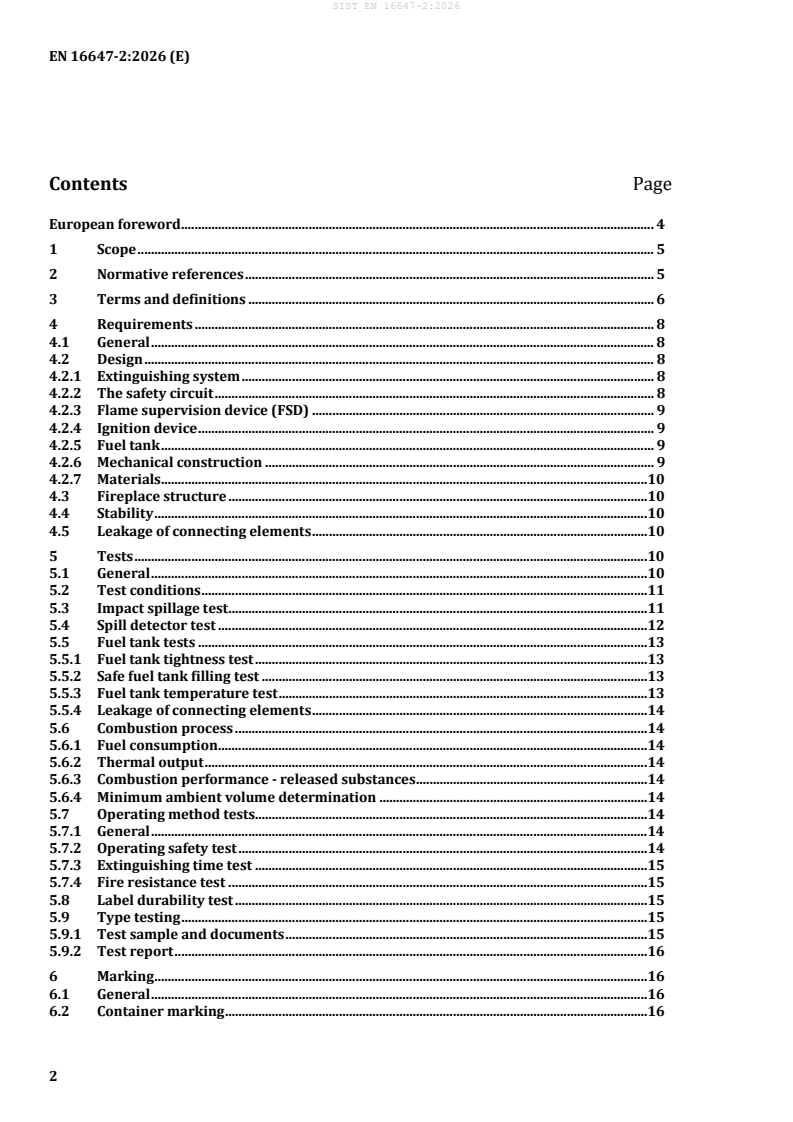
Contents Page
European foreword . 4
1 Scope . 5
2 Normative references . 5
3 Terms and definitions . 6
4 Requirements . 8
4.1 General . 8
4.2 Design . 8
4.2.1 Extinguishing system . 8
4.2.2 The safety circuit . 8
4.2.3 Flame supervision device (FSD) . 9
4.2.4 Ignition device . 9
4.2.5 Fuel tank . 9
4.2.6 Mechanical construction . 9
4.2.7 Materials .10
4.3 Fireplace structure .10
4.4 Stability .10
4.5 Leakage of connecting elements .10
5 Tests .10
5.1 General .10
5.2 Test conditions .11
5.3 Impact spillage test .11
5.4 Spill detector test .12
5.5 Fuel tank tests .13
5.5.1 Fuel tank tightness test .13
5.5.2 Safe fuel tank filling test .13
5.5.3 Fuel tank temperature test .13
5.5.4 Leakage of connecting elements .14
5.6 Combustion process .14
5.6.1 Fuel consumption .14
5.6.2 Thermal output .14
5.6.3 Combustion performance - released substances .14
5.6.4 Minimum ambient volume determination .14
5.7 Operating method tests.14
5.7.1 General .14
5.7.2 Operating safety test .14
5.7.3 Extinguishing time test .15
5.7.4 Fire resistance test .15
5.8 Label durability test .15
5.9 Type testing .15
5.9.1 Test sample and documents .15
5.9.2 Test report .16
6 Marking .16
6.1 General .16
6.2 Container marking .16
6.3 Fireplace labelling/Rating plate . 17
6.4 Marking on the packaging . 17
7 User’s manual . 18
7.1 General . 18
7.2 Warning information . 18
7.3 Installation instructions . 18
7.4 Instructions for use and maintenance . 19
8 Factory production control . 21
8.1 General . 21
8.2 Equipment . 22
8.2.1 Testing . 22
8.2.2 Production . 22
8.2.3 Raw materials and components . 22
8.2.4 Traceability and marking . 22
8.2.5 Product testing and evaluation . 22
Bibliography . 24
European foreword
This document EN 16647-2:2026 has been prepared by Technical Committee CEN/TC 46 “Fireplaces for
liquid fuels”, the secretariat of which is held by DIN.
This European Standard shall be given the status of a national standard, either by publication of an
identical text or by endorsement, at the latest by February 2027, and conflicting national standards shall
be withdrawn at the latest by February 2027.
Attention is drawn to the possibility that some of the elements of this document may be the subject of
patent rights. CEN shall not be held responsible for identifying any or all such patent rights.
This document, together with EN 16647-1:2025, supersedes EN 16647:2015.
EN 16647-2:2025 includes the following significant technical changes with respect to EN 16647:2015:
— splitting of EN 16647:2015 into two parts; this part covers automatically operated fireplaces;
— new Scope for automatically operated fireplaces;
— complete restructuring and revision of the requirements for automatically operated fireplaces,
including the requirements previously specified in Annex B of EN 16647:2015;
— incorporation and further development of the requirements for automatic functions.
EN 16647 consists of the following parts:
— EN 16647-1:2025, Alcohol powered flueless fireplaces — Safety requirements and test methods — Part
1: Manually operated decorative fireplaces for domestic use
— EN 16647-2:2026, Alcohol powered flueless fireplaces — Safety requirements and test methods — Part
2: Automatically operated decorative fireplaces for domestic use
Any feedback and questions on this document should be directed to the users’ national standards body.
A complete listing of these bodies can be found on the CEN website.
According to the CEN-CENELEC Internal Regulations, the national standards organisations of the
following countries are bound to implement this European Standard: Austria, Belgium, Bulgaria, Croatia,
Cyprus, Czech Republic, Denmark, Estonia, Finland, France, Germany, Greece, Hungary, Iceland, Ireland,
Italy, Latvia, Lithuania, Luxembourg, Malta, Netherlands, Norway, Poland, Portugal, Republic of North
Macedonia, Romania, Serbia, Slovakia, Slovenia, Spain, Sweden, Switzerland, Türkiye and the United
Kingdom.
1 Scope
This document applies to decorative, automatically controlled fireplaces for domestic use, producing a
flame using liquid alcohol, hereafter referred to as fuel, for decoration.
NOTE 1 The requirements outlined in this document can be applied even outside domestic settings. In that case
additional or different rules on the use of the fireplaces can apply.
This document applies to decorative fireplaces that do not require manual user interaction during normal
operation. These fireplaces include electric or electronic components that control the basic operation
(incl. automatic filling system).
NOTE 2 These components control the safe operation and avoid hazards such as:
— Fuel spillage while filling
— Overfilling
— Fuel explosion while igniting
— Accidental ignition while refilling
— Overheating
— Unsuccessful extinguishing
The document applies only to fireplaces for use in indoor areas.
This document applies to free-standing, wall-mounted and built-in fireplaces.
This document applies to fireplaces ready for use, whose burner is an integral component of the fireplace.
This document does not apply to fireplaces specifically designed for heating food or keeping food warm
(rechauds), as well as to fireplaces for use in boats, caravans, other.
This document does not apply to fireplaces with declared heating function.
This document does not apply to fireplaces, that are connected to a flue.
NOTE 3 Because of the safety component of automatically operated fireplaces this scope is not limited to a
specific heat output or fuel consumption. Regarding heat output limits, national legislation can apply.
2 Normative references
The following documents are referred to in the text in such a way that some or all of their content
constitutes requirements of this document. For dated references, only the edition cited applies. For
undated references, the latest edition of the referenced document (including any amendments) applies.
EN 10088-3, Stainless steels - Part 3: Technical delivery conditions for semi-finished products, bars, rods,
wire, sections and bright products of corrosion resistant steels for general purposes
EN 13501-1:2018, Fire classification of construction products and building elements - Part 1: Classification
using data from reaction to fire tests
EN 16647-1:2025, Alcohol powered flueless fireplaces - Safety requirements and test methods - Part 1:
Manually operated decorative fireplaces for domestic use
EN 60335-1, Household and similar electrical appliances — Safety — Part 1: General requirements
EN 60335-2-102, Household and similar electrical appliances - Safety - Part 2-102: Particular requirements
for gas, oil and solid-fuel burning appliances having electrical connections
ISO 7010, Graphical symbols — Safety colours and safety signs — Registered safety signs
EN IEC/IEEE 82079-1, Preparation of information for use (instructions for use) of products — Part 1:
Principles and general requirements
ISO/TS 20559:2020, Graphical symbols — Safety colours and safety signs — Guidance for the development
and use of a safety signing system
3 Terms and definitions
For the purposes of this document, the following terms and definitions apply.
ISO and IEC maintain terminology databases for use in standardization at the following addresses:
— ISO Online browsing platform: available at https://www.iso.org/obp/
— IEC Electropedia: available at https://www.electropedia.org/
3.1
fireplace
electronically controlled, decorative, liquid ethanol-fuelled appliance that does not require to be
connected to flue liner system, equipped with all parts and accessories, intended for decorative purposes
and not intended for heating purposes
3.2
controller
main electronic circuit equipped with a suitable electronic circuitry that controls fireplace functions and
receives and transmits specific signals to specific parts and subcomponents
3.3
safety circuit
component of the fireplace control system designed to autonomously detect hazards to the appliance, its
environment, or the user, and to initiate appropriate actions in response to the detected hazards without
user intervention
Note 1 to entry: Appropriate action is considered to be any action to eliminate or minimize the hazard by:
- extinguishing the fireplace;
- extinguishing and locking the appliance, until user interference;
- preventing the user from altering the appliance status;
- informing the user about the hazard that has occurred;
- informing the user about the action that could lead to the hazard;
- informing the user about other relevant information.
3.4
non-combustible material
material classified as A2-s1, d0 as per EN 13501-1:2018
3.5
surround
structure in which the fireplace is installed
3.6
minimum room volume
minimum required capacity of a room that enables efficient operation of the fireplace and ensures that
parameters intended are met, specified in the installation instructions
3.7
power output
product of fuel consumption and fuel calorific value, expressed in KW
3.8
combustion chamber
only part of the appliance where fuel is being burnt, separated from the fuel tank
3.9
fuel tank
part of the appliance that stores fuel, separated from the combustion chamber
3.10
built-in appliance
appliance designed to be placed in a surround, made according to installation instructions, which is not
permanently fixed to a building fabric
3.11
freestanding appliance
appliance not designed to be permanently fixed to the fabric of the building and not provided with helping
devices for moving
3.12
fuel
alcohol derivate with at least 91 % (volume concentration) C H OH
2 5
3.13
ignition device
part of the fireplace used to ignite fuel or its vapours
3.14
lowest appliance setting
operating parameters that give the lowest fuel consumption
3.15
highest appliance setting
operating parameters that give the highest fuel consumption
3.16
extinguishing system
system within the appliance responsible for safely and effectively extinguishing the flame on the
appliance burner
4 Requirements
4.1 General
The fireplaces shall be manufactured so that they:
— withstand loads occurring in operation;
— ensure safe use.
Electrically powered fireplaces shall meet the requirements of EN 60335-1 and EN 60335-2-102.
4.2 Design
4.2.1 Extinguishing system
The fireplace shall be equipped with a system that shuts down the fireplace.
The extinguishing system shall:
— ensure that the flame on the burner is effectively extinguished within the time specified in the
instruction for use but no longer than 2 min from the moment the stop command is issued,
— provide visual and/or acoustic signals to inform the user of the start of the flame extinguishing
process and
— prevent interruption the extinguishing sequence by any other action, e.g. re-starting, refueling; if
this could lead to danger.
4.2.2 The safety circuit
The safety circuit shall provide hazard detection for:
1. the temperature of critical components (e.g. fuel tank, burner);
2. fuel system leakage;
3. spillage of fuel during tank refilling;
4. attempts to access elements not intended for user operation (e.g. fuel filler);
Depending on the construction of the fireplace the safety circuit can optionally provide hazard detection
for:
5. concentration of combustion by-products, e.g. carbon dioxide;
6. motion detection, e.g. impact, movement, seismic shock;
7. other relevant hazards.
Any abnormal situation shall lead to a safety shut down, regardless of the operating status of the device
(e.g. standby mode, burning mode, cooling mode). The user shall be informed either by a visual or acoustic
signal. After a safety shut down it shall only be possible to re-lit the fireplace by user intervention.
The safety shut down shall extinguish the fire in 10 s or less.
4.2.3 Flame supervision device (FSD)
The fireplace shall have a flame supervision device. The FSD shall control the presence of fire in the
furnace during the combustion process. In case that the flame vanishes, the fireplace shall switch off
within 1 min and gives a signal that it is shutting down and an error occurred.
4.2.4 Ignition device
Ignition shall be carried out automatically using an ignition device built into the appliance.
If the appliance is fitted with a remote control system, the following requirements shall be met: The
remote control shall be designed and/or programmed to minimize the risk of its signals operating
another appliance.
The appliance signal receiver shall be designed and/or programmed to minimize the risk of the appliance
being operated by the remote controls for other appliances.
The remote control shall be so designed that operation of the appliance by means of this control is only
possible when the appliance is directly visible to an operator of the control who is present in the same
room as the appliance.
The remote control shall be so designed that:
— at least two distinct manual actions are required to start the operation of the fireplace (e.g.
activation of two different buttons) and
— the fireplace can be shut off quickly by means of a single action if necessary.
The user manual shall provide information for the safe use of the remote control.
4.2.5 Fuel tank
The fuel tank shall be constructed to prevent any leakage. This is checked according to 5.5.1.
The appliance shall be designed to ensure safety even in the event of fuel spillage (e.g. during filling or
refilling). The fireplace shall be equipped with a protection device that prevents ignition when fuel has
been spilled. At least one spill detector shall be installed where spilled fuel is likely to accumulate. If there
is a fuel system leak or the user spills fuel, the safety circuit should trigger a shutdown. This is checked
according to 5.3, 5.4, and 5.5.2
NOTE Protection using electronic spill detectors is acceptable
Fireplace instructions for use shall include information on automatic stopping of the fireplace in case of
spillage, leakage or fuel tank overfill.
A safe fuel tank filling method shall be described in the instruction for use and maintenance.
Provisions shall be taken that the fuel tank cannot be refilled when the fireplace is in operation.
As part of the safety circuit, the fuel tank shall be fitted with a sensor monitoring its temperature in
operation and in standby. The safety circuit shall initiate a safety shut down if the fuel tank temperature
exceeds 60°C. This is checked according to 5.5.3
4.2.6 Mechanical construction
The appliance's structural design shall ensure that welds are tight and continuous for all parts that come
into contact with liquid fuel.
All parts accessible to the user under standard operating conditions of the appliance shall be designed in
such a way that any cuts or injury are prevented, e.g. due sharp edges.
4.2.7 Materials
The parts which are in contact with the fuel shall be constructed with chrome-nickel steel X5CrNi18-10
according to EN 10088-3.
NOTE This is equivalent to chrome-nickel steel 1.4301.
If different materials are used, their suitability for intended operation in terms of thermal, chemical,
mechanical properties and corrosion resistance shall be proven by specification or by test; special
consideration shall be given to materials used in areas touching the flame.
Soldering flux containing Asbestos and Cadmium shall not be used in any components of the fireplace.
Any insulation material shall be non-combustible (A2s1d0 class according to EN 13501-1:2018) and its
application shall not pose any threat to health and safety.
Filling materials used in the burners shall be durable and specifically suited for the thermal strain under
contact with fuel and its combustion and shall not alter their properties. Proof shall be presented in order
to make sure the suitability of the material. This shall be tested according to 5.7.
Certificates issued by a test institute are acceptable proof.
The burner, and all components which can reach a temperature over 65 K above room temperature, shall
be constructed of non-combustible materials.
4.3 Fireplace structure
For freestanding appliances as well as built-in appliances with opening fro
...