


SIST EN 13305:2009
(Main)Bitumen and bituminous binders - Framework for specification of hard industrial bitumens
Bitumen and bituminous binders - Framework for specification of hard industrial bitumens
This European Standard provides a framework for the specification of hard industrial bitumens used mainly in flooring, varnishes, mineral rubber, roofing and mastic.
Within Europe several types of hard industrial bitumen are used, and dependent upon traditional practices, different grades may be used for the same purpose. The framework given in this European standard provides a basis for quality agreements to be established between supplier and client.
The hard industrial bitumen products are graded by the limits of the ring and ball softening point values, expressed as multiples of 5, and are characterised by an H in front of the values.
Bitumen und bitumenhaltige Bindemittel - Spezifikationsrahmen für Hartbitumen für industrielle Anwendungen
Diese Europäische Norm legt einen Rahmen für die Anforderungen an Hartbitumen fest, die hauptsächlich in Fußböden, Lacken, geblasenen Bitumen, Dachbelägen und Mastix verwendet werden.
In Europa werden verschiedene Arten Hartbitumen verwendet. Je nach traditioneller Technik können unterschiedliche Sorten für denselben Zweck verwendet werden. Der in dieser Norm enthaltene Rahmen liefert eine Grundlage für Qualitätsvereinbarungen zwischen dem Lieferanten und dem Kunden.
Die Produkte von Hartbitumen werden durch die Grenzwerte des Erweichungspunktes Ring und Kugel unterteilt, ausgedrückt als Vielfache von 5 und durch ein H vor den Werten gekennzeichnet.
Bitumes et liants bitumineux - Cadre de spécifications des bitumes industriels durs
La présente Norme européenne prescrit un cadre pour les spécifications des bitumes industriels durs utilisés principalement dans les revêtements de sols, les vernis, les caoutchoucs, les toitures et les mastics. Plusieurs types de bitumes industriels durs sont utilisés en Europe, et en fonction des conditions climatiques, du type de construction et des pratiques traditionnelles, des qualités différentes peuvent être utilisés pour des applications similaires. Le cadre indiqué dans la présente norme européenne fournit une base pour les accords portant sur la qualité établis entre client et fournisseur. Les bitumes industriels durs sont classés selon les limites du point de ramollissement Bille Anneau, exprimés par multiples de 5, et sont désignés par la lettre H placée avant ces valeurs.
Bitumen in bitumenska veziva - Okvirna specifikacija za trde industrijske bitumne
General Information
- Status
- Published
- Public Enquiry End Date
- 04-Jan-2009
- Publication Date
- 11-Jun-2009
- Technical Committee
- VLA - Water proofing
- Current Stage
- 6060 - National Implementation/Publication (Adopted Project)
- Start Date
- 25-May-2009
- Due Date
- 30-Jul-2009
- Completion Date
- 12-Jun-2009



Relations
- Effective Date
- 01-Jul-2009
- Effective Date
- 28-Jan-2026
- Effective Date
- 28-Jan-2026
- Effective Date
- 28-Jan-2026
- Effective Date
- 28-Jan-2026
- Effective Date
- 28-Jan-2026
- Effective Date
- 28-Jan-2026
- Referred By
SIST EN 12970:2003 - Mastic asphalt for waterproofing - Definitions, requirements and test methods - Effective Date
- 28-Jan-2026
Overview
SIST EN 13305:2009, titled Bitumen and bituminous binders - Framework for specification of hard industrial bitumens, establishes a unified European framework for specifying hard industrial bitumens. These bituminous binders are essential materials widely used in applications such as flooring, varnishes, roofing, mineral rubber, and mastic. The standard aims to harmonize the quality requirements and grades for hard industrial bitumens, promoting effective quality agreements between suppliers and clients across Europe.
The framework accommodates different national practices and enables the specification of various grades of hard industrial bitumen according to the ring and ball softening point values-an important parameter used throughout the bitumen industry.
Key Topics
- Scope and Purpose: The standard defines a basis for specifying hard industrial bitumens, focusing on their quality and grading. It supports better alignment and agreement between bitumen suppliers and users.
- Product Grading: Grades are determined by the ring and ball softening points, indicated in multiples of 5°C, prefixed with an "H" (e.g., H 85/95). This grading system provides a straightforward method for identifying product performance.
- Testing Methods: The standard references established European test methods, including:
- Needle penetration (EN 1426)
- Softening point (ring and ball method, EN 1427)
- Solubility in toluene (EN 12592)
- Loss in mass after heating (EN 13303)
- Density measurement (EN 15326)
- Flash and fire points (EN ISO 2592)
- Specification Values: Softening point, penetration, solubility, and flash point are the primary technical properties assessed, ensuring the suitability of the bitumen for various industrial applications.
- Client-Supplier Agreements: The framework encourages customization of product specifications by agreement, reflecting local preferences or project requirements.
Applications
Hard industrial bitumens specified under SIST EN 13305:2009 are used in a range of construction and manufacturing sectors:
- Flooring: Provides strength and durability for industrial flooring systems.
- Varnishes: Delivers essential protective and binding properties in industrial coatings.
- Mineral Rubber: Acts as a key component in the production of flexible, durable materials.
- Roofing: Ensures weatherproofing and longevity in roofing membranes and felts.
- Mastic: Used in making mastics for joint filling and industrial linings.
The standard’s grading system allows manufacturers and project managers to easily identify and select the suitable bitumen grade for their specific needs, improving efficiency in sourcing and quality management.
Related Standards
For comprehensive compliance and improved quality control, SIST EN 13305:2009 should be used alongside the following European bitumen standards:
- EN 1426 - Determination of needle penetration
- EN 1427 - Determination of softening point (ring and ball method)
- EN 12592 - Determination of solubility
- EN 13303 - Determination of loss in mass after heating of industrial bitumen
- EN 15326 - Measurement of density and specific gravity (pyknometer method)
- EN ISO 2592 - Determination of flash and fire points (Cleveland open cup)
These standards outline the detailed test methods referenced in SIST EN 13305:2009, ensuring robust characterization and specification of hard industrial bitumens.
Keywords: hard industrial bitumens, bituminous binders, specification framework, bitumen grading, ring and ball softening point, European standards, bitumen testing, industrial flooring, bituminous varnishes, roofing bitumen, mastic bitumen, SIST EN 13305:2009.
Get Certified
Connect with accredited certification bodies for this standard

DIBt (Deutsches Institut für Bautechnik)
German Institute for Building Technology.
DIN CERTCO
DIN Group product certification.

Element Materials Technology
Materials testing and product certification.
Sponsored listings
Frequently Asked Questions
SIST EN 13305:2009 is a standard published by the Slovenian Institute for Standardization (SIST). Its full title is "Bitumen and bituminous binders - Framework for specification of hard industrial bitumens". This standard covers: This European Standard provides a framework for the specification of hard industrial bitumens used mainly in flooring, varnishes, mineral rubber, roofing and mastic. Within Europe several types of hard industrial bitumen are used, and dependent upon traditional practices, different grades may be used for the same purpose. The framework given in this European standard provides a basis for quality agreements to be established between supplier and client. The hard industrial bitumen products are graded by the limits of the ring and ball softening point values, expressed as multiples of 5, and are characterised by an H in front of the values.
This European Standard provides a framework for the specification of hard industrial bitumens used mainly in flooring, varnishes, mineral rubber, roofing and mastic. Within Europe several types of hard industrial bitumen are used, and dependent upon traditional practices, different grades may be used for the same purpose. The framework given in this European standard provides a basis for quality agreements to be established between supplier and client. The hard industrial bitumen products are graded by the limits of the ring and ball softening point values, expressed as multiples of 5, and are characterised by an H in front of the values.
SIST EN 13305:2009 is classified under the following ICS (International Classification for Standards) categories: 75.140 - Waxes, bituminous materials and other petroleum products; 91.100.50 - Binders. Sealing materials. The ICS classification helps identify the subject area and facilitates finding related standards.
SIST EN 13305:2009 has the following relationships with other standards: It is inter standard links to SIST EN 13305:2003, SIST EN 1427:2015, SIST EN 13303:2017, SIST EN 12592:2014, SIST EN ISO 2592:2017, SIST EN 1426:2025, SIST EN 15326:2007+A1:2009, SIST EN 12970:2003. Understanding these relationships helps ensure you are using the most current and applicable version of the standard.
SIST EN 13305:2009 is available in PDF format for immediate download after purchase. The document can be added to your cart and obtained through the secure checkout process. Digital delivery ensures instant access to the complete standard document.
Standards Content (Sample)
2003-01.Slovenski inštitut za standardizacijo. Razmnoževanje celote ali delov tega standarda ni dovoljeno.Bitumen in bitumenska veziva - Okvirna specifikacija za trde industrijske bitumneBitumen und bitumenhaltige Bindemittel - Spezifikationsrahmen für Hartbitumen für industrielle AnwendungenBitumes et liants bitumineux - Cadre de spécifications des bitumes industriels dursBitumen and bituminous binders - Framework for specification of hard industrial bitumens91.100.50Veziva. Tesnilni materialiBinders. Sealing materials75.140Voski, bitumni in drugi naftni proizvodiWaxes, bituminous materials and other petroleum productsICS:Ta slovenski standard je istoveten z:EN 13305:2009SIST EN 13305:2009en,de01-julij-2009SIST EN 13305:2009SLOVENSKI
STANDARDSIST EN 13305:20031DGRPHãþD
EUROPEAN STANDARDNORME EUROPÉENNEEUROPÄISCHE NORMEN 13305March 2009ICS 75.140; 91.100.50Supersedes EN 13305:2003
English VersionBitumen and bituminous binders - Framework for specification ofhard industrial bitumensBitumes et liants bitumineux - Cadre de spécifications desbitumes industriels dursBitumen und bitumenhaltige Bindemittel -Spezifikationsrahmen für Hartbitumen für industrielleAnwendungenThis European Standard was approved by CEN on 10 February 2009.CEN members are bound to comply with the CEN/CENELEC Internal Regulations which stipulate the conditions for giving this EuropeanStandard the status of a national standard without any alteration. Up-to-date lists and bibliographical references concerning such nationalstandards may be obtained on application to the CEN Management Centre or to any CEN member.This European Standard exists in three official versions (English, French, German). A version in any other language made by translationunder the responsibility of a CEN member into its own language and notified to the CEN Management Centre has the same status as theofficial versions.CEN members are the national standards bodies of Austria, Belgium, Bulgaria, Cyprus, Czech Republic, Denmark, Estonia, Finland,France, Germany, Greece, Hungary, Iceland, Ireland, Italy, Latvia, Lithuania, Luxembourg, Malta, Netherlands, Norway, Poland, Portugal,Romania, Slovakia, Slovenia, Spain, Sweden, Switzerland and United Kingdom.EUROPEAN COMMITTEE FOR STANDARDIZATIONCOMITÉ EUROPÉEN DE NORMALISATIONEUROPÄISCHES KOMITEE FÜR NORMUNGManagement Centre:
Avenue Marnix 17,
B-1000 Brussels© 2009 CENAll rights of exploitation in any form and by any means reservedworldwide for CEN national Members.Ref. No. EN 13305:2009: ESIST EN 13305:2009
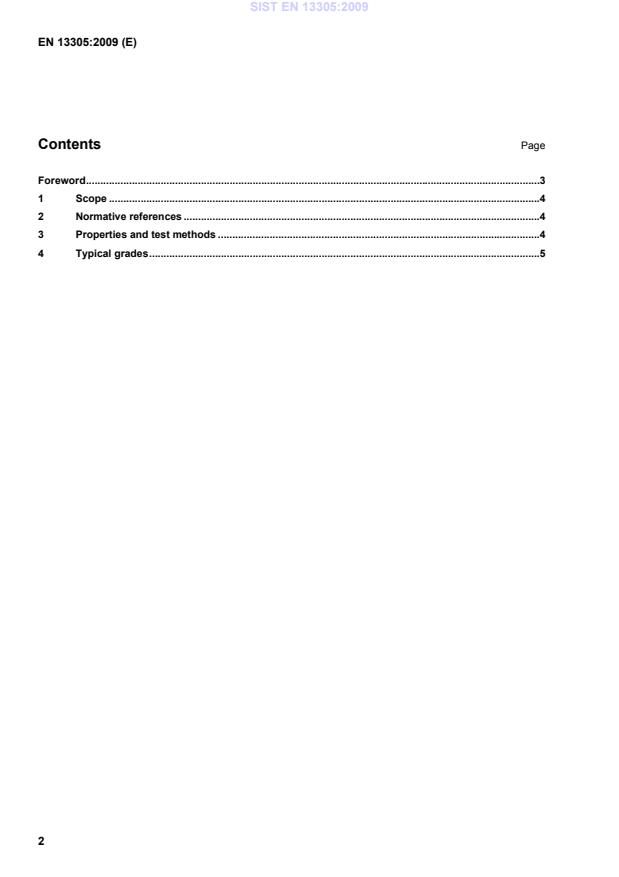
Page Foreword .31 Scope .42 Normative references .43 Properties and test methods .44 Typical grades .5 SIST EN 13305:2009
...