


oSIST prEN 196-7:2026
(Main)Methods of testing cement - Part 7: Methods for sampling and sample preparation of common cement and its constituents
General Information
- Abstract
This document specifies the equipment to be used, the procedures to be applied and the requirements for sampling common cement and/or its constituent materials, representative of defined lots, for testing purposes.
The same equipment and procedures can be used for other types of cement or materials; in some cases, modifications to the procedure are also permitted, provided that this document and/or the modifications are referenced in the relevant product standards.
The provisions of this document are only applicable when samples of constituent of common cement are:
a) required for evaluating the conformity of common cement or constituent of cement at the characteristics related to common cement, to cement constituents, to the release of dangerous substances to soil and ground water of common cement, and to environmental sustainability of common cement; or
b) requested for checking a delivery or a lot with a standard, the provisions of a contract or the specification in an order.
This document is applicable to the sampling of powders or bulk materials, whether they are:
c) contained in silos;
d) contained in bags, canisters, drums or any other packages;
e) transported in bulk in road vehicles, railway wagons, ships, etc.
NOTE The requirements of this document can also, by agreement between the parties, be followed for acceptance inspections for all non-standardized hydraulic binders.
- Status
- Not Published
- Public Enquiry End Date
- 22-Oct-2026
- Technical Committee
- CAA - Mineral binders and masonry
- Current Stage
- 4020 - Public enquire (PE) (Adopted Project)
- Start Date
- 06-Aug-2026
- Due Date
- 24-Dec-2026

Overview
oSIST prEN 196-7:2026 is a draft European standard developed by SIST that specifies methods for the sampling and sample preparation of common cement and its constituents. The standard outlines the necessary equipment, procedures, and requirements to ensure that samples are representative of defined lots for subsequent laboratory testing. Its provisions enable consistent, reliable evaluation of cement quality, conformity, and environmental safety across the cement supply chain.
The standard applies not only to common cement as defined in EN 197-1, but-with suitable modifications-can also be adapted for other types of cement and cement constituents, including those packaged or transported in silos, bags, containers, or bulk. Proper sampling is critical for verifying compliance with related regulations, standards, contractual specifications, and environmental directives.
Key Topics
- Sampling Equipment:
- Selection of non-corrodible, inert sampling tools and containers is crucial to prevent contamination or alteration of the sample. Equipment should be appropriately maintained and approved by all relevant parties.
- Sampling Procedures:
- Methods for collecting samples from various sources, including:
- Silos
- Bags, canisters, drums
- Bulk transport via trucks, rail wagons, or ships
- Conveyor belts and pneumatic conveying systems
- Stockpiles and stationary flow points
- Emphasis on safety, randomization, and representativeness to avoid bias and ensure the integrity of the test sample.
- Methods for collecting samples from various sources, including:
- Preparation of Samples:
- Procedures for homogenizing, reducing, and dividing samples using methods such as splitting, quartering, or mechanical mixers, with a focus on obtaining representative laboratory portions.
- Verification steps to confirm sample homogeneity before laboratory analysis.
- Packaging and Storage:
- Requirements for using clean, inert, dry, and sealed containers to preserve sample characteristics and prevent contamination or degradation.
- Recommendations for proper labeling, identification, and reporting.
- Documentation:
- Clear reporting protocols to capture all relevant details, including time, place, method, and any deviations or foreign materials encountered during sampling.
Applications
The sampling methods specified in oSIST prEN 196-7:2026 are directly applicable to:
- Quality Control in Cement Production: Ensures that tested samples accurately represent production lots, supporting uniformity and reliability in quality assessment.
- Conformity Assessment: Enables manufacturers, suppliers, and certifying bodies to verify that cement meets regulatory standards, customer requirements, or environmental guidelines.
- Environmental and Safety Evaluation: Facilitates assessment for the release of potentially harmful substances to soil or groundwater, supporting sustainability and environmental compliance.
- Acceptance Testing and Dispute Resolution: Provides standardized procedures for third-party verification during delivery, contract fulfillment, and settlement of disagreements regarding product quality.
- Custom and Inspection Authorities: Assures that control samples for inspection purposes are consistent across the supply chain.
While the standard's primary focus is common cement, it can, by agreement, be used for all non-standardized hydraulic binders, enhancing its breadth of application within the building materials sector.
Related Standards
- EN 197-1: Cement - Part 1: Composition, specifications, and conformity criteria for common cements
- EN 196 Series: Related methods of testing cement (including physical and chemical tests)
- EN 1097-3: Tests for mechanical and physical properties of aggregates - Determination of loose bulk density
- ISO and IEC Terminology Standards: For harmonized terminology used in standardization activities
By following oSIST prEN 196-7:2026, organizations across the cement industry gain assurance that their sampling practices enable reliable quality, conformity, and environmental safety evaluations-all essential for market confidence, regulatory compliance, and sustainable construction practices.
Relations
- Effective Date
- 25-Mar-2026
Get Certified
Connect with accredited certification bodies for this standard

DIBt (Deutsches Institut für Bautechnik)
German Institute for Building Technology.
DIN CERTCO
DIN Group product certification.

Aboma Certification B.V.
Specialized in construction, metal, and transport sectors.
Sponsored listings
Frequently Asked Questions
oSIST prEN 196-7:2026 is a draft published by the Slovenian Institute for Standardization (SIST). Its full title is "Methods of testing cement - Part 7: Methods for sampling and sample preparation of common cement and its constituents". This standard covers: This document specifies the equipment to be used, the procedures to be applied and the requirements for sampling common cement and/or its constituent materials, representative of defined lots, for testing purposes. The same equipment and procedures can be used for other types of cement or materials; in some cases, modifications to the procedure are also permitted, provided that this document and/or the modifications are referenced in the relevant product standards. The provisions of this document are only applicable when samples of constituent of common cement are: a) required for evaluating the conformity of common cement or constituent of cement at the characteristics related to common cement, to cement constituents, to the release of dangerous substances to soil and ground water of common cement, and to environmental sustainability of common cement; or b) requested for checking a delivery or a lot with a standard, the provisions of a contract or the specification in an order. This document is applicable to the sampling of powders or bulk materials, whether they are: c) contained in silos; d) contained in bags, canisters, drums or any other packages; e) transported in bulk in road vehicles, railway wagons, ships, etc. NOTE The requirements of this document can also, by agreement between the parties, be followed for acceptance inspections for all non-standardized hydraulic binders.
This document specifies the equipment to be used, the procedures to be applied and the requirements for sampling common cement and/or its constituent materials, representative of defined lots, for testing purposes. The same equipment and procedures can be used for other types of cement or materials; in some cases, modifications to the procedure are also permitted, provided that this document and/or the modifications are referenced in the relevant product standards. The provisions of this document are only applicable when samples of constituent of common cement are: a) required for evaluating the conformity of common cement or constituent of cement at the characteristics related to common cement, to cement constituents, to the release of dangerous substances to soil and ground water of common cement, and to environmental sustainability of common cement; or b) requested for checking a delivery or a lot with a standard, the provisions of a contract or the specification in an order. This document is applicable to the sampling of powders or bulk materials, whether they are: c) contained in silos; d) contained in bags, canisters, drums or any other packages; e) transported in bulk in road vehicles, railway wagons, ships, etc. NOTE The requirements of this document can also, by agreement between the parties, be followed for acceptance inspections for all non-standardized hydraulic binders.
oSIST prEN 196-7:2026 is classified under the following ICS (International Classification for Standards) categories: 91.100.10 - Cement. Gypsum. Lime. Mortar. The ICS classification helps identify the subject area and facilitates finding related standards.
oSIST prEN 196-7:2026 has the following relationships with other standards: It is inter standard links to SIST EN 196-7:2008. Understanding these relationships helps ensure you are using the most current and applicable version of the standard.
oSIST prEN 196-7:2026 is available in PDF format for immediate download after purchase. The document can be added to your cart and obtained through the secure checkout process. Digital delivery ensures instant access to the complete standard document.
Standards Content (Sample)
SLOVENSKI STANDARD
01-oktober-2026
Metode preskušanja cementa - 7. del: Metode za vzorčenje in pripravo vzorcev
običajnega cementa in njegovih sestavin
Methods of testing cement - Part 7: Methods for sampling and sample preparation of
common cement and its constituents
Prüfverfahren für Zement - Teil 7: Verfahren für die Probenahme und
Probenvorbereitung von gewöhnlichem Zement und seinen Bestandteilen
Méthodes d'essai des ciments - Partie 7: Méthodes de prélèvement et de préparation
d'échantillons de ciment ordinaire et de ses constituants
Ta slovenski standard je istoveten z: prEN 196-7
ICS:
91.100.10 Cement. Mavec. Apno. Malta Cement. Gypsum. Lime.
Mortar
2003-01.Slovenski inštitut za standardizacijo. Razmnoževanje celote ali delov tega standarda ni dovoljeno.
DRAFT
EUROPEAN STANDARD
NORME EUROPÉENNE
EUROPÄISCHE NORM
August 2026
ICS 91.100.10 Will supersede EN 196-7:2007
English Version
Methods of testing cement - Part 7: Methods for sampling
and sample preparation of common cement and its
constituents
Méthodes d'essai des ciments - Partie 7: Méthodes de Prüfverfahren für Zement - Teil 7: Verfahren für die
prélèvement et de préparation d'échantillons de Probenahme und Probenvorbereitung von
ciment ordinaire et de ses constituants gewöhnlichem Zement und seinen Bestandteilen
This draft European Standard is submitted to CEN members for enquiry. It has been drawn up by the Technical Committee
CEN/TC 51.
If this draft becomes a European Standard, CEN members are bound to comply with the CEN/CENELEC Internal Regulations
which stipulate the conditions for giving this European Standard the status of a national standard without any alteration.
This draft European Standard was established by CEN in three official versions (English, French, German). A version in any other
language made by translation under the responsibility of a CEN member into its own language and notified to the CEN-CENELEC
Management Centre has the same status as the official versions.
CEN members are the national standards bodies of Austria, Belgium, Bulgaria, Croatia, Cyprus, Czech Republic, Denmark, Estonia,
Finland, France, Germany, Greece, Hungary, Iceland, Ireland, Italy, Latvia, Lithuania, Luxembourg, Malta, Netherlands, Norway,
Poland, Portugal, Republic of North Macedonia, Romania, Serbia, Slovakia, Slovenia, Spain, Sweden, Switzerland, Türkiye and
United Kingdom.
Recipients of this draft are invited to submit, with their comments, notification of any relevant patent rights of which they are
aware and to provide supporting documentation.
Warning : This document is not a European Standard. It is distributed for review and comments. It is subject to change without
notice and shall not be referred to as a European Standard.
EUROPEAN COMMITTEE FOR STANDARDIZATION
COMITÉ EUROPÉEN DE NORMALISATION
EUROPÄISCHES KOMITEE FÜR NORMUNG
CEN-CENELEC Management Centre: Rue de la Science 23, B-1040 Brussels
© 2026 CEN All rights of exploitation in any form and by any means reserved Ref. No. prEN 196-7:2026 E
worldwide for CEN national Members.
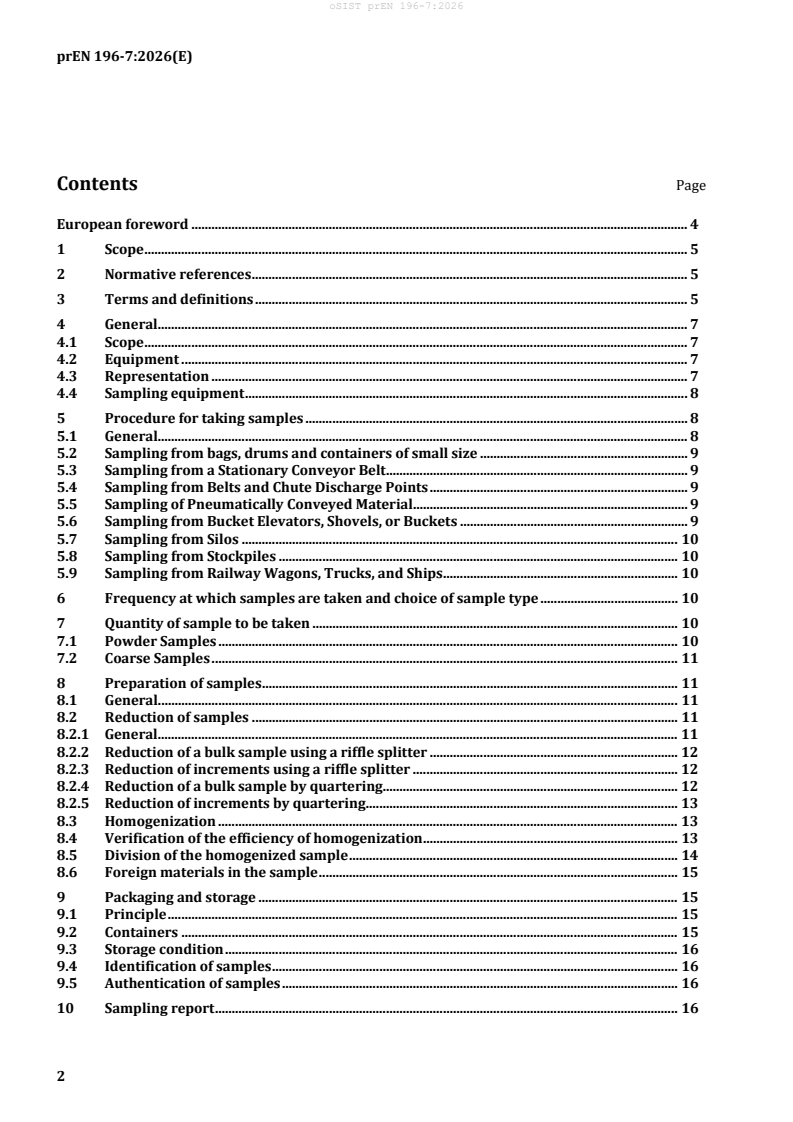
Contents Page
European foreword . 4
1 Scope . 5
2 Normative references . 5
3 Terms and definitions . 5
4 General. 7
4.1 Scope . 7
4.2 Equipment . 7
4.3 Representation . 7
4.4 Sampling equipment . 8
5 Procedure for taking samples . 8
5.1 General. 8
5.2 Sampling from bags, drums and containers of small size . 9
5.3 Sampling from a Stationary Conveyor Belt . 9
5.4 Sampling from Belts and Chute Discharge Points . 9
5.5 Sampling of Pneumatically Conveyed Material . 9
5.6 Sampling from Bucket Elevators, Shovels, or Buckets . 9
5.7 Sampling from Silos . 10
5.8 Sampling from Stockpiles . 10
5.9 Sampling from Railway Wagons, Trucks, and Ships . 10
6 Frequency at which samples are taken and choice of sample type . 10
7 Quantity of sample to be taken . 10
7.1 Powder Samples . 10
7.2 Coarse Samples . 11
8 Preparation of samples . 11
8.1 General. 11
8.2 Reduction of samples . 11
8.2.1 General. 11
8.2.2 Reduction of a bulk sample using a riffle splitter . 12
8.2.3 Reduction of increments using a riffle splitter . 12
8.2.4 Reduction of a bulk sample by quartering. 12
8.2.5 Reduction of increments by quartering . 13
8.3 Homogenization . 13
8.4 Verification of the efficiency of homogenization . 13
8.5 Division of the homogenized sample . 14
8.6 Foreign materials in the sample . 15
9 Packaging and storage . 15
9.1 Principle . 15
9.2 Containers . 15
9.3 Storage condition . 16
9.4 Identification of samples . 16
9.5 Authentication of samples . 16
10 Sampling report . 16
10.1 General . 16
10.2 Information to be included . 16
10.2.1 Obligatory information. 16
10.2.2 Optional information . 17
10.3 Authorization of the report . 17
10.4 Dispatch of the report . 17
Annex A (informative) Typical examples of equipment normally used for sampling and sample
preparation . 18
Annex B (informative) Measurement of sampling variation . 29
Bibliography . 31
European foreword
This document (prEN 196-7:2026) has been prepared by Technical Committee CEN/TC 51 Cement and
building limes”, the secretariat of which is held by NBN.
This document is currently submitted to the CEN Enquiry.
This document will supersede EN 196-7:2007.
1 Scope
This document specifies the equipment to be used, the procedures to be applied and the requirements
for sampling common cement and/or its constituent materials, representative of defined lots, for testing
purposes.
The same equipment and procedures can be used for other types of cement or materials; in some cases,
modifications to the procedure are also permitted, provided that this document and/or the modifications
are referenced in the relevant product standards.
The provisions of this document are only applicable when samples of constituent of common cement are:
a) required for evaluating the conformity of common cement or constituent of cement at the
characteristics related to common cement, to cement constituents, to the release of dangerous
substances to soil and ground water of common cement, and to environmental sustainability of
common cement; or
b) requested for checking a delivery or a lot with a standard, the provisions of a contract or the
specification in an order.
This document is applicable to the sampling of powders or bulk materials, whether they are:
c) contained in silos;
d) contained in bags, canisters, drums or any other packages;
e) transported in bulk in road vehicles, railway wagons, ships, etc.
NOTE The requirements of this document can also, by agreement between the parties, be followed for
acceptance inspections for all non-standardized hydraulic binders.
2 Normative references
There are no normative references in this document.
3 Terms and definitions
For the purposes of this document, the following terms and definitions apply.
ISO and IEC maintain terminology databases for use in standardization at the following addresses:
— ISO Online browsing platform: available at https://www.iso.org/obp/
— IEC Electropedia: available at https://www.electropedia.org/
3.1
constituent of common cement
As defined in EN 197-1.
3.2
common cement
As defined in EN 197-1.
3.3
order
formal request, covered by a single requisition placed with one manufacturer, factory, depot, or
dispatching centre, issued by a customer or authorized party for the supply or procurement of a product
in accordance with specified requirements, quantities, timeframes, and conditions
Note 1 to entry: The order can comprise of one or more consignments delivered over a defined period of time.
3.4
consignment
quantity of a product dispatched or received at one time, generally covered by a single dispatch note or
transport document, originating from a single manufacturer, factory, depot, or dispatching centre, and
presumed to have been manufactured under uniform conditions
3.5
lot
quantity of production, quantity of supply, or partial quantity of delivery (railway wagon load, truck load,
ship load) or stock of product produced at one time under conditions considered to be uniform
Note 1 to entry: In a continuous process, the quantity produced during an agreed period of time is regarded as a
lot.
Note 2 to entry: After specified tests this quantity is regarded as a whole as meeting or not meeting a standard, the
provisions of a contract or the specification in an order.
3.6
increment
quantity taken in a single operation using the sampling equipment used
Note 1 to entry: Each increment represents a part of the total sample collected for a specific lot or consignment and
is intended to be representative of the product in the location and time of sampling.
3.7
sample
quantity taken at random, or in accordance with a sampling plan, from a larger quantity (e.g. silo, stock
of bags, wagons, trucks, ships, etc.) or from a defined lot, for the purpose of the intended tests
Note 1 to entry: A sample can consist of one or more increments, each intended to be representative of the portion
of product from which it was taken.
3.8
spot sample
taken within a short period of time and at a fixed point from a larger quantity, for the purpose of the
intended tests
Note 1 to entry: A spot sample can be obtained by combining one or more immediately consecutive increments,
each intended to be representative of the portion of product from which it was taken.
3.9
composite sample
homogeneous mixture of spot samples taken:
a) at different points; or
b) at different times.
from a larger mass of the same material
Note 1 to entry: The composite sample is obtained by thoroughly mixing the combined spot samples and, if
necessary, reducing the size of the resulting mixture, in order to produce a representative sample for testing.
3.10
laboratory sample
prepared by thoroughly mixing, and if necessary, reducing, a larger sample (spot or composite sample),
intended for use by laboratories performing the tests.
3.11
sample for retest
retained for possible subsequent testing in the event that the results obtained from laboratory samples
are in doubt or disputed
3.12
retained sample
taken systematically from regular deliveries (for example, for large construction works), if necessary, in
the presence of all concerned parties, to be retained for possible testing in the event of doubt, dispute, or
subsequent problems.
Note 1 to entry: Definitions 3.3, 3.4, 3.5, and 3.12 are applicable only in the case of checks performed at the time of
delivery of a supply.
4 General
4.1 Scope
Sampling is the process of selecting and preparing one or more portions from a lot or batch under
specified conditions, so that they are representative of the entire lot. These portions are then used for
measurement, inspection, or analysis to provide information about the lot from which they were taken.
The purpose of sampling is to:
• obtain a representative specimen or specimens of a lot or batch so that subsequent inspection or
measurement results can be reliably related to the whole lot;
• facilitate decisions about conformity, quality level, acceptability or rejection of the lot without
inspecting every item.
• support efficient quality-control, acceptance inspection, process monitoring or conformity
assessment by reducing labour/time/resources compared to 100 % inspection.
• enable compliance with defined standards, contractual or regulatory requirements, while
controlling risks of wrong decision (e.g. producer’s risk, consumer’s risk).
4.2 Equipment
The equipment used, methods followed, and precautions taken can vary according to the nature of the
installation and the circumstances in which the samples are taken.
4.3 Representation
When taking delivery of a supply, sampling should be conducted in the presence of representatives of
both the manufacturer (or vendor) and the customer (or purchaser). The absence of one party shall not
prevent sampling; however, such absence can be recorded in the sampling report (see Clause 10).
Samples are normally taken before or during discharge or unloading. If necessary, sampling can be
performed after discharge or unloading, but no later than 24 h. In this case, the results of the tests shall
be interpreted with caution.
Note: For various reasons, the sample can no longer be fully representative of the product at the time of
discharge or unloading if there is a delay in sampling.
In all cases, the time of sampling shall be recorded in the sampling report (see Clause 10). When samples
are taken after discharge or unloading, the recommendations in the first paragraph above remain
applicable.
4.4 Sampling equipment
Industrial installations and sampling conditions vary widely. Therefore, it is not possible to specify a
single reference type of equipment. This document provides, by way of example in Annex A, simplified
illustrations of commonly used and satisfactory devices. Sampling equipment can be portable (e.g. ladle,
tube, screw sampler) or permanently installed (e.g. screw extractor or other equipment fixed to the
container).
Equipment shall be selected and used in accordance with the following requirements:
a) Approved by all relevant parties (e.g. certification bodies, manufacturer, supplier, customer, etc).
b) Made of non-corrodible material, not liable to react with the sample.
c) Maintained in working order and in a clean condition. Equipment can be thoroughly cleaned after
each sampling operation and protected from contamination, including lubricants from other
equipment.
NOTE Cleaning is not required between successive increments taken from the same cement intended for
forming a single sample.
5 Procedure for taking samples
5.1 General
The most suitable equipment for the circumstances shall be used to take a sample.
Safety and ergonomic regulations shall be followed at all times.
Sampling operations inevitably require personnel to work close to processing equipment and moving
vehicles. All operations shall be carried out in close coordination with operations management to ensure
workplace safety.
Materials in lump form normally have a size of less than 10 cm. When larger pieces are present, they shall
be crushed before sampling.
Materials in lump form should preferably be sampled from a stationary conveyor belt or from the
stationary flow of material. Samples should be taken at regular intervals throughout the handling of the
lot.
When sampling from a stockpile, it is difficult to maintain the principle of random sampling across the
entire lot because segregation can lead to biased results. Therefore, this method should be avoided
whenever possible.
Manual sampling using shovels or similar tools shall not be performed on moving material.
5.2 Sampling from bags, drums and containers of small size
When materials are packed in bags, drums, or other small containers, the composite sample shall be
formed by selecting a number of spot sample at random.
Each selected package can be taken as a whole or a sampling probe, in the case of large size of package,
(see A.2) can be used to obtain a spot sample from each selected package. Alternatively, each selected
package can be reduced using one of the procedures described in Clause 8.
NOTE Where possible, packages can be selected at random, either by choosing them at random intervals as
they pass a predetermined sampling point during loading or unloading, or by numbering all packages and using
random numbers.
5.3 Sampling from a Stationary Conveyor Belt
Sampling should begin only after a preliminary start-up to ensure that any irregularities in the belt
movement do not result in a biased sample.
All increments shall be taken at the same sampling point, and the material shall be collected across the
full cross-section of the conveyor belt at each increment.
The sampling tool (see A.6) should be used to separate the material to be taken as an increment at the
sampling point. Alternatively, a shovel or a flat metal plate can be used to isolate the increment from the
material remaining on the belt at both ends. Each increment shall have a length approximately three
times the width of the material stream on the belt, or a minimum mass calculated in accordance with
Clause 7.
5.4 Sampling from Belts and Chute Discharge Points
Sampling should begin only after a preliminary start-up to ensure that any irregularities in the flow do
not result in a biased sample.
A mechanical device represents the most practical means for taking samples from a conveyor belt or from
chute discharge points.
Manual sampling should be avoided whenever possible due to both safety risks and potential sampling
errors.
The period during which sampling is carried out shall be divided into an equal number of intervals, and
one increment shall be taken midway through each interval.
The increment shall be taken by passing the sampling container or sampling box (see A.7) uniformly
through the discharge stream, ensuring that the entire cross-section of the material flow is intercepted.
Samples can also be taken at the discharge of a screen using the same method.
5.5 Sampling of Pneumatically Conveyed Material
Sampling from pneumatic conveying systems shall be carried out in accordance with 8.3, using sampling
equipment installed by the manufacturer.
Such equipment, generally based on a diversion principle, shall be designed so that the entire material
flow can be diverted through the sampling line when required.
5.6 Sampling from Bucket Elevators, Shovels, or Buckets
Each increment shall consist of the entire contents of one bucket or one shovel load.
If the increment obtained is too large, it shall be reduced using one of the methods described in Clause 8,
or it can be discharged to form a small pile from which a sample shall be taken in accordance with 5.8.
5.7 Sampling from Silos
Sampling shall be performed at an extraction point in accordance with 5.4.
The silo shall be opened sufficiently to allow a uniform material flow without segregation.
5.8 Sampling from Stockpiles
Samples of approximately equal size shall be taken from various points and at different heights or depths
throughout the stockpile (see Figure 1) [3].
The location and number of increments shall take into account the method of stockpile formation, its
shape, and the likelihood of segregation within the pile.
Sampling shall be performed using a scoop (see A.5), shovel (see A.5), or probe (see A.9), collecting the
material from the deepest point of each hole.
Figure 1 — Sampling from flat stockpiles
5.9 Sampling from Railway Wagons, Trucks, and Ships
For all equipment used, care shall be taken material from the top or bottom layers of the mass of sample.
The thickness of the layer to be considered is at least 15 cm.
Sampling of nearly uniform or fine materials that flow freely from trucks can be carried out as described
in 5.8.
Sampling of fine materials from trucks can also be perform
...