


oSIST prEN 1804-4:2005
(Main)Machines for underground mines - Safety requirements for hydraulic powered roof supports - Part 4: Electro-hydraulic control systems
Machines for underground mines - Safety requirements for hydraulic powered roof supports - Part 4: Electro-hydraulic control systems
This standard specifies the safety requirements for the electro-hydraulic control systems of hydraulic powered roof supports and their emergency stop, pre-start-warning, monitoring and control devices when used as specified by the manufacturer or his authorised representative.
Maschinen für den Bergbau unter Tage - Sicherheitsanforderungen an hydraulischen Schreitausbau - Teil 4: Elektrohydraulische Steuerungen
Diese Norm legt die Sicherheitsanforderungen für die vom Hersteller oder seinem bevollmächtigten Vertreter vorgesehene bestimmungsgemäße Verwendung von elektrohydraulischen Steuerungen für Schreitausbau und ihrer Not-Aus-, Anlaufwarn-, Sperr- und Überwachungs-Einrichtungen fest.
Für die hydraulischen Komponenten der elektrohydraulischen Steuereinrichtungen gelten zusätzlich die Anforderungen nach EN 1804 Teil 3.
Diese Norm gilt für elektrohydraulische Steuerungen, die bei Umgebungstemperaturen zwischen -10°C bis 40°C und Betriebstemperaturen zwischen -10°C und 60°C eingesetzt werden.
Diese Norm identifiziert und berücksichtigt
- die Gefährdungen, die durch hydraulische Steuerungen hervorgerufen werden können;
- die Gefahrenbereiche und die Betriebsbedingungen, die irgendeine Gefährdung verursachen können;
- die Situationen, die zu Gefährdungen führen können, die eine Verletzung oder Gesundheitsschädigung verursachen und
- Gefahren, die durch Grubengas und/oder brennbare Stäube verursacht werden können.
Diese Norm beschreibt Methoden zur Reduzierung dieser Gefährdungen.
Abschnitt 4 enthält eine Liste der behandelten Gefährdungen.
Diese Norm gilt für alle elektrohydraulischen Steuerungen, die nach dem Ausgabedatum dieser Norm erstmalig in Verkehr gebracht werden.
Diese Europäische Norm spezifiziert keine zusätzlichen Anforderungen für:
- Kabellose Fernsteuerungen
- besonders korrosive Umgebung;
- Risiken bei Herstellung, Transport und Außerbetriebnahme;
- Erdbeben
Machines pour mines soterraines - Exigences de sécurité relatives aux soutenements marchants applicables aux piles - Partie 4 : Systemes de commande électro-hydrauliques
Stroji za podzemno pridobivanje - Varnostne zahteve za hidravlično nosilno podporje - 4. del: Elektrohidravlični krmilni sistemi
General Information
- Status
- Not Published
- Technical Committee
- VSN - Safety of machinery
- Current Stage
- 98 - Abandoned project (Adopted Project)
- Start Date
- 25-Aug-2010
- Due Date
- 30-Aug-2010
- Completion Date
- 25-Aug-2010
- Directive
- Harmonized Standard2006/42/EC - Directive 2006/42/EC of the European Parliament and of the Council of 17 May 2006 on machinery, and amending Directive 95/16/EC (recast)
Not Harmonized89/336/EEC - Electromagnetic compatibility (EMC)
Not Harmonized94/9/EC - Equipment and protective systems intended for use in potentially explosive atmospheres (ATEX)
Not Harmonized98/37/EC - Machinery

Overview
oSIST prEN 1804-4:2005 specifies essential safety requirements for electro-hydraulic control systems used in hydraulic powered roof supports in underground mines. Developed by the Slovenski inštitut za standardizacijo (SIST), this standard addresses the performance, safety, and operational demands on control devices, including emergency stop, pre-start warning, monitoring, and other control functions, as used under conditions defined by the manufacturer. Its goal is to identify and mitigate hazards that can arise during the use of electro-hydraulic controls in demanding underground environments.
Key Topics
Scope of Application
- Covers electro-hydraulic control devices for support units in powered roof supports, including key emergency and monitoring features.
- Applies to systems used at ambient temperatures between -10°C to +40°C and operating temperatures from -10°C to +60°C.
Hazard Identification and Control
- Identifies hazards from mechanical, electrical, thermal, and ergonomic sources, including risks arising from firedamp or combustible dust.
- Details safety requirements to minimize risks, such as:
- Emergency stop and local lockout devices
- Auditory and visible danger signals
- Monitoring for hazardous situations
Design and Component Considerations
- Outlines requirements for arrangement, construction, and labeling of control devices and wiring.
- Details on hardware (electro-hydraulic valves, transducers, cables) and software requirements.
- Specifies types of control logic and modes-unit, adjacent, sequence, remote, and automated controls.
Verification and Documentation
- Establishes methods for type tests and other verifications to ensure compliance.
- Provides detailed user information, including handling, installation, operation, maintenance, and system marking.
Applications
Electro-hydraulic control systems addressed by this standard play a key role in ensuring miner safety and operational efficiency in underground mining environments. Applications include:
- Powered Roof Supports: Enabling controlled movement, stabilization, and sequencing of mine roof supports to prevent cave-ins and rockfalls.
- Remote and Automated Operations: Improving operator safety by allowing controls from protected locations and enabling automation of repetitive mining processes.
- System Monitoring and Emergency Response: Real-time monitoring, pre-start warnings, and emergency stop mechanisms help reduce the likelihood of accidents and equipment failures.
- Explosion Prevention: Incorporating control system features to mitigate hazards from explosive gases and dust, as referenced by ATEX and related mining standards.
Related Standards
For comprehensive implementation, oSIST prEN 1804-4:2005 should be used alongside other standards for hydraulic powered roof supports and industrial safety:
- EN 1804-1: General requirements for support units
- EN 1804-2: Safety requirements for power set legs and rams
- EN 1804-3: Hydraulic control systems
- EN 1127-2: Concepts for explosion prevention and protection in mining
- EN 60204-1: Electrical equipment of machines - General requirements
- EN ISO 12100-2: Safety of machinery - Technical principles for design
- prEN 1710: Equipment for explosive atmospheres in mines
Electro-hydraulic control safety is vital in safeguarding underground mining operations. Adhering to this standard helps manufacturers, system integrators, and mining operators ensure compliance, minimize operational hazards, and promote overall occupational health and safety. By following oSIST prEN 1804-4:2005, stakeholders enhance system reliability and reduce risks throughout the mining lifecycle.
Get Certified
Connect with accredited certification bodies for this standard

Bureau Veritas Chile
Bureau Veritas certification services in Chile.
Bureau Veritas Peru
Bureau Veritas certification services in Peru.
BVQI Peru
Bureau Veritas certification in Peru.
Sponsored listings
Frequently Asked Questions
oSIST prEN 1804-4:2005 is a draft published by the Slovenian Institute for Standardization (SIST). Its full title is "Machines for underground mines - Safety requirements for hydraulic powered roof supports - Part 4: Electro-hydraulic control systems". This standard covers: This standard specifies the safety requirements for the electro-hydraulic control systems of hydraulic powered roof supports and their emergency stop, pre-start-warning, monitoring and control devices when used as specified by the manufacturer or his authorised representative.
This standard specifies the safety requirements for the electro-hydraulic control systems of hydraulic powered roof supports and their emergency stop, pre-start-warning, monitoring and control devices when used as specified by the manufacturer or his authorised representative.
oSIST prEN 1804-4:2005 is classified under the following ICS (International Classification for Standards) categories: 73.100.10 - Tunnelling and tubbing equipment. The ICS classification helps identify the subject area and facilitates finding related standards.
oSIST prEN 1804-4:2005 is associated with the following European legislation: EU Directives/Regulations: 2006/42/EC, 89/336/EEC, 94/9/EC, 98/37/EC; Standardization Mandates: M/396, M/BC/CEN/91/1. When a standard is cited in the Official Journal of the European Union, products manufactured in conformity with it benefit from a presumption of conformity with the essential requirements of the corresponding EU directive or regulation.
oSIST prEN 1804-4:2005 is available in PDF format for immediate download after purchase. The document can be added to your cart and obtained through the secure checkout process. Digital delivery ensures instant access to the complete standard document.
Standards Content (Sample)
SLOVENSKI oSIST prEN 1804-4:2005
PREDSTANDARD
januar 2005
Stroji za podzemno pridobivanje – Varnostne zahteve za hidravlično nosilno
podporje – 4. del: Elektrohidravlični krmilni sistemi
(istoveten prEN 1804-4:2004)
Machines for underground mines - Safety requirements for hydraulic powered roof
supports - Part 4: Electro-hydraulic control systems
ICS 73.100.10 Referenčna številka
© Standard je založil in izdal Slovenski inštitut za standardizacijo. Razmnoževanje ali kopiranje celote ali delov tega dokumenta ni dovoljeno
EUROPEAN STANDARD
DRAFT
NORME EUROPÉENNE
EUROPÄISCHE NORM
November 2004
ICS
English version
Machines for underground mines - Safety requirements for
hydraulic powered roof supports - Part 4: Electro-hydraulic
control systems
Machines pour mines soterraines - Exigences de sécurité Maschinen für den Bergbau unter Tage -
relatives aux soutènements marchants applicables aux Sicherheitsanforderungen an hydraulischen Schreitausbau
piles - Partie 4 : Systèmes de commande électro- - Teil 4: Elektrohydraulische Steuerungen
hydrauliques
This draft European Standard is submitted to CEN members for enquiry. It has been drawn up by the Technical Committee CEN/TC 196.
If this draft becomes a European Standard, CEN members are bound to comply with the CEN/CENELEC Internal Regulations which
stipulate the conditions for giving this European Standard the status of a national standard without any alteration.
This draft European Standard was established by CEN in three official versions (English, French, German). A version in any other language
made by translation under the responsibility of a CEN member into its own language and notified to the Management Centre has the same
status as the official versions.
CEN members are the national standards bodies of Austria, Belgium, Cyprus, Czech Republic, Denmark, Estonia, Finland, France,
Germany, Greece, Hungary, Iceland, Ireland, Italy, Latvia, Lithuania, Luxembourg, Malta, Netherlands, Norway, Poland, Portugal, Slovakia,
Slovenia, Spain, Sweden, Switzerland and United Kingdom.
Warning : This document is not a European Standard. It is distributed for review and comments. It is subject to change without notice and
shall not be referred to as a European Standard.
EUROPEAN COMMITTEE FOR STANDARDIZATION
COMITÉ EUROPÉEN DE NORMALISATION
EUROPÄISCHES KOMITEE FÜR NORMUNG
Management Centre: rue de Stassart, 36 B-1050 Brussels
© 2004 CEN All rights of exploitation in any form and by any means reserved Ref. No. prEN 1804-4:2004: E
worldwide for CEN national Members.
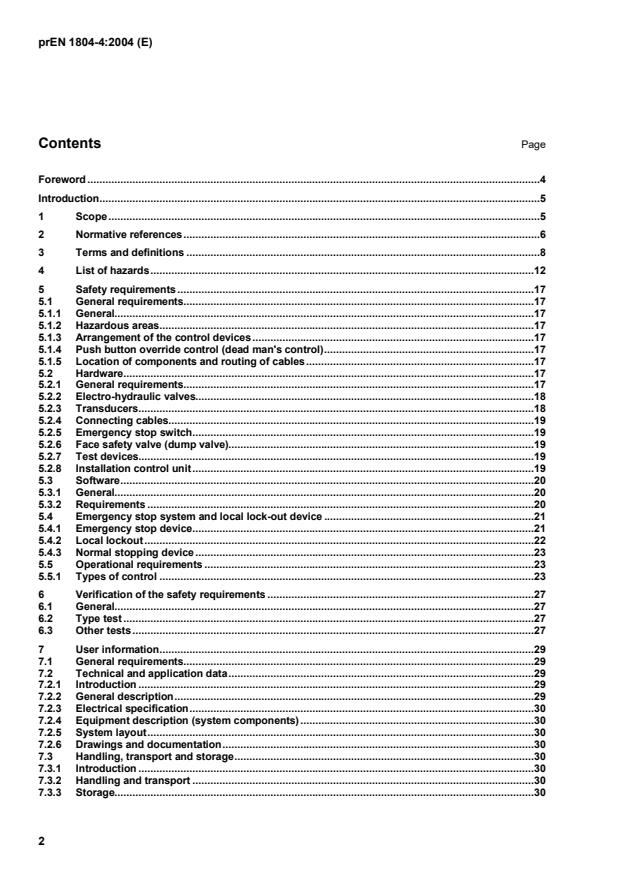
Contents Page
Foreword .4
Introduction.5
1 Scope.5
2 Normative references.6
3 Terms and definitions .8
4 List of hazards.12
5 Safety requirements.17
5.1 General requirements.17
5.1.1 General.17
5.1.2 Hazardous areas.17
5.1.3 Arrangement of the control devices.17
5.1.4 Push button override control (dead man's control).17
5.1.5 Location of components and routing of cables.17
5.2 Hardware.17
5.2.1 General requirements.17
5.2.2 Electro-hydraulic valves.18
5.2.3 Transducers.18
5.2.4 Connecting cables.19
5.2.5 Emergency stop switch.19
5.2.6 Face safety valve (dump valve).19
5.2.7 Test devices.19
5.2.8 Installation control unit.19
5.3 Software.20
5.3.1 General.20
5.3.2 Requirements .20
5.4 Emergency stop system and local lock-out device .21
5.4.1 Emergency stop device.21
5.4.2 Local lockout.22
5.4.3 Normal stopping device.23
5.5 Operational requirements .23
5.5.1 Types of control .23
6 Verification of the safety requirements .27
6.1 General.27
6.2 Type test .27
6.3 Other tests.27
7 User information.29
7.1 General requirements.29
7.2 Technical and application data.29
7.2.1 Introduction .29
7.2.2 General description.29
7.2.3 Electrical specification.30
7.2.4 Equipment description (system components).30
7.2.5 System layout.30
7.2.6 Drawings and documentation.30
7.3 Handling, transport and storage.30
7.3.1 Introduction .30
7.3.2 Handling and transport .30
7.3.3 Storage.30
7.4 Installation and commissioning. 31
7.4.1 Installation . 31
7.4.2 Commissioning. 31
7.5 Operation . 31
7.5.1 General. 31
7.5.2 Operator safety Instructions . 31
7.5.3 Modes of control. 31
7.5.4 Monitoring facilities. 31
7.6 Maintenance. 32
7.6.1 Introduction . 32
7.6.2 Technical description. 32
7.6.3 Maintenance instructions. 32
7.6.4 Fault diagnosis and correction . 32
7.6.5 Preventative maintenance schedules. 32
7.7 Parts identification list . 32
7.8 Marking . 33
7.9 Residual hazard . 33
Annex A (normative) Tests for verification of the safety requirements. 34
A.1 Tests. 34
A.1.1 Type test . 34
A.1.2 Vibration test. 35
A.1.3 Shock test . 35
A.1.4 Drop test . 35
A.1.5 Climate test. 36
A.1.6 Water tightness. 37
A.1.7 Pressure safety test. 37
A.1.8 Impulse test . 37
A.1.9 Explosion prevention and protection reference to ATEX/prEN 1710 . 37
A.1.10 EMC tests. 37
Annex B (normative) Manufacturer's EMC documentation. 38
B.1 Manufacturer's documentation . 38
B.2 Interference emission limits. 39
B.3 Immunity . 39
B.3.1 Performance assessment criteria. 39
B.3.2 Test conditions. 40
B.3.3 Immunity limits . 41
Annex C (informative) Checklist for testing. 45
C.1 Support units. 45
C.2 Control system . 45
Annex ZA (informative) Relationship between this European Standard and the Essential
Requirements of EU Directives. 48
Bibliography. 49
Foreword
This document (prEN 1804-4:2004) has been prepared by Technical Committee CEN/TC 196 “Machines for
underground mines - Safety”, the secretariat of which is held by DIN.
This document is currently submitted to the CEN Enquiry.
This European Standard has been prepared under a mandate given to CEN by the European Commission
and the European Free Trade Association, and supports essential requirements of EC Directive(s).
For relationship with EC Directive(s), see informative Annex ZA, which is an integral part of this standard.
This standard is Part 4 of a European Standard specifying the safety requirements for hydraulic powered roof
supports.
The other parts are:
Part 1: Support units and general requirements
Part 2: Power set legs and rams
Part 3: Hydraulic control systems
Annexes A and B are normative. Annexes C and ZA are informative.
Introduction
This European Standard is a type C standard as stated in EN 1070.
The extent to which hazards are covered is indicated in the scope of this standard.
While preparing this standard, it was assumed that:
only trained and competent persons operate the machine;
components without specific requirements are
a) designed in accordance with the usual engineering practice and calculation methods;
b) of sound mechanical and electrical construction;
c) free from defects;
components are kept in good working order;
a consultation took place between the manufacturer of the electro-hydraulic control systems and the user
(manufacturer of the support unit or user in the case of replacement parts) concerning the conditions of
use of the machinery.
1 Scope
This standard specifies the safety requirements for electro-hydraulic control devices for support units,
including their emergency stop, pre-start warning, monitoring and control devices, when used as specified by
the manufacturer or his authorized representative.
The requirements of EN 1804 Part 3 also apply to the hydraulic components of the electro-hydraulic control
systems
This standard applies to electro-hydraulic control systems used at ambient temperatures from –10 °C to
40 °C and operating temperatures from –10 °C to 60 °C.
This standard identifies and takes into account:
possible hazards which can be caused by the operation of hydraulic control devices;
areas and operating conditions which can create such hazards;
hazardous situations which can cause injury or may be damaging to health;
hazards which can be caused by firedamp and/or flammable dust.
This standard describes methods for the reduction of these hazards.
A list of hazards covered appears in Clause 4.
This standard is applicable to all electro-hydraulic control devices placed on the market for the first time
which are manufactured after the date on which this standard was issued.
This European Standard does not specify any additional requirements for:
cable less remote control systems;
specially corrosive environments;
hazards occurring during construction, transportation, decommissioning;
earthquakes.
2 Normative references
The following referenced documents are indispensable for the application of this document. For dated
references, only the edition cited applies. For undated references, the latest edition of the referenced
document (including any amendments) applies.
EN 457:1992, Safety of machinery — Auditory danger signals — General requirements, design and testing
(ISO 7731:1986, modified).
EN 954-1:1996, Safety of machinery — Safety-related parts of control systems — Part 1: General principles
for design.
EN 981:1996, Safety of machinery — System of auditory and visual danger and information signals.
EN 1050, Safety of machinery — Principles for risk assessment.
EN 1070, Safety of machinery — Terminology.
EN 1127-2:2002, Explosive atmospheres — Explosion prevention and protection — Part 2: Basic concepts
and methodology for mining.
prEN 1710, Equipment and components intended for use in potentially explosive atmospheres in mines.
EN 1804-1, Machines for underground mines — Safety requirements for hydraulic powered roof supports —
Part 1: Support units and general requirements.
EN 1804-2, Machines for underground mines — Safety requirements for hydraulic powered roof supports —
Part 2: Power set legs and rams.
prEN 1804-3, Machines for underground mines — Safety requirements for hydraulic powered roof supports —
Part 3: Hydraulic control systems.
EN ISO 12100-2:2003 Safety of machinery — Basic concepts, general principles for design — Part 2:
Technical principles (ISO 12100-2:2003).
EN 13463-1:2001, Non-electrical equipment for potentially explosive atmospheres — Part 1: Basic method
and requirements.
EN 50014:1997+A1+A2, Electrical apparatus for potentially explosive atmospheres — General requirements.
EN 50015:1998, Electrical apparatus for potentially explosive atmospheres — Oil immersion "o".
EN 50017:1998, Electrical apparatus for potentially explosive atmospheres — Powder filling "q".
EN 50018:2000+A1:2002, Electrical apparatus for potentially explosive atmospheres — Flameproof
enclosure "d".
EN 50020:2002, Electrical apparatus for potentially explosive atmospheres — Intrinsic safety "i".
EN 50028:1987, Electrical apparatus for potentially explosive atmospheres — Encapsulation "m".
EN 50281-1-1:1998, Electrical apparatus for use in the presence of combustible dust — Part 1-1: Electrical
apparatus protected by enclosures — Construction and testing.
EN 55011, Industrial, scientific and medical (ISM) radio-frequency equipment — Radio disturbance
characteristics — Limits and methods of measurement (CISPR 11:1997, modified).
EN 55014-1, Electromagnetic compatibility — Requirements for household appliances, electric tools and
similar apparatus — Part 1: Emission (CISPR 14-1:2000).
EN 55014-2, Electromagnetic compatibility — Requirements for household appliances, electric tools and
similar apparatus — Part 2: Immunity product family standard (CISPR 14-2:1997).
EN 55022, Information technology equipment — Radio disturbance characteristics — Limits and methods of
measurement (CISPR 22:1997, modified).
EN 60079-7:2003, Electrical apparatus for explosive gas atmospheres — Part 7: Increased safety "e"
(IEC 60079-7:2001).
EN 60079-25:2004, Electrical apparatus for explosive gas atmospheres — Part 25: Intrinsically safe systems
(IEC 60079-25:2003).
EN 60204-1:1997, Safety of machinery — Electrical equipment of machines — Part 1: General requirements.
EN 60529:1991+A1:2000, Degrees of protection provided by enclosures (IP code) (IEC 60529:1989).
EN 61000-4-2, Electromagnetic compatibility (EMC) — Part 4: Testing and measurement techniques —
Section 2: Electrostatic discharge immunity test — Basic EMC publication (IEC 61000-4-2:1995).
EN 61000-4-3, Electromagnetic compatibility (EMC) — Part 4-3: Testing and measurement techniques —
Radiated, radio-frequency, electromagnetic field immunity test (IEC 61000-4-3:2002).
EN 61000-4-4, Electromagnetic compatibility (EMC) — Part 4: Testing and measurement techniques —
Section 4: Electrical fast transient/burst immunity test — Basic EMV publication (IEC 61000-4-4:1995).
EN 61000-4-5, Electromagnetic compatibility (EMC) — Part 4: Testing and measurement techniques —
Section 5: Surge immunity test (IEC 61000-4-5:1995).
EN 61000-4-6, Electromagnetic compatibility (EMC) — Part 4: Testing and measurement techniques —
Section 6: Immunity to conducted disturbances, induced by radio-frequency fields (IEC 61000-4-6:1996).
EN 61000-4-8, Electromagnetic compatibility (EMC) — Part 4: Testing and measurement techniques —
Section 8: Power frequency magnetic field immunity test — Basic EMC publication (IEC 61000-4-8:1993).
EN 61000-4-11, Electromagnetic compatibility (EMC) — Part 4: Testing and measurement techniques —
Section 11: Voltage dips, short interruptions and voltage variations immunity tests (IEC 61000-4-11:1994).
ISO 6805, Rubber hoses and hose assemblies for underground mining — Wire-reinforced hydraulic types for
coal mining — Specification.
IEC 60038-2-6, Environmental testing — Part 2: Tests — Test Fc: Vibration (sinusoidal).
IEC 60038-2-27, Environmental testing — Part 2: Tests — Test Ea and guidance: Shock.
IEC 60038-2-32, Basic environmental testing procedures — Part 2: Tests — Test Ed: Free fall.
IEC 60038-2-38, Environmental testing — Part 2: Tests — Test Z/AD: Composite temperature/humidity cyclic
test.
IEC 60870-5-1, Telecontrol equipment and systems — Part 5: Transmission protocols — Section 1:
Transmission frame formats.
3 Terms and definitions
For the purposes of this European Standard, the definitions given in EN 1070 apply as far as relevant for this
standard and those of the EN 1804 series of standards and the following apply
3.1
types of control systems
3.1.1
unit control system
control system in which individual functions of a support unit are operated from within that support unit
3.1.2
adjacent control system
type of control system in which the individual functions of one support unit are manually operated from an
adjacent support unit (see EN 1804-3:2004)
3.1.3
sequence control system
control system in which a functional sequence, (e. g. lowering - advancing - setting) operates in one single
support unit (see EN 1804-3:2004)
3.1.4
batch sequence control system
control system in which a series of sequence controls are carried out consecutively in a specified number of
support units
3.1.5
positive setting control system
control system where the setting function of legs and/or support rams and any front cantilever is operated
automatically at least until the rated value of the setting pressure to the legs and/or support rams in the
support unit has been attained or a timing system operates
3.1.6
automatic synchronized fore pole control system
control system where the fore pole is operated as a function of the stroke of the advancing ram
3.1.7
automatic water spray control
3.1.7.1
automatic canopy water spray control system
control system where the canopy water spray system is operated as a function of the time/date and/or position
of the mineral production machine and/or the internal condition of the working face or the shield
3.1.7.2
automatic water curtain control system
control system where the water spraying system for the mineral production machine track is operated as a
function of the mineral production machine position, direction and speed of travel, and direction of ventilation
3.1.8
automatic control system for conveyor push
control system which pushes the conveyor automatically by initiated different criteria
3.1.9
automatic conveyor horizon control system
control system where the transverse inclination of the conveyor above the steering ram is controlled as a
function of the position and direction of travel of the mineral production machine, the rate of advance and the
inclination of the conveyor from set points
3.1.10
automatic base lift control system
control system where the base lift ram(s) are operated as a function of the movement of the support unit
3.1.11
automatic conveyor creep control system
control system where the anchor rams can be control by a number of functions including the movement of the
support unit, the position and direction of travel of the mineral production machine
3.1.12
automatic face sprag control system
control system where the face sprags are operated as a function of the position and direction of travel of the
mineral production machine and the movement of the support unit
3.1.13
automatic control system for the stabilizing ram
control system where the stabilizing ram(s) are operated as a function of the movement of the support unit
and of the pressure in the legs
3.1.14
automatic control system for support steering
control system where the steering rams of the advancing support and of the adjacent support units are
operated in order to steer the advancing support unit
3.1.15
automatic control system for conveyor pullback
control system where the conveyor is pulled back a specified amount
3.1.16
limited remote
control system where support units beyond the adjacent unit (e. g. next but one) are operated as in the normal
adjacent control mode (visible range)
3.1.17
remote control
control system where support units are controlled by a means other than adjacent control
3.1.18
cable less control unit
control system where data and control commands are transmitted by a means other than galvanic or fibre-
optic connections
3.1.19
minimum setting pressure for pushing the conveyor
minimum pressure in at least one of the legs of the support unit to allow automatic pushing of the conveyor
3.1.20
minimum setting pressure for pulling back the conveyor
minimum pressure in at least one leg of the support unit to allow automatic pulling back of the conveyor
3.1.21
transfer pressure
minimum pressure in at least one leg of a support unit to allow an auto sequence in the adjacent support
unit(s)
3.1.22
residual leg pressure
maximum pressure in at least one leg of the support unit to allow that support unit to be advanced
3.1.23
control device
device by which control commands can be given
3.1.24
auditory warning signal
signal indicating the possibility or actual occurrence of a dangerous situation requiring appropriate measures
for the elimination or control of the danger and indications concerting the conduct and course of action to be
taken (see EN 457, 3.1.1)
3.1.25
visible warning signal
visible signal indicating the imminent onset of a dangerous situation requiring appropriate measures for the
elimination or control of the danger (see EN 842, 3.1.1)
3.1.26
normal stop device
device for interrupting the progress of the automatic support sequence
3.1.27
single function
single movement in a support unit
3.1.28
electro-hydraulic control device
control device combining electrical and hydraulic elements
3.1.29
transducer
device converting physical variables (e. g. distances, pressures) into electrical signals
3.1.30
electromechanical actuator
device converting electrical energy into mechanical energy.(e. g. solenoid)
3.1.31
emergency stop device
arrangement of components intended to achieve the emergency stop function (see EN 418:1992)
3.1.32
emergency stop function for support units
function which interrupts movements immediately in case of emergency and which prevents restart
3.1.33
program
specifies the relationship between input signals and output functions or commands for a control unit
3.1.34
locked-on function
an initiated function retained until deliberately cancelled
3.1.35
manual in support control
mode of operation in which single functions are operable only by hydraulic controls in that support unit
3.1.36
local lockout
device ensuring that individual support units are prevented from electrical activation
3.1.37
control units
3.1.37.1
control unit
device in which control commands are processed
3.1.37.2
central control unit
control unit for gathering, processing, transmitting and displaying face data. It provides communication with
other control units and can be used for controlling support units
3.1.37.3
underground central control unit
central control unit mounted in the face end or gate area and conforming to the requirements for use below
ground
3.1.37.4
surface central control unit
central control unit installed above ground
3.1.37.5
single control unit
control unit mounted in a support unit or used as a portable device on the face
3.1.37.6
user interface
single control unit with which commands can be given and/or information received
3.1.37.7
cabled user interface
single control unit that communicates by cable with other control units
3.1.37.8
cable less user interface
single control unit that communicates with other control units without the use of a cable
3.1.37.9
integral user interface
single control unit that is incorporated into another control unit
3.1.37.10
electromechanical actuator/transducer interface module
control unit that is connected between a support control unit and electromechanical actuators or transducers
3.1.37.11
installation control unit
control unit used to install and withdraw support units
3.1.37.12
support control unit
control unit in a support unit that receives and processes data, outputs control commands for the support unit
and relays control commands for connected control units
3.1.38
pushbutton override control (dead man control)
function that remains active for as long a pushbutton is pressed
3.1.39
ambient temperature
average temperature measured in the general body of air across the face length when all the equipment
associated with the face is installed but not working when the temperature has normalized at the specified
minimum ventilation quantity
3.1.40
operating temperature
maximum surface temperature of a device or component under normal operating conditions
NOTE This is influenced by the ambient temperature, the proximity of the working fluid or other components, any
self-generating thermal effect and its location within the support unit
3.1.41
safe state of electro-hydraulic control system
state in which all outputs to actuators are disabled
3.1.42
installation control unit
control unit used to install and withdraw support units
3.1.43
face safety valve
electro-hydraulic control device which shuts off the hydraulic power supply and depressurizes the main feed
line(s) to the face
3.1.44
test device
apparatus used to verify the functionality of other defined items of equipment, e. g. control device, or to
evaluate system performance
4 List of hazards
The following list of significant hazards relates in all points to continuous operation and to setting up and
maintenance.
This list contains the hazards and hazardous situations, as far as they are dealt with in this European
Standard, identified by risk assessment significant for this type of machinery and which require action to
eliminate or reduce risk.
Table 1 — List of hazards
No. in
EN 1804-4
Hazards
EN 1050:
Hazards
Hazards, hazardous situations and hazardous events
1 Mechanical hazards due to
Machine parts or workpieces, e. g.: 5.1
shape; 5.1.2
relative location; 5.1.3
mass and stability (potential energy of elements which may move under the effect
5.2.8
of gravity);
mass and velocity (kinetic energy of elements in controlled or uncontrolled motion); not significant
inadequacy of mechanical strength; 5.2.1
accumulation of energy inside the machinery, e. g.: not significant
elastic elements (springs); not significant
liquids and gases under pressure; not significant
the effect of vacuum. not significant
1.1 Crushing hazard 5.1, 5.2.8, 5.4
1.2 Shearing hazard 5.1, 5.2.8, 5.4
1.3 Cutting or severing hazard 5.1, 5.2.8, 5.4
1.4 Entanglement hazard not significant
1.5 Drawing-in or trapping hazard not significant
1.6 Impact hazard not significant
1.7 Stabbing or puncture hazard not significant
1.8 Friction or abrasion hazard 5.2.1
1.9 High pressure fluid injection or ejection hazard 5.5.1.6.14
2 Electrical hazards due to
2.1 Contact of persons with live parts (direct contact) 5.2.1
Contact of persons with parts which have become live under faulty conditions
2.2 5.1.5, 5.2.1
(indirect contact)
2.3 Approach to live parts under high voltage not significant
2.4 Electrostatic phenomena 5.1.1
Thermal radiation or other phenomena such as the projection of molten particles
2.5 not significant
and chemical effects from short circuits, overloads, etc.
3 Thermal hazards, resulting in:
Burns, scalds and other injuries by a possible contact of persons with objects or
3.1 materials with an extreme high or low temperature, by flames or explosions and not significant
also by the radiation of heat sources
3.2 Damage to health by hot or cold working environment not significant
4 Hazards generated by noise, resulting in
Hearing loss (deafness), other physiological disorders (e. g. loss of balance, loss of 5.5.1.6.15,
4.1
awareness) 5.5.1.6.16
5.5.1.6.15,
4.2 Interference with speech communication, acoustic signals, etc.
5.5.1.6.16
Table 1 (continued)
No. in
EN 1804-4
Hazards
EN 1050:
Hazards
5 Hazards generated by vibration
Use of hand-held machines resulting in a variety of neurological and vascular
5.1 not significant
disorders
5.2 Whole body vibration, particularly when combined with poor postures not significant
6 Hazards generated by radiation
6.1 Low frequency, radio frequency radiation, micro waves 5.1.1
6.2 Infrared, visible and ultraviolet light not significant
6.3 X and gamma rays not significant
6.4 Alpha, beta rays, electron or ion beams, neutrons not significant
6.5 Lasers not significant
Hazards generated by materials and substances (and their constituent
7 not significant
elements) processed or used by the machinery
Hazards from contact with or inhalation of harmful fluids, gases, mists, fumes, and
7.1 not significant
dusts
7.2 Fire or explosion hazards 5.1.1
7.3 Biological or microbiological (viral or bacterial) hazards not significant
Hazards generated by neglecting ergonomic principles in machinery design
as, e. g. hazards from
8.1 Unhealthy postures or excessive effort 5.1.3
5.1.3,
8.2 Inadequate consideration of hand-arm or foot-leg anatomy
5.5.1.6.12
8.3 Neglected use of personal protection equipment not significant
8.4 Inadequate local lighting not significant
8.5 Mental overload and underload, stress not significant
8.6 Human error, human behaviour 5.4
8.7 Inadequate design, location or identification of manual controls 5.1.3
8.8 Inadequate design or location of visual display units 5.5.1.6.17
9 Combination of hazards not significant
Unexpected start-up, unexpected overrun/overspeed (or any similar
10 5.4
malfunction) from
10.1 Failure/disorder of the control system 5.4
10.2 Restoration of energy supply after an interruption 5.4
10.3 External influences on electrical equipment 5.2.1
10.4 Other external influences (gravity, wind, etc.) not significant
10.5 Errors in the software 5.3
Errors made by the operator (due to mismatch of machinery with human
10.6 5.5.1.6.13
characteristics and abilities, see 8.6)
11 Impossibility of stopping the machine in the best possible conditions 5.4
12 Variations in the rotational speed of tools not significant
13 Failure of the power supply 5.4
14 Failure of the control circuit 5.4
15 Errors of fitting 5.2.8
16 Break-up during operation 5.4
17 Falling or ejected objects or fluids 5.2.1
Table 1 (continued)
No. in
EN 1804-4
Hazards
EN 1050:
Hazards
18 Loss of stability/overturning of machinery 5.1
19 Slip, trip and fall of persons (related to the machinery) not significant
Additional hazards, hazardous situations and hazardous events due to mobility
20 Relating to travelling function
20.1 Movement when starting the engine 5.5.1.6.15
20.2 Movement without a driver at the driving position not significant
20.3 Movement without all parts in a safe position not significant
20.4 Excessive speed of pedestrian controlled machinery not significant
20.5 Excessive oscillations when moving not significant
20.6 Insufficient ability of machinery to be slowed down, stopped and immobilized 5.4
21 Linked to the work position (including driving station) on the machine
21.1 Fall of persons during access to (or at/from) the work position 5.4
21.2 Exhaust gases/lack of oxygen at the work position not significant
21.3 Fire (flammability of the cab, lack of extinguishing means) not significant
21.4 Mechanical hazards at the work position:
contact with the wheels; not significant
rollover; not significant
fall of objects, penetration by objects; not significant
break-up of parts rotating at high speed; not significant
contact of persons with machine parts or tools (pedestrian controlled machines). not significant
21.5 Insufficient visibility from the work position 5.5.1.6.13
21.6 Inadequate lighting 5.5.1.6.13
21.7 Inadequate seating not significant
21.8 Noise at the work position not significant
21.9 Vibration at the work position not significant
21.10 Insufficient means for evacuation/emergency exit 5.1.1
22 Due to the control system
22.1 Inadequate location of manual controls 5.1.1
22.2 Inadequate design of manual controls and their mode of operation 5.3.2.7
23 From handling the machine (lack of stability)
24 Due to the power source and to the transmission of power not significant
24.1 Hazards from the engine and batteries 5.1
24.2 Hazards from transmission of power between machines 5.2.4
24.3 Hazards from coupling and towing not significant
25 From/to third persons
25.1 Unauthorized start-up/use 5.5.1.6.12
25.2 Drift of a part away from its stopping position 5.4
25.3 Lack or inadequacy of visual or audible warning means 5.5.1.6.15
26 Insufficient instructions for the driver/operator 5.5.1.6.12
Table 1 (continued)
No. in
EN 1804-4
Hazards
EN 1050:
Hazards
Additional hazards, hazardous situations and hazardous events due to lifting
27 Mechanical hazards and hazardous events
27.1 From load falls, collisions, machine tipping caused by not significant
27.1.1 Lack of stability not significant
27.1.2 Uncontrolled loading, overloading, overturning moments exceeded not significant
27.1.3 Uncontrolled amplitude of movements 5.4
27.1.4 Unexpected/unintended movement of loads not significant
27.1.5 Inadequate holding devices/accessories not significant
27.1.6 Collision of more than one machine not significant
27.2 From access of persons to load support not significant
27.3 From derailment not significant
27.4 From insufficient mechanical strength of parts 5.2.1
27.5 From inadequate design of pulleys, drums not significant
From inadequate selection of chains, ropes, lifting and accessories and their
27.6 not significant
inadequate integration into the machine
27.7 From lowering of the load under the control of friction brake not significant
27.8 From abnormal conditions of assembly/testing/use/maintenance not significant
27.9 From the effect of load on persons (impact by load or counterweight) not significant
28 Electrical hazards
28.1 From lightning not significant
29 Hazards generated by neglecting ergonomic principles
29.1 Insufficient visibility from the driving position 5.1.3
Additional hazards, hazardous situations and hazardous events due to underground work
30 Mechanical hazards and hazardous events due to
30.1 Lack of stability of powered roof supports not significant
30.2 Failing accelerator or brake control of machinery running on rails not significant
30.3 Failing or lack of deadman´s control of machinery running on rails not significant
31 Restricted movement of persons 5.1.3
32 Fire and explosion 5.1.1
33 Emission of dust, gases etc. not significant
Additional hazards, hazardous situations and hazardous events due to the lifting or moving of persons
34 Mechanical hazards and hazardous events due to not significant
34.1 Inadequate mechanical strength – inadequate working coefficients not significant
34.2 Failing of loading control not significant
34.3 Failing of controls in person carrier (function, priority) not significant
34.4 Overspeed of person carrier not significant
35 Failing of person from person carrier not significant
36 Failing or overturning of person carrier not significant
37 Human error, human behaviour not significant
...