


kSIST FprEN ISO 10993-1:2025
(Main)Biological evaluation of medical devices - Part 1: Requirements and general principles for the evaluation of biological safety within a risk management process (ISO/FDIS 10993-1:2025)
Biological evaluation of medical devices - Part 1: Requirements and general principles for the evaluation of biological safety within a risk management process (ISO/FDIS 10993-1:2025)
This document specifies the requirements and general principles governing the biological evaluation of medical devices within a risk management process according to ISO 14971.
This document applies to the biological evaluation of medical devices that have direct contact or indirect contact with either:
— a patient's body during intended use or reasonably foreseeable misuse; or
— the body of other users who are not patients, if the medical device is intended for personal protection (e.g. medical gloves, surgical masks).
Biological evaluation assesses the biological safety of the medical device by considering the biological risks associated with:
— constituents of a medical device; and
— tissue-device interactions (including physical effects).
The biological evaluation specified in this document can address the biological safety of the medical device, considering the life cycle from design and development through initial use of the finished medical device to final decommissioning or withdrawal from use. The biological evaluation considers both the biological safety of the finished device in first use, and the significance of any changes to the medical device which can occur throughout the life cycle. However, the evaluation of risks related to environmental impacts of decommissioning of medical devices are not within the scope of this document. This document does not mandate re-testing of medical devices that are already on the market and have established and acceptable safety profiles (see 6.6.2).
This document can be useful to support clinical or usability evaluations of medical devices. For example, a biological evaluation is a pre-requisite for conducting a clinical trial. This means that principles outlined in this document can be applied to the evaluation of prototype or development stage devices, as well as to finished medical devices.
Other parts of the ISO 10993 series cover specific aspects of biological evaluation, such as chemical characterization, biological testing, sample preparation, animal welfare and toxicological risk assessment.
For some types of medical devices, specific requirements from other standards (outside the ISO 10993 series) can be considered with a justification for the approach taken if there are differences between the requirements of the ISO 10993 series and those provided in other standards. For example, the ISO 18562 series provides specific requirements for biological evaluation of breathing gas pathway medical devices and ISO 7405 provides specific requirements for biological evaluation of dental devices.
The evaluation of risks related to infectious agents [e.g. bacteria, moulds, yeasts, viruses, transmissible spongiform encephalopathy (TSE) agents] is not within the scope of this document.
NOTE 1 The evaluation of bacterial endotoxins is addressed by ISO 11737-3.
NOTE 2 The evaluation of risks related to viruses, TSE agents and other pathogens originating from materials of animal origin is addressed by the ISO 22442 series.
Biologische Beurteilung von Medizinprodukten - Teil 1: Anforderungen und allgemeine Grundsätze für die Beurteilung der biologischen Sicherheit im Rahmen eines Risikomanagementsystems (ISO/FDIS 10993-1:2025)
Dieses Dokument legt die Anforderungen und allgemeinen Grundsätze fest, die für die biologische Beurteilung von Medizinprodukten im Rahmen eines Risikomanagement-Prozesses nach ISO 14971 gelten.
Dieses Dokument gilt für die Beurteilung von Medizinprodukten, die in direkten Kontakt oder indirekten Kontakt kommen mit:
dem Körper des Patienten im Rahmen der bestimmungsgemäßen Verwendung oder einer vernünftigerweise vorhersehbaren Fehlanwendung; oder
dem Körper anderer Anwender, bei denen es sich nicht um Patienten handelt, wenn das Medizinprodukt für den persönlichen Schutz vorgesehen ist (z. B. medizinische Handschuhe, chirurgische Masken).
Durch eine biologische Beurteilung wird die biologische Sicherheit eines Medizinprodukts unter Betrachtung der biologischen Risiken beurteilt, die verbunden sind mit:
den Bestandteilen eines Medizinprodukts; und
den Wechselwirkungen zwischen Produkt und Geweben (einschließlich physikalischer Effekte).
Die in diesem Dokument festgelegte biologische Beurteilung kann die biologische Sicherheit des Medizinprodukts unter Berücksichtigung des Lebenszyklus von der Konzeption und Entwicklung über die Erstanwendung des fertigen Medizinprodukts bis hin zur endgültigen Außerbetriebnahme bzw. Beendigung der Verwendung betreffen. Bei der Beurteilung werden sowohl die biologische Sicherheit des fertigen Produkts bei der ersten Verwendung als auch die Bedeutung etwaiger Veränderungen des Medizinprodukts, die im Laufe des Lebenszyklus auftreten können, berücksichtigt. Die Bewertung der Risiken im Zusammenhang mit den Umweltauswirkungen der Außerbetriebnahme von Medizinprodukten fällt jedoch nicht in den Anwendungsbereich dieses Dokuments. Diese Ausgabe dieses Dokuments schreibt keine erneute Prüfung von Medizinprodukten vor, die bereits auf dem Markt sind und ein etabliertes und annehmbares Sicherheitsprofil aufweisen (siehe 6.6.2).
Dieses Dokument kann bei einer klinischen oder Gebrauchstauglichkeitsbeurteilung von Medizinprodukten von Nutzen sein. So ist beispielsweise die biologische Beurteilung eine Voraussetzung für die Durchführung einer klinischen Prüfung. Dies bedeutet, dass die in diesem Dokument dargestellten Grundsätze sowohl auf die Beurteilung von Prototypen oder Produkten im Entwicklungsstadium als auch auf fertige Medizinprodukte angewendet werden können.
Andere Teile der Normenreihe ISO 10993 befassen sich mit speziellen Aspekten der biologischen Beurteilung, wie z. B. der chemischen Charakterisierung, biologischen Prüfung, Probenvorbereitung, dem Tierschutz und der toxikologischen Risikobeurteilung.
Für einige Arten von Medizinprodukten können spezifische Anforderungen aus anderen Normen (außerhalb der Normenreihe ISO 10993) herangezogen werden, wobei die jeweilige Vorgehensweise zu begründen ist, wenn Unterschiede zwischen den Anforderungen der Normenreihe ISO 10993 und denen in anderen Normen bestehen. Beispielsweise enthält die Normenreihe ISO 18562 spezifische Anforderungen an die biologische Beurteilung von Medizinprodukten für Atemgaswege, und ISO 7405 enthält spezifische Anforderungen an die biologische Beurteilung von Dentalprodukten.
Die Beurteilung von Risiken im Zusammenhang mit Infektionserregern [z. B. Bakterien, Schimmelpilze, Hefen, Viren, Erreger der transmissiblen spongiformen Enzephalopathie (TSE)] fällt nicht in den Anwendungsbereich dieses Dokuments.
ANMERKUNG 1 Die Bewertung von bakteriellen Endotoxinen wird in ISO 11737 3 behandelt.
ANMERKUNG 2 Die Beurteilung von Risiken im Zusammenhang mit Viren, TSE und anderen Krankheitserregern, die aus Materialien tierischen Ursprungs stammen, wird in der Normenreihe ISO 22442 behandelt.
Évaluation biologique des dispositifs médicaux - Partie 1: Exigences et principes généraux pour l’évaluation de la sécurité biologique au sein d’un processus de gestion des risques (ISO/FDIS 10993-1:2025)
Le présent document spécifie:
— les principes généraux sur lesquels repose l'évaluation biologique des dispositifs médicaux dans un processus de gestion du risque;
— la classification générale des dispositifs médicaux, fondée sur la nature et la durée de leur contact avec le corps humain;
— l'évaluation de toutes les données pertinentes existantes;
— l'identification de lacunes dans les ensembles de données disponibles sur la base d'une analyse de risque;
— l'identification d'ensembles de données supplémentaires nécessaires à l'analyse de la sécurité biologique du dispositif médical;
— l'évaluation de la sécurité biologique du dispositif médical.
Le présent document s'applique à l'évaluation de matériaux et dispositifs médicaux qui sont destinés à entrer en contact direct ou indirect avec:
— le corps du patient pendant leur utilisation prévue;
— le corps de l'utilisateur si le dispositif médical est destiné à la protection (par exemple gants chirurgicaux, masques et autres).
Le présent document est applicable à l'évaluation biologique de tous types de dispositifs médicaux, y compris les dispositifs médicaux actifs, non actifs, implantables et non implantables.
Le présent document donne également des lignes directrices pour l'évaluation des dangers biologiques provenant de:
— risques tels que des modifications du dispositif médical au fil du temps, dans le cadre de l'évaluation de sécurité biologique générale;
— rupture d'un dispositif médical ou d'un composant de dispositif médical qui expose des tissus de l'organisme à des matériaux nouveaux.
Les autres parties de l'ISO 10993 couvrent des aspects spécifiques des évaluations biologiques et des essais associés. Des normes de produits ou spécifiques aux dispositifs traitent des essais mécaniques.
Le présent document exclut les dangers relatifs aux bactéries, moisissures, levures, virus, agents de l'encéphalopathie spongiforme transmissible (EST) et autres agents pathogènes.
Biološko ovrednotenje medicinskih pripomočkov - 1. del: Zahteve in splošna načela za oceno biološke varnosti znotraj procesa obvladovanja tveganja (ISO/FDIS 10993-1:2025)
General Information
Relations
Standards Content (Sample)
SLOVENSKI STANDARD
oSIST prEN ISO 10993-1:2024
01-september-2024
Biološko ovrednotenje medicinskih pripomočkov - 1. del: Zahteve in splošna
načela za oceno biološke varnosti znotraj procesa obvladovanja tveganja (ISO/DIS
10993-1:2024)
Biological evaluation of medical devices - Part 1: Requirements and general principles
for the evaluation of biological safety within a risk management process (ISO/DIS 10993-
1:2024)
Biologische Beurteilung von Medizinprodukten - Teil 1: Anforderungen und allgemeine
Grundsätze für die Beurteilung der biologischen Sicherheit im Rahmen eines
Risikomanagementsystems (ISO/DIS 10993-1:2024)
Évaluation biologique des dispositifs médicaux - Partie 1: Exigences et principes
généraux pour l’évaluation de la sécurité biologique au sein d’un processus de gestion
des risques (ISO/DIS 10993-1:2024)
Ta slovenski standard je istoveten z: prEN ISO 10993-1
ICS:
11.100.20 Biološko ovrednotenje Biological evaluation of
medicinskih pripomočkov medical devices
oSIST prEN ISO 10993-1:2024 en,fr,de
2003-01.Slovenski inštitut za standardizacijo. Razmnoževanje celote ali delov tega standarda ni dovoljeno.
oSIST prEN ISO 10993-1:2024
oSIST prEN ISO 10993-1:2024
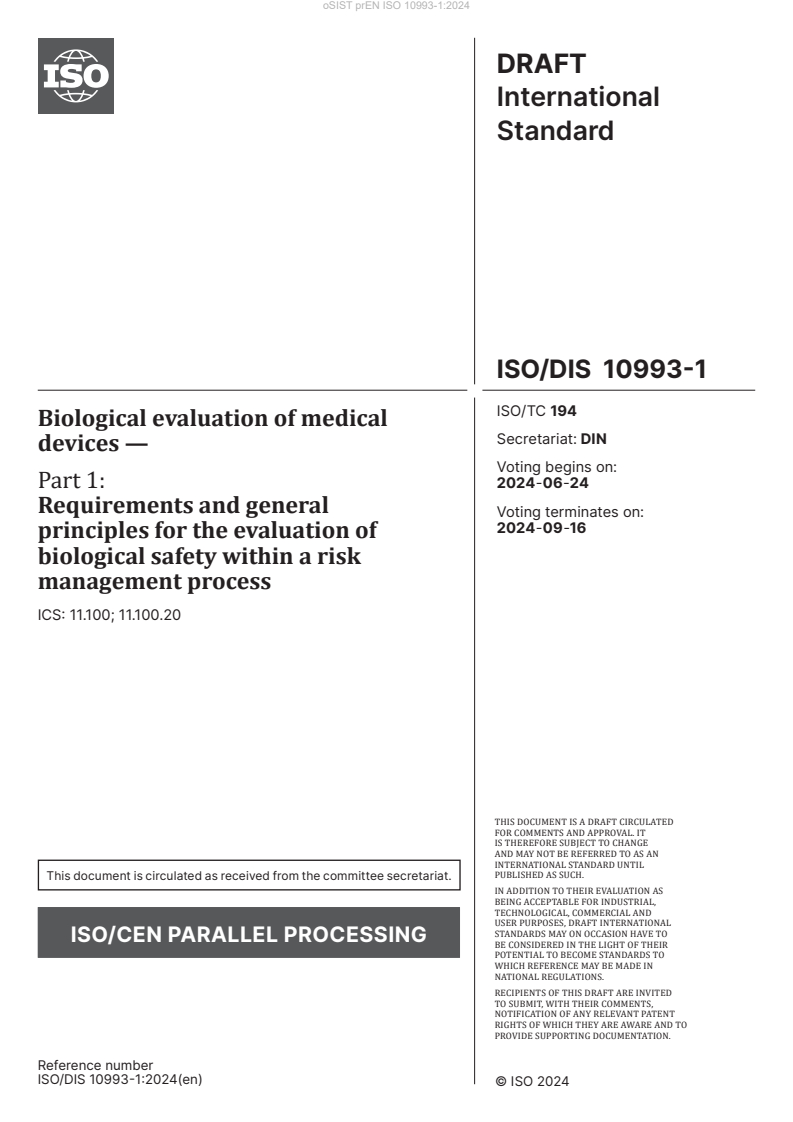
DRAFT
International
Standard
ISO/DIS 10993-1
ISO/TC 194
Biological evaluation of medical
Secretariat: DIN
devices —
Voting begins on:
Part 1: 2024-06-24
Requirements and general
Voting terminates on:
2024-09-16
principles for the evaluation of
biological safety within a risk
management process
ICS: 11.100; 11.100.20
THIS DOCUMENT IS A DRAFT CIRCULATED
FOR COMMENTS AND APPROVAL. IT
IS THEREFORE SUBJECT TO CHANGE
AND MAY NOT BE REFERRED TO AS AN
INTERNATIONAL STANDARD UNTIL
PUBLISHED AS SUCH.
This document is circulated as received from the committee secretariat.
IN ADDITION TO THEIR EVALUATION AS
BEING ACCEPTABLE FOR INDUSTRIAL,
TECHNOLOGICAL, COMMERCIAL AND
USER PURPOSES, DRAFT INTERNATIONAL
STANDARDS MAY ON OCCASION HAVE TO
ISO/CEN PARALLEL PROCESSING
BE CONSIDERED IN THE LIGHT OF THEIR
POTENTIAL TO BECOME STANDARDS TO
WHICH REFERENCE MAY BE MADE IN
NATIONAL REGULATIONS.
RECIPIENTS OF THIS DRAFT ARE INVITED
TO SUBMIT, WITH THEIR COMMENTS,
NOTIFICATION OF ANY RELEVANT PATENT
RIGHTS OF WHICH THEY ARE AWARE AND TO
PROVIDE SUPPORTING DOCUMENTATION.
Reference number
ISO/DIS 10993-1:2024(en)
oSIST prEN ISO 10993-1:2024
DRAFT
ISO/DIS 10993-1:2024(en)
International
Standard
ISO/DIS 10993-1
ISO/TC 194
Biological evaluation of medical
Secretariat: DIN
devices —
Voting begins on:
Part 1:
Requirements and general
Voting terminates on:
principles for the evaluation of
biological safety within a risk
management process
ICS: 11.100; 11.100.20
THIS DOCUMENT IS A DRAFT CIRCULATED
FOR COMMENTS AND APPROVAL. IT
IS THEREFORE SUBJECT TO CHANGE
AND MAY NOT BE REFERRED TO AS AN
INTERNATIONAL STANDARD UNTIL
PUBLISHED AS SUCH.
This document is circulated as received from the committee secretariat.
IN ADDITION TO THEIR EVALUATION AS
BEING ACCEPTABLE FOR INDUSTRIAL,
© ISO 2024
TECHNOLOGICAL, COMMERCIAL AND
USER PURPOSES, DRAFT INTERNATIONAL
All rights reserved. Unless otherwise specified, or required in the context of its implementation, no part of this publication may
STANDARDS MAY ON OCCASION HAVE TO
ISO/CEN PARALLEL PROCESSING
be reproduced or utilized otherwise in any form or by any means, electronic or mechanical, including photocopying, or posting on
BE CONSIDERED IN THE LIGHT OF THEIR
the internet or an intranet, without prior written permission. Permission can be requested from either ISO at the address below
POTENTIAL TO BECOME STANDARDS TO
WHICH REFERENCE MAY BE MADE IN
or ISO’s member body in the country of the requester.
NATIONAL REGULATIONS.
ISO copyright office
RECIPIENTS OF THIS DRAFT ARE INVITED
CP 401 • Ch. de Blandonnet 8
TO SUBMIT, WITH THEIR COMMENTS,
CH-1214 Vernier, Geneva
NOTIFICATION OF ANY RELEVANT PATENT
Phone: +41 22 749 01 11
RIGHTS OF WHICH THEY ARE AWARE AND TO
PROVIDE SUPPORTING DOCUMENTATION.
Email: copyright@iso.org
Website: www.iso.org
Published in Switzerland Reference number
ISO/DIS 10993-1:2024(en)
ii
oSIST prEN ISO 10993-1:2024
ISO/DIS 10993-1:2024(en)
Contents Page
Foreword .v
Introduction .vii
1 Scope . 1
2 Normative references . 2
3 Terms and definitions . 2
4 General principles . 7
4.1 Biological evaluation within an ISO 14971 risk management framework .7
4.2 Medical device life cycle .9
4.3 Animal welfare .10
5 Biological evaluation process .10
5.1 Overview .10
5.2 Biological evaluation plan .10
6 Biological risk analysis .12
6.1 General approach . 12
6.2 Identification of characteristics related to biological safety . 13
6.3 Identification of biological hazards, biologically hazardous situations, and potential
biological harms .14
6.4 Categorization of medical device and determination of scope of evaluation . 15
6.4.1 General . 15
6.4.2 Exposure duration categories . 15
6.4.3 Calculation of exposure duration for medical devices with daily contact with
tissues .16
6.4.4 Calculation of exposure duration for medical devices with intermittent contact
with tissues .16
6.4.5 Body contact and biological effects for consideration .16
6.5 Identified biological effects for evaluation . 20
6.5.1 Overall approach . 20
6.5.2 totoxicity .21
6.5.3 Sensitisation .21
6.5.4 Irritation .21
6.5.5 Systemic toxicity .21
6.5.6 Local effects after tissue contact . 22
6.5.7 Genotoxicity . 22
6.5.8 Carcinogenicity . 23
6.5.9 Haemocompatibility . 23
6.5.10 Other biological effects. 23
6.5.11 Other Factors to be considered .24
6.6 Gap analysis . 26
6.6.1 General . 26
6.6.2 Medical devices evaluated using previous versions of the standard .27
6.7 Biological equivalence .27
6.8 Testing . 29
6.8.1 General principles . 29
6.8.2 Biological, physical and chemical testing . 30
6.8.3 Degradation testing .31
6.8.4 Toxicokinetic studies .31
6.9 Biological risk estimation .31
7 Biological evaluation .32
8 Biological risk control .33
9 Biological evaluation report . .33
10 Production and post-production activities .33
iii
oSIST prEN ISO 10993-1:2024
ISO/DIS 10993-1:2024(en)
Annex A (informative) Material selection and characterisation to support the biological
evaluation of a medical device .35
Annex B (informative) Rationale for key changes in the biological effects listed in Tables 1-4 .38
Annex C (informative) Possible approaches to biological risk estimation .
...
Questions, Comments and Discussion
Ask us and Technical Secretary will try to provide an answer. You can facilitate discussion about the standard in here.