


SIST-TS CEN/TS 15531-7:2025
(Main)Service Interface for Real Time Information (SIRI) - Part 7: Passenger Real-Time Information European Profile
Service Interface for Real Time Information (SIRI) - Part 7: Passenger Real-Time Information European Profile
The main objective of this WI is to define a SIRI Passenger Real-Time Information European profile:
• To identify a minimum subset of SIRI with codification rules and constraints for a European level plug and play exchange of real-time passenger information data between organisations at a European level
• To reflect already existing NeTEx profiles defined at national level (Norway, France, Sweden, etc.).
• To maintain a relevant real-time information dataset, as small and simple as possible, to ensure interoperability is maximised while at the same time enabling exchange of supplementary national real-time data that will not interfere with the core international dataset
• To complement the EPIP (NeTEx European Passenger Information Profile) with real-time passenger information
• To establish quality assessment procedures for implementing validation and quality assessment tools - including compliance checking rules - necessary to fulfil the requirement of the Commission
This profile will complement the NeTEx Passenger information profile and NeTEx Accessibility profile (under drafting) in order to get a set of consistent European profiles fulfilling the requirements of the Priority Action "A" of the ITS Directive.
Serviceschnittstelle für Echtzeitinformationen (SIRI) - Europäisches Profil für Echtzeitinformationen von Reisenden
Javni prevoz - Vmesnik za informiranje v realnem času za potrebe delovanja javnega prevoza - 7. del: Evropski profil za informacije o potnikih v realnem času
Ta dokument je profil skupine standardov EN oziroma CEN/TS 15531. Osredotoča se na ustreznost informacij v storitvah zagotavljanja informacij o potnikih, ki izpolnjujejo pričakovanja delegirane uredbe Direktive o inteligentnih prometnih sistemih (storitve zagotavljanja večmodalnih potovalnih informacij po vsej EU, delegirana uredba Komisije (EU) 2017/1926 MMTIS DR, spremenjena z Uredbo (EU) 2024/490).
Vmesnik SIRI je namenjen izmenjavi podatkov v realnem času in dopolnjuje format NeTEx za izmenjavo rednih podatkov. Oba temeljita na modelu Transmodel (skupina standardov EN 12986). Vmesnik SIRI podpira izmenjavo informacij, pomembnih za storitve javnega prevoza za informacije o potnikih in sisteme AVMS.
Kot pri večini standardov za izmenjavo podatkov je opredelitev podnizov podatkov in namenskih pravil za določene primere uporabe v veliko pomoč izvajalcem ter zagotavlja splošno interoperabilnost. Ta podniz se običajno imenuje »profil« in profil v tem dokumentu se uporablja samo za informacije o potnikih.
Ta profil je zasnovan tudi tako, da dopolnjuje profil EPIP (NeTEx) z informacijami v realnem času, zato se imenuje EPIP-RT: oba profila sta dobro oblikovana in ju je mogoče uporabljati nemoteno (na nacionalni ravni v nacionalnih točkah dostopa (NAP) ali na kateri koli lokalni ravni, kjer se dosledno zagotavljajo tako redne informacije kot tudi informacije v realnem času).
General Information
- Status
- Published
- Publication Date
- 07-Sep-2025
- Technical Committee
- ITC - Information technology
- Current Stage
- 6060 - National Implementation/Publication (Adopted Project)
- Start Date
- 21-Aug-2025
- Due Date
- 26-Oct-2025
- Completion Date
- 08-Sep-2025

Relations
- Effective Date
- 28-Jan-2026
- Effective Date
- 28-Jan-2026
Overview
SIST-TS CEN/TS 15531-7:2025 is a technical specification from the Slovenian Institute for Standardization (SIST), aligned with CEN (European Committee for Standardization). Titled Service Interface for Real Time Information (SIRI) - Part 7: Passenger Real-Time Information European Profile, this standard defines a European profile for the exchange of real-time passenger information in public transport networks. The main goal is to streamline and harmonize real-time data exchange across European countries to achieve plug-and-play interoperability, supporting both cross-border and national passenger information services.
This European profile is intended to become the minimum working subset of SIRI-using agreed rules for codification and constraints-and complements NeTEx (Network Timetable Exchange) profiles established at national levels. Ultimately, the standard enables seamless integration and high-quality passenger information across different organizations and IT systems, and supports requirements set out by the European Commission for Intelligent Transport Systems (ITS).
Key Topics
Minimum SIRI Subset and Codification Rules
- Defines the essential components and allowable data structures for cross-border interoperability
- Applies uniform coding and data constraints to support seamless plug-and-play integration
Interoperability and Simplicity
- Keeps the core dataset simple and small, essential for wide adoption
- Allows addition of supplementary national data without interfering with the standardized core
Alignment with NeTEx Profiles
- Leverages lessons and approaches from national NeTEx profiles (France, Norway, Sweden, etc.)
- Ensures compatibility with the existing European Passenger Information Profile (EPIP) for NeTEx
Quality Assessment and Validation
- Specifies procedures and compliance checks to ensure reliable data exchange
- Provides tools for validation and ongoing assessment of data quality
ITS Directive Compliance
- Contributes to fulfilling Priority Action "A" within the European ITS Directive, improving real-time travel information for passengers
Applications
The SIST-TS CEN/TS 15531-7:2025 standard is highly relevant for:
Public Transport Operators and Authorities
- Facilitates real-time exchange of timetable, vehicle location, and disruption information
- Enables better, more accurate passenger information at stops, in journey planners, and via apps
IT Solution Providers and Developers
- Provides a clear, interoperable framework for developing European-ready real-time information systems
- Simplifies integration across borders and between multiple operators
National and Regional Transport Networks
- Allows networks to maintain unique operational data while participating in the wider European real-time passenger information ecosystem
Passengers and End Users
- Benefits from more consistent, up-to-date, and reliable real-time information, leading to improved travel experiences
Compliance and Procurement
- Public administrations and transit agencies can specify this standard to ensure solution compatibility and future-proof system upgrades
Related Standards
For comprehensive and effective deployment, this standard should be considered in relation to:
- CEN/TS 15531-1 to 15531-6 - Other parts of the SIRI standard, covering different aspects of real-time information exchange
- NeTEx (EN 16614 series) - Network Timetable Exchange standards, particularly the EPIP (European Passenger Information Profile)
- ITS Directive 2010/40/EU - Establishes the legal framework for ITS deployment, including the provision of real-time transport information
- SIST-TS CEN/TS 16614 series - Covers accessibility and other passenger information data profiles in conjunction with this real-time profile
In summary: The SIST-TS CEN/TS 15531-7:2025 European Passenger Real-Time Information Profile is essential for enabling interoperable, accurate, and up-to-date traveler information across Europe’s public transport networks, supporting smarter mobility and high-quality passenger service delivery.
Get Certified
Connect with accredited certification bodies for this standard

BSI Group
BSI (British Standards Institution) is the business standards company that helps organizations make excellence a habit.

NYCE
Mexican standards and certification body.
Sponsored listings
Frequently Asked Questions
SIST-TS CEN/TS 15531-7:2025 is a technical specification published by the Slovenian Institute for Standardization (SIST). Its full title is "Service Interface for Real Time Information (SIRI) - Part 7: Passenger Real-Time Information European Profile". This standard covers: The main objective of this WI is to define a SIRI Passenger Real-Time Information European profile: • To identify a minimum subset of SIRI with codification rules and constraints for a European level plug and play exchange of real-time passenger information data between organisations at a European level • To reflect already existing NeTEx profiles defined at national level (Norway, France, Sweden, etc.). • To maintain a relevant real-time information dataset, as small and simple as possible, to ensure interoperability is maximised while at the same time enabling exchange of supplementary national real-time data that will not interfere with the core international dataset • To complement the EPIP (NeTEx European Passenger Information Profile) with real-time passenger information • To establish quality assessment procedures for implementing validation and quality assessment tools - including compliance checking rules - necessary to fulfil the requirement of the Commission This profile will complement the NeTEx Passenger information profile and NeTEx Accessibility profile (under drafting) in order to get a set of consistent European profiles fulfilling the requirements of the Priority Action "A" of the ITS Directive.
The main objective of this WI is to define a SIRI Passenger Real-Time Information European profile: • To identify a minimum subset of SIRI with codification rules and constraints for a European level plug and play exchange of real-time passenger information data between organisations at a European level • To reflect already existing NeTEx profiles defined at national level (Norway, France, Sweden, etc.). • To maintain a relevant real-time information dataset, as small and simple as possible, to ensure interoperability is maximised while at the same time enabling exchange of supplementary national real-time data that will not interfere with the core international dataset • To complement the EPIP (NeTEx European Passenger Information Profile) with real-time passenger information • To establish quality assessment procedures for implementing validation and quality assessment tools - including compliance checking rules - necessary to fulfil the requirement of the Commission This profile will complement the NeTEx Passenger information profile and NeTEx Accessibility profile (under drafting) in order to get a set of consistent European profiles fulfilling the requirements of the Priority Action "A" of the ITS Directive.
SIST-TS CEN/TS 15531-7:2025 is classified under the following ICS (International Classification for Standards) categories: 35.240.60 - IT applications in transport; 35.240.99 - IT applications in other fields. The ICS classification helps identify the subject area and facilitates finding related standards.
SIST-TS CEN/TS 15531-7:2025 has the following relationships with other standards: It is inter standard links to SIST EN 15531-1:2022, SIST-TS CEN/TS 17402:2020. Understanding these relationships helps ensure you are using the most current and applicable version of the standard.
SIST-TS CEN/TS 15531-7:2025 is associated with the following European legislation: EU Directives/Regulations: 2010/40/EU; Standardization Mandates: M/456. When a standard is cited in the Official Journal of the European Union, products manufactured in conformity with it benefit from a presumption of conformity with the essential requirements of the corresponding EU directive or regulation.
SIST-TS CEN/TS 15531-7:2025 is available in PDF format for immediate download after purchase. The document can be added to your cart and obtained through the secure checkout process. Digital delivery ensures instant access to the complete standard document.
Standards Content (Sample)
SLOVENSKI STANDARD
01-oktober-2025
Javni prevoz - Vmesnik za informiranje v realnem času za potrebe delovanja
javnega prevoza - 7. del: Evropski profil za informacije o potnikih v realnem času
Service Interface for Real Time Information (SIRI) - Part 7: Passenger Real-Time
Information European Profile
Serviceschnittstelle für Echtzeitinformationen (SIRI) - Europäisches Profil für
Echtzeitinformationen von Reisenden
Ta slovenski standard je istoveten z: CEN/TS 15531-7:2025
ICS:
35.240.60 Uporabniške rešitve IT v IT applications in transport
prometu
2003-01.Slovenski inštitut za standardizacijo. Razmnoževanje celote ali delov tega standarda ni dovoljeno.
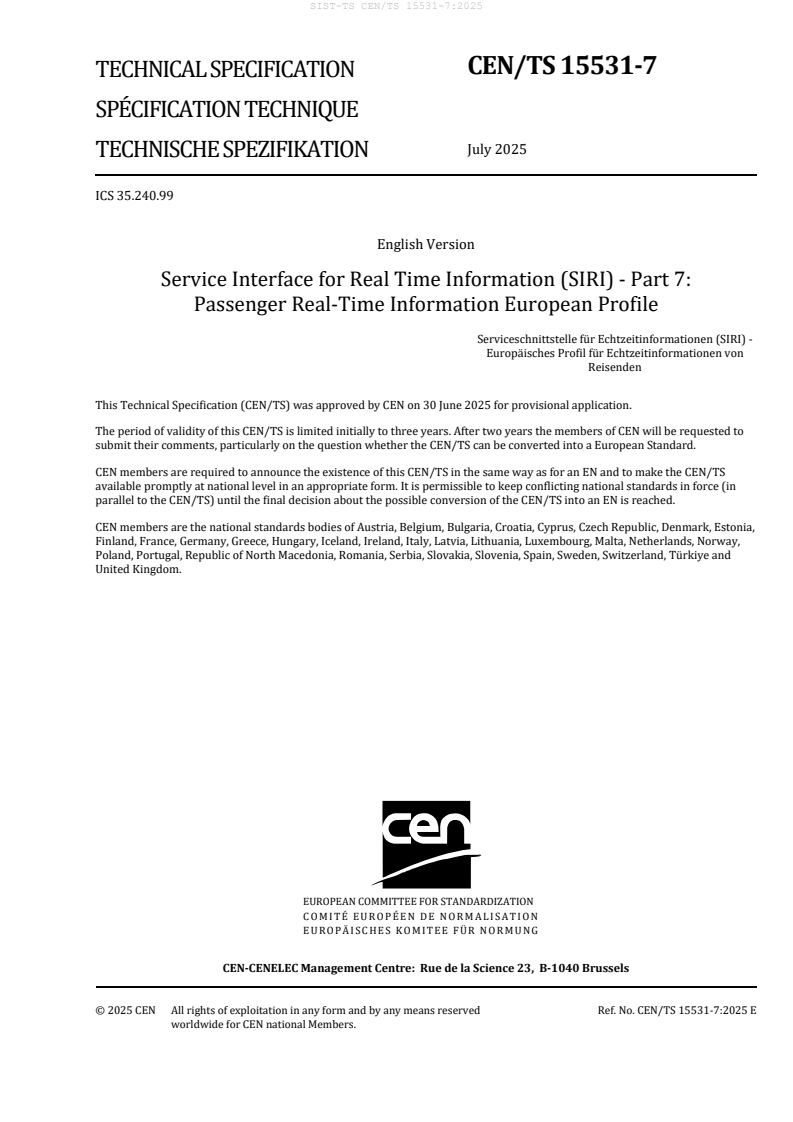
CEN/TS 15531-7
TECHNICAL SPECIFICATION
SPÉCIFICATION TECHNIQUE
July 2025
TECHNISCHE SPEZIFIKATION
ICS 35.240.99
English Version
Service Interface for Real Time Information (SIRI) - Part 7:
Passenger Real-Time Information European Profile
Serviceschnittstelle für Echtzeitinformationen (SIRI) -
Europäisches Profil für Echtzeitinformationen von
Reisenden
This Technical Specification (CEN/TS) was approved by CEN on 30 June 2025 for provisional application.
The period of validity of this CEN/TS is limited initially to three years. After two years the members of CEN will be requested to
submit their comments, particularly on the question whether the CEN/TS can be converted into a European Standard.
CEN members are required to announce the existence of this CEN/TS in the same way as for an EN and to make the CEN/TS
available promptly at national level in an appropriate form. It is permissible to keep conflicting national standards in force (in
parallel to the CEN/TS) until the final decision about the possible conversion of the CEN/TS into an EN is reached.
CEN members are the national standards bodies of Austria, Belgium, Bulgaria, Croatia, Cyprus, Czech Republic, Denmark, Estonia,
Finland, France, Germany, Greece, Hungary, Iceland, Ireland, Italy, Latvia, Lithuania, Luxembourg, Malta, Netherlands, Norway,
Poland, Portugal, Republic of North Macedonia, Romania, Serbia, Slovakia, Slovenia, Spain, Sweden, Switzerland, Türkiye and
United Kingdom.
EUROPEAN COMMITTEE FOR STANDARDIZATION
COMITÉ EUROPÉEN DE NORMALISATION
EUROPÄISCHES KOMITEE FÜR NORMUNG
CEN-CENELEC Management Centre: Rue de la Science 23, B-1040 Brussels
© 2025 CEN All rights of exploitation in any form and by any means reserved Ref. No. CEN/TS 15531-7:2025 E
worldwide for CEN national Members.
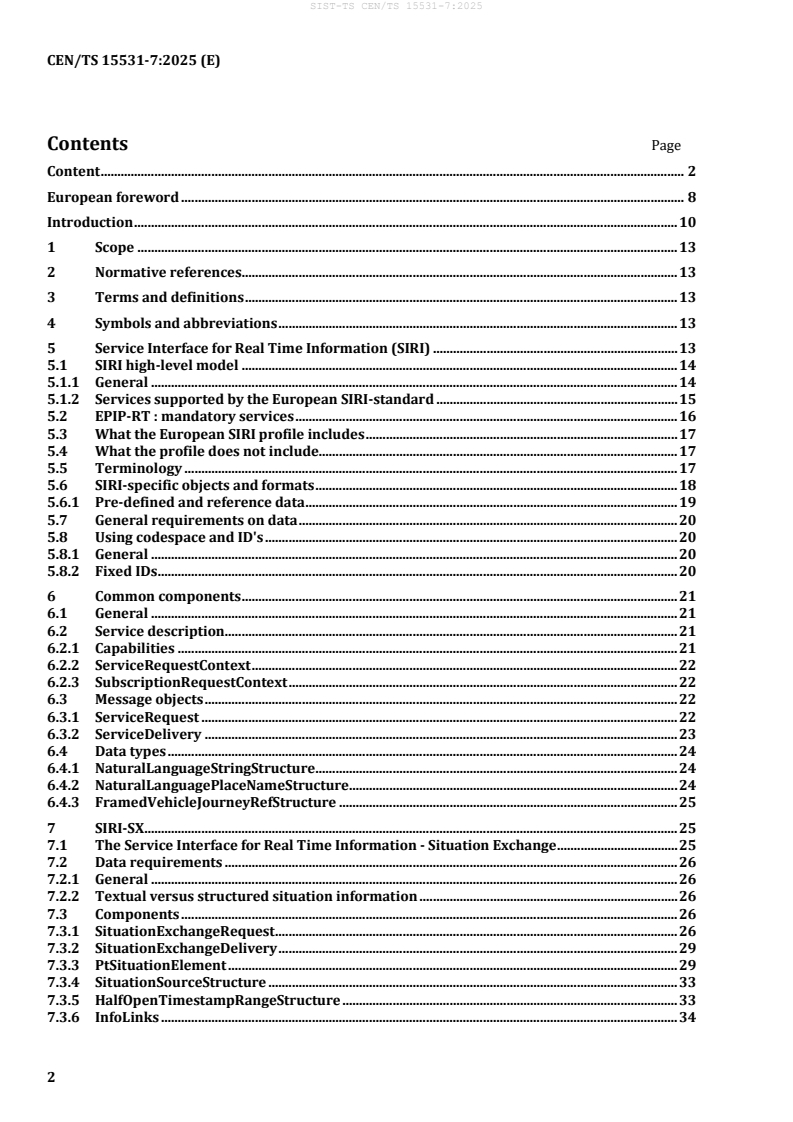
Contents Page
Content . 2
European foreword . 8
Introduction . 10
1 Scope . 13
2 Normative references. 13
3 Terms and definitions . 13
4 Symbols and abbreviations . 13
5 Service Interface for Real Time Information (SIRI) . 13
5.1 SIRI high-level model . 14
5.1.1 General . 14
5.1.2 Services supported by the European SIRI-standard . 15
5.2 EPIP-RT : mandatory services . 16
5.3 What the European SIRI profile includes . 17
5.4 What the profile does not include. 17
5.5 Terminology . 17
5.6 SIRI-specific objects and formats . 18
5.6.1 Pre-defined and reference data . 19
5.7 General requirements on data . 20
5.8 Using codespace and ID's . 20
5.8.1 General . 20
5.8.2 Fixed IDs . 20
6 Common components . 21
6.1 General . 21
6.2 Service description . 21
6.2.1 Capabilities . 21
6.2.2 ServiceRequestContext . 22
6.2.3 SubscriptionRequestContext . 22
6.3 Message objects . 22
6.3.1 ServiceRequest . 22
6.3.2 ServiceDelivery . 23
6.4 Data types . 24
6.4.1 NaturalLanguageStringStructure . 24
6.4.2 NaturalLanguagePlaceNameStructure . 24
6.4.3 FramedVehicleJourneyRefStructure . 25
7 SIRI-SX . 25
7.1 The Service Interface for Real Time Information - Situation Exchange . 25
7.2 Data requirements . 26
7.2.1 General . 26
7.2.2 Textual versus structured situation information . 26
7.3 Components . 26
7.3.1 SituationExchangeRequest . 26
7.3.2 SituationExchangeDelivery . 29
7.3.3 PtSituationElement . 29
7.3.4 SituationSourceStructure . 33
7.3.5 HalfOpenTimestampRangeStructure . 33
7.3.6 InfoLinks . 34
7.3.7 InfoLink . 34
7.3.8 PtConsequencesStructure . 34
7.3.9 Consequence . 34
7.3.10 PtAdviceStructure . 36
7.3.11 DelaysStructure . 37
7.3.12 AffectsScopeStructure. 37
7.3.13 Networks . 39
7.3.14 StopPlaces . 39
7.3.15 StopPoints . 39
7.3.16 VehicleJourneys . 40
7.3.17 AffectedNetworkStructure . 40
7.3.18 AffectedOperatorStructure . 41
7.3.19 AffectedLineStructure . 41
7.3.20 Sections . 42
7.3.21 AffectedSectionStructure . 42
7.3.22 Calls . 43
7.3.23 StopPoints . 43
7.3.24 AffectedStopPointStructure . 44
7.3.25 AffectedStopPlaceStructure . 45
7.3.26 AffectedFacilityStructure . 46
7.3.27 AccessibilityAssessment . 46
7.3.28 AccessibilityLimitation . 46
7.3.29 AffectedComponents . 47
7.3.30 AffectedStopPlaceComponentStructure . 47
7.3.31 AffectedVehicleJourneyStructure . 48
7.3.32 PublishingActionStructure . 50
7.4 SituationExchangeCapabilities . 57
7.5 Use Case Examples . 58
7.5.1 Disruption of a network section . 58
7.5.2 Disruption of a line . 59
7.5.3 Disruption of a Facility at a stop place . 64
7.5.4 Disruption of a Journey . 67
7.5.5 Change of boarding activity . 68
8 SIRI-ET . 69
8.1 The Service Interface for Real Time Information - Estimated Timetable . 69
8.2 Data requirements . 69
8.3 Components . 70
8.3.1 EstimatedTimetableRequest . 70
8.3.2 EstimatedTimetableDelivery . 71
8.3.3 EstimatedJourneyVersionFrame . 71
8.3.4 EstimatedVehicleJourney . 72
8.3.5 SimpleContactStructure . 76
8.3.6 SituationRefStructure . 76
8.3.7 RecordedCalls . 77
8.3.8 RecordedCallStructure . 77
8.3.9 FormationAssignmentStructure . 80
8.3.10 StopAssignmentStructure . 81
8.3.11 EstimatedCalls . 81
8.3.12 EstimatedCallStructure . 81
8.3.13 VehicleOccupancyStructure . 85
8.3.14 PassengerCapacityStructure . 87
8.3.15 TrainFormationReferenceGroup . 87
8.3.16 JourneyRelation . 88
8.3.17 JourneyParts . 88
8.3.18 RelatedJourneyPartStructure . 88
8.3.19 RelatedJourneyStructure . 89
8.4 EstimatedTimetableCapabilities . 89
8.5 Use Case Examples. 90
8.5.1 General . 90
8.5.2 Use of Order within this document . 90
8.5.3 Incremental update support . 90
8.5.4 Establishing a baseline . 91
8.5.5 Delays . 95
8.5.6 Platform changes . 99
8.5.7 Journey cancellation . 101
8.5.8 Additional Journey . 102
8.5.9 Cancellation of stops . 102
8.5.10 Exceptional stop . 104
8.5.11 Rerouting . 105
8.5.12 Change of boarding activity . 108
8.5.13 Recording of calls . 109
8.5.14 Vehicle waiting at stop . 109
8.5.15 Change of formation . 109
8.5.16 Change of occupancy . 117
8.5.17 Replacement of Journey and Relations . 121
9 SIRI-VM . 124
9.1 The Service Interface for Real Time Information - Vehicle Monitoring . 124
9.2 Data requirements . 124
9.3 Components . 124
9.3.1 VehicleMonitoringRequest . 124
9.3.2 VehicleMonitoringDelivery . 125
9.3.3 VehicleActivity . 125
9.3.4 ProgressBetweenStops . 126
9.3.5 MonitoredVehicleJourney . 126
9.3.6 Location . 128
9.3.7 MonitoredCallStructure . 129
9.4 VehicleMonitoringCapabilities . 129
9.5 Use Case Examples. 131
9.5.1 Establishing a baseline . 131
9.5.2 Exact Vehicle Location combined with a Delay . 132
10 SIRI-FM . 133
10.1 General . 133
10.2 Data requirements . 133
10.3 Components . 134
10.3.1 FacilityMonitoringRequest. 134
10.3.2 FacilityCondition Structure . 135
10.3.3 Facility Structure . 135
10.3.4 Counting . 137
10.3.5 Remedy . 138
10.4 FacilityMonitoringCapabilities . 138
10.5 Use Case Examples. 140
10.5.1 Elevator out of business . 140
10.5.2 Service relations and connected events . 140
Annex A (informative) General Requirements . 141
A.1 Exchanging data . 141
A.2 Available services . 141
A.3 Security . 141
A.3.1 General . 141
A.3.2 Network security recommendations . 141
A.3.3 Authentication . 142
A.3.4 Authorization and access management (application level) . 142
A.4 Technical roles . 142
A.4.1 General . 142
A.4.2 The Producer . 142
A.4.3 The Data Hub . 142
A.4.4 The Broadcaster or Consumer . 142
A.5 Data exchange protocols . 143
A.5.1 General . 143
A.5.2 Asychronous: Publish/Subscribe - Direct delivery . 143
A.5.3 Synchronous: Request/response . 150
A.5.4 Message based data exchange . 152
A.6 Subscription Handling . 152
A.6.1 Managing subscriptions across multiple services . 152
A.6.2 Subscription initiation request . 152
A.6.3 Subscription response . 153
A.6.4 Subscription keep-alive . 154
A.6.5 Subscription termination . 154
A.7 Data exchange . 155
A.7.1 General . 155
A.7.2 SIRI VM (simplified example) . 155
A.7.3 SIRI ET (simplified example). 156
A.7.4 SIRI SX (simplified example) . 156
A.7.5 SIRI FM (simplified example) . 156
A.8 Compression . 157
A.9 Error Handling. 157
Annex B (informative) Requirements on Data Exchange . 160
B.1 General . 160
B.2 Standard values . 160
B.3 Data correctness . 160
B.4 Data completeness . 160
B.5 Data content . 160
B.6 Data freshness . 161
B.7 Disregarding the PreviewInterval . 161
B.8 Update intervals . 161
B.9 Completeness of incremental updates . 162
B.10 Incremental updates and IsCompleteStopSequence . 162
B.10.1 General . 162
B.10.2 IsCompleteStopSequence and active state of a journey. 163
B.10.3 IsCompleteStopSequence and full history of a journey . 164
B.10.4 Incremental update process in a non-traditional setting . 165
B.11 Buffering . 165
B.12 Handling of predictions . 166
B.13 Handling of recorded data . 167
B.14 Functional definition of arrival and departure . 168
B.14.1 General . 168
B.14.2 Arrival . 168
B.14.3 Departure . 168
Annex C (informative) Implementation Best Practices . 169
C.1 General . 169
C.2 Triggering events . 169
C.3 RecordedCall with missing actual times . 170
C.4 Immutability of actual times . 170
C.5 RecordedCalls in initial loads . 171
C.6 Expected times in RecordedCall . 171
C.7 Special case recording of cancelled calls . 171
C.8 Special case exceptional passthrough . 171
C.9 Special case optional stop . 172
C.10 Special case vehicle at stop . 172
C.11 Illustration of the default case . 174
C.12 Event not triggered . 175
C.13 Loss of connection . 177
C.14 Events not triggered and prediction unknown . 178
C.15 Events not triggered after a certain point. 179
C.16 Extra journey without real-time feed . 180
Annex D (informative) Enumeration values for SIRI Part 7 . 182
D.1 Overview of Enumerations . 182
D.2 General Enumerations . 184
D.2.1 VehicleModesOfTransportEnumeration . 184
D.2.2 AccessModeEnumeration . 185
D.3 Accessibility Enumerations . 185
D.3.1 AccessibilityEnumeration. 185
D.3.2 StopPlaceComponentTypeEnumeration . 185
D.3.3 AccessibilityFeatureEnumeration . 186
D.3.4 OccupancyEnumeration . 186
D.4 Call Enumerations . 187
D.4.1 CallStatusEnumeration . 187
D.4.2 ArrivalBoardingActivityEnumeration. 187
D.4.3 DepartureBoardingActivityEnumeration . 188
D.4.4 VehicleStatusEnumeration . 188
D.5 SIRI-FM Enumerations . 189
D.5.1 FacilityClassEnumeration . 189
D.5.2 FacilityStatusEnumeration . 189
D.5.3 CountingTypeEnumeration . 190
D.5.4 CountedFeatureUnitEnumeration . 190
D.5.5 CountingTrendEnumeration . 190
D.5.6 RemedyTypeEnumeration . 191
D.6 SIRI-SX Enumerations . 191
D.6.1 RoutePointTypeEnumeration . 191
D.6.2 SeverityEnumeration . 192
D.6.3 ReportTypeEnumeration . 192
D.6.4 ScopeTypeEnumeration . 192
D.6.5 EndTimePrecisionEnumeration . 193
D.6.6 WorkflowStatusEnumeration . 193
D.6.7 SourceTypeEnumeration . 194
D.6.8 AdviceTypeEnumeration . 194
D.6.9 ServiceConditionEnumeration . 195
D.6.10 DelayBandEnumeration . 196
D.6.11 DelaysTypeEnumeration . 196
D.6.12 AlertCauseEnumeration . 196
D.6.13 PublicEventTypeEnum . 201
D.6.14 JourneyRelationTypeEnumeration . 204
Bibliography . 207
European foreword
This document (CEN/TS 15531-7:2025) has been prepared by Technical Committee CEN/TC 278 “Road
transport and traffic telematics”, the secretariat of which is held by NEN.
Attention is drawn to the possibility that some of the elements of this document may be the subject of
patent rights. CEN shall not be held responsible for identifying any or all such patent rights
This document presents a Real-time Passenger Information European Profile of the European Technical
Specification known as SIRI. SIRI provides a framework for specifying communications and data exchange
protocols for organizations wishing to exchange Real-time Information relating to public transport opera-
tions.
SIRI is presented in eight main parts:
• context and framew
...