


SIST EN 50388-1:2022
(Main)Railway Applications - Fixed installations and rolling stock - Technical criteria for the coordination between electric traction power supply systems and rolling stock to achieve interoperability - Part 1: General
Railway Applications - Fixed installations and rolling stock - Technical criteria for the coordination between electric traction power supply systems and rolling stock to achieve interoperability - Part 1: General
This document establishes requirements for the electrical aspects to achieve technical compatibility between rolling stock and electric traction systems, limited to:
- co-ordination of protection principles between power supply and traction units, i.e. separation sections, train set current or power limitation, short circuit current discrimination, breaker coordination and use of regenerative braking.
- co-ordination of installed power on the line and the power demand of trains, i.e. traction unit power factor, train set current or power limitation, electric system performance, type and characterization.
- compatibility assessment relating to harmonics and dynamic effects.
Informative values are given for some parts of the existing European railway networks, in annexes.
NOTE For those railways within the scope of EU Interoperability Directive, definitive values are set out in the register of infrastructure published in accordance with Article 49 of Directive (EU) 2016/797, and the list of items included in the register is described in the commission decision (EU) 2019/777.
The following electric traction systems are within the scope of this document:
- railways;
- guided mass transport systems that are integrated with railways;
- material transport systems that are integrated with railways.
Information is given on electrification parameters to enable train operating companies to confirm, after consultation with the rolling stock manufacturers, that risks of non-compatibility are minimized and that there will be no consequential disturbance on the electrification system.
The interaction between pantograph and overhead contact line is dealt with in EN 50367:2020.
The interaction with the control-command and signalling subsystem is not dealt with in this document.
Basic considerations have been included concerning the use of accumulator trains.
Bahnanwendungen - Ortsfeste Anlagen und Fahrzeuge - Technische Kriterien für die Koordination zwischen elektrische Bahnenergieversorgungssysteme und Fahrzeugen zum Erreichen der Interoperabilität - Teil 1: Allgemeines
Applications ferroviaires - Installations fixes et matériel roulant - Critères techniques pour la coordination entre les installations fixes de traction électrique et le matériel roulant pour réaliser l'interopérabilité
Le présent document définit les exigences relatives aux critères électriques visant à garantir la compatibilité technique entre les réseaux de traction électrique et le matériel roulant, qui se limitent à :
- la coordination des mesures de protection entre l'alimentation électrique et les unités motrices, et plus particulièrement les sections de séparation, la limitation du courant fixé ou de la puissance d train, la discrimination des défauts lors des court-circuits, la coordination des disjoncteurs et l'utilisation du freinage par récupération ;
- la coordination entre la puissance installée d'une ligne et la demande en énergie des trains, et plus particulièrement le facteur de puissance d’une unité motrice, la limitation du courant fixé ou de la puissance du train, la performance, le type et les caractéristiques du système électrique ;
- l'évaluation de compatibilité relative aux harmoniques et aux effets dynamiques.
Les valeurs informatives fournies en annexe concernent certaines parties des réseaux ferroviaires européens.
NOTE Pour les réseaux ferroviaires relevant de la directive européenne sur l'interopérabilité, des valeurs définitives sont indiquées dans le registre de l'infrastructure publié conformément à l'Article 49 de la Directive (UE) 2016/797. La liste des éléments inclus dans ce registre est décrite dans la décision de la Commission (UE) 2019/777.
Les réseaux de traction électrique suivants relèvent du domaine d'application du présent document :
- les réseaux ferroviaires ;
- les réseaux de transport en commun guidés intégrés aux réseaux ferroviaires ;
- les réseaux de transport de matériaux intégrés aux réseaux ferroviaires.
Le présent document fournit des informations relatives aux paramètres d'électrification pour permettre aux exploitants ferroviaires de confirmer, après consultation des constructeurs de matériel roulant, que les risques de non-compatibilité sont réduits au maximum et que le système d'électrification ne fera pas l'objet de perturbations consécutives.
L'interaction entre le pantographe et la ligne aérienne de contact est traitée dans l’EN 50367:2020.
L'interaction avec le sous-système de contrôle-commande et signalisation n'est pas traitée dans la présente norme.
Des considérations fondamentales concernant l'utilisation des trains à accumulateurs ont été intégrées.
Železniške naprave - Fiksni postroji in vozna sredstva - Tehnični kriteriji za uskladitev med napajalnimi viri in voznimi sredstvi za doseganje interoperabilnosti - 1. del: Splošno
Ta evropski standard določa zahteve za združljivost voznih sredstev z infrastrukturo, zlasti v zvezi z: – uskladitvijo načel zaščite za napajalne postaje in vlečna vozila, zlasti na področju ugotavljanja napak pri kratkih stikih; – uskladitvijo napajalne napeljave na progi in potreb bo električni energiji vlakov; – uskladitvijo regenerativnega zaviranja vlečnih vozil in njihove dovzetnosti za napajanje; – uskladitvijo harmoničnega delovanja. Ta evropski standard obravnava definicijo in zahteve glede kakovosti za preskrbo z električno energijo na vmesnikih med vlečnimi vozili in nepremičnimi napravami. Ta evropski standard določa vmesnik med voznimi sredstvi in električnimi nepremičnimi napravami za vleko, kar zadeva sistem preskrbe z električno energijo. Interakcija med odjemnikom toka in kontaktnim vodnikom je obravnavana v standardu EN 50367. Interakcija s podsistemom »upravljanja-vodenja« (zlasti signalizacijo) ni obravnavana v tem standardu. Navedene so zahteve za proge, skladne s tehničnimi specifikacijami za interoperabilnost (TSI) (za visoke in konvencionalne hitrosti), ter za običajne proge. Če so vrednosti za običajne proge navedene, so to vrednosti za obstoječa evropska omrežja. Poleg tega se navedene največje vrednosti uporabljajo za predviden razvoj infrastrukture vseevropskih železniških omrežij. Področje uporabe zajema naslednje električne vlečne sisteme: – železnice; – vodene sisteme javnega prevoza, ki so integrirani z železnicami; – sisteme prevoza blaga, ki so integrirani z železnicami. Ta evropski standard se ne uporablja retrospektivno za vozna sredstva, ki so že v obratovanju. Navedene so informacije o elektrifikacijskih parametrih, na podlagi katerih se družbam za opravljanje železniških prevozov omogoči, da po posvetovanju s proizvajalci voznih sredstev potrdijo, da ne bo bistvenih motenj na elektrifikacijskem sistemu.
General Information
- Status
- Published
- Public Enquiry End Date
- 31-Jan-2021
- Publication Date
- 25-Sep-2022
- Technical Committee
- ŽEN - Electrical applications for railways
- Current Stage
- 6060 - National Implementation/Publication (Adopted Project)
- Start Date
- 03-Aug-2022
- Due Date
- 08-Oct-2022
- Completion Date
- 26-Sep-2022
Relations
- Effective Date
- 01-Oct-2022
- Effective Date
- 02-Aug-2022
- Effective Date
- 02-Aug-2022
- Effective Date
- 02-Aug-2022
- Effective Date
- 17-Sep-2018
- Effective Date
- 17-Sep-2018
Overview
SIST EN 50388-1:2022 - Railway Applications - Part 1: General - defines the electrical requirements and technical criteria to achieve interoperability between electric traction power supply systems and rolling stock. This standard focuses on electrical compatibility (not on pantograph/contact line interaction or signalling) and establishes requirements for protection coordination, power/energy coordination, and compatibility assessment of harmonics and dynamic effects. It supersedes EN 50388:2012 and provides informative and some normative values in annexes to support design, testing and acceptance.
Keywords: SIST EN 50388-1:2022, railway interoperability, electric traction power supply, rolling stock compatibility, regenerative braking, protection coordination, harmonics.
Key topics and technical requirements
- Coordination of protection principles
- Separation and phase separation sections
- Short-circuit current levels, discrimination and breaker coordination
- Auto-reclose/closing sequences and inrush/transient current behaviour
- Power and current management
- Coordination of installed line power with train demand
- Train set current/power limitation functions (including limits tied to line voltage and frequency)
- Traction unit power factor requirements and acceptance criteria
- Regenerative braking
- Conditions for returning energy to the contact line and system requirements for accepting regenerative energy
- Harmonics and dynamic effects
- Compatibility assessment methodology for harmonic distortion and transient/dynamic interactions
- Common codes of practice and acceptance criteria; normative compatibility study (Annex I)
- Performance, testing and acceptance
- Procedures for dimensioning studies, voltage limits, tests and test methodology (Clauses 8, 14, 15)
- Informative and normative annexes provide calculation methods, reference times, maximum train currents, and data to run compatibility studies
Practical applications
- Ensuring interoperability when introducing new rolling stock or changing electrification parameters.
- Designing and commissioning traction substations, protection schemes and feeder systems to avoid overloads, nuisance trips or instability.
- Specifying and validating train power limitation functions and regenerative braking strategies with infrastructure managers.
- Performing harmonic and dynamic compatibility studies prior to entry into service.
- Preparing acceptance tests and verifying compliance with electrical interface requirements.
Who should use this standard
- Infrastructure managers and electrical planners
- Rolling stock manufacturers and system integrators
- Train operating companies and maintenance organizations
- Test laboratories and certification bodies
- Regulatory and standards teams assessing EU interoperability compliance
Related standards and references
- EN 50367:2020 (pantograph / overhead contact line interaction)
- EN 50388-2 (planned follow-up for additional details)
- EU Interoperability Directive (Directive (EU) 2016/797) and Commission Decision (EU) 2019/777 - registry requirements referenced in the standard
SIST EN 50388-1:2022 is essential for stakeholders who must harmonize electrical behaviour between trains and the traction power system to ensure reliable, safe and interoperable railway operations.



Frequently Asked Questions
SIST EN 50388-1:2022 is a standard published by the Slovenian Institute for Standardization (SIST). Its full title is "Railway Applications - Fixed installations and rolling stock - Technical criteria for the coordination between electric traction power supply systems and rolling stock to achieve interoperability - Part 1: General". This standard covers: This document establishes requirements for the electrical aspects to achieve technical compatibility between rolling stock and electric traction systems, limited to: - co-ordination of protection principles between power supply and traction units, i.e. separation sections, train set current or power limitation, short circuit current discrimination, breaker coordination and use of regenerative braking. - co-ordination of installed power on the line and the power demand of trains, i.e. traction unit power factor, train set current or power limitation, electric system performance, type and characterization. - compatibility assessment relating to harmonics and dynamic effects. Informative values are given for some parts of the existing European railway networks, in annexes. NOTE For those railways within the scope of EU Interoperability Directive, definitive values are set out in the register of infrastructure published in accordance with Article 49 of Directive (EU) 2016/797, and the list of items included in the register is described in the commission decision (EU) 2019/777. The following electric traction systems are within the scope of this document: - railways; - guided mass transport systems that are integrated with railways; - material transport systems that are integrated with railways. Information is given on electrification parameters to enable train operating companies to confirm, after consultation with the rolling stock manufacturers, that risks of non-compatibility are minimized and that there will be no consequential disturbance on the electrification system. The interaction between pantograph and overhead contact line is dealt with in EN 50367:2020. The interaction with the control-command and signalling subsystem is not dealt with in this document. Basic considerations have been included concerning the use of accumulator trains.
This document establishes requirements for the electrical aspects to achieve technical compatibility between rolling stock and electric traction systems, limited to: - co-ordination of protection principles between power supply and traction units, i.e. separation sections, train set current or power limitation, short circuit current discrimination, breaker coordination and use of regenerative braking. - co-ordination of installed power on the line and the power demand of trains, i.e. traction unit power factor, train set current or power limitation, electric system performance, type and characterization. - compatibility assessment relating to harmonics and dynamic effects. Informative values are given for some parts of the existing European railway networks, in annexes. NOTE For those railways within the scope of EU Interoperability Directive, definitive values are set out in the register of infrastructure published in accordance with Article 49 of Directive (EU) 2016/797, and the list of items included in the register is described in the commission decision (EU) 2019/777. The following electric traction systems are within the scope of this document: - railways; - guided mass transport systems that are integrated with railways; - material transport systems that are integrated with railways. Information is given on electrification parameters to enable train operating companies to confirm, after consultation with the rolling stock manufacturers, that risks of non-compatibility are minimized and that there will be no consequential disturbance on the electrification system. The interaction between pantograph and overhead contact line is dealt with in EN 50367:2020. The interaction with the control-command and signalling subsystem is not dealt with in this document. Basic considerations have been included concerning the use of accumulator trains.
SIST EN 50388-1:2022 is classified under the following ICS (International Classification for Standards) categories: 29.280 - Electric traction equipment; 45.060.01 - Railway rolling stock in general. The ICS classification helps identify the subject area and facilitates finding related standards.
SIST EN 50388-1:2022 has the following relationships with other standards: It is inter standard links to SIST EN 50388:2012, SIST EN 50388:2012/AC:2013, SIST EN 50388:2012/AC:2013, SIST EN 50388:2012/AC:2012, SIST EN 50388:2012, SIST EN 50388:2012/AC:2013. Understanding these relationships helps ensure you are using the most current and applicable version of the standard.
SIST EN 50388-1:2022 is associated with the following European legislation: EU Directives/Regulations: 2008/57/EC, 2016/797/EU; Standardization Mandates: M/483, M/591. When a standard is cited in the Official Journal of the European Union, products manufactured in conformity with it benefit from a presumption of conformity with the essential requirements of the corresponding EU directive or regulation.
SIST EN 50388-1:2022 is available in PDF format for immediate download after purchase. The document can be added to your cart and obtained through the secure checkout process. Digital delivery ensures instant access to the complete standard document.
Standards Content (Sample)
SLOVENSKI STANDARD
01-oktober-2022
Nadomešča:
SIST EN 50388:2012
SIST EN 50388:2012/AC:2012
SIST EN 50388:2012/AC:2013
SIST EN 50388:2012/AC:2013
Železniške naprave - Fiksni postroji in vozna sredstva - Tehnični kriteriji za
uskladitev med napajalnimi viri in voznimi sredstvi za doseganje interoperabilnosti
- 1. del: Splošno
Railway Applications - Fixed installations and rolling stock - Technical criteria for the
coordination between electric traction power supply systems and rolling stock to achieve
interoperability - Part 1: General
Applications ferroviaires - Installations fixes et matériel roulant - Critères techniques pour
la coordination entre les installations fixes de traction électrique et le matériel roulant
pour réaliser l'interopérabilité
Ta slovenski standard je istoveten z: EN 50388-1:2022
ICS:
29.280 Električna vlečna oprema Electric traction equipment
45.060.01 Železniška vozila na splošno Railway rolling stock in
general
2003-01.Slovenski inštitut za standardizacijo. Razmnoževanje celote ali delov tega standarda ni dovoljeno.
EUROPEAN STANDARD EN 50388-1
NORME EUROPÉENNE
EUROPÄISCHE NORM July 2022
ICS 29.280; 45.060.01 Supersedes EN 50388:2012; EN 50388:2012/AC:2013
English Version
Railway Applications - Fixed installations and rolling stock -
Technical criteria for the coordination between electric traction
power supply systems and rolling stock to achieve
interoperability - Part 1: General
Applications ferroviaires - Installations fixes et matériel Bahnanwendungen - Ortsfeste Anlagen und Fahrzeuge -
roulant - Critères techniques pour la coordination entre les Technische Kriterien für die Koordination zwischen
installations fixes de traction électrique et le matériel roulant elektrische Bahnenergieversorgungssysteme und
pour réaliser l'interopérabilité - Partie 1: généralités Fahrzeugen zum Erreichen der Interoperabilität - Teil 1:
Allgemeines
This European Standard was approved by CENELEC on 2022-07-04. CENELEC members are bound to comply with the CEN/CENELEC
Internal Regulations which stipulate the conditions for giving this European Standard the status of a national standard without any alteration.
Up-to-date lists and bibliographical references concerning such national standards may be obtained on application to the CEN-CENELEC
Management Centre or to any CENELEC member.
This European Standard exists in three official versions (English, French, German). A version in any other language made by translation
under the responsibility of a CENELEC member into its own language and notified to the CEN-CENELEC Management Centre has the
same status as the official versions.
CENELEC members are the national electrotechnical committees of Austria, Belgium, Bulgaria, Croatia, Cyprus, the Czech Republic,
Denmark, Estonia, Finland, France, Germany, Greece, Hungary, Iceland, Ireland, Italy, Latvia, Lithuania, Luxembourg, Malta, the
Netherlands, Norway, Poland, Portugal, Republic of North Macedonia, Romania, Serbia, Slovakia, Slovenia, Spain, Sweden, Switzerland,
Türkiye and the United Kingdom.
European Committee for Electrotechnical Standardization
Comité Européen de Normalisation Electrotechnique
Europäisches Komitee für Elektrotechnische Normung
CEN-CENELEC Management Centre: Rue de la Science 23, B-1040 Brussels
© 2022 CENELEC All rights of exploitation in any form and by any means reserved worldwide for CENELEC Members.
Ref. No. EN 50388-1:2022 E
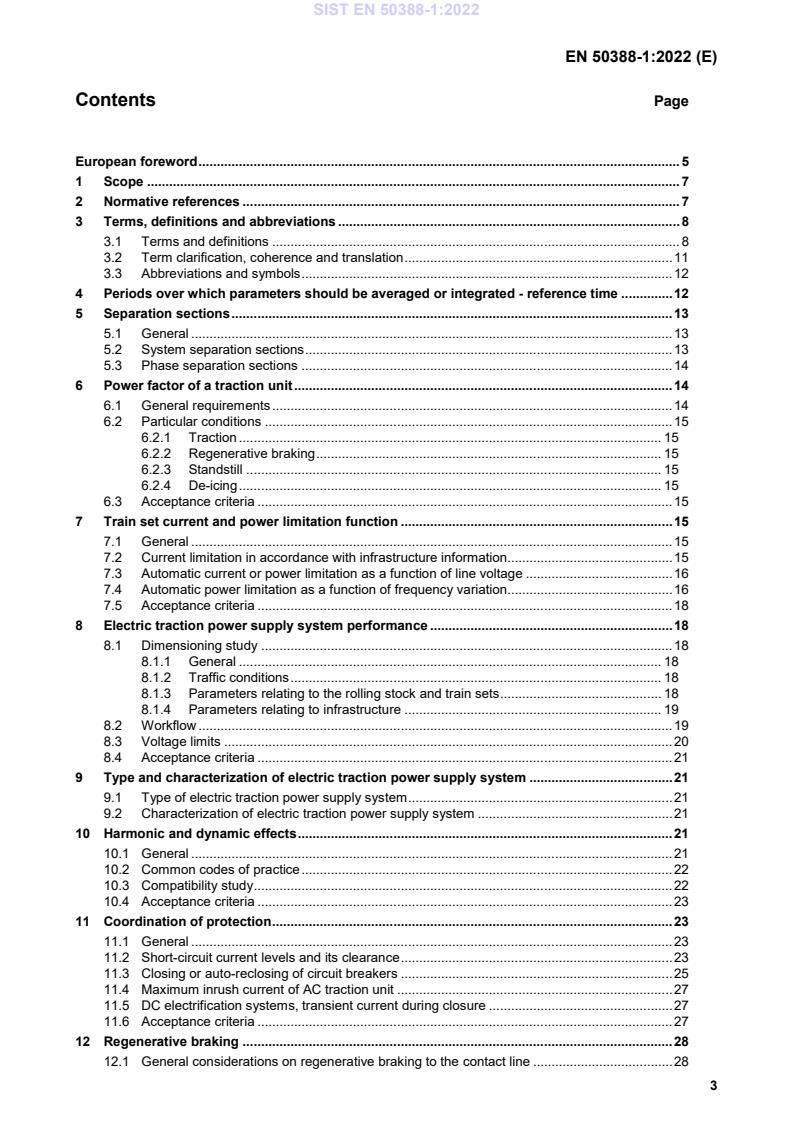
Contents Page
European foreword . 5
1 Scope . 7
2 Normative references . 7
3 Terms, definitions and abbreviations . 8
3.1 Terms and definitions . 8
3.2 Term clarification, coherence and translation . 11
3.3 Abbreviations and symbols . 12
4 Periods over which parameters should be averaged or integrated - reference time . 12
5 Separation sections . 13
5.1 General . 13
5.2 System separation sections . 13
5.3 Phase separation sections . 14
6 Power factor of a traction unit . 14
6.1 General requirements . 14
6.2 Particular conditions . 15
6.2.1 Traction . 15
6.2.2 Regenerative braking . 15
6.2.3 Standstill . 15
6.2.4 De-icing . 15
6.3 Acceptance criteria . 15
7 Train set current and power limitation function . 15
7.1 General . 15
7.2 Current limitation in accordance with infrastructure information. 15
7.3 Automatic current or power limitation as a function of line voltage . 16
7.4 Automatic power limitation as a function of frequency variation. 16
7.5 Acceptance criteria . 18
8 Electric traction power supply system performance . 18
8.1 Dimensioning study . 18
8.1.1 General . 18
8.1.2 Traffic conditions . 18
8.1.3 Parameters relating to the rolling stock and train sets . 18
8.1.4 Parameters relating to infrastructure . 19
8.2 Workflow . 19
8.3 Voltage limits . 20
8.4 Acceptance criteria . 21
9 Type and characterization of electric traction power supply system . 21
9.1 Type of electric traction power supply system . 21
9.2 Characterization of electric traction power supply system . 21
10 Harmonic and dynamic effects . 21
10.1 General . 21
10.2 Common codes of practice . 22
10.3 Compatibility study . 22
10.4 Acceptance criteria . 23
11 Coordination of protection . 23
11.1 General . 23
11.2 Short-circuit current levels and its clearance . 23
11.3 Closing or auto-reclosing of circuit breakers . 25
11.4 Maximum inrush current of AC traction unit . 27
11.5 DC electrification systems, transient current during closure . 27
11.6 Acceptance criteria . 27
12 Regenerative braking . 28
12.1 General considerations on regenerative braking to the contact line . 28
12.2 General conditions and requirements on the use of regenerative braking . 28
12.2.1 Traction unit . 28
12.2.2 Power supply system conditions . 29
12.3 Acceptance criteria . 29
13 Effects of DC operation on AC systems . 29
14 Tests . 30
15 Test methodology . 30
15.1 Separation sections . 30
15.1.1 Tests for traction unit . 30
15.1.2 Tests for infrastructure . 30
15.2 Power factor . 30
15.2.1 Tests for traction unit . 30
15.3 Train set current and power limitation . 30
15.3.1 Current or power limitation function of the train set as a function of register of
infrastructure information and function of line voltage - Tests for traction unit . 30
15.3.2 Power limitation as a function of line frequency - Tests for traction unit . 31
15.4 Requirements for performance of power supply - Tests for infrastructure . 31
15.5 Coordination of protection. 31
15.5.1 Short circuit current levels and its clearance . 31
15.5.2 Closing or auto-reclosing of circuit breakers. 32
15.5.3 Maximum inrush current of AC traction unit - Tests for traction unit . 32
15.5.4 DC traction units; transient current during closure - Tests for traction unit . 32
15.6 Regenerative braking . 32
15.6.1 Tests for traction unit . 32
15.6.2 Tests for Substation . 33
Annex A (informative) Integration periods over which parameters can be averaged . 34
A.1 General . 34
A.2 Reference time period over which values can be averaged or integrated . 34
Annex B (informative) Description, calculation and use of mean useful voltage . 35
B.1 General . 35
B.2 Description and methodology . 35
B.3 Selection criteria determining the voltage U at the pantograph . 36
pantograph
B.4 Values for Minimum Mean Useful Voltage at the pantograph . 37
B.5 Relation between U and U . 38
mean useful min1
B.6 Acceptance criteria . 38
B.7 Testing . 38
Annex C (informative) Sign convention of active and reactive power . 40
C.1 Sign convention . 40
C.2 description of power factor requirements . 43
Annex D (informative) Maximum allowable train set current . 44
Annex E (informative) Power limitation as a function of line frequency - 15 kV 16,7 Hz systems 46
Annex F (normative) Maximum traction current and power of a train set against voltage . 47
Annex G (informative) Use of regenerative braking . 49
Annex H (informative) Data related to the compatibility study of harmonics and dynamic effects
.......................................................................................................................................................... 50
H.1 Characterization of the electric traction system installations . 50
H.2 Characterization of the trains . 53
Annex I (normative) Compatibility study . 56
Annex J (normative) Special national conditions . 61
Annex ZZ (informative) Relationship between this European Standard and the Essential
Requirements of EU Directive 2016/797 aimed to be covered . 62
Bibliography . 64
European foreword
This document (EN 50388-1:2022) has been prepared by CLC/SC 9XC, “Electric supply and earthing systems
for public transport equipment and ancillary apparatus (Fixed installations)”, of Technical Committee
CLC/TC 9X, “Electrical and electronic applications for railways”. It also concerns the expertise of CLC/SC 9XB,
“Electromechanical material on board of rolling stock”.
The following dates are fixed:
• latest date by which this document has to be (dop) 2023-07-04
implemented at national level by publication of an
identical national standard or by endorsement
• latest date by which the national standards (dow) 2025-07-04
conflicting with this document have to
be withdrawn
This document supersedes EN 50388:2012 and all of its amendments and corrigenda (if any).
EN 50388−1:2022 includes the following significant technical changes with respect to EN 50388:2012:
• Clause 1: clarification of scope,
• Clause 2: set dated normative references, simplification,
• Clause 3: clarification of definition, renumbering, coherence among terms, addition of abbreviations,
withdrawal of terms not used anymore,
• Clause 4: clarification of applicability,
• Clause 5: new structure,
• Clause 6: new drafting taking into account the latest development of traction unit drives,
• Clause 7: new structure taking into account the latest development of traction unit and needs from
infrastructure traction power supply system. Addition of power limitation due to frequency variation,
• Clause 8: complete change, giving new parameters to evaluate the capability of the traction power supply
system to supply the trains, definition of new indices,
• Previous text of Clause 8 in new Annex B,
• Clause 9: distinction between the table on traction power supply systems and their characterization,
• Clause 10: new structure and text, reference to future EN 50388-2, description of compatibility study
process moved to Annex I,
• Clause 11: clarification on the use of this chapter, new information on the sequence of tripping among the
circuit breakers, new figure on reclosing sequences, new chapter on maximum inrush current of AC
traction unit,
• Clause 12: clarification and improvement, ex Table 8 in new Annex G, new condition for DC systems
• Clause 15: adaptation of the subclauses due to changes in Clauses 5 to 12
• Clause 15.4.1: new text, former Table 10 in Annex B,
• Annex A: improvement on values,
• Annex B, includes part of the previous Clause 8,
• Former Annex C will be located in part 2 of the EN 50388,
• New Annex C on sign convention, includes ex Annex E,
• New Annex D including ex Annex F, on maximum allowable train set current,
• New Annex E on power limitation as a function of line frequency,
• New Annex F on maximum traction and power of a train set against voltage, includes parts of ex Clause 7,
• New Annex G includes ex Table 8 on the use of regenerative braking,
• New Annex H includes former Annex D as long as part 2 of the EN 50388 is not issued,
• New Annex I includes former text from 10.3 on compatibility study
• New Annex J includes former Annex G
This version includes technical changes, clarifications without technical changes and best practises coming
from the use of the last version of the document.
Attention is drawn to the possibility that some of the elements of this document may be the subject of patent
rights. CENELEC shall not be held responsible for identifying any or all such patent rights.
This document has been prepared under a Standardization Request given to CENELEC by the European
Commission and the European Free Trade Association, and supports essential requirements of EU
Directive(s) / Regulation(s).
For relationship with EU Directive(s) / Regulation(s), see informative Annex ZZ, which is an integral part of this
document.
An additional part 2 is in preparation. In relation to assessment of harmonics and dynamic effects, this
document (Part 1) sets out the generic process in Clause 10, and a future part 2 of this standard will give
details and acceptance criteria related to known stability, harmonic phenomena and technologies.
EN 50388 “Railway applications – Fixed installations and rolling stock - Technical criteria for the coordination
between traction power supply and rolling stock to achieve interoperability” will consist of the following parts:
• EN 50388-1, General
• Future EN 50388-2, Stability and harmonics
Any feedback and questions on this document should be directed to the users’ national committee. A complete
listing of these bodies can be found on the CENELEC website.
1 Scope
This document establishes requirements for the electrical aspects to achieve technical compatibility between
rolling stock and electric traction systems, limited to:
— co-ordination of protection principles between power supply and traction units, i.e. separation sections,
train set current or power limitation, short circuit current discrimination, breaker coordination and use of
regenerative braking.
— co-ordination of installed power on the line and the power demand of trains, i.e. traction unit power factor,
train set current or power limitation, electric system performance, type and characterization.
— compatibility assessment relating to harmonics and dynamic effects.
Informative values are given for some parts of the existing European railway networks, in annexes.
NOTE For those railways within the scope of EU Interoperability Directive, definitive values are set out in the register
of infrastructure published in accordance with Article 49 of Directive (EU) 2016/797, and the list of items included in the
register is described in the commission decision (EU) 2019/777.
The following electric traction systems are within the scope of this document:
— railways;
— guided mass transport systems that are integrated with railways;
— material transport systems that are integrated with railways.
Information is given on electrification parameters to enable train operating companies to confirm, after
consultation with the rolling stock manufacturers, that risks of non-compatibility are minimized and that there
will be no consequential disturbance on the electrification system.
The interaction between pantograph and overhead contact line is dealt with in EN 50367:2020.
The interaction with the control-command and signalling subsystem is not dealt with in this document.
Basic considerations have been included concerning the use of accumulator trains.
2 Normative references
The following documents are referred to in the text in such a way that some or all of their content constitutes
requirements of this document. For dated references, only the edition cited applies. For undated references,
the latest edition of the referenced document (including any amendments) applies.
EN 50122-2:2010, Railway applications - Fixed installations - Electrical safety, earthing and the return circuit -
Part 2: Provisions against the effects of stray currents caused by d.c. traction systems
EN 50124-1:2017, Railway applications - Insulation coordination - Part 1: Basic requirements - Clearances
and creepage distances for all electrical and electronic equipment
EN 50163:2004, Railway applications - Supply voltages of traction systems (with Corrigenda in May 2010 and
January 2013)
IEC 60050-811:2017, International Electrotechnical Vocabulary (IEV) - Part 811: Electric traction
As impacted by EN 50163:2004/A1:2007, EN 50163:2004/AC:2013 and EN 50163:2004/Corrigendum May
2010.
3 Terms, definitions and abbreviations
3.1 Terms and definitions
For the purposes of this document, the terms and definitions given in IEC 60050-811:2017 and the following
apply.
ISO and IEC maintain terminological databases for use in standardization at the following addresses:
• ISO Online browsing platform: available at http://www.iso.org/obp
• IEC Electropedia: available at http://www.electropedia.org/
3.1.1
contact line
conductor system for supplying electric energy to vehicles through current-collecting equipment
[SOURCE: IEC 60050-811:2017, 811-33-01, modified - The Note 1 to entry has been removed.]
3.1.2
overhead contact line
contact line placed above the upper limit of the vehicle gauge and supplying vehicles with electric energy
through pantographs
[SOURCE: IEC 60050-811:2017, 811-33-02, modified - “Catenary” has been removed as synonym, “or beside”
has been removed, “roof mounted current collection equipment” has been replaced by “pantographs“.]
3.1.3
infrastructure manager
any body or undertaking that is responsible in particular for establishing and maintaining railway infrastructure
Note 1 to entry: This may also include the management of infrastructure control and safety systems. The functions of
the infrastructure manager on a network or part of a network may be allocated to different bodies or undertakings.
[SOURCE: Directive 2012/34/EU Article 3 (2) modified - only referring to part of the infrastructure.]
3.1.4
new element
new, rebuilt or modified traction-unit or power supply component (hardware or software) having a possible
influence on the harmonic or dynamic behaviour of the power supply system
Note 1 to entry: This new element can be integrated in an existing power supply network with traction units e.g. for fixed
installation:
• Transformer;
• HV cable;
• Filters;
• Converter.
Note 2 to entry: Depot areas are a combination of equipment listed in note 1 to entry associated with a large number of
traction units and therefore very prone to harmonic and dynamic effects.
Note 3 to entry: New means also introduction of an existing element on another infrastructure system: “new to this
infrastructure”.
Note 4 to entry: This concept will be addressed further in the future part 2 of this document.
3.1.5
normal operating conditions
conditions pertaining when traffic is operating to the design timetable and train formation used for power supply
fixed installation design
Note 1 to entry: Power supply equipment is operated in accordance with the system specification which is defined by the
infrastructure manager’s policy,
[SOURCE: EN 50163:2004, 3.16, modified – “traffic operating” has been replaced by “Conditions pertaining
when traffic is operating “, last sentence has been removed and the Note 1 to entry has been modified.]
3.1.6
displacement power factor cos φ
ratio of the active power of the fundamental component P to the apparent power of the fundamental
component S1 under periodic conditions
active power of the fundamental
cosϕ=
apparent power of the fundamental
Note 1 to entry: In this document, only the fundamental component is considered
3.1.7
register of infrastructure
for those railways within the scope of EU Interoperability Directive, register stating the values of the network
parameters of each subsystem or part of subsystem concerned, as set out in the relevant TSI
Note 1 to entry: The parameters are given for each section of line and those relevant to the electric traction system are set
out in the Energy subsystem entry.
Note 2 to entry: The register of infrastructure is published in accordance with Article 49 of Directive (EU) 2016/797, and
the list of items included in the register is described in the commission decision (EU) 2019/777.
[SOURCE: derived from Article 49 of Directive (EU) 2016/797]
3.1.8
rolling stock
all vehicles with or without motors
Note 1 to entry: Examples of vehicles include a locomotive, a coach and a wagon.
Note 2 to entry: Preferred German translation “Bahnfahrzeuge”, French translation “Matériel roulant”, other translations
given in IEV.
[SOURCE: IEC 60050-811:2017, 811-02-01, modified – The Note 2 to entry has been added.]
3.1.9
separation section
section of a contact line provided with a sectioning point at each end to prevent successive electrical sections,
differing in voltage amplitude, phase or frequency being connected together by the passage of current
collectors
Note 1 to entry: In other standards, IEV, EN 50367, the term “neutral” replaces “separation”.
3.1.10
substation,
installation, the main function of which is to supply a contact line system, at which the voltage of a primary
supply system, and in certain cases the frequency, is converted to the voltage and frequency of the contact
line
[SOURCE: IEC 60050-811:2017, 811-36-02, modified – The specific use “in electric traction” and the synonym
“substation” have been removed.] The definition has been modified and the Note 1 to entry has been removed.]
3.1.11
traction unit (TU)
locomotive, motor coach or train-unit
Note 1 to entry: German translation “Triebfahrzeugeinheit”, French translation “Unité motrice”, other translations given in
IEV.
[SOURCE: IEC 60050-811:2017, 811-02-04, modified – The Note 1 to entry has been added.]
3.1.12
train set
combination of vehicles coupled together, including banking locomotives
Note 1 to entry: German translation “Zugverband”, French translation “Train (composition)”.
3.1.13
maximum power at wheel
highest power derived from tractive effort vs speed diagram calculated for any type of train set
3.1.14
electric traction power supply system
railway electric distribution network used to provide energy for rolling stock
Note 1 to entry: The system includes
• contact line systems,
• return circuit of electric traction systems,
• running rails of non-electric traction systems, which are in the vicinity of, and conductively connected to the
running rails of an electric traction system,
• electric installations, which are supplied from contact lines either directly or via a transformer,
• electric installations in power plants and substations, which are utilized solely for generation and distribution
of power directly to the contact line,
• electric installations of switching stations.
[SOURCE: IEC 60050-811:2017, 811-36-21], modified – “power supply” has been added in the term
3.1.15
vehicle
any single item of rolling stock, e.g. a locomotive, a coach or a wagon
Note 1 to entry: German translation “Fahrzeug”, French translation “Véhicule”.
3.1.16
short-circuit current (I )
ss
prospective sustained current resulting from a short circuit due to a fault or an incorrect connection in an electric
circuit
Note 1 to entry: The term Iss relates to the short circuit performance characteristics for DC switchgear.
[SOURCE: EN 50123-1:2003, 3.2.12], modified – Note 1 to entry has been added
3.1.17
cut-off current (I )
cut-off
maximum instantaneous value of current attained during the breaking operation of a switching device
[SOURCE: EN 50123-1:2003, 3.2.14], modified – “(I )” has been added in the term
cut-off
3.1.18
inrush current
transient current associated with energizing of transformers, cables, reactors, etc
[SOURCE: IEC 60050-448:1995, 448-11-30]
3.2 Term clarification, coherence and translation
Due to inconsistency of definitions in the bibliography, the following statement in the Table 1, Figure 1, Figure 2
and following text should be considered.
Table 1 — Term coherence and translation
Subclause English term German term French term
3.1.15 Vehicle Fahrzeug Véhicule
3.1.8 Rolling stock Bahnfahrzeuge Matériel roulant
3.1.12 Train set Zugverband Train (composition)
3.1.11 Traction unit (TU) Triebfahrzeugeinheit Unité motrice
For information Train (train path) Zug (Zugfahrt) Train (circulation)
For information (motor) Train-unit Triebzug Automotrice
Key
Motor vehicles shown in solid grey.
Unpowered vehicles are shown in white.
Note: in the case of an EMU, motored axles are typically distributed throughout vehicles.
Figure 1 — Term clarification for Traction unit (TU) and Train set
Figure 2 — Term clarification for Train (train path)
NOTE A unit is a piece of rolling stock which is subject to the application of a TSI, and subject to ’EC’ verification. It
can be composed of several vehicles, as defined in Directive (EU) 2016/797, Article 2(3); considering the scope of a TSI,
the use of the term “vehicle” in a TSI is limited to the rolling stock subsystem.
3.3 Abbreviations and symbols
For the purposes of this document, the following abbreviations apply.
EC European Commission
EU European Union
ETCS European Train Control System
HV High Voltage
LRAS Load Reference-Arrow System
RMS. root mean square
RINF register of infrastructure
TSI Technical specification for interoperability
Umax2 highest non-permanent voltage defined in EN 50163:2004, 3.5
U highest permanent voltage defined in EN 50163:2004, 3.4
max1
Un nominal voltage defined in EN 50163:2004, 3.3
U lowest permanent voltage defined in EN 50163:2004, 3.7
min1
Umin2 lowest non-permanent voltage defined in EN 50163:2004, 3.8
v velocity
Other terms in the document are defined at the point of use within this document.
4 Periods over which parameters should be averaged or integrated - reference
time
Where train operators or infrastructure managers use various parameters for their dimensioning computations,
protection measures and planning, these are effective only if they are averaged over precisely defined time
spans. Guidance and recommendations on these time spans are given in Annex A (informative).
5 Separation sections
5.1 General
Separation sections shall allow train sets to move from one overhead contact line section to another without
bridging them by the pantograph(s). Train sets shall be designed to accommodate this.
NOTE 1: EN 50367:2020 describes the mechanical design of separation sections with allowed section lengths and
pantograph distances and connections.
Train sets shall pass a separation section by use of one of the following operational principles of train set
action:
1. No action required, i.e. pantograph(s) may remain raised and on-board circuit breaker may remain closed.
NOTE 2: No train set action can be used for sectioning points.
2. With pantograph(s) raised and touching the contact wire(s), but with traction power exchange to the
contact line brought to zero before entering the separation section.
NOTE 3: This solution to bring traction power exchange to zero is faster than opening the on-board circuit breaker
and is in many cases sufficient as auxiliary and no-load current from components can be negligible to create an arc.
The on-board circuit breaker can however be opened depending on train set design e.g., in order not to exceed
permissible voltage limits.
3. With pantograph(s) raised and touching the contact wire(s) and on-board circuit breaker opened before
entering the separation section.
4. With pantograph(s) lowered before entering the separation section and not touching the contact wire(s).
Power exchange to the contact line shall be brought to zero before lowering the pantograph(s).
For lines with speed
• v ≥ 250 [km/h] train set action shall be done automatically.
• v < 250 [km/h] train set action should be done automatically, otherwise it shall be done manually by
intervention of the driver.
The choice of principle of train set action for each separation section shall be made by the infrastructure
manager(s) and shall be set out in register of infrastructure. The train set’s driver shall be informed about
necessary manual action by adequate means (e.g. visual signs along the track) sufficiently before entering the
separation section.
NOTE 4 There might be other types of overhead contact line sections requiring train set actions, e.g. de-energised
sections due to insufficient insulation distance or sections where overhead contact line is not installed for use of train sets
with on-board energy storage. Such solutions are not yet standardized, but the requirements as for separation sections
may be applied as far as reasonable to facilitate interoperability.
5.2 System separation sections
System separation sections separate different types of electric traction power supply systems.
Train set action (automatic or manual, for train sets designed for several power supply systems) additionally
include choosing correct pantograph and electric circuits for the actual type of electric traction power supply
system.
System separation section shall have provisions to avoid bridging of the adjacent systems if the train set action
fails, e.g. a neutral zone connected to rail.
5.3 Phase separation sections
Phase separation sections separate feeding sections with different voltage amplitude or phase within the same
type of electric traction power supply system.
If train set action is required, the principle of passing with raised pantographs are preferred. It depends mainly
on the distribution of pantographs on the train set. Principle of lowering pantograph may be used under
particular circumstances.
Other designs of phase separation sections that allow train sets to pass a sectioning point whilst taking power
from the contact line (e.g. automatically switched sections or “change over sections”), are subject to future
development. In this case, reliability and compatibility parameters shall be agreed between the parties involved.
6 Power factor of a traction unit
6.1 General requirements
The total power factor of a traction unit influences the power supply system performance, i.e. voltage profile,
power feeding (active and reactive) and transfer capacity, energy losses, system stability and reliability of
protection relays.
Where a train set comprises multiple traction units, if the requirements of each single traction unit are fulfilled,
then they are considered to be fulfilled for the train set.
The displacement factor is measured at the pantograph.
The total power factor is composed of the following two elements:
• The displacement power factor and
• The total harmonic distortion caused by load current or source current harmonics.
No requirement on total harmonic distortion is given in this document.
NOTE 1 Requirements on overvoltages caused by harmonics are given in Clause 10 and in the future EN 50388-2.
More specifically the requirements below do not apply to traction units in AC systems in short term conditions
(e.g. < 2 s) and transformer inrush.
NOTE 2 Infrastructure managers can impose economic conditions and/or operational restrictions or power limiting
conditions to existing traction units not fulfilling the requirements of Clause 6.
The requirements apply only to traction units and therefore do not apply to separate loads such as carriages
and wagons which are supplied by traction units.
NOTE 3 For carriages/wagons, see CEN/TS 50535:2010, 6.1.
NOTE 4 Informative Annex C gives only sign convention on active and reactive power.
In the ideal situation the displacement power factor of a traction unit is 1. In practice, the following applies to
each traction unit, except as set out in 6.2:
• The displacement power factor shall be 0,95 or greater, e.g. taking into account control accuracy at high
power.
• A reactive power (inductive or capacitive) of 3 % of the maximum power at wheel at nominal voltage Un
shall be allowed e.g. taking into account control accuracy at low power and all passive components within
the traction unit (e.g. filters, cables) whatever the operating mode (traction, regenerative, standstill).
• For line voltages exceeding Umax1 the capacitive reactive power per traction unit shall not exceed the
following limits in all operation modes:
• 60 kVAr at Umax1 for 15 kV, 16,7 Hz system;
• 190 kVAr at Umax1 for 25 kV, 50 Hz system
NOTE 5 These values represent a compromise for both power supply system and traction units.
• The requirements of displacement power factor in particular conditions are given in 6.2.
6.2 Particular conditions
6.2.1 Traction
For line voltages below 1,1 Un, displacement power factor may be capacitive between 1 and 0,95 in order to
support the line voltage in weak feeding conditions. Lower capacitive values may be used provided that voltage
stability is maintained.
For line voltages above Umax1 the displacement power factor may decrease freely but shall remain inductive.
This keeps the line voltage within limits as defined in EN 50163:2004.
In order to allow different traction unit internal supply strategies (e.g. diode rectifying) for power less than 15 %
of maximum power at wheel, the displacement power factor may decrease to 0,8 (inductive).
6.2.2 Regenerative braking
The displacement power factor may be inductive and decrease freely in the range of 1,1 U and U in order
n max2
to keep voltage within limits as defined in EN 50163:2004. It facilitates regenerative braking as far as stability
is still maintained.
The displacement power factor shall not be capacitive in order not to reduce the reliable operation of the
protection relays.
6.2.3 Standstill
In order to allow different traction unit internal supply strategies (e.g. diode rectifying) for power less than 15 %
of maximum power at wheel, the displacement power factor may decrease to 0,8 (inductive).
6.2.4 De-icing
Where current is drawn solely for the purpose of de-icing of the contact wire using reactive power, the
displacement power factor may be inductive without limitation.
To avoid damage on the contact wire during de-icing at standstill the current shall be limited. References can
be made to EN 50367.
6.3 Acceptance criteria
The displacement power factor is acceptable if the requirements given in 6.1 and 6.2 are fulfilled.
7 Train set current and power limitation function
7.1 General
This Clause 7 considers maximum current or power exchange between electric traction power supply system
and the train set through the pantograph(s). Charging current or power to on-board energy storage systems,
e.g. rechargeable batteries, for traction purposes are included in the mentioned traction current or power.
7.2 Current limitation in accordance with infrastructure information
The maximum current is the total current of traction, auxiliary and energy storage system if any.
In order to avoid any adverse effects on the electric traction power supply system due to permanent or
temporary current overload and/or allow the train s
...
Questions, Comments and Discussion
Ask us and Technical Secretary will try to provide an answer. You can facilitate discussion about the standard in here.
Loading comments...