


SIST EN 455-3:2024
(Main)Medical gloves for single use - Part 3: Requirements and testing for biological evaluation
Medical gloves for single use - Part 3: Requirements and testing for biological evaluation
This part of EN 455 specifies requirements for the evaluation of biological safety for medical gloves for single use. It gives requirements for labelling and the disclosure of information relevant to the test methods used.
Medizinische Handschuhe zum einmaligen Gebrauch - Teil 3: Anforderungen und Prüfung für die biologische Bewertung
Dieser Teil von EN 455 legt Anforderungen für die Bewertung der biologischen Sicherheit von medizinischen Handschuhen zum einmaligen Gebrauch fest. Er enthält Anforderungen an die Kennzeichnung und die Informationsangaben entsprechend den angewendeten Prüfverfahren.
Gants médicaux non réutilisables - Partie 3 : Exigences et essais pour évaluation biologique
La présente partie de l’EN 455 spécifie les exigences permettant d’évaluer la sécurité biologique des gants médicaux non réutilisables. Elle mentionne les exigences d’étiquetage des gants et de diffusion des informations concernant les méthodes d’essai utilisées.
Medicinske rokavice za enkratno uporabo - 3. del: Zahteve in preskušanje za biološko ovrednotenje
Ta del standarda EN 455 določa zahteve za ovrednotenje biološke varnosti medicinskih rokavic za
enkratno uporabo. Določa zahteve za označevanje in razkrivanje informacij, ki so pomembne za uporabljene preskusne metode.
General Information
- Status
- Published
- Public Enquiry End Date
- 17-May-2022
- Publication Date
- 08-Feb-2024
- Technical Committee
- VAZ - Healthcare
- Current Stage
- 6060 - National Implementation/Publication (Adopted Project)
- Start Date
- 24-Jan-2024
- Due Date
- 30-Mar-2024
- Completion Date
- 09-Feb-2024
Relations
- Effective Date
- 01-Mar-2024
- Effective Date
- 05-Jun-2024
Overview
EN 455-3:2023 - "Medical gloves for single use - Part 3: Requirements and testing for biological evaluation" (CEN) defines biological safety requirements and test methods for single‑use medical gloves. The standard sets out how manufacturers, test laboratories and regulators should evaluate biological risks associated with gloves (natural rubber latex and synthetic materials), and requires labelling and disclosure of information relevant to the biological test methods used.
Key topics and technical requirements
- Scope and purpose: Evaluation of biological safety for single‑use medical gloves and required information disclosure for testing.
- Biological hazards addressed: proteins and natural rubber latex allergens, endotoxins (pyrogens), residual chemicals and leachables, and issues specific to powder‑free gloves.
- Labelling and information: mandatory labelling elements and disclosure of test method details so users and regulators can assess biological safety claims.
- Test methods and reporting:
- Endotoxin testing procedures and reporting requirements.
- Powder measurement methods for powdered gloves.
- Determination of aqueous extractable proteins - normative Annex A specifies a modified Lowry assay procedure for natural rubber gloves.
- Informative Annex B covers immunological methods for measuring natural rubber latex allergens.
- Informative Annex C describes Amino Acid Analysis (AAA) by HPLC for protein determination.
- Clause 6 defines the test report content to ensure traceable, consistent results.
- Harmonization and compliance: alignment with EU Medical Device Regulation (MDR) requirements is addressed in Annex ZA; EN 455-3:2023 replaces EN 455-3:2015.
Practical applications - who uses EN 455-3:2023
- Glove manufacturers - to design, test and document biological safety and prepare compliant labelling and technical files.
- Independent testing laboratories - to perform standardized assays (endotoxins, extractable proteins, allergen analyses) and produce EN‑compliant test reports.
- Regulatory and conformity bodies / Notified bodies - to assess glove safety evidence and conformity with EU MDR and national requirements.
- Procurement officers and healthcare providers - to understand biological safety claims and compare glove products on documented test results.
- R&D and quality assurance teams - to guide formulation changes (e.g., powder‑free processing) and evaluate potential immunological or pyrogenic risks.
Related standards
- EN 455 series (other parts):
- Part 1: freedom from holes
- Part 2: physical properties
- Part 4: shelf life determination
- (Part 5 on extractable chemical residues under development)
- ISO 10993 (biological evaluation of medical devices) - EN 455-3 provides glove‑specific detail complementary to ISO 10993.
Keywords: EN 455-3:2023, medical gloves biological evaluation, single-use gloves, endotoxins, extractable proteins, latex allergens, Lowry assay, HPLC AAA, glove testing, medical device regulation.



Frequently Asked Questions
SIST EN 455-3:2024 is a standard published by the Slovenian Institute for Standardization (SIST). Its full title is "Medical gloves for single use - Part 3: Requirements and testing for biological evaluation". This standard covers: This part of EN 455 specifies requirements for the evaluation of biological safety for medical gloves for single use. It gives requirements for labelling and the disclosure of information relevant to the test methods used.
This part of EN 455 specifies requirements for the evaluation of biological safety for medical gloves for single use. It gives requirements for labelling and the disclosure of information relevant to the test methods used.
SIST EN 455-3:2024 is classified under the following ICS (International Classification for Standards) categories: 11.140 - Hospital equipment. The ICS classification helps identify the subject area and facilitates finding related standards.
SIST EN 455-3:2024 has the following relationships with other standards: It is inter standard links to SIST EN 455-3:2015, SIST EN 455-3:2024/oprA1:2025. Understanding these relationships helps ensure you are using the most current and applicable version of the standard.
SIST EN 455-3:2024 is associated with the following European legislation: EU Directives/Regulations: 2017/745, EUR-PUB; Standardization Mandates: M/565, M/575, M/575 AMD 2. When a standard is cited in the Official Journal of the European Union, products manufactured in conformity with it benefit from a presumption of conformity with the essential requirements of the corresponding EU directive or regulation.
SIST EN 455-3:2024 is available in PDF format for immediate download after purchase. The document can be added to your cart and obtained through the secure checkout process. Digital delivery ensures instant access to the complete standard document.
Standards Content (Sample)
SLOVENSKI STANDARD
01-marec-2024
Nadomešča:
SIST EN 455-3:2015
Medicinske rokavice za enkratno uporabo - 3. del: Zahteve in preskušanje za
biološko ovrednotenje
Medical gloves for single use - Part 3: Requirements and testing for biological evaluation
Medizinische Handschuhe zum einmaligen Gebrauch - Teil 3: Anforderungen und
Prüfung für die biologische Bewertung
Gants médicaux non réutilisables - Partie 3 : Exigences et essais pour évaluation
biologique
Ta slovenski standard je istoveten z: EN 455-3:2023
ICS:
11.140 Oprema bolnišnic Hospital equipment
2003-01.Slovenski inštitut za standardizacijo. Razmnoževanje celote ali delov tega standarda ni dovoljeno.
EN 455-3
EUROPEAN STANDARD
NORME EUROPÉENNE
November 2023
EUROPÄISCHE NORM
ICS 11.140 Supersedes EN 455-3:2015
English Version
Medical gloves for single use - Part 3: Requirements and
testing for biological evaluation
Gants médicaux non réutilisables - Partie 3 : Exigences Medizinische Handschuhe zum einmaligen Gebrauch -
et essais pour évaluation biologique Teil 3: Anforderungen und Prüfung für die biologische
Bewertung
This European Standard was approved by CEN on 29 October 2023.
CEN members are bound to comply with the CEN/CENELEC Internal Regulations which stipulate the conditions for giving this
European Standard the status of a national standard without any alteration. Up-to-date lists and bibliographical references
concerning such national standards may be obtained on application to the CEN-CENELEC Management Centre or to any CEN
member.
This European Standard exists in three official versions (English, French, German). A version in any other language made by
translation under the responsibility of a CEN member into its own language and notified to the CEN-CENELEC Management
Centre has the same status as the official versions.
CEN members are the national standards bodies of Austria, Belgium, Bulgaria, Croatia, Cyprus, Czech Republic, Denmark, Estonia,
Finland, France, Germany, Greece, Hungary, Iceland, Ireland, Italy, Latvia, Lithuania, Luxembourg, Malta, Netherlands, Norway,
Poland, Portugal, Republic of North Macedonia, Romania, Serbia, Slovakia, Slovenia, Spain, Sweden, Switzerland, Türkiye and
United Kingdom.
EUROPEAN COMMITTEE FOR STANDARDIZATION
COMITÉ EUROPÉEN DE NORMALISATION
EUROPÄISCHES KOMITEE FÜR NORMUNG
CEN-CENELEC Management Centre: Rue de la Science 23, B-1040 Brussels
© 2023 CEN All rights of exploitation in any form and by any means reserved Ref. No. EN 455-3:2023 E
worldwide for CEN national Members.
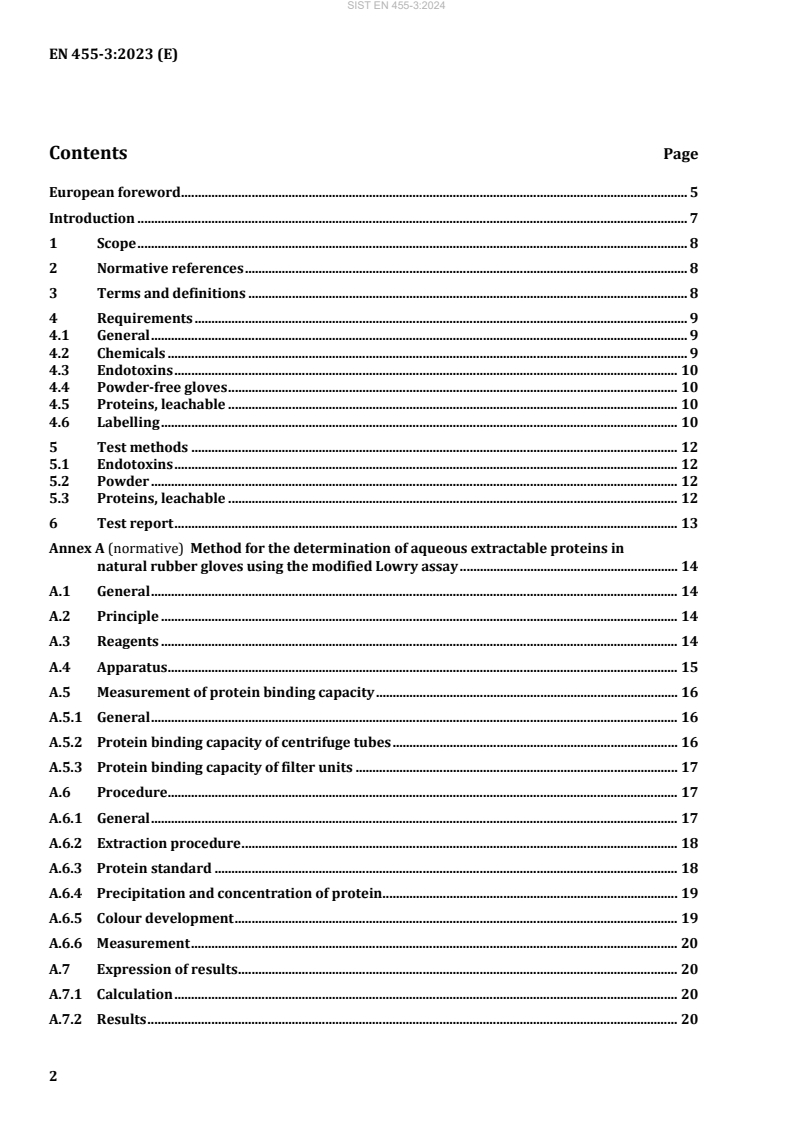
Contents Page
European foreword . 5
Introduction . 7
1 Scope . 8
2 Normative references . 8
3 Terms and definitions . 8
4 Requirements . 9
4.1 General . 9
4.2 Chemicals . 9
4.3 Endotoxins . 10
4.4 Powder-free gloves . 10
4.5 Proteins, leachable . 10
4.6 Labelling . 10
5 Test methods . 12
5.1 Endotoxins . 12
5.2 Powder . 12
5.3 Proteins, leachable . 12
6 Test report . 13
Annex A (normative) Method for the determination of aqueous extractable proteins in
natural rubber gloves using the modified Lowry assay . 14
A.1 General . 14
A.2 Principle . 14
A.3 Reagents . 14
A.4 Apparatus . 15
A.5 Measurement of protein binding capacity . 16
A.5.1 General . 16
A.5.2 Protein binding capacity of centrifuge tubes . 16
A.5.3 Protein binding capacity of filter units . 17
A.6 Procedure. 17
A.6.1 General . 17
A.6.2 Extraction procedure . 18
A.6.3 Protein standard . 18
A.6.4 Precipitation and concentration of protein . 19
A.6.5 Colour development . 19
A.6.6 Measurement . 20
A.7 Expression of results . 20
A.7.1 Calculation . 20
A.7.2 Results . 20
A.7.3 Statistical information . 22
A.8 References . 23
Annex B (informative) Immunological methods for the measurements of natural rubber
latex allergens . 24
B.1 General . 24
B.2 Natural rubber latex allergens in manufactured rubber products . 24
B.3 Methods for measuring natural rubber latex allergens . 25
B.3.1 Qualitative methods . 25
B.3.2 Semiquantitative methods . 25
B.3.3 Specific quantitative methods . 26
B.4 Conclusion . 27
B.5 References . 27
Annex C (informative) Amino acid analysis (AAA) by high pressure liquid chromatography
(HPLC) . 30
C.1 Background . 30
C.2 Principles of the determination of proteins by HPLC . 30
C.3 Material . 30
C.4 Buffers and solutions . 31
C.4.1 Norvalin-100 . 31
C.4.2 Norvalin-1 . 31
C.4.3 o-Phthaldialdehyde (OPA). 31
C.4.4 Boratebuffer . 31
C.4.5 Stop-solution . 32
C.4.6 Phosphate buffer . 32
C.4.7 Solvent 1 . 32
C.4.8 Solvent 2 . 32
C.4.9 Sodium carbonate solution (0,1 M) . 32
C.5 Hydrolysis. 32
C.5.1 Samples . 32
C.5.2 Standards . 32
C.5.3 Incubation (hydrolysis) . 32
C.5.4 Free amino acids . 32
C.6 Analysis (HPLC) . 32
C.6.1 Sample preparation . 32
C.6.2 Derivatisation . 33
C.6.3 HPLC . 33
C.6.4 Calculation. 33
C.7 Examples . 33
C.7.1 Standard . 33
C.7.2 Glove extract . 34
C.8 Advantages and disadvantages of the HPLC method . 34
C.8.1 Advantages . 34
C.8.2 Disadvantages . 34
C.9 References . 37
Annex ZA (informative) Relationship between this European standard and General Safety
and Performance Requirements of Regulation (EU) 2017/745 aimed to be covered . 39
Bibliography . 42
European foreword
This document (EN 455-3:2023) has been prepared by Technical Committee CEN/TC 205 “Non-active
medical devices”, the secretariat of which is held by DIN.
This European Standard shall be given the status of a national standard, either by publication of an
identical text or by endorsement, at the latest by May 2024, and conflicting national standards shall be
withdrawn at the latest by November 2025.
Attention is drawn to the possibility that some of the elements of this document may be the subject of
patent rights. CEN shall not be held responsible for identifying any or all such patent rights.
This document supersedes EN 455-3:2015.
Compared to the previous edition EN 455-3:2015 the following main changes have been introduced:
a) update of Clause 3 'Terms and definitions';
b) update of Clause 4 'Requirements' especially in regard of the subclauses 'Chemicals', 'Endotoxins'
and 'Labelling';
c) clarification of 5.3, NOTE 2
d) update of Clause 6 'Test report'
e) alignment of Annex ZA to the MDR;
f) complete editorial revision.
EN 455 consists of the following parts under the general title “Medical gloves for single use”:
— Part 1: Requirements and testing for freedom from holes;
— Part 2: Requirements and testing for physical properties;
— Part 3: Requirements and testing for biological evaluation;
— Part 4: Requirements and testing for shelf life determination.
The following part is under development:
— Part 5: Extractable chemical residues.
This document has been prepared under a standardization request addressed to CEN by the European
Commission. The Standing Committee of the EFTA States subsequently approves these requests for its
Member States.
For the relationship with EU Legislation, see informative Annex ZA, which is an integral part of this
document.
Any feedback and questions on this document should be directed to the users’ national standards body.
A complete listing of these bodies can be found on the CEN website.
According to the CEN-CENELEC Internal Regulations, the national standards organisations of the
following countries are bound to implement this European Standard: Austria, Belgium, Bulgaria, Croatia,
Cyprus, Czech Republic, Denmark, Estonia, Finland, France, Germany, Greece, Hungary, Iceland, Ireland,
Italy, Latvia, Lithuania, Luxembourg, Malta, Netherlands, Norway, Poland, Portugal, Republic of North
Macedonia, Romania, Serbia, Slovakia, Slovenia, Spain, Sweden, Switzerland, Türkiye and the United
Kingdom.
Introduction
Adverse reactions to proteins in latex products have been reported over several years in variable rates
of prevalence. Additionally, adverse reactions due to chemicals, lubricants, sterilization residues,
pyrogens or other residues are described in the scientific literature. Adverse reactions are most often
reported due to gloves made from natural rubber latex, but some of the reactions can also be seen due to
gloves made from synthetic polymers.
EN ISO 10993 specifies requirements and test methods for biological evaluation of medical devices.
However, it does not specifically address adverse reactions that can result from the use of medical gloves
(e.g. immediate type allergies). These adverse reactions occur to specific allergens that can be present in
gloves. Several factors contribute to the risk of reaction:
a) the duration and frequency of skin contact with gloves;
b) the exposure to the allergens through direct contact to mucosa and skin (especially when not intact)
and by inhalation of particles;
c) the occlusive nature of the glove/skin interaction during glove use.
This part of EN 455 gives requirements and test methods for evaluation of the biological safety of medical
gloves as part of a risk management process, in accordance with EN ISO 10993.
Users and choosers who are looking for guidance for selection, storage and use of medical gloves for
single use are referred to CEN/TR 16953:2017.
1 Scope
This part of EN 455 specifies requirements for the evaluation of biological safety for medical gloves for
single use. It gives requirements for labelling and the disclosure of information relevant to the test
methods used.
2 Normative references
The following documents are referred to in the text in such a way that some or all of their content
constitutes requirements of this document. For dated references, only the edition cited applies. For
undated references, the latest edition of the referenced document (including any amendments) applies.
EN ISO 10993-1:2020, Biological evaluation of medical devices — Part 1: Evaluation and testing within a
risk management process (ISO 10993-1:2018, including corrected version 2018-10)
EN ISO 15223-1:2021, Medical devices — Symbols to be used with information to be supplied by the
manufacturer — Part 1: General requirements (ISO 15223-1:2021)
EN ISO 21171:2006, Medical gloves — Determination of removable surface powder (ISO 21171:2006)
th
European Pharmacopoeia, 10 edition, General chapter 2.6.14 Bacterial Endotoxins: publisher EDQM -
Council of Europe; 7 allée Kastner, CS 30026, F-67081 Strasbourg; France http://www.edqm.eu/
3 Terms and definitions
For the purposes of this document, the following terms and definitions apply.
ISO and IEC maintain terminological databases for use in standardization at the following addresses:
— ISO Online browsing platform: available at https://www.iso.org/obp
— IEC Electropedia: available at https://www.electropedia.org/
3.1
endotoxin
lipo-polysaccharide originating from the outer cell-membrane of Gram-negative bacteria
Note 1 to entry: Endotoxins are one type of pyrogen. Sources of endotoxins can include bacterial contamination
of the raw materials, especially the process water used during manufacturing and manual handling of the gloves,
and can be present on gloves post sterilisation.
3.2
pouch
peel pack
package for aseptic presentation of a single glove or pairs of gloves
3.3
dispenser pack
package, intended for distribution to a consumer, containing loose gloves or peel packs
3.4
powder
all water insoluble material on the surface of a glove that is removed by washing under the conditions of
the test
[SOURCE: EN ISO 21171:2006, 3.1]
Note 1 to entry: This includes both deliberately added powder and other processing aids or materials
accidentally present which may be readily detached from the surface of the glove. For the purpose of this document
any glove containing 2 mg or less powder is a powder-free glove and more than 2 mg is a powdered glove (for
requirement see 4.4).
3.5
process limit
highest value likely to be encountered for a validated manufacturing process
3.6
proteins, allergenic
proteins capable of causing a type I allergic reaction
3.7
proteins, leachable
aqueous proteins and peptides extractable from the final product
3.8
pyrogen
substance creating fever in rabbits which can be related to fever and other adverse reactions in humans
4 Requirements
4.1 General
Medical gloves shall be compliant with EN ISO 10993-1:2020.
4.2 Chemicals
Chemicals which are relevant in accordance with the scope of this document are substances added or
formed during any step of the manufacturing process or in storage which may be available in the final
product.
These can include lubricants, chemical coatings and sterilizing agents. Several chemical ingredients are
commonly used during processing of gloves, some of them are known to cause type IV allergic reactions.
The type and amount of residual chemicals added and finally present are variable.
Gloves shall not be dressed with talcum powder (magnesium silicate).
A list of chemical ingredients either added during manufacturing or already known to be present in the
product such as accelerators, antioxidants and biocides which are known to cause adverse health effects
based on current data shall be made available from the manufacturer.
NOTE An example of ingredients which can cause adverse health effects are Type IV allergens.
The absence of a substance shall only be declared if the substance is not used in any part of the
manufacturing process. No compounds shall be used in the manufacture of the product, which are known
to form a substance that is subject of such a declaration.
4.3 Endotoxins
If sterile gloves are to be labelled as “low endotoxin gloves”, they shall be tested using the test method
specified in 5.1. For such labelled gloves the endotoxin content shall not exceed the limit of 20 endotoxin
units per pair of gloves.
NOTE Some healthcare procedures are particularly sensitive to the presence of endotoxin, and therefore it is
necessary to minimise endotoxin levels to mitigate the clinical risk. For example, it is important to avoid endotoxin
biocontamination during procedures relating to the Central Nervous System [1] and during orthopaedic
implantation [2]. For such procedures, users can choose to wash gloves according to protocols that ensure
endotoxin removal, or to use a ‘low endotoxin’ glove which complies with the requirements of 4.3.
4.4 Powder-free gloves
For powder-free gloves the total quantity of powder residues determined according to the test method
under 5.2 shall not exceed 2 mg per glove. Any glove containing more than 2 mg powder is a powdered
glove.
NOTE 1 The use of powder-free gloves is strongly recommended; numerous adverse health effects of glove
donning powder have been described in the literature [2-14]. Several countries have banned the use of powdered
gloves, including: United States of America [15], Japan [16], Philippines [17], Saudi Arabia [18], Bahrain [19],
Thailand, Hong Kong, Taiwan, Korea.
NOTE 2 There is no agreement amongst experts on the maximum amount of powder which can be present on a
powdered medical glove, nor the need to specify an upper limit. Sterile medical gloves are required to be washed to
remove donning powder before commencing invasive procedures, see 4.6 f).
4.5 Proteins, leachable
The manufacturing process shall aim to minimize the leachable protein level.
The leachable protein content in the finished gloves containing natural rubber latex shall be monitored
by the method specified in 5.3 and described in Annex A and it shall be ensured that the process limit is
not exceeded. The documentation of these results shall be retained. The results of the test and applied
test method shall be made available on request.
NOTE 1 This document specifies a method of measuring a broad approximation for the allergen content, i.e.
leachable proteins. Quantitative methods to measure allergenic proteins are described in Annex B.
NOTE 2 It is not possible to specify a safe maximum level of protein because not all proteins are allergenic
(allergenicity can depend on the structural orientation of the protein molecule - the so called ‘epitope’). However,
the peer reviewed literature supports the view that minimising leachable protein levels mitigates the risk of latex
allergy [20].
4.6 Labelling
In addition to the relevant symbols given in EN ISO 15223-1:2021, the following requirements apply:
a) medical gloves shall be labelled for single use on one individual during a single procedure.
NOTE 1 This is in accordance with the Regulation (EU) 2017/745.
For any medical glove the product labelling shall not include any term suggesting disinfection,
reprocessing or re-use;
b) for any medical glove where chemical ingredients such as accelerators, antioxidants and biocides are
either added during manufacturing or already known to be present in the product, and there is a
residual risk of causing Type IV allergy, the labelling on at least the dispenser pack shall include the
following or equivalent warning statement "Contains potential Type IV chemical allergens." or the
symbol in Figure 1;
Figure 1 — Symbol "Contains or presence of Type IV allergen" (derived from ISO 7000 – 2725)
c) for any medical glove where chemical ingredients such as accelerators, antioxidants and biocides are
either added during manufacturing or already known to be present in the product, and which are
known to cause Type IV allergy, the product labelling shall not include:
— any term suggesting relative safety, such as low allergenicity, hypoallergenicity or low or
reduced content of Type IV allergens;
— any unjustified indication or misleading claims of the absence or presence of allergens;
d) medical gloves containing natural rubber latex shall be labelled on the packaging of at least the pouch
with the EN ISO 15223-1:2021 symbol for latex (reference number 5.4.5).
The labelling shall include the following or equivalent warning statement together with the symbol
“(Product) contains natural rubber latex which may cause allergic reactions, including anaphylactic
responses.”;
e) the labelling shall state whether the glove is powdered or powder-free;
f) sterile powdered gloves shall be labelled with the following or equivalent:
'CAUTION: Surface powder shall be removed aseptically prior to undertaking operative procedures
in order to minimize the risk of adverse tissue reactions';
NOTE 2 This caution statement can be given on the inner wrapping.
g) for any medical glove containing natural rubber latex the product labelling shall not include:
— any term suggesting relative safety, such as low allergenicity, hypoallergenicity or low protein;
— any unjustified indication of the presence of allergens;
h) if the manufacturer labels the gloves with the protein content, the process limit, measured as
specified in 5.3 shall be given.
This does not allow a protein labelling claim below 50 µg/g. Lower claims are not considered to be
reliable given the expected process variation in manufacture and inter-laboratory testing.
5 Test methods
5.1 Endotoxins
Except where non-removable interferences in the Limulus Amoebocyte Lysate (LAL) procedures are
present, selection, validation and use of technique shall be as described in the European Pharmacopoeia,
Monograph 2.6.14, “Bacterial Endotoxins”. The results shall be expressed in endotoxin units (EU) per pair
of gloves.
NOTE 1 Where non-removable interferences in the LAL procedure are present, the bacterial endotoxin level
cannot be accurately measured.
The minimum number of pairs of gloves recommended to be tested in relation to the number of items in
the batch are two pairs of gloves for a batch size under thirty, three pairs of gloves for a batch size thirty
to one hundred, and 3 % of a batch above size one hundred, up to a maximum of ten pairs of gloves per
batch.
The outside surface of a pair of gloves is extracted with 40 ml of endotoxin-free water (Water LAL,
European Pharmacopoeia) for not less than 40 min and not more than 60 min at a temperature between
37 °C and 40 °C in a way to ensure that all surfaces come into contact with the extraction medium. The
extract is centrifuged, if necessary, for 15 min at 2 000 g to remove particles after which the liquid
component is decanted and tested for endotoxin immediately afterwards.
NOTE 2 Other methods for the analysis of endotoxins exist and these can be used for routine quality control
purposes provided they have been validated and a correlation established against the reference method specified
in this document.
5.2 Powder
The test method for the determination of powder residues described in EN ISO 21171:2006, Clauses 7
and 9 shall be used.
5.3 Proteins, leachable
The test method for the analytical determination of leachable protein shall be the modified Lowry method
given in Annex A or a suitably validated method which has been correlated against the modified Lowry
method.
NOTE 1 An example of a validated analytical method is given in Annex C.
NOTE 2 The immunological methods in Annex B are currently not validated against the modified Lowry method
and are not necessarily correlated to clinical response data.
6 Test report
The test report shall include at least the following information:
a) reference to EN 455-3:2023;
b) the type of gloves (examination / procedure or surgical), whether powdered or powder-free, the
material (e.g. nitrile, NR latex) and the manufacturing batch code;
c) the name and address of the manufacturer or distributor and of the test laboratory, if different;
d) the date of the testing performed;
e) the description of the test method applied (including any deviation of the test procedure and any
unusual features observed);
f) the test results.
Annex A
(normative)
Method for the determination of aqueous extractable proteins
in natural rubber gloves using the modified Lowry assay
A.1 General
This method is for the determination of the amount of aqueous extractable proteins in gloves for medical
use made from natural rubber (NR). It has been validated during inter-laboratory tests. The lower
quantification limit is approximately 10 μg protein per g of glove (i.e. 2 μg protein per ml of extract)
depending on the glove weight.
Chemicals such as surfactants, accelerators and antioxidants added to the NR latex during the
manufacture of the gloves can interfere with the colour development during the determination. Some
materials may reduce colour development while others can increase it. If the test method yields results
that appear erroneous due to interferants, then any validated amino acid analysis method can be used
(as an example see the method given in Annex C).
Persons using this method should be familiar with normal laboratory practice.
NOTE This method does not purport to address all of the safety problems, if any, associated with its use. It is
the responsibility of the user to establish appropriate safety and health practices and to ensure compliance with
any national regulatory conditions.
A.2 Principle
Water soluble proteins are extracted into a buffer solution and then precipitated with acids in the
presence of sodium deoxycholate to concentrate them and to separate them from water soluble
substances which may interfere with the determination. The precipitated proteins are re-dissolved in
alkali and quantified colourimetrically by a modified Lowry method. The assay is based on the reaction
of proteins with copper and Folin reagent in an alkaline medium to give a characteristic blue colour.
Spectrophotometric measurements are performed at a fixed wavelength in the range 600 nm to 750 nm.
A.3 Reagents
A.3.1 General
Wherever water is called for, double distilled water or water of equivalent quality should be used. All
other reagents should be of analytical quality.
A.3.2 Extractant
A.3.2.1 N-tris-[Hydroxymethyl]-methyl-2-aminoethanesulfonic acid (TES), hemisodium salt.
A.3.2.2 Extraction buffer, 0,1 mol/l, prepared by dissolving 24 g TES (A.3.2.1) in 1 l water. Any
equivalent buffering system can be used provided the solution has sufficient buffering capacity to hold a
pH of 7,4 ± 0,2 in the glove extracts.
Prepare a sufficient quantity for the glove extraction (A.6.2), the preparation of the protein standard
solutions (A.6.3.2) and the blank.
A.3.2.3 Dye solution, Bromophenol blue, sodium salt solution, prepared by dissolving 100 mg
bromophenol blue in 1 l of water. Prepare a fresh solution every four weeks.
A.3.3 Lowry protein assay reagents
NOTE Reagents can either be prepared from off-shelf chemicals [1] or be purchased as commercial kits. The
method for this document was validated with a commercial kit.
A.3.3.1 Reagent A, Copper reagent (alkaline copper tartrate or copper citrate solution).
A.3.3.2 Reagent B, Diluted Folin reagent.
A.3.4 Sodium hydroxide, 0,1 mol/l aqueous solution.
A.3.5 Sodium deoxycholate (DOC), 3,47 mmol/l, prepared by dissolving 0,15 g sodium deoxycholate
in water and diluting with water to 100 ml. Do not use this solution more than four weeks after it has
been prepared.
A.3.6 Trichloroacetic acid (TCA), 4,4 mmol/l in water, prepared by dissolving 72 g TCA in water and
diluting with water to 100 ml.
A.3.7 Phosphotungstic acid (PTA), prepared by dissolving 72 g PTA in water and diluting with water
to 100 ml. Do not use this solution more than four weeks after it has been prepared.
A.3.8 Ovalbumin, from chicken egg lyophilized, salt-free.
A.4 Apparatus
A.4.1 Synthetic gloves, powder-free.
A.4.2 Centrifuge, capable of reaching at least 6 000 g.
A.4.3 Centrifuge tubes, 30 ml or 50 ml polypropylene tubes with a low protein binding capacity of
10 µg per tube or less. Do not use glass equipment because of surface absorption of proteins.
NOTE A method for the determination of protein binding capacity is described in A.5.
A.4.4 Filter units, single use, with 0,22 μm pore size and a low protein binding capacity of 10 μg per
filter or less.
NOTE A method for the determination of protein binding capacity is described in A.5.
A.4.5 Syringes, disposable, 20 ml, made of polyethylene or polypropylene.
Lowry Micro DC Protein Assay Kit (catalogue number 500-0116), available from BioRad Laboratories, 2000 Alfred
Nobel Drive, Hercules, CA 9456547, USA. This information is given for the convenience of users of this document and
does not constitute an endorsement by CEN of the product named.
This ovalbumin is prepared from fresh chicken egg whites by ammonium sulfate fractionation and repeated
crystallisation at pH 4,5; for example Sigma A 5503, chicken egg albumin, Grade V, available from Sigma Chemical Co.
P.0. Box 14506, St Louis, MO 63178, USA is suitable. This information is given for the convenience of users of this
document and does not constitute an endorsement by CEN of the product named.
A.4.6 Micro tubes, 2 ml, made of polypropylene.
A.4.7 Quartz cuvette, of 10 mm path length.
A.4.8 Microtitre plate, with 96 wells, flat bottomed, made of polystyrene, or disposable cuvettes
(A.4.9).
A.4.9 Disposable cuvettes, 1,5 ml semi-micro, 10 mm path length, made of polystyrene.
A.4.10 Microplate reader, operating at a wavelength in the range 600 nm to 750 nm.
A.4.11 Spectrophotometer, operating in the wavelength range 230 nm to 750 nm.
A.4.12 Vortex mixer.
A.4.13 Micropipettes, with disposable polypropylene tips.
A.4.14 Clamps, for sealing gloves watertight during extraction. Pairs of aluminium bars lined with foam
rubber and which can be screwed together (see Figure A.1) or 170 mm long plastic clips for
haemodialysis are suggested.
A.4.15 Shaker.
A.5 Measurement of protein binding capacity
A.5.1 General
Single use polypropylene equipment (which is known to have a low protein binding capacity) is
recommended for use throughout. The protein binding capacity shall be checked by the following
methods before using centrifuge tubes or filter units from a new batch. The test shall be carried out within
one day.
A.5.2 Protein binding capacity of centrifuge tubes
A.5.2.1 Prepare in a centrifuge tube (A.4.3) 30 ml of a reference solution containing 10 μg/ml
ovalbumin by dilution of the protein stock solution (A.6.3.1) with the extraction buffer (A.3.2.2).
A.5.2.2 Transfer 10 ml test portions of the ovalbumin solution (A.5.2.1) to each of two fresh
centrifuge tubes and shake the tubes on a shaker (A.4.15) ensuring that the whole surface is wetted by
the solution. After 30 min transfer the solutions to a further two tubes and shake them. Repeat the
procedure until each of the 10 ml portions has been exposed to five tubes. Store the remaining test
solutions.
A.5.2.3 Determine the concentration of the protein in the reference solution and the two test
solutions in triplicate using the method given in A.6.4 to A.6.6.
A.5.2.4 Calculate the average absorbed ovalbumin, O, using Formula (A.1):
10 RT−
( )
O=
(A.1)
O 2 RT−
( )
where
=
O is the absorbed ovalbumin in μg/tube;
R is the mean of three determinations of the ovalbumin content of the reference solution in
μg/ml;
T is the mean ovalbumin content of the test solution after passage through the tubes (i.e. the
mean of six values) in μg/tube.
The value for the absorbed ovalbumin (O) shall be less than 10 μg per tube, otherwise the tubes are
unsuitable for the determination.
A.5.3 Protein binding capacity of filter units
A.5.3.1 Prepare in a centrifuge tube (A.4.3) 30 ml of a reference solution containing 10 μg/ml
ovalbumin by dilution of the protein stock solution (A.6.3.1) with the extraction buffer (A.3.2.2).
A.5.3.2 Prepare two stacks of five filter units (A.4.4). Filter 10 ml of the reference solution through
each filter stack into a centrifuge tube (A.4.3).
A.5.3.3 Determine the protein content of the reference solution and the two test solutions in triplicate
using the method given in A.6.4 to A.6.6.
A.5.3.4 Calculate the average absorbed ovalbumin, O, using Formula (A.2):
10 RT−
( )
O=
(A.2)
O 2 RT−
( )
where
O is the absorbed ovalbumin in μg/tube;
R is the mean of three determinations of the ovalbumin content of the reference solution in
μg/ml;
T is the mean ovalbumin content of the test solution after passage through the filter units (i.e.
the mean of six values) in μg/tube.
The value for the absorbed ovalbumin (O) shall be less than 10 μg per filter, otherwise the filters are
unsuitable for the determination.
A.6 Procedure
A.6.1 General
The procedure involves the extraction of the gloves followed by purification and concentration of the
extract by a factor of five. The determination on the extract is performed by reference to a calibration
curve prepared using standard protein solutions which have been concentrated in the same manner.
The extraction procedure employed is one in which the inside of one glove and the outside of a second
glove are extracted simultaneously. It allows the extraction volume to be minimized at 25 ml and avoids
any loss of proteins to container surfaces because the extraction buffer is only exposed to the gloves.
=
NOTE Alternative extraction procedures can be used if they are validated against this method. A round robin
test by selected laboratories in Europe and in the USA revealed equivalent results with the ASTM D5712:1995 [2]
when extracting cut pieces of gloves for 2 h at 25 °C in TES buffer pH 7,4.
A.6.2 Extraction procedure
A.6.2.1 Use synthetic gloves (A.4.1) to handle the glove samples used for the extraction.
Take eight glove specimens of the same size and the same lot and separate them into four pairs. In the
case of hand-specific gloves, choose four right-handed and four left-handed samples and separate them
into two right-handed and two left-handed pairs.
Mark the cuff of one glove of each pair at a point (200 ± 10) mm from the tip of the middle finger and
weigh the glove (m ) to the nearest 0,1 g. For each pair, insert the second glove inside the marked one so
that they fit together as shown in Figure A.1 a).
NOTE The method for introducing one glove into the other is not of cr
...
Questions, Comments and Discussion
Ask us and Technical Secretary will try to provide an answer. You can facilitate discussion about the standard in here.
Loading comments...